
USA Industrial Gas Market Outlook to 2030
Region:North America
Author(s):Yogita Sahu
Product Code:KROD3068
October 2024
81
About the Report
USA Industrial Gas Market Overview
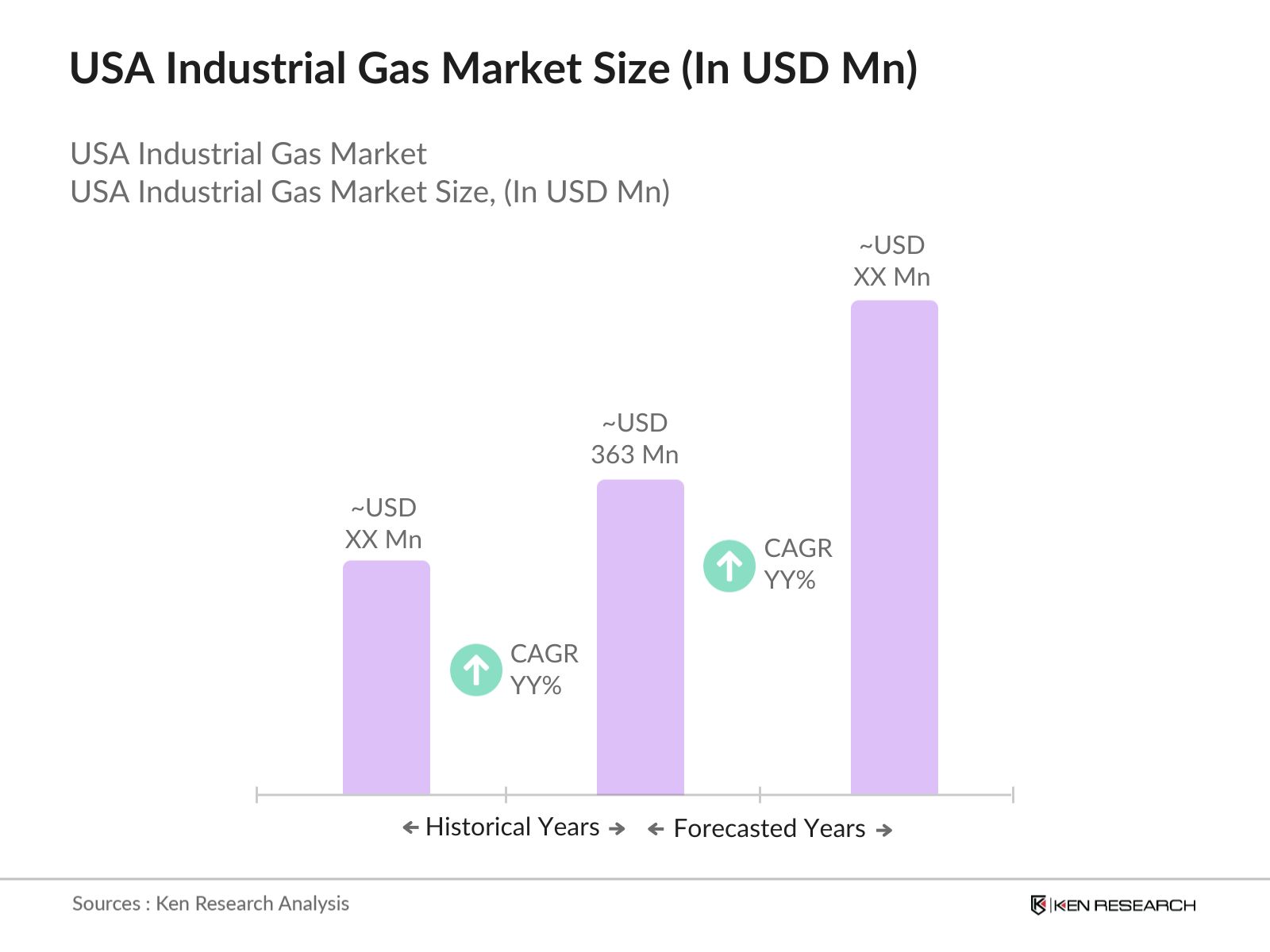
- The USA Industrial Gas Market is valued at USD 363 million, supported by strong growth across key sectors such as healthcare, manufacturing, and food processing industries. This robust demand is driven by the increasing use of gases like oxygen, hydrogen, and nitrogen, particularly in the healthcare sector due to the rise in medical emergencies and treatments.
- Cities like Houston, Los Angeles, and Chicago dominate the industrial gas market, primarily due to their large industrial base and the presence of major refineries and manufacturing plants. Houston, being a hub for the petrochemical industry, contributes significantly to the demand for industrial gases like nitrogen and hydrogen.
- The U.S. government has allocated $2.5 billion for the development of hydrogen energy infrastructure in 2024, aimed at reducing carbon emissions and promoting clean energy alternatives. This initiative will boost the production and demand for industrial gases, particularly hydrogen, as the government seeks to build hydrogen refueling stations and enhance hydrogen storage capabilities.
USA Industrial Gas Market Segmentation
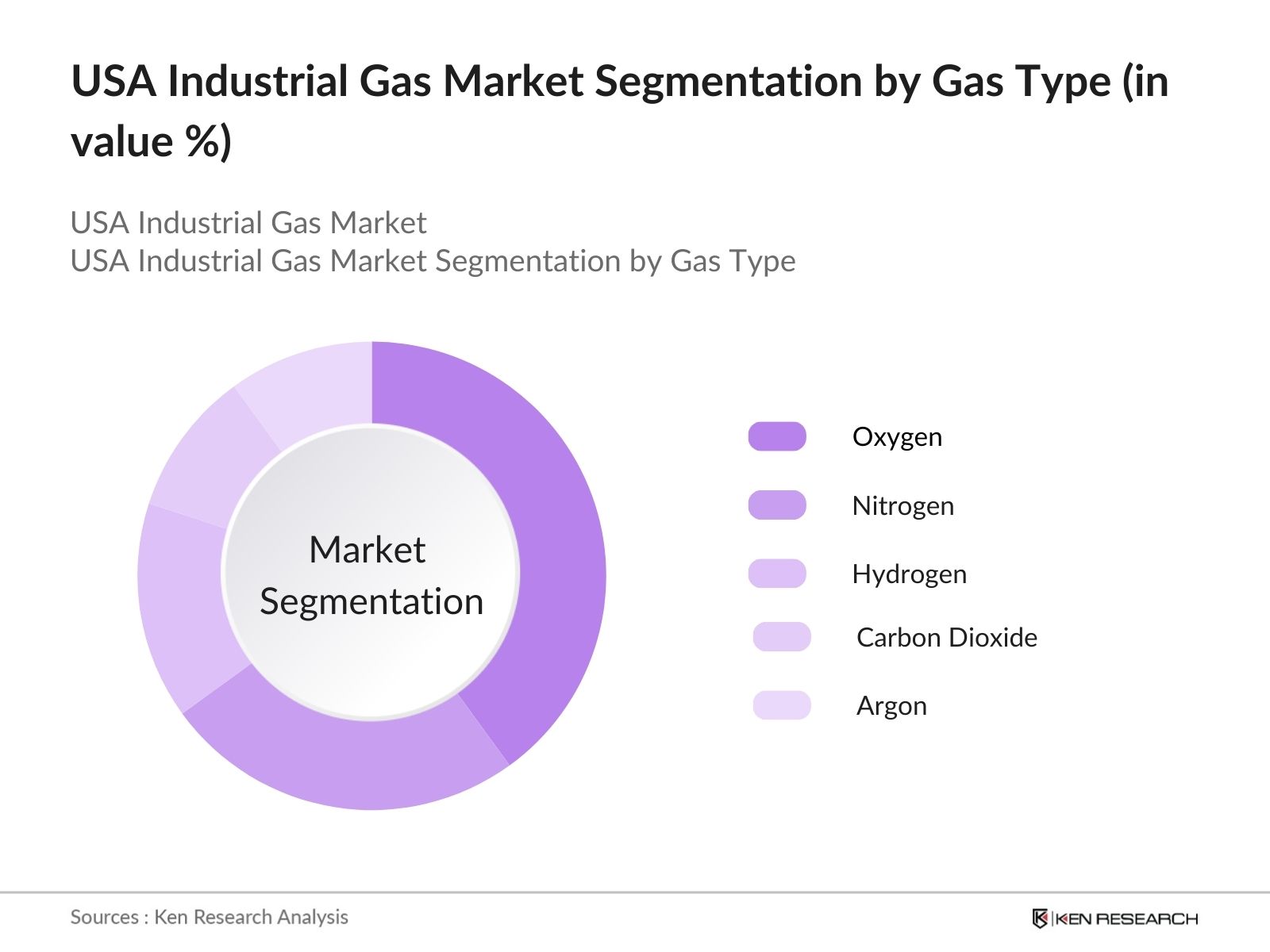
By Gas Type: The market is segmented by gas type into oxygen, nitrogen, hydrogen, carbon dioxide, and argon. Oxygen dominates the market primarily because of its widespread use in the healthcare and steel industries. Hospitals require a continuous supply of oxygen to treat patients with respiratory issues and during surgical procedures.
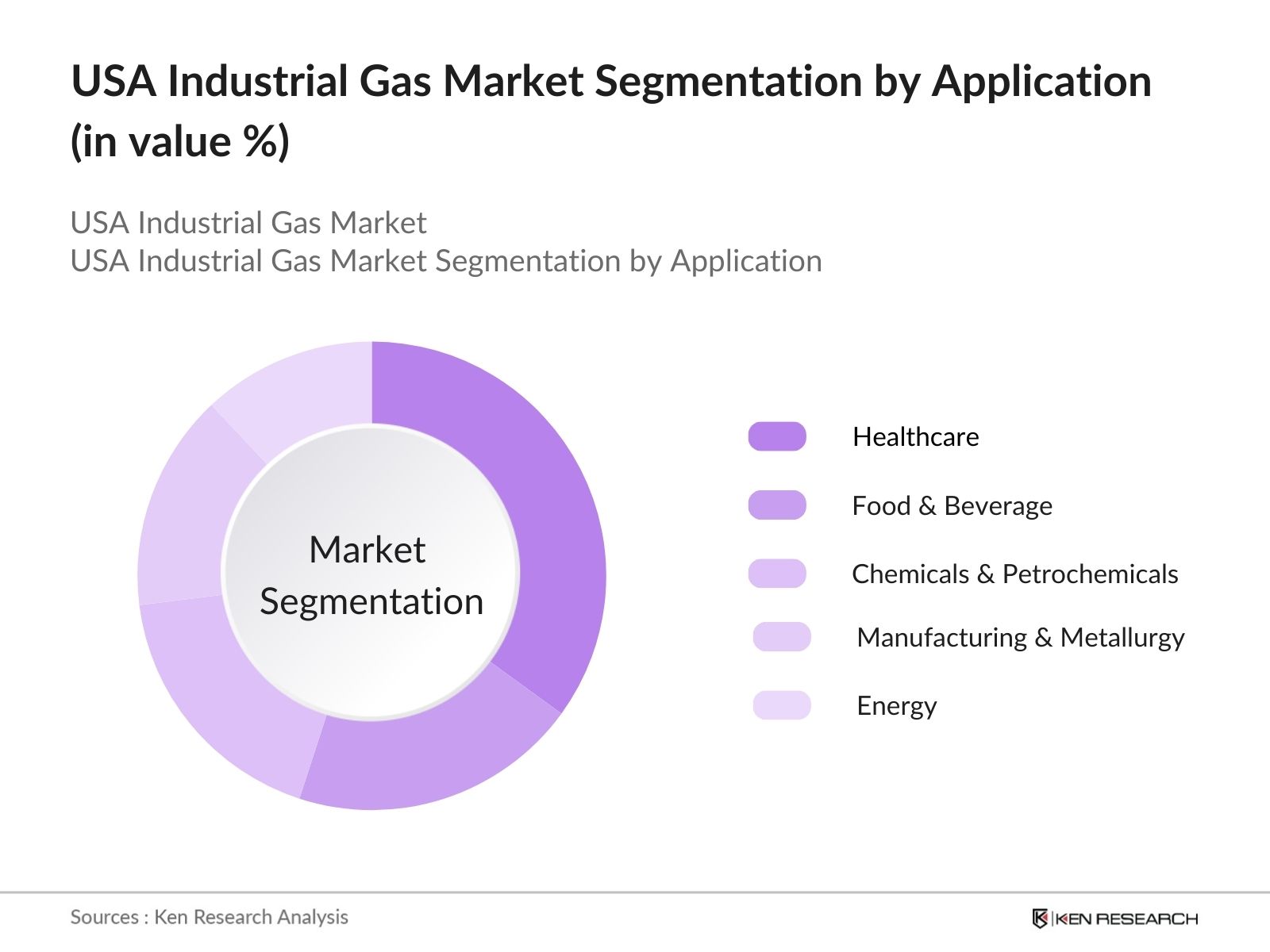
By Application: The market is also segmented by application into healthcare, food & beverage, chemicals & petrochemicals, manufacturing & metallurgy, and energy. Healthcare continues to lead as a major application segment, largely due to the need for medical gases in hospitals and other health facilities.
USA Industrial Gas Market Competitive Landscape
The market is dominated by a few major players who have established extensive supply chains and production facilities across the country. The market consolidation is led by global giants like Linde Plc, Air Products and Chemicals, and Air Liquide. These companies maintain dominance due to their strong R&D capabilities and their ability to offer innovative gas solutions for industries such as healthcare, food processing, and energy.
|
Company |
Establishment Year |
Headquarters |
Revenue (2023) |
No. of Employees |
Market Position |
Key Products |
Supply Chain |
R&D Investments |
|
Linde Plc |
1879 |
Dublin, Ireland |
||||||
|
Air Products & Chemicals |
1940 |
Pennsylvania, USA |
||||||
|
Air Liquide |
1902 |
Paris, France |
||||||
|
Praxair Inc. |
1907 |
Connecticut, USA |
||||||
|
Messer Group |
1898 |
Bad Soden, Germany |
USA Industrial Gas Market Analysis
Market Growth Drivers
- Expansion in the Healthcare Sector: The U.S. healthcare sector continues to expand, driving demand for industrial gases, particularly oxygen and nitrogen, used in medical applications. The sector spending is increasing the consumption of industrial gases used for surgeries, respiratory therapies, and sterilization processes. Additionally, the growing number of hospitals, which is expected to exceed 6,200 by the end of 2024, further accelerates the need for high-purity gases in healthcare settings.
- Increased Use in Food and Beverage Industry: Industrial gases play a pivotal role in enhancing food preservation, packaging, and beverage production processes in the U.S. food and beverage sector. Carbon dioxide is extensively used for carbonation, freezing, and preserving beverages, while nitrogen is vital for packaging to maintain freshness. The industry increasingly relies on these gases to meet growing demands for longer shelf life and improved food safety.
- Boost in Renewable Energy Projects: Industrial gases are playing a vital role in renewable energy projects, particularly in the hydrogen energy sector. Hydrogen Council's report indicates that committed investments in clean hydrogen are projected to reach$75 billion across 434 projectsin 2024. This investment is expected to drive the demand for industrial gases required in hydrogen fuel cell development and other renewable energy applications.
Market Challenges
- Stricter Environmental Regulations: The U.S. government has introduced stricter environmental regulations, including emission control mandates that require companies to invest in cleaner production technologies. The EPAs new guidelines, which aim to reduce emissions of carbon dioxide, sulfur dioxide, and nitrogen oxides, necessitate the installation of advanced filtration systems, adding to the operational costs of industrial gas production.
- Supply Chain Disruptions: The U.S. industrial gas market faces disruptions due to global supply chain issues, particularly in the import of specialized equipment required for gas separation and transportation. In 2024, port congestion and transportation bottlenecks led to a 20% reduction in the import of cryogenic tanks and gas compressors, causing production delays. These disruptions hinder companies' ability to meet rising market demand, impacting revenues and limiting growth.
USA Industrial Gas Market Future Outlook
Over the next five years, the USA Industrial Gas industry is expected to witness moderate growth, driven by advancements in technology, expanding healthcare needs, and the transition to cleaner energy sources like hydrogen. With increasing government regulations focusing on reducing carbon emissions, the adoption of hydrogen and carbon capture technologies will likely fuel further demand in the market.
Future Market Opportunities
- Growth in Hydrogen Economy: Over the next five years, the U.S. hydrogen economy is expected to expand as the government continues to invest in hydrogen infrastructure. Hydrogen will be increasingly used as a fuel alternative in transportation, particularly for trucks and buses. With more hydrogen refueling stations expected to be operational by 2028, the demand for industrial gases like hydrogen will experience steady growth, driven by the U.S. Department of Energys funding initiatives.
- Rising Adoption of Carbon Capture Technologies: By 2028, carbon capture technologies are expected to become a key focus in U.S. industries as emission reduction targets tighten. The demand for industrial gases used in carbon capture, such as nitrogen and carbon dioxide, will grow as companies invest in technologies to meet federal emissions standards. This trend is expected to drive growth in the industrial gas market over the next five years.
Scope of the Report
|
By Gas Type |
Oxygen Nitrogen Hydrogen Carbon Dioxide Argon |
|
By Application |
Manufacturing and Metallurgy Chemicals and Petrochemicals Food & Beverage Healthcare Energy |
|
By Production Method |
Cryogenic Distillation Non-Cryogenic Technologies PSA Membrane Technology |
|
By Supply Mode |
Bulk Supply Cylinder and Packaged Supply On-Site Generation Pipeline Supply |
|
By Region |
North East West South |
Products
Key Target Audience Organizations and Entities Who Can Benefit by Subscribing This Report:
Industrial Gas Manufacturers
Chemical & Petrochemical Companies
Manufacturing & Metallurgy Firms
Food & Beverage Industry
Energy Providers and Refineries Firms
Government and Regulatory Bodies (Environmental Protection Agency, Occupational Safety and Health Administration)
Investment and Venture Capitalist Firms
Companies
Players Mentioned in the Report:
Linde Plc
Air Products & Chemicals, Inc.
Air Liquide
Praxair, Inc.
Messer Group
Taiyo Nippon Sanso Corporation
Matheson Tri-Gas, Inc.
Gulf Cryo
The Southern Company Gas
TNSC America
NuCO2
Airgas Inc.
Nippon Gases
Gulf Industrial Gases
Welders Supply Company
Table of Contents
1. USA Industrial Gas Market Overview
1.1. Definition and Scope
1.2. Market Taxonomy
1.3. Market Growth Rate
1.4. Market Segmentation Overview
2. USA Industrial Gas Market Size (In USD Mn)
2.1. Historical Market Size
2.2. Year-On-Year Growth Analysis
2.3. Key Market Developments and Milestones
3. USA Industrial Gas Market Analysis
3.1. (Energy Demand, Industrial Expansion, Healthcare Growth, Government Regulations)
3.1.1. Rising Demand from Healthcare Sector
3.1.2. Expanding Applications in Manufacturing and Steel Industry
3.1.3. Increased Use in Food and Beverage Industry
3.1.4. Growing Environmental Regulations for Cleaner Alternatives
3.2. (High Production Costs, Energy-Intensive Processes, Carbon Emission Regulations, Supply Chain Disruptions)
3.2.1. High Cost of Industrial Gas Separation and Storage
3.2.2. Stringent Environmental Policies on Emissions
3.2.3. Disruptions in Supply Chains Post-Pandemic
3.2.4. Fluctuating Prices of Raw Materials
3.3. (Hydrogen Economy, Carbon Capture, Technological Innovation, Renewables Integration)
3.3.1. Growing Hydrogen Economy for Energy Transition
3.3.2. Rising Demand for Carbon Capture and Storage (CCS)
3.3.3. Technological Advancements in Gas Processing
3.3.4. Integration with Renewable Energy Solutions
3.4. (Digitalization, Decentralization, Sustainability Initiatives, Green Hydrogen)
3.4.1. Adoption of IoT and Automation in Gas Production
3.4.2. Decentralized Production for Industrial Gas Supply
3.4.3. Increasing Focus on Sustainability and ESG Goals
3.4.4. Development of Green Hydrogen Solutions
3.5. (Clean Air Act, OSHA Guidelines, FDA Regulations, Emission Control Laws)
3.5.1. EPA Regulations on Industrial Emissions
3.5.2. OSHA Safety Standards for Gas Handling
3.5.3. FDA Regulations for Medical Gases
3.5.4. Compliance with Clean Air Act for Industrial Gas Emissions
3.6. SWOT Analysis
3.7. Stakeholder Ecosystem
3.8. Porters Five Forces
3.9. Competition Ecosystem
4. USA Industrial Gas Market Segmentation
4.1. By Gas Type (In Value %)
4.1.1. Oxygen
4.1.2. Nitrogen
4.1.3. Hydrogen
4.1.4. Carbon Dioxide
4.1.5. Argon
4.2. By Application (In Value %)
4.2.1. Manufacturing and Metallurgy
4.2.2. Chemicals and Petrochemicals
4.2.3. Food & Beverage
4.2.4. Healthcare
4.2.5. Energy
4.3. By Production Method (In Value %)
4.3.1. Cryogenic Distillation
4.3.2. Non-Cryogenic Technologies
4.3.3. Pressure Swing Adsorption (PSA)
4.3.4. Membrane Technology
4.4. By Supply Mode (In Value %)
4.4.1. Bulk Supply
4.4.2. Cylinder and Packaged Supply
4.4.3. On-Site Generation
4.4.4. Pipeline Supply
4.5. By Region (In Value %)
4.5.1. North
4.5.2. West
4.5.3. South
4.5.4. East
5. USA Industrial Gas Market Competitive Analysis
5.1. Detailed Profiles of Major Companies
5.1.1. Air Products and Chemicals, Inc.
5.1.2. Linde Plc
5.1.3. Praxair, Inc.
5.1.4. Air Liquide
5.1.5. Messer Group
5.1.6. Matheson Tri-Gas, Inc.
5.1.7. Taiyo Nippon Sanso Corporation
5.1.8. Gulf Cryo
5.1.9. The Southern Company Gas
5.1.10. The Messer Group GmbH
5.1.11. TNSC America
5.1.12. MATHESON
5.1.13. Linde Gas North America
5.1.14. NuCO2
5.1.15. Airgas Inc.
5.2. Cross Comparison Parameters (Headquarters, Revenue, Number of Employees, Market Position, Supply Network, Customer Base, Product Range, R&D Investments)
5.3. Market Share Analysis
5.4. Strategic Initiatives
5.5. Mergers and Acquisitions
5.6. Investment Analysis
5.7. Venture Capital Funding
5.8. Government Grants
5.9. Private Equity Investments
6. USA Industrial Gas Market Regulatory Framework
6.1. Environmental Standards
6.2. Compliance Requirements
6.3. Certification Processes
7. USA Industrial Gas Market Future Market Size (In USD Bn)
7.1. Future Market Size Projections
7.2. Key Factors Driving Future Market Growth
8. USA Industrial Gas Market Future Segmentation
8.1. By Gas Type (In Value %)
8.2. By Application (In Value %)
8.3. By Production Method (In Value %)
8.4. By Supply Mode (In Value %)
8.5. By Region (In Value %)
9. USA Industrial Gas Market Analysts Recommendations
9.1. TAM/SAM/SOM Analysis
9.2. Customer Cohort Analysis
9.3. Marketing Initiatives
9.4. White Space Opportunity Analysis
Disclaimer Contact Us
Research Methodology
Step 1: Identification of Key Variables
The first step involved mapping out all the major players and stakeholders within the USA Industrial Gas Market. This was done through extensive desk research, using proprietary databases to gather detailed industry-level information. Key variables such as gas production, application sectors, and supply chain logistics were identified to understand the overall market dynamics.
Step 2: Market Analysis and Construction
We collected and analyzed historical data on industrial gas consumption and production in the USA. This included assessing market growth, technological advancements, and regulatory influences. Key indicators like market penetration and revenue generation were also evaluated to ensure reliable estimates.
Step 3: Hypothesis Validation and Expert Consultation
Market hypotheses were validated through expert consultations via structured interviews with industry professionals from top industrial gas companies. These discussions provided practical insights and helped in refining the data for better accuracy.
Step 4: Research Synthesis and Final Output
The final step included synthesizing the research findings from various sources. This involved engaging with manufacturers and other stakeholders to verify product segment data and cross-check with bottom-up market analysis, ensuring a thorough and accurate understanding of the market.
Frequently Asked Questions
01. How big is the USA Industrial Gas Market?
The USA Industrial Gas Market is valued at USD 363 million, driven by significant demand across healthcare, manufacturing, and food processing industries.
02. What are the challenges in the USA Industrial Gas Market?
Key challenges in the USA Industrial Gas Market include high production costs, stringent environmental regulations, and supply chain disruptions post-pandemic. Additionally, the fluctuating price of raw materials is a challenge for market profitability.
03. Who are the major players in the USA Industrial Gas Market?
Major players in the USA Industrial Gas Market include Linde Plc, Air Products & Chemicals, Air Liquide, Praxair Inc., and Messer Group, all of which dominate through strong supply chains, innovation, and R&D capabilities.
04. What are the growth drivers of the USA Industrial Gas Market?
Growth in the USA Industrial Gas Market is propelled by the increasing demand from the healthcare sector, expansion in manufacturing activities, and the growing hydrogen economy. Advancements in gas processing technologies are also fueling growth.
05. What are the opportunities in the USA Industrial Gas Market?
Opportunities in the USA Industrial Gas Market include the rise of hydrogen as a clean energy source, increased investments in carbon capture and storage (CCS), and the integration of industrial gases into renewable energy solutions.
Why Buy From Us?

What makes us stand out is that our consultants follows Robust, Refine and Result (RRR) methodology. i.e. Robust for clear definitions, approaches and sanity checking, Refine for differentiating respondents facts and opinions and Result for presenting data with story

We have set a benchmark in the industry by offering our clients with syndicated and customized market research reports featuring coverage of entire market as well as meticulous research and analyst insights.

While we don't replace traditional research, we flip the method upside down. Our dual approach of Top Bottom & Bottom Top ensures quality deliverable by not just verifying company fundamentals but also looking at the sector and macroeconomic factors.

With one step in the future, our research team constantly tries to show you the bigger picture. We help with some of the tough questions you may encounter along the way: How is the industry positioned? Best marketing channel? KPI's of competitors? By aligning every element, we help maximize success.

Our report gives you instant access to the answers and sources that other companies might choose to hide. We elaborate each steps of research methodology we have used and showcase you the sample size to earn your trust.

If you need any support, we are here! We pride ourselves on universe strength, data quality, and quick, friendly, and professional service.