USA Polysilicon Market Outlook to 2030

Region:North America

Author(s):Shubham Kashyap

Product Code:KROD11314

Published On

November 2024

Total pages

92

About the Report

USA Polysilicon Market Overview

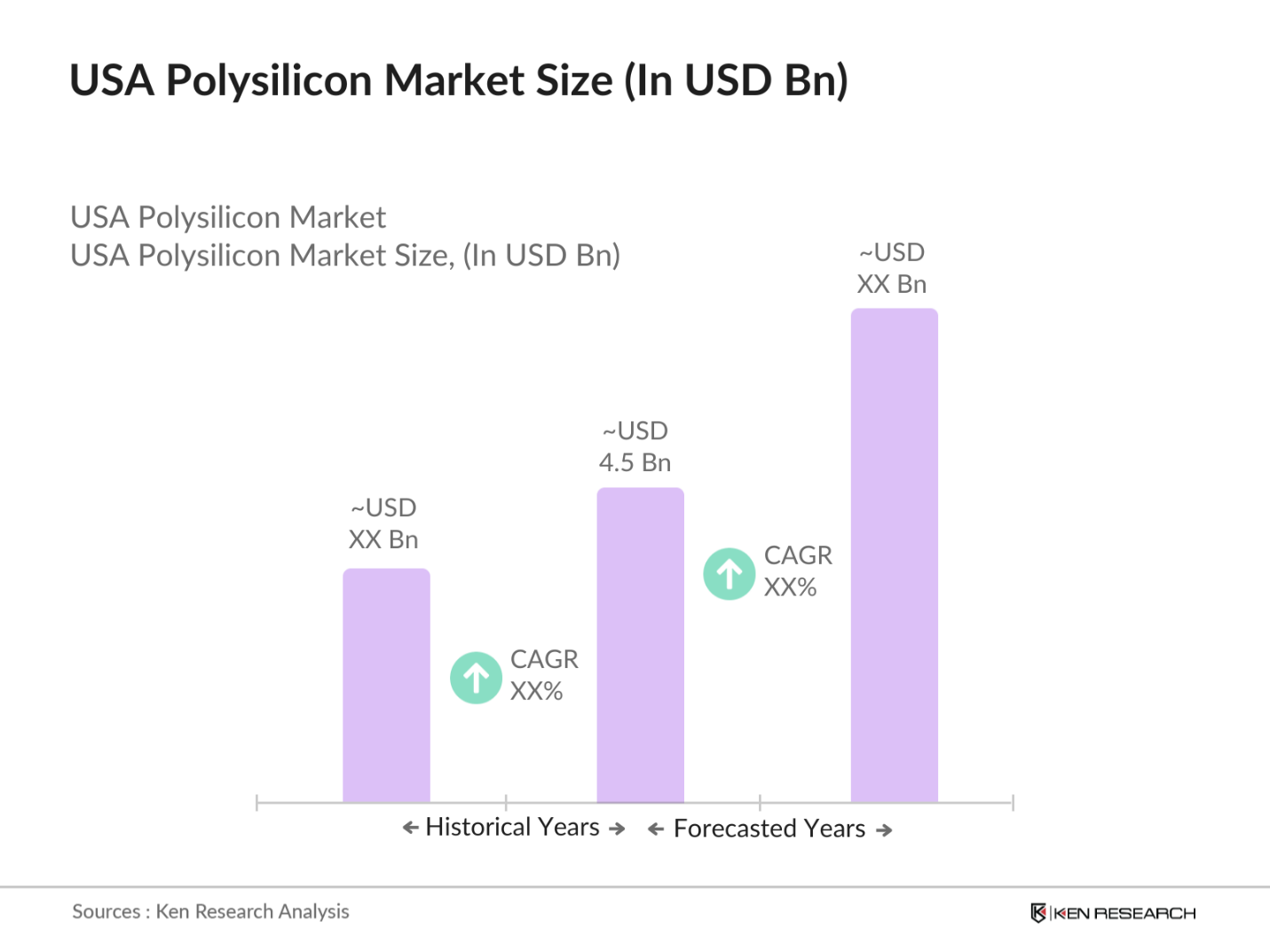
  • The U.S. Polysilicon Market is valued at around USD 4.5 billion, driven by the surging demand for renewable energy solutions and the growing semiconductor industry. Factors such as the rising adoption of solar panels in residential, commercial, and utilityscale projects, coupled with advancements in semiconductor technology, are key growth drivers. The market benefits from government policies supporting clean energy adoption, alongside investments in highpurity polysilicon production technologies, positioning it as a critical component in photovoltaic (PV) cells and electronic circuits.USA Polysilicon Market Size
  • Key production and consumption hubs for polysilicon in the U.S. include states like California and Texas, driven by robust solar installation projects and favorable climatic conditions. Additionally, Michigan is emerging as a polysilicon manufacturing hub due to significant investments in production facilities and its strategic proximity to automotive and semiconductor industries. These states' dominance is attributed to a combination of abundant resources, financial incentives, and strong manufacturing infrastructure.
  • The U.S. government has implemented anti-dumping measures to protect domestic polysilicon manufacturers from unfair foreign competition. In 2023, the Department of Commerce imposed tariffs ranging from 25% to 35% on imported polysilicon from certain countries found to be selling below fair market value. These measures aim to level the playing field for U.S. producers and encourage local production.

USA Polysilicon Market Segmentation

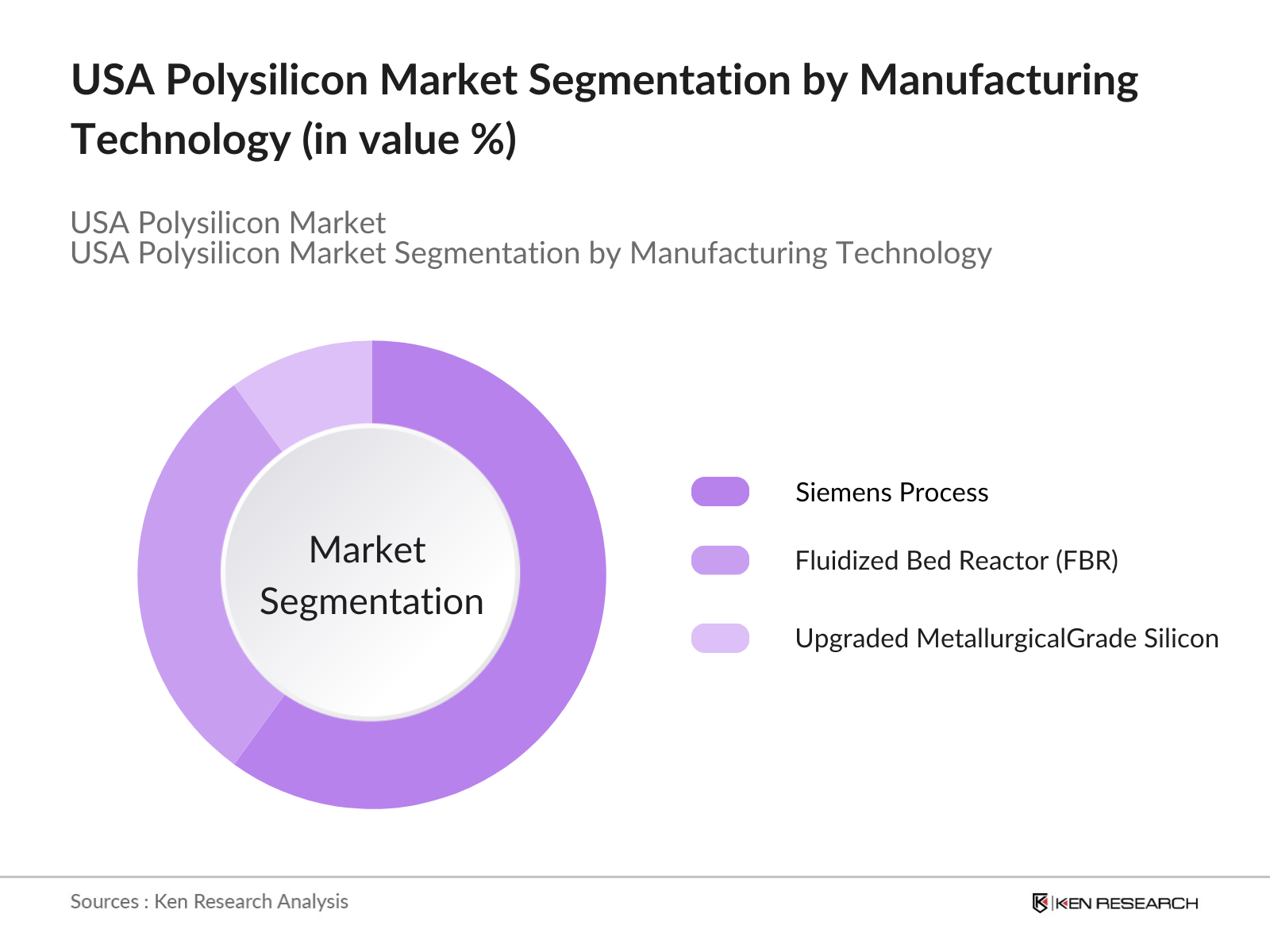
  • By Manufacturing Technology: The market is segmented by manufacturing technology into Siemens Process, Fluidized Bed Reactor (FBR) Process, and Upgraded MetallurgicalGrade Silicon (UMG) Process. Holding the dominant market share, this process is preferred for its ability to produce highpurity polysilicon essential for highefficiency solar panels and advanced semiconductors. Its widespread adoption stems from the growing demand for monocrystalline silicon in photovoltaic cells, despite being energyintensive. The process remains a key choice for premium applications, with significant investments driving advancements in energy efficiency.

USA Polysilicon Market Segmentation by technology

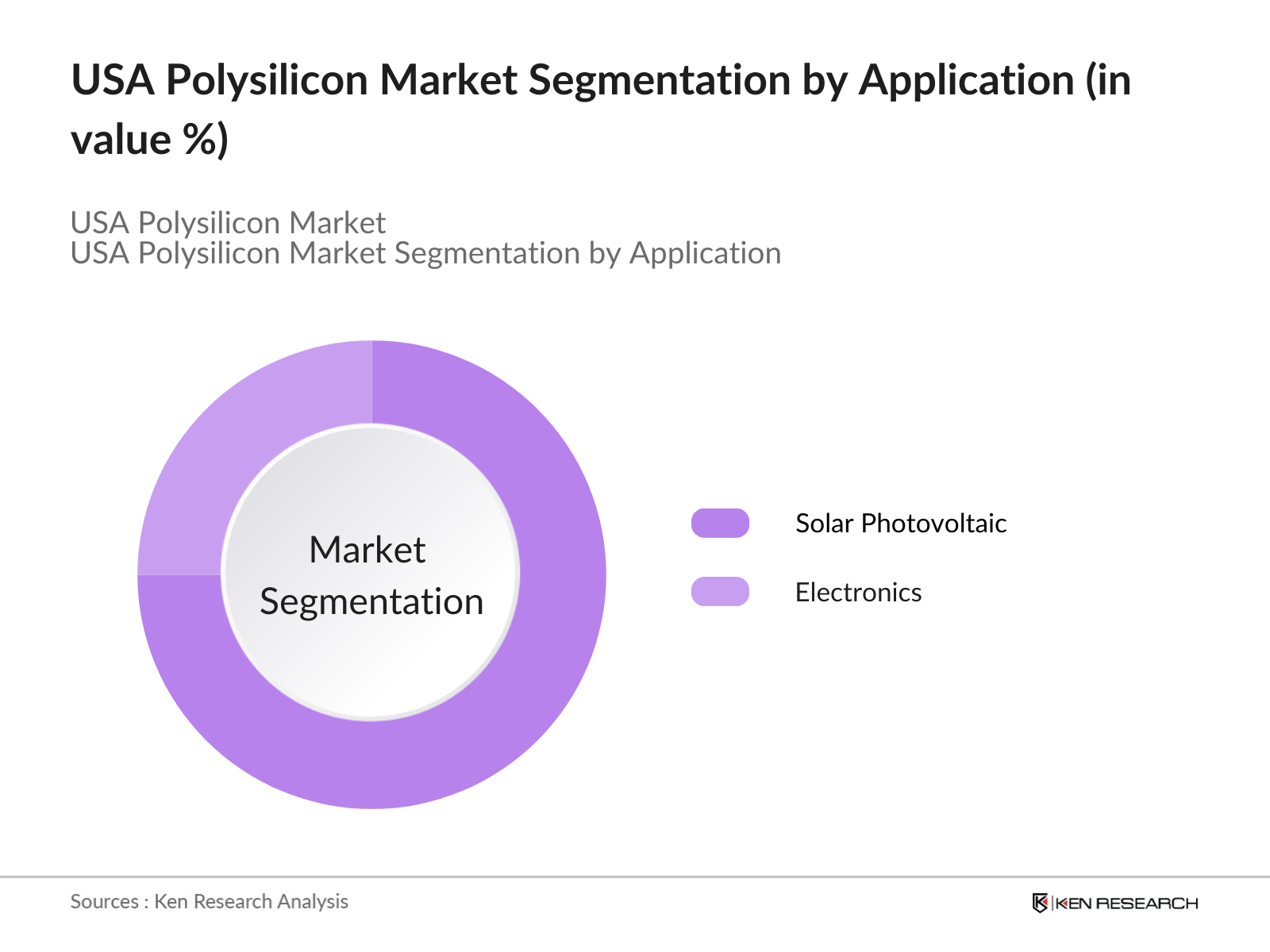
  • By Application: The market is segmented by application into Solar Photovoltaic (PV) and Electronics. Solar PV dominates the application segment, accounting for a significant share due to the rapid deployment of solar energy systems across the U.S. Increasing government incentives like the federal solar tax credit and falling installation costs have propelled the demand for polysilicon in this segment. Utilityscale solar farms, particularly in sunbelt states like Texas and Arizona, are major drivers of polysilicon consumption. USA Polysilicon Market Segmentation by application

USA Polysilicon Market Competitive Landscape

The USA Polysilicon Market is characterized by a few leading players that leverage advanced manufacturing technologies, strategic partnerships, and robust government collaborations. These firms maintain their competitive edge by focusing on highpurity production and scaling up capacity to meet growing demand.
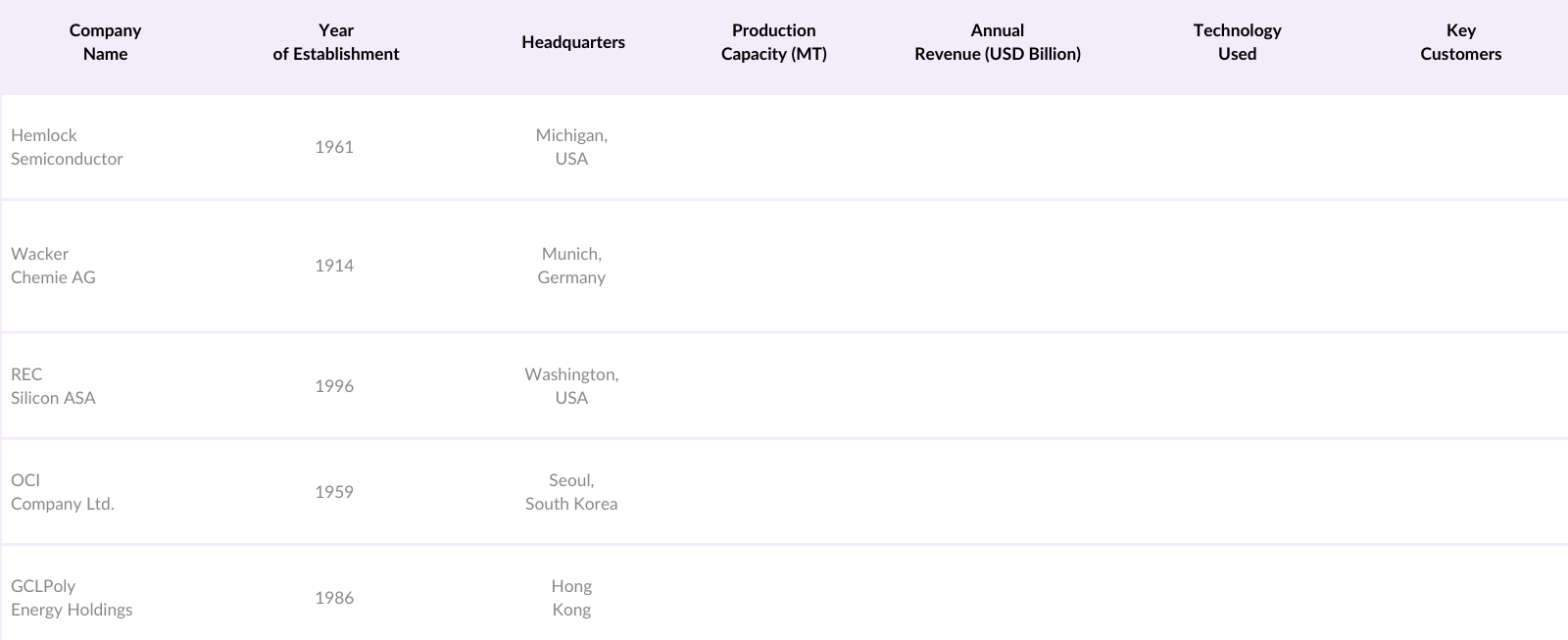
USA Polysilicon Market Competitive Landscape

USA Polysilicon Market Analysis

Growth Drivers

  • Expansion of Solar Photovoltaic Installations: The United States has significantly increased its solar photovoltaic (PV) capacity, reaching 32.4 gigawatts (GW) by the end of 2023, which represents a 51% increase from the previous year. This growth is driven by substantial investments in renewable energy infrastructure and favorable government policies. The U.S. Department of Energy reported that solar energy accounted for 4% of the nation's electricity generation in 2023, a notable increase from 3% in 2022. This expansion has directly boosted the demand for polysilicon, a critical material in solar panel manufacturing.
  • Advancements in Semiconductor Manufacturing: The U.S. semiconductor industry has experienced robust growth, with domestic production valued at USD 80 billion in 2023. This surge is attributed to increased demand for electronic devices and advancements in semiconductor technologies. Polysilicon, essential for producing semiconductor wafers, has seen heightened demand as manufacturers strive to meet the needs of sectors such as consumer electronics, automotive, and telecommunications. The Semiconductor Industry Association noted that U.S. semiconductor exports reached USD 62 billion in 2021, reflecting the industry's global competitiveness.
  • Government Incentives for Renewable Energy: The U.S. government has implemented various incentives to promote renewable energy adoption. The Investment Tax Credit (ITC) offers a 30% tax credit for solar installations commenced in 2023, encouraging both residential and commercial investments in solar energy. Additionally, the Department of Energy allocated a substantial amount in grants in 2023 to support renewable energy projects, further stimulating the polysilicon market by increasing demand for solar panels.

Challenges

  • Volatility in Raw Material Prices The polysilicon market faces challenges due to fluctuations in raw material prices. For instance, the price of metallurgical-grade silicon, a key input, increased substantially in 2023 compared to 2022, impacting production costs. This volatility is influenced by factors such as supply chain disruptions and geopolitical tensions, affecting the profitability of polysilicon manufacturers.
  • Environmental and Regulatory Compliance: Polysilicon production involves processes that can have environmental impacts, including significant energy consumption and chemical usage. In 2023, the Environmental Protection Agency (EPA) introduced stricter regulations on industrial emissions, requiring polysilicon manufacturers to invest in cleaner technologies and compliance measures. These regulatory requirements have increased operational costs and necessitated technological upgrades to meet environmental standards.

USA Polysilicon Market Future Outlook

The USA Polysilicon Market is poised for steady growth, driven by expanding solar PV installations and advancements in semiconductor technologies. The increasing focus on renewable energy targets and the development of costeffective manufacturing techniques will sustain market growth. Emerging applications, such as electric vehicles and energy storage, present new opportunities for polysilicon demand.

Future Market Opportunities

  • Development of High-Purity Polysilicon for Electronics: The electronics industry requires ultra-high-purity polysilicon for semiconductor manufacturing. In 2023, the demand for electronic-grade polysilicon in the U.S. reached 38,000 metric tons, driven by the growth of advanced technologies such as 5G and artificial intelligence. Investing in the production of high-purity polysilicon presents an opportunity for U.S. manufacturers to cater to this specialized market segment, reducing reliance on imports and enhancing domestic supply chains.
  • Integration of Polysilicon in Emerging Technologies: Emerging technologies, including electric vehicles (EVs) and renewable energy storage systems, are increasing the demand for semiconductors and, consequently, polysilicon. The U.S. EV market saw sales of one million units in 2023, a 52% increase from 2022, highlighting the growing need for semiconductor components. Polysilicon manufacturers can capitalize on this trend by supplying materials for EVs and energy storage applications, diversifying their product offerings and tapping into new revenue streams.

Scope of the Report

By Manufacturing Technology

 Siemens Process
 Fluidized Bed Reactor (FBR) Process
 Upgraded MetallurgicalGrade Silicon Process

By Form

 Chips
 Chunks
 Rods

By Application

 Solar Photovoltaic
 Electronics

By End-User

 Solar Energy
 Semiconductor Manufacturing
 Consumer Electronics
 Automotive

By Region

 Northeast
 Midwest
 South
 West

Products

Key Target Audience

  • Polysilicon Manufacturers

  • Solar Panel Manufacturers

  • Semiconductor Industry Players

  • Energy Infrastructure Developers

  • Investors and Venture Capitalist Firms

  • Banks and Financial Institutions

  • U.S. Department of Energy

  • Environmental Protection Agency

Companies

Players Mentioned in the Report

  • Hemlock Semiconductor

  • REC Silicon ASA

  • Wacker Chemie AG

  • OCI Company Ltd.

  • GCLPoly Energy Holdings

  • Daqo New Energy Corp.

  • Tokuyama Corporation

  • Mitsubishi Materials Corporation

  • Asia Silicon (Qinghai) Co., Ltd.

  • TBEA Co., Ltd.

  • Qatar Solar Technologies

  • LDK Solar Co., Ltd.

  • ReneSola Ltd.

  • Hanwha Chemical Co., Ltd.

  • SunEdison, Inc.

Table of Contents

1. U.S. Polysilicon Market Overview

1.1 Definition and Scope

1.2 Market Taxonomy

1.3 Market Growth Rate

1.4 Market Segmentation Overview

2. U.S. Polysilicon Market Size (USD Billion)

2.1 Historical Market Size

2.2 Year-On-Year Growth Analysis

2.3 Key Market Developments and Milestones

3. U.S. Polysilicon Market Analysis

3.1 Growth Drivers

3.1.1 Expansion of Solar Photovoltaic Installations

3.1.2 Advancements in Semiconductor Manufacturing

3.1.3 Government Incentives for Renewable Energy

3.1.4 Technological Innovations in Polysilicon Production

3.2 Market Challenges

3.2.1 Volatility in Raw Material Prices

3.2.2 Environmental and Regulatory Compliance

3.2.3 Competition from Low-Cost Imports

3.3 Opportunities

3.3.1 Development of High-Purity Polysilicon for Electronics

3.3.2 Integration of Polysilicon in Emerging Technologies

3.3.3 Expansion into Untapped Regional Markets

3.4 Trends

3.4.1 Shift Towards Monocrystalline Silicon in Solar Panels

3.4.2 Adoption of Fluidized Bed Reactor (FBR) Technology

3.4.3 Strategic Alliances and Joint Ventures

3.5 Government Regulations

3.5.1 Anti-Dumping Policies

3.5.2 Environmental Standards and Compliance

3.5.3 Renewable Portfolio Standards (RPS)

3.5.4 Trade Tariffs and Import Restrictions

3.6 SWOT Analysis

3.7 Stakeholder Ecosystem

3.8 Porters Five Forces Analysis

3.9 Competitive Landscape

4. U.S. Polysilicon Market Segmentation

4.1 By Manufacturing Technology (Value %)

4.1.1 Siemens Process

4.1.2 Fluidized Bed Reactor (FBR) Process

4.1.3 Upgraded Metallurgical-Grade Silicon Process

4.2 By Form (Value %)

4.2.1 Chips

4.2.2 Chunks

4.2.3 Rods

4.3 By Application (Value %)

4.3.1 Solar Photovoltaic

4.3.2 Electronics

4.4 By End-User (Value %)

4.4.1 Solar Energy

4.4.2 Semiconductor Manufacturing

4.4.3 Consumer Electronics

4.4.4 Automotive

4.5 By Region (Value %)

4.5.1 Northeast

4.5.2 Midwest

4.5.3 South

4.5.4 West

5. U.S. Polysilicon Market Competitive Analysis

5.1 Detailed Profiles of Major Companies

5.1.1 Hemlock Semiconductor Operations LLC

5.1.2 REC Silicon ASA

5.1.3 Wacker Chemie AG

5.1.4 OCI Company Ltd.

5.1.5 GCL-Poly Energy Holdings Limited

5.1.6 Daqo New Energy Corp.

5.1.7 Tokuyama Corporation

5.1.8 Mitsubishi Materials Corporation

5.1.9 Asia Silicon (Qinghai) Co., Ltd.

5.1.10 TBEA Co., Ltd.

5.1.11 Qatar Solar Technologies

5.1.12 LDK Solar Co., Ltd.

5.1.13 ReneSola Ltd.

5.1.14 Hanwha Chemical Co., Ltd.

5.1.15 SunEdison, Inc.

5.2 Cross Comparison Parameters (Number of Employees, Headquarters, Inception Year, Revenue, Production Capacity, Market Share, R&D Investment, Key Clients)

5.3 Market Share Analysis

5.4 Strategic Initiatives

5.5 Mergers and Acquisitions

5.6 Investment Analysis

5.6.1 Venture Capital Funding

5.6.2 Government Grants

5.6.3 Private Equity Investments

6. U.S. Polysilicon Market Regulatory Framework

6.1 Environmental Standards

6.2 Compliance Requirements

6.3 Certification Processes

7. U.S. Polysilicon Future Market Size (USD Billion)

7.1 Future Market Size Projections

7.2 Key Factors Driving Future Market Growth

8. U.S. Polysilicon Future Market Segmentation

8.1 By Manufacturing Technology (Value %)

8.2 By Form (Value %)

8.3 By Application (Value %)

8.4 By End-User (Value %)

8.5 By Region (Value %)

9. U.S. Polysilicon Market Analysts Recommendations

9.1 Total Addressable Market (TAM), Serviceable Available Market (SAM), and Serviceable Obtainable Market (SOM) Analysis

9.2 Customer Cohort Analysis

9.3 Marketing Initiatives

9.4 White Space Opportunity Analysis

Disclaimer Contact Us

Research Methodology

Step 1: Identification of Key Variables

A detailed study of the polysilicon ecosystem, including major stakeholders and market drivers, was conducted through secondary and proprietary research methods.

Step 2: Market Analysis and Construction

Historical data and market trends were analyzed to construct a robust market framework, incorporating insights into technology advancements and production dynamics.

Step 3: Hypothesis Validation and Expert Consultation

Industry experts validated hypotheses through interviews, ensuring the accuracy of market segmentation and growth projections.

Step 4: Research Synthesis and Final Output

Data synthesis was completed by integrating insights from primary and secondary research, ensuring a comprehensive analysis of the U.S. polysilicon market. 

Frequently Asked Questions

How big is the U.S. polysilicon market?

The U.S. polysilicon market is valued at USD 4.5 billion, driven by strong demand in solar PV and semiconductor applications.

What drives the U.S. polysilicon market?

U.S. polysilicon market growth is fueled by increased solar energy adoption, advancements in semiconductor manufacturing, and supportive government policies.

Who are the major players in the U.S. polysilicon market?

Key players in the U.S. polysilicon market include Hemlock Semiconductor, REC Silicon ASA, Wacker Chemie AG, OCI Company Ltd., and GCLPoly Energy Holdings.

What are the challenges in the U.S. polysilicon market?

Challenges in the U.S. polysilicon market include high energy costs, environmental compliance requirements, and competition from lowcost imports.


Why Buy From Us?

RRR
Refine Robust Result (RRR) Framework

What makes us stand out is that our consultants follows Robust, Refine and Result (RRR) methodology. i.e. Robust for clear definitions, approaches and sanity checking, Refine for differentiating respondents facts and opinions and Result for presenting data with story

Our Reach Is Unmatched

We have set a benchmark in the industry by offering our clients with syndicated and customized market research reports featuring coverage of entire market as well as meticulous research and analyst insights.

Research
Shifting the Research Paradigm

While we don't replace traditional research, we flip the method upside down. Our dual approach of Top Bottom & Bottom Top ensures quality deliverable by not just verifying company fundamentals but also looking at the sector and macroeconomic factors.

Insite
More Insights-Better Decisions

With one step in the future, our research team constantly tries to show you the bigger picture. We help with some of the tough questions you may encounter along the way: How is the industry positioned? Best marketing channel? KPI's of competitors? By aligning every element, we help maximize success.

Trust
Transparency and Trust

Our report gives you instant access to the answers and sources that other companies might choose to hide. We elaborate each steps of research methodology we have used and showcase you the sample size to earn your trust.

support
Round the Clock Support

If you need any support, we are here! We pride ourselves on universe strength, data quality, and quick, friendly, and professional service.

Why Client Choose Us?

400000+ Reports in repository
150+ Consulting project a year
100+ Analysts
8000+ Client Queries in 2022