About the Report
Base Year 2024Japan Coin Operated Commercial Laundry Market Overview
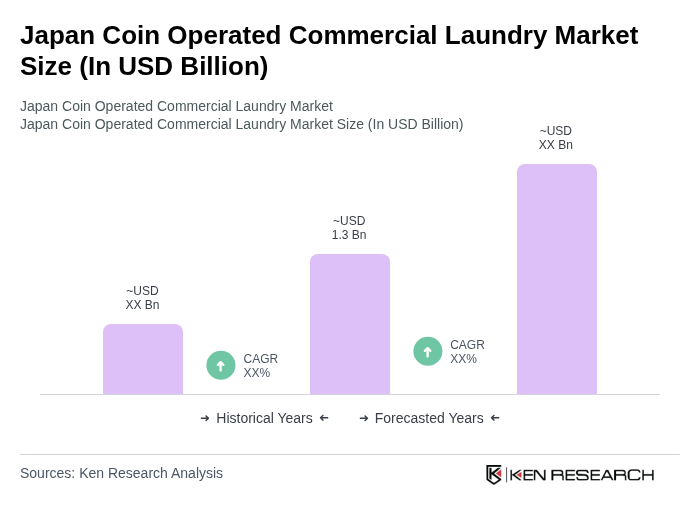
- The Japan Coin Operated Commercial Laundry Market is valued at USD 1.1 billion, based on a five-year historical analysis. This growth is primarily driven by the increasing urban population, rising disposable incomes, growing trend towards convenience in laundry services, and high level of automation and technology integration in laundromats.
- Key cities such as Tokyo, Osaka, and Yokohama dominate the market due to their high population density and fast-paced lifestyles. These urban centers have a significant number of residents living in apartments without in-unit laundry facilities, leading to a higher reliance on commercial laundries. Additionally, the presence of numerous hotels and educational institutions in these cities further boosts the demand for laundry services.
- The Top Runner Program, 2021 issued by the Ministry of Economy, Trade and Industry (METI), establishes energy efficiency standards for commercial washing machines and dryers. Facilities with equipment above specified capacity thresholds must comply with minimum energy performance standards during certification and labeling, requiring operators to select certified high-efficiency models for new installations and replacements.
Japan Coin Operated Commercial Laundry Market Segmentation
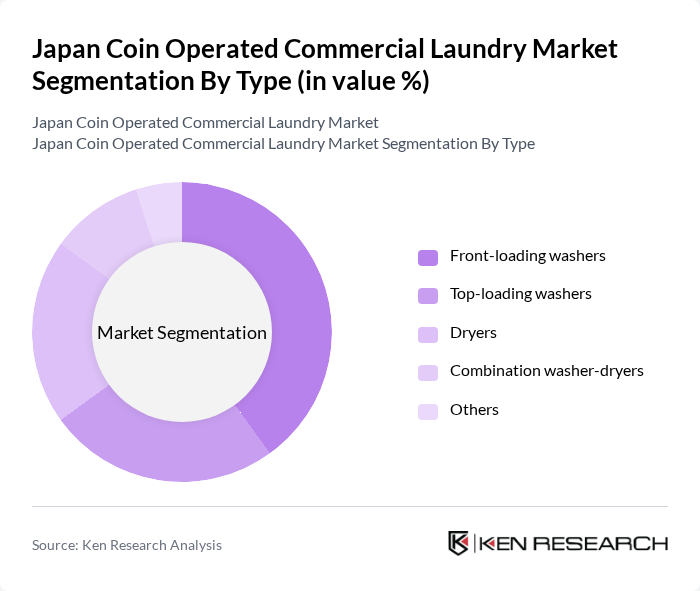
By Type:The market is segmented into various types of equipment used in coin-operated commercial laundry services. The primary subsegments include Front-Loading Washers, Top-Loading Washers, Dryers, Combination Units, and Others. Each type serves different consumer preferences and operational needs, with front-loading washers being particularly popular due to their efficiency and water-saving features.
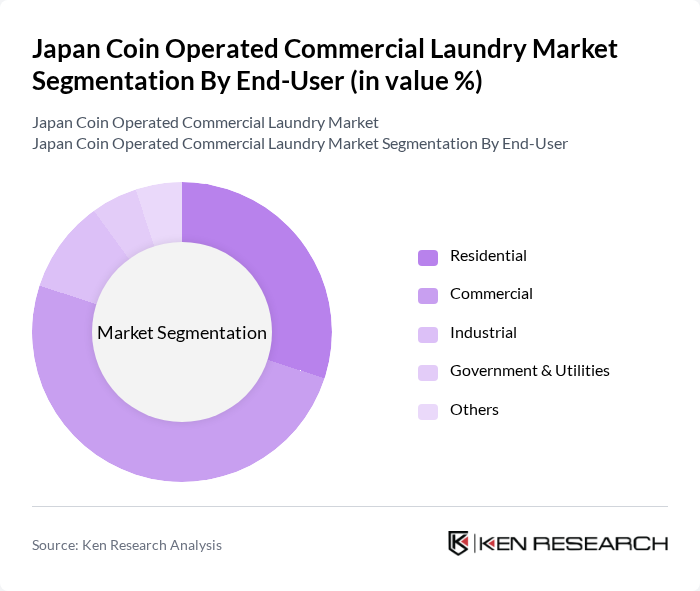
By End-User:The end-user segmentation includes Laundromats, Hotels and Motels, Hospitals and Healthcare Facilities, Educational Institutions, and Others. Laundromats are the leading segment, driven by the increasing number of self-service laundry facilities catering to urban residents and students.
Japan Coin Operated Commercial Laundry Market Competitive Landscape
The Japan Coin Operated Commercial Laundry Market is characterized by a dynamic mix of regional and international players. Leading participants such as Panasonic Corporation, Electrolux AB, Whirlpool Corporation, Miele & Cie. KG, LG Electronics, Speed Queen, Maytag Commercial Laundry, Dexter Laundry, Wascomat, Huebsch, Crossover Laundry, B&C Technologies, Continental Girbau, UniMac, Rinnai Corporation contribute to innovation, geographic expansion, and service delivery in this space.
Japan Coin Operated Commercial Laundry Market Industry Analysis
Growth Drivers
- Increasing Urbanization:Japan's urban population is projected to reach approximately 92% in future, according to the World Bank. This urbanization trend drives demand for convenient laundry services, as city dwellers often lack space for in-home laundry facilities. The growing number of single-person households, which accounted for 36% of all households, further fuels the need for accessible coin-operated laundries, making them a vital service in densely populated areas.
- Rising Demand for Convenience:The convenience factor is paramount in Japan's fast-paced lifestyle, with over 62% of consumers preferring self-service laundry options. The Japan External Trade Organization reported that the number of coin-operated laundries increased by 16% from 2020 to 2023, reflecting a shift towards services that save time. This trend is particularly evident in urban centers, where busy professionals seek efficient solutions for their laundry needs, driving market growth.
- Growth in Tourism and Hospitality Sector:Japan's tourism sector is expected to welcome over 42 million international visitors in future, as reported by the Japan National Tourism Organization. This influx increases the demand for laundry services in hotels and hostels, where coin-operated laundries provide a cost-effective solution for guests. The hospitality industry's growth, coupled with rising domestic travel, creates a robust market for commercial laundry services, enhancing overall market potential.
Market Challenges
- High Initial Investment Costs:Establishing a coin-operated laundry facility in Japan requires significant capital investment, often exceeding ¥11 million (approximately $100,000). This high entry barrier can deter new businesses from entering the market. Additionally, ongoing maintenance and equipment upgrades further strain financial resources, making it challenging for operators to achieve profitability, especially in competitive urban areas where margins are tight.
- Competition from In-House Laundry Services:Many hotels and residential complexes in Japan offer in-house laundry services, which can be more convenient for customers. This competition poses a significant challenge for coin-operated laundries, particularly in urban settings where convenience is key. According to industry reports, approximately 32% of households utilize in-house laundry facilities, limiting the potential customer base for commercial laundries and impacting overall market growth.
Japan Coin Operated Commercial Laundry Market Future Outlook
The future of the Japan coin-operated commercial laundry market appears promising, driven by technological advancements and evolving consumer preferences. As urbanization continues, the demand for convenient laundry solutions will likely increase. Additionally, the integration of smart technology, such as app-based payment systems and machine monitoring, is expected to enhance customer experience. Furthermore, the focus on sustainability will encourage laundries to adopt eco-friendly practices, positioning them favorably in a competitive landscape.
Market Opportunities
- Expansion into Rural Areas:With urban markets becoming saturated, expanding coin-operated laundries into rural areas presents a significant opportunity. Approximately 21% of Japan's population resides in rural regions, where laundry services are limited. Establishing facilities in these areas can cater to unmet needs, driving growth and profitability while enhancing service accessibility for residents.
- Adoption of Eco-Friendly Practices:The increasing consumer awareness of environmental issues presents an opportunity for laundries to adopt eco-friendly practices. Implementing energy-efficient machines and biodegradable detergents can attract environmentally conscious customers. According to a recent survey, 72% of consumers prefer businesses that prioritize sustainability, indicating that eco-friendly initiatives can significantly enhance market appeal and customer loyalty.
Scope of the Report
| Segment | Sub-Segments |
|---|---|
| By Type | Front-Loading Washers Top-Loading Washers Dryers Combination Units Others |
| By End-User | Laundromats Hotels and Motels Hospitals and Healthcare Facilities Educational Institutions Others |
| By Payment Method | Coin-Based Payments Card-Based Payments Mobile Payments Others |
| By Location | Urban Areas Suburban Areas Rural Areas Others |
| By Service Type | Self-Service Full-Service Drop-Off Services Others |
| By Equipment Size | Small Capacity Medium Capacity Large Capacity Others |
| By Brand Preference | Domestic Brands International Brands Others |
Key Target Audience
Investors and Venture Capitalist Firms
Government and Regulatory Bodies (e.g., Ministry of Economy, Trade and Industry)
Manufacturers and Producers of Laundry Equipment
Distributors and Retailers of Laundry Services
Property Management Companies
Real Estate Developers
Industry Associations (e.g., Japan Coin Laundry Association)
Financial Institutions and Banks
Players Mentioned in the Report:
Panasonic Corporation
Electrolux AB
Whirlpool Corporation
Miele & Cie. KG
LG Electronics
Speed Queen
Maytag Commercial Laundry
Dexter Laundry
Wascomat
Huebsch
Crossover Laundry
B&C Technologies
Continental Girbau
UniMac
Rinnai Corporation
Table of Contents
Market Assessment Phase
1. Executive Summary and Approach
2. Japan Coin Operated Commercial Laundry Market Overview
2.1 Key Insights and Strategic Recommendations
2.2 Japan Coin Operated Commercial Laundry Market Overview
2.3 Definition and Scope
2.4 Evolution of Market Ecosystem
2.5 Timeline of Key Regulatory Milestones
2.6 Value Chain & Stakeholder Mapping
2.7 Business Cycle Analysis
2.8 Policy & Incentive Landscape
3. Japan Coin Operated Commercial Laundry Market Analysis
3.1 Growth Drivers
3.1.1 Increasing Urbanization
3.1.2 Rising Demand for Convenience
3.1.3 Growth in Tourism and Hospitality Sector
3.1.4 Technological Advancements in Laundry Equipment
3.2 Market Challenges
3.2.1 High Initial Investment Costs
3.2.2 Competition from In-House Laundry Services
3.2.3 Fluctuating Energy Prices
3.2.4 Regulatory Compliance Issues
3.3 Market Opportunities
3.3.1 Expansion into Rural Areas
3.3.2 Adoption of Eco-Friendly Practices
3.3.3 Integration of Smart Technology
3.3.4 Partnerships with Local Businesses
3.4 Market Trends
3.4.1 Shift Towards Self-Service Models
3.4.2 Increased Focus on Sustainability
3.4.3 Growth of Mobile Payment Solutions
3.4.4 Customization of Services
3.5 Government Regulation
3.5.1 Energy Efficiency Standards
3.5.2 Waste Management Regulations
3.5.3 Health and Safety Compliance
3.5.4 Consumer Protection Laws
4. SWOT Analysis
5. Stakeholder Analysis
6. Porter's Five Forces Analysis
7. Japan Coin Operated Commercial Laundry Market Market Size, 2019-2024
7.1 By Value
7.2 By Volume
7.3 By Average Selling Price
8. Japan Coin Operated Commercial Laundry Market Segmentation
8.1 By Type
8.1.1 Front-Loading Washers
8.1.2 Top-Loading Washers
8.1.3 Dryers
8.1.4 Combination Units
8.1.5 Others
8.2 By End-User
8.2.1 Laundromats
8.2.2 Hotels and Motels
8.2.3 Hospitals and Healthcare Facilities
8.2.4 Educational Institutions
8.2.5 Others
8.3 By Payment Method
8.3.1 Coin-Based Payments
8.3.2 Card-Based Payments
8.3.3 Mobile Payments
8.3.4 Others
8.4 By Location
8.4.1 Urban Areas
8.4.2 Suburban Areas
8.4.3 Rural Areas
8.4.4 Others
8.5 By Service Type
8.5.1 Self-Service
8.5.2 Full-Service
8.5.3 Drop-Off Services
8.5.4 Others
8.6 By Equipment Size
8.6.1 Small Capacity
8.6.2 Medium Capacity
8.6.3 Large Capacity
8.6.4 Others
8.7 By Brand Preference
8.7.1 Domestic Brands
8.7.2 International Brands
8.7.3 Others
9. Japan Coin Operated Commercial Laundry Market Competitive Analysis
9.1 Market Share of Key Players
9.2 Cross Comparison of Key Players
9.2.1 Company Name
9.2.2 Group Size (Large, Medium, or Small as per industry convention)
9.2.3 Revenue Growth Rate
9.2.4 Customer Retention Rate
9.2.5 Market Penetration Rate
9.2.6 Average Order Value
9.2.7 Pricing Strategy
9.2.8 Service Response Time
9.2.9 Equipment Utilization Rate
9.2.10 Customer Satisfaction Score
9.3 SWOT Analysis of Top Players
9.4 Pricing Analysis
9.5 Detailed Profile of Major Companies
9.5.1 Panasonic Corporation
9.5.2 Electrolux AB
9.5.3 Whirlpool Corporation
9.5.4 Miele & Cie. KG
9.5.5 LG Electronics
9.5.6 Speed Queen
9.5.7 Maytag Commercial Laundry
9.5.8 Dexter Laundry
9.5.9 Wascomat
9.5.10 Huebsch
9.5.11 Crossover Laundry
9.5.12 B&C Technologies
9.5.13 Continental Girbau
9.5.14 UniMac
9.5.15 Rinnai Corporation
10. Japan Coin Operated Commercial Laundry Market End-User Analysis
10.1 Procurement Behavior of Key Ministries
10.1.1 Budget Allocation Trends
10.1.2 Decision-Making Processes
10.1.3 Supplier Selection Criteria
10.1.4 Contract Management Practices
10.2 Corporate Spend on Infrastructure & Energy
10.2.1 Investment Trends in Laundry Services
10.2.2 Budgeting for Equipment Upgrades
10.2.3 Energy Efficiency Investments
10.2.4 Maintenance and Operational Costs
10.3 Pain Point Analysis by End-User Category
10.3.1 Equipment Downtime
10.3.2 Service Reliability
10.3.3 Cost Management
10.3.4 Quality of Service
10.4 User Readiness for Adoption
10.4.1 Awareness of Coin Operated Services
10.4.2 Willingness to Pay
10.4.3 Training and Support Needs
10.4.4 Technology Adoption Rates
10.5 Post-Deployment ROI and Use Case Expansion
10.5.1 Measurement of ROI
10.5.2 Expansion into New Use Cases
10.5.3 Customer Feedback Mechanisms
10.5.4 Long-Term Value Creation
11. Japan Coin Operated Commercial Laundry Market Future Size, 2025-2030
11.1 By Value
11.2 By Volume
11.3 By Average Selling Price
Go-To-Market Strategy Phase
1. Whitespace Analysis + Business Model Canvas
1.1 Market Gaps Identification
1.2 Value Proposition Development
1.3 Revenue Streams Analysis
1.4 Cost Structure Evaluation
1.5 Key Partnerships Exploration
1.6 Customer Segmentation
1.7 Channels of Distribution
2. Marketing and Positioning Recommendations
2.1 Branding Strategies
2.2 Product USPs
2.3 Target Audience Identification
2.4 Communication Strategies
2.5 Digital Marketing Approaches
2.6 Offline Marketing Tactics
2.7 Performance Metrics
3. Distribution Plan
3.1 Urban Retail Strategies
3.2 Rural NGO Tie-Ups
3.3 E-commerce Integration
3.4 Logistics and Supply Chain Management
3.5 Distribution Partnerships
3.6 Inventory Management
3.7 Customer Service Channels
4. Channel & Pricing Gaps
4.1 Underserved Routes
4.2 Pricing Bands Analysis
4.3 Competitor Pricing Strategies
4.4 Customer Price Sensitivity
4.5 Value-Based Pricing Models
4.6 Discounting Strategies
4.7 Price Optimization Techniques
5. Unmet Demand & Latent Needs
5.1 Category Gaps
5.2 Consumer Segments Analysis
5.3 Emerging Trends Identification
5.4 Customer Feedback Analysis
5.5 Market Research Insights
5.6 Product Development Opportunities
5.7 Service Enhancement Areas
6. Customer Relationship
6.1 Loyalty Programs
6.2 After-Sales Service
6.3 Customer Engagement Strategies
6.4 Feedback Mechanisms
6.5 Relationship Management Tools
6.6 Community Building Initiatives
6.7 Customer Retention Strategies
7. Value Proposition
7.1 Sustainability Initiatives
7.2 Integrated Supply Chains
7.3 Unique Selling Points
7.4 Customer-Centric Approaches
7.5 Competitive Advantages
7.6 Market Differentiation Strategies
7.7 Value Delivery Mechanisms
8. Key Activities
8.1 Regulatory Compliance
8.2 Branding Initiatives
8.3 Distribution Setup
8.4 Training and Development
8.5 Marketing Campaigns
8.6 Performance Monitoring
8.7 Stakeholder Engagement
9. Entry Strategy Evaluation
9.1 Domestic Market Entry Strategy
9.1.1 Product Mix Considerations
9.1.2 Pricing Band Analysis
9.1.3 Packaging Strategies
9.2 Export Entry Strategy
9.2.1 Target Countries Identification
9.2.2 Compliance Roadmap Development
10. Entry Mode Assessment
10.1 Joint Ventures
10.2 Greenfield Investments
10.3 Mergers & Acquisitions
10.4 Distributor Model Evaluation
10.5 Risk Assessment
10.6 Strategic Fit Analysis
10.7 Long-Term Viability
11. Capital and Timeline Estimation
11.1 Capital Requirements
11.2 Timelines for Implementation
11.3 Financial Projections
11.4 Funding Sources
11.5 Budget Allocation
11.6 Cost-Benefit Analysis
12. Control vs Risk Trade-Off
12.1 Ownership vs Partnerships
12.2 Risk Mitigation Strategies
12.3 Control Mechanisms
12.4 Partnership Evaluation
12.5 Long-Term Control Strategies
12.6 Risk Assessment Framework
13. Profitability Outlook
13.1 Breakeven Analysis
13.2 Long-Term Sustainability
13.3 Profit Margin Projections
13.4 Revenue Growth Forecasts
13.5 Cost Management Strategies
13.6 Financial Health Indicators
14. Potential Partner List
14.1 Distributors
14.2 Joint Ventures
14.3 Acquisition Targets
14.4 Strategic Alliances
14.5 Supplier Partnerships
14.6 Technology Collaborations
14.7 Market Entry Partners
15. Execution Roadmap
15.1 Phased Plan for Market Entry
15.1.1 Market Setup
15.1.2 Market Entry
15.1.3 Growth Acceleration
15.1.4 Scale & Stabilize
15.2 Key Activities and Milestones
15.2.1 Milestone Identification
15.2.2 Activity Scheduling
15.2.3 Resource Allocation
15.2.4 Performance Tracking
Research Methodology
Phase 1: Approach1
Desk Research
- Industry reports from Japanese trade associations and laundry equipment manufacturers
- Government publications on commercial laundry regulations and standards
- Market analysis from academic journals focusing on consumer behavior in Japan
Primary Research
- Interviews with owners and operators of coin-operated laundries across major Japanese cities
- Surveys targeting customers of commercial laundries to understand usage patterns and preferences
- Field visits to laundromats to observe operations and customer interactions
Validation & Triangulation
- Cross-validation of findings with data from industry experts and market analysts
- Triangulation of insights from primary interviews with secondary data trends
- Sanity checks through feedback from a panel of industry veterans
Phase 2: Market Size Estimation1
Top-down Assessment
- Analysis of national statistics on laundry service revenues and growth rates
- Segmentation of the market by urban vs. rural laundromat distribution
- Incorporation of demographic trends influencing laundry service demand
Bottom-up Modeling
- Estimation of average revenue per machine based on operational data from laundromats
- Volume estimates derived from customer footfall and service frequency
- Cost analysis of equipment, maintenance, and utilities to determine profitability
Forecasting & Scenario Analysis
- Multi-variable forecasting using economic indicators and urbanization rates
- Scenario modeling based on potential shifts in consumer behavior post-pandemic
- Baseline, optimistic, and pessimistic projections through 2030
Phase 3: CATI Sample Composition1
| Scope Item/Segment | Sample Size | Target Respondent Profiles |
|---|---|---|
| Urban Coin-Operated Laundromats | 150 | Laundromat Owners, Store Managers |
| Customer Usage Patterns | 120 | Regular Customers, Occasional Users |
| Equipment Suppliers | 50 | Sales Representatives, Product Managers |
| Regulatory Insights | 40 | Government Officials, Industry Regulators |
| Market Trends and Innovations | 40 | Industry Analysts, Market Researchers |
Frequently Asked Questions
What is the current value of the Japan Coin Operated Commercial Laundry Market?
The Japan Coin Operated Commercial Laundry Market is valued at approximately USD 1.1 billion, reflecting a significant growth trend driven by urbanization, rising disposable incomes, and the increasing demand for convenient laundry services.
Which cities dominate the Japan Coin Operated Commercial Laundry Market?
What are the main types of equipment used in Japan's coin-operated laundries?
Who are the major players in the Japan Coin Operated Commercial Laundry Market?
Other Regional/Country Reports
Other Adjacent Reports
Malaysia Commercial Laundry Equipment Market
Mexico Self-Service Laundromat Market
KSA Hospitality Laundry Services Market
Philippines Industrial Washing Machine Market
Thailand Commercial Dryer Market
Oman Vending Machine Market Report Size Share Growth Drivers Trends Opportunities & Forecast 2025–2030South Africa Smart Appliance Technology Market
Brazil Eco-Friendly Laundry Products Market
Thailand Urban Convenience Services Market
Brazil Appliance Manufacturing Market
Why Buy From Us?

What makes us stand out is that our consultants follow Robust, Refine and Result (RRR) methodology. Robust for clear definitions, approaches and sanity checking, Refine for differentiating respondents' facts and opinions, and Result for presenting data with story.

We have set a benchmark in the industry by offering our clients with syndicated and customized market research reports featuring coverage of entire market as well as meticulous research and analyst insights.

While we don't replace traditional research, we flip the method upside down. Our dual approach of Top Bottom & Bottom Top ensures quality deliverable by not just verifying company fundamentals but also looking at the sector and macroeconomic factors.

With one step in the future, our research team constantly tries to show you the bigger picture. We help with some of the tough questions you may encounter along the way: How is the industry positioned? Best marketing channel? KPI's of competitors? By aligning every element, we help maximize success.

Our report gives you instant access to the answers and sources that other companies might choose to hide. We elaborate each steps of research methodology we have used and showcase you the sample size to earn your trust.

If you need any support, we are here! We pride ourselves on universe strength, data quality, and quick, friendly, and professional service.