About the Report
Base Year 2024Japan Security Paper Market Overview
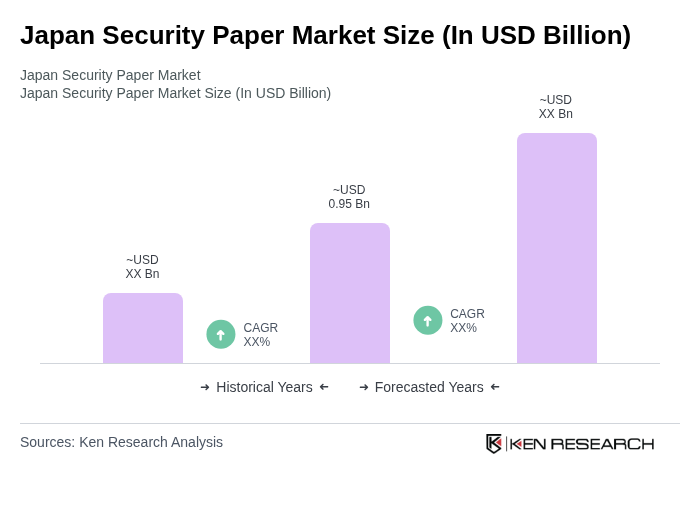
- The Japan Security Paper Market is valued at USD 0.95 billion, based on a five-year historical analysis. This growth is primarily driven by the increasing demand for secure documents, such as banknotes, passports, residence cards, and other identification documents, alongside the rising need for anti-counterfeiting measures in sectors such as finance, tax administration, and brand protection. The market is also supported by advancements in printing technologies and materials that enhance security features, including holograms, embedded security threads, watermarks, color?shifting inks, and machine-readable features integrated during security printing processes.
- Key demand centers in this market include major metropolitan regions such as Tokyo, Osaka, and Nagoya, which dominate due to their robust financial sectors, concentration of government institutions, and advanced printing and electronics industries. These cities host the headquarters or major operations of leading banks, central government agencies, and security printing and imaging companies, facilitating strong demand for security paper products and continuous innovation in security features.
- In 2021, the Japanese government strengthened requirements for secure official documents through instruments including the Act on Prevention of Transfer of Criminal Proceeds (as amended) and related enforcement orders issued by the National Police Agency and the Financial Services Agency, which require enhanced identity verification and the use of documents with advanced security features for customer due diligence and transaction monitoring. In parallel, the Basic Resident Registration Act and the My Number Act, administered by the Ministry of Internal Affairs and Communications, mandate the issuance of residence cards and Individual Number (My Number) cards with multiple embedded security elements (IC chips, holograms, laser engraving, and anti-counterfeiting printing) for use as official identification. These frameworks have supported demand for high-quality security substrates and security printing across central and local government documents.
Japan Security Paper Market Segmentation
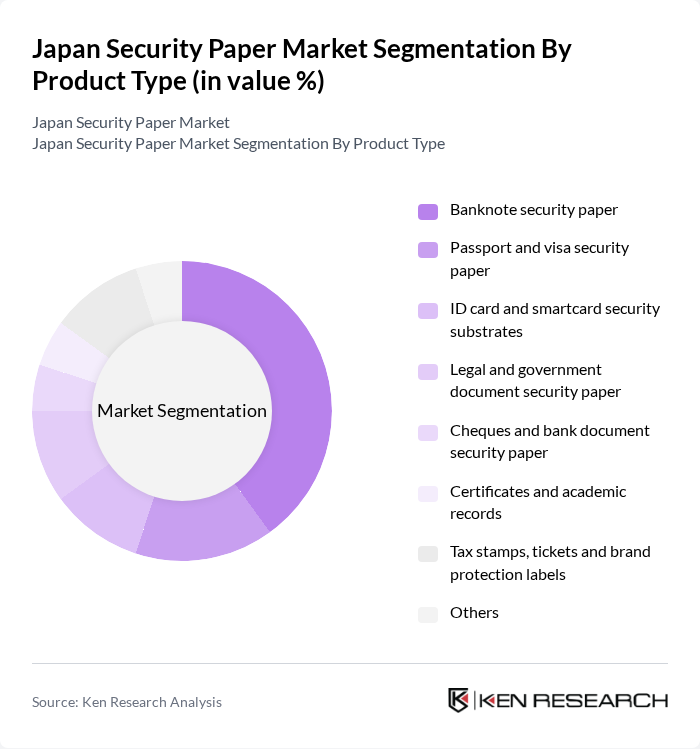
By Product Type:The product type segmentation includes various categories such as banknote security paper, passport and visa security paper, ID card and smartcard security substrates, legal and government document security paper, cheques and bank document security paper, certificates and academic records, tax stamps, tickets and brand protection labels, and others. This structure is consistent with global and Asia-Pacific security paper classifications, where banknotes, ID/passport substrates, tax stamps, and brand protection labels represent the core application clusters. Among these, banknote security paper is the leading sub-segment due to the continuous need for secure currency production by central banks and the increasing sophistication of counterfeiting techniques that require multi-layered security features in the substrate itself.
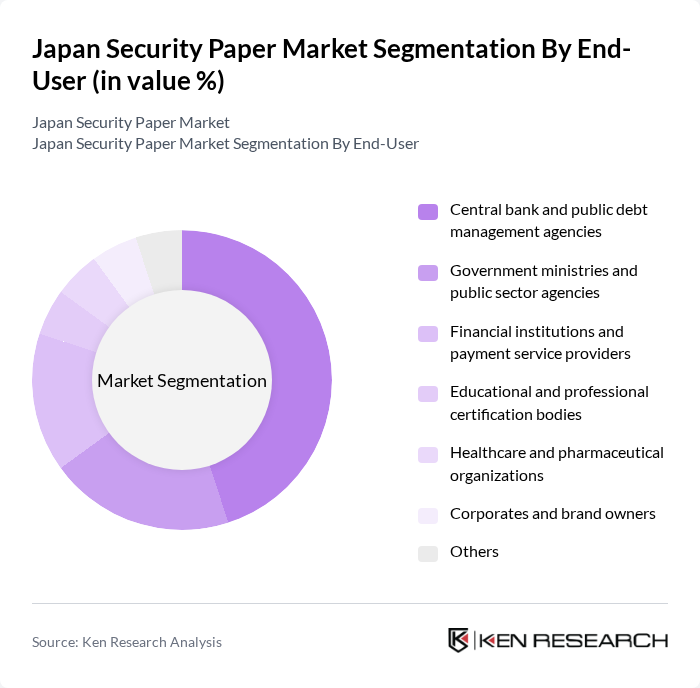
By End-User:The end-user segmentation encompasses central bank and public debt management agencies, government ministries and public sector agencies, financial institutions and payment service providers, educational and professional certification bodies, healthcare and pharmaceutical organizations, corporates and brand owners, and others. This end-user structure reflects the global demand pattern where sovereign monetary authorities, government departments, and financial intermediaries are the primary consumers of secure substrates and security printing solutions. Central banks and public debt management agencies are the dominant end-users, driven by the necessity for secure currency, treasury instruments, and other high-value negotiable documents that must remain durable and counterfeit-resistant throughout circulation.
Japan Security Paper Market Competitive Landscape
The Japan Security Paper Market is characterized by a dynamic mix of regional and international players. Leading participants such as Nippon Paper Industries Co., Ltd., Daio Paper Corporation, Oji Holdings Corporation, Mitsubishi Paper Mills Limited, Toppan Inc., Dai Nippon Printing Co., Ltd. (DNP), Toyo Ink SC Holdings Co., Ltd., Seiko Epson Corporation, Canon Inc., Fujifilm Holdings Corporation, Ricoh Company, Ltd., Hitachi High-Tech Corporation, Konica Minolta, Inc., Asahi Kasei Corporation, Kuraray Co., Ltd., Showa Denko Materials Co., Ltd. contribute to innovation, geographic expansion, and service delivery in this space.
Japan Security Paper Market Industry Analysis
Growth Drivers
- Increasing Demand for Secure Documents:The demand for secure documents in Japan is driven by the need for identity verification and fraud prevention. In future, the Japanese government is expected to issue approximately 10 million secure identification documents, reflecting a 15% increase from a previous period. This surge is attributed to heightened security concerns and the implementation of stricter regulations, which necessitate the use of advanced security paper to prevent forgery and unauthorized access to sensitive information.
- Government Initiatives for Anti-Counterfeiting:The Japanese government has allocated ¥5 billion (approximately $45 million) for anti-counterfeiting initiatives in future. This funding aims to enhance the security features of government-issued documents, including passports and currency. As a result, the demand for specialized security paper is projected to rise, as manufacturers will need to innovate and produce materials that meet the new standards set by regulatory bodies, ensuring the integrity of official documents.
- Technological Advancements in Security Printing:The security printing sector in Japan is experiencing rapid technological advancements, with investments reaching ¥3 billion ($27 million) in future. Innovations such as holographic printing and embedded security features are becoming standard. These technologies not only enhance the security of documents but also improve production efficiency, allowing manufacturers to meet the growing demand for high-quality security paper while reducing costs associated with traditional printing methods.
Market Challenges
- High Production Costs:The production costs for security paper in Japan are significantly high, averaging ¥1,200 ($11) per kilogram in future. This is primarily due to the specialized materials and advanced technologies required for manufacturing secure documents. As a result, smaller manufacturers may struggle to compete with larger firms that can absorb these costs, potentially leading to market consolidation and reduced competition in the industry.
- Competition from Digital Alternatives:The rise of digital documentation solutions poses a significant challenge to the security paper market. In future, it is estimated that 30% of businesses in Japan will adopt digital identity verification systems, reducing the demand for physical secure documents. This shift not only threatens traditional security paper manufacturers but also necessitates a strategic pivot towards integrating digital solutions to remain relevant in an increasingly digital landscape.
Japan Security Paper Market Future Outlook
The future of the Japan security paper market is poised for transformation, driven by technological advancements and evolving consumer preferences. As digital solutions gain traction, manufacturers will need to innovate by integrating advanced security features into their products. Additionally, the increasing focus on sustainability will push companies to develop eco-friendly security papers, aligning with global environmental standards. This dual approach will not only enhance product offerings but also ensure competitiveness in a rapidly changing market landscape.
Market Opportunities
- Expansion into Emerging Markets:Japanese security paper manufacturers have a significant opportunity to expand into emerging markets in Southeast Asia, where demand for secure documents is rising. With an estimated market growth of 20% in these regions, companies can leverage their expertise to capture new customers and diversify their revenue streams, enhancing overall market presence.
- Development of Eco-Friendly Security Papers:The growing emphasis on sustainability presents an opportunity for innovation in eco-friendly security papers. By investing in sustainable materials and production processes, manufacturers can meet the increasing demand from environmentally conscious consumers and businesses, potentially capturing a market segment that values both security and sustainability.
Scope of the Report
| Segment | Sub-Segments |
|---|---|
| By Product Type | Banknote security paper Passport and visa security paper ID card and smartcard security substrates Legal and government document security paper Cheques and bank document security paper Certificates and academic records Tax stamps, tickets and brand protection labels Others |
| By End-User | Central bank and public debt management agencies Government ministries and public sector agencies Financial institutions and payment service providers Educational and professional certification bodies Healthcare and pharmaceutical organizations Corporates and brand owners Others |
| By Application | Currency and high-value transactional documents Identity and travel documents Legal, tax and regulatory documents Brand protection and product authentication Tickets, stamps and vouchers Others |
| By Substrate Material | Cotton-fibre paper Hybrid cotton–polymer substrates Polymer substrate Synthetic and specialty fibre paper Recycled-fibre security paper Others |
| By Security Feature Integration | Watermarks and electrotypes Security threads and windows Holograms and optically variable devices (OVD) UV/IR fibres, inks and dyes Micro-printing and nano-text Colour-shifting and magnetic inks RFID/NFC and machine-readable features Others |
| By Printing Technology | Intaglio printing Offset lithographic printing Letterpress and gravure printing Digital and inkjet security printing Screen and flexographic printing Others |
| By Region | Kanto Kansai Chubu Kyushu & Okinawa Tohoku Hokkaido Chugoku & Shikoku Others |
Key Target Audience
Investors and Venture Capitalist Firms
Government and Regulatory Bodies (e.g., Ministry of Finance, National Printing Bureau)
Manufacturers and Producers of Security Paper
Distributors and Retailers of Security Products
Banking and Financial Institutions
Security Printing Companies
Law Enforcement Agencies
Insurance Companies
Players Mentioned in the Report:
Nippon Paper Industries Co., Ltd.
Daio Paper Corporation
Oji Holdings Corporation
Mitsubishi Paper Mills Limited
Toppan Inc.
Dai Nippon Printing Co., Ltd. (DNP)
Toyo Ink SC Holdings Co., Ltd.
Seiko Epson Corporation
Canon Inc.
Fujifilm Holdings Corporation
Ricoh Company, Ltd.
Hitachi High-Tech Corporation
Konica Minolta, Inc.
Asahi Kasei Corporation
Kuraray Co., Ltd.
Showa Denko Materials Co., Ltd.
Table of Contents
Market Assessment Phase
1. Executive Summary and Approach
2. Japan Security Paper Market Overview
2.1 Key Insights and Strategic Recommendations
2.2 Japan Security Paper Market Overview
2.3 Definition and Scope
2.4 Evolution of Market Ecosystem
2.5 Timeline of Key Regulatory Milestones
2.6 Value Chain & Stakeholder Mapping
2.7 Business Cycle Analysis
2.8 Policy & Incentive Landscape
3. Japan Security Paper Market Analysis
3.1 Growth Drivers
3.1.1 Increasing demand for secure documents
3.1.2 Government initiatives for anti-counterfeiting
3.1.3 Technological advancements in security printing
3.1.4 Rising awareness of document security
3.2 Market Challenges
3.2.1 High production costs
3.2.2 Competition from digital alternatives
3.2.3 Regulatory compliance complexities
3.2.4 Limited availability of raw materials
3.3 Market Opportunities
3.3.1 Expansion into emerging markets
3.3.2 Development of eco-friendly security papers
3.3.3 Collaborations with tech firms for innovative solutions
3.3.4 Increasing use in financial institutions
3.4 Market Trends
3.4.1 Shift towards digital security solutions
3.4.2 Growing customization in security paper products
3.4.3 Integration of advanced security features
3.4.4 Rise in counterfeit threats
3.5 Government Regulation
3.5.1 Standards for security paper production
3.5.2 Regulations on anti-counterfeiting measures
3.5.3 Compliance requirements for financial documents
3.5.4 Environmental regulations affecting production
4. SWOT Analysis
5. Stakeholder Analysis
6. Porter's Five Forces Analysis
7. Japan Security Paper Market Market Size, 2019-2024
7.1 By Value
7.2 By Volume
7.3 By Average Selling Price
8. Japan Security Paper Market Segmentation
8.1 By Product Type
8.1.1 Banknote security paper
8.1.2 Passport and visa security paper
8.1.3 ID card and smartcard security substrates
8.1.4 Legal and government document security paper
8.1.5 Cheques and bank document security paper
8.1.6 Certificates and academic records
8.1.7 Tax stamps, tickets and brand protection labels
8.1.8 Others
8.2 By End-User
8.2.1 Central bank and public debt management agencies
8.2.2 Government ministries and public sector agencies
8.2.3 Financial institutions and payment service providers
8.2.4 Educational and professional certification bodies
8.2.5 Healthcare and pharmaceutical organizations
8.2.6 Corporates and brand owners
8.2.7 Others
8.3 By Application
8.3.1 Currency and high-value transactional documents
8.3.2 Identity and travel documents
8.3.3 Legal, tax and regulatory documents
8.3.4 Brand protection and product authentication
8.3.5 Tickets, stamps and vouchers
8.3.6 Others
8.4 By Substrate Material
8.4.1 Cotton-fibre paper
8.4.2 Hybrid cotton–polymer substrates
8.4.3 Polymer substrate
8.4.4 Synthetic and specialty fibre paper
8.4.5 Recycled-fibre security paper
8.4.6 Others
8.5 By Security Feature Integration
8.5.1 Watermarks and electrotypes
8.5.2 Security threads and windows
8.5.3 Holograms and optically variable devices (OVD)
8.5.4 UV/IR fibres, inks and dyes
8.5.5 Micro-printing and nano-text
8.5.6 Colour-shifting and magnetic inks
8.5.7 RFID/NFC and machine-readable features
8.5.8 Others
8.6 By Printing Technology
8.6.1 Intaglio printing
8.6.2 Offset lithographic printing
8.6.3 Letterpress and gravure printing
8.6.4 Digital and inkjet security printing
8.6.5 Screen and flexographic printing
8.6.6 Others
8.7 By Region
8.7.1 Kanto
8.7.2 Kansai
8.7.3 Chubu
8.7.4 Kyushu & Okinawa
8.7.5 Tohoku
8.7.6 Hokkaido
8.7.7 Chugoku & Shikoku
8.7.8 Others
9. Japan Security Paper Market Competitive Analysis
9.1 Market Share of Key Players
9.2 Cross Comparison of Key Players
9.2.1 Company Name
9.2.2 Group Size (Large, Medium, or Small as per industry convention)
9.2.3 Japan security paper revenue (latest year, USD million)
9.2.4 3-year CAGR of Japan security paper revenue (%)
9.2.5 Japan market share in security paper (%)
9.2.6 Capacity utilization rate of security paper assets (%)
9.2.7 EBITDA margin from security paper business (%)
9.2.8 R&D spend on security paper as % of segment revenue
9.2.9 Capex intensity (security paper capex as % of sales)
9.2.10 Average selling price per tonne of security paper (USD/tonne)
9.2.11 Customer concentration (revenue share of top 5 clients, %)
9.2.12 New contract wins and renewal rate (%)
9.2.13 Product and feature diversification index
9.2.14 On-time delivery and quality compliance rate (%)
9.3 SWOT Analysis of Top Players
9.4 Pricing Analysis
9.5 Detailed Profile of Major Companies
9.5.1 Nippon Paper Industries Co., Ltd.
9.5.2 Daio Paper Corporation
9.5.3 Oji Holdings Corporation
9.5.4 Mitsubishi Paper Mills Limited
9.5.5 Toppan Inc.
9.5.6 Dai Nippon Printing Co., Ltd. (DNP)
9.5.7 Toyo Ink SC Holdings Co., Ltd.
9.5.8 Seiko Epson Corporation
9.5.9 Canon Inc.
9.5.10 Fujifilm Holdings Corporation
9.5.11 Ricoh Company, Ltd.
9.5.12 Hitachi High-Tech Corporation
9.5.13 Konica Minolta, Inc.
9.5.14 Asahi Kasei Corporation
9.5.15 Kuraray Co., Ltd.
9.5.16 Showa Denko Materials Co., Ltd.
10. Japan Security Paper Market End-User Analysis
10.1 Procurement Behavior of Key Ministries
10.1.1 Ministry of Finance
10.1.2 Ministry of Internal Affairs and Communications
10.1.3 Ministry of Education, Culture, Sports, Science and Technology
10.1.4 Ministry of Health, Labour and Welfare
10.2 Corporate Spend on Infrastructure & Energy
10.2.1 Financial sector investments
10.2.2 Government infrastructure projects
10.2.3 Educational institution funding
10.2.4 Healthcare sector expenditures
10.3 Pain Point Analysis by End-User Category
10.3.1 Security concerns in financial transactions
10.3.2 Counterfeit risks in government documents
10.3.3 Compliance challenges in educational certifications
10.3.4 Quality assurance in healthcare documentation
10.4 User Readiness for Adoption
10.4.1 Awareness of security paper benefits
10.4.2 Training and support requirements
10.4.3 Integration with existing systems
10.4.4 Budget allocation for security solutions
10.5 Post-Deployment ROI and Use Case Expansion
10.5.1 Cost savings from reduced fraud
10.5.2 Increased efficiency in document processing
10.5.3 Enhanced customer trust and satisfaction
10.5.4 Opportunities for new applications
11. Japan Security Paper Market Future Size, 2025-2030
11.1 By Value
11.2 By Volume
11.3 By Average Selling Price
Go-To-Market Strategy Phase
1. Whitespace Analysis + Business Model Canvas
1.1 Market Gaps Identification
1.2 Business Model Development
2. Marketing and Positioning Recommendations
2.1 Branding strategies
2.2 Product USPs
3. Distribution Plan
3.1 Urban retail vs rural NGO tie-ups
4. Channel & Pricing Gaps
4.1 Underserved routes
4.2 Pricing bands
5. Unmet Demand & Latent Needs
5.1 Category gaps
5.2 Consumer segments
6. Customer Relationship
6.1 Loyalty programs
6.2 After-sales service
7. Value Proposition
7.1 Sustainability
7.2 Integrated supply chains
8. Key Activities
8.1 Regulatory compliance
8.2 Branding
8.3 Distribution setup
9. Entry Strategy Evaluation
9.1 Domestic Market Entry Strategy
9.1.1 Product mix
9.1.2 Pricing band
9.1.3 Packaging
9.2 Export Entry Strategy
9.2.1 Target countries
9.2.2 Compliance roadmap
10. Entry Mode Assessment
10.1 JV
10.2 Greenfield
10.3 M&A
10.4 Distributor Model
11. Capital and Timeline Estimation
11.1 Capital requirements
11.2 Timelines
12. Control vs Risk Trade-Off
12.1 Ownership vs Partnerships
13. Profitability Outlook
13.1 Breakeven analysis
13.2 Long-term sustainability
14. Potential Partner List
14.1 Distributors
14.2 JVs
14.3 Acquisition targets
15. Execution Roadmap
15.1 Phased Plan for Market Entry
15.1.1 Market Setup
15.1.2 Market Entry
15.1.3 Growth Acceleration
15.1.4 Scale & Stabilize
15.2 Key Activities and Milestones
15.2.1 Activity Planning
15.2.2 Milestone Tracking
Research Methodology
Phase 1: Approach1
Desk Research
- Analysis of industry reports from Japanese government agencies and trade associations
- Review of academic publications and market studies focusing on security paper applications
- Examination of import/export data and market trends from customs and trade databases
Primary Research
- Interviews with key stakeholders in the security paper manufacturing sector
- Surveys targeting end-users such as banks, government agencies, and security printing firms
- Field visits to production facilities to gather insights on operational practices and innovations
Validation & Triangulation
- Cross-validation of findings through multiple data sources including trade statistics and expert opinions
- Triangulation of qualitative insights from interviews with quantitative data from market reports
- Sanity checks conducted through expert panel reviews to ensure data reliability
Phase 2: Market Size Estimation1
Top-down Assessment
- Estimation of total market size based on national security expenditure and printing volumes
- Segmentation of the market by application areas such as banknotes, passports, and certificates
- Incorporation of trends in digital security and anti-counterfeiting measures affecting demand
Bottom-up Modeling
- Collection of production capacity data from leading security paper manufacturers
- Cost analysis based on raw material prices and production processes
- Volume estimates derived from historical sales data and projected growth rates
Forecasting & Scenario Analysis
- Multi-variable forecasting models incorporating economic indicators and technological advancements
- Scenario analysis based on potential regulatory changes and shifts in consumer behavior
- Development of baseline, optimistic, and pessimistic market projections through 2030
Phase 3: CATI Sample Composition1
| Scope Item/Segment | Sample Size | Target Respondent Profiles |
|---|---|---|
| Banknote Production | 100 | Production Managers, Quality Assurance Officers |
| Government Document Security | 80 | Procurement Officers, Security Analysts |
| Anti-Counterfeiting Solutions | 70 | R&D Managers, Product Development Leads |
| Security Printing Firms | 90 | Operations Managers, Sales Directors |
| Market Trends and Innovations | 60 | Industry Experts, Market Analysts |
Frequently Asked Questions
What is the current value of the Japan Security Paper Market?
The Japan Security Paper Market is valued at approximately USD 0.95 billion, reflecting a historical analysis over five years. This valuation is driven by the increasing demand for secure documents and anti-counterfeiting measures across various sectors.
What are the main drivers of growth in the Japan Security Paper Market?
Which cities are the primary demand centers for security paper in Japan?
What types of products are included in the Japan Security Paper Market?
Other Regional/Country Reports
Other Adjacent Reports
Bahrain Anti-Counterfeiting Technology Market
Malaysia Holographic Materials Market
Thailand Security Ink Market
Belgium Specialty Paper Market
Belgium Identity Document Market
KSA Brand Protection Market
India Smart Card Market Outlook to 2030Mexico Document Authentication Market
Thailand Forensic Technology Market
Why Buy From Us?

What makes us stand out is that our consultants follow Robust, Refine and Result (RRR) methodology. Robust for clear definitions, approaches and sanity checking, Refine for differentiating respondents' facts and opinions, and Result for presenting data with story.

We have set a benchmark in the industry by offering our clients with syndicated and customized market research reports featuring coverage of entire market as well as meticulous research and analyst insights.

While we don't replace traditional research, we flip the method upside down. Our dual approach of Top Bottom & Bottom Top ensures quality deliverable by not just verifying company fundamentals but also looking at the sector and macroeconomic factors.

With one step in the future, our research team constantly tries to show you the bigger picture. We help with some of the tough questions you may encounter along the way: How is the industry positioned? Best marketing channel? KPI's of competitors? By aligning every element, we help maximize success.

Our report gives you instant access to the answers and sources that other companies might choose to hide. We elaborate each steps of research methodology we have used and showcase you the sample size to earn your trust.

If you need any support, we are here! We pride ourselves on universe strength, data quality, and quick, friendly, and professional service.