About the Report
Base Year 2025KSA Stationery Market Overview
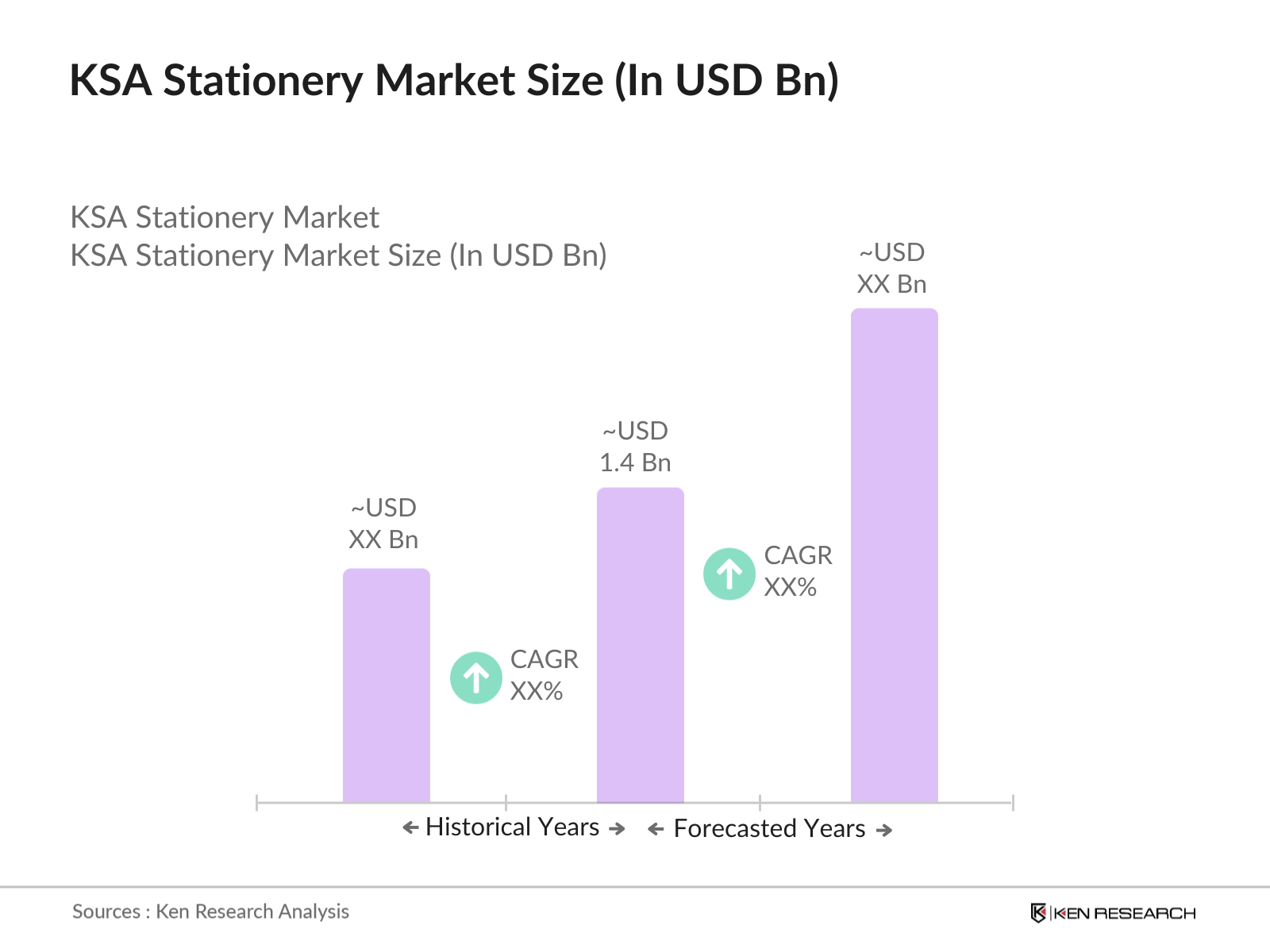
- The KSA Stationery Market is valued at approximately USD 1462 million, based on a five-year historical analysis. The market is supported by recurring school demand, office procurement, writing and paper-product consumption, creative activities and personal organization. Saudi Arabia also consumes approximately 59 thousand tons of stationery products, reflecting substantial demand across notebooks, registers, writing instruments, filing products, art materials and everyday school and workplace stationery categories.
- Riyadh, Jeddah and Dammam dominate the KSA Stationery Market because they combine large student populations, corporate offices, government institutions, bookstores, stationery retailers and wholesale distribution networks. Riyadh benefits from its concentration of headquarters and public administration, Jeddah serves a major commercial and education base in the Western Region, while Dammam and the wider Eastern Province generate demand from schools, industrial companies, professional offices and institutional buyers.
- The Product Safety System Implementing Regulation, 2024, administered through the Saudi Standards, Metrology and Quality Organization framework, strengthens product-safety obligations for goods placed in the Saudi market. Commercial products are registered through the Saber platform according to their regulatory classification. Regulated products may require Product Conformity Certificates, while applicable non-regulated products use self-declaration procedures, and imported commercial consignments require completion of the relevant Shipment Certificate process before market entry.
KSA Stationery Market Segmentation
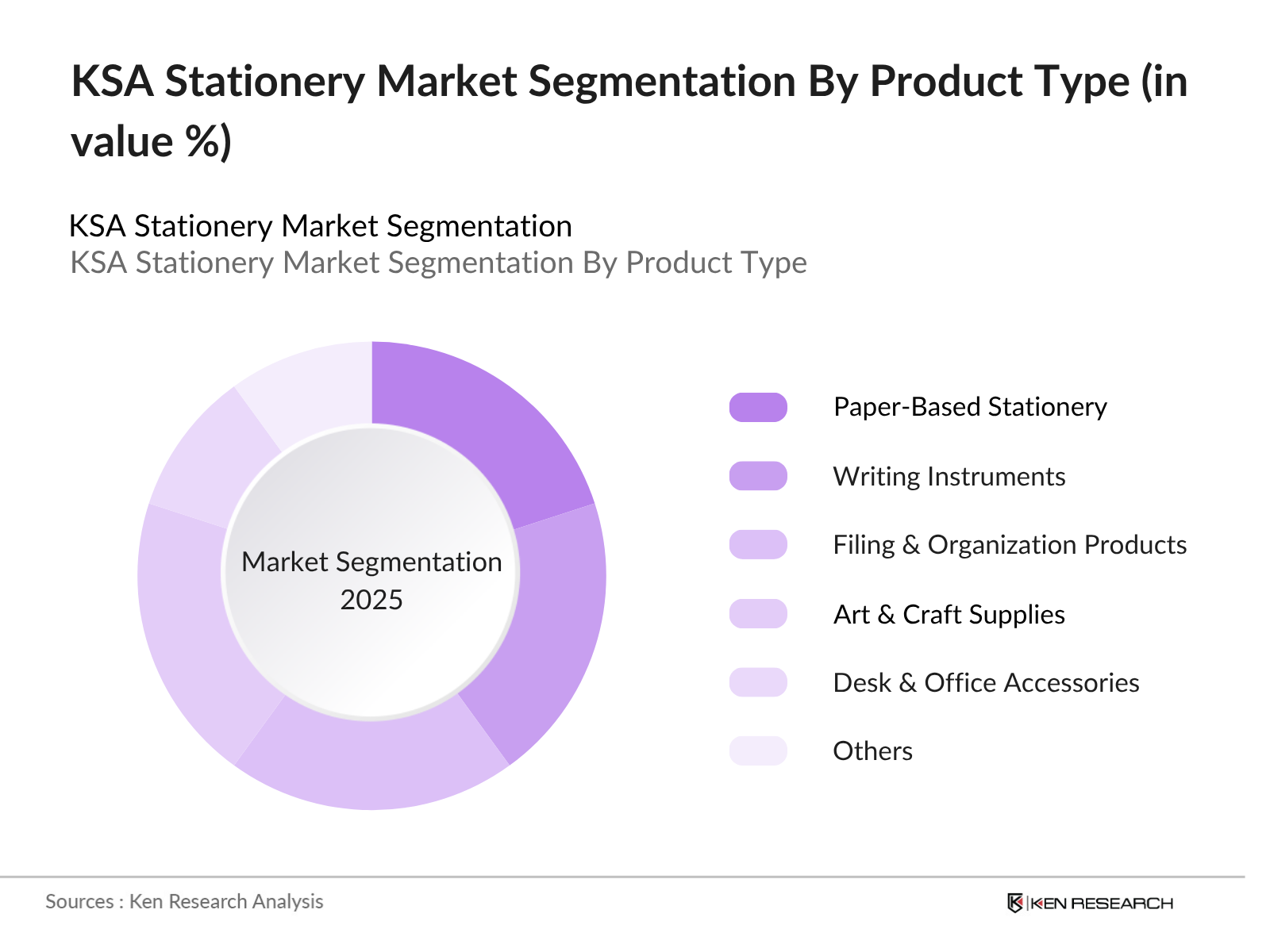
By Product Type:Paper-based stationery is the leading product category because notebooks, registers, notepads, writing pads, files and related paper products remain core requirements across schools, offices and public institutions. The wider Saudi office-supplies category also shows paper supplies as its largest product group, supporting the category’s structural importance. Writing instruments form the second-largest segment, supported by high-volume purchases of pens, pencils, markers and highlighters. Filing and organization products serve corporate and government users, while art and craft supplies benefit from school activities and creative hobbies. Desk accessories provide recurring workplace demand, and school stationery sets experience strong seasonal sales around academic terms. Adhesives and correction products remain relatively smaller but frequently replenished categories. Premium, eco-friendly and personalized products are increasing assortment depth across retailers and online channels.
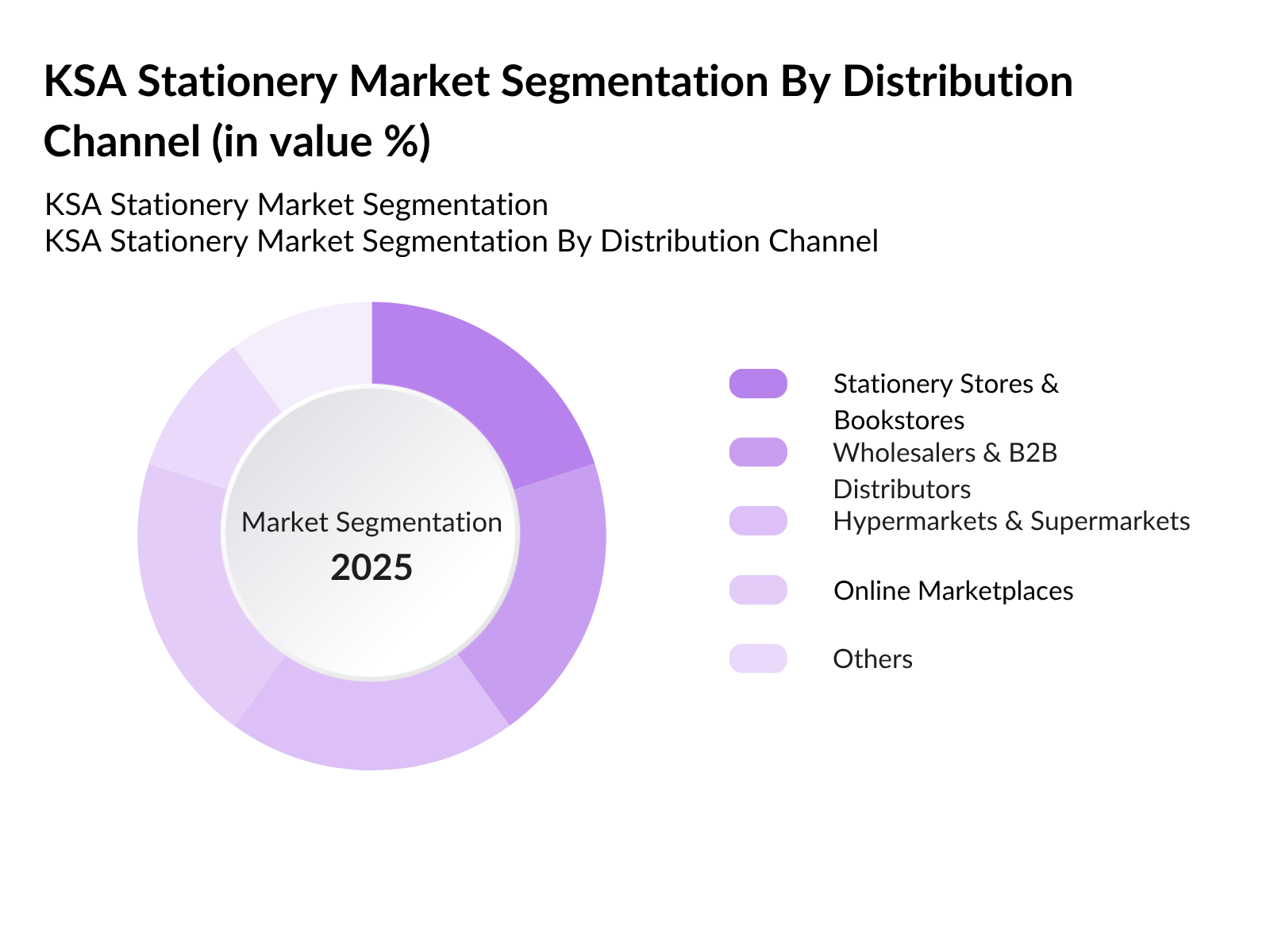
By Distribution Channel:Stationery stores and bookstores remain the leading distribution channel because consumers value immediate product availability, physical product comparison and broad back-to-school assortments. Established retailers combine store networks with online ordering, increasing convenience while preserving physical retail strength. Wholesalers and B2B distributors account for a significant share through recurring supply to companies, schools, government institutions and smaller retailers. Hypermarkets and supermarkets benefit from high footfall and seasonal school promotions. Online marketplaces are gaining importance through broader assortment, home delivery and price comparison, particularly for branded writing tools, creative supplies and premium products. Institutional procurement contributes steady bulk volumes through education and corporate accounts, while brand-owned digital channels provide direct access to specialized products. The remaining market is served through smaller neighborhood stores and miscellaneous channels.
KSA Stationery Market Competitive Landscape
The KSA Stationery Market is characterized by a mix of established Saudi retailers, specialist stationery distributors and international writing and office-supply brands. Participants such as Jarir Marketing Company, Faber-Castell AG, Pilot Corporation, STAEDTLER SE and Société BIC S.A. compete through product assortment, distribution reach, institutional accounts, brand recognition, e-commerce availability and price positioning across school, office and creative-use categories.
KSA Stationery Market Industry Analysis
Growth Drivers
- Large Education Demand Base:Saudi Arabia’s education system provides a recurring demand base for notebooks, pens, pencils, folders and classroom supplies. More than 6.7 million students attend over 31,000 general-education schools, while official service statistics count 31,412 schools nationwide. This creates predictable back-to-school and term-based purchasing cycles for families, schools and distributors. Institutional demand is further supported by 2,078 private technical and vocational institutes, expanding the addressable base for writing, filing, presentation and classroom stationery products across the Kingdom.
- Strong Import Demand for Core Stationery Products:Import flows demonstrate substantial demand for everyday writing and paper stationery. Saudi Arabia imported about USD 22.7 million of registers, account books and similar paper products, totaling roughly 8.35 million kilograms. Felt-tip and porous-tip pen imports reached about USD 17.9 million and 39.1 million items. These volumes support a broad ecosystem of importers, wholesalers, bookstores and online sellers, while encouraging retailers to maintain multi-brand assortments across economy, mid-range and premium price points for school and office customers.
- Recurring Corporate and Office Procurement:Paper-based supplies remain commercially important within Saudi office and stationery procurement. The closely aligned office-supplies category was valued at about USD 220 million, with paper supplies representing roughly one-third of sales, equivalent to nearly USD 74 million. Demand is reinforced by corporate offices, government departments, professional services firms and small businesses that continue purchasing notebooks, paper products, filing materials and desk supplies despite digitization. Expansion of business procurement and hybrid retail channels sustains repeat ordering and bulk-account opportunities.
Market Challenges
- Digital Substitution of Traditional Stationery:Digitization is reducing the intensity of some traditional paper-based usage even as physical stationery remains necessary in education, administration and creative work. A market of roughly USD 220 million in the broader office-supplies category is increasingly competing with digital note-taking, document management and electronic workflows. Suppliers therefore face pressure to differentiate through design, premium writing products, art materials, sustainable stationery and bundled school solutions rather than relying only on commodity paper products, where price competition can compress retailer and distributor margins.
- Compliance and SKU Management Complexity:Saudi importers must manage product conformity, shipment documentation and customs classification across a highly fragmented stationery assortment. SASO reported more than 7.5 million products registered on the Saber platform and over 5 million conformity and consignment certificates issued by the latest reporting period. For stationery distributors carrying thousands of SKUs, requirements can vary by product classification and applicable technical regulation. Compliance administration, inventory documentation and frequent replenishment therefore increase operating complexity, especially for smaller importers and multi-brand sellers.
KSA Stationery Market Future Outlook
The KSA Stationery Market is expected to remain resilient as education demand, corporate procurement, creative hobbies and gifting offset gradual substitution from digital tools. The country’s 31,412 schools and more than 6.7 million general-education students provide a durable consumption base, while paper, writing and organization products continue to serve offices and public institutions. Growth opportunities will concentrate in premium writing instruments, eco-friendly materials, customized school kits, online ordering and institutional supply contracts. Retailers with strong inventory visibility, nationwide delivery and trusted brands should gain advantage as buyers increasingly expect convenience, authenticity, competitive pricing and rapid replenishment.
Market Opportunities
- Institutional Education Procurement:Institutional supply is a scalable opportunity because Saudi Arabia has 31,412 schools, 95 government technical and vocational institutes, and 2,078 private institutes. Suppliers can build recurring contracts around notebooks, writing instruments, filing products, classroom tools and standardized student kits. Centralized ordering, annual price agreements and scheduled replenishment can reduce procurement friction while improving volume visibility for distributors and manufacturers.
- E-Commerce and Premium Stationery:E-commerce and premiumization offer a second growth path. Saudi Arabia imported about 39.1 million felt-tip and porous-tip pens and 8.35 million kilograms of registers and related paper products, indicating deep category consumption. Sellers can use online catalogs, personalized products, premium pen brands, art supplies and eco-friendly ranges to increase basket size while reaching customers beyond major urban retail locations.
Scope of the Report
| Segment | Sub-Segments |
|---|---|
| By Product Type | Paper-Based Stationery Writing Instruments Filing & Organization Products Art & Craft Supplies Desk & Office Accessories School Stationery Sets Adhesives & Correction Products Others |
| By End-User | K-12 Schools & Students Universities & Higher Education Institutions Corporate Offices Government & Public-Sector Organizations SMEs & Co-Working Spaces Home & Individual Users Artists, Designers & Creative Professionals Others |
| By Distribution Channel | Stationery Stores & Bookstores Wholesalers & B2B Distributors Hypermarkets & Supermarkets Online Marketplaces Institutional & Corporate Procurement Brand-Owned Online Stores Others |
| By Price Tier | Economy Mid-Range Premium Luxury & Gifting |
| By Material & Sustainability Positioning | Conventional Paper-Based Products Plastic-Based Stationery Recycled Paper Products Refillable & Reusable Stationery Biodegradable & Eco-Friendly Products Others |
| By Customer Type | Business-to-Consumer Business-to-Business Business-to-Government Educational Institution Procurement Resellers & Wholesale Buyers |
| By Region | Central Region Western Region Eastern Region Southern Region Northern Region |
| By Usage Occasion | Back-to-School Purchases Daily Office & Administrative Use Examination & Academic Use Art, Design & Creative Activities Corporate Gifting & Promotional Use Personal Organization & Journaling Others |
Key Target Audience
Stationery Manufacturers and Brand Owners
Stationery Importers, Distributors and Wholesalers
Bookstores and Specialized Stationery Retailers
Schools, Universities and Education Procurement Departments
Corporate Office-Supply Procurement Teams
Government and Regulatory Bodies including Ministry of Education, SASO and ZATCA
Investors and Venture Capitalist Firms
E-Commerce Platforms and Institutional Procurement Providers
Major Players Mentioned
Jarir Marketing Company
MASCO Saudi Trading Company
Alershad Bookshop & Stationery
Riyadh Office Trading Est. - IMEX Office Supplies
Fusul
Faber-Castell AG
Pilot Corporation
STAEDTLER SE
Société BIC S.A.
Maped SAS
Table of Contents
Market Assessment Phase
1. Executive Summary and Approach
2. KSA Stationery Market Overview
2.1 Key Insights and Strategic Recommendations
2.2 KSA Stationery Market Overview
2.3 Definition and Scope
2.4 Evolution of Market Ecosystem
2.5 Timeline of Key Regulatory Milestones
2.6 Value Chain & Stakeholder Mapping
2.7 Business Cycle Analysis
2.8 Policy & Incentive Landscape
3. KSA Stationery Market Analysis
3.1 Growth Drivers
3.1.1 Large Student Population and Expanding Educational Infrastructure
3.1.2 Recurring Back-to-School and Academic-Year Purchasing Cycles
3.1.3 Growth in Corporate, SME and Government Office Procurement
3.1.4 Expansion of Omnichannel Stationery Retail and E-Commerce
3.2 Market Challenges
3.2.1 Digitalization Reducing Consumption of Selected Paper-Based Stationery
3.2.2 High Price Competition in Commodity Stationery Categories
3.2.3 Import Dependence Across Major Writing and Art-Supply Categories
3.2.4 SKU Complexity and Seasonal Inventory Management
3.3 Market Opportunities
3.3.1 Institutional School and Government Procurement Contracts
3.3.2 Sustainable and Eco-Friendly Stationery Products
3.3.3 Premium, Personalized and Gifting-Oriented Stationery
3.3.4 Digital B2B Ordering and Automated Replenishment Solutions
3.4 Market Trends
3.4.1 Rising Demand for Premium Writing Instruments
3.4.2 Growing Adoption of Recycled and Refillable Stationery
3.4.3 Expansion of Online Stationery Assortments and Home Delivery
3.4.4 Growth of Private-Label and Value-Priced Product Ranges
3.5 Government Regulation
3.5.1 SASO Product Safety and Conformity Requirements
3.5.2 Saber Product Registration and Shipment Certification
3.5.3 ZATCA Customs Classification and Import Requirements
3.5.4 Consumer Product Labeling and Market Surveillance Requirements
4. SWOT Analysis
5. Stakeholder Analysis
6. Porter's Five Forces Analysis
7. KSA Stationery Market Size, 2019-2024
7.1 By Value
7.2 By Volume
7.3 By Average Selling Price
8. KSA Stationery Market Segmentation
8.1 By Product Type
8.1.1 Paper-Based Stationery
8.1.2 Writing Instruments
8.1.3 Filing & Organization Products
8.1.4 Art & Craft Supplies
8.1.5 Desk & Office Accessories
8.1.6 School Stationery Sets
8.1.7 Adhesives & Correction Products
8.1.8 Others
8.2 By End-User
8.2.1 K-12 Schools & Students
8.2.2 Universities & Higher Education Institutions
8.2.3 Corporate Offices
8.2.4 Government & Public-Sector Organizations
8.2.5 SMEs & Co-Working Spaces
8.2.6 Home & Individual Users
8.2.7 Artists, Designers & Creative Professionals
8.2.8 Others
8.3 By Distribution Channel
8.3.1 Stationery Stores & Bookstores
8.3.2 Wholesalers & B2B Distributors
8.3.3 Hypermarkets & Supermarkets
8.3.4 Online Marketplaces
8.3.5 Institutional & Corporate Procurement
8.3.6 Brand-Owned Online Stores
8.3.7 Others
8.4 By Price Tier
8.4.1 Economy
8.4.2 Mid-Range
8.4.3 Premium
8.4.4 Luxury & Gifting
8.5 By Material & Sustainability Positioning
8.5.1 Conventional Paper-Based Products
8.5.2 Plastic-Based Stationery
8.5.3 Recycled Paper Products
8.5.4 Refillable & Reusable Stationery
8.5.5 Biodegradable & Eco-Friendly Products
8.5.6 Others
8.6 By Customer Type
8.6.1 Business-to-Consumer
8.6.2 Business-to-Business
8.6.3 Business-to-Government
8.6.4 Educational Institution Procurement
8.6.5 Resellers & Wholesale Buyers
8.7 By Region
8.7.1 Central Region
8.7.2 Western Region
8.7.3 Eastern Region
8.7.4 Southern Region
8.7.5 Northern Region
8.8 By Usage Occasion
8.8.1 Back-to-School Purchases
8.8.2 Daily Office & Administrative Use
8.8.3 Examination & Academic Use
8.8.4 Art, Design & Creative Activities
8.8.5 Corporate Gifting & Promotional Use
8.8.6 Personal Organization & Journaling
8.8.7 Others
9. KSA Stationery Market Competitive Analysis
9.1 Market Share of Key Players (Micro, Small, Medium, Large Enterprises)
9.2 Cross Comparison of Key Players
9.2.1 Company Name
9.2.2 Group Size (Large, Medium, or Small as per industry convention)
9.2.3 Product SKU Breadth
9.2.4 Distribution Reach
9.2.5 Institutional & B2B Account Coverage
9.2.6 Retail & E-Commerce Presence
9.2.7 Brand Portfolio Strength
9.2.8 Inventory Replenishment Lead Time
9.2.9 School & Office Channel Penetration
9.2.10 Pricing Strategy
9.3 SWOT Analysis of Top Players
9.4 Pricing Analysis by Product Category and Price Tier
9.5 Detailed Profile of Major Companies
9.5.1 Jarir Marketing Company
9.5.2 MASCO Saudi Trading Company
9.5.3 Alershad Bookshop & Stationery
9.5.4 Riyadh Office Trading Est. - IMEX Office Supplies
9.5.5 Fusul
9.5.6 Faber-Castell AG
9.5.7 Pilot Corporation
9.5.8 STAEDTLER SE
9.5.9 Société BIC S.A.
9.5.10 Maped SAS
9.5.11 Pentel Co., Ltd.
9.5.12 Zebra Co., Ltd.
9.5.13 Mitsubishi Pencil Co., Ltd.
9.5.14 Schneider Schreibgeräte GmbH
9.5.15 Deli Group Co., Ltd.
10. KSA Stationery Market End-User Analysis
10.1 Procurement Behavior of Key Ministries
10.1.1 Ministry of Education School-Supply Procurement
10.1.2 Government Tender-Based Office Stationery Procurement
10.1.3 Bulk Purchasing and Framework Contracts
10.1.4 Product Standardization Across Public Institutions
10.2 Corporate Spend on Office & Workplace Supplies
10.2.1 Large Enterprise Office-Supply Procurement
10.2.2 SME and Co-Working Space Stationery Demand
10.2.3 Corporate Gifting and Branded Stationery
10.2.4 Recurring Consumable Replenishment
10.3 Pain Point Analysis by End-User Category
10.3.1 Seasonal Product Stock-Outs
10.3.2 Quality Variability in Economy Product Tiers
10.3.3 High Procurement Fragmentation
10.3.4 Limited Availability of Specialized Creative Products
10.4 User Readiness for Adoption
10.4.1 Adoption of Eco-Friendly Stationery
10.4.2 Adoption of Online and App-Based Ordering
10.4.3 Acceptance of Private-Label Products
10.4.4 Demand for Personalized and Premium Stationery
10.5 Post-Deployment ROI and Use Case Expansion
10.5.1 Procurement Consolidation and Cost Savings
10.5.2 Automated Replenishment Programs
10.5.3 School Kit and Corporate Stationery Bundling
10.5.4 Private-Label Portfolio Expansion
11. KSA Stationery Market Future Size, 2025-2030
11.1 By Value
11.2 By Volume
11.3 By Average Selling Price
Go-To-Market Strategy Phase
1. Whitespace Analysis + Business Model Canvas
1.1 Eco-Friendly School and Office Stationery
1.2 Premium Writing and Journaling Products
1.3 Institutional Replenishment Contracts
1.4 Private-Label Stationery Portfolio
2. Marketing and Positioning Recommendations (Branding Strategies, Product USPs)
2.1 Position Around Product Quality and Durability
2.2 Develop School, Office and Creative Product Architecture
2.3 Highlight Sustainability and Refillable Product USPs
2.4 Build Seasonal Back-to-School Campaigns
3. Distribution Plan (Retail, Institutional and Online Channels)
3.1 Riyadh Distribution and Corporate Accounts
3.2 Jeddah Retail and Education Channel Coverage
3.3 Eastern Province Corporate and Industrial Office Demand
3.4 Nationwide E-Commerce and Secondary City Fulfillment
4. Channel & Pricing Gaps (Underserved Routes, Pricing Bands)
4.1 Mid-Priced Branded Stationery Gap
4.2 Specialized Art and Creative Supplies Gap
4.3 Institutional Online Procurement Gap
4.4 Sustainable Stationery Pricing Gap
5. Unmet Demand & Latent Needs (Category Gaps, Consumer Segments)
5.1 Sustainable School Stationery
5.2 Premium Journaling and Planning Products
5.3 Customized School Kits
5.4 Corporate Branded Stationery
6. Customer Relationship (Loyalty Programs, After-Sales Service)
7.1 School and Parent Loyalty Programs
7.2 Corporate Account Management
7.3 B2B Replenishment Subscriptions
7.4 Volume Discounts and Institutional Agreements
7. Value Proposition (Sustainability, Integrated Supply Chains)
8.1 Broad Product Assortment
8.2 Authentic Global and Local Brands
8.3 Competitive Institutional Pricing
8.4 Fast Nationwide Replenishment
8. Key Activities (Regulatory Compliance, Branding, Distribution Setup)
9.1 SASO and Saber Compliance Management
9.2 Product Sourcing and Supplier Qualification
9.3 Seasonal Inventory Planning
9.4 Retail, B2B and E-Commerce Distribution Development
9. Entry Strategy Evaluation
9.1 Domestic Market Entry Strategy (Product Mix, Pricing Band, Packaging)
10.1.1 Launch with High-Turn Paper and Writing Categories
10.1.2 Build Economy, Mid-Range and Premium Price Tiers
10.1.3 Use Arabic-English Packaging and Product Information
10.1.4 Prioritize Back-to-School and Corporate Procurement Cycles
9.2 Export Entry Strategy (Source Countries, Compliance Roadmap)
10.2.1 Complete Product Classification and Saber Registration
10.2.2 Establish Product Conformity Documentation
10.2.3 Select Saudi Importer and Distribution Partners
10.2.4 Develop Multi-Country Sourcing to Reduce Supply Risk
10. Entry Mode Assessment (JV, Greenfield, M&A, Distributor Model)
11.1 Exclusive Distributor Model
11.2 Multi-Distributor Model
11.3 Joint Venture with Local Stationery Distributor
11.4 Direct Retail and E-Commerce Model
11. Capital and Timeline Estimation (Capital Requirements, Timelines)
12.1 Initial Inventory Requirements
12.2 Warehouse and Fulfillment Setup
12.3 Product Compliance and Registration Requirements
12.4 Brand Launch and Channel Development
12. Control vs Risk Trade-Off (Ownership vs Partnerships)
13.1 Direct Retail Control versus Distributor Scale
13.2 Inventory Breadth versus Working-Capital Exposure
13.3 Exclusive Distribution versus Multi-Channel Reach
13.4 Premium Branding versus Mass-Market Penetration
13. Profitability Outlook (Breakeven Analysis, Long-Term Sustainability)
14.1 Gross Margin by Product Category
14.2 Inventory Turnover Efficiency
14.3 Seasonal Sell-Through Performance
14.4 Institutional Contract Economics
14. Potential Partner List (Distributors, JVs, Acquisition Targets)
15.1 Jarir Marketing Company - Retail and Corporate Distribution Assessment
15.2 MASCO Saudi Trading Company - Stationery Distribution Assessment
15.3 Alershad Bookshop & Stationery - Retail Distribution Assessment
15.4 Riyadh Office Trading Est. - B2B Distribution Assessment
15. Execution Roadmap
15.1 Phased Plan for Market Entry (Market Setup → Market Entry → Growth Acceleration → Scale & Stabilize)
16.1.1 Market Setup: Compliance, Product Portfolio and Supplier Selection
16.1.2 Market Entry: Distributor Appointment and Initial Inventory Launch
16.1.3 Growth Acceleration: Education, Corporate and E-Commerce Expansion
16.1.4 Scale & Stabilize: Private Label, Sustainability and Regional Coverage
15.2 Key Activities and Milestones
16.2.1 Finalize Product Classification and Compliance
16.2.2 Establish Local Import and Distribution Infrastructure
16.2.3 Launch Priority Stationery Categories
16.2.4 Onboard School, Corporate and Retail Accounts
16.2.5 Expand E-Commerce and Nationwide Delivery
16.2.6 Optimize Product Mix Using Sell-Through Data
Research Methodology
Phase 1: Approach1
Desk Research
- Analysis of Saudi stationery consumption, school infrastructure, product imports and office-supply category indicators
- Review of Ministry of Education, GASTAT, SASO, ZATCA and related government information relevant to stationery demand and product compliance
- Assessment of retailer assortments, international stationery brands, wholesale distribution structures and institutional procurement channels
Primary Research
- Interviews with stationery wholesalers, importers, distributors and bookstore operators across major Saudi cities
- Discussions with school procurement managers, teachers, corporate administration managers and institutional buyers
- Interviews with retail category managers, e-commerce sellers and distributors of writing, paper and creative stationery products
Validation & Triangulation
- Cross-validation of product demand using consumption, import, retail and education indicators
- Triangulation of product-category shares through distributor interviews, retailer assortment analysis and procurement behavior
- Sanity checks across school demand, corporate usage, seasonal cycles and product-level import flows
Phase 2: Market Size Estimation1
Top-down Assessment
- Assessment of Saudi stationery consumption value and volume across paper, writing, school and office product categories
- Allocation of demand across education, corporate, government, household and creative end users
- Adjustment for retail margins, institutional purchasing, domestic supply and imported stationery products
Bottom-up Modeling
- Retailer and distributor sales benchmarks across major stationery categories
- Institutional demand estimates based on school, office and government procurement intensity
- Product volume multiplied by category-level selling-price benchmarks across economy, mid-range and premium tiers
Forecasting & Scenario Analysis
- Assessment of student population, education infrastructure, office procurement and consumer spending patterns
- Scenarios based on digital substitution, e-commerce penetration, sustainability adoption and premiumization
- Baseline, accelerated-premiumization and constrained-traditional-stationery scenarios through the outlook period
Phase 3: CATI Sample Composition1
| Scope Item/Segment | Sample Size | Target Respondent Profiles |
|---|---|---|
| School & Education Stationery | 120 | School Procurement Managers, Teachers, Administrators, Stationery Buyers |
| Stationery Retailers & Bookstores | 100 | Store Owners, Category Managers, Retail Buyers, Branch Managers |
| Corporate & Institutional Procurement | 90 | Procurement Managers, Administration Heads, Office Managers |
| Wholesalers & Import Distributors | 80 | Business Owners, Sales Directors, Import Managers, Distribution Managers |
| Online & Creative Stationery Sellers | 60 | E-Commerce Managers, Marketplace Sellers, Art-Supply Retailers |
Frequently Asked Questions
What is the size of the KSA Stationery Market?
The KSA Stationery Market is valued at approximately USD 155 million based on the historical market assessment. Demand spans paper-based stationery, writing instruments, school supplies, filing products, office accessories and creative materials purchased by students, institutions, businesses, government organizations and individual consumers.
What is driving demand in the KSA Stationery Market?
Which stationery product category leads the Saudi market?
Why Buy From Us?

What makes us stand out is that our consultants follow Robust, Refine and Result (RRR) methodology. Robust for clear definitions, approaches and sanity checking, Refine for differentiating respondents' facts and opinions, and Result for presenting data with story.

We have set a benchmark in the industry by offering our clients with syndicated and customized market research reports featuring coverage of entire market as well as meticulous research and analyst insights.

While we don't replace traditional research, we flip the method upside down. Our dual approach of Top Bottom & Bottom Top ensures quality deliverable by not just verifying company fundamentals but also looking at the sector and macroeconomic factors.

With one step in the future, our research team constantly tries to show you the bigger picture. We help with some of the tough questions you may encounter along the way: How is the industry positioned? Best marketing channel? KPI's of competitors? By aligning every element, we help maximize success.

Our report gives you instant access to the answers and sources that other companies might choose to hide. We elaborate each steps of research methodology we have used and showcase you the sample size to earn your trust.

If you need any support, we are here! We pride ourselves on universe strength, data quality, and quick, friendly, and professional service.