About the Report
Base Year 2024Listen to the audio summary
Kuwait Breast Pumps Market Overview
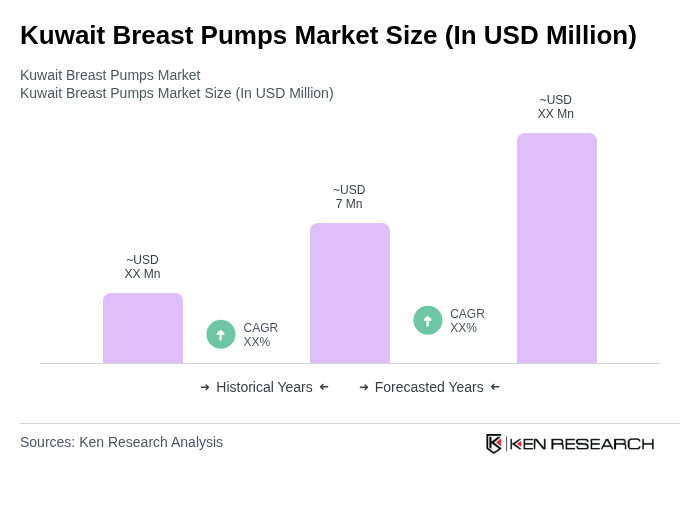
- The Kuwait Breast Pumps Market is valued at USD 7 million, based on a five-year historical analysis. This growth is primarily driven by increasing awareness of breastfeeding benefits, supported by global and regional initiatives that promote breastfeeding and pumping among working women. Coupled with a rise in working mothers seeking convenient solutions for milk expression and a growing preference for technologically advanced devices such as wearable pumps, the market has seen steady demand for both manual and electric breast pumps, reflecting a shift towards modern parenting practices and evidence-based healthcare recommendations.
- Kuwait City is the dominant hub in the market, attributed to its high population density and concentration of healthcare facilities, including major public and private hospitals and maternity centers that serve as key access points for maternal and child health products. The presence of numerous maternity clinics and hospitals in urban areas facilitates easy access to breast pump products through hospital pharmacies, specialty baby stores, and modern retail formats. Additionally, the comparatively affluent population in these regions, coupled with high female labor-force participation in professional and service sectors, drives demand for premium and technologically advanced breast pumps, further solidifying their market position.
- The Kuwaiti government supports breastfeeding promotion through policies and regulations aligned with international standards, including requirements for hospitals to provide breastfeeding counseling, protect breastfeeding from inappropriate breast-milk substitute marketing, and ensure maternity services comply with quality benchmarks. In particular, the Kuwait Code for the Marketing of Breast-milk Substitutes, issued by the Ministry of Health in line with the International Code of Marketing of Breast-milk Substitutes, and the Baby-Friendly Hospital Initiative standards adopted in Kuwaiti hospitals, mandate breastfeeding support services and counseling as part of routine maternity care. These measures aim to promote breastfeeding as a vital health practice and ensure that new mothers have access to necessary resources and informed guidance, thereby enhancing maternal and infant health outcomes and indirectly supporting the use of breast pumps where medically or socially indicated.
Kuwait Breast Pumps Market Segmentation
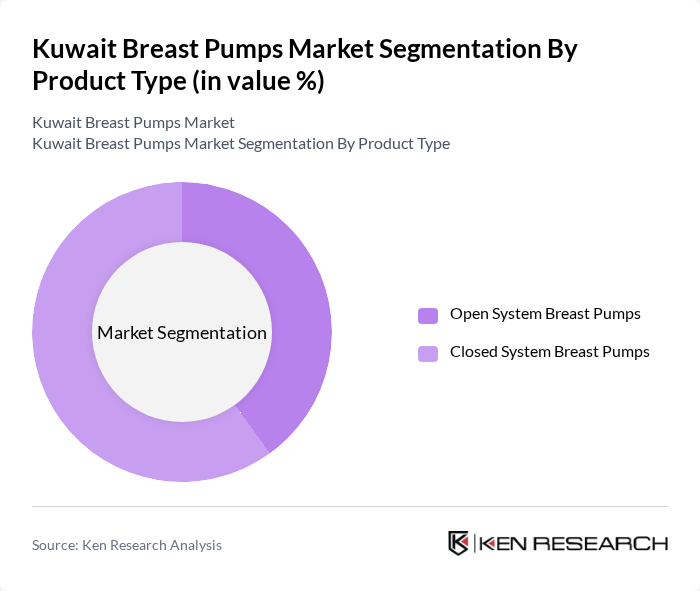
By Product Type:The market is segmented into Open System Breast Pumps and Closed System Breast Pumps, in line with global product categorization where closed systems incorporate a barrier between the milk collection kit and the pumping mechanism. Open system breast pumps are typically positioned at a lower price point and appeal to cost-sensitive users, although they generally require more careful cleaning and are more common in older or basic designs. Closed system breast pumps, on the other hand, are preferred for their hygienic design, which prevents milk and moisture from entering the pump motor or tubing, thereby enhancing safety, reducing risk of contamination, and improving suitability for repeated or multi-user settings. The closed system segment is increasingly leading the market as consumers and healthcare providers prioritize infection control, hygiene, and long-term reliability, supported by broader global trends toward hospital-grade and hygienic pumping solutions.
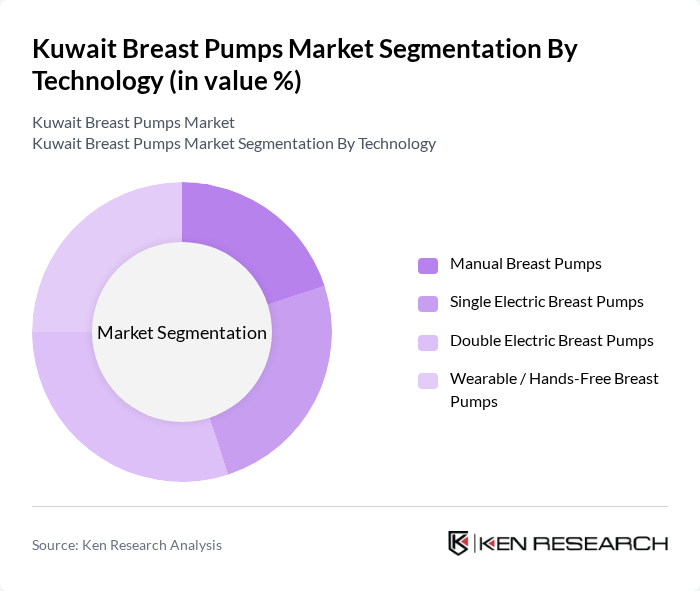
By Technology:The technology segment includes Manual Breast Pumps, Single Electric Breast Pumps, Double Electric Breast Pumps, and Wearable / Hands-Free Breast Pumps, reflecting the same technology groupings highlighted in global and regional analyses. Manual breast pumps are favored for their portability, low initial cost, and suitability for occasional use, especially among mothers who do not need to express frequently. Electric pumps offer convenience and higher efficiency for regular use, and within this category, double electric breast pumps are gaining traction due to their ability to express milk from both breasts simultaneously, significantly reducing pumping time and supporting working mothers who need to maintain supply. Wearable / hands-free breast pumps are emerging as a particularly fast-growing sub-segment in Kuwait, supported by rising imports of wearable devices and consumer preference for discreet, cordless, and app-connected solutions that can be used under clothing during work or travel. This has positioned wearable pumps among the leading technology choices in urban, higher-income segments of the market.
Kuwait Breast Pumps Market Competitive Landscape
The Kuwait Breast Pumps Market is characterized by a dynamic mix of regional and international players. Leading participants such as Medela AG, Philips Avent (Koninklijke Philips N.V.), Pigeon Corporation, Lansinoh Laboratories, Inc., Ameda, Inc., Tommee Tippee (Mayborn Group), Spectra Baby, Haakaa, Chicco (Artsana Group), Evenflo Feeding, BabyBuddha, Bellababy, Elvie, Willow, Local & Regional Private Label Brands contribute to innovation, geographic expansion, and service delivery in this space.
Kuwait Breast Pumps Market Industry Analysis
Growth Drivers
- Increasing Awareness of Breastfeeding Benefits:The awareness of breastfeeding's health benefits has surged, with 85% of mothers in Kuwait recognizing its importance for infant health. The World Health Organization recommends exclusive breastfeeding for the first six months, aligning with Kuwait's health initiatives. This awareness is supported by a report from the Ministry of Health, which indicated a 25% increase in breastfeeding rates among new mothers, driving demand for breast pumps as mothers seek to maintain breastfeeding while managing work and personal commitments.
- Rising Number of Working Mothers:The labor force participation rate for women in Kuwait reached 53% in future, reflecting a significant increase in working mothers. This demographic shift necessitates the use of breast pumps, as many mothers aim to balance their careers with breastfeeding. According to the Public Authority for Civil Information, the number of working mothers has grown by 20% over the past five years, creating a robust market for breast pumps that facilitate breastfeeding while managing professional responsibilities.
- Technological Advancements in Breast Pump Design:Innovations in breast pump technology have led to the introduction of more efficient and user-friendly devices. In future, the market saw a 35% increase in sales of portable and smart breast pumps, which offer features like app connectivity and customizable settings. This trend is supported by a report from the Kuwait Institute for Scientific Research, highlighting that 45% of mothers prefer technologically advanced pumps for their convenience and effectiveness, further driving market growth.
Market Challenges
- High Cost of Advanced Breast Pumps:The average price of advanced breast pumps in Kuwait ranges from KWD 50 to KWD 150, which can be prohibitive for many families. A survey by the Kuwait Consumer Protection Agency revealed that 65% of mothers consider cost a significant barrier to purchasing high-quality breast pumps. This challenge is compounded by the limited availability of affordable options, which restricts access for lower-income families, potentially hindering overall market growth.
- Cultural Stigma Around Breastfeeding in Public:Despite increasing awareness, cultural attitudes towards breastfeeding in public remain a challenge in Kuwait. A study indicated that 50% of mothers feel uncomfortable breastfeeding in public spaces due to societal pressures. This stigma can deter mothers from using breast pumps outside the home, limiting their ability to maintain breastfeeding while engaging in social or professional activities, thus impacting the overall market potential.
Kuwait Breast Pumps Market Future Outlook
The future of the Kuwait breast pumps market appears promising, driven by evolving consumer preferences and technological advancements. As more mothers seek convenient solutions for breastfeeding, the demand for portable and smart breast pumps is expected to rise. Additionally, government initiatives aimed at promoting breastfeeding will likely enhance market growth. The increasing acceptance of breastfeeding in public spaces may further support this trend, creating a more favorable environment for breast pump usage among working mothers.
Market Opportunities
- Expansion of E-commerce Platforms:The growth of e-commerce in Kuwait presents a significant opportunity for breast pump manufacturers. In future, online retail sales increased by 30%, indicating a shift in consumer purchasing behavior. This trend allows for greater accessibility to a wider range of breast pump products, catering to diverse consumer needs and preferences, ultimately driving sales and market penetration.
- Introduction of Eco-friendly Breast Pump Options:With rising environmental awareness, there is a growing demand for eco-friendly breast pump options. A survey indicated that 75% of mothers are willing to pay a premium for sustainable products. This trend presents an opportunity for manufacturers to innovate and introduce biodegradable or recyclable breast pumps, appealing to environmentally conscious consumers and enhancing brand loyalty.
Scope of the Report
| Segment | Sub-Segments |
|---|---|
| By Product Type | Open System Breast Pumps Closed System Breast Pumps |
| By Technology | Manual Breast Pumps Single Electric Breast Pumps Double Electric Breast Pumps Wearable / Hands-Free Breast Pumps |
| By Application / Usage | Personal Use Breast Pumps Hospital-Grade Breast Pumps |
| By End-User | Hospitals Maternity Clinics & Lactation Centers Homecare Settings Others |
| By Distribution Channel | Hospital Pharmacies Retail Pharmacies & Baby Stores Supermarkets / Hypermarkets Online Channels (E-commerce & Brand Websites) |
| By Price Range | Economy Mid-Range Premium |
| By User Demographics | First-Time Mothers Experienced Mothers Working Mothers High-Risk / Preterm Birth Mothers |
Key Target Audience
Investors and Venture Capitalist Firms
Government and Regulatory Bodies (e.g., Ministry of Health, Kuwait)
Manufacturers and Producers
Distributors and Retailers
Healthcare Providers and Hospitals
Insurance Companies
Pharmaceutical Companies
Trade Associations and Industry Groups
Players Mentioned in the Report:
Medela AG
Philips Avent (Koninklijke Philips N.V.)
Pigeon Corporation
Lansinoh Laboratories, Inc.
Ameda, Inc.
Tommee Tippee (Mayborn Group)
Spectra Baby
Haakaa
Chicco (Artsana Group)
Evenflo Feeding
BabyBuddha
Bellababy
Elvie
Willow
Local & Regional Private Label Brands
Table of Contents
Market Assessment Phase
1. Executive Summary and Approach
2. Kuwait Breast Pumps Market Overview
2.1 Key Insights and Strategic Recommendations
2.2 Kuwait Breast Pumps Market Overview
2.3 Definition and Scope
2.4 Evolution of Market Ecosystem
2.5 Timeline of Key Regulatory Milestones
2.6 Value Chain & Stakeholder Mapping
2.7 Business Cycle Analysis
2.8 Policy & Incentive Landscape
3. Kuwait Breast Pumps Market Analysis
3.1 Growth Drivers
3.1.1 Increasing awareness of breastfeeding benefits
3.1.2 Rising number of working mothers
3.1.3 Technological advancements in breast pump design
3.1.4 Government initiatives promoting breastfeeding
3.2 Market Challenges
3.2.1 High cost of advanced breast pumps
3.2.2 Limited availability of specialized products
3.2.3 Cultural stigma around breastfeeding in public
3.2.4 Competition from alternative feeding methods
3.3 Market Opportunities
3.3.1 Expansion of e-commerce platforms
3.3.2 Introduction of eco-friendly breast pump options
3.3.3 Collaborations with healthcare providers
3.3.4 Increasing demand for rental services
3.4 Market Trends
3.4.1 Growth in portable and wearable breast pumps
3.4.2 Rising popularity of smart breast pumps
3.4.3 Increased focus on user-friendly designs
3.4.4 Shift towards subscription-based models
3.5 Government Regulation
3.5.1 Standards for product safety and quality
3.5.2 Regulations on advertising and marketing
3.5.3 Support for breastfeeding education programs
3.5.4 Import regulations for breast pump devices
4. SWOT Analysis
5. Stakeholder Analysis
6. Porter's Five Forces Analysis
7. Kuwait Breast Pumps Market Market Size, 2019-2024
7.1 By Value
7.2 By Volume
7.3 By Average Selling Price
8. Kuwait Breast Pumps Market Segmentation
8.1 By Product Type
8.1.1 Open System Breast Pumps
8.1.2 Closed System Breast Pumps
8.2 By Technology
8.2.1 Manual Breast Pumps
8.2.2 Single Electric Breast Pumps
8.2.3 Double Electric Breast Pumps
8.2.4 Wearable / Hands-Free Breast Pumps
8.3 By Application / Usage
8.3.1 Personal Use Breast Pumps
8.3.2 Hospital-Grade Breast Pumps
8.4 By End-User
8.4.1 Hospitals
8.4.2 Maternity Clinics & Lactation Centers
8.4.3 Homecare Settings
8.4.4 Others
8.5 By Distribution Channel
8.5.1 Hospital Pharmacies
8.5.2 Retail Pharmacies & Baby Stores
8.5.3 Supermarkets / Hypermarkets
8.5.4 Online Channels (E-commerce & Brand Websites)
8.6 By Price Range
8.6.1 Economy
8.6.2 Mid-Range
8.6.3 Premium
8.7 By User Demographics
8.7.1 First-Time Mothers
8.7.2 Experienced Mothers
8.7.3 Working Mothers
8.7.4 High-Risk / Preterm Birth Mothers
9. Kuwait Breast Pumps Market Competitive Analysis
9.1 Market Share of Key Players
9.2 Cross Comparison of Key Players
9.2.1 Company Name
9.2.2 Group Size (Global, Regional, or Local Player)
9.2.3 Kuwait Breast Pump Revenue (USD, Latest Year)
9.2.4 3-Year Revenue CAGR in Kuwait (%)
9.2.5 Kuwait Market Share (%)
9.2.6 Average Selling Price Positioning (Low / Mid / Premium)
9.2.7 Product Portfolio Breadth (No. of SKUs in Kuwait)
9.2.8 R&D / Innovation Intensity (% of Revenue, Global)
9.2.9 Distribution Reach (No. of Key Retail / Pharmacy Partners)
9.2.10 Online Penetration (% of Kuwait Sales via E-commerce)
9.2.11 Kuwait Gross Margin (%)
9.2.12 Kuwait EBITDA Margin (%)
9.2.13 Marketing & Promotion Intensity (% of Revenue in Kuwait)
9.2.14 Brand Awareness / Preference Score (Survey-Based)
9.3 SWOT Analysis of Top Players
9.4 Pricing Analysis
9.5 Detailed Profile of Major Companies
9.5.1 Medela AG
9.5.2 Philips Avent (Koninklijke Philips N.V.)
9.5.3 Pigeon Corporation
9.5.4 Lansinoh Laboratories, Inc.
9.5.5 Ameda, Inc.
9.5.6 Tommee Tippee (Mayborn Group)
9.5.7 Spectra Baby
9.5.8 Haakaa
9.5.9 Chicco (Artsana Group)
9.5.10 Evenflo Feeding
9.5.11 BabyBuddha
9.5.12 Bellababy
9.5.13 Elvie
9.5.14 Willow
9.5.15 Local & Regional Private Label Brands
10. Kuwait Breast Pumps Market End-User Analysis
10.1 Procurement Behavior of Key Ministries
10.1.1 Government procurement policies
10.1.2 Budget allocation for maternal health
10.1.3 Collaboration with NGOs
10.1.4 Evaluation criteria for suppliers
10.2 Corporate Spend on Infrastructure & Energy
10.2.1 Investment in healthcare facilities
10.2.2 Funding for breastfeeding programs
10.2.3 Partnerships with private sector
10.2.4 Allocation for educational campaigns
10.3 Pain Point Analysis by End-User Category
10.3.1 Challenges faced by hospitals
10.3.2 Issues for home users
10.3.3 Concerns of healthcare providers
10.3.4 Others
10.4 User Readiness for Adoption
10.4.1 Awareness of breast pump benefits
10.4.2 Accessibility of products
10.4.3 Support from healthcare professionals
10.4.4 Others
10.5 Post-Deployment ROI and Use Case Expansion
10.5.1 Measurement of breastfeeding success
10.5.2 User feedback and product improvement
10.5.3 Expansion into new markets
10.5.4 Others
11. Kuwait Breast Pumps Market Future Size, 2025-2030
11.1 By Value
11.2 By Volume
11.3 By Average Selling Price
Go-To-Market Strategy Phase
1. Whitespace Analysis + Business Model Canvas
1.1 Market gaps and opportunities
2. Marketing and Positioning Recommendations
2.1 Branding strategies
2.2 Product USPs
3. Distribution Plan
3.1 Urban retail vs rural NGO tie-ups
4. Channel & Pricing Gaps
4.1 Underserved routes
4.2 Pricing bands
5. Unmet Demand & Latent Needs
5.1 Category gaps
5.2 Consumer segments
6. Customer Relationship
6.1 Loyalty programs
6.2 After-sales service
7. Value Proposition
7.1 Sustainability
7.2 Integrated supply chains
8. Key Activities
8.1 Regulatory compliance
8.2 Branding
8.3 Distribution setup
9. Entry Strategy Evaluation
9.1 Domestic Market Entry Strategy
9.1.1 Product mix
9.1.2 Pricing band
9.1.3 Packaging
9.2 Export Entry Strategy
9.2.1 Target countries
9.2.2 Compliance roadmap
10. Entry Mode Assessment
10.1 JV
10.2 Greenfield
10.3 M&A
10.4 Distributor Model
11. Capital and Timeline Estimation
11.1 Capital requirements
11.2 Timelines
12. Control vs Risk Trade-Off
12.1 Ownership vs Partnerships
13. Profitability Outlook
13.1 Breakeven analysis
13.2 Long-term sustainability
14. Potential Partner List
14.1 Distributors
14.2 JVs
14.3 Acquisition targets
15. Execution Roadmap
15.1 Phased Plan for Market Entry
15.1.1 Market Setup
15.1.2 Market Entry
15.1.3 Growth Acceleration
15.1.4 Scale & Stabilize
15.2 Key Activities and Milestones
15.2.1 Milestone planning
Research Methodology
Phase 1: Approach1
Desk Research
- Analysis of market reports from health and wellness organizations focusing on breastfeeding trends in Kuwait
- Review of government publications and health ministry statistics on maternal and infant health
- Examination of academic journals and articles related to breastfeeding practices and breast pump usage
Primary Research
- Interviews with pediatricians and lactation consultants to gather insights on breast pump recommendations
- Surveys with new mothers to understand preferences and purchasing behavior regarding breast pumps
- Focus groups with healthcare professionals to discuss the effectiveness and accessibility of breast pumps
Validation & Triangulation
- Cross-validation of findings through comparison with international breastfeeding data and trends
- Triangulation of insights from healthcare professionals, mothers, and market data
- Sanity check through expert panel reviews consisting of industry specialists and market analysts
Phase 2: Market Size Estimation1
Top-down Assessment
- Estimation of the total addressable market based on Kuwait's population demographics and breastfeeding rates
- Segmentation of the market by breast pump types (manual, electric, and hospital-grade) and distribution channels
- Incorporation of trends in maternal health policies and initiatives promoting breastfeeding
Bottom-up Modeling
- Collection of sales data from major retailers and online platforms selling breast pumps in Kuwait
- Estimation of average selling prices and volume sold across different breast pump categories
- Analysis of consumer purchasing patterns and frequency of breast pump usage
Forecasting & Scenario Analysis
- Multi-factor regression analysis incorporating economic indicators, healthcare access, and cultural attitudes towards breastfeeding
- Scenario modeling based on potential changes in government policies and healthcare initiatives
- Baseline, optimistic, and pessimistic projections for market growth through 2030
Phase 3: CATI Sample Composition1
| Scope Item/Segment | Sample Size | Target Respondent Profiles |
|---|---|---|
| New Mothers | 150 | Women aged 20-40 who have recently given birth |
| Pediatricians | 60 | Healthcare professionals specializing in child health |
| Lactation Consultants | 40 | Certified lactation specialists providing breastfeeding support |
| Retailers of Baby Products | 40 | Store managers and sales representatives from baby product retailers |
| Healthcare Policy Makers | 40 | Government officials involved in maternal and child health policies |
Frequently Asked Questions
What is the current value of the Kuwait Breast Pumps Market?
The Kuwait Breast Pumps Market is valued at approximately USD 7 million, reflecting a steady demand driven by increasing awareness of breastfeeding benefits and the rise of working mothers seeking convenient solutions for milk expression.
What factors are driving the growth of the Kuwait Breast Pumps Market?
Which city in Kuwait is the primary hub for breast pump sales?
What types of breast pumps are available in the Kuwait market?
Other Regional/Country Reports
Other Adjacent Reports
Philippines Baby Bottles Market
Oman Nursing Accessories Market
Japan Maternity Wear Market
Brazil Infant Nutrition Market
Qatar Wearable Medical Devices Market
Singapore Maternal Health Services Market
Thailand Breast Milk Storage Market
Germany Pediatric Healthcare Market
Egypt Womens Health Products Market
Singapore Baby Care Devices Market
Why Buy From Us?

What makes us stand out is that our consultants follow Robust, Refine and Result (RRR) methodology. Robust for clear definitions, approaches and sanity checking, Refine for differentiating respondents' facts and opinions, and Result for presenting data with story.

We have set a benchmark in the industry by offering our clients with syndicated and customized market research reports featuring coverage of entire market as well as meticulous research and analyst insights.

While we don't replace traditional research, we flip the method upside down. Our dual approach of Top Bottom & Bottom Top ensures quality deliverable by not just verifying company fundamentals but also looking at the sector and macroeconomic factors.

With one step in the future, our research team constantly tries to show you the bigger picture. We help with some of the tough questions you may encounter along the way: How is the industry positioned? Best marketing channel? KPI's of competitors? By aligning every element, we help maximize success.

Our report gives you instant access to the answers and sources that other companies might choose to hide. We elaborate each steps of research methodology we have used and showcase you the sample size to earn your trust.

If you need any support, we are here! We pride ourselves on universe strength, data quality, and quick, friendly, and professional service.