About the Report
Base Year 2024Kuwait Uranium Enrichment Market Overview
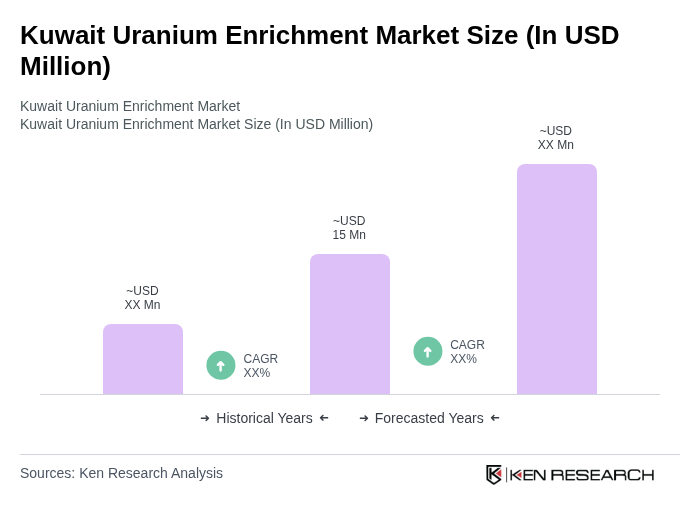
- The Kuwait Uranium Enrichment Market is valued at USD 15 million, based on a five-year historical analysis. This growth is primarily driven by the increasing demand for nuclear energy as a sustainable power source, coupled with Kuwait's strategic initiatives to diversify its energy portfolio amid rising global investments in nuclear fuel cycle infrastructure. The government's focus on developing nuclear capabilities to meet future energy needs has significantly contributed to the market's expansion.
- Key players in this market include Kuwait Atomic Energy Commission, Kuwait Institute for Scientific Research, and several international firms. Kuwait's geographical location and its investment in nuclear technology make it a focal point for uranium enrichment activities in the region, enhancing its competitive edge in the market.
- The Executive Regulations of Law No. 1 of 2014 on Regulating Nuclear and Radiological Activities, issued by the Kuwait Public Authority for Housing Welfare in 2015, establish a regulatory framework ensuring the safe and secure use of nuclear energy. This framework mandates licensing for nuclear facilities, adherence to IAEA safety standards, radiation protection thresholds below 1 mSv annual effective dose for the public, and comprehensive environmental impact assessments, which are essential for the development of nuclear facilities and the enrichment of uranium, thereby fostering a responsible approach to nuclear energy utilization.
Kuwait Uranium Enrichment Market Segmentation
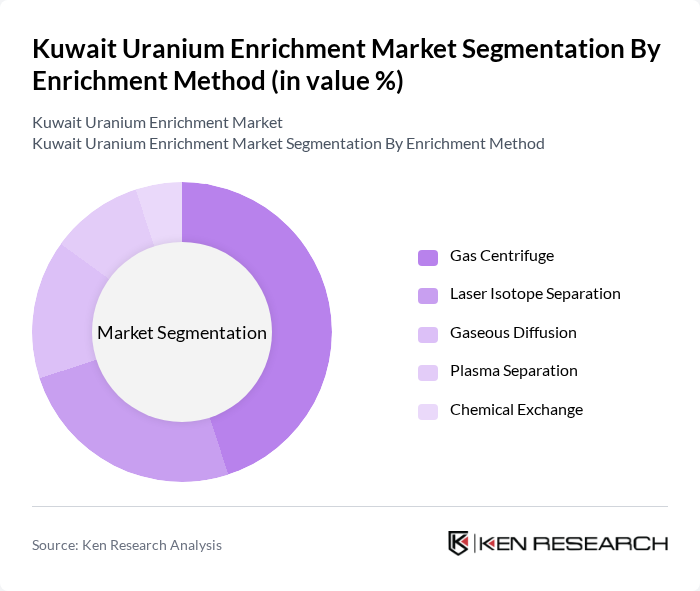
By Enrichment Method:The enrichment methods utilized in the uranium enrichment market include various advanced technologies. Gas centrifuge technology is widely adopted due to its efficiency and lower operational costs. Laser isotope separation is gaining traction for its precision, while gaseous diffusion remains a traditional method. Plasma separation and chemical exchange are also employed, albeit to a lesser extent, due to their complexity and cost implications.
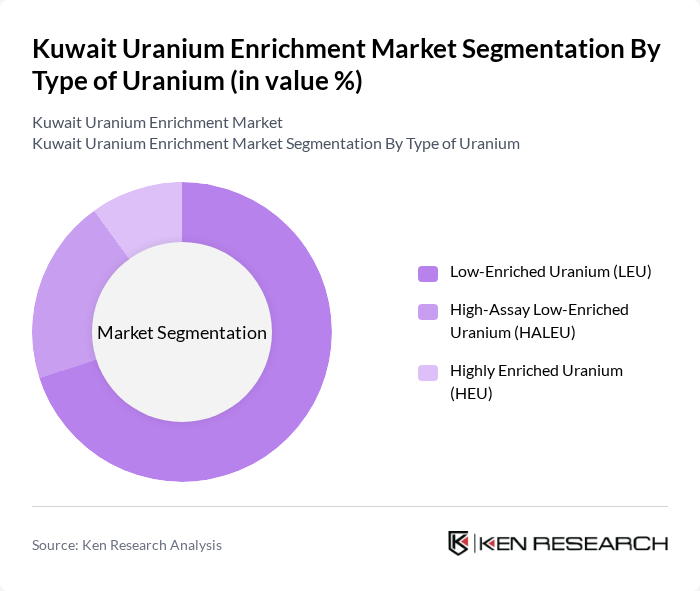
By Type of Uranium:The uranium enrichment market is segmented based on the type of uranium produced. Low-Enriched Uranium (LEU) is the most commonly produced type, primarily used in nuclear reactors. High-Assay Low-Enriched Uranium (HALEU) is emerging due to its potential for advanced reactor designs including small modular reactors, while Highly Enriched Uranium (HEU) is utilized in specific applications such as research reactors and military purposes.
Kuwait Uranium Enrichment Market Competitive Landscape
The Kuwait Uranium Enrichment Market is characterized by a dynamic mix of regional and international players. Leading participants such as Urenco Limited, Centrus Energy Corp, Orano (formerly AREVA), Kazatomprom, Global Laser Enrichment (GLE), Rosatom State Atomic Energy Corporation, China National Nuclear Corporation (CNNC), TerraPower LLC, X-Energy Ventures, NuScale Power Corporation, Terrestrial Energy, BWX Technologies Inc, Korea Hydro & Nuclear Power, Kuwait Institute for Scientific Research, Kuwait Atomic Energy Commission contribute to innovation, geographic expansion, and service delivery in this space.
Kuwait Uranium Enrichment Market Industry Analysis
Growth Drivers
- Increasing Energy Demand:Kuwait's energy consumption is projected to reach 22,000 GWh in the future, driven by population growth and industrial expansion. The country's reliance on fossil fuels has prompted a shift towards nuclear energy, with the government aiming to generate 20% of its electricity from nuclear sources in the future. This transition is essential for meeting the rising energy needs while ensuring energy security and sustainability, thus creating a favorable environment for uranium enrichment initiatives.
- Government Investment in Nuclear Technology:The Kuwaiti government has allocated approximately USD 3 billion for nuclear energy development, including uranium enrichment projects. This investment is part of a broader strategy to diversify energy sources and reduce dependence on oil. The establishment of the Kuwait Institute for Scientific Research (KISR) further supports this initiative, fostering research and development in nuclear technology, which is crucial for enhancing the country's energy infrastructure and capabilities.
- Strategic Geopolitical Positioning:Kuwait's geographical location in the Gulf region positions it as a strategic player in the energy sector. With neighboring countries like Iran and Saudi Arabia investing heavily in nuclear technology, Kuwait aims to enhance its energy security and geopolitical influence. The country’s commitment to developing a nuclear program aligns with regional trends, potentially attracting international partnerships and investments that can bolster its uranium enrichment capabilities and overall energy strategy.
Market Challenges
- Regulatory Compliance Complexity:Navigating the regulatory landscape for nuclear energy in Kuwait presents significant challenges. The country must adhere to stringent international standards set by the International Atomic Energy Agency (IAEA) and local regulations, which can complicate project timelines and increase costs. Compliance with these regulations requires substantial resources and expertise, potentially hindering the swift development of uranium enrichment facilities and delaying the realization of energy goals.
- Public Perception and Environmental Concerns:Public apprehension regarding nuclear energy remains a significant challenge in Kuwait. Concerns about safety, environmental impact, and potential disasters can lead to opposition against nuclear projects. According to a recent survey, 65% of the population expressed concerns about nuclear safety. Addressing these perceptions through transparent communication and robust safety measures is essential for gaining public support and ensuring the successful implementation of uranium enrichment initiatives.
Kuwait Uranium Enrichment Market Future Outlook
The future of the Kuwait uranium enrichment market appears promising, driven by increasing energy demands and government initiatives to diversify energy sources. As Kuwait invests in nuclear technology, advancements in enrichment processes are expected to enhance efficiency and safety. Furthermore, international collaborations may facilitate knowledge transfer and technology sharing, positioning Kuwait as a regional leader in nuclear energy. The focus on sustainable energy solutions will likely shape the market landscape, fostering innovation and growth in the sector.
Market Opportunities
- International Collaboration and Partnerships:Engaging in partnerships with established nuclear nations can provide Kuwait access to advanced technologies and expertise. Collaborations with countries like France and the USA can enhance Kuwait's uranium enrichment capabilities, ensuring compliance with international standards while fostering knowledge exchange that can accelerate project timelines and improve operational efficiency.
- Diversification of Energy Sources:Kuwait's commitment to diversifying its energy portfolio presents significant opportunities for uranium enrichment. By integrating nuclear energy into its energy mix, Kuwait can reduce its reliance on fossil fuels, enhance energy security, and contribute to global sustainability efforts. This diversification strategy can attract investments and foster innovation in the energy sector, positioning Kuwait as a key player in the regional energy landscape.
Scope of the Report
| Segment | Sub-Segments |
|---|---|
| By Enrichment Method | Gas Centrifuge Laser Isotope Separation Gaseous Diffusion Plasma Separation Chemical Exchange |
| By Type of Uranium | Low-Enriched Uranium (LEU) High-Assay Low-Enriched Uranium (HALEU) Highly Enriched Uranium (HEU) |
| By Application | Nuclear Power Generation Small Modular Reactors (SMRs) Research Reactors Medical Isotope Production Naval Propulsion |
| By End-User | Utilities & Nuclear Power Plants Government & Defense Fuel Fabricators Research Institutions Private SMR Developers |
| By Supplier Type | Government-Owned Entities Private Companies |
| By Investment Source | Government Funding Private Investments International Partnerships |
| By Market Maturity | Emerging Growth Mature |
Key Target Audience
Investors and Venture Capitalist Firms
Government and Regulatory Bodies (e.g., Kuwait Nuclear Regulatory Authority)
Uranium Mining Companies
Energy Sector Stakeholders
International Atomic Energy Agency (IAEA)
Environmental Protection Agencies
Energy Policy Makers
Utility Companies and Power Generators
Players Mentioned in the Report:
Urenco Limited
Centrus Energy Corp
Orano (formerly AREVA)
Kazatomprom
Global Laser Enrichment (GLE)
Rosatom State Atomic Energy Corporation
China National Nuclear Corporation (CNNC)
TerraPower LLC
X-Energy Ventures
NuScale Power Corporation
Terrestrial Energy
BWX Technologies Inc
Korea Hydro & Nuclear Power
Kuwait Institute for Scientific Research
Kuwait Atomic Energy Commission
Table of Contents
Market Assessment Phase
1. Executive Summary and Approach
2. Kuwait Uranium Enrichment Market Overview
2.1 Key Insights and Strategic Recommendations
2.2 Kuwait Uranium Enrichment Market Overview
2.3 Definition and Scope
2.4 Evolution of Market Ecosystem
2.5 Timeline of Key Regulatory Milestones
2.6 Value Chain & Stakeholder Mapping
2.7 Business Cycle Analysis
2.8 Policy & Incentive Landscape
3. Kuwait Uranium Enrichment Market Analysis
3.1 Growth Drivers
3.1.1 Increasing Energy Demand
3.1.2 Government Investment in Nuclear Technology
3.1.3 Strategic Geopolitical Positioning
3.1.4 Technological Advancements in Enrichment Processes
3.2 Market Challenges
3.2.1 Regulatory Compliance Complexity
3.2.2 High Initial Capital Investment
3.2.3 Public Perception and Environmental Concerns
3.2.4 Geopolitical Risks and Stability Issues
3.3 Market Opportunities
3.3.1 International Collaboration and Partnerships
3.3.2 Development of Advanced Enrichment Technologies
3.3.3 Expansion into Regional Markets
3.3.4 Diversification of Energy Sources
3.4 Market Trends
3.4.1 Shift Towards Sustainable Energy Solutions
3.4.2 Increased Focus on Nuclear Safety Standards
3.4.3 Growth of Private Sector Participation
3.4.4 Integration of Digital Technologies in Operations
3.5 Government Regulation
3.5.1 Nuclear Regulatory Authority Guidelines
3.5.2 Environmental Protection Regulations
3.5.3 International Atomic Energy Agency Compliance
3.5.4 Local Content Requirements
4. SWOT Analysis
5. Stakeholder Analysis
6. Porter's Five Forces Analysis
7. Kuwait Uranium Enrichment Market Market Size, 2019-2024
7.1 By Value
7.2 By Volume
7.3 By Average Selling Price
8. Kuwait Uranium Enrichment Market Segmentation
8.1 By Enrichment Method
8.1.1 Gas Centrifuge
8.1.2 Laser Isotope Separation
8.1.3 Gaseous Diffusion
8.1.4 Plasma Separation
8.1.5 Chemical Exchange
8.2 By Type of Uranium
8.2.1 Low-Enriched Uranium (LEU)
8.2.2 High-Assay Low-Enriched Uranium (HALEU)
8.2.3 Highly Enriched Uranium (HEU)
8.3 By Application
8.3.1 Nuclear Power Generation
8.3.2 Small Modular Reactors (SMRs)
8.3.3 Research Reactors
8.3.4 Medical Isotope Production
8.3.5 Naval Propulsion
8.4 By End-User
8.4.1 Utilities & Nuclear Power Plants
8.4.2 Government & Defense
8.4.3 Fuel Fabricators
8.4.4 Research Institutions
8.4.5 Private SMR Developers
8.5 By Supplier Type
8.5.1 Government-Owned Entities
8.5.2 Private Companies
8.6 By Investment Source
8.6.1 Government Funding
8.6.2 Private Investments
8.6.3 International Partnerships
8.7 By Market Maturity
8.7.1 Emerging
8.7.2 Growth
8.7.3 Mature
9. Kuwait Uranium Enrichment Market Competitive Analysis
9.1 Market Share of Key Players
9.2 Cross Comparison of Key Players
9.2.1 Company Name
9.2.2 Group Size (Large, Medium, or Small as per industry convention)
9.2.3 Revenue Growth Rate (%)
9.2.4 Market Penetration Rate (%)
9.2.5 Customer Retention Rate (%)
9.2.6 Pricing Strategy (Premium/Mid-Market/Cost Leadership)
9.2.7 Operational Efficiency (Cost per Unit/Capacity Utilization %)
9.2.8 Innovation Rate (R&D Investment as % of Revenue)
9.2.9 Market Share Percentage (%)
9.2.10 Customer Satisfaction Index (NPS/CSAT Score)
9.3 SWOT Analysis of Top Players
9.4 Pricing Analysis
9.5 Detailed Profile of Major Companies
9.5.1 Urenco Limited
9.5.2 Centrus Energy Corp
9.5.3 Orano (formerly AREVA)
9.5.4 Kazatomprom
9.5.5 Global Laser Enrichment (GLE)
9.5.6 Rosatom State Atomic Energy Corporation
9.5.7 China National Nuclear Corporation (CNNC)
9.5.8 TerraPower LLC
9.5.9 X-Energy Ventures
9.5.10 NuScale Power Corporation
9.5.11 Terrestrial Energy
9.5.12 BWX Technologies Inc
9.5.13 Korea Hydro & Nuclear Power
9.5.14 Kuwait Institute for Scientific Research
9.5.15 Kuwait Atomic Energy Commission
10. Kuwait Uranium Enrichment Market End-User Analysis
10.1 Procurement Behavior of Key Ministries
10.1.1 Ministry of Electricity and Water
10.1.2 Ministry of Oil
10.1.3 Ministry of Defense
10.1.4 Ministry of Health
10.2 Corporate Spend on Infrastructure & Energy
10.2.1 Energy Sector Investments
10.2.2 Infrastructure Development Budgets
10.2.3 Research and Development Funding
10.2.4 Others
10.3 Pain Point Analysis by End-User Category
10.3.1 Power Generation Sector
10.3.2 Research Institutions
10.3.3 Defense Sector
10.3.4 Others
10.4 User Readiness for Adoption
10.4.1 Awareness Levels
10.4.2 Training and Skill Development
10.4.3 Infrastructure Readiness
10.4.4 Others
10.5 Post-Deployment ROI and Use Case Expansion
10.5.1 Performance Metrics
10.5.2 Cost-Benefit Analysis
10.5.3 Scalability Potential
10.5.4 Others
11. Kuwait Uranium Enrichment Market Future Size, 2025-2030
11.1 By Value
11.2 By Volume
11.3 By Average Selling Price
Go-To-Market Strategy Phase
1. Whitespace Analysis + Business Model Canvas
1.1 Market Gaps Identification
1.2 Business Model Development
2. Marketing and Positioning Recommendations
2.1 Branding Strategies
2.2 Product USPs
3. Distribution Plan
3.1 Urban Retail Strategies
3.2 Rural NGO Tie-ups
4. Channel & Pricing Gaps
4.1 Underserved Routes
4.2 Pricing Bands
5. Unmet Demand & Latent Needs
5.1 Category Gaps
5.2 Consumer Segments
6. Customer Relationship
6.1 Loyalty Programs
6.2 After-sales Service
7. Value Proposition
7.1 Sustainability Initiatives
7.2 Integrated Supply Chains
8. Key Activities
8.1 Regulatory Compliance
8.2 Branding Efforts
8.3 Distribution Setup
9. Entry Strategy Evaluation
9.1 Domestic Market Entry Strategy
9.1.1 Product Mix
9.1.2 Pricing Band
9.1.3 Packaging
9.2 Export Entry Strategy
9.2.1 Target Countries
9.2.2 Compliance Roadmap
10. Entry Mode Assessment
10.1 Joint Ventures
10.2 Greenfield Investments
10.3 Mergers & Acquisitions
10.4 Distributor Model
11. Capital and Timeline Estimation
11.1 Capital Requirements
11.2 Timelines
12. Control vs Risk Trade-Off
12.1 Ownership vs Partnerships
13. Profitability Outlook
13.1 Breakeven Analysis
13.2 Long-term Sustainability
14. Potential Partner List
14.1 Distributors
14.2 Joint Ventures
14.3 Acquisition Targets
15. Execution Roadmap
15.1 Phased Plan for Market Entry
15.1.1 Market Setup
15.1.2 Market Entry
15.1.3 Growth Acceleration
15.1.4 Scale & Stabilize
15.2 Key Activities and Milestones
15.2.1 Milestone Planning
15.2.2 Activity Tracking
Research Methodology
Phase 1: Approach1
Desk Research
- Analysis of government publications and reports on nuclear energy policies in Kuwait
- Review of international uranium market trends and pricing from industry journals
- Examination of academic papers and case studies on uranium enrichment technologies
Primary Research
- Interviews with key stakeholders in the Kuwaiti energy sector, including government officials
- Surveys with industry experts and consultants specializing in nuclear energy
- Field interviews with engineers and scientists involved in uranium enrichment projects
Validation & Triangulation
- Cross-validation of findings through multiple data sources, including trade publications and regulatory documents
- Triangulation of insights from expert interviews with market data and trends
- Sanity checks through peer reviews and expert panel discussions
Phase 2: Market Size Estimation1
Top-down Assessment
- Estimation of the total addressable market for uranium enrichment based on national energy consumption forecasts
- Segmentation of the market by potential end-users, including power generation and research institutions
- Incorporation of regional geopolitical factors influencing uranium supply and demand
Bottom-up Modeling
- Collection of operational data from existing uranium enrichment facilities in the region
- Cost analysis based on technology adoption and operational efficiency metrics
- Volume estimates derived from projected energy needs and enrichment capacity requirements
Forecasting & Scenario Analysis
- Multi-factor regression analysis incorporating energy policy changes and global uranium prices
- Scenario modeling based on varying levels of investment in nuclear technology and regulatory frameworks
- Development of baseline, optimistic, and pessimistic market forecasts through 2030
Phase 3: CATI Sample Composition1
| Scope Item/Segment | Sample Size | Target Respondent Profiles |
|---|---|---|
| Government Energy Policy Makers | 100 | Energy Ministers, Regulatory Officials |
| Nuclear Energy Consultants | 80 | Industry Analysts, Technical Advisors |
| Uranium Enrichment Facility Operators | 60 | Plant Managers, Operations Supervisors |
| Academic Researchers in Nuclear Science | 50 | Professors, Research Scientists |
| Energy Sector Investors | 70 | Venture Capitalists, Private Equity Analysts |
Frequently Asked Questions
What is the current value of the Kuwait Uranium Enrichment Market?
The Kuwait Uranium Enrichment Market is valued at approximately USD 15 million, reflecting a five-year historical analysis. This growth is driven by increasing demand for nuclear energy and Kuwait's strategic initiatives to diversify its energy portfolio.
What are the key drivers of growth in the Kuwait Uranium Enrichment Market?
Who are the major players in the Kuwait Uranium Enrichment Market?
What regulatory framework governs uranium enrichment in Kuwait?
Other Regional/Country Reports
Other Adjacent Reports
Germany Nuclear Energy Market
KSA Uranium Mining Market
Brazil Nuclear Fuel Market
Mexico Nuclear Reactor Market
Qatar Radiation Protection Market
Brazil Nuclear Waste Management Market
Singapore Isotope Separation Market
Vietnam Nuclear Technology Market
Brazil Energy Diversification Market
Europe Power Generation Market Outlook to 2030: Size, Share, Growth and TrendsWhy Buy From Us?

What makes us stand out is that our consultants follow Robust, Refine and Result (RRR) methodology. Robust for clear definitions, approaches and sanity checking, Refine for differentiating respondents' facts and opinions, and Result for presenting data with story.

We have set a benchmark in the industry by offering our clients with syndicated and customized market research reports featuring coverage of entire market as well as meticulous research and analyst insights.

While we don't replace traditional research, we flip the method upside down. Our dual approach of Top Bottom & Bottom Top ensures quality deliverable by not just verifying company fundamentals but also looking at the sector and macroeconomic factors.

With one step in the future, our research team constantly tries to show you the bigger picture. We help with some of the tough questions you may encounter along the way: How is the industry positioned? Best marketing channel? KPI's of competitors? By aligning every element, we help maximize success.

Our report gives you instant access to the answers and sources that other companies might choose to hide. We elaborate each steps of research methodology we have used and showcase you the sample size to earn your trust.

If you need any support, we are here! We pride ourselves on universe strength, data quality, and quick, friendly, and professional service.