About the Report
Base Year 2024Listen to the audio summary
Kuwait Vaccine Adjuvants Market Overview
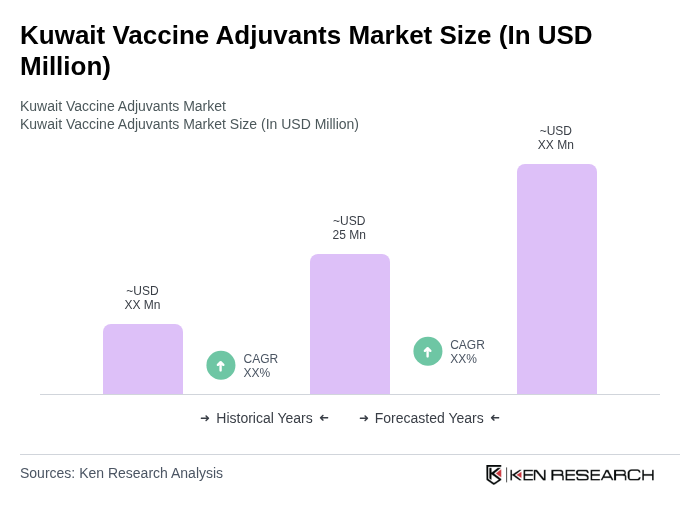
- The Kuwait Vaccine Adjuvants Market is valued at USD 25 million, based on a five-year historical analysis. This growth is primarily driven by the increasing demand for effective vaccines, particularly in response to emerging infectious diseases and ongoing global health challenges. Recent trends include heightened investment in next-generation adjuvants, expansion of immunization programs, and collaborations with international organizations to improve vaccine coverage and efficacy. The rising awareness of vaccine efficacy and safety has led to a surge in research and development activities, further propelling the market.
- Kuwait, particularly its capital city, Kuwait City, continues to dominate the vaccine adjuvants market due to its advanced healthcare infrastructure and significant investments in biotechnology and pharmaceuticals. The presence of leading pharmaceutical companies and research institutions in the region fosters innovation and collaboration, making it a hub for vaccine development and distribution. Strategic partnerships with global organizations such as Gavi and WHO have further enhanced Kuwait’s position in vaccine innovation and access.
- In 2023, the Kuwaiti government enacted Ministerial Resolution No. 73/2023 issued by the Ministry of Health, mandating the inclusion of approved adjuvants in all vaccine formulations distributed within the country. This regulation requires manufacturers to comply with international standards for immunogenicity and safety, submit detailed documentation of adjuvant composition, and undergo periodic review for continued market authorization. The regulation aims to improve public health outcomes and ensure that vaccines meet international standards for efficacy and safety, thereby increasing the demand for various adjuvants in the market.
Kuwait Vaccine Adjuvants Market Segmentation
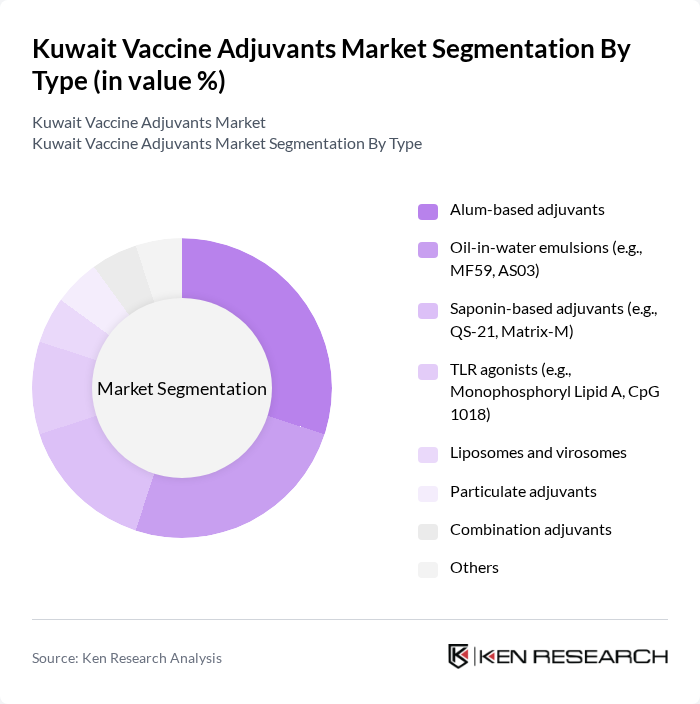
By Type:The market is segmented into various types of adjuvants, including Alum-based adjuvants, Oil-in-water emulsions, Saponin-based adjuvants, TLR agonists, Liposomes and virosomes, Particulate adjuvants, Combination adjuvants, and Others. Each type plays a distinct role in enhancing vaccine efficacy and safety. Alum-based adjuvants remain the most widely used due to their established safety profile and cost-effectiveness, while oil-in-water emulsions and saponin-based adjuvants are increasingly adopted for newer vaccines targeting complex pathogens. TLR agonists and liposomal formulations are gaining traction in advanced immunization programs, reflecting ongoing innovation in adjuvant technology.
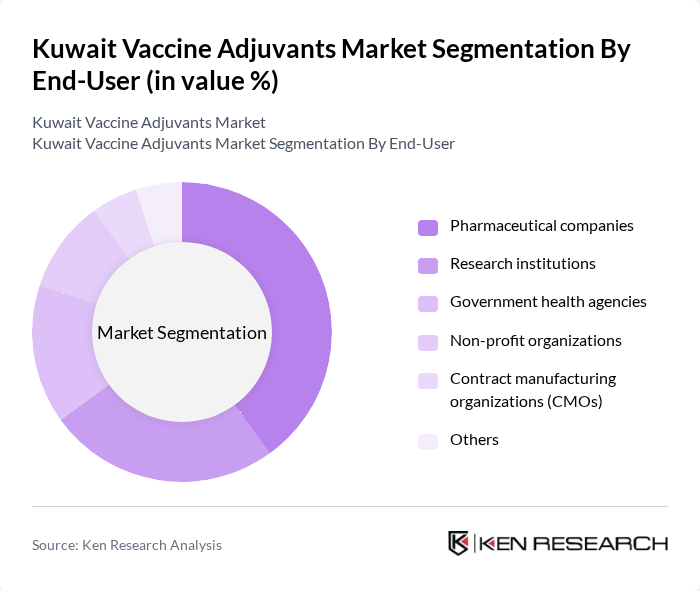
By End-User:The end-user segmentation includes Pharmaceutical companies, Research institutions, Government health agencies, Non-profit organizations, Contract manufacturing organizations (CMOs), and Others. Pharmaceutical companies are the largest segment, reflecting their central role in vaccine development, production, and distribution. Research institutions and government agencies are critical for clinical trials, regulatory oversight, and public health initiatives, while CMOs and non-profit organizations support manufacturing scale-up and outreach for immunization programs.
Kuwait Vaccine Adjuvants Market Competitive Landscape
The Kuwait Vaccine Adjuvants Market is characterized by a dynamic mix of regional and international players. Leading participants such as GSK (GlaxoSmithKline plc), Merck & Co., Inc., Sanofi Pasteur, Pfizer Inc., Novartis AG, AstraZeneca plc, Seqirus (a CSL company), Emergent BioSolutions Inc., Valneva SE, Vaxart, Inc., Inovio Pharmaceuticals, Inc., MedImmune (AstraZeneca subsidiary), Bharat Biotech International Ltd., Serum Institute of India Pvt. Ltd., Zydus Lifesciences Limited (formerly Zydus Cadila) contribute to innovation, geographic expansion, and service delivery in this space.
Kuwait Vaccine Adjuvants Market Industry Analysis
Growth Drivers
- Increasing Vaccine Development Initiatives:The Kuwaiti government has allocated approximately $50 million for vaccine development initiatives, reflecting a commitment to enhancing public health. This funding supports research and development activities, fostering innovation in vaccine adjuvants. The Ministry of Health aims to increase the number of vaccines developed locally, addressing both infectious diseases and emerging health threats, thereby driving demand for advanced adjuvant technologies.
- Rising Prevalence of Infectious Diseases:Kuwait has reported a 15% increase in infectious disease cases over the past year, with respiratory infections and viral diseases being the most prevalent. This surge necessitates the development of effective vaccines, which rely on adjuvants to enhance immune responses. The growing burden of infectious diseases is prompting healthcare authorities to prioritize vaccine research, thereby stimulating the demand for innovative adjuvant solutions in the market.
- Government Funding for Vaccine Research:The Kuwaiti government is expected to increase its funding for vaccine research by 20%, reaching a total of $60 million. This financial support is aimed at fostering collaborations between public institutions and private biotech firms, enhancing the development of novel adjuvants. Such investments are crucial for accelerating the research pipeline and ensuring that Kuwait remains at the forefront of vaccine innovation, ultimately benefiting public health.
Market Challenges
- Stringent Regulatory Requirements:The regulatory landscape for vaccine adjuvants in Kuwait is characterized by rigorous compliance standards, which can delay product approvals. The Kuwait Food and Drug Administration (KFDA) mandates extensive clinical trials and safety evaluations, often extending timelines by 12-18 months. These stringent requirements can deter smaller firms from entering the market, limiting innovation and competition in the vaccine adjuvant sector.
- High Development Costs:The average cost of developing a new vaccine adjuvant in Kuwait is estimated at $30 million, encompassing research, clinical trials, and regulatory compliance. These high costs pose significant barriers for emerging biotech companies, which may lack the necessary capital. Consequently, this financial burden can stifle innovation and limit the number of new adjuvants entering the market, ultimately affecting the availability of diverse vaccine options.
Kuwait Vaccine Adjuvants Market Future Outlook
The future of the Kuwait vaccine adjuvants market appears promising, driven by increasing investments in healthcare and a growing emphasis on public health initiatives. As the government continues to prioritize vaccine development, collaborations between public and private sectors are expected to flourish. Additionally, advancements in biotechnology will likely lead to the emergence of novel adjuvants, enhancing vaccine efficacy. This evolving landscape will create a conducive environment for innovation and growth in the vaccine adjuvant sector.
Market Opportunities
- Expansion of Vaccine Manufacturing Facilities:Kuwait's government plans to invest $40 million in expanding local vaccine manufacturing facilities. This initiative aims to enhance self-sufficiency in vaccine production, creating opportunities for local adjuvant manufacturers to supply their products. Increased production capacity will facilitate faster vaccine development and distribution, ultimately benefiting public health.
- Collaborations with Biotech Firms:The Kuwaiti government is actively seeking partnerships with biotech firms, with an estimated $25 million allocated for collaborative research projects. These collaborations will focus on developing innovative adjuvants tailored to specific health challenges, fostering a dynamic ecosystem for vaccine research. Such partnerships are expected to enhance the capabilities of local firms and drive advancements in vaccine technology.
Scope of the Report
| Segment | Sub-Segments |
|---|---|
| By Type | Alum-based adjuvants Oil-in-water emulsions (e.g., MF59, AS03) Saponin-based adjuvants (e.g., QS-21, Matrix-M) TLR agonists (e.g., Monophosphoryl Lipid A, CpG 1018) Liposomes and virosomes Particulate adjuvants Combination adjuvants Others |
| By End-User | Pharmaceutical companies Research institutions Government health agencies Non-profit organizations Contract manufacturing organizations (CMOs) Others |
| By Application | Infectious disease vaccines Cancer vaccines Therapeutic vaccines Prophylactic vaccines Veterinary vaccines Others |
| By Route of Administration | Intramuscular Subcutaneous Intradermal Oral Intranasal Others |
| By Distribution Channel | Direct sales Distributors Online sales Retail pharmacies Hospital pharmacies Others |
| By Region | Central Kuwait Southern Kuwait Northern Kuwait Eastern Kuwait Western Kuwait Others |
| By Research and Development Stage | Preclinical Clinical trials Market-ready Post-market surveillance Others |
Key Target Audience
Investors and Venture Capitalist Firms
Government and Regulatory Bodies (e.g., Kuwait Ministry of Health)
Pharmaceutical Manufacturers
Biotechnology Companies
Healthcare Providers and Hospitals
Public Health Organizations (e.g., Kuwait Institute for Scientific Research)
Contract Research Organizations (CROs)
Supply Chain and Logistics Companies
Players Mentioned in the Report:
GSK (GlaxoSmithKline plc)
Merck & Co., Inc.
Sanofi Pasteur
Pfizer Inc.
Novartis AG
AstraZeneca plc
Seqirus (a CSL company)
Emergent BioSolutions Inc.
Valneva SE
Vaxart, Inc.
Inovio Pharmaceuticals, Inc.
MedImmune (AstraZeneca subsidiary)
Bharat Biotech International Ltd.
Serum Institute of India Pvt. Ltd.
Zydus Lifesciences Limited (formerly Zydus Cadila)
Table of Contents
Market Assessment Phase
1. Executive Summary and Approach
2. Kuwait Vaccine Adjuvants Market Overview
2.1 Key Insights and Strategic Recommendations
2.2 Kuwait Vaccine Adjuvants Market Overview
2.3 Definition and Scope
2.4 Evolution of Market Ecosystem
2.5 Timeline of Key Regulatory Milestones
2.6 Value Chain & Stakeholder Mapping
2.7 Business Cycle Analysis
2.8 Policy & Incentive Landscape
3. Kuwait Vaccine Adjuvants Market Analysis
3.1 Growth Drivers
3.1.1 Increasing vaccine development initiatives
3.1.2 Rising prevalence of infectious diseases
3.1.3 Government funding for vaccine research
3.1.4 Technological advancements in adjuvant formulations
3.2 Market Challenges
3.2.1 Stringent regulatory requirements
3.2.2 High development costs
3.2.3 Limited awareness among healthcare providers
3.2.4 Competition from alternative therapies
3.3 Market Opportunities
3.3.1 Expansion of vaccine manufacturing facilities
3.3.2 Collaborations with biotech firms
3.3.3 Growing demand for personalized vaccines
3.3.4 Increasing focus on global health initiatives
3.4 Market Trends
3.4.1 Shift towards adjuvants with improved safety profiles
3.4.2 Rise in combination vaccines
3.4.3 Adoption of novel delivery systems
3.4.4 Increased investment in R&D for adjuvants
3.5 Government Regulation
3.5.1 Compliance with WHO guidelines
3.5.2 National vaccine policies
3.5.3 Approval processes for new adjuvants
3.5.4 Monitoring and evaluation frameworks
4. SWOT Analysis
5. Stakeholder Analysis
6. Porter's Five Forces Analysis
7. Kuwait Vaccine Adjuvants Market Market Size, 2019-2024
7.1 By Value
7.2 By Volume
7.3 By Average Selling Price
8. Kuwait Vaccine Adjuvants Market Segmentation
8.1 By Type
8.1.1 Alum-based adjuvants
8.1.2 Oil-in-water emulsions (e.g., MF59, AS03)
8.1.3 Saponin-based adjuvants (e.g., QS-21, Matrix-M)
8.1.4 TLR agonists (e.g., Monophosphoryl Lipid A, CpG 1018)
8.1.5 Liposomes and virosomes
8.1.6 Particulate adjuvants
8.1.7 Combination adjuvants
8.1.8 Others
8.2 By End-User
8.2.1 Pharmaceutical companies
8.2.2 Research institutions
8.2.3 Government health agencies
8.2.4 Non-profit organizations
8.2.5 Contract manufacturing organizations (CMOs)
8.2.6 Others
8.3 By Application
8.3.1 Infectious disease vaccines
8.3.2 Cancer vaccines
8.3.3 Therapeutic vaccines
8.3.4 Prophylactic vaccines
8.3.5 Veterinary vaccines
8.3.6 Others
8.4 By Route of Administration
8.4.1 Intramuscular
8.4.2 Subcutaneous
8.4.3 Intradermal
8.4.4 Oral
8.4.5 Intranasal
8.4.6 Others
8.5 By Distribution Channel
8.5.1 Direct sales
8.5.2 Distributors
8.5.3 Online sales
8.5.4 Retail pharmacies
8.5.5 Hospital pharmacies
8.5.6 Others
8.6 By Region
8.6.1 Central Kuwait
8.6.2 Southern Kuwait
8.6.3 Northern Kuwait
8.6.4 Eastern Kuwait
8.6.5 Western Kuwait
8.6.6 Others
8.7 By Research and Development Stage
8.7.1 Preclinical
8.7.2 Clinical trials
8.7.3 Market-ready
8.7.4 Post-market surveillance
8.7.5 Others
9. Kuwait Vaccine Adjuvants Market Competitive Analysis
9.1 Market Share of Key Players
9.2 Cross Comparison of Key Players
9.2.1 Company Name
9.2.2 Group Size (Large, Medium, or Small as per industry convention)
9.2.3 Revenue Growth Rate (Kuwait and regional)
9.2.4 Market Penetration Rate (share of adjuvant-containing vaccines in Kuwait)
9.2.5 Number of Registered Adjuvant Products in Kuwait
9.2.6 R&D Investment as % of Revenue
9.2.7 Regulatory Approval Success Rate (Kuwait and GCC)
9.2.8 Local Distribution Network Strength
9.2.9 Strategic Partnerships/Collaborations in Kuwait
9.2.10 Product Portfolio Breadth (adjuvant types/applications)
9.2.11 Pricing Strategy
9.2.12 Product Development Cycle Time
9.2.13 Distribution Efficiency
9.2.14 Brand Recognition Score
9.2.15 Regulatory Compliance Rate
9.3 SWOT Analysis of Top Players
9.4 Pricing Analysis
9.5 Detailed Profile of Major Companies
9.5.1 GSK (GlaxoSmithKline plc)
9.5.2 Merck & Co., Inc.
9.5.3 Sanofi Pasteur
9.5.4 Pfizer Inc.
9.5.5 Novartis AG
9.5.6 AstraZeneca plc
9.5.7 Seqirus (a CSL company)
9.5.8 Emergent BioSolutions Inc.
9.5.9 Valneva SE
9.5.10 Vaxart, Inc.
9.5.11 Inovio Pharmaceuticals, Inc.
9.5.12 MedImmune (AstraZeneca subsidiary)
9.5.13 Bharat Biotech International Ltd.
9.5.14 Serum Institute of India Pvt. Ltd.
9.5.15 Zydus Lifesciences Limited (formerly Zydus Cadila)
10. Kuwait Vaccine Adjuvants Market End-User Analysis
10.1 Procurement Behavior of Key Ministries
10.1.1 Ministry of Health
10.1.2 Ministry of Education
10.1.3 Ministry of Defense
10.1.4 Ministry of Interior
10.1.5 Others
10.2 Corporate Spend on Infrastructure & Energy
10.2.1 Investment in healthcare infrastructure
10.2.2 Funding for vaccine research
10.2.3 Budget allocation for public health
10.2.4 Partnerships with private sector
10.2.5 Others
10.3 Pain Point Analysis by End-User Category
10.3.1 Healthcare providers
10.3.2 Government agencies
10.3.3 Non-profit organizations
10.3.4 Pharmaceutical companies
10.3.5 Others
10.4 User Readiness for Adoption
10.4.1 Awareness of vaccine adjuvants
10.4.2 Training and education needs
10.4.3 Infrastructure readiness
10.4.4 Financial readiness
10.4.5 Others
10.5 Post-Deployment ROI and Use Case Expansion
10.5.1 Evaluation of vaccine effectiveness
10.5.2 Cost-benefit analysis
10.5.3 Expansion into new markets
10.5.4 Long-term sustainability assessments
10.5.5 Others
11. Kuwait Vaccine Adjuvants Market Future Size, 2025-2030
11.1 By Value
11.2 By Volume
11.3 By Average Selling Price
Go-To-Market Strategy Phase
1. Whitespace Analysis + Business Model Canvas
1.1 Market gaps identification
1.2 Value proposition development
1.3 Revenue model exploration
1.4 Customer segmentation analysis
1.5 Competitive landscape overview
1.6 Key partnerships identification
1.7 Risk assessment
2. Marketing and Positioning Recommendations
2.1 Branding strategies
2.2 Product USPs
2.3 Target audience definition
2.4 Communication strategy
2.5 Digital marketing approach
2.6 Event marketing plans
2.7 Feedback mechanisms
3. Distribution Plan
3.1 Urban retail vs rural NGO tie-ups
3.2 Direct sales strategies
3.3 Online distribution channels
3.4 Partnerships with distributors
3.5 Logistics and supply chain management
3.6 Inventory management strategies
3.7 Customer service integration
4. Channel & Pricing Gaps
4.1 Underserved routes
4.2 Pricing bands
4.3 Competitor pricing analysis
4.4 Value-based pricing strategies
4.5 Discount and promotion strategies
4.6 Price elasticity considerations
4.7 Customer feedback on pricing
5. Unmet Demand & Latent Needs
5.1 Category gaps
5.2 Consumer segments
5.3 Emerging trends analysis
5.4 Product development opportunities
5.5 Market entry barriers
5.6 Customer pain points
5.7 Future demand forecasting
6. Customer Relationship
6.1 Loyalty programs
6.2 After-sales service
6.3 Customer engagement strategies
6.4 Feedback collection methods
6.5 Relationship management tools
6.6 Community building initiatives
6.7 Customer education programs
7. Value Proposition
7.1 Sustainability
7.2 Integrated supply chains
7.3 Unique selling points
7.4 Customer-centric approach
7.5 Competitive advantages
7.6 Long-term value creation
7.7 Brand loyalty enhancement
8. Key Activities
8.1 Regulatory compliance
8.2 Branding
8.3 Distribution setup
8.4 Market research
8.5 Training and development
8.6 Performance monitoring
8.7 Stakeholder engagement
9. Entry Strategy Evaluation
9.1 Domestic Market Entry Strategy
9.1.1 Product mix
9.1.2 Pricing band
9.1.3 Packaging
9.2 Export Entry Strategy
9.2.1 Target countries
9.2.2 Compliance roadmap
10. Entry Mode Assessment
10.1 Joint Ventures
10.2 Greenfield investments
10.3 Mergers & Acquisitions
10.4 Distributor Model
10.5 Risk assessment
10.6 Market entry timelines
10.7 Resource allocation
11. Capital and Timeline Estimation
11.1 Capital requirements
11.2 Timelines
11.3 Funding sources
11.4 Financial projections
11.5 Budget allocation
11.6 Cost management strategies
11.7 Investment return expectations
12. Control vs Risk Trade-Off
12.1 Ownership vs Partnerships
12.2 Risk management strategies
12.3 Control mechanisms
12.4 Partnership evaluation criteria
12.5 Long-term relationship management
12.6 Exit strategies
12.7 Performance metrics
13. Profitability Outlook
13.1 Breakeven analysis
13.2 Long-term sustainability
13.3 Profit margin analysis
13.4 Revenue forecasting
13.5 Cost structure evaluation<
Research Methodology
Phase 1: Approach1
Desk Research
- Analysis of government health reports and vaccination statistics from the Kuwait Ministry of Health
- Review of scientific literature on vaccine adjuvants published in medical journals and databases
- Examination of market reports and white papers from global health organizations and industry associations
Primary Research
- Interviews with immunologists and vaccine researchers at local universities and research institutions
- Surveys with healthcare professionals involved in vaccine administration and public health policy
- Focus groups with pharmaceutical companies engaged in vaccine development and production
Validation & Triangulation
- Cross-validation of findings through multiple data sources, including academic and industry reports
- Triangulation of qualitative insights from interviews with quantitative data from surveys
- Sanity checks conducted through expert panel reviews comprising industry veterans and academic leaders
Phase 2: Market Size Estimation1
Top-down Assessment
- Estimation of total vaccine market size in Kuwait, segmented by type and application
- Analysis of government healthcare expenditure and its impact on vaccine procurement
- Incorporation of demographic data to assess potential vaccine uptake rates
Bottom-up Modeling
- Collection of sales data from local pharmaceutical distributors and manufacturers
- Estimation of production costs and pricing strategies for vaccine adjuvants
- Volume estimates based on historical sales trends and projected healthcare needs
Forecasting & Scenario Analysis
- Multi-factor regression analysis incorporating population growth, disease prevalence, and vaccination rates
- Scenario modeling based on potential changes in healthcare policy and funding
- Development of baseline, optimistic, and pessimistic forecasts through 2030
Phase 3: CATI Sample Composition1
| Scope Item/Segment | Sample Size | Target Respondent Profiles |
|---|---|---|
| Healthcare Providers | 100 | Doctors, Nurses, Public Health Officials |
| Pharmaceutical Manufacturers | 60 | Product Managers, R&D Directors |
| Regulatory Bodies | 40 | Regulatory Affairs Specialists, Policy Makers |
| Research Institutions | 50 | Researchers, Academics, Lab Managers |
| Public Health Organizations | 45 | Health Program Coordinators, Epidemiologists |
Frequently Asked Questions
What is the current value of the Kuwait Vaccine Adjuvants Market?
The Kuwait Vaccine Adjuvants Market is valued at approximately USD 25 million, reflecting a five-year historical analysis. This growth is driven by the increasing demand for effective vaccines in response to emerging infectious diseases and global health challenges.
What factors are driving the growth of the Kuwait Vaccine Adjuvants Market?
Which types of adjuvants are commonly used in Kuwait?
Who are the major players in the Kuwait Vaccine Adjuvants Market?
Other Regional/Country Reports
Indonesia Vaccine Adjuvants Market
Malaysia Vaccine Adjuvants Market
KSA Vaccine Adjuvants Market
APAC Vaccine Adjuvants Market
SEA Vaccine Adjuvants Market
Vietnam Vaccine Adjuvants Market
Other Adjacent Reports
Qatar Human Vaccines Market
Global Veterinary Vaccines Market Size, Share & Forecast, By Vaccine Technology, Animal Type & Route of Administration, 2026-2031Kuwait Immunotherapy Market
UAE Biopharmaceuticals MarketUAE Pharmaceutical Excipients MarketAsia Pacific Clinical Trials Market Size, Share & Forecast, By Phase, Study Design & Therapeutic Area, 2025-2032Japan Biotechnology Equipment Market
Japan Cold Chain Logistics Market Size, Share & Forecast, By Service Type, Mode of Transport & End-Use Industry, 2025–2032KSA healthcare it market size, share, growth drivers, trends, opportunities & forecast 2025–2030Oman Regulatory Consulting Services Market
Why Buy From Us?

What makes us stand out is that our consultants follow Robust, Refine and Result (RRR) methodology. Robust for clear definitions, approaches and sanity checking, Refine for differentiating respondents' facts and opinions, and Result for presenting data with story.

We have set a benchmark in the industry by offering our clients with syndicated and customized market research reports featuring coverage of entire market as well as meticulous research and analyst insights.

While we don't replace traditional research, we flip the method upside down. Our dual approach of Top Bottom & Bottom Top ensures quality deliverable by not just verifying company fundamentals but also looking at the sector and macroeconomic factors.

With one step in the future, our research team constantly tries to show you the bigger picture. We help with some of the tough questions you may encounter along the way: How is the industry positioned? Best marketing channel? KPI's of competitors? By aligning every element, we help maximize success.

Our report gives you instant access to the answers and sources that other companies might choose to hide. We elaborate each steps of research methodology we have used and showcase you the sample size to earn your trust.

If you need any support, we are here! We pride ourselves on universe strength, data quality, and quick, friendly, and professional service.