About the Report
Base Year 2024Malaysia Anhydrous Hydrogen Fluoride Market Overview
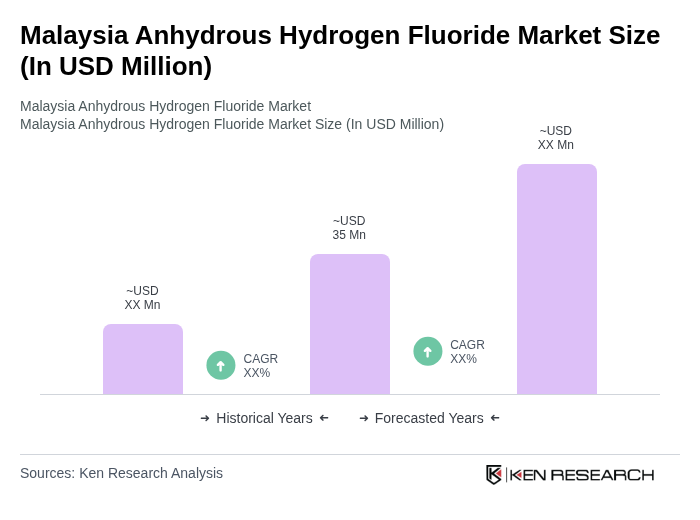
- The Malaysia Anhydrous Hydrogen Fluoride Market is valued at USD 35 million, based on a five-year historical analysis and the country’s share within the Asia Pacific anhydrous hydrogen fluoride market, which generated about USD 1,375.9 million regionally. This growth is primarily driven by the increasing demand for fluorinated compounds in various applications, including electronics, fluorogases and chemical manufacturing, aligned with strong regional demand for fluorogases as the largest application segment. The market is also supported by the rising production of semiconductors and advanced electronics in Malaysia, alongside the expansion of the automotive and HVAC sectors, which utilize anhydrous hydrogen fluoride through its role in refrigerants, metal treatment, and fluoropolymer production.,
- Key demand and distribution hubs for anhydrous hydrogen fluoride in Malaysia include Kuala Lumpur, Penang, and Johor Bahru, which are prominent due to their strategic locations and robust industrial infrastructure., These cities are home to numerous electronics, petrochemical and chemical manufacturing facilities, free industrial zones and research institutions, fostering innovation and facilitating the supply chain for anhydrous hydrogen fluoride-linked products. The presence of major semiconductor, electronics and chemical companies in these regions, particularly in Penang and Johor’s industrial parks, further enhances their importance as core consumption and logistics centers for anhydrous hydrogen fluoride.,
- In 2023, the Malaysian government strengthened regulations to enhance the safety and environmental standards for the handling and storage of hazardous chemicals such as anhydrous hydrogen fluoride through instruments including the Occupational Safety and Health (Classification, Labelling and Safety Data Sheet of Hazardous Chemicals) Regulations 2013 issued by the Department of Occupational Safety and Health (DOSH), and the Environmental Quality (Scheduled Wastes) Regulations 2005 issued by the Department of Environment., These regulations mandate that facilities handling hazardous chemicals must ensure proper classification and labelling, maintain up-to-date safety data sheets, implement strict scheduled-waste management, and provide adequate training and engineering controls, including monitoring and containment systems, to prevent leaks, accidental releases and exposure when dealing with substances such as anhydrous hydrogen fluoride.,
Malaysia Anhydrous Hydrogen Fluoride Market Segmentation
By Purity Grade:
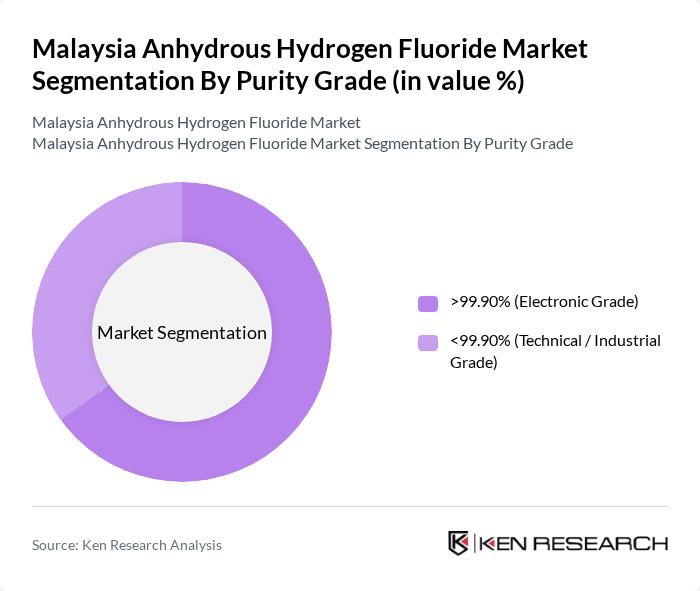
The purity grade segmentation of the market includes two subsegments: >99.90% (Electronic Grade) and <99.90% (Technical / Industrial Grade). The electronic grade, which is highly pure, is primarily used in the semiconductor and flat-panel display industry, where precision, low metal content and particle control are critical., This subsegment is currently significant and growing rapidly in Malaysia due to the increasing demand for high-performance electronic devices, advanced packaging and wafer fabrication within the country’s electrical and electronics cluster. The technical / industrial grade, while also important, is more commonly used in bulk fluorochemical production, metal processing, glass etching and other industrial applications, which are expanding steadily but generally at a more moderate pace compared to high-purity electronic applications in the broader Asia Pacific market.,
By Application:
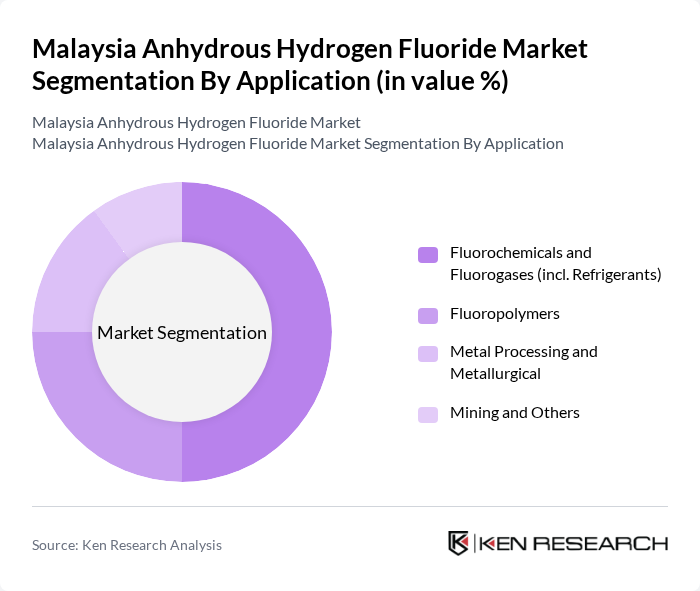
The application segmentation includes four subsegments: Fluorochemicals and Fluorogases (incl. Refrigerants), Fluoropolymers, Metal Processing and Metallurgical, and Mining and Others. The fluorochemicals and fluorogases segment is leading the market, supported by Asia Pacific data showing fluorogases as the largest revenue-generating application for anhydrous hydrogen fluoride, driven by strong demand for refrigerants, blowing agents and other fluorinated gases in cooling, insulation and industrial uses., Fluoropolymers are also gaining traction due to their chemical resistance, dielectric properties and use in wire and cable, coatings and automotive components, reflecting broader regional trends toward high-performance materials. Metal processing and metallurgical applications, including pickling and surface treatment, as well as mining and other downstream uses, remain important niche segments but contribute a comparatively smaller share of value relative to fluorogases and fluoropolymer-related demand.,
Malaysia Anhydrous Hydrogen Fluoride Market Competitive Landscape
The Malaysia Anhydrous Hydrogen Fluoride Market is characterized by a dynamic mix of regional and international players in the broader anhydrous hydrogen fluoride and fluorochemicals value chain. Leading participants such as Solvay S.A., Honeywell International Inc., Daikin Industries, Ltd., The Chemours Company, Air Products and Chemicals, Inc., Kanto Chemical Co., Inc., Merck KGaA, FUJIFILM Corporation, Resonac Holdings Corporation (Showa Denko K.K.), Dongyue Group, Zhejiang Jianye Chemical Co., Ltd., Zhejiang Sanmei Chemical Co., Ltd., Juhua Group Corporation, Linde plc, Air Liquide S.A. contribute to innovation, geographic expansion, and service delivery in this space through their portfolios of hydrogen fluoride, fluorogases, electronic chemicals and specialty materials serving Asia Pacific electronics and chemical manufacturing clusters.,
Malaysia Anhydrous Hydrogen Fluoride Market Industry Analysis
Growth Drivers
- Increasing Demand from the Semiconductor Industry:The semiconductor industry in Malaysia is projected to reach a value of MYR 120 billion in future, driven by the global shift towards advanced electronics. Anhydrous hydrogen fluoride is essential for etching silicon wafers, a critical process in semiconductor manufacturing. As the demand for electronic devices rises, particularly in 5G technology and IoT applications, the need for high-purity anhydrous hydrogen fluoride will significantly increase, supporting market growth.
- Expansion of the Chemical Manufacturing Sector:Malaysia's chemical manufacturing sector is expected to grow at a rate of 5.5% annually, reaching MYR 60 billion in future. This expansion is fueled by increased production capacities and the establishment of new facilities. Anhydrous hydrogen fluoride is a vital component in producing various fluorinated chemicals, which are essential for numerous applications, including agrochemicals and specialty chemicals, thereby driving demand in the market.
- Rising Applications in Refrigerants:The global refrigerant market is anticipated to grow to USD 35 billion in future, with Malaysia playing a significant role in this sector. Anhydrous hydrogen fluoride is a precursor for hydrofluorocarbons (HFCs), which are widely used in refrigeration and air conditioning systems. As Malaysia's climate continues to drive demand for cooling solutions, the need for anhydrous hydrogen fluoride will increase, further propelling market growth.
Market Challenges
- Environmental Regulations and Compliance Costs:The Malaysian government has implemented stringent environmental regulations concerning the production and use of hazardous materials, including anhydrous hydrogen fluoride. Compliance with these regulations can lead to increased operational costs, estimated at MYR 12 million annually for medium-sized manufacturers. These financial burdens may hinder market growth and deter new entrants in the industry.
- High Production Costs:The production of anhydrous hydrogen fluoride involves complex processes and significant energy consumption, leading to high production costs. Current estimates suggest that production costs can exceed MYR 18,000 per ton. These elevated costs can limit profit margins for manufacturers and may result in higher prices for end-users, potentially stifling demand in price-sensitive markets.
Malaysia Anhydrous Hydrogen Fluoride Market Future Outlook
The future of the Malaysia anhydrous hydrogen fluoride market appears promising, driven by technological advancements and a growing focus on sustainability. As manufacturers adopt greener production methods, the market is likely to witness a shift towards eco-friendly practices. Additionally, the increasing collaboration between industry players and research institutions will foster innovation, leading to the development of new applications and enhanced product quality, further solidifying the market's position in the region.
Market Opportunities
- Growth in Electronics and Automotive Sectors:The electronics and automotive sectors in Malaysia are projected to grow significantly, with investments expected to reach MYR 25 billion in future. This growth presents an opportunity for anhydrous hydrogen fluoride, as it is crucial for manufacturing components in both industries, particularly in electric vehicles and advanced electronic devices.
- Development of New Applications in Pharmaceuticals:The pharmaceutical industry in Malaysia is set to expand, with a projected market value of MYR 15 billion in future. Anhydrous hydrogen fluoride is increasingly being explored for its potential in drug synthesis and formulation. This emerging application could open new revenue streams for manufacturers, enhancing market prospects in the pharmaceutical sector.
Scope of the Report
| Segment | Sub-Segments |
|---|---|
| By Purity Grade | >99.90% (Electronic Grade) <99.90% (Technical / Industrial Grade) |
| By Application | Fluorochemicals and Fluorogases (incl. Refrigerants) Fluoropolymers Metal Processing and Metallurgical Mining and Others |
| By End-Use Industry | Semiconductors and Electronics Chemical Manufacturing Automotive and Industrial Other Industrial End Users |
| By Physical Form | Liquid Gas |
| By Region (Malaysia) | Central Region Northern Region Southern Region Eastern Region |
| By Customer Type | Large Integrated Chemical & Electronics Manufacturers Small & Medium Enterprises (SMEs) Government and Research Institutions Traders and Distributors |
Key Target Audience
Investors and Venture Capitalist Firms
Government and Regulatory Bodies (e.g., Ministry of International Trade and Industry, Department of Environment)
Manufacturers and Producers of Anhydrous Hydrogen Fluoride
Chemical Industry Associations
Distributors and Wholesalers of Specialty Chemicals
Environmental Protection Agencies
Industrial Gas Suppliers
Financial Institutions and Investment Banks
Players Mentioned in the Report:
Solvay S.A.
Honeywell International Inc.
Daikin Industries, Ltd.
The Chemours Company
Air Products and Chemicals, Inc.
Kanto Chemical Co., Inc.
Merck KGaA
FUJIFILM Corporation
Resonac Holdings Corporation (Showa Denko K.K.)
Dongyue Group
Zhejiang Jianye Chemical Co., Ltd.
Zhejiang Sanmei Chemical Co., Ltd.
Juhua Group Corporation
Linde plc
Air Liquide S.A.
Table of Contents
Market Assessment Phase
1. Executive Summary and Approach
2. Malaysia Anhydrous Hydrogen Fluoride Market Overview
2.1 Key Insights and Strategic Recommendations
2.2 Malaysia Anhydrous Hydrogen Fluoride Market Overview
2.3 Definition and Scope
2.4 Evolution of Market Ecosystem
2.5 Timeline of Key Regulatory Milestones
2.6 Value Chain & Stakeholder Mapping
2.7 Business Cycle Analysis
2.8 Policy & Incentive Landscape
3. Malaysia Anhydrous Hydrogen Fluoride Market Analysis
3.1 Growth Drivers
3.1.1 Increasing demand from the semiconductor industry
3.1.2 Expansion of the chemical manufacturing sector
3.1.3 Rising applications in refrigerants
3.1.4 Government initiatives promoting fluorine-based products
3.2 Market Challenges
3.2.1 Environmental regulations and compliance costs
3.2.2 High production costs
3.2.3 Limited availability of raw materials
3.2.4 Competition from alternative chemicals
3.3 Market Opportunities
3.3.1 Growth in electronics and automotive sectors
3.3.2 Development of new applications in pharmaceuticals
3.3.3 Increasing investments in R&D
3.3.4 Potential for export to neighboring countries
3.4 Market Trends
3.4.1 Shift towards sustainable production methods
3.4.2 Technological advancements in production processes
3.4.3 Rising focus on product quality and safety
3.4.4 Increasing collaborations and partnerships in the industry
3.5 Government Regulation
3.5.1 Implementation of stricter environmental standards
3.5.2 Regulations on the handling and storage of hazardous materials
3.5.3 Incentives for green technology adoption
3.5.4 Compliance requirements for import and export
4. SWOT Analysis
5. Stakeholder Analysis
6. Porter's Five Forces Analysis
7. Malaysia Anhydrous Hydrogen Fluoride Market Market Size, 2019-2024
7.1 By Value
7.2 By Volume
7.3 By Average Selling Price
8. Malaysia Anhydrous Hydrogen Fluoride Market Segmentation
8.1 By Purity Grade
8.1.1 >99.90% (Electronic Grade)
8.1.2 <99.90% (Technical / Industrial Grade)
8.2 By Application
8.2.1 Fluorochemicals and Fluorogases (incl. Refrigerants)
8.2.2 Fluoropolymers
8.2.3 Metal Processing and Metallurgical
8.2.4 Mining and Others
8.3 By End-Use Industry
8.3.1 Semiconductors and Electronics
8.3.2 Chemical Manufacturing
8.3.3 Automotive and Industrial
8.3.4 Other Industrial End Users
8.4 By Physical Form
8.4.1 Liquid
8.4.2 Gas
8.5 By Region (Malaysia)
8.5.1 Central Region
8.5.2 Northern Region
8.5.3 Southern Region
8.5.4 Eastern Region
8.6 By Customer Type
8.6.1 Large Integrated Chemical & Electronics Manufacturers
8.6.2 Small & Medium Enterprises (SMEs)
8.6.3 Government and Research Institutions
8.6.4 Traders and Distributors
9. Malaysia Anhydrous Hydrogen Fluoride Market Competitive Analysis
9.1 Market Share of Key Players
9.2 Cross Comparison of Key Players
9.2.1 Company Name
9.2.2 Malaysia AHF Revenue (USD Million)
9.2.3 Malaysia AHF Volume Sold (Tonnes)
9.2.4 3-Year CAGR in Malaysia AHF Revenue
9.2.5 EBITDA Margin from AHF Business (%)
9.2.6 Market Share in Malaysia AHF (%)
9.2.7 Capacity Utilization Rate (%)
9.2.8 Capex Intensity (% of Revenue)
9.2.9 R&D Spend as % of Revenue
9.2.10 Return on Invested Capital (ROIC) for AHF (%)
9.3 SWOT Analysis of Top Players
9.4 Pricing Analysis
9.5 Detailed Profile of Major Companies
9.5.1 Solvay S.A.
9.5.2 Honeywell International Inc.
9.5.3 Daikin Industries, Ltd.
9.5.4 The Chemours Company
9.5.5 Air Products and Chemicals, Inc.
9.5.6 Kanto Chemical Co., Inc.
9.5.7 Merck KGaA
9.5.8 FUJIFILM Corporation
9.5.9 Resonac Holdings Corporation (Showa Denko K.K.)
9.5.10 Dongyue Group
9.5.11 Zhejiang Jianye Chemical Co., Ltd.
9.5.12 Zhejiang Sanmei Chemical Co., Ltd.
9.5.13 Juhua Group Corporation
9.5.14 Linde plc
9.5.15 Air Liquide S.A.
10. Malaysia Anhydrous Hydrogen Fluoride Market End-User Analysis
10.1 Procurement Behavior of Key Ministries
10.1.1 Budget Allocation Trends
10.1.2 Procurement Processes
10.1.3 Supplier Selection Criteria
10.1.4 Contract Management Practices
10.2 Corporate Spend on Infrastructure & Energy
10.2.1 Investment Trends
10.2.2 Spending Priorities
10.2.3 Cost Management Strategies
10.2.4 Future Spending Projections
10.3 Pain Point Analysis by End-User Category
10.3.1 Challenges Faced by Electronics Manufacturers
10.3.2 Issues in Chemical Production
10.3.3 Regulatory Compliance Difficulties
10.3.4 Others
10.4 User Readiness for Adoption
10.4.1 Awareness Levels
10.4.2 Training Needs
10.4.3 Infrastructure Readiness
10.4.4 Others
10.5 Post-Deployment ROI and Use Case Expansion
10.5.1 ROI Measurement Techniques
10.5.2 Use Case Success Stories
10.5.3 Future Expansion Opportunities
10.5.4 Others
11. Malaysia Anhydrous Hydrogen Fluoride Market Future Size, 2025-2030
11.1 By Value
11.2 By Volume
11.3 By Average Selling Price
Go-To-Market Strategy Phase
1. Whitespace Analysis + Business Model Canvas
1.1 Market Gaps Identification
1.2 Business Model Framework
2. Marketing and Positioning Recommendations
2.1 Branding Strategies
2.2 Product USPs
3. Distribution Plan
3.1 Urban Retail Strategies
3.2 Rural NGO Tie-ups
4. Channel & Pricing Gaps
4.1 Underserved Routes
4.2 Pricing Bands
5. Unmet Demand & Latent Needs
5.1 Category Gaps
5.2 Consumer Segments
6. Customer Relationship
6.1 Loyalty Programs
6.2 After-sales Service
7. Value Proposition
7.1 Sustainability Initiatives
7.2 Integrated Supply Chains
8. Key Activities
8.1 Regulatory Compliance
8.2 Branding Efforts
8.3 Distribution Setup
9. Entry Strategy Evaluation
9.1 Domestic Market Entry Strategy
9.1.1 Product Mix
9.1.2 Pricing Band
9.1.3 Packaging
9.2 Export Entry Strategy
9.2.1 Target Countries
9.2.2 Compliance Roadmap
10. Entry Mode Assessment
10.1 Joint Ventures
10.2 Greenfield Investments
10.3 Mergers & Acquisitions
10.4 Distributor Model
11. Capital and Timeline Estimation
11.1 Capital Requirements
11.2 Timelines
12. Control vs Risk Trade-Off
12.1 Ownership vs Partnerships
13. Profitability Outlook
13.1 Breakeven Analysis
13.2 Long-term Sustainability
14. Potential Partner List
14.1 Distributors
14.2 Joint Ventures
14.3 Acquisition Targets
15. Execution Roadmap
15.1 Phased Plan for Market Entry
15.1.1 Market Setup
15.1.2 Market Entry
15.1.3 Growth Acceleration
15.1.4 Scale & Stabilize
15.2 Key Activities and Milestones
15.2.1 Milestone Planning
15.2.2 Activity Tracking
Research Methodology
Phase 1: Approach1
Desk Research
- Analysis of industry reports from Malaysian government agencies and chemical associations
- Review of academic journals and publications focusing on anhydrous hydrogen fluoride applications
- Examination of market trends and forecasts from reputable market research firms
Primary Research
- Interviews with key stakeholders in the chemical manufacturing sector, including production managers
- Surveys conducted with end-users in industries such as electronics and pharmaceuticals
- Field visits to chemical plants to gather insights on operational practices and demand
Validation & Triangulation
- Cross-validation of data through multiple sources, including trade publications and industry experts
- Triangulation of findings from primary interviews and secondary data sources
- Sanity checks performed by consulting with a panel of industry experts
Phase 2: Market Size Estimation1
Top-down Assessment
- Estimation of market size based on national consumption statistics of anhydrous hydrogen fluoride
- Segmentation of market data by end-user industries such as electronics, pharmaceuticals, and metal processing
- Incorporation of government regulations impacting the production and use of anhydrous hydrogen fluoride
Bottom-up Modeling
- Collection of production volume data from major chemical manufacturers in Malaysia
- Cost analysis based on pricing models from suppliers and distributors in the market
- Estimation of market size through a volume x price approach for each segment
Forecasting & Scenario Analysis
- Utilization of time-series analysis to project future demand based on historical data
- Scenario modeling based on potential regulatory changes and technological advancements
- Development of multiple forecasts (baseline, optimistic, and pessimistic) through 2030
Phase 3: CATI Sample Composition1
| Scope Item/Segment | Sample Size | Target Respondent Profiles |
|---|---|---|
| Electronics Manufacturing Sector | 100 | Production Managers, Quality Control Supervisors |
| Pharmaceutical Industry Users | 80 | Research Scientists, Procurement Managers |
| Metal Processing Companies | 70 | Operations Managers, Safety Compliance Officers |
| Chemical Distribution Firms | 60 | Sales Managers, Logistics Coordinators |
| Environmental Regulatory Bodies | 40 | Policy Analysts, Environmental Compliance Officers |
Frequently Asked Questions
What is the current value of the Malaysia Anhydrous Hydrogen Fluoride Market?
The Malaysia Anhydrous Hydrogen Fluoride Market is valued at approximately USD 35 million, reflecting its share within the broader Asia Pacific market, which is valued at around USD 1,375.9 million. This growth is driven by increasing demand across various applications.
What are the primary applications of anhydrous hydrogen fluoride in Malaysia?
Which regions in Malaysia are key hubs for anhydrous hydrogen fluoride?
What are the growth drivers for the Malaysia Anhydrous Hydrogen Fluoride Market?
Other Regional/Country Reports
Other Adjacent Reports
Indonesia Fluorochemicals Market
Egypt Fluorogases Market
India Refrigerants Market Outlook to 2030Belgium Fluoropolymers Market
Bahrain Electronic Chemicals Market
Japan Metal Processing Market
Egypt Chemical Manufacturing Market
UAE Automotive Components Market
UAE Pharmaceutical Intermediates MarketWhy Buy From Us?

What makes us stand out is that our consultants follow Robust, Refine and Result (RRR) methodology. Robust for clear definitions, approaches and sanity checking, Refine for differentiating respondents' facts and opinions, and Result for presenting data with story.

We have set a benchmark in the industry by offering our clients with syndicated and customized market research reports featuring coverage of entire market as well as meticulous research and analyst insights.

While we don't replace traditional research, we flip the method upside down. Our dual approach of Top Bottom & Bottom Top ensures quality deliverable by not just verifying company fundamentals but also looking at the sector and macroeconomic factors.

With one step in the future, our research team constantly tries to show you the bigger picture. We help with some of the tough questions you may encounter along the way: How is the industry positioned? Best marketing channel? KPI's of competitors? By aligning every element, we help maximize success.

Our report gives you instant access to the answers and sources that other companies might choose to hide. We elaborate each steps of research methodology we have used and showcase you the sample size to earn your trust.

If you need any support, we are here! We pride ourselves on universe strength, data quality, and quick, friendly, and professional service.