About the Report
Base Year 2024Middle East Cross Border Workforce Migration Solutions Market Overview
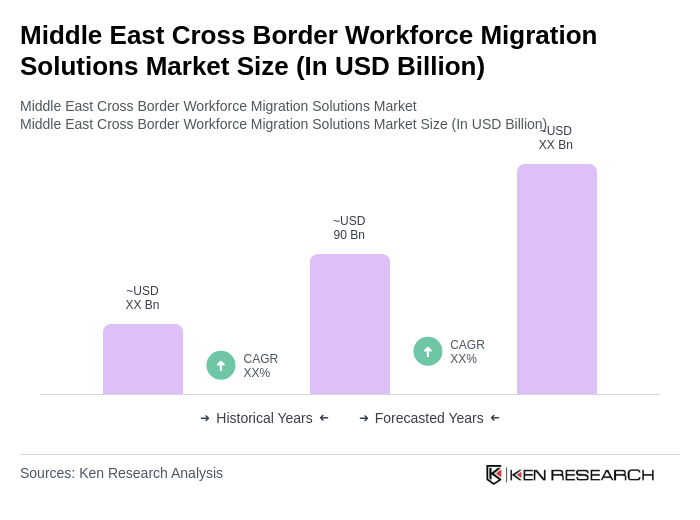
- The Middle East Cross Border Workforce Migration Solutions Market is valued at USD 90 billion, based on a five-year historical analysis. This robust market size is driven by the accelerating demand for skilled labor in construction, healthcare, technology, and other sectors, as well as ongoing economic diversification initiatives across the Gulf states. The region’s status as a global hub for expatriate employment continues to fuel market growth, positioning migration solutions as a critical element of the Middle Eastern economy .
- Key players in this market include the United Arab Emirates, Saudi Arabia, and Qatar, which lead due to strong economic expansion, extensive infrastructure projects, and progressive labor policies. These countries attract a substantial volume of foreign workers, fostering a competitive landscape for migration solutions tailored to diverse workforce needs. Saudi Arabia and UAE, in particular, are recognized for their significant investments in digital platforms and streamlined labor management systems .
- The UAE Cabinet Decision No. 65 of 2022, issued by the United Arab Emirates government, introduced new visa regulations that streamline the process for skilled workers. This regulation enables faster application processing, reduces approval times, and enhances the overall experience for expatriates. The initiative supports the UAE’s strategy to attract global talent and sustain economic growth, requiring employers to meet specific compliance standards and documentation thresholds for skilled labor sponsorship .
Middle East Cross Border Workforce Migration Solutions Market Segmentation
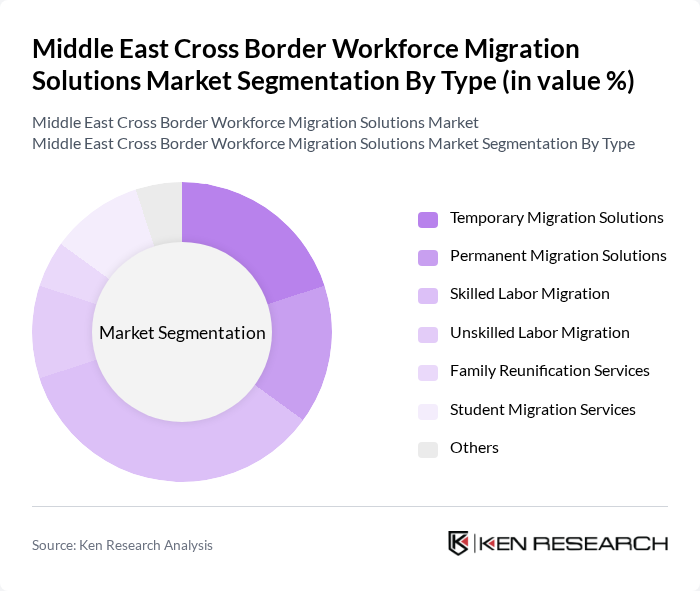
By Type:The segmentation by type reflects a diverse range of migration solutions designed for various demographics and industry requirements. Subsegments include Temporary Migration Solutions, Permanent Migration Solutions, Skilled Labor Migration, Unskilled Labor Migration, Family Reunification Services, Student Migration Services, and Others. Skilled Labor Migration remains the leading subsegment, propelled by the region’s sustained demand for specialized expertise in construction, healthcare, and technology. Corporations and government agencies increasingly prioritize skilled migration solutions to address workforce gaps and support strategic growth .
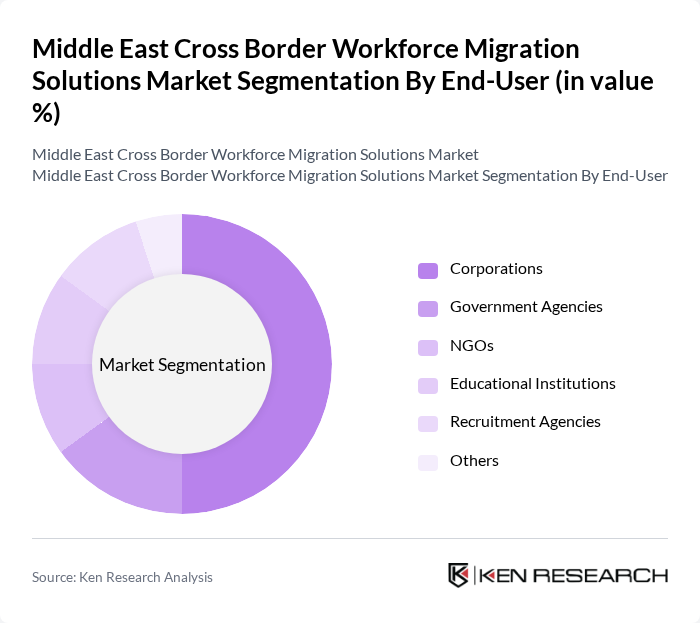
By End-User:The end-user segmentation includes Corporations, Government Agencies, NGOs, Educational Institutions, Recruitment Agencies, and Others. Corporations are the predominant end-users, driven by their need for skilled labor to support operational expansion and innovation. The construction, healthcare, and technology sectors, in particular, rely heavily on migration solutions to secure qualified talent and maintain competitive advantage .
Middle East Cross Border Workforce Migration Solutions Market Competitive Landscape
The Middle East Cross Border Workforce Migration Solutions Market is characterized by a dynamic mix of regional and international players. Leading participants such as Adecco Group, ManpowerGroup, Randstad N.V., GulfTalent, Michael Page International, Hays plc, Robert Walters, KPMG, PwC, Ernst & Young, Deloitte, BDO International, Al-Futtaim Group, TASC Outsourcing, Hudson McKenzie, Newland Chase, Fragomen, Centuro Global, Arthur Lawrence contribute to innovation, geographic expansion, and service delivery in this space.
Middle East Cross Border Workforce Migration Solutions Market Industry Analysis
Growth Drivers
- Increasing Demand for Skilled Labor:The Middle East is experiencing a significant demand for skilled labor, particularly in sectors such as construction, healthcare, and technology. In future, the region is projected to require approximately 1.8 million skilled workers to meet the needs of ongoing infrastructure projects and economic diversification efforts. This demand is driven by initiatives like Saudi Arabia's Vision 2030, which aims to create a more diversified economy, thereby increasing the need for specialized talent.
- Economic Diversification Initiatives:Countries in the Middle East are actively pursuing economic diversification to reduce reliance on oil revenues. For instance, the UAE's non-oil sector is expected to contribute 75% to its GDP in future, necessitating a skilled workforce to support this transition. This shift is fostering an environment where cross-border workforce migration solutions are essential to attract the necessary talent, thereby driving growth in the migration solutions market.
- Government Policies Promoting Workforce Mobility:Governments in the Middle East are implementing policies that facilitate workforce mobility, such as streamlined visa processes and bilateral agreements. For example, the UAE has introduced a new visa system that allows skilled workers to obtain residency more easily. In future, these policies are expected to enhance labor market flexibility, enabling companies to access a broader talent pool and further stimulating the cross-border migration solutions market.
Market Challenges
- Regulatory Complexities:Navigating the regulatory landscape in the Middle East can be challenging for companies seeking to employ foreign workers. Each country has its own set of labor laws and immigration policies, which can lead to confusion and compliance issues. In future, it is estimated that over 65% of businesses in the region face difficulties in understanding and adhering to these regulations, potentially hindering workforce mobility and market growth.
- Cultural Integration Issues:Cultural integration remains a significant challenge for expatriates in the Middle East. In future, studies indicate that nearly 45% of expatriates report difficulties in adapting to local customs and workplace cultures. This can lead to lower job satisfaction and higher turnover rates, which ultimately impacts the effectiveness of cross-border workforce migration solutions and the overall stability of the labor market.
Middle East Cross Border Workforce Migration Solutions Market Future Outlook
The future of the Middle East cross-border workforce migration solutions market appears promising, driven by ongoing economic diversification and the increasing need for skilled labor. As governments continue to refine immigration policies and promote workforce mobility, the market is likely to see enhanced collaboration between public and private sectors. Additionally, the rise of digital migration solutions will facilitate smoother transitions for expatriates, making it easier for businesses to access the talent they need while addressing cultural integration challenges effectively.
Market Opportunities
- Expansion of Digital Migration Solutions:The growing reliance on technology presents an opportunity for the development of digital migration solutions. In future, it is anticipated that 60% of migration processes will be digitized, streamlining applications and reducing processing times. This shift can significantly enhance the efficiency of cross-border workforce migration, attracting more skilled labor to the region.
- Partnerships with Local Governments:Collaborating with local governments can create tailored workforce solutions that address specific regional needs. In future, partnerships are expected to increase by 35%, allowing companies to leverage local insights and resources. This approach can enhance the effectiveness of migration solutions and foster a more inclusive labor market, benefiting both expatriates and local economies.
Scope of the Report
| Segment | Sub-Segments |
|---|---|
| By Type | Temporary Migration Solutions Permanent Migration Solutions Skilled Labor Migration Unskilled Labor Migration Family Reunification Services Student Migration Services Others |
| By End-User | Corporations Government Agencies NGOs Educational Institutions Recruitment Agencies Others |
| By Service Type | Visa Processing Services Relocation Services Legal Advisory Services Cultural Training Services Immigration Tech Platforms Mobility Management Solutions Labor Market Compliance & Verification Tools Identity & Background Verification Platforms Others |
| By Region | Gulf Cooperation Council (GCC) Levant Region North Africa Others |
| By Duration of Stay | Short-term Migration Long-term Migration Seasonal Migration Others |
| By Industry | Construction Healthcare Information Technology Hospitality Financial Services Education Others |
| By Recruitment Method | Direct Recruitment Agency Recruitment Online Platforms Outsourcing Providers Others |
Key Target Audience
Investors and Venture Capitalist Firms
Government and Regulatory Bodies (e.g., Ministry of Labor, Ministry of Interior)
International Organizations (e.g., International Organization for Migration)
Human Resource Management Firms
Recruitment Agencies
Non-Governmental Organizations (NGOs) focused on labor rights
Trade Unions and Labor Federations
Technology Providers specializing in workforce management solutions
Players Mentioned in the Report:
Adecco Group
ManpowerGroup
Randstad N.V.
GulfTalent
Michael Page International
Hays plc
Robert Walters
KPMG
PwC
Ernst & Young
Deloitte
BDO International
Al-Futtaim Group
TASC Outsourcing
Hudson McKenzie
Newland Chase
Fragomen
Centuro Global
Arthur Lawrence
Table of Contents
Market Assessment Phase
1. Executive Summary and Approach
2. Middle East Cross Border Workforce Migration Solutions Market Overview
2.1 Key Insights and Strategic Recommendations
2.2 Middle East Cross Border Workforce Migration Solutions Market Overview
2.3 Definition and Scope
2.4 Evolution of Market Ecosystem
2.5 Timeline of Key Regulatory Milestones
2.6 Value Chain & Stakeholder Mapping
2.7 Business Cycle Analysis
2.8 Policy & Incentive Landscape
3. Middle East Cross Border Workforce Migration Solutions Market Analysis
3.1 Growth Drivers
3.1.1 Increasing demand for skilled labor
3.1.2 Economic diversification initiatives
3.1.3 Government policies promoting workforce mobility
3.1.4 Rising expatriate population
3.2 Market Challenges
3.2.1 Regulatory complexities
3.2.2 Cultural integration issues
3.2.3 Economic fluctuations
3.2.4 Competition from local labor markets
3.3 Market Opportunities
3.3.1 Expansion of digital migration solutions
3.3.2 Partnerships with local governments
3.3.3 Development of training programs
3.3.4 Increased investment in infrastructure
3.4 Market Trends
3.4.1 Growth of remote work solutions
3.4.2 Emphasis on compliance and legal frameworks
3.4.3 Adoption of technology in migration processes
3.4.4 Focus on sustainability in workforce solutions
3.5 Government Regulation
3.5.1 Labor laws and employment standards
3.5.2 Visa and immigration policies
3.5.3 Health and safety regulations
3.5.4 Taxation policies for expatriates
4. SWOT Analysis
5. Stakeholder Analysis
6. Porter's Five Forces Analysis
7. Middle East Cross Border Workforce Migration Solutions Market Market Size, 2019-2024
7.1 By Value
7.2 By Volume
7.3 By Average Selling Price
8. Middle East Cross Border Workforce Migration Solutions Market Segmentation
8.1 By Type
8.1.1 Temporary Migration Solutions
8.1.2 Permanent Migration Solutions
8.1.3 Skilled Labor Migration
8.1.4 Unskilled Labor Migration
8.1.5 Family Reunification Services
8.1.6 Student Migration Services
8.1.7 Others
8.2 By End-User
8.2.1 Corporations
8.2.2 Government Agencies
8.2.3 NGOs
8.2.4 Educational Institutions
8.2.5 Recruitment Agencies
8.2.6 Others
8.3 By Service Type
8.3.1 Visa Processing Services
8.3.2 Relocation Services
8.3.3 Legal Advisory Services
8.3.4 Cultural Training Services
8.3.5 Immigration Tech Platforms
8.3.6 Mobility Management Solutions
8.3.7 Labor Market Compliance & Verification Tools
8.3.8 Identity & Background Verification Platforms
8.3.9 Others
8.4 By Region
8.4.1 Gulf Cooperation Council (GCC)
8.4.2 Levant Region
8.4.3 North Africa
8.4.4 Others
8.5 By Duration of Stay
8.5.1 Short-term Migration
8.5.2 Long-term Migration
8.5.3 Seasonal Migration
8.5.4 Others
8.6 By Industry
8.6.1 Construction
8.6.2 Healthcare
8.6.3 Information Technology
8.6.4 Hospitality
8.6.5 Financial Services
8.6.6 Education
8.6.7 Others
8.7 By Recruitment Method
8.7.1 Direct Recruitment
8.7.2 Agency Recruitment
8.7.3 Online Platforms
8.7.4 Outsourcing Providers
8.7.5 Others
9. Middle East Cross Border Workforce Migration Solutions Market Competitive Analysis
9.1 Market Share of Key Players
9.2 Cross Comparison of Key Players
9.2.1 Company Name
9.2.2 Group Size (Large, Medium, or Small as per industry convention)
9.2.3 Revenue Growth Rate
9.2.4 Customer Acquisition Cost
9.2.5 Market Penetration Rate
9.2.6 Customer Retention Rate
9.2.7 Pricing Strategy
9.2.8 Average Contract Value
9.2.9 Service Delivery Time
9.2.10 Customer Satisfaction Score
9.2.11 Technology Adoption Rate
9.2.12 Compliance Success Rate
9.2.13 Geographic Coverage (Number of Countries Served)
9.2.14 Volume of Placements (Annual)
9.2.15 Percentage of Digital/Remote Placements
9.3 SWOT Analysis of Top Players
9.4 Pricing Analysis
9.5 Detailed Profile of Major Companies
9.5.1 Adecco Group
9.5.2 ManpowerGroup
9.5.3 Randstad N.V.
9.5.4 GulfTalent
9.5.5 Michael Page International
9.5.6 Hays plc
9.5.7 Robert Walters
9.5.8 KPMG
9.5.9 PwC
9.5.10 Ernst & Young
9.5.11 Deloitte
9.5.12 BDO International
9.5.13 Al-Futtaim Group
9.5.14 TASC Outsourcing
9.5.15 Hudson McKenzie
9.5.16 Newland Chase
9.5.17 Fragomen
9.5.18 Centuro Global
9.5.19 Arthur Lawrence
10. Middle East Cross Border Workforce Migration Solutions Market End-User Analysis
10.1 Procurement Behavior of Key Ministries
10.1.1 Budget Allocation Trends
10.1.2 Decision-Making Processes
10.1.3 Preferred Service Providers
10.1.4 Compliance Requirements
10.2 Corporate Spend on Infrastructure & Energy
10.2.1 Investment Priorities
10.2.2 Spending Patterns
10.2.3 Impact of Economic Conditions
10.3 Pain Point Analysis by End-User Category
10.3.1 Skill Shortages
10.3.2 Compliance Challenges
10.3.3 Cultural Barriers
10.4 User Readiness for Adoption
10.4.1 Technology Adoption Rates
10.4.2 Training Needs
10.4.3 Support Requirements
10.5 Post-Deployment ROI and Use Case Expansion
10.5.1 Performance Metrics
10.5.2 Case Studies
10.5.3 Future Expansion Plans
11. Middle East Cross Border Workforce Migration Solutions Market Future Size, 2025-2030
11.1 By Value
11.2 By Volume
11.3 By Average Selling Price
Go-To-Market Strategy Phase
1. Whitespace Analysis + Business Model Canvas
1.1 Market Gaps Identification
1.2 Business Model Framework
2. Marketing and Positioning Recommendations
2.1 Branding Strategies
2.2 Product USPs
3. Distribution Plan
3.1 Urban Retail Strategies
3.2 Rural NGO Tie-ups
4. Channel & Pricing Gaps
4.1 Underserved Routes
4.2 Pricing Bands
5. Unmet Demand & Latent Needs
5.1 Category Gaps
5.2 Consumer Segments
6. Customer Relationship
6.1 Loyalty Programs
6.2 After-sales Service
7. Value Proposition
7.1 Sustainability Initiatives
7.2 Integrated Supply Chains
8. Key Activities
8.1 Regulatory Compliance
8.2 Branding Efforts
8.3 Distribution Setup
9. Entry Strategy Evaluation
9.1 Domestic Market Entry Strategy
9.1.1 Product Mix
9.1.2 Pricing Band
9.1.3 Packaging
9.2 Export Entry Strategy
9.2.1 Target Countries
9.2.2 Compliance Roadmap
10. Entry Mode Assessment
10.1 Joint Ventures
10.2 Greenfield Investments
10.3 Mergers & Acquisitions
10.4 Distributor Model
11. Capital and Timeline Estimation
11.1 Capital Requirements
11.2 Timelines
12. Control vs Risk Trade-Off
12.1 Ownership vs Partnerships
13. Profitability Outlook
13.1 Breakeven Analysis
13.2 Long-term Sustainability
14. Potential Partner List
14.1 Distributors
14.2 Joint Ventures
14.3 Acquisition Targets
15. Execution Roadmap
15.1 Phased Plan for Market Entry
15.1.1 Market Setup
15.1.2 Market Entry
15.1.3 Growth Acceleration
15.1.4 Scale & Stabilize
15.2 Key Activities and Milestones
15.2.1 Milestone Planning
15.2.2 Activity Tracking
Research Methodology
Phase 1: Approach1
Desk Research
- Analysis of migration statistics from regional labor ministries and international organizations
- Review of academic papers and industry reports on cross-border workforce migration trends
- Examination of policy documents and bilateral agreements affecting labor mobility in the Middle East
Primary Research
- Interviews with HR managers from multinational companies operating in the Middle East
- Surveys targeting migrant workers to understand their experiences and challenges
- Focus groups with labor market experts and migration policy analysts
Validation & Triangulation
- Cross-validation of findings through multiple data sources, including government and NGO reports
- Triangulation of qualitative insights from interviews with quantitative data from surveys
- Sanity checks conducted through expert panel discussions to ensure data reliability
Phase 2: Market Size Estimation1
Top-down Assessment
- Estimation of total workforce migration based on regional economic indicators and labor demand forecasts
- Segmentation of the market by industry sectors such as construction, healthcare, and technology
- Incorporation of demographic trends and migration policies impacting workforce availability
Bottom-up Modeling
- Collection of data on the number of migrant workers from various countries in the region
- Estimation of average income levels and remittance flows to assess economic impact
- Analysis of employment rates and job vacancies in key sectors to gauge demand for migrant labor
Forecasting & Scenario Analysis
- Development of predictive models based on economic growth rates and labor market dynamics
- Scenario analysis considering potential changes in immigration policies and geopolitical factors
- Projections of market growth under different economic conditions through 2030
Phase 3: CATI Sample Composition1
| Scope Item/Segment | Sample Size | Target Respondent Profiles |
|---|---|---|
| Construction Sector Workforce | 100 | Site Managers, Labor Contractors |
| Healthcare Professionals Migration | 90 | HR Directors, Medical Staff Recruiters |
| Technology Sector Talent Acquisition | 60 | IT Managers, Recruitment Specialists |
| Hospitality Industry Labor Trends | 50 | Hotel Managers, HR Executives |
| Remittance Impact Studies | 40 | Migrant Workers, Financial Advisors |
Frequently Asked Questions
What is the current value of the Middle East Cross Border Workforce Migration Solutions Market?
The Middle East Cross Border Workforce Migration Solutions Market is valued at approximately USD 90 billion, reflecting a robust demand for skilled labor across various sectors, including construction, healthcare, and technology, driven by economic diversification initiatives in the region.
Which countries are leading in the Middle East Cross Border Workforce Migration Solutions Market?
What are the key drivers of growth in the Middle East Cross Border Workforce Migration Solutions Market?
What challenges does the Middle East Cross Border Workforce Migration Solutions Market face?
Other Regional/Country Reports
Indonesia Cross Border Workforce Migration Solutions Market
Malaysia Cross Border Workforce Migration Solutions Market
KSA Cross Border Workforce Migration Solutions Market
APAC Cross Border Workforce Migration Solutions Market
SEA Cross Border Workforce Migration Solutions Market
Vietnam Cross Border Workforce Migration Solutions Market
Other Adjacent Reports
UAE Recruitment Process Outsourcing Market
Singapore Immigration Consulting Services Market
Malaysia Talent Acquisition Software Market
Malaysia Expatriate Management Services Market
Bahrain Labor Law Compliance Solutions Market
Oman Employee Relocation Services Market
Thailand Visa Processing Services Market
KSA Global Mobility Solutions Market
Global HR Analytics Market Size, Share & Forecast, By Solution Type, Deployment Model & Application, 2026-2031Why Buy From Us?

What makes us stand out is that our consultants follow Robust, Refine and Result (RRR) methodology. Robust for clear definitions, approaches and sanity checking, Refine for differentiating respondents' facts and opinions, and Result for presenting data with story.

We have set a benchmark in the industry by offering our clients with syndicated and customized market research reports featuring coverage of entire market as well as meticulous research and analyst insights.

While we don't replace traditional research, we flip the method upside down. Our dual approach of Top Bottom & Bottom Top ensures quality deliverable by not just verifying company fundamentals but also looking at the sector and macroeconomic factors.

With one step in the future, our research team constantly tries to show you the bigger picture. We help with some of the tough questions you may encounter along the way: How is the industry positioned? Best marketing channel? KPI's of competitors? By aligning every element, we help maximize success.

Our report gives you instant access to the answers and sources that other companies might choose to hide. We elaborate each steps of research methodology we have used and showcase you the sample size to earn your trust.

If you need any support, we are here! We pride ourselves on universe strength, data quality, and quick, friendly, and professional service.