About the Report
Base Year 2024Middle East Equine Regenerative Medicine Market Overview
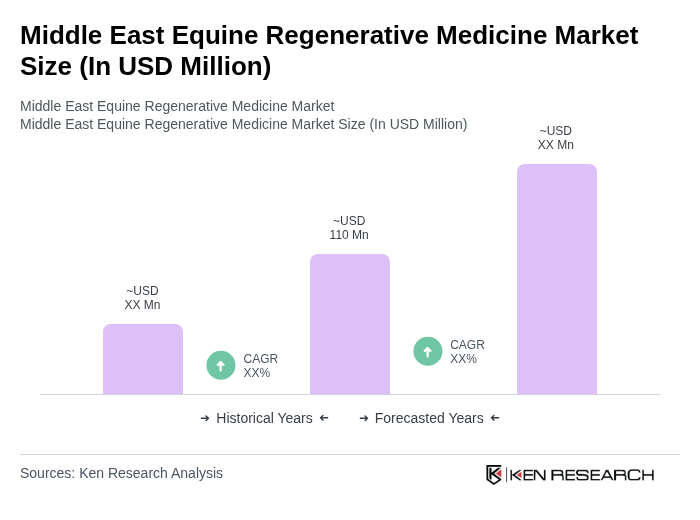
- The Middle East Equine Regenerative Medicine Market is valued at USD 110 million, based on a five-year historical analysis and normalization against regional veterinary regenerative medicine data. This growth is primarily driven by advancements in veterinary medicine, increasing awareness of equine health, and the rising demand for effective treatment options for performance horses. The market is also supported by the growing number of equine sports events, high-value equestrian investments, and the need for innovative therapies to enhance recovery and performance. Recent trends include the expansion of stem cell biobanking, increased adoption of platelet-rich plasma (PRP) therapies, and international collaborations to accelerate access to advanced biologics and regenerative solutions .
- Key players in this market include the UAE, Saudi Arabia, and Qatar, which dominate due to their strong equestrian culture, significant investments in equine sports, and the presence of advanced veterinary facilities. The UAE, in particular, has established itself as a hub for equine activities, hosting numerous international events and attracting investments in equine healthcare. The Saudi market is also rapidly expanding, propelled by government investment in veterinary infrastructure and a growing number of private equestrian centers. Qatar has enhanced its position through initiatives such as the launch of biobanking and regenerative research facilities at the Equine Veterinary Medical Center .
- In 2023, the UAE government issued the “Ministerial Resolution No. 384 of 2023 on the Regulation of Veterinary Medical Products,” under the Ministry of Climate Change and Environment. This binding instrument mandates that all regenerative therapies used in veterinary practices, including stem cell and PRP treatments for equines, must be certified and registered with the Ministry. The regulation sets operational standards for product safety, efficacy, and traceability, and requires veterinary clinics to maintain compliance documentation and report adverse events as part of post-market surveillance .
Middle East Equine Regenerative Medicine Market Segmentation
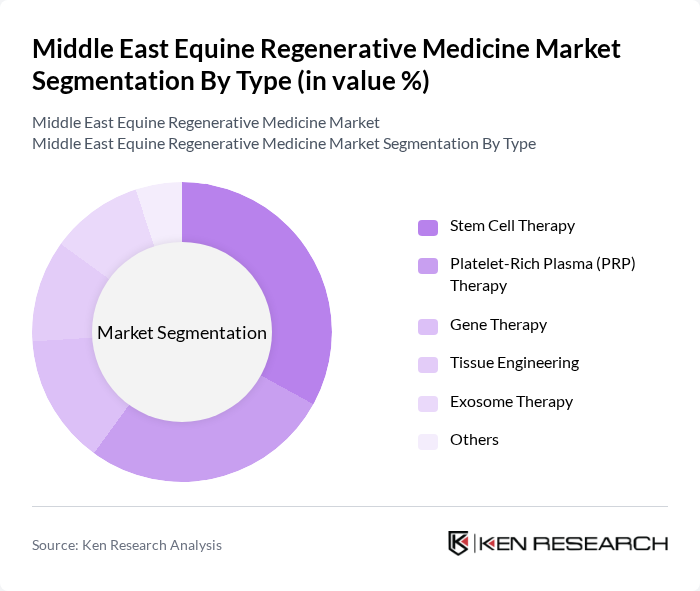
By Type:The market is segmented into various types of regenerative therapies, including Stem Cell Therapy, Platelet-Rich Plasma (PRP) Therapy, Gene Therapy, Tissue Engineering, Exosome Therapy, and Others. Among these,Stem Cell Therapyis gaining significant traction due to its effectiveness in treating tendon, ligament, and joint injuries in equines. The increasing acceptance of this therapy by veterinarians and horse owners is driving its dominance in the market. PRP Therapy is also widely adopted for musculoskeletal injuries, while gene and tissue engineering therapies are emerging as research-driven segments. Exosome therapy is in early adoption, primarily in specialized clinics .
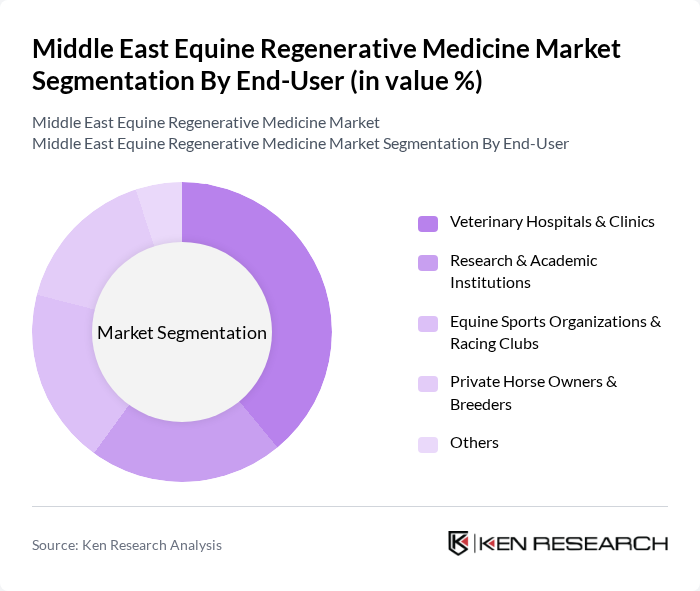
By End-User:The end-user segmentation includes Veterinary Hospitals & Clinics, Research & Academic Institutions, Equine Sports Organizations & Racing Clubs, Private Horse Owners & Breeders, and Others.Veterinary Hospitals & Clinicsare the leading end-users, as they are the primary providers of regenerative therapies and have the necessary infrastructure and expertise to administer these advanced treatments effectively. Research and academic institutions are pivotal in driving clinical trials and innovation, while equine sports organizations and racing clubs are major adopters due to the high value placed on performance and recovery. Private horse owners and breeders are increasingly utilizing regenerative solutions for both therapeutic and preventive care .
Middle East Equine Regenerative Medicine Market Competitive Landscape
The Middle East Equine Regenerative Medicine Market is characterized by a dynamic mix of regional and international players. Leading participants such as VetStem Biopharma, Medrego, Arti-Cell Forte (Global Stem cell Technology NV, a Boehringer Ingelheim company), Pet Pavilion Veterinary Clinic (UAE), Equine Veterinary Medical Center (EVMC, Qatar Foundation), Zoetis, Regeneus, Cell Therapy Sciences (Saudi Arabia), Al Ain Equine Hospital (UAE), Dubai Equine Hospital (UAE), King Abdulaziz City for Science and Technology (KACST, Saudi Arabia), Anicells, Stem Cell Arabia, Equine Regenerative Medicine Group, Al Shaqab Equine Veterinary Medical Center (Qatar) contribute to innovation, geographic expansion, and service delivery in this space.
Middle East Equine Regenerative Medicine Market Industry Analysis
Growth Drivers
- Increasing Demand for Advanced Veterinary Care:The Middle East has seen a significant rise in the equine population, with over 1.6 million horses reported in future. This growth has led to a heightened demand for advanced veterinary care, particularly regenerative medicine, which is expected to reach a market value of $220 million by future. The increasing investment in equine health facilities and services is a direct response to this demand, driving the adoption of innovative treatment options.
- Rising Awareness of Regenerative Therapies:Awareness of regenerative therapies among horse owners and veterinarians is growing, with educational initiatives increasing by 35% in the last two years. This trend is supported by the establishment of specialized training programs, which have seen enrollment rise to over 600 participants annually. As more practitioners become knowledgeable about these therapies, the adoption rate is expected to increase, further propelling market growth in the region.
- Technological Advancements in Regenerative Medicine:The Middle East is witnessing rapid technological advancements in regenerative medicine, particularly in stem cell therapy and tissue engineering. In future, investments in veterinary biotechnology reached approximately $180 million, with a projected increase of 25% in future. These advancements are enhancing treatment efficacy and safety, making regenerative therapies more appealing to equine practitioners and owners, thus driving market growth.
Market Challenges
- High Cost of Regenerative Treatments:The cost of regenerative treatments in the Middle East can range from $2,500 to $12,000 per procedure, which poses a significant barrier for many horse owners. With the average income of horse owners in the region being around $55,000 annually, the financial burden of these treatments can deter potential clients. This challenge limits the accessibility and widespread adoption of regenerative therapies in the equine sector.
- Limited Availability of Trained Professionals:There is a notable shortage of trained professionals specializing in equine regenerative medicine in the Middle East. Currently, only about 250 veterinarians are certified in advanced regenerative techniques, which is insufficient to meet the growing demand. This lack of expertise can lead to suboptimal treatment outcomes and may hinder the overall growth of the market, as horse owners seek qualified practitioners.
Middle East Equine Regenerative Medicine Market Future Outlook
The future of the equine regenerative medicine market in the Middle East appears promising, driven by increasing investments in veterinary research and the expansion of specialized clinics. As awareness of regenerative therapies continues to rise, more horse owners are likely to seek these advanced treatment options. Additionally, the integration of telemedicine and AI in veterinary practices is expected to enhance service delivery, making it easier for practitioners to offer innovative solutions tailored to equine health needs.
Market Opportunities
- Expansion of Veterinary Clinics Offering Regenerative Services:The establishment of new veterinary clinics specializing in regenerative medicine is on the rise, with an estimated 30 new clinics projected to open in future. This expansion will provide greater access to advanced treatments, catering to the increasing demand from horse owners seeking innovative care options for their equine companions.
- Collaborations with Research Institutions:Partnerships between veterinary clinics and research institutions are becoming more common, with at least six major collaborations expected to be announced in future. These collaborations will facilitate the development of new treatment protocols and enhance the overall quality of care, positioning the market for significant growth as innovative therapies are introduced.
Scope of the Report
| Segment | Sub-Segments |
|---|---|
| By Type | Stem Cell Therapy Platelet-Rich Plasma (PRP) Therapy Gene Therapy Tissue Engineering Exosome Therapy Others |
| By End-User | Veterinary Hospitals & Clinics Research & Academic Institutions Equine Sports Organizations & Racing Clubs Private Horse Owners & Breeders Others |
| By Application | Orthopedic Injuries (Tendon, Ligament, Bone) Soft Tissue Injuries Degenerative Joint Diseases (Osteoarthritis, DJD) Performance Enhancement & Recovery Wound Healing Others |
| By Region | GCC Countries (UAE, Saudi Arabia, Qatar, Kuwait, Bahrain, Oman) Levant (Jordan, Lebanon, etc.) North Africa (Egypt, Morocco, etc.) Others |
| By Treatment Method | Intra-Articular Injections Surgical Procedures Rehabilitation & Physical Therapy Programs Topical Applications Others |
| By Product Type | Biologics (Stem Cells, PRP, Growth Factors) Medical Devices (Delivery Systems, Imaging, Monitoring) Consumables (Kits, Reagents, Media) Others |
| By Distribution Channel | Direct Sales (Manufacturer to Clinic) Online Sales Veterinary Distributors Others |
Key Target Audience
Investors and Venture Capitalist Firms
Government and Regulatory Bodies (e.g., Ministry of Agriculture, Ministry of Health)
Equine Veterinary Clinics and Hospitals
Biotechnology and Pharmaceutical Companies
Equine Breeding Farms and Stables
Animal Health Product Distributors
Equine Sports Organizations and Associations
Insurance Companies Specializing in Equine Health
Players Mentioned in the Report:
VetStem Biopharma
Medrego
Arti-Cell Forte (Global Stem cell Technology NV, a Boehringer Ingelheim company)
Pet Pavilion Veterinary Clinic (UAE)
Equine Veterinary Medical Center (EVMC, Qatar Foundation)
Zoetis
Regeneus
Cell Therapy Sciences (Saudi Arabia)
Al Ain Equine Hospital (UAE)
Dubai Equine Hospital (UAE)
King Abdulaziz City for Science and Technology (KACST, Saudi Arabia)
Anicells
Stem Cell Arabia
Equine Regenerative Medicine Group
Al Shaqab Equine Veterinary Medical Center (Qatar)
Table of Contents
Market Assessment Phase
1. Executive Summary and Approach
2. Middle East Equine Regenerative Medicine Market Overview
2.1 Key Insights and Strategic Recommendations
2.2 Middle East Equine Regenerative Medicine Market Overview
2.3 Definition and Scope
2.4 Evolution of Market Ecosystem
2.5 Timeline of Key Regulatory Milestones
2.6 Value Chain & Stakeholder Mapping
2.7 Business Cycle Analysis
2.8 Policy & Incentive Landscape
3. Middle East Equine Regenerative Medicine Market Analysis
3.1 Growth Drivers
3.1.1 Increasing demand for advanced veterinary care
3.1.2 Rising awareness of regenerative therapies
3.1.3 Growth in equine sports and competitions
3.1.4 Technological advancements in regenerative medicine
3.2 Market Challenges
3.2.1 High cost of regenerative treatments
3.2.2 Limited availability of trained professionals
3.2.3 Regulatory hurdles in product approval
3.2.4 Lack of awareness among horse owners
3.3 Market Opportunities
3.3.1 Expansion of veterinary clinics offering regenerative services
3.3.2 Collaborations with research institutions
3.3.3 Development of cost-effective treatment options
3.3.4 Increasing investment in equine health research
3.4 Market Trends
3.4.1 Growing popularity of stem cell therapy
3.4.2 Rise in telemedicine for veterinary care
3.4.3 Integration of AI in treatment planning
3.4.4 Focus on preventive care and wellness programs
3.5 Government Regulation
3.5.1 Guidelines for stem cell therapy in animals
3.5.2 Regulations on the use of biologics in veterinary medicine
3.5.3 Licensing requirements for veterinary practitioners
3.5.4 Compliance with international standards for animal health
4. SWOT Analysis
5. Stakeholder Analysis
6. Porter's Five Forces Analysis
7. Middle East Equine Regenerative Medicine Market Market Size, 2019-2024
7.1 By Value
7.2 By Volume
7.3 By Average Selling Price
8. Middle East Equine Regenerative Medicine Market Segmentation
8.1 By Type
8.1.1 Stem Cell Therapy
8.1.2 Platelet-Rich Plasma (PRP) Therapy
8.1.3 Gene Therapy
8.1.4 Tissue Engineering
8.1.5 Exosome Therapy
8.1.6 Others
8.2 By End-User
8.2.1 Veterinary Hospitals & Clinics
8.2.2 Research & Academic Institutions
8.2.3 Equine Sports Organizations & Racing Clubs
8.2.4 Private Horse Owners & Breeders
8.2.5 Others
8.3 By Application
8.3.1 Orthopedic Injuries (Tendon, Ligament, Bone)
8.3.2 Soft Tissue Injuries
8.3.3 Degenerative Joint Diseases (Osteoarthritis, DJD)
8.3.4 Performance Enhancement & Recovery
8.3.5 Wound Healing
8.3.6 Others
8.4 By Region
8.4.1 GCC Countries (UAE, Saudi Arabia, Qatar, Kuwait, Bahrain, Oman)
8.4.2 Levant (Jordan, Lebanon, etc.)
8.4.3 North Africa (Egypt, Morocco, etc.)
8.4.4 Others
8.5 By Treatment Method
8.5.1 Intra-Articular Injections
8.5.2 Surgical Procedures
8.5.3 Rehabilitation & Physical Therapy Programs
8.5.4 Topical Applications
8.5.5 Others
8.6 By Product Type
8.6.1 Biologics (Stem Cells, PRP, Growth Factors)
8.6.2 Medical Devices (Delivery Systems, Imaging, Monitoring)
8.6.3 Consumables (Kits, Reagents, Media)
8.6.4 Others
8.7 By Distribution Channel
8.7.1 Direct Sales (Manufacturer to Clinic)
8.7.2 Online Sales
8.7.3 Veterinary Distributors
8.7.4 Others
9. Middle East Equine Regenerative Medicine Market Competitive Analysis
9.1 Market Share of Key Players
9.2 Cross Comparison of Key Players
9.2.1 Company Name
9.2.2 Company Size (Large, Medium, Small)
9.2.3 Revenue Growth Rate (Equine Segment)
9.2.4 Market Penetration (Number of Clinics/Installations in Middle East)
9.2.5 R&D Investment as % of Revenue
9.2.6 Product Portfolio Breadth (Number of Regenerative Products/Services)
9.2.7 Regulatory Approvals/Certifications (Regional/International)
9.2.8 Strategic Partnerships (with Clinics, Research Institutes, Racing Clubs)
9.2.9 Distribution Network Strength (Countries Covered, Local Partners)
9.2.10 Customer Satisfaction/Clinical Outcomes Index
9.3 SWOT Analysis of Top Players
9.4 Pricing Analysis
9.5 Detailed Profile of Major Companies
9.5.1 VetStem Biopharma
9.5.2 Medrego
9.5.3 Arti-Cell Forte (Global Stem cell Technology NV, a Boehringer Ingelheim company)
9.5.4 Pet Pavilion Veterinary Clinic (UAE)
9.5.5 Equine Veterinary Medical Center (EVMC, Qatar Foundation)
9.5.6 Zoetis
9.5.7 Regeneus
9.5.8 Cell Therapy Sciences (Saudi Arabia)
9.5.9 Al Ain Equine Hospital (UAE)
9.5.10 Dubai Equine Hospital (UAE)
9.5.11 King Abdulaziz City for Science and Technology (KACST, Saudi Arabia)
9.5.12 Anicells
9.5.13 Stem Cell Arabia
9.5.14 Equine Regenerative Medicine Group
9.5.15 Al Shaqab Equine Veterinary Medical Center (Qatar)
10. Middle East Equine Regenerative Medicine Market End-User Analysis
10.1 Procurement Behavior of Key Ministries
10.1.1 Government Funding for Equine Health
10.1.2 Policy Support for Regenerative Medicine
10.1.3 Collaboration with Veterinary Institutions
10.1.4 Regulatory Compliance Requirements
10.2 Corporate Spend on Infrastructure & Energy
10.2.1 Investment in Veterinary Facilities
10.2.2 Budget Allocation for Research and Development
10.2.3 Spending on Advanced Medical Equipment
10.2.4 Others
10.3 Pain Point Analysis by End-User Category
10.3.1 Cost of Treatments
10.3.2 Accessibility of Services
10.3.3 Quality of Care
10.3.4 Others
10.4 User Readiness for Adoption
10.4.1 Awareness of Regenerative Medicine
10.4.2 Training and Education Needs
10.4.3 Financial Readiness
10.4.4 Others
10.5 Post-Deployment ROI and Use Case Expansion
10.5.1 Evaluation of Treatment Outcomes
10.5.2 Long-term Cost Savings
10.5.3 Expansion into New Services
10.5.4 Others
11. Middle East Equine Regenerative Medicine Market Future Size, 2025-2030
11.1 By Value
11.2 By Volume
11.3 By Average Selling Price
Go-To-Market Strategy Phase
1. Whitespace Analysis + Business Model Canvas
1.1 Market Gaps Identification
1.2 Business Model Development
2. Marketing and Positioning Recommendations
2.1 Branding Strategies
2.2 Product USPs
3. Distribution Plan
3.1 Urban Retail Strategies
3.2 Rural NGO Tie-ups
4. Channel & Pricing Gaps
4.1 Underserved Routes
4.2 Pricing Bands
5. Unmet Demand & Latent Needs
5.1 Category Gaps
5.2 Consumer Segments
6. Customer Relationship
6.1 Loyalty Programs
6.2 After-sales Service
7. Value Proposition
7.1 Sustainability
7.2 Integrated Supply Chains
8. Key Activities
8.1 Regulatory Compliance
8.2 Branding
8.3 Distribution Setup
9. Entry Strategy Evaluation
9.1 Domestic Market Entry Strategy
9.1.1 Product Mix
9.1.2 Pricing Band
9.1.3 Packaging
9.2 Export Entry Strategy
9.2.1 Target Countries
9.2.2 Compliance Roadmap
10. Entry Mode Assessment
10.1 Joint Ventures
10.2 Greenfield Investments
10.3 Mergers & Acquisitions
10.4 Distributor Model
11. Capital and Timeline Estimation
11.1 Capital Requirements
11.2 Timelines
12. Control vs Risk Trade-Off
12.1 Ownership vs Partnerships
13. Profitability Outlook
13.1 Breakeven Analysis
13.2 Long-term Sustainability
14. Potential Partner List
14.1 Distributors
14.2 Joint Ventures
14.3 Acquisition Targets
15. Execution Roadmap
15.1 Phased Plan for Market Entry
15.1.1 Market Setup
15.1.2 Market Entry
15.1.3 Growth Acceleration
15.1.4 Scale & Stabilize
15.2 Key Activities and Milestones
15.2.1 Milestone Planning
15.2.2 Activity Tracking
Research Methodology
Phase 1: Approach1
Desk Research
- Analysis of industry reports from equine health organizations and veterinary associations
- Review of scientific literature on regenerative medicine applications in equine care
- Examination of market trends and forecasts from regional trade publications and journals
Primary Research
- Interviews with veterinarians specializing in equine regenerative therapies
- Surveys with equine facility managers and horse owners regarding treatment preferences
- Focus groups with equine health product manufacturers and distributors
Validation & Triangulation
- Cross-validation of findings through multiple expert interviews and stakeholder feedback
- Triangulation of data from primary and secondary sources to ensure consistency
- Sanity checks through expert panel reviews and industry roundtables
Phase 2: Market Size Estimation1
Top-down Assessment
- Estimation of market size based on overall veterinary spending in the Middle East
- Segmentation by equine health categories, including stem cell therapy and PRP treatments
- Incorporation of regional growth rates and demographic trends in horse ownership
Bottom-up Modeling
- Collection of sales data from leading equine regenerative medicine providers
- Estimation of treatment costs and frequency of procedures across different equine facilities
- Volume estimates based on the number of horses treated annually in the region
Forecasting & Scenario Analysis
- Multi-factor regression analysis incorporating economic indicators and veterinary advancements
- Scenario modeling based on potential regulatory changes and market entry of new therapies
- Development of baseline, optimistic, and pessimistic forecasts through 2030
Phase 3: CATI Sample Composition1
| Scope Item/Segment | Sample Size | Target Respondent Profiles |
|---|---|---|
| Equine Veterinary Clinics | 100 | Veterinarians, Clinic Managers |
| Equestrian Centers and Stables | 70 | Stable Owners, Facility Managers |
| Equine Health Product Distributors | 50 | Sales Representatives, Product Managers |
| Equine Research Institutions | 40 | Research Scientists, Academic Professors |
| Horse Owners and Enthusiasts | 90 | Horse Owners, Equestrian Athletes |
Frequently Asked Questions
What is the current value of the Middle East Equine Regenerative Medicine Market?
The Middle East Equine Regenerative Medicine Market is valued at approximately USD 110 million, driven by advancements in veterinary medicine and increasing demand for effective treatment options for performance horses.
What factors are driving the growth of the equine regenerative medicine market in the Middle East?
Which countries are leading in the Middle East Equine Regenerative Medicine Market?
What types of regenerative therapies are available in the Middle East for equines?
Other Regional/Country Reports
Indonesia Equine Regenerative Medicine Market
Malaysia Equine Regenerative Medicine Market
KSA Equine Regenerative Medicine Market
APAC Equine Regenerative Medicine Market
SEA Equine Regenerative Medicine Market
Vietnam Equine Regenerative Medicine Market
Other Adjacent Reports
Thailand Equine Stem Cell Therapy Market
Oman Veterinary Platelet-Rich Plasma Market
Egypt Animal Gene Therapy Market
Egypt Equine Tissue Engineering Market
South Korea Exosome Therapy Market
South Korea Veterinary Hospitals Market
UAE Equine Sports Organizations Market
UAE Animal Biobanking Market
Malaysia Veterinary Biotechnology Market
Oman Equine Health Diagnostics Market
Why Buy From Us?

What makes us stand out is that our consultants follow Robust, Refine and Result (RRR) methodology. Robust for clear definitions, approaches and sanity checking, Refine for differentiating respondents' facts and opinions, and Result for presenting data with story.

We have set a benchmark in the industry by offering our clients with syndicated and customized market research reports featuring coverage of entire market as well as meticulous research and analyst insights.

While we don't replace traditional research, we flip the method upside down. Our dual approach of Top Bottom & Bottom Top ensures quality deliverable by not just verifying company fundamentals but also looking at the sector and macroeconomic factors.

With one step in the future, our research team constantly tries to show you the bigger picture. We help with some of the tough questions you may encounter along the way: How is the industry positioned? Best marketing channel? KPI's of competitors? By aligning every element, we help maximize success.

Our report gives you instant access to the answers and sources that other companies might choose to hide. We elaborate each steps of research methodology we have used and showcase you the sample size to earn your trust.

If you need any support, we are here! We pride ourselves on universe strength, data quality, and quick, friendly, and professional service.