About the Report
Base Year 2024Middle East Gynecological Chairs Tables Market Overview
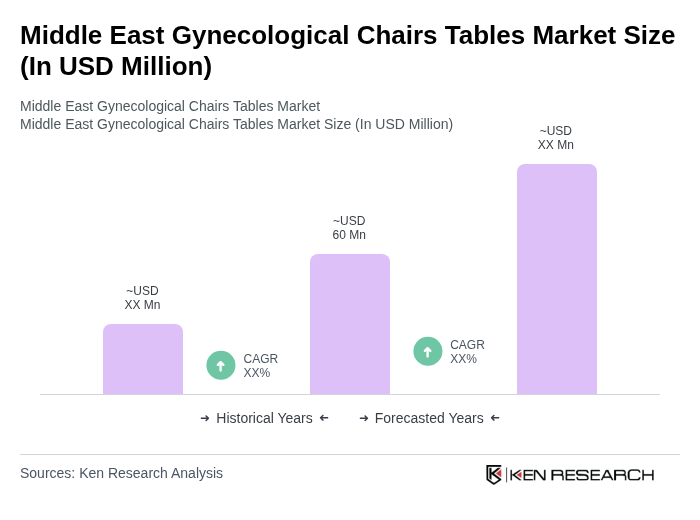
- The Middle East Gynecological Chairs Tables Market is valued at USD 60 million, based on a five-year historical analysis. This growth is primarily driven by increasing healthcare expenditure, rising awareness of women's health issues, and advancements in medical technology, particularly the shift toward ergonomic, powered, and bariatric-compatible examination and procedure chairs. The demand for specialized gynecological equipment has surged as healthcare facilities strive to enhance patient care and comfort, meet infection-control requirements, and support higher patient throughput during examinations and minor procedures.
- Key players in this market include Saudi Arabia, the United Arab Emirates, and Qatar, which together account for a substantial share of Middle East gynecological chairs and tables demand as part of broader gynecology equipment purchases. These countries dominate the market due to their robust healthcare infrastructure, significant investments in tertiary and specialty hospitals, and a growing population that demands improved women’s healthcare services, including fertility, maternity, and preventive gynecology. The presence of leading healthcare providers, ongoing hospital and clinic expansion programs, and national-level initiatives to strengthen women’s health services further contribute to their market leadership.
- In Saudi Arabia, the procurement and use of gynecological chairs and tables in public hospitals are guided by medical device and facility standards issued by national authorities, including the Medical Devices Interim Regulation and implementing rules overseen by the Saudi Food and Drug Authority (SFDA), as well as Ministry of Health technical specifications for hospital equipment. These instruments require that imported and locally supplied medical equipment be registered, meet safety and performance requirements, and comply with applicable facility codes, which in practice supports the adoption of advanced, motorized, and ergonomically designed gynecological equipment in public-sector hospitals. The regulatory and standards framework emphasizes upgrading hospital infrastructure, improving quality of care for women, and ensuring that specialized gynecological services are supported by certified, clinically appropriate equipment.
Middle East Gynecological Chairs Tables Market Segmentation
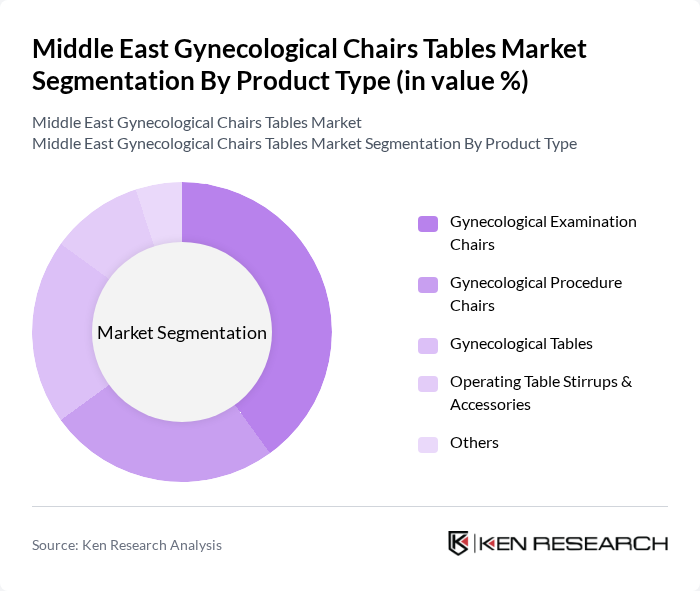
By Product Type:The product type segmentation includes various categories such as Gynecological Examination Chairs, Gynecological Procedure Chairs, Gynecological Tables, Operating Table Stirrups & Accessories, and Others. Among these, Gynecological Examination Chairs are leading the market due to their essential role in routine check-ups, antenatal visits, colposcopy, and preventive care, in line with global patterns where gynecological chairs command the largest product share. The increasing focus on early detection of gynecological issues, expansion of outpatient and day-care surgery centers, and the push toward patient-friendly, ergonomic examination environments contribute to the demand for these chairs.
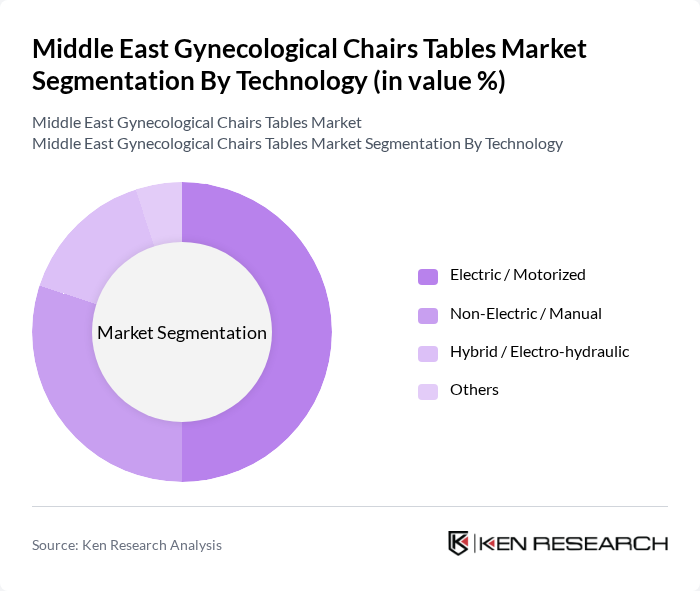
By Technology:The technology segmentation encompasses Electric / Motorized, Non-Electric / Manual, Hybrid / Electro-hydraulic, and Others. The Electric / Motorized segment is currently dominating the market due to its ease of use, enhanced functionality, and improved patient comfort, aligned with global trends where electric models lead in share driven by precise motion control and accessibility requirements. The growing preference for automated solutions in healthcare settings, including programmable positioning, bariatric load capacities, and compatibility with infection-control protocols, is driving the adoption of electric gynecological chairs and tables, while electro-hydraulic hybrids are increasingly selected in facilities with power-supply constraints.
Middle East Gynecological Chairs Tables Market Competitive Landscape
The Middle East Gynecological Chairs Tables Market is characterized by a dynamic mix of regional and international players. Leading participants such as STERIS plc, UMF Medical, Medifa GmbH & Co. KG, Merivaara Corp., Advin Health Care, Surgitech, Metron Healthcare, Clinton Industries, Inc., Baxter International Inc., Hausmann Enterprises, LLC, Al-Salam Medical Company, Gulf Medical Company, Medline Industries, Inc., Stryker Corporation, Hillrom (Baxter/Hill-Rom Holdings, Inc.) contribute to innovation, geographic expansion, and service delivery in this space.
Middle East Gynecological Chairs Tables Market Industry Analysis
Growth Drivers
- Increasing Demand for Advanced Gynecological Care:The Middle East has seen a significant rise in the demand for advanced gynecological care, driven by a growing population of women seeking specialized healthcare services. In future, the region's healthcare expenditure is projected to reach approximately $220 billion, with a notable portion allocated to women's health initiatives. This trend is further supported by the increasing prevalence of gynecological disorders, which affects around 32% of women in the region, necessitating advanced medical equipment like gynecological chairs.
- Rising Awareness of Women's Health Issues:Awareness campaigns and educational programs have significantly increased the understanding of women's health issues in the Middle East. Reports indicate that over 65% of women are now more informed about reproductive health, leading to a higher demand for specialized medical services. This shift is reflected in the growing number of health seminars and workshops, with over 1,200 events held annually, promoting the importance of regular gynecological check-ups and the use of advanced medical equipment.
- Technological Advancements in Medical Equipment:The gynecological chairs market is benefiting from rapid technological advancements, including the integration of smart technologies and ergonomic designs. In future, the investment in medical technology in the Middle East is expected to exceed $12 billion, with a significant portion directed towards gynecological equipment. Innovations such as automated adjustments and enhanced patient comfort features are becoming standard, driving demand for modern gynecological chairs that meet the evolving needs of healthcare providers and patients alike.
Market Challenges
- High Cost of Advanced Gynecological Chairs:The high cost associated with advanced gynecological chairs poses a significant challenge for healthcare facilities in the Middle East. Prices for these chairs can range from $6,000 to $22,000, making them a substantial investment for hospitals and clinics, particularly in lower-income areas. This financial barrier limits access to modern equipment, hindering the overall quality of gynecological care and potentially affecting patient outcomes in the region.
- Limited Availability of Skilled Healthcare Professionals:The shortage of skilled healthcare professionals in the Middle East is a critical challenge impacting the gynecological chairs market. As of in future, the region faces a deficit of approximately 120,000 healthcare workers, particularly in specialized fields like gynecology. This shortage not only affects the quality of care but also limits the effective utilization of advanced medical equipment, as there are insufficient trained personnel to operate and maintain these technologies.
Middle East Gynecological Chairs Tables Market Future Outlook
The future of the Middle East gynecological chairs market appears promising, driven by ongoing investments in healthcare infrastructure and a growing emphasis on women's health. As governments allocate more resources to healthcare, the demand for advanced gynecological equipment is expected to rise. Additionally, the integration of telemedicine and remote healthcare services is likely to enhance access to gynecological care, further stimulating market growth. The focus on ergonomic designs and smart technologies will also shape the future landscape of this market.
Market Opportunities
- Expansion of Private Healthcare Facilities:The rapid expansion of private healthcare facilities in the Middle East presents a significant opportunity for the gynecological chairs market. With over 1,500 private hospitals projected to open in future, there will be an increased demand for advanced gynecological equipment, allowing manufacturers to tap into a growing customer base seeking quality healthcare services.
- Increasing Investment in Women's Health Programs:Governments and NGOs are increasingly investing in women's health programs, with funding expected to reach $600 million in future. This investment will enhance access to gynecological care and create opportunities for the adoption of advanced gynecological chairs, as healthcare providers seek to improve service delivery and patient outcomes in women's health.
Scope of the Report
| Segment | Sub-Segments |
|---|---|
| By Product Type | Gynecological Examination Chairs Gynecological Procedure Chairs Gynecological Tables Operating Table Stirrups & Accessories Others |
| By Technology | Electric / Motorized Non?Electric / Manual Hybrid / Electro?hydraulic Others |
| By Application | Gynecological Examinations Obstetrics & Antenatal Care Gynecological Oncology Procedures Uro?gynecology & Pelvic Floor Procedures Others |
| By End-User | Public Hospitals Private Hospitals Specialized Obstetrics & Gynecology Clinics Day Surgery Centers / Ambulatory Care Centers Others |
| By Price Range | Low / Budget Mid-Range Premium Ultra?Premium / High?end |
| By Distribution Channel | Direct Tenders & Institutional Sales Distributors / Dealers Online & E?Procurement Platforms Others |
| By Country | Saudi Arabia United Arab Emirates Qatar Kuwait Oman Bahrain Rest of Middle East |
Key Target Audience
Investors and Venture Capitalist Firms
Government and Regulatory Bodies (e.g., Ministry of Health, Health Authority Abu Dhabi)
Manufacturers and Producers
Distributors and Retailers
Healthcare Providers and Hospitals
Medical Equipment Suppliers
Industry Associations (e.g., Middle East Healthcare Association)
Financial Institutions
Players Mentioned in the Report:
STERIS plc
UMF Medical
Medifa GmbH & Co. KG
Merivaara Corp.
Advin Health Care
Surgitech
Metron Healthcare
Clinton Industries, Inc.
Baxter International Inc.
Hausmann Enterprises, LLC
Al-Salam Medical Company
Gulf Medical Company
Medline Industries, Inc.
Stryker Corporation
Hillrom (Baxter/Hill-Rom Holdings, Inc.)
Table of Contents
Market Assessment Phase
1. Executive Summary and Approach
2. Middle East Gynecological Chairs Tables Market Overview
2.1 Key Insights and Strategic Recommendations
2.2 Middle East Gynecological Chairs Tables Market Overview
2.3 Definition and Scope
2.4 Evolution of Market Ecosystem
2.5 Timeline of Key Regulatory Milestones
2.6 Value Chain & Stakeholder Mapping
2.7 Business Cycle Analysis
2.8 Policy & Incentive Landscape
3. Middle East Gynecological Chairs Tables Market Analysis
3.1 Growth Drivers
3.1.1 Increasing demand for advanced gynecological care
3.1.2 Rising awareness of women's health issues
3.1.3 Technological advancements in medical equipment
3.1.4 Government initiatives to improve healthcare infrastructure
3.2 Market Challenges
3.2.1 High cost of advanced gynecological chairs
3.2.2 Limited availability of skilled healthcare professionals
3.2.3 Regulatory hurdles in medical equipment approval
3.2.4 Variability in healthcare funding across the region
3.3 Market Opportunities
3.3.1 Expansion of private healthcare facilities
3.3.2 Increasing investment in women's health programs
3.3.3 Growth in telemedicine and remote healthcare services
3.3.4 Rising demand for ergonomic and user-friendly designs
3.4 Market Trends
3.4.1 Shift towards minimally invasive procedures
3.4.2 Integration of smart technology in medical devices
3.4.3 Focus on sustainability and eco-friendly materials
3.4.4 Customization of medical equipment to meet specific needs
3.5 Government Regulation
3.5.1 Compliance with international safety standards
3.5.2 Licensing requirements for medical equipment manufacturers
3.5.3 Regulations on import and export of medical devices
3.5.4 Guidelines for clinical trials and product testing
4. SWOT Analysis
5. Stakeholder Analysis
6. Porter's Five Forces Analysis
7. Middle East Gynecological Chairs Tables Market Market Size, 2019-2024
7.1 By Value
7.2 By Volume
7.3 By Average Selling Price
8. Middle East Gynecological Chairs Tables Market Segmentation
8.1 By Product Type
8.1.1 Gynecological Examination Chairs
8.1.2 Gynecological Procedure Chairs
8.1.3 Gynecological Tables
8.1.4 Operating Table Stirrups & Accessories
8.1.5 Others
8.2 By Technology
8.2.1 Electric / Motorized
8.2.2 Non?Electric / Manual
8.2.3 Hybrid / Electro?hydraulic
8.2.4 Others
8.3 By Application
8.3.1 Gynecological Examinations
8.3.2 Obstetrics & Antenatal Care
8.3.3 Gynecological Oncology Procedures
8.3.4 Uro?gynecology & Pelvic Floor Procedures
8.3.5 Others
8.4 By End-User
8.4.1 Public Hospitals
8.4.2 Private Hospitals
8.4.3 Specialized Obstetrics & Gynecology Clinics
8.4.4 Day Surgery Centers / Ambulatory Care Centers
8.4.5 Others
8.5 By Price Range
8.5.1 Low / Budget
8.5.2 Mid-Range
8.5.3 Premium
8.5.4 Ultra?Premium / High?end
8.6 By Distribution Channel
8.6.1 Direct Tenders & Institutional Sales
8.6.2 Distributors / Dealers
8.6.3 Online & E?Procurement Platforms
8.6.4 Others
8.7 By Country
8.7.1 Saudi Arabia
8.7.2 United Arab Emirates
8.7.3 Qatar
8.7.4 Kuwait
8.7.5 Oman
8.7.6 Bahrain
8.7.7 Rest of Middle East
9. Middle East Gynecological Chairs Tables Market Competitive Analysis
9.1 Market Share of Key Players
9.2 Cross Comparison of Key Players
9.2.1 Company Name
9.2.2 Group Size (Large, Medium, or Small)
9.2.3 Regional Revenue in Middle East (USD million)
9.2.4 3-Year Revenue CAGR (%) in Gynecological Chairs & Tables
9.2.5 Middle East Market Share (%)
9.2.6 Installed Base in Middle East (Number of Units)
9.2.7 Average Selling Price Benchmark (USD per Unit)
9.2.8 EBITDA Margin (%) – Regional Operations
9.2.9 R&D Spend as % of Revenue
9.2.10 New Product Launches (Last 3 Years)
9.2.11 Tender Win Rate (%) in Key GCC Markets
9.2.12 Distributor Coverage (Number of Active Channel Partners)
9.2.13 Service Response Time SLA (Average Hours)
9.3 SWOT Analysis of Top Players
9.4 Pricing Analysis
9.5 Detailed Profile of Major Companies
9.5.1 STERIS plc
9.5.2 UMF Medical
9.5.3 Medifa GmbH & Co. KG
9.5.4 Merivaara Corp.
9.5.5 Advin Health Care
9.5.6 Surgitech
9.5.7 Metron Healthcare
9.5.8 Clinton Industries, Inc.
9.5.9 Baxter International Inc.
9.5.10 Hausmann Enterprises, LLC
9.5.11 Al-Salam Medical Company
9.5.12 Gulf Medical Company
9.5.13 Medline Industries, Inc.
9.5.14 Stryker Corporation
9.5.15 Hillrom (Baxter/Hill-Rom Holdings, Inc.)
10. Middle East Gynecological Chairs Tables Market End-User Analysis
10.1 Procurement Behavior of Key Ministries
10.1.1 Budget Allocation Trends
10.1.2 Decision-Making Processes
10.1.3 Supplier Selection Criteria
10.1.4 Contracting Practices
10.2 Corporate Spend on Infrastructure & Energy
10.2.1 Investment Priorities
10.2.2 Spending Patterns
10.2.3 Funding Sources
10.2.4 Projected Growth Areas
10.3 Pain Point Analysis by End-User Category
10.3.1 Challenges Faced by Hospitals
10.3.2 Issues in Clinics
10.3.3 Concerns of Diagnostic Centers
10.3.4 Needs of Research Institutions
10.4 User Readiness for Adoption
10.4.1 Training Requirements
10.4.2 Technology Acceptance Levels
10.4.3 Infrastructure Readiness
10.4.4 Support Services Availability
10.5 Post-Deployment ROI and Use Case Expansion
10.5.1 Performance Metrics
10.5.2 User Feedback Mechanisms
10.5.3 Case Studies of Successful Implementations
10.5.4 Future Expansion Opportunities
11. Middle East Gynecological Chairs Tables Market Future Size, 2025-2030
11.1 By Value
11.2 By Volume
11.3 By Average Selling Price
Go-To-Market Strategy Phase
1. Whitespace Analysis + Business Model Canvas
1.1 Market Gaps Identification
1.2 Business Model Framework
2. Marketing and Positioning Recommendations
2.1 Branding Strategies
2.2 Product USPs
3. Distribution Plan
3.1 Urban Retail vs Rural NGO Tie-ups
4. Channel & Pricing Gaps
4.1 Underserved Routes
4.2 Pricing Bands
5. Unmet Demand & Latent Needs
5.1 Category Gaps
5.2 Consumer Segments
6. Customer Relationship
6.1 Loyalty Programs
6.2 After-sales Service
7. Value Proposition
7.1 Sustainability
7.2 Integrated Supply Chains
8. Key Activities
8.1 Regulatory Compliance
8.2 Branding
8.3 Distribution Setup
9. Entry Strategy Evaluation
9.1 Domestic Market Entry Strategy
9.1.1 Product Mix
9.1.2 Pricing Band
9.1.3 Packaging
9.2 Export Entry Strategy
9.2.1 Target Countries
9.2.2 Compliance Roadmap
10. Entry Mode Assessment
10.1 JV
10.2 Greenfield
10.3 M&A
10.4 Distributor Model
11. Capital and Timeline Estimation
11.1 Capital Requirements
11.2 Timelines
12. Control vs Risk Trade-Off
12.1 Ownership vs Partnerships
13. Profitability Outlook
13.1 Breakeven Analysis
13.2 Long-term Sustainability
14. Potential Partner List
14.1 Distributors
14.2 JVs
14.3 Acquisition Targets
15. Execution Roadmap
15.1 Phased Plan for Market Entry
15.1.1 Market Setup
15.1.2 Market Entry
15.1.3 Growth Acceleration
15.1.4 Scale & Stabilize
15.2 Key Activities and Milestones
15.2.1 Milestone Tracking
15.2.2 Activity Scheduling
Research Methodology
Phase 1: Approach1
Desk Research
- Industry reports from regional health organizations and gynecological associations
- Market analysis publications focusing on medical equipment and furniture trends in the Middle East
- Government health statistics and demographic data relevant to women's health services
Primary Research
- Interviews with gynecologists and healthcare administrators in hospitals and clinics
- Surveys targeting procurement managers in medical equipment supply companies
- Field visits to healthcare facilities to observe the usage of gynecological chairs and tables
Validation & Triangulation
- Cross-validation of findings with multiple data sources, including sales data and expert opinions
- Triangulation of market trends with insights from healthcare policy changes and funding initiatives
- Sanity checks through expert panel discussions with industry veterans and market analysts
Phase 2: Market Size Estimation1
Top-down Assessment
- Analysis of total healthcare expenditure in the Middle East and its allocation to gynecological services
- Segmentation of the market by country, focusing on population demographics and healthcare infrastructure
- Incorporation of trends in women's health awareness and increasing demand for gynecological services
Bottom-up Modeling
- Estimation of unit sales based on historical data from leading manufacturers of gynecological chairs and tables
- Cost analysis of production and distribution channels for medical furniture
- Volume projections based on healthcare facility expansions and new hospital constructions
Forecasting & Scenario Analysis
- Multi-variable forecasting using factors such as population growth, healthcare access, and technological advancements
- Scenario analysis based on potential regulatory changes and shifts in healthcare funding
- Development of baseline, optimistic, and pessimistic market growth projections through 2030
Phase 3: CATI Sample Composition1
| Scope Item/Segment | Sample Size | Target Respondent Profiles |
|---|---|---|
| Public Hospitals in UAE | 120 | Hospital Administrators, Procurement Officers |
| Private Clinics in Saudi Arabia | 90 | Gynecologists, Clinic Managers |
| Healthcare Equipment Distributors | 70 | Sales Managers, Product Specialists |
| Women’s Health NGOs | 50 | Program Directors, Outreach Coordinators |
| Medical Equipment Trade Shows | 60 | Exhibitors, Industry Experts |
Frequently Asked Questions
What is the current value of the Middle East Gynecological Chairs Tables Market?
The Middle East Gynecological Chairs Tables Market is valued at approximately USD 60 million, based on a five-year historical analysis. This valuation reflects the growing demand for specialized gynecological equipment driven by increased healthcare expenditure and advancements in medical technology.
Which countries are the key players in the Middle East Gynecological Chairs Tables Market?
What factors are driving the growth of the gynecological chairs market in the Middle East?
What are the main product types in the Middle East Gynecological Chairs Tables Market?
Other Regional/Country Reports
Indonesia Gynecological Chairs Tables Market
Malaysia Gynecological Chairs Tables Market
KSA Gynecological Chairs Tables Market
APAC Gynecological Chairs Tables Market
SEA Gynecological Chairs Tables Market
Other Adjacent Reports
Indonesia Gynecological Devices Market
Singapore Obstetrics Equipment Market
Singapore Medical Furniture Market
Oman Hospital Beds Market
Indonesia Operating Tables Market
UAE Surgical Instruments Market
Belgium Diagnostic Imaging Market
Bahrain Womens Health Equipment Market
Qatar Patient Positioning Systems Market
South Korea Bariatric Medical Equipment Market
Why Buy From Us?

What makes us stand out is that our consultants follow Robust, Refine and Result (RRR) methodology. Robust for clear definitions, approaches and sanity checking, Refine for differentiating respondents' facts and opinions, and Result for presenting data with story.

We have set a benchmark in the industry by offering our clients with syndicated and customized market research reports featuring coverage of entire market as well as meticulous research and analyst insights.

While we don't replace traditional research, we flip the method upside down. Our dual approach of Top Bottom & Bottom Top ensures quality deliverable by not just verifying company fundamentals but also looking at the sector and macroeconomic factors.

With one step in the future, our research team constantly tries to show you the bigger picture. We help with some of the tough questions you may encounter along the way: How is the industry positioned? Best marketing channel? KPI's of competitors? By aligning every element, we help maximize success.

Our report gives you instant access to the answers and sources that other companies might choose to hide. We elaborate each steps of research methodology we have used and showcase you the sample size to earn your trust.

If you need any support, we are here! We pride ourselves on universe strength, data quality, and quick, friendly, and professional service.