About the Report
Base Year 2024Middle East Hotel Hospitality Management Software Market Overview
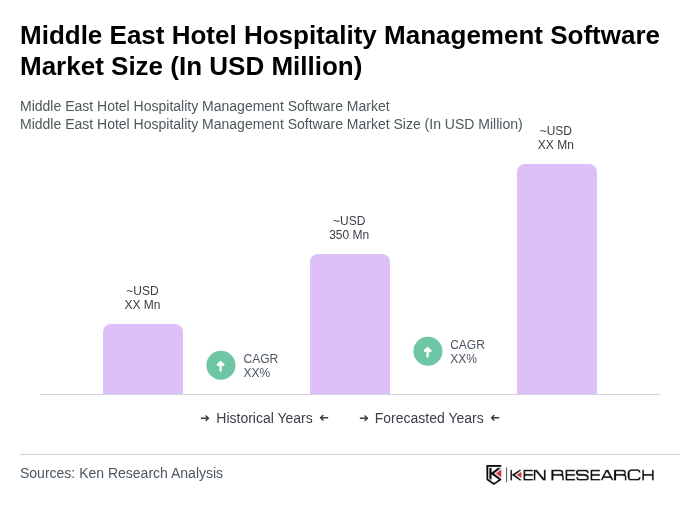
- The Middle East Hotel Hospitality Management Software Market is valued at USD 350 million, based on a five-year historical analysis. This growth is primarily driven by the increasing demand for efficient management solutions in the hospitality sector, coupled with the rise in tourism and hospitality investments across the region. The adoption of advanced technologies such as cloud computing and mobile applications has further propelled the market, enabling hotels to enhance operational efficiency and guest experiences.
- Key players in this market include the UAE, Saudi Arabia, and Qatar, which dominate due to their robust tourism infrastructure and significant investments in hospitality projects. The UAE, particularly Dubai, is a global tourism hub, attracting millions of visitors annually, while Saudi Arabia's Vision 2030 initiative aims to diversify its economy and boost tourism, creating a favorable environment for hospitality software solutions.
- Saudi Arabia's Vision 2030 digitalization and tourism regulatory upgrades encourage and, in some cases, require more standardized digital processes in hotels, improving the overall guest experience.
Middle East Hotel Hospitality Management Software Market Segmentation
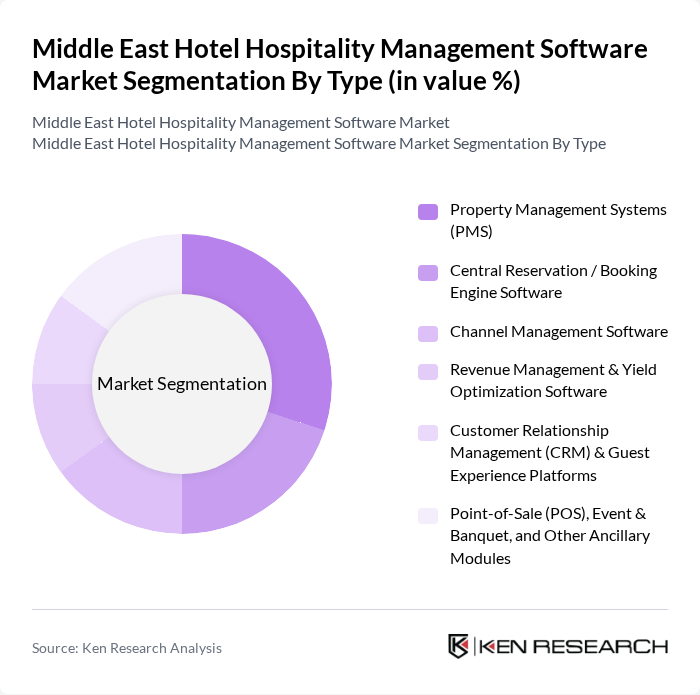
By Type:The market is segmented into various types of software solutions that cater to different operational needs within the hospitality industry. The primary subsegments include Property Management Systems (PMS), Central Reservation / Booking Engine Software, Channel Management Software, Revenue Management & Yield Optimization Software, Customer Relationship Management (CRM) & Guest Experience Platforms, and Point-of-Sale (POS), Event & Banquet, and Other Ancillary Modules. Among these, Property Management Systems (PMS) are leading the market due to their essential role in managing hotel operations, reservations, and guest services efficiently.
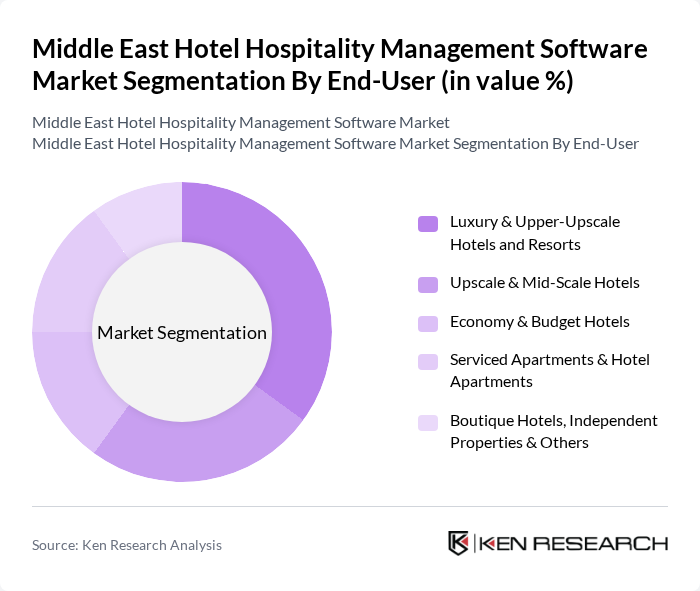
By End-User:The end-user segmentation includes various types of hospitality establishments such as Luxury & Upper-Upscale Hotels and Resorts, Upscale & Mid-Scale Hotels, Economy & Budget Hotels, Serviced Apartments & Hotel Apartments, and Boutique Hotels, Independent Properties & Others. The Luxury & Upper-Upscale Hotels and Resorts segment is currently dominating the market, driven by the increasing demand for high-quality services and personalized guest experiences, which necessitate advanced management software solutions.
Middle East Hotel Hospitality Management Software Market Competitive Landscape
The Middle East Hotel Hospitality Management Software Market is characterized by a dynamic mix of regional and international players. Leading participants such as Oracle Hospitality (Oracle Corporation), Amadeus Hospitality (Amadeus IT Group), Shiji Group, Agilysys Inc., Mews Systems, Cloudbeds, Hotelogix, eZee Technosys, Protel Hotelsoftware (Planet), RMS Cloud, Guestline, StayNTouch, Sabre Hospitality Solutions, WebRezPro (World Web Technologies), Little Hotelier (SiteMinder Group) contribute to innovation, geographic expansion, and service delivery in this space.
Middle East Hotel Hospitality Management Software Market Industry Analysis
Growth Drivers
- Increasing Demand for Automation:The Middle East hotel sector is experiencing a significant shift towards automation, with an estimated 60% of hotels adopting management software in future. This trend is driven by the need to streamline operations, reduce labor costs, and enhance efficiency. According to the World Bank, the region's hospitality industry is projected to grow by USD 10 billion, further fueling the demand for automated solutions that improve operational workflows and guest services.
- Rising Tourism and Hospitality Sector Growth:The Middle East is witnessing a tourism boom, with visitor numbers expected to reach 200 million in future, as reported by the UNWTO. This surge in tourism is prompting hotels to invest in advanced hospitality management software to cater to increasing guest expectations. The region's GDP contribution from travel and tourism is projected to exceed USD 100 billion, highlighting the critical need for efficient management systems to handle the influx of guests.
- Enhanced Guest Experience through Technology:Hotels in the Middle East are increasingly leveraging technology to improve guest experiences, with 75% of establishments planning to implement advanced software solutions in future. This includes features like mobile check-in, personalized services, and real-time feedback systems. The International Hotel & Restaurant Association indicates that enhancing guest satisfaction can lead to a 20% increase in repeat bookings, making technology integration essential for competitive advantage.
Market Challenges
- High Initial Investment Costs:The adoption of hotel management software often requires substantial upfront investments, which can deter smaller establishments. Initial costs can range from USD 10,000 to USD 50,000, depending on the software's complexity and features. According to industry reports, nearly 40% of small hotels cite financial constraints as a primary barrier to adopting new technologies, limiting their ability to compete effectively in a rapidly evolving market.
- Resistance to Change from Traditional Management Practices:Many hotels in the Middle East are entrenched in traditional management practices, leading to resistance against adopting new software solutions. A survey by the Middle East Hotel Association found that 55% of hotel managers prefer familiar methods over new technologies. This reluctance can hinder operational efficiency and innovation, ultimately affecting guest satisfaction and profitability in a competitive landscape.
Middle East Hotel Hospitality Management Software Market Future Outlook
The future of the Middle East hotel hospitality management software market appears promising, driven by technological advancements and evolving consumer preferences. As hotels increasingly adopt integrated management systems, the focus will shift towards enhancing operational efficiency and guest engagement. The rise of contactless services and sustainability initiatives will further shape the market landscape, compelling software providers to innovate continuously. Additionally, the integration of AI and data analytics will play a crucial role in personalizing guest experiences and optimizing hotel operations, ensuring long-term growth and competitiveness.
Market Opportunities
- Expansion of Cloud-Based Solutions:The shift towards cloud-based hospitality management software presents a significant opportunity, with an expected increase in adoption by 40% in future. This model offers scalability and cost-effectiveness, allowing hotels to access advanced features without heavy upfront investments. As more hotels recognize these benefits, the demand for cloud solutions is likely to surge, enhancing operational flexibility and data accessibility.
- Growing Demand for Mobile Applications:The increasing reliance on mobile technology among travelers is creating a robust market opportunity for mobile applications in hospitality. With over 70% of travelers using mobile devices for bookings and services, hotels that invest in mobile-friendly management software can significantly enhance guest engagement. This trend is expected to drive a 30% increase in mobile app development within the sector, fostering improved customer interactions and satisfaction.
Scope of the Report
| Segment | Sub-Segments |
|---|---|
| By Type | Property Management Systems (PMS) Central Reservation / Booking Engine Software Channel Management Software Revenue Management & Yield Optimization Software Customer Relationship Management (CRM) & Guest Experience Platforms Point-of-Sale (POS), Event & Banquet, and Other Ancillary Modules |
| By End-User | Luxury & Upper-Upscale Hotels and Resorts Upscale & Mid-Scale Hotels Economy & Budget Hotels Serviced Apartments & Hotel Apartments Boutique Hotels, Independent Properties & Others |
| By Deployment Model | On-Premise Cloud-Based / Software-as-a-Service (SaaS) Hybrid Private-Cloud / Hosted and Others |
| By Region | GCC Countries (UAE, Saudi Arabia, Qatar, Kuwait, Bahrain, Oman) Levant Region (Jordan, Lebanon and Neighboring Countries) North Africa (Egypt and Key MENA Tourism Markets) Rest of Middle East & Adjacent Markets |
| By Functionality | Front Office & Reservations Management Back Office, Finance & Inventory Management Housekeeping & Maintenance Management Distribution, Guest Engagement, Analytics & Other Functions |
| By Customer Size | Independent Properties (Single-Property) Small & Medium Hotel Groups (2–20 Properties) Large Hotel Chains & Enterprise Groups Management Companies, Franchise Operators & Others |
| By Pricing Model | Subscription-Based (Per Room / Per Property SaaS) One-Time License Fee with Annual Maintenance Freemium / Tiered Feature Access Transaction-Based, Revenue-Share and Other Models |
Key Target Audience
Investors and Venture Capitalist Firms
Government and Regulatory Bodies (e.g., Ministry of Tourism, Ministry of Economy)
Hotel Chains and Hospitality Groups
Property Management Companies
Technology Providers and Software Developers
Hospitality Industry Associations
Real Estate Developers
Financial Institutions and Banks
Players Mentioned in the Report:
Oracle Hospitality (Oracle Corporation)
Amadeus Hospitality (Amadeus IT Group)
Shiji Group
Agilysys Inc.
Mews Systems
Cloudbeds
Hotelogix
eZee Technosys
Protel Hotelsoftware (Planet)
RMS Cloud
Guestline
StayNTouch
Sabre Hospitality Solutions
WebRezPro (World Web Technologies)
Little Hotelier (SiteMinder Group)
Table of Contents
Market Assessment Phase
1. Executive Summary and Approach
2. Middle East Hotel Hospitality Management Software Market Overview
2.1 Key Insights and Strategic Recommendations
2.2 Middle East Hotel Hospitality Management Software Market Overview
2.3 Definition and Scope
2.4 Evolution of Market Ecosystem
2.5 Timeline of Key Regulatory Milestones
2.6 Value Chain & Stakeholder Mapping
2.7 Business Cycle Analysis
2.8 Policy & Incentive Landscape
3. Middle East Hotel Hospitality Management Software Market Analysis
3.1 Growth Drivers
3.1.1 Increasing demand for automation in hotel operations
3.1.2 Rising tourism and hospitality sector growth
3.1.3 Enhanced guest experience through technology
3.1.4 Integration of AI and data analytics in management software
3.2 Market Challenges
3.2.1 High initial investment costs
3.2.2 Resistance to change from traditional management practices
3.2.3 Data security and privacy concerns
3.2.4 Limited awareness of software benefits among smaller hotels
3.3 Market Opportunities
3.3.1 Expansion of cloud-based solutions
3.3.2 Growing demand for mobile applications in hospitality
3.3.3 Partnerships with local tourism boards
3.3.4 Customization of software for niche markets
3.4 Market Trends
3.4.1 Shift towards contactless services
3.4.2 Increasing focus on sustainability in hotel operations
3.4.3 Adoption of integrated management systems
3.4.4 Use of virtual reality for guest experiences
3.5 Government Regulation
3.5.1 Compliance with data protection laws
3.5.2 Regulations on software interoperability
3.5.3 Standards for cybersecurity in hospitality
3.5.4 Incentives for adopting green technologies
4. SWOT Analysis
5. Stakeholder Analysis
6. Porter's Five Forces Analysis
7. Middle East Hotel Hospitality Management Software Market Size, 2019-2024
7.1 By Value
7.2 By Volume
7.3 By Average Selling Price
8. Middle East Hotel Hospitality Management Software Market Segmentation
8.1 By Type
8.1.1 Property Management Systems (PMS)
8.1.2 Central Reservation / Booking Engine Software
8.1.3 Channel Management Software
8.1.4 Revenue Management & Yield Optimization Software
8.1.5 Customer Relationship Management (CRM) & Guest Experience Platforms
8.1.6 Point-of-Sale (POS), Event & Banquet, and Other Ancillary Modules
8.2 By End-User
8.2.1 Luxury & Upper-Upscale Hotels and Resorts
8.2.2 Upscale & Mid-Scale Hotels
8.2.3 Economy & Budget Hotels
8.2.4 Serviced Apartments & Hotel Apartments
8.2.5 Boutique Hotels, Independent Properties & Others
8.3 By Deployment Model
8.3.1 On-Premise
8.3.2 Cloud-Based / Software-as-a-Service (SaaS)
8.3.3 Hybrid
8.3.4 Private-Cloud / Hosted and Others
8.4 By Region
8.4.1 GCC Countries (UAE, Saudi Arabia, Qatar, Kuwait, Bahrain, Oman)
8.4.2 Levant Region (Jordan, Lebanon and Neighboring Countries)
8.4.3 North Africa (Egypt and Key MENA Tourism Markets)
8.4.4 Rest of Middle East & Adjacent Markets
8.5 By Functionality
8.5.1 Front Office & Reservations Management
8.5.2 Back Office, Finance & Inventory Management
8.5.3 Housekeeping & Maintenance Management
8.5.4 Distribution, Guest Engagement, Analytics & Other Functions
8.6 By Customer Size
8.6.1 Independent Properties (Single-Property)
8.6.2 Small & Medium Hotel Groups (2–20 Properties)
8.6.3 Large Hotel Chains & Enterprise Groups
8.6.4 Management Companies, Franchise Operators & Others
8.7 By Pricing Model
8.7.1 Subscription-Based (Per Room / Per Property SaaS)
8.7.2 One-Time License Fee with Annual Maintenance
8.7.3 Freemium / Tiered Feature Access
8.7.4 Transaction-Based, Revenue-Share and Other Models
9. Middle East Hotel Hospitality Management Software Market Competitive Analysis
9.1 Market Share of Key Players
9.2 Cross Comparison of Key Players
9.2.1 Company Name
9.2.2 Regional Footprint (Number of Middle East Countries Served)
9.2.3 Installed Base (Properties / Rooms Under Management in Middle East)
9.2.4 Target Customer Segment (Chain vs Independent, Luxury vs Economy)
9.2.5 Average Revenue Per Account (ARPA) in Middle East
9.2.6 Pricing Model (Subscription / License / Hybrid)
9.2.7 Market Penetration and Growth Rate in Middle East
9.2.8 Product Breadth (PMS, CRS, Channel Manager, RMS, CRM, POS, etc.)
9.2.9 Integration Ecosystem (OTAs, Payment Gateways, APIs, Local Partners)
9.2.10 Customer Satisfaction & Net Promoter Score (NPS)
9.2.11 Average Implementation Time & Service SLAs
9.3 SWOT Analysis of Top Players
9.4 Pricing Analysis
9.5 Detailed Profile of Major Companies
9.5.1 Oracle Hospitality (Oracle Corporation)
9.5.2 Amadeus Hospitality (Amadeus IT Group)
9.5.3 Shiji Group
9.5.4 Agilysys Inc.
9.5.5 Mews Systems
9.5.6 Cloudbeds
9.5.7 Hotelogix
9.5.8 eZee Technosys
9.5.9 Protel Hotelsoftware (Planet)
9.5.10 RMS Cloud
9.5.11 Guestline
9.5.12 StayNTouch
9.5.13 Sabre Hospitality Solutions
9.5.14 WebRezPro (World Web Technologies)
9.5.15 Little Hotelier (SiteMinder Group)
10. Middle East Hotel Hospitality Management Software Market End-User Analysis
10.1 Procurement Behavior of Key Ministries
10.1.1 Budget Allocation Trends
10.1.2 Decision-Making Processes
10.1.3 Preferred Software Features
10.1.4 Vendor Selection Criteria
10.2 Corporate Spend on Infrastructure & Energy
10.2.1 Investment Trends in Hospitality Technology
10.2.2 Budgeting for Software Solutions
10.2.3 Cost-Benefit Analysis Practices
10.2.4 Long-Term Financial Commitments
10.3 Pain Point Analysis by End-User Category
10.3.1 Operational Inefficiencies
10.3.2 Guest Experience Challenges
10.3.3 Integration Issues with Existing Systems
10.3.4 Training and Support Needs
10.4 User Readiness for Adoption
10.4.1 Technology Adoption Rates
10.4.2 Training Requirements
10.4.3 Change Management Strategies
10.4.4 Feedback Mechanisms
10.5 Post-Deployment ROI and Use Case Expansion
10.5.1 Measurement of ROI
10.5.2 Case Studies of Successful Implementations
10.5.3 Future Use Case Opportunities
10.5.4 Customer Feedback and Iteration
11. Middle East Hotel Hospitality Management Software Market Future Size, 2025-2030
11.1 By Value
11.2 By Volume
11.3 By Average Selling Price
Go-To-Market Strategy Phase
1. Whitespace Analysis + Business Model Canvas
1.1 Market Gaps Identification
1.2 Business Model Development
2. Marketing and Positioning Recommendations
2.1 Branding Strategies
2.2 Product USPs
3. Distribution Plan
3.1 Urban Retail vs Rural NGO Tie-Ups
4. Channel & Pricing Gaps
4.1 Underserved Routes
4.2 Pricing Bands
5. Unmet Demand & Latent Needs
5.1 Category Gaps
5.2 Consumer Segments
6. Customer Relationship
6.1 Loyalty Programs
6.2 After-Sales Service
7. Value Proposition
7.1 Sustainability
7.2 Integrated Supply Chains
8. Key Activities
8.1 Regulatory Compliance
8.2 Branding
8.3 Distribution Setup
9. Entry Strategy Evaluation
9.1 Domestic Market Entry Strategy
9.1.1 Product Mix
9.1.2 Pricing Band
9.1.3 Packaging
9.2 Export Entry Strategy
9.2.1 Target Countries
9.2.2 Compliance Roadmap
10. Entry Mode Assessment
10.1 JV
10.2 Greenfield
10.3 M&A
10.4 Distributor Model
11. Capital and Timeline Estimation
11.1 Capital Requirements
11.2 Timelines
12. Control vs Risk Trade-Off
12.1 Ownership vs Partnerships
13. Profitability Outlook
13.1 Breakeven Analysis
13.2 Long-Term Sustainability
14. Potential Partner List
14.1 Distributors
14.2 JVs
14.3 Acquisition Targets
15. Execution Roadmap
15.1 Phased Plan for Market Entry
15.1.1 Market Setup
15.1.2 Market Entry
15.1.3 Growth Acceleration
15.1.4 Scale & Stabilize
15.2 Key Activities and Milestones
15.2.1 Milestone Planning
15.2.2 Activity Tracking
Research Methodology
Phase 1: Approach1
Desk Research
- Analysis of industry reports from hospitality associations and market research firms
- Review of government publications and tourism statistics from Middle Eastern countries
- Examination of white papers and case studies on hotel management software trends
Primary Research
- Interviews with hotel managers and IT directors in the hospitality sector
- Surveys targeting software vendors and service providers in hotel management
- Focus groups with end-users, including hotel staff and management teams
Validation & Triangulation
- Cross-validation of findings through multiple data sources, including trade publications
- Triangulation of insights from primary interviews and secondary data analysis
- Sanity checks conducted through expert panel reviews and feedback sessions
Phase 2: Market Size Estimation1
Top-down Assessment
- Estimation of total market size based on regional hotel occupancy rates and revenue
- Segmentation by hotel categories (luxury, mid-scale, budget) and software types
- Incorporation of growth trends in tourism and hospitality investments in the region
Bottom-up Modeling
- Collection of data on software adoption rates from a sample of hotels
- Operational cost analysis based on pricing models of leading hotel management software
- Volume estimates derived from the number of hotels and average software licenses per hotel
Forecasting & Scenario Analysis
- Multi-factor regression analysis considering tourism growth, technology adoption rates
- Scenario planning based on economic conditions and regulatory changes affecting the hospitality sector
- Development of baseline, optimistic, and pessimistic forecasts through 2030
Phase 3: CATI Sample Composition1
| Scope Item/Segment | Sample Size | Target Respondent Profiles |
|---|---|---|
| Luxury Hotel Management Software | 85 | General Managers, IT Managers |
| Mid-Scale Hotel Operations | 75 | Operations Managers, Front Office Managers |
| Budget Hotel Software Solutions | 65 | Operations Managers, Front Office Managers |
| Integrated Hotel Management Systems | 80 | IT Directors, Systems Administrators |
| Guest Experience Management Tools | 70 | Guest Services Managers, Front Desk Managers |
Frequently Asked Questions
What is the current value of the Middle East Hotel Hospitality Management Software Market?
The Middle East Hotel Hospitality Management Software Market is valued at approximately USD 350 million, driven by the increasing demand for efficient management solutions and the rise in tourism and hospitality investments across the region.
Which countries are the key players in the Middle East Hotel Hospitality Management Software Market?
What types of software solutions are included in the Middle East Hotel Hospitality Management Software Market?
What are the primary growth drivers for the Middle East Hotel Hospitality Management Software Market?
Other Regional/Country Reports
Indonesia Hotel Hospitality Management Software Market
Malaysia Hotel Hospitality Management Software Market
KSA Hotel Hospitality Management Software Market
APAC Hotel Hospitality Management Software Market
SEA Hotel Hospitality Management Software Market
Other Adjacent Reports
Philippines Property Management Systems Market
Malaysia Revenue Management Software Market
Thailand Customer Relationship Management Software Market
Kuwait Point of Sale Systems Market
Japan Cloud-Based Hospitality Solutions Market
Germany Mobile Hospitality Applications Market
Qatar event management software market report size, share, growth drivers, trends, opportunities & forecast 2025–2030Singapore Tourism Analytics Market
Egypt Online Travel Booking Market
South Korea Guest Experience Platforms Market
Why Buy From Us?

What makes us stand out is that our consultants follow Robust, Refine and Result (RRR) methodology. Robust for clear definitions, approaches and sanity checking, Refine for differentiating respondents' facts and opinions, and Result for presenting data with story.

We have set a benchmark in the industry by offering our clients with syndicated and customized market research reports featuring coverage of entire market as well as meticulous research and analyst insights.

While we don't replace traditional research, we flip the method upside down. Our dual approach of Top Bottom & Bottom Top ensures quality deliverable by not just verifying company fundamentals but also looking at the sector and macroeconomic factors.

With one step in the future, our research team constantly tries to show you the bigger picture. We help with some of the tough questions you may encounter along the way: How is the industry positioned? Best marketing channel? KPI's of competitors? By aligning every element, we help maximize success.

Our report gives you instant access to the answers and sources that other companies might choose to hide. We elaborate each steps of research methodology we have used and showcase you the sample size to earn your trust.

If you need any support, we are here! We pride ourselves on universe strength, data quality, and quick, friendly, and professional service.