About the Report
Base Year 2024Middle East Primary Water Wastewater Treatment Equipment Market Overview
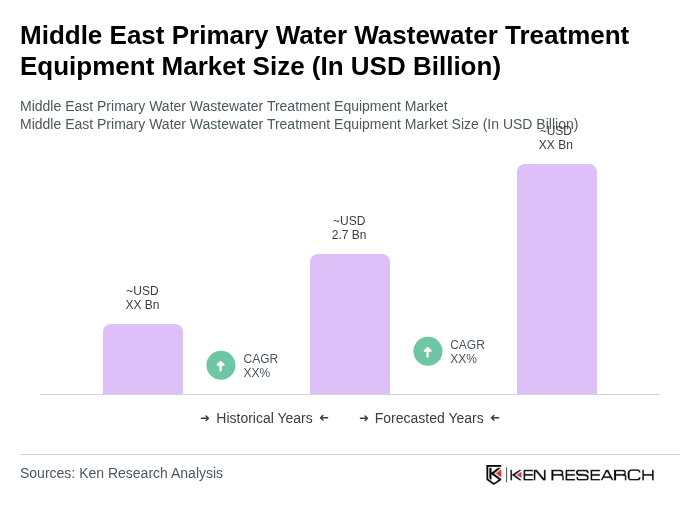
- The Middle East Primary Water Wastewater Treatment Equipment Market is valued at USD 2.7 billion, based on a five-year historical analysis. This growth is primarily driven by increasing urbanization, stringent environmental regulations, and the rising demand for efficient water management solutions in the region. The need for advanced wastewater treatment technologies has surged due to the growing population and industrial activities, necessitating investments in infrastructure and technology.
- Key players in this market include Saudi Arabia, the United Arab Emirates, and Qatar. These countries dominate the market due to their substantial investments in water infrastructure, driven by rapid urbanization and economic diversification efforts. The UAE's focus on sustainability and water conservation, along with Saudi Arabia's Vision 2030 initiative, further enhances their leadership in the wastewater treatment sector.
- The Wastewater Treatment Standards, 2021 issued by the Saudi Standards, Metrology and Quality Organization (SASO) require municipal wastewater treatment facilities to achieve effluent quality standards including biochemical oxygen demand not exceeding 20 mg/l and total suspended solids not exceeding 30 mg/l. This regulation establishes compliance requirements for treated effluent discharge and reuse, supporting water reuse applications and minimizing environmental pollution in line with national sustainability objectives.
Middle East Primary Water Wastewater Treatment Equipment Market Segmentation
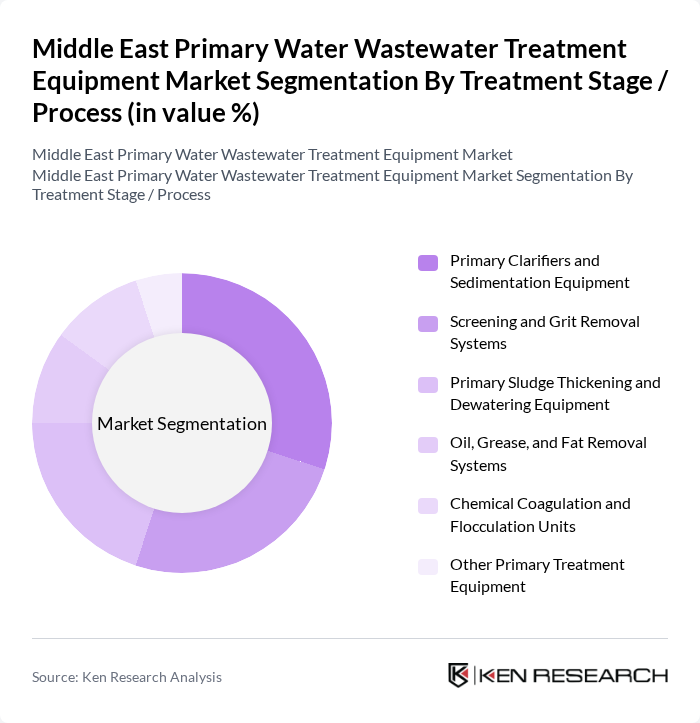
By Treatment Stage / Process:The treatment stage/process segment includes various methods employed in the initial stages of wastewater treatment. The primary clarifiers and sedimentation equipment are crucial for removing solids from wastewater, while screening and grit removal systems help eliminate larger debris. Primary sludge thickening and dewatering equipment are essential for managing sludge, and oil, grease, and fat removal systems are vital for treating industrial effluents. Chemical coagulation and flocculation units enhance the treatment process by promoting the aggregation of particles, while other primary treatment equipment encompasses additional technologies used in the initial treatment stages.
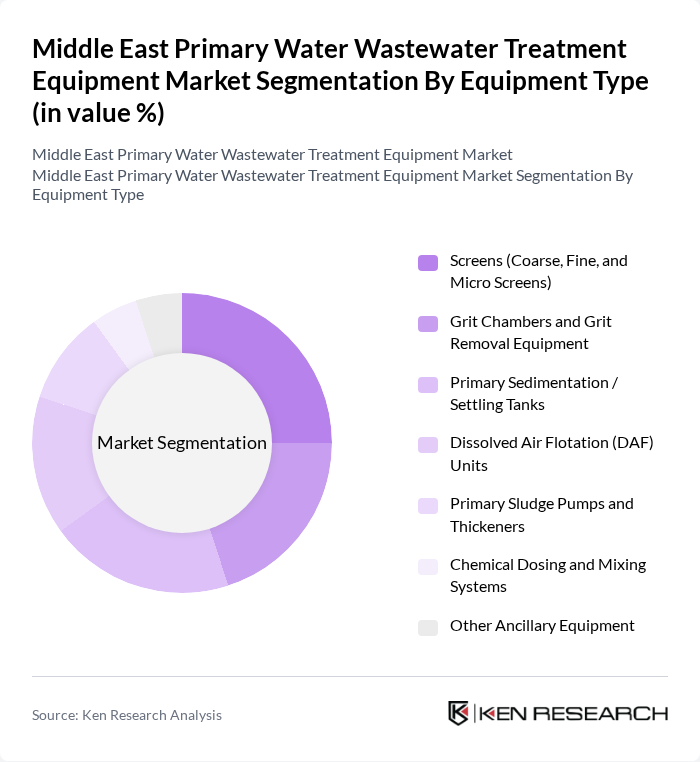
By Equipment Type:The equipment type segment encompasses various tools and machinery used in wastewater treatment processes. Screens, including coarse, fine, and micro screens, are essential for filtering out solids. Grit chambers and grit removal equipment are vital for separating heavier particles, while primary sedimentation/settling tanks facilitate the settling of solids. Dissolved air flotation (DAF) units are increasingly popular for their efficiency in removing suspended solids and oils. Primary sludge pumps and thickeners are crucial for managing sludge, and chemical dosing and mixing systems ensure optimal treatment conditions. Other ancillary equipment supports the primary treatment processes.
Middle East Primary Water Wastewater Treatment Equipment Market Competitive Landscape
The Middle East Primary Water Wastewater Treatment Equipment Market is characterized by a dynamic mix of regional and international players. Leading participants such as Veolia Water Technologies & Solutions Middle East, SUEZ International Middle East, Xylem Middle East & Africa, Metito Utilities Limited, Saudi Water Environment Technologies Co. (WETICO), Abu Dhabi Sewerage Services Company (ADSSC), ACWA Power – Water & Wastewater Assets, Doosan Enerbility (Water & Wastewater Division, Middle East), IDE Technologies Ltd., Aqualia MENA, Kurita Water Industries – Middle East Operations, Pentair Middle East, Aquatech International LLC – Middle East, BESIX Environment & Concessions (incl. BESIX Middle East), Black & Veatch – Middle East Water Business contribute to innovation, geographic expansion, and service delivery in this space.
Middle East Primary Water Wastewater Treatment Equipment Market Industry Analysis
Growth Drivers
- Increasing Water Scarcity:The Middle East faces severe water scarcity, with per capita water availability dropping to approximately 800 cubic meters annually, significantly below the global average of 6,000 cubic meters. This scarcity drives demand for advanced wastewater treatment solutions, as countries like Saudi Arabia and the UAE invest heavily in technologies to recycle and reuse water. The World Bank estimates that by the future, the region will require an additional 30% increase in water treatment capacity to meet growing needs.
- Government Initiatives for Water Conservation:Governments in the Middle East are implementing robust policies to enhance water conservation. For instance, the UAE's Water Security Strategy aims to reduce water consumption by 40% by the future. This initiative is supported by investments exceeding $2 billion in water infrastructure projects. Such government backing is crucial for the adoption of innovative wastewater treatment technologies, fostering a favorable environment for market growth.
- Technological Advancements in Treatment Processes:The adoption of cutting-edge technologies, such as membrane bioreactors and advanced oxidation processes, is revolutionizing wastewater treatment in the Middle East. The market for these technologies is projected to grow significantly, with investments in R&D expected to reach $600 million by the future. These advancements not only improve efficiency but also reduce operational costs, making them attractive options for municipalities and industries facing stringent water quality regulations.
Market Challenges
- High Initial Investment Costs:The high capital expenditure associated with establishing wastewater treatment facilities poses a significant barrier to market entry. For instance, the cost of constructing a modern wastewater treatment plant can exceed $15 million, deterring smaller municipalities from investing. This challenge is compounded by the need for ongoing maintenance and operational costs, which can strain budgets, particularly in less affluent regions of the Middle East.
- Regulatory Compliance Issues:Navigating the complex regulatory landscape in the Middle East can hinder the growth of the wastewater treatment market. Countries have varying standards for water quality and treatment processes, leading to confusion and potential non-compliance. For example, the Gulf Cooperation Council (GCC) countries have different regulations, which can complicate cross-border projects. This inconsistency can result in delays and increased costs for companies seeking to enter the market.
Middle East Primary Water Wastewater Treatment Equipment Market Future Outlook
The future of the Middle East primary water wastewater treatment equipment market appears promising, driven by increasing investments in sustainable water management solutions. As governments prioritize water security, the integration of smart technologies and IoT in water management systems is expected to enhance operational efficiency. Additionally, the rising demand for recycled water will further stimulate innovation in treatment processes, ensuring that the region can meet its water needs sustainably while addressing environmental concerns.
Market Opportunities
- Expansion of Desalination Projects:With over 70% of the world's desalination capacity located in the Middle East, the ongoing expansion of these projects presents significant opportunities. Investments in desalination are projected to exceed $20 billion by the future, creating demand for advanced treatment equipment that can efficiently process saline water into potable water.
- Investment in Smart Water Management Systems:The shift towards smart water management systems is gaining momentum, with projected investments reaching $2 billion by the future. These systems utilize IoT and AI technologies to optimize water usage and treatment processes, presenting a lucrative opportunity for companies specializing in innovative wastewater treatment solutions.
Scope of the Report
| Segment | Sub-Segments |
|---|---|
| By Treatment Stage / Process | Primary Clarifiers and Sedimentation Equipment Screening and Grit Removal Systems Primary Sludge Thickening and Dewatering Equipment Oil, Grease, and Fat Removal Systems Chemical Coagulation and Flocculation Units Other Primary Treatment Equipment |
| By Equipment Type | Screens (Coarse, Fine, and Micro Screens) Grit Chambers and Grit Removal Equipment Primary Sedimentation / Settling Tanks Dissolved Air Flotation (DAF) Units Primary Sludge Pumps and Thickeners Chemical Dosing and Mixing Systems Other Ancillary Equipment |
| By End-User | Municipal Wastewater Treatment Plants Oil & Gas and Petrochemical Facilities Power Generation and Utilities Food & Beverage and Industrial Processing Other Industrial and Commercial Users |
| By Application | Primary Treatment of Municipal Sewage Primary Treatment of Industrial Effluent Pretreatment for Desalination and Water Reuse Primary Treatment in Onsite / Decentralized Systems Other Primary Treatment Applications |
| By Technology Configuration | Conventional Gravity-Based Primary Treatment High-Rate Primary Treatment Systems Physico-Chemical Primary Treatment Systems Compact / Package Primary Treatment Plants Other Technology Configurations |
| By Ownership & Investment Model | Publicly Owned Treatment Works (POTWs) Privately Owned Industrial Plants EPC / Turnkey Projects Public-Private Partnership (PPP / BOT / BOO) Projects Other Ownership Structures |
| By Country | Saudi Arabia United Arab Emirates Qatar Kuwait Oman Bahrain Rest of Middle East |
Key Target Audience
Investors and Venture Capitalist Firms
Government and Regulatory Bodies (e.g., Ministry of Water Resources, Environmental Protection Agency)
Manufacturers and Producers of Water Treatment Equipment
Distributors and Retailers of Water Treatment Solutions
Water Utility Companies
Technology Providers for Water Treatment Solutions
Industry Associations (e.g., Water Environment Federation, International Water Association)
Financial Institutions and Funding Agencies
Players Mentioned in the Report:
Veolia Water Technologies & Solutions Middle East
SUEZ International Middle East
Xylem Middle East & Africa
Metito Utilities Limited
Saudi Water Environment Technologies Co. (WETICO)
Abu Dhabi Sewerage Services Company (ADSSC)
ACWA Power Water & Wastewater Assets
Doosan Enerbility (Water & Wastewater Division, Middle East)
IDE Technologies Ltd.
Aqualia MENA
Kurita Water Industries Middle East Operations
Pentair Middle East
Aquatech International LLC Middle East
BESIX Environment & Concessions (incl. BESIX Middle East)
Black & Veatch Middle East Water Business
Table of Contents
Market Assessment Phase
1. Executive Summary and Approach
2. Middle East Primary Water Wastewater Treatment Equipment Market Overview
2.1 Key Insights and Strategic Recommendations
2.2 Middle East Primary Water Wastewater Treatment Equipment Market Overview
2.3 Definition and Scope
2.4 Evolution of Market Ecosystem
2.5 Timeline of Key Regulatory Milestones
2.6 Value Chain & Stakeholder Mapping
2.7 Business Cycle Analysis
2.8 Policy & Incentive Landscape
3. Middle East Primary Water Wastewater Treatment Equipment Market Analysis
3.1 Growth Drivers
3.1.1 Increasing Water Scarcity
3.1.2 Government Initiatives for Water Conservation
3.1.3 Technological Advancements in Treatment Processes
3.1.4 Rising Environmental Awareness
3.2 Market Challenges
3.2.1 High Initial Investment Costs
3.2.2 Regulatory Compliance Issues
3.2.3 Limited Infrastructure in Some Regions
3.2.4 Competition from Alternative Solutions
3.3 Market Opportunities
3.3.1 Expansion of Desalination Projects
3.3.2 Investment in Smart Water Management Systems
3.3.3 Partnerships with Private Sector
3.3.4 Growing Demand for Recycled Water
3.4 Market Trends
3.4.1 Adoption of IoT in Water Management
3.4.2 Shift Towards Sustainable Practices
3.4.3 Increasing Use of Membrane Technologies
3.4.4 Focus on Energy-Efficient Solutions
3.5 Government Regulation
3.5.1 Water Quality Standards Enforcement
3.5.2 Incentives for Renewable Energy Use
3.5.3 Regulations on Wastewater Discharge
3.5.4 Support for Research and Development
4. SWOT Analysis
5. Stakeholder Analysis
6. Porter's Five Forces Analysis
7. Middle East Primary Water Wastewater Treatment Equipment Market Size, 2019-2024
7.1 By Value
7.2 By Volume
7.3 By Average Selling Price
8. Middle East Primary Water Wastewater Treatment Equipment Market Segmentation
8.1 By Treatment Stage / Process
8.1.1 Primary Clarifiers and Sedimentation Equipment
8.1.2 Screening and Grit Removal Systems
8.1.3 Primary Sludge Thickening and Dewatering Equipment
8.1.4 Oil, Grease, and Fat Removal Systems
8.1.5 Chemical Coagulation and Flocculation Units
8.1.6 Other Primary Treatment Equipment
8.2 By Equipment Type
8.2.1 Screens (Coarse, Fine, and Micro Screens)
8.2.2 Grit Chambers and Grit Removal Equipment
8.2.3 Primary Sedimentation / Settling Tanks
8.2.4 Dissolved Air Flotation (DAF) Units
8.2.5 Primary Sludge Pumps and Thickeners
8.2.6 Chemical Dosing and Mixing Systems
8.2.7 Other Ancillary Equipment
8.3 By End-User
8.3.1 Municipal Wastewater Treatment Plants
8.3.2 Oil & Gas and Petrochemical Facilities
8.3.3 Power Generation and Utilities
8.3.4 Food & Beverage and Industrial Processing
8.3.5 Other Industrial and Commercial Users
8.4 By Application
8.4.1 Primary Treatment of Municipal Sewage
8.4.2 Primary Treatment of Industrial Effluent
8.4.3 Pretreatment for Desalination and Water Reuse
8.4.4 Primary Treatment in Onsite / Decentralized Systems
8.4.5 Other Primary Treatment Applications
8.5 By Technology Configuration
8.5.1 Conventional Gravity-Based Primary Treatment
8.5.2 High-Rate Primary Treatment Systems
8.5.3 Physico-Chemical Primary Treatment Systems
8.5.4 Compact / Package Primary Treatment Plants
8.5.5 Other Technology Configurations
8.6 By Ownership & Investment Model
8.6.1 Publicly Owned Treatment Works (POTWs)
8.6.2 Privately Owned Industrial Plants
8.6.3 EPC / Turnkey Projects
8.6.4 Public-Private Partnership (PPP / BOT / BOO) Projects
8.6.5 Other Ownership Structures
8.7 By Country
8.7.1 Saudi Arabia
8.7.2 United Arab Emirates
8.7.3 Qatar
8.7.4 Kuwait
8.7.5 Oman
8.7.6 Bahrain
8.7.7 Rest of Middle East
9. Middle East Primary Water Wastewater Treatment Equipment Market Competitive Analysis
9.1 Market Share of Key Players
9.2 Cross Comparison of Key Players
9.2.1 Company Name
9.2.2 Regional Revenue from Primary Water & Wastewater Treatment Equipment (USD)
9.2.3 Share of Primary Treatment in Total Middle East Water & Wastewater Equipment Revenue (%)
9.2.4 Installed Primary Treatment Capacity in Middle East (m³/day)
9.2.5 Number of Active Primary Treatment Projects in Middle East
9.2.6 Exposure by End-User Segment (Municipal vs. Industrial Revenue Mix)
9.2.7 Order Backlog and New Order Intake in the Region
9.2.8 EBITDA Margin from Middle East Projects (%)
9.2.9 Average Contract Size and Project Duration
9.2.10 R&D and Technology Partnerships Focused on Primary Treatment
9.2.11 Geographic Footprint within Middle East (Countries Served)
9.2.12 After-Sales & Operations and Maintenance (O&M) Revenue Share (%)
9.3 SWOT Analysis of Top Players
9.4 Pricing Analysis
9.5 Detailed Profile of Major Companies
9.5.1 Veolia Water Technologies & Solutions Middle East
9.5.2 SUEZ International Middle East
9.5.3 Xylem Middle East & Africa
9.5.4 Metito Utilities Limited
9.5.5 Saudi Water Environment Technologies Co. (WETICO)
9.5.6 Abu Dhabi Sewerage Services Company (ADSSC)
9.5.7 ACWA Power – Water & Wastewater Assets
9.5.8 Doosan Enerbility (Water & Wastewater Division, Middle East)
9.5.9 IDE Technologies Ltd.
9.5.10 Aqualia MENA
9.5.11 Kurita Water Industries – Middle East Operations
9.5.12 Pentair Middle East
9.5.13 Aquatech International LLC – Middle East
9.5.14 BESIX Environment & Concessions (incl. BESIX Middle East)
9.5.15 Black & Veatch – Middle East Water Business
10. Middle East Primary Water Wastewater Treatment Equipment Market End-User Analysis
10.1 Procurement Behavior of Key Ministries
10.1.1 Ministry of Water Resources
10.1.2 Ministry of Environment
10.1.3 Ministry of Agriculture
10.1.4 Ministry of Urban Development
10.2 Corporate Spend on Infrastructure & Energy
10.2.1 Investment Trends in Water Infrastructure
10.2.2 Budget Allocations for Wastewater Treatment
10.2.3 Corporate Social Responsibility Initiatives
10.2.4 Partnerships with NGOs
10.3 Pain Point Analysis by End-User Category
10.3.1 Municipal Challenges
10.3.2 Industrial Compliance Issues
10.3.3 Commercial Water Management
10.3.4 Agricultural Water Scarcity
10.4 User Readiness for Adoption
10.4.1 Awareness of Treatment Technologies
10.4.2 Financial Readiness
10.4.3 Technical Expertise
10.4.4 Regulatory Compliance Understanding
10.5 Post-Deployment ROI and Use Case Expansion
10.5.1 Performance Metrics
10.5.2 Cost Savings Analysis
10.5.3 User Feedback Mechanisms
10.5.4 Future Expansion Plans
11. Middle East Primary Water Wastewater Treatment Equipment Market Future Size, 2025-2030
11.1 By Value
11.2 By Volume
11.3 By Average Selling Price
Go-To-Market Strategy Phase
1. Whitespace Analysis + Business Model Canvas
1.1 Market Gaps Identification
1.2 Business Model Framework
2. Marketing and Positioning Recommendations
2.1 Branding Strategies
2.2 Product USPs
3. Distribution Plan
3.1 Urban Retail Strategies
3.2 Rural NGO Tie-ups
4. Channel & Pricing Gaps
4.1 Underserved Routes
4.2 Pricing Bands
5. Unmet Demand & Latent Needs
5.1 Category Gaps
5.2 Consumer Segments
6. Customer Relationship
6.1 Loyalty Programs
6.2 After-sales Service
7. Value Proposition
7.1 Sustainability Initiatives
7.2 Integrated Supply Chains
8. Key Activities
8.1 Regulatory Compliance
8.2 Branding Efforts
8.3 Distribution Setup
9. Entry Strategy Evaluation
9.1 Domestic Market Entry Strategy
9.1.1 Product Mix
9.1.2 Pricing Band
9.1.3 Packaging
9.2 Export Entry Strategy
9.2.1 Target Countries
9.2.2 Compliance Roadmap
10. Entry Mode Assessment
10.1 Joint Ventures
10.2 Greenfield Investments
10.3 Mergers & Acquisitions
10.4 Distributor Model
11. Capital and Timeline Estimation
11.1 Capital Requirements
11.2 Timelines
12. Control vs Risk Trade-Off
12.1 Ownership vs Partnerships
13. Profitability Outlook
13.1 Breakeven Analysis
13.2 Long-term Sustainability
14. Potential Partner List
14.1 Distributors
14.2 Joint Ventures
14.3 Acquisition Targets
15. Execution Roadmap
15.1 Phased Plan for Market Entry
15.1.1 Market Setup
15.1.2 Market Entry
15.1.3 Growth Acceleration
15.1.4 Scale & Stabilize
15.2 Key Activities and Milestones
15.2.1 Milestone Planning
15.2.2 Activity Tracking
Research Methodology
Phase 1: Approach1
Desk Research
- Analysis of industry reports from regional water management authorities
- Review of market studies published by environmental NGOs and think tanks
- Examination of government publications on water treatment regulations and standards
Primary Research
- Interviews with key stakeholders in municipal water treatment facilities
- Surveys conducted with equipment manufacturers and suppliers in the region
- Field interviews with engineers and project managers involved in wastewater projects
Validation & Triangulation
- Cross-validation of findings through multiple data sources including trade publications
- Triangulation of insights from primary interviews with secondary data trends
- Sanity checks through expert panels comprising industry veterans and academics
Phase 2: Market Size Estimation1
Top-down Assessment
- Estimation of market size based on national water treatment expenditure reports
- Segmentation by technology type (e.g., membrane filtration, biological treatment)
- Incorporation of regional water scarcity initiatives and funding allocations
Bottom-up Modeling
- Volume estimates derived from equipment sales data from leading manufacturers
- Operational cost analysis based on installation and maintenance expenses
- Calculation of market size based on unit sales and average pricing models
Forecasting & Scenario Analysis
- Multi-variable regression analysis incorporating population growth and urbanization rates
- Scenario modeling based on potential regulatory changes and technological advancements
- Development of baseline, optimistic, and pessimistic forecasts through 2030
Phase 3: CATI Sample Composition1
| Scope Item/Segment | Sample Size | Target Respondent Profiles |
|---|---|---|
| Municipal Water Treatment Facilities | 120 | Facility Managers, Water Quality Analysts |
| Industrial Wastewater Treatment Plants | 100 | Operations Managers, Environmental Compliance Officers |
| Equipment Manufacturers | 90 | Sales Directors, Product Development Engineers |
| Consulting Firms in Water Management | 80 | Consultants, Project Managers |
| Government Regulatory Bodies | 70 | Policy Makers, Regulatory Affairs Specialists |
Frequently Asked Questions
What is the current value of the Middle East Primary Water Wastewater Treatment Equipment Market?
The Middle East Primary Water Wastewater Treatment Equipment Market is valued at approximately USD 2.7 billion, reflecting significant growth driven by urbanization, environmental regulations, and the demand for efficient water management solutions in the region.
What factors are driving the growth of the wastewater treatment equipment market in the Middle East?
Which countries are the leading players in the Middle East wastewater treatment market?
What are the regulatory standards for wastewater treatment in the Middle East?
Other Regional/Country Reports
Indonesia Primary Water Wastewater Treatment Equipment Market
Malaysia Primary Water Wastewater Treatment Equipment Market
KSA Primary Water Wastewater Treatment Equipment Market
APAC Primary Water Wastewater Treatment Equipment Market
SEA Primary Water Wastewater Treatment Equipment Market
Vietnam Primary Water Wastewater Treatment Equipment Market
Other Adjacent Reports
Kuwait Desalination Equipment Market
South Korea Water Recycling Systems Market
South Korea Sludge Management Equipment Market
Oman Industrial Wastewater Treatment Market
South Africa Municipal Water Supply Equipment Market
Japan Water Filtration Systems Market
Egypt Chemical Dosing Equipment Market
Japan Membrane Bioreactor Market
Egypt Water Purification Chemicals Market
UAE Smart Water Management Systems Market
Why Buy From Us?

What makes us stand out is that our consultants follow Robust, Refine and Result (RRR) methodology. Robust for clear definitions, approaches and sanity checking, Refine for differentiating respondents' facts and opinions, and Result for presenting data with story.

We have set a benchmark in the industry by offering our clients with syndicated and customized market research reports featuring coverage of entire market as well as meticulous research and analyst insights.

While we don't replace traditional research, we flip the method upside down. Our dual approach of Top Bottom & Bottom Top ensures quality deliverable by not just verifying company fundamentals but also looking at the sector and macroeconomic factors.

With one step in the future, our research team constantly tries to show you the bigger picture. We help with some of the tough questions you may encounter along the way: How is the industry positioned? Best marketing channel? KPI's of competitors? By aligning every element, we help maximize success.

Our report gives you instant access to the answers and sources that other companies might choose to hide. We elaborate each steps of research methodology we have used and showcase you the sample size to earn your trust.

If you need any support, we are here! We pride ourselves on universe strength, data quality, and quick, friendly, and professional service.