About the Report
Base Year 2024Middle East Shopping Centers Market Overview
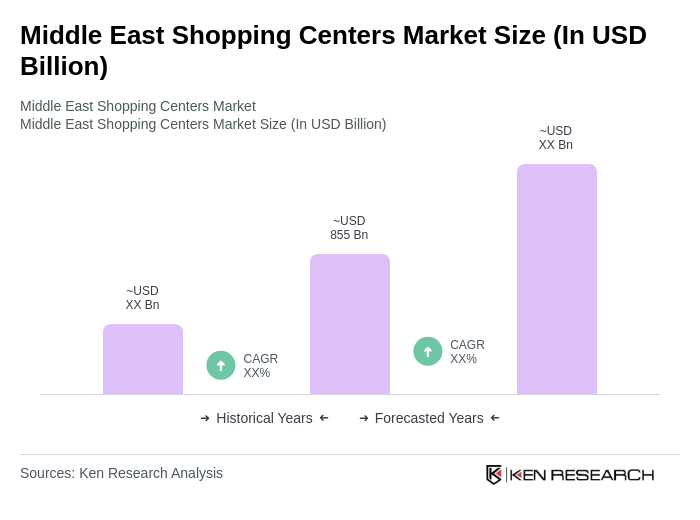
- The Middle East Shopping Centers Market is valued at USD 855 billion, based on a five-year historical analysis. This growth is primarily driven by increasing urbanization, rising disposable incomes, and a shift in consumer preferences towards experiential shopping. The expansion of retail spaces and the integration of entertainment options within shopping centers have further fueled this market's growth. Additionally, rapid digital adoption, coupled with rising consumer spending power and the growth of middle-class populations in urban areas, continues to accelerate market expansion, with retailers increasingly investing in omnichannel solutions to bridge online and offline experiences.
- Key players in this market include the United Arab Emirates, Saudi Arabia, and Qatar. The UAE, particularly Dubai, is a hub for luxury shopping and tourism, attracting millions of visitors annually. Saudi Arabia's Vision 2030 initiative aims to diversify the economy, leading to significant investments in retail infrastructure. Qatar's growing population and economic stability also contribute to its prominence in the shopping center market. The MENA region encompasses diverse economies from wealthy Gulf Cooperation Council countries such as the UAE and Saudi Arabia to developing markets, creating varied opportunities across the shopping center sector.
- The UAE government has implemented comprehensive regulations to enhance the retail sector's sustainability through the UAE Clean Energy Strategy 2050 and related emirate-level directives. These regulations include mandates for shopping centers to adopt energy-efficient technologies and waste management practices, establishing specific compliance requirements for environmental performance standards. Such regulations are designed to promote environmentally friendly practices while ensuring the long-term viability of shopping centers in the region, with shopping centers serving as critical anchors for sustainable urban development initiatives.
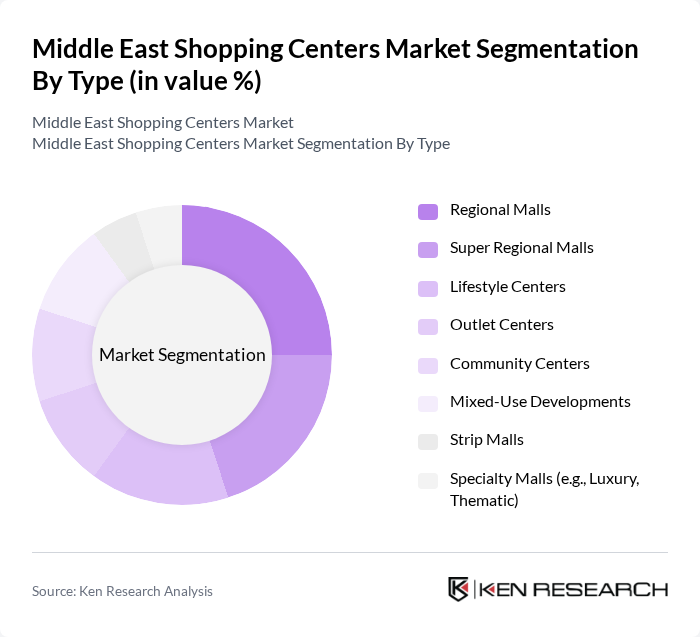
Middle East Shopping Centers Market Segmentation
By Type:The shopping centers market can be segmented into various types, including Regional Malls, Super Regional Malls, Lifestyle Centers, Outlet Centers, Community Centers, Mixed-Use Developments, Strip Malls, and Specialty Malls (e.g., Luxury, Thematic). Each type serves different consumer needs and preferences, influencing their market presence and growth.
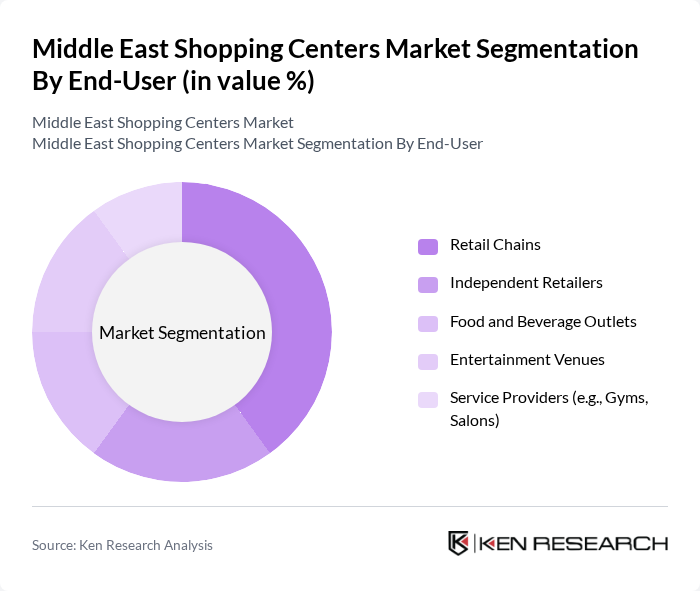
By End-User:The end-user segmentation includes Retail Chains, Independent Retailers, Food and Beverage Outlets, Entertainment Venues, and Service Providers (e.g., Gyms, Salons). Each end-user category plays a crucial role in shaping the shopping experience and driving foot traffic to shopping centers.
Middle East Shopping Centers Market Competitive Landscape
The Middle East Shopping Centers Market is characterized by a dynamic mix of regional and international players. Leading participants such as Majid Al Futtaim Properties, Emaar Malls, Al-Futtaim Group, Al Habtoor Group, Gulf Related, Nakheel Properties, Meraas Holding, Landmark Group, Al Othaim Holding, Al Ain Mall, The Avenues (Kuwait), Mall of the Emirates, City Centre (Majid Al Futtaim), Ibn Battuta Mall, Yas Mall, Doha Festival City, Red Sea Mall, Marina Mall Abu Dhabi, Sahara Centre, and Dubai Festival City Mall contribute to innovation, geographic expansion, and service delivery in this space.
Middle East Shopping Centers Market Industry Analysis
Growth Drivers
- Increasing Urbanization:The Middle East is experiencing rapid urbanization, with urban populations projected to reach 85% in future, up from approximately 80% in recent years. This shift is driving demand for shopping centers, as urban dwellers seek convenient access to retail and entertainment options. Cities like Dubai and Riyadh are expanding their infrastructure, with over 30 new shopping centers planned, contributing to an estimated increase in retail space of 1.5 million square meters in future, according to the Middle East Council of Shopping Centres.
- Rising Disposable Incomes:The average disposable income in the Middle East is expected to rise to $20,000 per capita in future, up from $15,000 in recent years. This increase is primarily driven by economic diversification efforts in countries like Saudi Arabia and the UAE. As consumers have more disposable income, they are likely to spend more on retail experiences, leading to a projected growth in shopping center foot traffic by 10% annually, according to the World Bank.
- Expansion of Retail Brands:The Middle East is witnessing a surge in international retail brands entering the market, with over 200 new brands expected to launch in future. This influx is supported by favorable trade agreements and a growing consumer base. Notably, the UAE has seen a significant increase in retail brand presence in recent years, with major players like Zara and H&M expanding their footprint, thus enhancing the attractiveness of shopping centers as retail destinations.
Market Challenges
- Economic Fluctuations:The Middle East's economy is vulnerable to fluctuations in oil prices, which can impact consumer spending. Oil prices have averaged between $75 and $85 per barrel in recent periods, but projections indicate potential declines in future. This volatility can lead to reduced disposable incomes and lower foot traffic in shopping centers, as consumers tighten their budgets in response to economic uncertainty, according to the International Monetary Fund.
- Competition from E-commerce:The rise of e-commerce in the Middle East is a significant challenge for traditional shopping centers. Online retail sales are estimated to have reached approximately $37 billion in recent years, with continued growth expected in future. This shift in consumer behavior is forcing shopping centers to adapt by enhancing their in-store experiences and integrating online and offline shopping channels, as consumers increasingly prefer the convenience of online shopping, according to the United Nations Conference on Trade and Development.
Middle East Shopping Centers Market Future Outlook
The future of the Middle East shopping centers market appears promising, driven by urbanization and rising incomes. As consumers increasingly seek unique experiences, shopping centers are likely to evolve into lifestyle hubs that offer entertainment, dining, and retail. Additionally, the integration of technology, such as augmented reality and mobile payment systems, will enhance customer engagement. The focus on sustainability will also shape future developments, with shopping centers adopting eco-friendly designs and practices to attract environmentally conscious consumers.
Market Opportunities
- Development of Mixed-Use Spaces:There is a growing opportunity for shopping centers to develop mixed-use spaces that combine retail, residential, and office environments. This trend is supported by urban planning initiatives in cities like Abu Dhabi, where mixed-use developments are projected to increase significantly in future, creating vibrant communities that attract diverse consumer demographics.
- Integration of Technology in Retail:The integration of technology in shopping centers presents significant opportunities for enhancing customer experiences. With substantial investment in smart technologies expected in future, shopping centers can leverage data analytics and IoT to personalize shopping experiences, streamline operations, and improve customer engagement, thus driving foot traffic and sales.
Scope of the Report
| Segment | Sub-Segments |
|---|---|
| By Type | Regional Malls Super Regional Malls Lifestyle Centers Outlet Centers Community Centers Mixed-Use Developments Strip Malls Specialty Malls (e.g., Luxury, Thematic) |
| By End-User | Retail Chains Independent Retailers Food and Beverage Outlets Entertainment Venues Service Providers (e.g., Gyms, Salons) |
| By Location | Urban Areas Suburban Areas Rural Areas |
| By Size | Small (Less than 50,000 sq ft) Medium (50,000 - 150,000 sq ft) Large (More than 150,000 sq ft) |
| By Ownership Type | Publicly Owned Privately Owned Joint Ventures |
| By Investment Type | Foreign Direct Investment Domestic Investment Public-Private Partnerships |
| By Consumer Demographics | Age Groups Income Levels Family Size Tourist vs. Resident Footfall Nationality (Local vs. Expat) |
Key Target Audience
Investors and Venture Capitalist Firms
Government and Regulatory Bodies (e.g., Ministry of Commerce and Investment, Urban Planning Authorities)
Real Estate Developers
Shopping Center Management Companies
Retail Chains and Franchisors
Construction and Engineering Firms
Marketing and Advertising Agencies
Financial Institutions and Banks
Players Mentioned in the Report:
Majid Al Futtaim Properties
Emaar Malls
Al-Futtaim Group
Al Habtoor Group
Gulf Related
Nakheel Properties
Meraas Holding
Landmark Group
Al Othaim Holding
Al Ain Mall
The Avenues (Kuwait)
Mall of the Emirates
City Centre (Majid Al Futtaim)
Ibn Battuta Mall
Yas Mall
Doha Festival City
Red Sea Mall
Marina Mall Abu Dhabi
Sahara Centre
Dubai Festival City Mall
Table of Contents
Market Assessment Phase
1. Executive Summary and Approach
2. Middle East Shopping Centers Market Overview
2.1 Key Insights and Strategic Recommendations
2.2 Middle East Shopping Centers Market Overview
2.3 Definition and Scope
2.4 Evolution of Market Ecosystem
2.5 Timeline of Key Regulatory Milestones
2.6 Value Chain & Stakeholder Mapping
2.7 Business Cycle Analysis
2.8 Policy & Incentive Landscape
3. Middle East Shopping Centers Market Analysis
3.1 Growth Drivers
3.1.1 Increasing Urbanization
3.1.2 Rising Disposable Incomes
3.1.3 Expansion of Retail Brands
3.1.4 Government Initiatives for Tourism
3.2 Market Challenges
3.2.1 Economic Fluctuations
3.2.2 Competition from E-commerce
3.2.3 Regulatory Hurdles
3.2.4 Changing Consumer Preferences
3.3 Market Opportunities
3.3.1 Development of Mixed-Use Spaces
3.3.2 Integration of Technology in Retail
3.3.3 Sustainable Shopping Center Designs
3.3.4 Expansion into Underserved Markets
3.4 Market Trends
3.4.1 Rise of Experiential Retail
3.4.2 Focus on Sustainability
3.4.3 Growth of Omnichannel Retailing
3.4.4 Increased Investment in Smart Technologies
3.5 Government Regulation
3.5.1 Zoning Laws and Land Use Regulations
3.5.2 Retail Licensing Requirements
3.5.3 Consumer Protection Laws
3.5.4 Environmental Regulations
4. SWOT Analysis
5. Stakeholder Analysis
6. Porter's Five Forces Analysis
7. Middle East Shopping Centers Market Market Size, 2019-2024
7.1 By Value
7.2 By Volume
7.3 By Average Selling Price
8. Middle East Shopping Centers Market Segmentation
8.1 By Type
8.1.1 Regional Malls
8.1.2 Super Regional Malls
8.1.3 Lifestyle Centers
8.1.4 Outlet Centers
8.1.5 Community Centers
8.1.6 Mixed-Use Developments
8.1.7 Strip Malls
8.1.8 Specialty Malls (e.g., Luxury, Thematic)
8.2 By End-User
8.2.1 Retail Chains
8.2.2 Independent Retailers
8.2.3 Food and Beverage Outlets
8.2.4 Entertainment Venues
8.2.5 Service Providers (e.g., Gyms, Salons)
8.3 By Location
8.3.1 Urban Areas
8.3.2 Suburban Areas
8.3.3 Rural Areas
8.4 By Size
8.4.1 Small (Less than 50,000 sq ft)
8.4.2 Medium (50,000 - 150,000 sq ft)
8.4.3 Large (More than 150,000 sq ft)
8.5 By Ownership Type
8.5.1 Publicly Owned
8.5.2 Privately Owned
8.5.3 Joint Ventures
8.6 By Investment Type
8.6.1 Foreign Direct Investment
8.6.2 Domestic Investment
8.6.3 Public-Private Partnerships
8.7 By Consumer Demographics
8.7.1 Age Groups
8.7.2 Income Levels
8.7.3 Family Size
8.7.4 Tourist vs. Resident Footfall
8.7.5 Nationality (Local vs. Expat)
9. Middle East Shopping Centers Market Competitive Analysis
9.1 Market Share of Key Players
9.2 Cross Comparison of Key Players
9.2.1 Company Name
9.2.2 Group Size (Large, Medium, or Small as per industry convention)
9.2.3 Total Gross Leasable Area (GLA)
9.2.4 Revenue Growth Rate
9.2.5 Annual Customer Footfall
9.2.6 Average Lease Duration
9.2.7 Occupancy Rate
9.2.8 Net Operating Income (NOI)
9.2.9 Marketing Spend as Percentage of Revenue
9.2.10 Customer Satisfaction Index
9.2.11 Return on Investment (ROI)
9.2.12 Tenant Mix Diversity
9.2.13 Sustainability/ESG Ratings
9.3 SWOT Analysis of Top Players
9.4 Pricing Analysis
9.5 Detailed Profile of Major Companies
9.5.1 Majid Al Futtaim Properties
9.5.2 Emaar Malls
9.5.3 Al-Futtaim Group
9.5.4 Al Habtoor Group
9.5.5 Gulf Related
9.5.6 Nakheel Properties
9.5.7 Meraas Holding
9.5.8 Landmark Group
9.5.9 Al Othaim Holding
9.5.10 Al Ain Mall
9.5.11 The Avenues (Kuwait)
9.5.12 Mall of the Emirates
9.5.13 City Centre (Majid Al Futtaim)
9.5.14 Ibn Battuta Mall
9.5.15 Yas Mall
9.5.16 Doha Festival City
9.5.17 Red Sea Mall
9.5.18 Marina Mall Abu Dhabi
9.5.19 Sahara Centre
9.5.20 Dubai Festival City Mall
10. Middle East Shopping Centers Market End-User Analysis
10.1 Procurement Behavior of Key Ministries
10.1.1 Budget Allocation Trends
10.1.2 Procurement Processes
10.1.3 Key Decision Makers
10.2 Corporate Spend on Infrastructure & Energy
10.2.1 Investment Priorities
10.2.2 Spending Patterns
10.2.3 Infrastructure Development Plans
10.3 Pain Point Analysis by End-User Category
10.3.1 Retailer Challenges
10.3.2 Consumer Preferences
10.3.3 Operational Hurdles
10.4 User Readiness for Adoption
10.4.1 Technology Adoption Rates
10.4.2 Training and Support Needs
10.4.3 Market Awareness Levels
10.5 Post-Deployment ROI and Use Case Expansion
10.5.1 Performance Metrics
10.5.2 Case Studies
10.5.3 Future Expansion Plans
11. Middle East Shopping Centers Market Future Size, 2025-2030
11.1 By Value
11.2 By Volume
11.3 By Average Selling Price
Go-To-Market Strategy Phase
1. Whitespace Analysis + Business Model Canvas
1.1 Market Gaps Identification
1.2 Business Model Components
1.3 Value Proposition Canvas
1.4 Competitive Landscape Analysis
1.5 Customer Segmentation
1.6 Revenue Streams
1.7 Cost Structure
2. Marketing and Positioning Recommendations
2.1 Branding Strategies
2.2 Product USPs
2.3 Target Audience Identification
2.4 Marketing Channels
2.5 Promotional Activities
2.6 Customer Engagement Strategies
3. Distribution Plan
3.1 Urban Retail Strategies
3.2 Rural NGO Tie-ups
3.3 Distribution Channels
3.4 Logistics and Supply Chain
3.5 Partnership Opportunities
4. Channel & Pricing Gaps
4.1 Underserved Routes
4.2 Pricing Bands
4.3 Competitive Pricing Analysis
4.4 Value-Based Pricing Strategies
4.5 Discount and Promotion Strategies
5. Unmet Demand & Latent Needs
5.1 Category Gaps
5.2 Consumer Segments
5.3 Emerging Trends
5.4 Product Development Opportunities
5.5 Market Entry Barriers
6. Customer Relationship
6.1 Loyalty Programs
6.2 After-sales Service
6.3 Customer Feedback Mechanisms
6.4 Community Engagement
6.5 Customer Retention Strategies
7. Value Proposition
7.1 Sustainability Initiatives
7.2 Integrated Supply Chains
7.3 Unique Selling Points
7.4 Customer-Centric Approach
7.5 Competitive Advantages
8. Key Activities
8.1 Regulatory Compliance
8.2 Branding Initiatives
8.3 Distribution Setup
8.4 Market Research Activities
8.5 Training and Development
9. Entry Strategy Evaluation
9.1 Domestic Market Entry Strategy
9.1.1 Product Mix
9.1.2 Pricing Band
9.1.3 Packaging
9.2 Export Entry Strategy
9.2.1 Target Countries
9.2.2 Compliance Roadmap
10. Entry Mode Assessment
10.1 Joint Ventures
10.2 Greenfield Investments
10.3 Mergers & Acquisitions
10.4 Distributor Model
11. Capital and Timeline Estimation
11.1 Capital Requirements
11.2 Timelines
12. Control vs Risk Trade-Off
12.1 Ownership vs Partnerships
13. Profitability Outlook
13.1 Breakeven Analysis
13.2 Long-term Sustainability
14. Potential Partner List
14.1 Distributors
14.2 Joint Ventures
14.3 Acquisition Targets
15. Execution Roadmap
15.1 Phased Plan for Market Entry
15.1.1 Market Setup
15.1.2 Market Entry
15.1.3 Growth Acceleration
15.1.4 Scale & Stabilize
15.2 Key Activities and Milestones
15.2.1 Milestone Planning
15.2.2 Activity Scheduling
Research Methodology
Phase 1: Approach1
Desk Research
- Analysis of market reports from industry associations and government publications
- Review of financial statements and annual reports from leading shopping center developers
- Examination of demographic and economic data from national statistics agencies
Primary Research
- Interviews with shopping center managers and operators across the Middle East
- Surveys targeting retail brand representatives and leasing agents
- Focus groups with consumers to understand shopping preferences and behaviors
Validation & Triangulation
- Cross-validation of findings through multiple data sources, including trade publications and expert opinions
- Triangulation of qualitative insights from interviews with quantitative data from surveys
- Sanity checks through expert panel reviews comprising industry veterans
Phase 2: Market Size Estimation1
Top-down Assessment
- Estimation of total retail sales in the Middle East as a basis for shopping center revenue
- Segmentation of market size by country and shopping center type (e.g., malls, lifestyle centers)
- Incorporation of tourism and expatriate spending patterns into market size calculations
Bottom-up Modeling
- Collection of data on average footfall and sales per square meter from existing shopping centers
- Estimation of occupancy rates and rental yields from interviews with property managers
- Calculation of total market size based on aggregated data from individual shopping centers
Forecasting & Scenario Analysis
- Multi-factor regression analysis incorporating economic indicators and consumer spending trends
- Scenario modeling based on potential impacts of geopolitical stability and economic reforms
- Development of baseline, optimistic, and pessimistic forecasts through 2030
Phase 3: CATI Sample Composition1
| Scope Item/Segment | Sample Size | Target Respondent Profiles |
|---|---|---|
| Shopping Center Management | 100 | Center Managers, Operations Directors |
| Retail Brand Representation | 80 | Brand Managers, Retail Executives |
| Consumer Shopping Behavior | 120 | Frequent Shoppers, Mall Visitors |
| Leasing and Property Management | 60 | Leasing Agents, Property Managers |
| Market Trends and Insights | 50 | Industry Analysts, Economic Advisors |
Frequently Asked Questions
What is the current value of the Middle East Shopping Centers Market?
The Middle East Shopping Centers Market is valued at approximately USD 855 billion, driven by factors such as urbanization, rising disposable incomes, and a growing preference for experiential shopping among consumers.
Which countries are key players in the Middle East Shopping Centers Market?
What are the main types of shopping centers in the Middle East?
How is urbanization affecting the shopping centers market in the Middle East?
Other Regional/Country Reports
Indonesia Shopping Centers Market
Malaysia Shopping Centers Market
KSA Shopping Centers Market
APAC Shopping Centers Market
SEA Shopping Centers Market
Vietnam Shopping Centers Market
Other Adjacent Reports
Thailand Commercial Real Estate Market
Kuwait Retail Technology Market
Philippines E-Commerce Market
KSA Tourism Market
Oman Food and Beverage Market
Vietnam Entertainment Market
Thailand Luxury Retail Market
Singapore Sustainable Development Market
Germany Urban Planning Market
Philippines Mixed-Use Property Market
Why Buy From Us?

What makes us stand out is that our consultants follow Robust, Refine and Result (RRR) methodology. Robust for clear definitions, approaches and sanity checking, Refine for differentiating respondents' facts and opinions, and Result for presenting data with story.

We have set a benchmark in the industry by offering our clients with syndicated and customized market research reports featuring coverage of entire market as well as meticulous research and analyst insights.

While we don't replace traditional research, we flip the method upside down. Our dual approach of Top Bottom & Bottom Top ensures quality deliverable by not just verifying company fundamentals but also looking at the sector and macroeconomic factors.

With one step in the future, our research team constantly tries to show you the bigger picture. We help with some of the tough questions you may encounter along the way: How is the industry positioned? Best marketing channel? KPI's of competitors? By aligning every element, we help maximize success.

Our report gives you instant access to the answers and sources that other companies might choose to hide. We elaborate each steps of research methodology we have used and showcase you the sample size to earn your trust.

If you need any support, we are here! We pride ourselves on universe strength, data quality, and quick, friendly, and professional service.