About the Report
Base Year 2024Middle East Underground Mining Equipment Market Overview
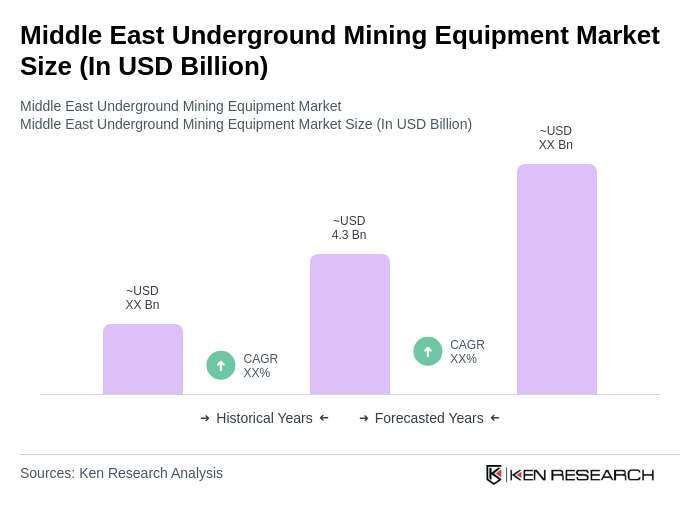
- The Middle East Underground Mining Equipment Market is valued at USD 4.3 billion, based on a five-year historical analysis. This growth is primarily driven by the increasing demand for minerals and metals, coupled with the expansion of mining activities in the region. The rise in infrastructure projects and urbanization has further fueled the need for advanced mining equipment, enhancing operational efficiency and safety in underground mining operations .
- Countries such as Saudi Arabia, the United Arab Emirates, and Turkey dominate the market due to their rich mineral resources and significant investments in mining infrastructure. Saudi Arabia's Vision 2030 initiative aims to diversify the economy, leading to increased mining activities. The UAE's strategic location and investment in technology also contribute to its market leadership, while Turkey's established mining sector supports its competitive position in the region .
- In 2023, the Saudi Arabian government implemented the "Mining Investment Law" (Royal Decree No. M/140, issued by the Ministry of Industry and Mineral Resources, 2020), which includes enhanced safety standards for underground mining operations. These regulations mandate the adoption of advanced safety technologies and regular training for workers, aiming to reduce accidents and improve overall operational safety. The initiative reflects the government's commitment to fostering a sustainable and safe mining environment, aligning with global best practices .
Middle East Underground Mining Equipment Market Segmentation
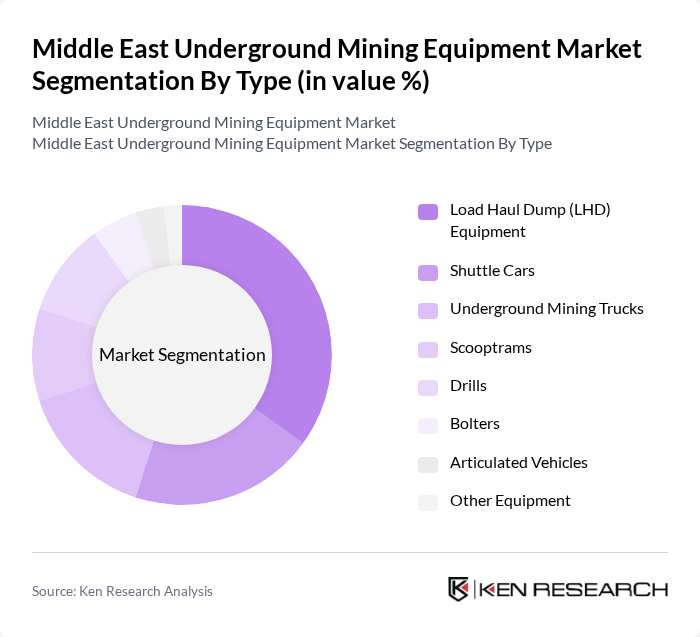
By Type:The market is segmented into various types of underground mining equipment, including Load Haul Dump (LHD) Equipment, Shuttle Cars, Underground Mining Trucks, Scooptrams, Drills, Bolters, Articulated Vehicles, and Other Equipment. Among these, Load Haul Dump (LHD) Equipment is the most dominant segment due to its versatility and efficiency in transporting materials within underground mines. The increasing focus on automation and operational efficiency has led to a higher adoption rate of LHDs, making them essential for modern mining operations .
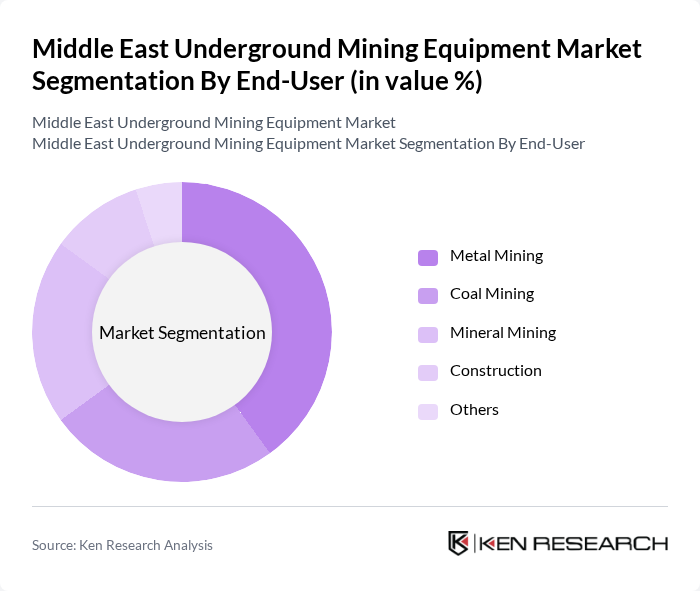
By End-User:The end-user segmentation includes Metal Mining, Coal Mining, Mineral Mining, Construction, and Others. The Metal Mining segment holds the largest share due to the high demand for metals such as gold, copper, and iron ore in the region. The growth in construction activities and infrastructure development further drives the demand for metal mining, as these materials are essential for various construction projects .
Middle East Underground Mining Equipment Market Competitive Landscape
The Middle East Underground Mining Equipment Market is characterized by a dynamic mix of regional and international players. Leading participants such as Caterpillar Inc., Komatsu Ltd., Sandvik AB, Epiroc AB, Hitachi Construction Machinery Co., Ltd., Atlas Copco AB, Liebherr Group, Normet Group Oy, Volvo Construction Equipment, JCB, XCMG Group, SANY Group, FLSmidth A/S, GHH Group GmbH, Astec Industries, Inc. contribute to innovation, geographic expansion, and service delivery in this space.
Middle East Underground Mining Equipment Market Industry Analysis
Growth Drivers
- Increasing Demand for Minerals and Metals:The Middle East's mineral production is projected to reach 220 million tons in the future, driven by rising global demand for metals such as copper and gold. The region's mining sector is expected to contribute approximately $35 billion to the GDP, reflecting a robust growth trajectory. This demand is fueled by industrialization and urbanization, particularly in countries like Saudi Arabia and the UAE, which are investing heavily in mining infrastructure to meet both domestic and international needs.
- Technological Advancements in Mining Equipment:The adoption of advanced mining technologies, including automation and IoT, is transforming the underground mining landscape. In the future, investments in smart mining technologies are expected to exceed $6 billion in the Middle East. These innovations enhance operational efficiency and reduce costs, enabling companies to optimize resource extraction. As a result, mining operations are becoming more productive, with a projected increase in output by 20% over the next few years, driven by these technological improvements.
- Government Investments in Infrastructure:Governments in the Middle East are prioritizing infrastructure development, with over $120 billion allocated for mining-related projects in the future. This includes the construction of roads, railways, and ports to facilitate mineral transportation. Such investments are crucial for enhancing the operational capabilities of mining companies, allowing for increased production and efficiency. Countries like Oman and Qatar are leading these initiatives, aiming to diversify their economies and reduce reliance on oil revenues through mining sector growth.
Market Challenges
- High Initial Capital Investment:The underground mining sector requires substantial upfront capital, often exceeding $60 million for new projects. This high initial investment can deter potential entrants and limit the expansion of existing operations. Additionally, the long payback periods associated with mining projects, which can extend up to 12 years, pose significant financial risks. As a result, many companies face challenges in securing funding, particularly in a fluctuating economic environment where access to capital can be restricted.
- Fluctuating Commodity Prices:The volatility of commodity prices significantly impacts the profitability of mining operations. For instance, the price of copper has fluctuated between $7,000 and $11,000 per ton over the past two years. Such price instability can lead to unpredictable revenue streams, making it difficult for companies to plan investments and operational strategies effectively. This uncertainty is compounded by geopolitical factors and global economic conditions, which can further exacerbate price fluctuations in the mining sector.
Middle East Underground Mining Equipment Market Future Outlook
The future of the Middle East underground mining equipment market appears promising, driven by ongoing technological advancements and increased government support. As countries in the region continue to diversify their economies away from oil dependency, mining is expected to play a pivotal role. The integration of automation and digital technologies will enhance operational efficiency, while sustainable practices will become increasingly important. Overall, the market is poised for growth, with significant investments anticipated in both equipment and infrastructure to support this evolution.
Market Opportunities
- Expansion of Mining Operations in Emerging Markets:Emerging markets in the Middle East, particularly in Africa and Central Asia, present significant opportunities for expansion. With mineral reserves estimated at over $1.2 trillion, companies can tap into these resources to meet global demand. This expansion is expected to create new jobs and stimulate local economies, making it a strategic focus for mining firms looking to diversify their operations.
- Adoption of Automation and Digitalization:The shift towards automation in mining operations is expected to create a market worth $4 billion in the future. Companies that invest in digital technologies can enhance productivity and reduce operational costs. The integration of AI and machine learning will enable predictive maintenance and optimize resource allocation, positioning firms to capitalize on efficiency gains and improve their competitive edge in the market.
Scope of the Report
| Segment | Sub-Segments |
|---|---|
| By Type | Load Haul Dump (LHD) Equipment Shuttle Cars Underground Mining Trucks Scooptrams Drills Bolters Articulated Vehicles Other Equipment |
| By End-User | Metal Mining Coal Mining Mineral Mining Construction Others |
| By Application | Underground Mining Tunneling Others |
| By Distribution Channel | Direct Sales Distributors Online Sales Others |
| By Region | GCC Countries Levant Region North Africa Others |
| By Price Range | Low Range Mid Range High Range |
| By Technology | Conventional Technology Advanced Technology Automation & Remote Operation Technology Battery-Electric Equipment Others |
Key Target Audience
Investors and Venture Capitalist Firms
Government and Regulatory Bodies (e.g., Ministry of Energy, Ministry of Industry and Mineral Resources)
Mining Equipment Manufacturers
Mining Operations and Companies
Distributors and Suppliers of Mining Equipment
Mining Industry Associations
Financial Institutions and Banks
Environmental and Safety Regulatory Agencies (e.g., Environmental Protection Agency)
Players Mentioned in the Report:
Caterpillar Inc.
Komatsu Ltd.
Sandvik AB
Epiroc AB
Hitachi Construction Machinery Co., Ltd.
Atlas Copco AB
Liebherr Group
Normet Group Oy
Volvo Construction Equipment
JCB
XCMG Group
SANY Group
FLSmidth A/S
GHH Group GmbH
Astec Industries, Inc.
Table of Contents
Market Assessment Phase
1. Executive Summary and Approach
2. Middle East Underground Mining Equipment Market Overview
2.1 Key Insights and Strategic Recommendations
2.2 Middle East Underground Mining Equipment Market Overview
2.3 Definition and Scope
2.4 Evolution of Market Ecosystem
2.5 Timeline of Key Regulatory Milestones
2.6 Value Chain & Stakeholder Mapping
2.7 Business Cycle Analysis
2.8 Policy & Incentive Landscape
3. Middle East Underground Mining Equipment Market Analysis
3.1 Growth Drivers
3.1.1 Increasing demand for minerals and metals
3.1.2 Technological advancements in mining equipment
3.1.3 Government investments in infrastructure
3.1.4 Rising focus on safety and environmental regulations
3.2 Market Challenges
3.2.1 High initial capital investment
3.2.2 Fluctuating commodity prices
3.2.3 Skilled labor shortages
3.2.4 Regulatory compliance complexities
3.3 Market Opportunities
3.3.1 Expansion of mining operations in emerging markets
3.3.2 Adoption of automation and digitalization
3.3.3 Development of sustainable mining practices
3.3.4 Strategic partnerships and collaborations
3.4 Market Trends
3.4.1 Increasing use of electric and hybrid mining equipment
3.4.2 Growth in underground mining activities
3.4.3 Enhanced focus on operational efficiency
3.4.4 Integration of IoT in mining operations
3.5 Government Regulation
3.5.1 Environmental protection regulations
3.5.2 Safety standards for mining operations
3.5.3 Licensing and permitting requirements
3.5.4 Tax incentives for mining investments
4. SWOT Analysis
5. Stakeholder Analysis
6. Porter's Five Forces Analysis
7. Middle East Underground Mining Equipment Market Market Size, 2019-2024
7.1 By Value
7.2 By Volume
7.3 By Average Selling Price
8. Middle East Underground Mining Equipment Market Segmentation
8.1 By Type
8.1.1 Load Haul Dump (LHD) Equipment
8.1.2 Shuttle Cars
8.1.3 Underground Mining Trucks
8.1.4 Scooptrams
8.1.5 Drills
8.1.6 Bolters
8.1.7 Articulated Vehicles
8.1.8 Other Equipment
8.2 By End-User
8.2.1 Metal Mining
8.2.2 Coal Mining
8.2.3 Mineral Mining
8.2.4 Construction
8.2.5 Others
8.3 By Application
8.3.1 Underground Mining
8.3.2 Tunneling
8.3.3 Others
8.4 By Distribution Channel
8.4.1 Direct Sales
8.4.2 Distributors
8.4.3 Online Sales
8.4.4 Others
8.5 By Region
8.5.1 GCC Countries
8.5.2 Levant Region
8.5.3 North Africa
8.5.4 Others
8.6 By Price Range
8.6.1 Low Range
8.6.2 Mid Range
8.6.3 High Range
8.7 By Technology
8.7.1 Conventional Technology
8.7.2 Advanced Technology
8.7.3 Automation & Remote Operation Technology
8.7.4 Battery-Electric Equipment
8.7.5 Others
9. Middle East Underground Mining Equipment Market Competitive Analysis
9.1 Market Share of Key Players(Micro, Small, Medium, Large Enterprises)
9.2 Cross Comparison of Key Players
9.2.1 Company Name
9.2.2 Group Size (Large, Medium, or Small as per industry convention)
9.2.3 Regional Revenue (Middle East, USD Million)
9.2.4 Revenue Growth Rate (CAGR %)
9.2.5 Market Share (%)
9.2.6 Installed Equipment Base (Units)
9.2.7 Product Portfolio Breadth (Number of Product Lines)
9.2.8 Aftermarket & Service Network Coverage
9.2.9 R&D Investment (% of Revenue)
9.2.10 Technology Adoption Rate (Automation, Electrification)
9.2.11 Local Partnerships/Presence (Number of Regional Offices/Dealers)
9.2.12 Customer Base (Number of Key Mining Clients)
9.2.13 ESG Performance/Compliance
9.3 SWOT Analysis of Top Players
9.4 Pricing Analysis(By Class and Payload)
9.5 Detailed Profile of Major Companies
9.5.1 Caterpillar Inc.
9.5.2 Komatsu Ltd.
9.5.3 Sandvik AB
9.5.4 Epiroc AB
9.5.5 Hitachi Construction Machinery Co., Ltd.
9.5.6 Atlas Copco AB
9.5.7 Liebherr Group
9.5.8 Normet Group Oy
9.5.9 Volvo Construction Equipment
9.5.10 JCB
9.5.11 XCMG Group
9.5.12 SANY Group
9.5.13 FLSmidth A/S
9.5.14 GHH Group GmbH
9.5.15 Astec Industries, Inc.
10. Middle East Underground Mining Equipment Market End-User Analysis
10.1 Procurement Behavior of Key Ministries
10.1.1 Ministry of Energy
10.1.2 Ministry of Industry
10.1.3 Ministry of Environment
10.1.4 Ministry of Finance
10.2 Corporate Spend on Infrastructure & Energy
10.2.1 Mining Corporations
10.2.2 Construction Firms
10.2.3 Government Projects
10.3 Pain Point Analysis by End-User Category
10.3.1 Equipment Reliability
10.3.2 Maintenance Costs
10.3.3 Safety Concerns
10.4 User Readiness for Adoption
10.4.1 Training and Skill Development
10.4.2 Technology Acceptance
10.5 Post-Deployment ROI and Use Case Expansion
10.5.1 Performance Metrics
10.5.2 Long-term Cost Savings
10.5.3 Expansion Opportunities
11. Middle East Underground Mining Equipment Market Future Size, 2025-2030
11.1 By Value
11.2 By Volume
11.3 By Average Selling Price
Go-To-Market Strategy Phase
1. Whitespace Analysis + Business Model Canvas
1.1 Market Gaps Identification
1.2 Business Model Framework
2. Marketing and Positioning Recommendations
2.1 Branding Strategies
2.2 Product USPs
3. Distribution Plan
3.1 Urban Retail vs Rural NGO Tie-ups
4. Channel & Pricing Gaps
4.1 Underserved Routes
4.2 Pricing Bands
5. Unmet Demand & Latent Needs
5.1 Category Gaps
5.2 Consumer Segments
6. Customer Relationship
6.1 Loyalty Programs
6.2 After-sales Service
7. Value Proposition
7.1 Sustainability
7.2 Integrated Supply Chains
8. Key Activities
8.1 Regulatory Compliance
8.2 Branding
8.3 Distribution Setup
9. Entry Strategy Evaluation
9.1 Domestic Market Entry Strategy
9.1.1 Product Mix
9.1.2 Pricing Band
9.1.3 Packaging
9.2 Export Entry Strategy
9.2.1 Target Countries
9.2.2 Compliance Roadmap
10. Entry Mode Assessment
10.1 JV
10.2 Greenfield
10.3 M&A
10.4 Distributor Model
11. Capital and Timeline Estimation
11.1 Capital Requirements
11.2 Timelines
12. Control vs Risk Trade-Off
12.1 Ownership vs Partnerships
13. Profitability Outlook
13.1 Breakeven Analysis
13.2 Long-term Sustainability
14. Potential Partner List
14.1 Distributors
14.2 JVs
14.3 Acquisition Targets
15. Execution Roadmap
15.1 Phased Plan for Market Entry
15.1.1 Market Setup
15.1.2 Market Entry
15.1.3 Growth Acceleration
15.1.4 Scale & Stabilize
15.2 Key Activities and Milestones
15.2.1 Milestone Planning
15.2.2 Activity Tracking
Research Methodology
Phase 1: Approach1
Desk Research
- Industry reports from mining associations and trade publications
- Market analysis from government mining departments and regulatory bodies
- Published white papers and case studies on underground mining technologies
Primary Research
- Interviews with mining equipment manufacturers and suppliers
- Surveys with mining operations managers and site supervisors
- Field visits to underground mining sites for observational insights
Validation & Triangulation
- Cross-validation of data from multiple industry sources and reports
- Triangulation of findings from primary interviews and secondary data
- Sanity checks through expert panels comprising industry veterans
Phase 2: Market Size Estimation1
Top-down Assessment
- Analysis of national mining output and equipment usage statistics
- Segmentation by mining type (coal, minerals, metals) and equipment category
- Incorporation of regional mining regulations and investment trends
Bottom-up Modeling
- Volume estimates based on equipment sales data from major suppliers
- Operational cost analysis derived from equipment maintenance and lifecycle
- Estimation of market size based on unit sales and average pricing
Forecasting & Scenario Analysis
- Multi-variable regression analysis considering economic growth and mining demand
- Scenario modeling based on technological advancements and regulatory changes
- Baseline, optimistic, and pessimistic forecasts through 2030
Phase 3: CATI Sample Composition1
| Scope Item/Segment | Sample Size | Target Respondent Profiles |
|---|---|---|
| Coal Mining Equipment Usage | 100 | Mining Operations Managers, Equipment Procurement Officers |
| Mineral Extraction Technologies | 80 | Site Supervisors, Technical Engineers |
| Metals Mining Equipment Trends | 70 | Production Managers, Safety Officers |
| Underground Mining Safety Practices | 50 | Health and Safety Managers, Compliance Officers |
| Emerging Technologies in Mining | 60 | R&D Managers, Innovation Leads |
Frequently Asked Questions
What is the current value of the Middle East Underground Mining Equipment Market?
The Middle East Underground Mining Equipment Market is valued at approximately USD 4.3 billion, reflecting a robust growth trajectory driven by increasing demand for minerals and metals, as well as the expansion of mining activities in the region.
Which countries dominate the Middle East Underground Mining Equipment Market?
What are the key growth drivers for the Middle East Underground Mining Equipment Market?
What types of underground mining equipment are most commonly used?
Other Regional/Country Reports
Indonesia Underground Mining Equipment Market
Malaysia Underground Mining Equipment Market
KSA Underground Mining Equipment Market
APAC Underground Mining Equipment Market
SEA Underground Mining Equipment Market
Other Adjacent Reports
KSA Mining Automation Market
Japan Mineral Processing Equipment Market
Egypt Drilling and Blasting Equipment Market
UAE Mining Safety Gear Market
Philippines Ventilation Systems Market
Indonesia Crushing and Screening Equipment Market
Thailand Mining Software Solutions Market
Bahrain Heavy Machinery Leasing Market
Vietnam Explosives Manufacturing Market
Why Buy From Us?

What makes us stand out is that our consultants follow Robust, Refine and Result (RRR) methodology. Robust for clear definitions, approaches and sanity checking, Refine for differentiating respondents' facts and opinions, and Result for presenting data with story.

We have set a benchmark in the industry by offering our clients with syndicated and customized market research reports featuring coverage of entire market as well as meticulous research and analyst insights.

While we don't replace traditional research, we flip the method upside down. Our dual approach of Top Bottom & Bottom Top ensures quality deliverable by not just verifying company fundamentals but also looking at the sector and macroeconomic factors.

With one step in the future, our research team constantly tries to show you the bigger picture. We help with some of the tough questions you may encounter along the way: How is the industry positioned? Best marketing channel? KPI's of competitors? By aligning every element, we help maximize success.

Our report gives you instant access to the answers and sources that other companies might choose to hide. We elaborate each steps of research methodology we have used and showcase you the sample size to earn your trust.

If you need any support, we are here! We pride ourselves on universe strength, data quality, and quick, friendly, and professional service.