About the Report
Base Year 2024New Zealand Poultry Meat Processing Equipment Market Overview
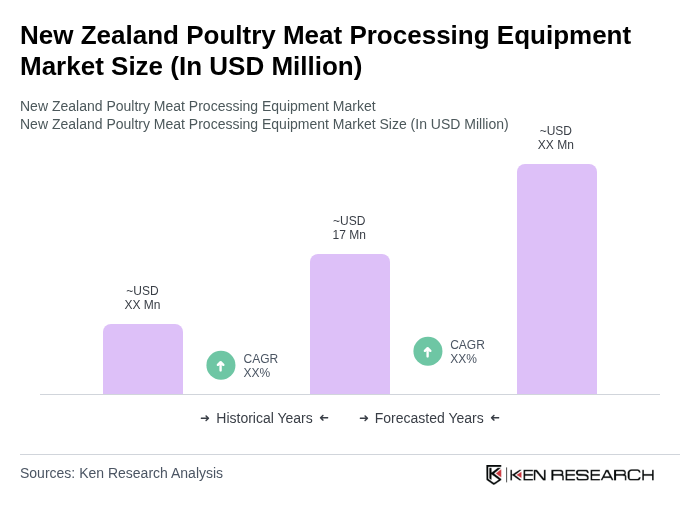
- The New Zealand Poultry Meat Processing Equipment Market is valued at USD 17 million, based on a five-year historical analysis. This growth is primarily driven by the increasing demand for poultry products, advancements in processing technologies, and a focus on food safety and quality standards. The market has seen a rise in automation and efficiency in processing operations, catering to both domestic consumption and export needs.
- Key players in this market include Auckland, Wellington, and Christchurch, which dominate due to their strategic locations, robust infrastructure, and proximity to major poultry farms. These cities have established a strong supply chain network, facilitating efficient distribution and processing of poultry products, thus enhancing their market presence.
- The Animal Products Act 1999, issued by the Ministry for Primary Industries (MPI), governs poultry processing by requiring risk management programmes for all operators handling animal products. Processors must implement approved programmes that include hygiene controls, hazard analysis, and traceability measures, with mandatory registration and regular audits to ensure compliance across processing facilities.
New Zealand Poultry Meat Processing Equipment Market Segmentation
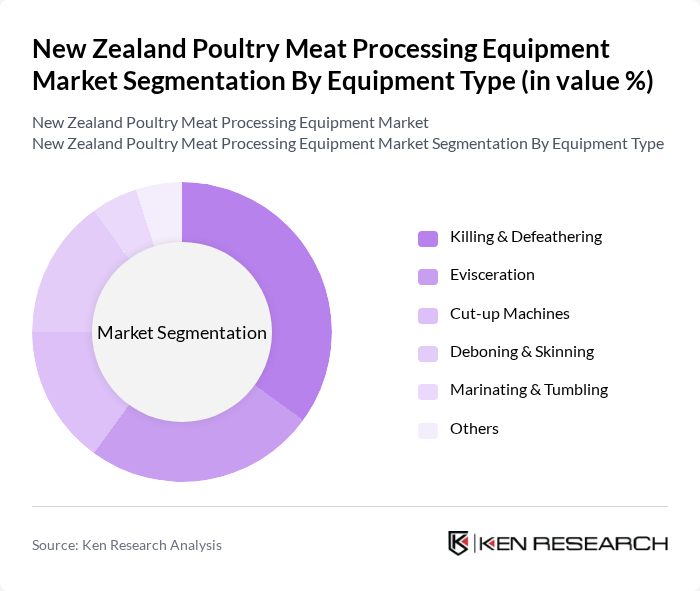
By Equipment Type:The equipment type segmentation includes various categories essential for poultry processing. The dominant sub-segment is Killing & Defeathering, which is crucial for initial processing stages. Evisceration and Deboning & Skinning also hold significant market shares due to the increasing demand for processed poultry products. The Cut-up Machines segment is gaining traction as consumer preferences shift towards ready-to-cook products. Marinating & Tumbling equipment is also witnessing growth as value-added products become popular among consumers.
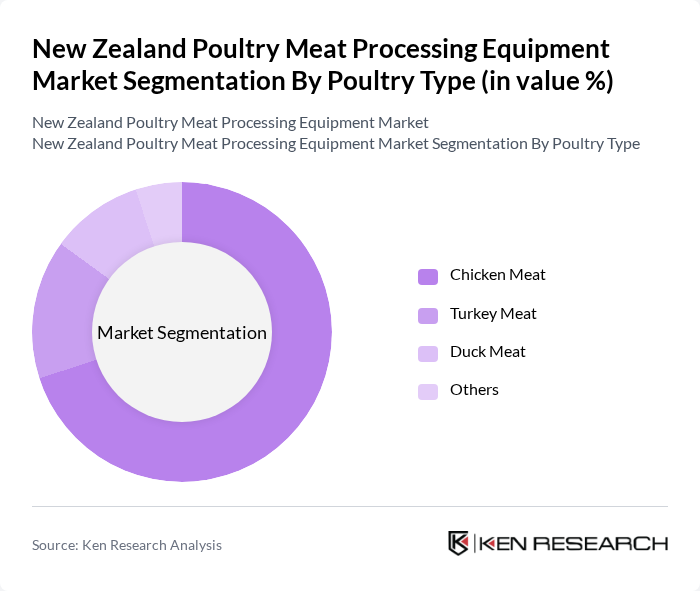
By Poultry Type:The poultry type segmentation includes Chicken Meat, Turkey Meat, Duck Meat, and Others. Chicken Meat is the leading sub-segment, driven by its popularity and versatility in various cuisines. Turkey Meat is also gaining traction, particularly during festive seasons, while Duck Meat remains a niche market. The Others category includes less common poultry types, which contribute to the overall diversity of the market.
New Zealand Poultry Meat Processing Equipment Market Competitive Landscape
The New Zealand Poultry Meat Processing Equipment Market is characterized by a dynamic mix of regional and international players. Leading participants such as Inghams Group, Tegel Foods, Silver Fern Farms, Brinks Poultry, PGG Wrightson, Farmgate, Bidfood, New Zealand Chicken, Cargill, Alliance Group, Bounty Holdings New Zealand, Brink's NZ Chicken contribute to innovation, geographic expansion, and service delivery in this space.
New Zealand Poultry Meat Processing Equipment Market Industry Analysis
Growth Drivers
- Increasing Demand for Poultry Meat:The demand for poultry meat in New Zealand is projected to reach approximately 420,000 metric tons in future, driven by a growing population and changing dietary preferences. The per capita consumption of poultry meat is expected to rise to 87 kg, reflecting a shift towards protein-rich diets. This surge in demand necessitates advanced processing equipment to enhance production efficiency and meet consumer expectations for quality and safety, thereby propelling market growth.
- Technological Advancements in Processing Equipment:The New Zealand poultry processing sector is witnessing significant technological innovations, with investments exceeding NZD 55 million in automation and AI technologies in future. These advancements improve processing speed and reduce labor costs, enhancing overall productivity. The integration of smart technologies in processing equipment is expected to streamline operations, reduce waste, and ensure compliance with stringent food safety standards, further driving market expansion.
- Rising Health Consciousness Among Consumers:As health awareness increases, New Zealand consumers are increasingly opting for lean protein sources, with poultry meat sales projected to grow by NZD 110 million in future. This trend is prompting processors to adopt healthier processing methods and offer products with reduced additives. The shift towards organic and free-range poultry products is also gaining traction, compelling equipment manufacturers to innovate and cater to these evolving consumer preferences.
Market Challenges
- High Initial Investment Costs:The poultry meat processing equipment market faces significant barriers due to high initial investment costs, which can exceed NZD 1.1 million for advanced processing lines. Smaller processors may struggle to secure financing, limiting their ability to upgrade equipment and compete effectively. This financial strain can hinder technological adoption and slow down overall market growth, particularly among smaller enterprises in the sector.
- Stringent Regulatory Requirements:Compliance with stringent food safety and environmental regulations poses a significant challenge for poultry processors in New Zealand. The cost of meeting these regulations can reach up to NZD 210,000 annually for mid-sized operations. Failure to comply can result in hefty fines and operational shutdowns, creating a challenging environment for businesses to navigate while striving for growth and innovation in processing technologies.
New Zealand Poultry Meat Processing Equipment Market Future Outlook
The future of the New Zealand poultry meat processing equipment market appears promising, driven by technological advancements and evolving consumer preferences. As automation and AI technologies become more prevalent, processors will likely enhance efficiency and reduce operational costs. Additionally, the increasing demand for organic and sustainably sourced poultry products will push manufacturers to innovate, ensuring compliance with health and safety standards while meeting consumer expectations for quality and traceability in the supply chain.
Market Opportunities
- Expansion into Export Markets:New Zealand's poultry industry has significant potential for growth in export markets, with exports projected to reach NZD 320 million in future. This expansion can be facilitated by enhancing processing capabilities and meeting international quality standards, allowing local producers to tap into lucrative overseas markets and diversify their revenue streams.
- Development of Sustainable Processing Methods:There is a growing opportunity for the adoption of sustainable processing methods, with investments in eco-friendly technologies expected to exceed NZD 25 million in future. This shift not only aligns with global sustainability trends but also meets consumer demand for environmentally responsible products, positioning New Zealand poultry processors favorably in a competitive market landscape.
Scope of the Report
| Segment | Sub-Segments |
|---|---|
| By Equipment Type | Killing & Defeathering Evisceration Cut-up Machines Deboning & Skinning Marinating & Tumbling Others |
| By Poultry Type | Chicken Meat Turkey Meat Duck Meat Others |
| By Product Type | Fresh Processed Raw Cooked Pre-Cooked Raw Fermented Sausages Cured Dried Others |
| By End-User | Poultry Processors Food Service Providers Retailers Exporters Others |
| By Distribution Channel | Direct Sales Distributors Online Sales Others |
| By Region | North Island South Island Others |
Key Target Audience
Investors and Venture Capitalist Firms
Government and Regulatory Bodies (e.g., Ministry for Primary Industries, New Zealand Food Safety)
Poultry Meat Processors
Equipment Manufacturers and Suppliers
Logistics and Supply Chain Companies
Industry Associations (e.g., Poultry Industry Association of New Zealand)
Food Safety Inspectors and Auditors
Financial Institutions and Banks
Players Mentioned in the Report:
Inghams Group
Tegel Foods
Silver Fern Farms
Brinks Poultry
PGG Wrightson
Farmgate
Bidfood
New Zealand Chicken
Cargill
Alliance Group
Bounty Holdings New Zealand
Brink's NZ Chicken
Table of Contents
Market Assessment Phase
1. Executive Summary and Approach
2. New Zealand Poultry Meat Processing Equipment Market Overview
2.1 Key Insights and Strategic Recommendations
2.2 New Zealand Poultry Meat Processing Equipment Market Overview
2.3 Definition and Scope
2.4 Evolution of Market Ecosystem
2.5 Timeline of Key Regulatory Milestones
2.6 Value Chain & Stakeholder Mapping
2.7 Business Cycle Analysis
2.8 Policy & Incentive Landscape
3. New Zealand Poultry Meat Processing Equipment Market Analysis
3.1 Growth Drivers
3.1.1 Increasing demand for poultry meat
3.1.2 Technological advancements in processing equipment
3.1.3 Rising health consciousness among consumers
3.1.4 Government support for the poultry industry
3.2 Market Challenges
3.2.1 High initial investment costs
3.2.2 Stringent regulatory requirements
3.2.3 Competition from alternative protein sources
3.2.4 Supply chain disruptions
3.3 Market Opportunities
3.3.1 Expansion into export markets
3.3.2 Adoption of automation and AI technologies
3.3.3 Development of sustainable processing methods
3.3.4 Increasing consumer preference for organic poultry products
3.4 Market Trends
3.4.1 Shift towards plant-based alternatives
3.4.2 Growing focus on food safety and traceability
3.4.3 Integration of IoT in processing equipment
3.4.4 Rise in demand for ready-to-eat poultry products
3.5 Government Regulation
3.5.1 Food safety standards compliance
3.5.2 Environmental regulations on waste management
3.5.3 Animal welfare legislation
3.5.4 Import/export regulations for poultry products
4. SWOT Analysis
5. Stakeholder Analysis
6. Porter's Five Forces Analysis
7. New Zealand Poultry Meat Processing Equipment Market Market Size, 2019-2024
7.1 By Value
7.2 By Volume
7.3 By Average Selling Price
8. New Zealand Poultry Meat Processing Equipment Market Segmentation
8.1 By Equipment Type
8.1.1 Killing & Defeathering
8.1.2 Evisceration
8.1.3 Cut-up Machines
8.1.4 Deboning & Skinning
8.1.5 Marinating & Tumbling
8.1.6 Others
8.2 By Poultry Type
8.2.1 Chicken Meat
8.2.2 Turkey Meat
8.2.3 Duck Meat
8.2.4 Others
8.3 By Product Type
8.3.1 Fresh Processed
8.3.2 Raw Cooked
8.3.3 Pre-Cooked
8.3.4 Raw Fermented Sausages
8.3.5 Cured
8.3.6 Dried
8.3.7 Others
8.4 By End-User
8.4.1 Poultry Processors
8.4.2 Food Service Providers
8.4.3 Retailers
8.4.4 Exporters
8.4.5 Others
8.5 By Distribution Channel
8.5.1 Direct Sales
8.5.2 Distributors
8.5.3 Online Sales
8.5.4 Others
8.6 By Region
8.6.1 North Island
8.6.2 South Island
8.6.3 Others
9. New Zealand Poultry Meat Processing Equipment Market Competitive Analysis
9.1 Market Share of Key Players
9.2 Cross Comparison of Key Players
9.2.1 Company Name
9.2.2 Market Capitalization
9.2.3 Revenue Growth Rate (CAGR)
9.2.4 EBITDA Margin
9.2.5 Market Share %
9.2.6 Return on Equity (ROE)
9.2.7 Customer Acquisition Cost (CAC)
9.2.8 Gross Margin %
9.2.9 R&D Investment as % of Revenue
9.2.10 Supply Chain Resilience Score
9.3 SWOT Analysis of Top Players
9.4 Pricing Analysis
9.5 Detailed Profile of Major Companies
9.5.1 Inghams Group
9.5.2 Tegel Foods
9.5.3 Silver Fern Farms
9.5.4 Brinks Poultry
9.5.5 PGG Wrightson
9.5.6 Farmgate
9.5.7 Bidfood
9.5.8 New Zealand Chicken
9.5.9 Cargill
9.5.10 Alliance Group
9.5.11 Bounty Holdings New Zealand
9.5.12 Brink's NZ Chicken
10. New Zealand Poultry Meat Processing Equipment Market End-User Analysis
10.1 Procurement Behavior of Key Ministries
10.1.1 Ministry of Primary Industries
10.1.2 Ministry of Health
10.1.3 Ministry of Trade and Export Growth
10.1.4 Others
10.2 Corporate Spend on Infrastructure & Energy
10.2.1 Investment in Processing Facilities
10.2.2 Energy Efficiency Initiatives
10.2.3 Technology Upgrades
10.2.4 Others
10.3 Pain Point Analysis by End-User Category
10.3.1 Cost Management
10.3.2 Quality Assurance
10.3.3 Supply Chain Reliability
10.3.4 Others
10.4 User Readiness for Adoption
10.4.1 Training and Support Needs
10.4.2 Technology Familiarity
10.4.3 Investment Willingness
10.4.4 Others
10.5 Post-Deployment ROI and Use Case Expansion
10.5.1 Performance Metrics
10.5.2 Scalability Potential
10.5.3 Customer Feedback Integration
10.5.4 Others
11. New Zealand Poultry Meat Processing Equipment Market Future Size, 2025-2030
11.1 By Value
11.2 By Volume
11.3 By Average Selling Price
Go-To-Market Strategy Phase
1. Whitespace Analysis + Business Model Canvas
1.1 Market Gaps Identification
1.2 Business Model Development
2. Marketing and Positioning Recommendations
2.1 Branding Strategies
2.2 Product USPs
3. Distribution Plan
3.1 Urban Retail Strategies
3.2 Rural NGO Tie-ups
4. Channel & Pricing Gaps
4.1 Underserved Routes
4.2 Pricing Bands
5. Unmet Demand & Latent Needs
5.1 Category Gaps
5.2 Consumer Segments
6. Customer Relationship
6.1 Loyalty Programs
6.2 After-sales Service
7. Value Proposition
7.1 Sustainability Initiatives
7.2 Integrated Supply Chains
8. Key Activities
8.1 Regulatory Compliance
8.2 Branding Efforts
8.3 Distribution Setup
9. Entry Strategy Evaluation
9.1 Domestic Market Entry Strategy
9.1.1 Product Mix
9.1.2 Pricing Band
9.1.3 Packaging
9.2 Export Entry Strategy
9.2.1 Target Countries
9.2.2 Compliance Roadmap
10. Entry Mode Assessment
10.1 Joint Ventures
10.2 Greenfield Investments
10.3 Mergers & Acquisitions
10.4 Distributor Model
11. Capital and Timeline Estimation
11.1 Capital Requirements
11.2 Timelines
12. Control vs Risk Trade-Off
12.1 Ownership vs Partnerships
13. Profitability Outlook
13.1 Breakeven Analysis
13.2 Long-term Sustainability
14. Potential Partner List
14.1 Distributors
14.2 Joint Ventures
14.3 Acquisition Targets
15. Execution Roadmap
15.1 Phased Plan for Market Entry
15.1.1 Market Setup
15.1.2 Market Entry
15.1.3 Growth Acceleration
15.1.4 Scale & Stabilize
15.2 Key Activities and Milestones
15.2.1 Activity Planning
15.2.2 Milestone Tracking
Research Methodology
Phase 1: Approach1
Desk Research
- Industry reports from New Zealand's Ministry for Primary Industries and relevant agricultural bodies
- Market analysis from trade associations focused on poultry and meat processing
- Published articles and white papers on technological advancements in poultry processing equipment
Primary Research
- Interviews with key stakeholders in poultry processing facilities across New Zealand
- Surveys targeting equipment manufacturers and suppliers in the poultry sector
- Field visits to processing plants to gather firsthand insights on equipment usage and needs
Validation & Triangulation
- Cross-validation of data through multiple industry sources and expert opinions
- Triangulation of findings from desk research and primary interviews to ensure consistency
- Sanity checks conducted through expert panel reviews comprising industry veterans
Phase 2: Market Size Estimation1
Top-down Assessment
- Analysis of national poultry production statistics to estimate equipment demand
- Segmentation of the market by equipment type, including processing, packaging, and refrigeration
- Incorporation of government regulations impacting poultry processing and equipment standards
Bottom-up Modeling
- Volume estimates based on production capacities of major poultry processing plants
- Cost analysis of equipment procurement and maintenance across different processing stages
- Estimation of market size based on unit sales and average selling prices of equipment
Forecasting & Scenario Analysis
- Multi-factor regression analysis considering factors like consumer demand and export trends
- Scenario planning based on potential changes in trade policies and environmental regulations
- Development of baseline, optimistic, and pessimistic forecasts through 2030
Phase 3: CATI Sample Composition1
| Scope Item/Segment | Sample Size | Target Respondent Profiles |
|---|---|---|
| Poultry Processing Equipment Manufacturers | 45 | Product Managers, Sales Directors |
| Poultry Processing Plant Operators | 120 | Operations Managers, Plant Supervisors |
| Supply Chain and Logistics Providers | 65 | Logistics Coordinators, Supply Chain Analysts |
| Regulatory Bodies and Industry Associations | 40 | Policy Makers, Industry Analysts |
| End-users in Retail and Food Service | 55 | Procurement Officers, Quality Assurance Managers |
Frequently Asked Questions
What is the current value of the New Zealand Poultry Meat Processing Equipment Market?
The New Zealand Poultry Meat Processing Equipment Market is valued at approximately USD 17 million, reflecting a five-year historical analysis that highlights growth driven by increasing demand for poultry products and advancements in processing technologies.
What are the key drivers of growth in the New Zealand Poultry Meat Processing Equipment Market?
Which cities dominate the New Zealand Poultry Meat Processing Equipment Market?
What regulatory framework governs poultry processing in New Zealand?
Other Regional/Country Reports
Other Adjacent Reports
KSA Meat Processing Equipment Market
Belgium Poultry Farming Equipment Market
KSA Food Packaging Machinery Market
Egypt Slaughterhouse Equipment Market
Kuwait Food Automation Systems Market
Germany Refrigeration Equipment Market
Oman Food Safety Testing Market
Germany Animal Feed Processing Market
Mexico Livestock Handling Equipment Market
New Zealand Seafood Processing Equipment Market Size Share Growth Drivers Trends Opportunities & Forecast 2025–2030Why Buy From Us?

What makes us stand out is that our consultants follow Robust, Refine and Result (RRR) methodology. Robust for clear definitions, approaches and sanity checking, Refine for differentiating respondents' facts and opinions, and Result for presenting data with story.

We have set a benchmark in the industry by offering our clients with syndicated and customized market research reports featuring coverage of entire market as well as meticulous research and analyst insights.

While we don't replace traditional research, we flip the method upside down. Our dual approach of Top Bottom & Bottom Top ensures quality deliverable by not just verifying company fundamentals but also looking at the sector and macroeconomic factors.

With one step in the future, our research team constantly tries to show you the bigger picture. We help with some of the tough questions you may encounter along the way: How is the industry positioned? Best marketing channel? KPI's of competitors? By aligning every element, we help maximize success.

Our report gives you instant access to the answers and sources that other companies might choose to hide. We elaborate each steps of research methodology we have used and showcase you the sample size to earn your trust.

If you need any support, we are here! We pride ourselves on universe strength, data quality, and quick, friendly, and professional service.