About the Report
Base Year 2024Nigeria Agri Export Processing Market Overview
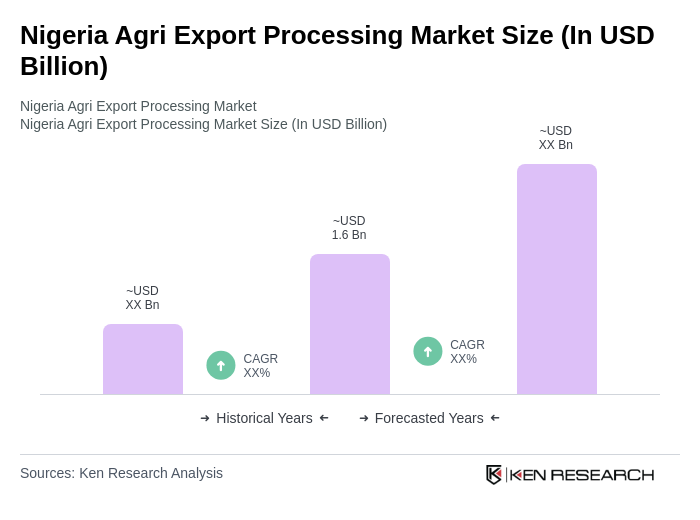
- The Nigeria Agri Export Processing Market is valued at USD 1.6 billion, based on a five-year historical analysis. This growth is primarily driven by the increasing demand for agricultural products in international markets, coupled with government initiatives aimed at boosting agricultural exports and enhancing processing capabilities.
- Key players in this market include Lagos, Kano, and Port Harcourt, which dominate due to their strategic locations, access to transportation networks, and established agricultural infrastructure. These cities serve as hubs for processing and exporting various agricultural products, making them critical to the market's growth. The Netherlands and the United States have emerged as primary export destinations, with the Netherlands accounting for 18.64% of Nigerian export value.
- The Nigerian Export Promotion Council (NEPC) under the Renewed Hope Agenda of President Bola Ahmed Tinubu, 2023 has implemented comprehensive export enhancement initiatives that focus on value addition, capacity building, and market access facilitation. These measures include establishing Export Skill Acquisition Centers, organizing extensive training programmes covering export documentation and quality standards, and promoting processed and semi-processed products over raw commodity exports, thereby fostering growth in the agri export processing market.
Nigeria Agri Export Processing Market Segmentation
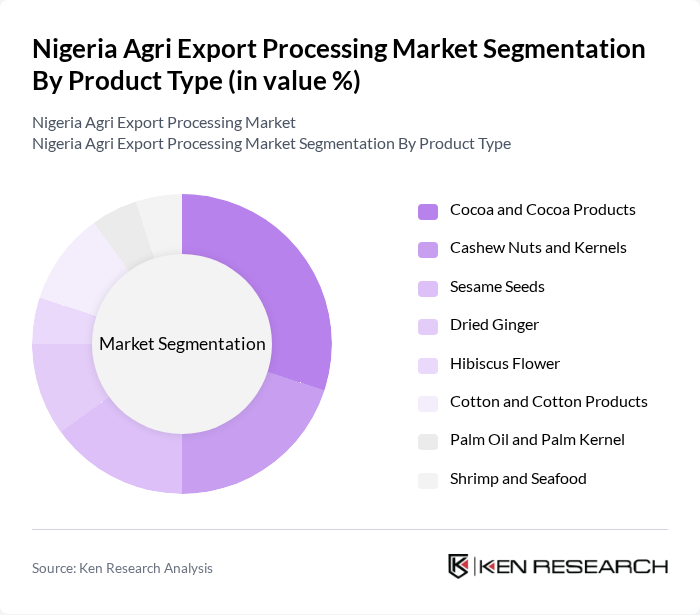
By Product Type:The product type segmentation includes various agricultural products that are processed and exported. The dominant sub-segment is Cocoa and Cocoa Products, which has demonstrated exceptional performance with cocoa exports generating over 1.2 trillion Naira in the first quarter of 2025 alone, primarily from standard and superior quality beans shipped to the Netherlands and Belgium. Other significant sub-segments include Cashew Nuts and Kernels, which contributed 158 billion Naira, and Sesame Seeds, which generated 128 billion Naira, reflecting their high export value and versatility in food production. The market has also shown increasing diversification with growth in semi-processed goods like natural cocoa butter and soya flour, along with non-traditional exports such as cut and ornamental flowers, and frozen shrimps and prawns.
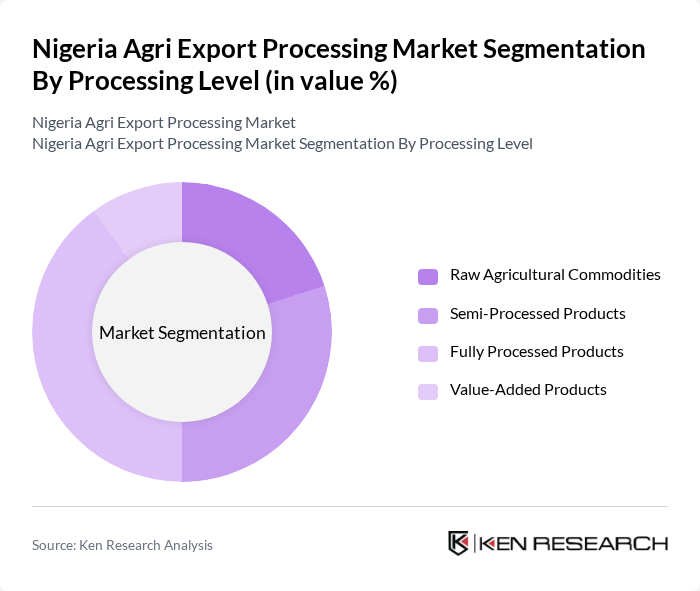
By Processing Level:The processing level segmentation categorizes products based on their degree of processing. The leading sub-segment is Fully Processed Products, which are in high demand due to their readiness for consumption and higher market value, with the NEPC actively promoting value addition initiatives such as converting shea nuts into shea butter and raw leather into finished goods. Semi-Processed Products also hold a significant share, as they cater to various industries that require intermediate goods for further processing, with notable growth observed in natural cocoa butter and soya flour exports.
Nigeria Agri Export Processing Market Competitive Landscape
The Nigeria Agri Export Processing Market is characterized by a dynamic mix of regional and international players. Leading participants such as Olam Nigeria Limited, Tulip Cocoa Processing Limited, Enkay Indo Nigerian Industries Limited, Foodpro Group, Atlantic Shrimpers Limited, ETC Agro Company Nigeria Limited, Valency Agro Nigeria Limited, Cargill West Africa Limited, Flour Mills of Nigeria Plc, Dangote Sugar Refinery Plc, Presco Plc, Nigerian Export Promotion Council, Heirs Energies Limited, Seplat Energy Plc, Oando Plc contribute to innovation, geographic expansion, and service delivery in this space.
Nigeria Agri Export Processing Market Industry Analysis
Growth Drivers
- Increasing Global Demand for Agricultural Products:The global agricultural market is projected to reach $3.4 trillion in future, driven by rising populations and changing dietary preferences. Nigeria, as one of Africa's largest agricultural producers, is well-positioned to meet this demand. In future, Nigeria's agricultural exports were valued at approximately $1.5 billion, with significant growth expected as international markets seek diverse sources of food products, particularly in the wake of supply chain disruptions caused by global events.
- Government Support and Incentives for Export:The Nigerian government has implemented various initiatives to boost agricultural exports, including the Agricultural Promotion Policy, which aims to increase export volumes by 20% annually. In future, the government allocated ?100 billion (approximately $240 million) to support farmers and exporters through subsidies and grants. This financial backing is crucial for enhancing production capabilities and ensuring compliance with international quality standards, thereby facilitating access to global markets.
- Development of Infrastructure and Logistics:Nigeria's investment in infrastructure, particularly in transportation and storage, is vital for the agri export processing market. In future, the government announced a ?1.5 trillion ($3.6 billion) infrastructure development plan, focusing on roads, railways, and ports. Improved logistics will reduce post-harvest losses, which currently stand at 30% for certain crops, and enhance the efficiency of agricultural exports, making Nigerian products more competitive in international markets.
Market Challenges
- Inconsistent Quality Standards:One of the significant challenges facing Nigeria's agri export processing market is the inconsistency in quality standards. In future, about 40% of agricultural exports failed to meet international quality requirements, leading to rejections and loss of market access. This inconsistency is often attributed to inadequate training for farmers and processors, as well as a lack of standardized practices across the industry, which undermines Nigeria's reputation as a reliable supplier.
- Regulatory Compliance Issues:Navigating the regulatory landscape poses a challenge for exporters in Nigeria. In future, over 50% of exporters reported difficulties in complying with both local and international regulations, which can lead to delays and increased costs. The complexity of obtaining necessary certifications and permits, coupled with frequent changes in regulations, creates an uncertain environment that can deter investment and hinder growth in the agri export processing sector.
Nigeria Agri Export Processing Market Future Outlook
The future of Nigeria's agri export processing market appears promising, driven by increasing global demand and government initiatives aimed at enhancing production and export capabilities. As infrastructure improvements continue, the sector is likely to attract more investments, fostering innovation and efficiency. Additionally, the growing trend towards sustainable practices will encourage producers to adopt environmentally friendly methods, further enhancing Nigeria's competitiveness in the global market. The focus on quality and compliance will also play a crucial role in shaping the industry's trajectory.
Market Opportunities
- Expansion into New Export Markets:With the global agricultural market expanding, Nigeria has the opportunity to penetrate new markets, particularly in Asia and Europe. In future, exports to these regions accounted for only 15% of total agricultural exports, indicating significant room for growth. Targeting these markets can diversify Nigeria's export base and reduce dependency on traditional markets, enhancing economic resilience.
- Value-Added Processing of Agricultural Products:There is a growing demand for processed agricultural products, which presents an opportunity for Nigerian exporters. In future, processed agricultural goods represented only 25% of total agricultural exports. By investing in value-added processing, Nigeria can increase export revenues and create jobs, while meeting the rising consumer preference for convenience and quality in food products.
Scope of the Report
| Segment | Sub-Segments |
|---|---|
| By Product Type | Cocoa and Cocoa Products Cashew Nuts and Kernels Sesame Seeds Dried Ginger Hibiscus Flower Cotton and Cotton Products Palm Oil and Palm Kernel Shrimp and Seafood |
| By Processing Level | Raw Agricultural Commodities Semi-Processed Products Fully Processed Products Value-Added Products |
| By Export Destination | Europe Asia North America Middle East Africa |
| By Company Size | Large-Scale Exporters Medium-Scale Processors Small-Scale Aggregators Smallholder Farmer Cooperatives |
| By Processing Technology | Traditional Processing Methods Modern Mechanized Processing Advanced Technology Processing |
| By Quality Certification | Organic Certification Fair Trade Certification HACCP Certification ISO Quality Standards Rainforest Alliance Certification |
| By Supply Chain Integration | Vertically Integrated Companies Contract Farming Models Independent Processors Trading Companies |
Key Target Audience
Investors and Venture Capitalist Firms
Government and Regulatory Bodies (e.g., Nigerian Export Promotion Council, Federal Ministry of Agriculture and Rural Development)
Manufacturers and Producers
Exporters and Importers
Logistics and Supply Chain Companies
Agri-tech Startups
Industry Associations (e.g., National Association of Smallholder Farmers in Nigeria)
Financial Institutions (e.g., Bank of Agriculture)
Players Mentioned in the Report:
Olam Nigeria Limited
Tulip Cocoa Processing Limited
Enkay Indo Nigerian Industries Limited
Foodpro Group
Atlantic Shrimpers Limited
ETC Agro Company Nigeria Limited
Valency Agro Nigeria Limited
Cargill West Africa Limited
Flour Mills of Nigeria Plc
Dangote Sugar Refinery Plc
Presco Plc
Nigerian Export Promotion Council
Heirs Energies Limited
Seplat Energy Plc
Oando Plc
Table of Contents
Market Assessment Phase
1. Executive Summary and Approach
2. Nigeria Agri Export Processing Market Overview
2.1 Key Insights and Strategic Recommendations
2.2 Nigeria Agri Export Processing Market Overview
2.3 Definition and Scope
2.4 Evolution of Market Ecosystem
2.5 Timeline of Key Regulatory Milestones
2.6 Value Chain & Stakeholder Mapping
2.7 Business Cycle Analysis
2.8 Policy & Incentive Landscape
3. Nigeria Agri Export Processing Market Analysis
3.1 Growth Drivers
3.1.1 Increasing Global Demand for Agricultural Products
3.1.2 Government Support and Incentives for Export
3.1.3 Development of Infrastructure and Logistics
3.1.4 Technological Advancements in Processing Techniques
3.2 Market Challenges
3.2.1 Inconsistent Quality Standards
3.2.2 Regulatory Compliance Issues
3.2.3 Limited Access to Financing
3.2.4 Infrastructure Deficiencies
3.3 Market Opportunities
3.3.1 Expansion into New Export Markets
3.3.2 Value-Added Processing of Agricultural Products
3.3.3 Partnerships with International Buyers
3.3.4 Adoption of Sustainable Practices
3.4 Market Trends
3.4.1 Rise of Organic and Fair-Trade Products
3.4.2 Increasing Use of E-commerce for Exports
3.4.3 Focus on Traceability and Transparency
3.4.4 Growth of Agro-Processing Clusters
3.5 Government Regulation
3.5.1 Export Quality Control Regulations
3.5.2 Tariff and Non-Tariff Barriers
3.5.3 Agricultural Subsidy Programs
3.5.4 Environmental Compliance Regulations
4. SWOT Analysis
5. Stakeholder Analysis
6. Porter's Five Forces Analysis
7. Nigeria Agri Export Processing Market Market Size, 2019-2024
7.1 By Value
7.2 By Volume
7.3 By Average Selling Price
8. Nigeria Agri Export Processing Market Segmentation
8.1 By Product Type
8.1.1 Cocoa and Cocoa Products
8.1.2 Cashew Nuts and Kernels
8.1.3 Sesame Seeds
8.1.4 Dried Ginger
8.1.5 Hibiscus Flower
8.1.6 Cotton and Cotton Products
8.1.7 Palm Oil and Palm Kernel
8.1.8 Shrimp and Seafood
8.2 By Processing Level
8.2.1 Raw Agricultural Commodities
8.2.2 Semi-Processed Products
8.2.3 Fully Processed Products
8.2.4 Value-Added Products
8.3 By Export Destination
8.3.1 Europe
8.3.2 Asia
8.3.3 North America
8.3.4 Middle East
8.3.5 Africa
8.4 By Company Size
8.4.1 Large-Scale Exporters
8.4.2 Medium-Scale Processors
8.4.3 Small-Scale Aggregators
8.4.4 Smallholder Farmer Cooperatives
8.5 By Processing Technology
8.5.1 Traditional Processing Methods
8.5.2 Modern Mechanized Processing
8.5.3 Advanced Technology Processing
8.6 By Quality Certification
8.6.1 Organic Certification
8.6.2 Fair Trade Certification
8.6.3 HACCP Certification
8.6.4 ISO Quality Standards
8.6.5 Rainforest Alliance Certification
8.7 By Supply Chain Integration
8.7.1 Vertically Integrated Companies
8.7.2 Contract Farming Models
8.7.3 Independent Processors
8.7.4 Trading Companies
9. Nigeria Agri Export Processing Market Competitive Analysis
9.1 Market Share of Key Players
9.2 Cross Comparison of Key Players
9.2.1 Export Volume (Metric Tonnes per Annum)
9.2.2 Export Revenue (USD Million)
9.2.3 Processing Capacity Utilization Rate (%)
9.2.4 Number of Smallholder Farmers in Network
9.2.5 Geographic Coverage (Number of States)
9.2.6 Product Diversification Index
9.2.7 International Certification Holdings
9.2.8 Supply Chain Traceability Score
9.2.9 Export Market Penetration Rate
9.2.10 Investment in Processing Infrastructure (USD Million)
9.3 SWOT Analysis of Top Players
9.4 Pricing Analysis
9.5 Detailed Profile of Major Companies
9.5.1 Olam Nigeria Limited
9.5.2 Tulip Cocoa Processing Limited
9.5.3 Enkay Indo Nigerian Industries Limited
9.5.4 Foodpro Group
9.5.5 Atlantic Shrimpers Limited
9.5.6 ETC Agro Company Nigeria Limited
9.5.7 Valency Agro Nigeria Limited
9.5.8 Cargill West Africa Limited
9.5.9 Flour Mills of Nigeria Plc
9.5.10 Dangote Sugar Refinery Plc
9.5.11 Presco Plc
9.5.12 Nigerian Export Promotion Council
9.5.13 Heirs Energies Limited
9.5.14 Seplat Energy Plc
9.5.15 Oando Plc
10. Nigeria Agri Export Processing Market End-User Analysis
10.1 Procurement Behavior of Key Ministries
10.1.1 Ministry of Agriculture and Rural Development
10.1.2 Ministry of Trade and Investment
10.1.3 Ministry of Finance
10.2 Corporate Spend on Infrastructure & Energy
10.2.1 Investment in Processing Facilities
10.2.2 Funding for Export Logistics
10.3 Pain Point Analysis by End-User Category
10.3.1 Smallholder Farmers
10.3.2 Exporters
10.3.3 Processors
10.4 User Readiness for Adoption
10.4.1 Technology Adoption Levels
10.4.2 Training and Capacity Building Needs
10.5 Post-Deployment ROI and Use Case Expansion
10.5.1 Measurement of Export Performance
10.5.2 Expansion into New Markets
11. Nigeria Agri Export Processing Market Future Size, 2025-2030
11.1 By Value
11.2 By Volume
11.3 By Average Selling Price
Go-To-Market Strategy Phase
1. Whitespace Analysis + Business Model Canvas
1.1 Market Gaps Identification
1.2 Value Proposition Development
1.3 Revenue Streams Analysis
1.4 Cost Structure Evaluation
1.5 Key Partnerships Exploration
1.6 Customer Segmentation
1.7 Channels of Distribution
2. Marketing and Positioning Recommendations
2.1 Branding Strategies
2.2 Product USPs
2.3 Target Audience Identification
2.4 Communication Strategy
2.5 Digital Marketing Approaches
3. Distribution Plan
3.1 Urban Retail Strategies
3.2 Rural NGO Tie-ups
3.3 Logistics Optimization
3.4 Channel Partnerships
4. Channel & Pricing Gaps
4.1 Underserved Routes
4.2 Pricing Bands Analysis
4.3 Competitive Pricing Strategies
5. Unmet Demand & Latent Needs
5.1 Category Gaps
5.2 Consumer Segments
5.3 Product Development Opportunities
6. Customer Relationship
6.1 Loyalty Programs
6.2 After-sales Service
6.3 Customer Feedback Mechanisms
7. Value Proposition
7.1 Sustainability Initiatives
7.2 Integrated Supply Chains
7.3 Competitive Advantages
8. Key Activities
8.1 Regulatory Compliance
8.2 Branding Efforts
8.3 Distribution Setup
9. Entry Strategy Evaluation
9.1 Domestic Market Entry Strategy
9.1.1 Product Mix Considerations
9.1.2 Pricing Band Strategy
9.1.3 Packaging Solutions
9.2 Export Entry Strategy
9.2.1 Target Countries Identification
9.2.2 Compliance Roadmap Development
10. Entry Mode Assessment
10.1 Joint Ventures
10.2 Greenfield Investments
10.3 Mergers & Acquisitions
10.4 Distributor Model Evaluation
11. Capital and Timeline Estimation
11.1 Capital Requirements
11.2 Timelines for Implementation
12. Control vs Risk Trade-Off
12.1 Ownership vs Partnerships
13. Profitability Outlook
13.1 Breakeven Analysis
13.2 Long-term Sustainability Strategies
14. Potential Partner List
14.1 Distributors
14.2 Joint Ventures
14.3 Acquisition Targets
15. Execution Roadmap
15.1 Phased Plan for Market Entry
15.1.1 Market Setup
15.1.2 Market Entry
15.1.3 Growth Acceleration
15.1.4 Scale & Stabilize
15.2 Key Activities and Milestones
15.2.1
Research Methodology
Phase 1: Approach1
Desk Research
- Analysis of agricultural export data from the Nigerian Export Promotion Council (NEPC)
- Review of market reports and publications from the Food and Agriculture Organization (FAO)
- Examination of government policies and regulations impacting agri-export processing
Primary Research
- Interviews with key stakeholders in the agri-export sector, including exporters and processors
- Surveys conducted with agricultural cooperatives and farmer associations
- Field visits to processing facilities to gather firsthand insights on operations
Validation & Triangulation
- Cross-validation of findings through multiple data sources, including trade statistics and expert opinions
- Triangulation of qualitative insights from interviews with quantitative data from surveys
- Sanity checks through expert panel reviews comprising industry veterans and academic researchers
Phase 2: Market Size Estimation1
Top-down Assessment
- Estimation of total agricultural exports based on national trade data and growth trends
- Segmentation of the market by key agricultural products and export destinations
- Incorporation of government initiatives aimed at boosting agri-exports and processing capabilities
Bottom-up Modeling
- Collection of production volume data from leading agricultural producers and processors
- Operational cost analysis based on processing methods and export logistics
- Estimation of revenue potential based on pricing strategies and market demand
Forecasting & Scenario Analysis
- Multi-factor regression analysis incorporating variables such as global market trends and local agricultural policies
- Scenario modeling based on potential changes in trade agreements and export tariffs
- Development of baseline, optimistic, and pessimistic forecasts through 2030
Phase 3: CATI Sample Composition1
| Scope Item/Segment | Sample Size | Target Respondent Profiles |
|---|---|---|
| Exporting Farmers | 100 | Farm Owners, Agricultural Entrepreneurs |
| Processing Facilities | 60 | Plant Managers, Quality Control Supervisors |
| Logistics Providers | 50 | Logistics Coordinators, Supply Chain Managers |
| Government Agencies | 40 | Policy Makers, Regulatory Officials |
| Export Market Analysts | 40 | Market Researchers, Trade Analysts |
Frequently Asked Questions
What is the current value of the Nigeria Agri Export Processing Market?
The Nigeria Agri Export Processing Market is valued at approximately USD 1.6 billion, reflecting significant growth driven by increasing international demand for agricultural products and government initiatives to enhance processing capabilities and export volumes.
Which cities are key players in Nigeria's Agri Export Processing Market?
What are the primary export destinations for Nigerian agricultural products?
What initiatives has the Nigerian government implemented to boost agricultural exports?
Other Regional/Country Reports
Indonesia Agri Export Processing Market
Malaysia Agri Export Processing Market
KSA Agri Export Processing Market
APAC Agri Export Processing Market
SEA Agri Export Processing Market
Vietnam Agri Export Processing Market
Other Adjacent Reports
Germany Agricultural Commodities Trading Market
Indonesia Food Processing Equipment Market
Bahrain Export Logistics and Transportation Market
Kuwait Agri Supply Chain Management Market
Kuwait Crop Protection Products Market
Indonesia Organic Food Export Market
Oman Cold Chain Infrastructure Market
South Korea AgriTech Solutions Market
Germany Sustainable Farming Practices Market
Japan International Trade Finance Market
Why Buy From Us?

What makes us stand out is that our consultants follow Robust, Refine and Result (RRR) methodology. Robust for clear definitions, approaches and sanity checking, Refine for differentiating respondents' facts and opinions, and Result for presenting data with story.

We have set a benchmark in the industry by offering our clients with syndicated and customized market research reports featuring coverage of entire market as well as meticulous research and analyst insights.

While we don't replace traditional research, we flip the method upside down. Our dual approach of Top Bottom & Bottom Top ensures quality deliverable by not just verifying company fundamentals but also looking at the sector and macroeconomic factors.

With one step in the future, our research team constantly tries to show you the bigger picture. We help with some of the tough questions you may encounter along the way: How is the industry positioned? Best marketing channel? KPI's of competitors? By aligning every element, we help maximize success.

Our report gives you instant access to the answers and sources that other companies might choose to hide. We elaborate each steps of research methodology we have used and showcase you the sample size to earn your trust.

If you need any support, we are here! We pride ourselves on universe strength, data quality, and quick, friendly, and professional service.