About the Report
Base Year 2024Oman Agritourism Market Overview
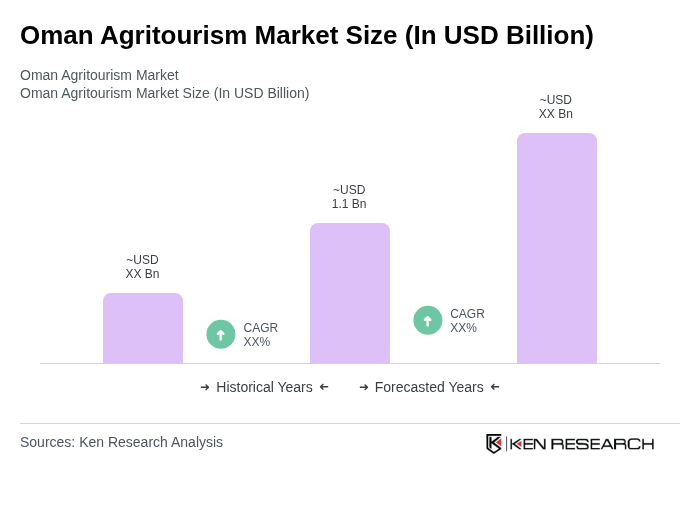
- The Oman Agritourism Market is valued at USD 1.1 billion, based on a five-year historical analysis. This aligns with the growing value of Oman’s wider agriculture sector, which has reached around USD 2.1 billion, and with the rapid expansion of Oman’s tourism industry, where tourism revenues exceeded the equivalent of USD 5.5 billion, supported by rising domestic trips and increased focus on nature? and rural?based tourism. This growth is primarily driven by increasing interest in sustainable and nature?based tourism, local food and farm?to?table experiences, and the desire for authentic cultural interactions in rural communities, in line with global agritourism trends.
- Key regions dominating the Oman Agritourism Market include Muscat, Dhofar, and Al Dakhiliyah. Muscat attracts tourists due to its cultural heritage, access to coastal farms, and its role as the main gateway for domestic trips, with Omanis undertaking more than thirteen million domestic journeys in a recent year that increasingly include rural and farm?based activities. Dhofar is known for its lush khareef landscapes, frankincense groves, and diversified agriculture, making it a core hub for farm and monsoon?season visits. Al Dakhiliyah offers historical oases, terrace farms, and traditional aflaj?irrigated agriculture around Jabal Al Akhdar and Nizwa, where model farms and integrated agro?tourism concepts have been highlighted as part of Oman’s agricultural development.
- In 2023, the Omani government strengthened its policy focus on linking agriculture and tourism under Oman Vision 2040, with agritourism positioned within broader rural and eco?tourism development. A key binding instrument is the Executive Regulations of the Tourism Law issued by the Ministry of Heritage and Tourism in 2022, which set licensing and quality standards for tourism establishments, including farm?based accommodations and nature lodges, covering requirements such as classification, environmental safeguards, and service standards for operators. Complementary initiatives include Environment Authority and OMRAN?led investments in eco?tourism infrastructure across several nature reserves, along with model farms and agro?tourism projects in regions such as North Al Sharqiyah and Al Dakhiliyah that provide financial and technical support for farmers to develop visitor facilities, diversify income, and integrate educational and recreational services.
Oman Agritourism Market Segmentation
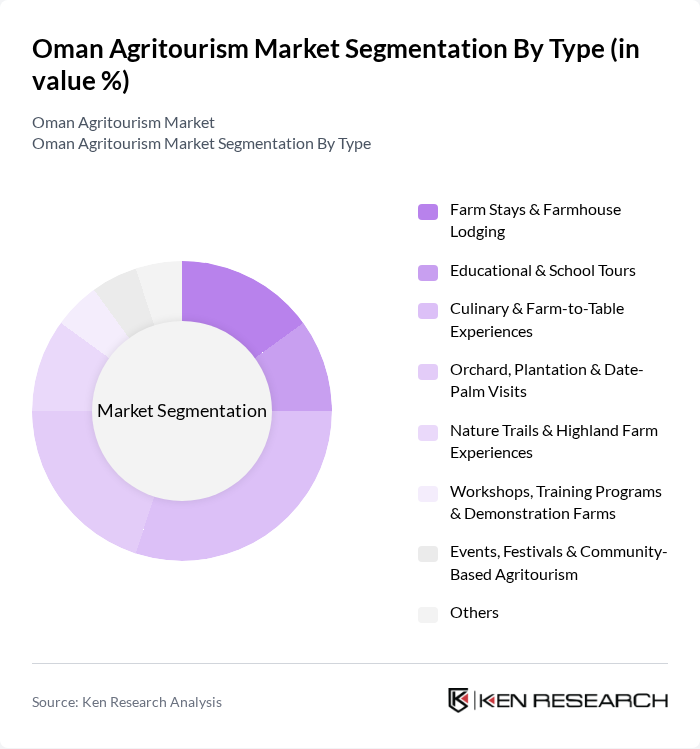
By Type:The agritourism market in Oman is segmented into various types, including Farm Stays & Farmhouse Lodging, Educational & School Tours, Culinary & Farm-to-Table Experiences, Orchard, Plantation & Date-Palm Visits, Nature Trails & Highland Farm Experiences, Workshops, Training Programs & Demonstration Farms, Events, Festivals & Community-Based Agritourism, and Others. Among these, Culinary & Farm-to-Table Experiences are particularly popular, driven by the growing trend of health-conscious consumers seeking fresh, locally sourced food. This segment has gained traction as tourists increasingly prioritize authentic culinary experiences that connect them to local culture and agriculture.
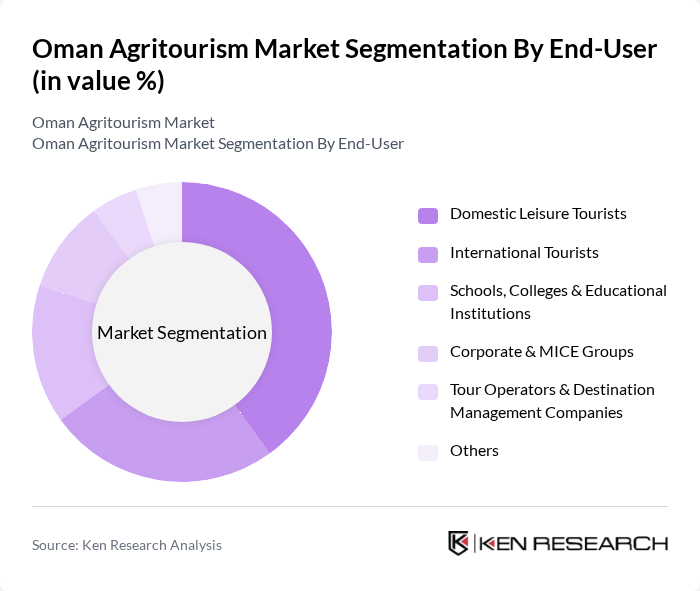
By End-User:The agritourism market in Oman is segmented by end-user categories, including Domestic Leisure Tourists, International Tourists, Schools, Colleges & Educational Institutions, Corporate & MICE Groups, Tour Operators & Destination Management Companies, and Others. The Domestic Leisure Tourists segment is currently leading the market, as local residents increasingly seek weekend getaways and family outings that offer a blend of relaxation and educational experiences in agricultural settings. This trend is fueled by a growing awareness of the benefits of agritourism and the desire to support local farmers.
Oman Agritourism Market Competitive Landscape
The Oman Agritourism Market is characterized by a dynamic mix of regional and international players. Leading participants such as Anantara Al Jabal Al Akhdar Resort (Highland Farm & Orchard Experiences), Alila Jabal Akhdar (Cliff-Top Resort with Local Farm & Orchard Activities), Nirvana Farm (Nizwa Agritourism & Farm-Stay Experience), Barka Farm & Garden (Al Batinah Coastal Agritourism Farm), Salalah Farm & Agro Experiences (Dhofar Monsoon Agritourism), Jebel Akhdar Rose & Pomegranate Terraces (Community-Based Agritourism), Omran Group – Community & Farm-Based Tourism Projects, Sidab Farms & Rural Experiences (Muscat Hinterland), Wakan Village & Terrace Farms (Al Batinah Highland Agritourism), Misfat Al Abriyeen Guesthouses & Oasis Farms (Al Dakhiliyah), Al Hoota Cave & Surrounding Farm Experiences (Al Hajar Region), Al Batinah Model Farms & Visitor Programs, North Al Sharqiyah Model Farms & Agro-Tourism Projects, Private Date-Palm & Frankincense Farm Tours (Dhofar & Interior Oman), Integrated Farm-Stay & Eco-Lodge Operators (Selected SMEs across Oman) contribute to innovation, geographic expansion, and service delivery in this space.
Oman Agritourism Market Industry Analysis
Growth Drivers
- Increasing Interest in Sustainable Tourism:The global shift towards sustainable tourism is evident in Oman, where the Ministry of Tourism reported a 30% increase in sustainable tourism initiatives. This trend is driven by a growing consumer preference for eco-friendly travel options, with a substantial share of travelers indicating a willingness to pay more for sustainable experiences. This rising interest is expected to further boost agritourism, aligning with Oman’s natural landscapes and agricultural heritage.
- Government Support for Agritourism Initiatives:The Omani government has allocated approximately OMR 5 million (USD 13 million) for agritourism development, aiming to enhance rural economies. This funding supports infrastructure improvements and marketing campaigns to promote agritourism. Additionally, the government’s strategic plan includes partnerships with local farmers, which is projected to increase agritourism participation by 25%, fostering economic growth in rural areas.
- Rising Consumer Demand for Authentic Experiences:A significant trend in tourism is the demand for authentic experiences, with a notable percentage of tourists in Oman seeking immersive cultural interactions. This shift is supported by data from the World Travel & Tourism Council, which indicates that experiential travel is growing at a rate of 20% annually. Agritourism offers unique opportunities for visitors to engage with local farming practices, enhancing their travel experience and contributing to the local economy.
Market Challenges
- Limited Awareness of Agritourism Benefits:Despite its potential, agritourism in Oman faces challenges due to limited awareness among both tourists and local communities. A survey conducted by the Oman Tourism Board revealed that only 40% of potential visitors are familiar with agritourism offerings. This lack of awareness hampers growth, as many travelers still prefer traditional tourism options, limiting the market's expansion and potential revenue generation.
- Seasonal Fluctuations in Tourist Arrivals:The agritourism sector in Oman is significantly affected by seasonal fluctuations, with peak tourist arrivals occurring between October and April. Data from the Ministry of Tourism indicates that visitor numbers drop by 50% during the summer months, impacting agritourism operators' revenue. This seasonality poses a challenge for sustaining business operations year-round, necessitating strategies to attract visitors during off-peak periods.
Oman Agritourism Market Future Outlook
The future of agritourism in Oman appears promising, driven by increasing consumer interest in sustainable and authentic travel experiences. As the government continues to invest in rural infrastructure and promote local agricultural practices, the sector is likely to see enhanced visibility and participation. Additionally, the integration of digital marketing strategies will play a crucial role in reaching potential tourists, ensuring that agritourism becomes a key component of Oman’s overall tourism strategy, fostering economic growth and community engagement.
Market Opportunities
- Expansion of Eco-Friendly Accommodations:There is a growing opportunity for eco-friendly accommodations in agritourism, with a projected increase of 15% in demand for sustainable lodging options. This trend aligns with global preferences for environmentally conscious travel, allowing operators to attract eco-minded tourists while promoting sustainable practices in local communities.
- Collaboration with Local Farmers and Producers:Collaborating with local farmers can enhance the authenticity of agritourism experiences. By establishing partnerships, agritourism operators can offer farm-to-table dining experiences, which are increasingly popular among tourists. This collaboration is expected to boost local economies and create a unique selling proposition that differentiates Oman’s agritourism offerings from competitors.
Scope of the Report
| Segment | Sub-Segments |
|---|---|
| By Type | Farm Stays & Farmhouse Lodging Educational & School Tours Culinary & Farm-to-Table Experiences Orchard, Plantation & Date-Palm Visits Nature Trails & Highland Farm Experiences Workshops, Training Programs & Demonstration Farms Events, Festivals & Community-Based Agritourism Others |
| By End-User | Domestic Leisure Tourists International Tourists Schools, Colleges & Educational Institutions Corporate & MICE Groups Tour Operators & Destination Management Companies Others |
| By Region | Muscat & Al Batinah Coast Dhofar (Salalah & Surrounding Areas) Al Dakhiliyah (Nizwa, Jabal Akhdar & Interior Oases) Al Sharqiyah (North & South, including Wadis & Desert Farms) Other Governorates (Al Dhahirah, Al Buraimi, Musandam, Al Wusta) |
| By Activity Type | Crop Harvesting & Date-Palm Activities Animal Husbandry & Dairy Farm Visits Organic & Sustainable Farming Experiences Eco-Tourism & Nature-Based Farm Activities On-Farm Sales & Farm-Shop Experiences Others |
| By Duration of Stay | Day Trips & Excursions Weekend & Short Breaks (1–3 Nights) Extended Stays (4–7 Nights) Long-Stay & Seasonal Programs Others |
| By Pricing Model | All-Inclusive Packages Pay-per-Activity / Experience-Based Pricing Accommodation plus Add-on Experiences Group & Educational Tariffs Others |
| By Customer Demographics | Age Groups (Children, Youth, Adults, Seniors) Income Levels (Budget, Mid-range, Premium) Source Markets (GCC, Other International, Local Residents) Travel Purpose (Leisure, Educational, Corporate, Wellness) Others |
Key Target Audience
Investors and Venture Capitalist Firms
Government and Regulatory Bodies (e.g., Ministry of Agriculture, Ministry of Tourism)
Agricultural Producers and Farmers
Tourism Operators and Travel Agencies
Local Community Organizations
Hospitality and Accommodation Providers
Environmental and Conservation Groups
Food and Beverage Companies
Players Mentioned in the Report:
Anantara Al Jabal Al Akhdar Resort (Highland Farm & Orchard Experiences)
Alila Jabal Akhdar (Cliff-Top Resort with Local Farm & Orchard Activities)
Nirvana Farm (Nizwa Agritourism & Farm-Stay Experience)
Barka Farm & Garden (Al Batinah Coastal Agritourism Farm)
Salalah Farm & Agro Experiences (Dhofar Monsoon Agritourism)
Jebel Akhdar Rose & Pomegranate Terraces (Community-Based Agritourism)
Omran Group Community & Farm-Based Tourism Projects
Sidab Farms & Rural Experiences (Muscat Hinterland)
Wakan Village & Terrace Farms (Al Batinah Highland Agritourism)
Misfat Al Abriyeen Guesthouses & Oasis Farms (Al Dakhiliyah)
Al Hoota Cave & Surrounding Farm Experiences (Al Hajar Region)
Al Batinah Model Farms & Visitor Programs
North Al Sharqiyah Model Farms & Agro-Tourism Projects
Private Date-Palm & Frankincense Farm Tours (Dhofar & Interior Oman)
Integrated Farm-Stay & Eco-Lodge Operators (Selected SMEs across Oman)
Table of Contents
Market Assessment Phase
1. Executive Summary and Approach
2. Oman Agritourism Market Overview
2.1 Key Insights and Strategic Recommendations
2.2 Oman Agritourism Market Overview
2.3 Definition and Scope
2.4 Evolution of Market Ecosystem
2.5 Timeline of Key Regulatory Milestones
2.6 Value Chain & Stakeholder Mapping
2.7 Business Cycle Analysis
2.8 Policy & Incentive Landscape
3. Oman Agritourism Market Analysis
3.1 Growth Drivers
3.1.1 Increasing interest in sustainable tourism
3.1.2 Government support for agritourism initiatives
3.1.3 Rising consumer demand for authentic experiences
3.1.4 Development of rural infrastructure
3.2 Market Challenges
3.2.1 Limited awareness of agritourism benefits
3.2.2 Seasonal fluctuations in tourist arrivals
3.2.3 Competition from established tourism sectors
3.2.4 Regulatory hurdles for new entrants
3.3 Market Opportunities
3.3.1 Expansion of eco-friendly accommodations
3.3.2 Collaboration with local farmers and producers
3.3.3 Development of educational agritourism programs
3.3.4 Promotion of local cuisine and cultural experiences
3.4 Market Trends
3.4.1 Growth of wellness tourism within agritourism
3.4.2 Increasing use of digital marketing strategies
3.4.3 Focus on experiential travel and hands-on activities
3.4.4 Rise of community-based tourism initiatives
3.5 Government Regulation
3.5.1 Licensing requirements for agritourism operators
3.5.2 Safety and health regulations for visitors
3.5.3 Environmental protection laws impacting agritourism
3.5.4 Incentives for sustainable farming practices
4. SWOT Analysis
5. Stakeholder Analysis
6. Porter's Five Forces Analysis
7. Oman Agritourism Market Market Size, 2019-2024
7.1 By Value
7.2 By Volume
7.3 By Average Selling Price
8. Oman Agritourism Market Segmentation
8.1 By Type
8.1.1 Farm Stays & Farmhouse Lodging
8.1.2 Educational & School Tours
8.1.3 Culinary & Farm-to-Table Experiences
8.1.4 Orchard, Plantation & Date-Palm Visits
8.1.5 Nature Trails & Highland Farm Experiences
8.1.6 Workshops, Training Programs & Demonstration Farms
8.1.7 Events, Festivals & Community-Based Agritourism
8.1.8 Others
8.2 By End-User
8.2.1 Domestic Leisure Tourists
8.2.2 International Tourists
8.2.3 Schools, Colleges & Educational Institutions
8.2.4 Corporate & MICE Groups
8.2.5 Tour Operators & Destination Management Companies
8.2.6 Others
8.3 By Region
8.3.1 Muscat & Al Batinah Coast
8.3.2 Dhofar (Salalah & Surrounding Areas)
8.3.3 Al Dakhiliyah (Nizwa, Jabal Akhdar & Interior Oases)
8.3.4 Al Sharqiyah (North & South, including Wadis & Desert Farms)
8.3.5 Other Governorates (Al Dhahirah, Al Buraimi, Musandam, Al Wusta)
8.4 By Activity Type
8.4.1 Crop Harvesting & Date-Palm Activities
8.4.2 Animal Husbandry & Dairy Farm Visits
8.4.3 Organic & Sustainable Farming Experiences
8.4.4 Eco-Tourism & Nature-Based Farm Activities
8.4.5 On-Farm Sales & Farm-Shop Experiences
8.4.6 Others
8.5 By Duration of Stay
8.5.1 Day Trips & Excursions
8.5.2 Weekend & Short Breaks (1–3 Nights)
8.5.3 Extended Stays (4–7 Nights)
8.5.4 Long-Stay & Seasonal Programs
8.5.5 Others
8.6 By Pricing Model
8.6.1 All-Inclusive Packages
8.6.2 Pay-per-Activity / Experience-Based Pricing
8.6.3 Accommodation plus Add-on Experiences
8.6.4 Group & Educational Tariffs
8.6.5 Others
8.7 By Customer Demographics
8.7.1 Age Groups (Children, Youth, Adults, Seniors)
8.7.2 Income Levels (Budget, Mid-range, Premium)
8.7.3 Source Markets (GCC, Other International, Local Residents)
8.7.4 Travel Purpose (Leisure, Educational, Corporate, Wellness)
8.7.5 Others
9. Oman Agritourism Market Competitive Analysis
9.1 Market Share of Key Players
9.2 Cross Comparison of Key Players
9.2.1 Company Name
9.2.2 Ownership & Integration with Farms (Standalone Farm, Hotel-Farm Partnership, Community-Based)
9.2.3 Annual Visitor Volume (Domestic & International)
9.2.4 Average Occupancy Rate / Utilization of Agritourism Capacity
9.2.5 Average Revenue per Visitor (ARPV)
9.2.6 Revenue Growth Rate (3–5 Year CAGR)
9.2.7 Share of Online Bookings & Digital Distribution
9.2.8 Visitor Satisfaction & Review Score (e.g., OTA Ratings)
9.2.9 Repeat-Visit / Customer Retention Rate
9.2.10 Product Diversity Index (Number of Activity Types Offered)
9.2.11 Contribution of Agritourism to Total Business Revenue
9.2.12 Sustainability & Community Engagement Score
9.3 SWOT Analysis of Top Players
9.4 Pricing Analysis
9.5 Detailed Profile of Major Companies
9.5.1 Anantara Al Jabal Al Akhdar Resort (Highland Farm & Orchard Experiences)
9.5.2 Alila Jabal Akhdar (Cliff-Top Resort with Local Farm & Orchard Activities)
9.5.3 Nirvana Farm (Nizwa Agritourism & Farm-Stay Experience)
9.5.4 Barka Farm & Garden (Al Batinah Coastal Agritourism Farm)
9.5.5 Salalah Farm & Agro Experiences (Dhofar Monsoon Agritourism)
9.5.6 Jebel Akhdar Rose & Pomegranate Terraces (Community-Based Agritourism)
9.5.7 Omran Group – Community & Farm-Based Tourism Projects
9.5.8 Sidab Farms & Rural Experiences (Muscat Hinterland)
9.5.9 Wakan Village & Terrace Farms (Al Batinah Highland Agritourism)
9.5.10 Misfat Al Abriyeen Guesthouses & Oasis Farms (Al Dakhiliyah)
9.5.11 Al Hoota Cave & Surrounding Farm Experiences (Al Hajar Region)
9.5.12 Al Batinah Model Farms & Visitor Programs
9.5.13 North Al Sharqiyah Model Farms & Agro-Tourism Projects
9.5.14 Private Date-Palm & Frankincense Farm Tours (Dhofar & Interior Oman)
9.5.15 Integrated Farm-Stay & Eco-Lodge Operators (Selected SMEs across Oman)
10. Oman Agritourism Market End-User Analysis
10.1 Procurement Behavior of Key Ministries
10.1.1 Ministry of Tourism
10.1.2 Ministry of Agriculture and Fisheries
10.1.3 Ministry of Environment and Climate Affairs
10.1.4 Others
10.2 Corporate Spend on Infrastructure & Energy
10.2.1 Investment in Sustainable Practices
10.2.2 Funding for Agritourism Projects
10.2.3 Partnerships with Local Farmers
10.2.4 Others
10.3 Pain Point Analysis by End-User Category
10.3.1 Lack of Awareness
10.3.2 Accessibility Issues
10.3.3 Quality of Services
10.3.4 Others
10.4 User Readiness for Adoption
10.4.1 Interest in Sustainable Tourism
10.4.2 Willingness to Pay for Unique Experiences
10.4.3 Familiarity with Agritourism Concepts
10.4.4 Others
10.5 Post-Deployment ROI and Use Case Expansion
10.5.1 Measurement of Visitor Satisfaction
10.5.2 Analysis of Repeat Visits
10.5.3 Expansion of Service Offerings
10.5.4 Others
11. Oman Agritourism Market Future Size, 2025-2030
11.1 By Value
11.2 By Volume
11.3 By Average Selling Price
Go-To-Market Strategy Phase
1. Whitespace Analysis + Business Model Canvas
1.1 Market Gaps Identification
1.2 Value Proposition Development
1.3 Revenue Streams Analysis
1.4 Cost Structure Evaluation
1.5 Key Partnerships Exploration
1.6 Customer Segments Definition
1.7 Channels of Distribution
2. Marketing and Positioning Recommendations
2.1 Branding Strategies
2.2 Product USPs
3. Distribution Plan
3.1 Urban Retail vs Rural NGO Tie-ups
4. Channel & Pricing Gaps
4.1 Underserved Routes
4.2 Pricing Bands
5. Unmet Demand & Latent Needs
5.1 Category Gaps
5.2 Consumer Segments
6. Customer Relationship
6.1 Loyalty Programs
6.2 After-sales Service
7. Value Proposition
7.1 Sustainability
7.2 Integrated Supply Chains
8. Key Activities
8.1 Regulatory Compliance
8.2 Branding
8.3 Distribution Setup
9. Entry Strategy Evaluation
9.1 Domestic Market Entry Strategy
9.1.1 Product Mix
9.1.2 Pricing Band
9.1.3 Packaging
9.2 Export Entry Strategy
9.2.1 Target Countries
9.2.2 Compliance Roadmap
10. Entry Mode Assessment
10.1 JV
10.2 Greenfield
10.3 M&A
10.4 Distributor Model
11. Capital and Timeline Estimation
11.1 Capital Requirements
11.2 Timelines
12. Control vs Risk Trade-Off
12.1 Ownership vs Partnerships
13. Profitability Outlook
13.1 Breakeven Analysis
13.2 Long-term Sustainability
14. Potential Partner List
14.1 Distributors
14.2 JVs
14.3 Acquisition Targets
15. Execution Roadmap
15.1 Phased Plan for Market Entry
15.1.1 Market Setup
15.1.2 Market Entry
15.1.3 Growth Acceleration
15.1.4 Scale & Stabilize
15.2 Key Activities and Milestones
15.2.1 Milestone Planning
15.2.2 Activity Scheduling
Research Methodology
Phase 1: Approach1
Desk Research
- Analysis of government reports on agritourism policies and initiatives in Oman
- Review of academic journals and publications focusing on agritourism trends and consumer behavior
- Examination of tourism statistics from the Oman Ministry of Heritage and Tourism
Primary Research
- Interviews with agritourism operators and farm owners in various regions of Oman
- Surveys conducted with tourists who have participated in agritourism activities
- Focus group discussions with local communities involved in agritourism
Validation & Triangulation
- Cross-validation of findings through comparison with international agritourism case studies
- Triangulation of data from government reports, industry publications, and primary research
- Sanity checks through expert panel reviews consisting of agritourism specialists and economists
Phase 2: Market Size Estimation1
Top-down Assessment
- Estimation of the overall tourism market size in Oman and its agritourism segment
- Analysis of demographic trends and their impact on agritourism participation
- Incorporation of government tourism growth targets and agritourism promotion strategies
Bottom-up Modeling
- Collection of revenue data from individual agritourism farms and experiences
- Estimation of visitor numbers and average spending per visitor in agritourism
- Calculation of growth rates based on historical data and emerging trends
Forecasting & Scenario Analysis
- Multi-factor regression analysis incorporating economic indicators and tourism growth rates
- Scenario modeling based on potential changes in consumer preferences and travel restrictions
- Development of baseline, optimistic, and pessimistic forecasts through 2030
Phase 3: CATI Sample Composition1
| Scope Item/Segment | Sample Size | Target Respondent Profiles |
|---|---|---|
| Agritourism Operators | 60 | Farm Owners, Tour Guides, Agritourism Managers |
| Tourist Participants | 120 | Domestic Tourists, International Visitors, Travel Enthusiasts |
| Local Community Stakeholders | 70 | Community Leaders, Local Business Owners, Farmers |
| Government Officials | 40 | Tourism Department Representatives, Policy Makers |
| Industry Experts | 40 | Agritourism Consultants, Academic Researchers, Economists |
Frequently Asked Questions
What is the current value of the Oman Agritourism Market?
The Oman Agritourism Market is valued at approximately USD 1.1 billion, reflecting the growth of Omans agriculture sector and the expanding tourism industry, which has seen revenues exceed USD 5.5 billion.
Which regions are key players in the Oman Agritourism Market?
What types of experiences are popular in Omans Agritourism?
How is the Omani government supporting agritourism?
Other Regional/Country Reports
Indonesia Agritourism Market
Malaysia Agritourism Market
KSA Agritourism Market
SEA Agritourism Market
Vietnam Agritourism Market
Other Adjacent Reports
Belgium Eco-Tourism Market
Vietnam Culinary Tourism Market
Mexico Rural Tourism Market
Oman Organic Farming Market
South Korea Sustainable Hospitality Market
Egypt Cultural Tourism Market
Qatar Adventure Tourism Market
Vietnam Educational Tourism Market
Vietnam Event and Festival Market
Qatar Community-Based Tourism Market
Why Buy From Us?

What makes us stand out is that our consultants follow Robust, Refine and Result (RRR) methodology. Robust for clear definitions, approaches and sanity checking, Refine for differentiating respondents' facts and opinions, and Result for presenting data with story.

We have set a benchmark in the industry by offering our clients with syndicated and customized market research reports featuring coverage of entire market as well as meticulous research and analyst insights.

While we don't replace traditional research, we flip the method upside down. Our dual approach of Top Bottom & Bottom Top ensures quality deliverable by not just verifying company fundamentals but also looking at the sector and macroeconomic factors.

With one step in the future, our research team constantly tries to show you the bigger picture. We help with some of the tough questions you may encounter along the way: How is the industry positioned? Best marketing channel? KPI's of competitors? By aligning every element, we help maximize success.

Our report gives you instant access to the answers and sources that other companies might choose to hide. We elaborate each steps of research methodology we have used and showcase you the sample size to earn your trust.

If you need any support, we are here! We pride ourselves on universe strength, data quality, and quick, friendly, and professional service.