About the Report
Base Year 2024Philippines Food Antioxidants Market Overview
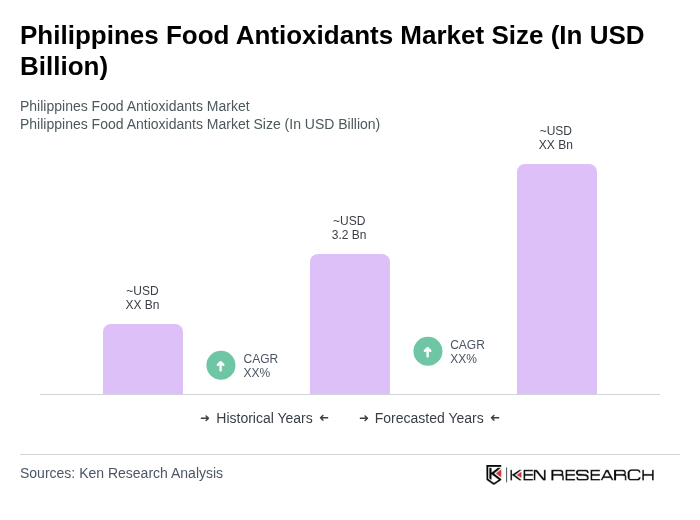
- The Philippines Food Antioxidants Market is valued at USD 3.2 billion, based on a five-year historical analysis. This growth is primarily driven by increasing consumer awareness regarding the health benefits of antioxidants, rising demand for natural food preservatives, and the expanding processed food and beverage industry, particularly in snacks, edible oils, meats, and ready-to-eat products. The market is also influenced by the growing trend of clean-label products and preference for plant-derived ingredients, which has led to a marked shift towards natural antioxidants such as tocopherols and herbal extracts.
- Metro Manila, Cebu, and Davao are the dominant regions in the Philippines Food Antioxidants Market. Metro Manila, being the capital and the primary industrial and commercial hub, has a high concentration of food and beverage manufacturers, modern retail chains, and consumers who are increasingly health-conscious and receptive to clean-label, longer-shelf-life packaged foods. Cebu and Davao are also significant due to their growing urban populations, expanding food processing clusters, and improving cold-chain and distribution infrastructure, which together contribute to the rising demand for antioxidant-enabled shelf-life extension in processed foods and beverages.
- The Philippines government implements food additive controls under the Food Safety Act of 2013 (Republic Act No. 10611) issued by the Congress of the Philippines, which strengthens the regulatory framework for food safety and food additives, including antioxidants. Implementing rules are further detailed through the Department of Health Administrative Order No. 2014-0029 and subsequent Food and Drug Administration circulars, which adopt and operationalize the Philippine National Standards for Food Additives aligned with the Codex General Standard for Food Additives, specifying permitted antioxidant substances, maximum use levels, and labeling requirements. These instruments aim to ensure consumer safety, require the use of approved antioxidants within defined limits, and enhance the overall quality and compliance of food products available in the market.
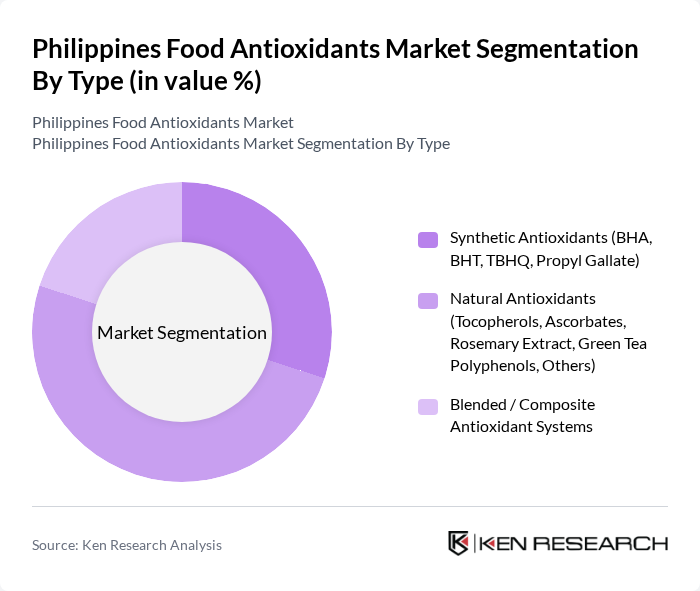
Philippines Food Antioxidants Market Segmentation
By Type:The market is segmented into three main types of antioxidants: Synthetic Antioxidants, Natural Antioxidants, and Blended/Composite Antioxidant Systems. Among these, Natural Antioxidants, which include tocopherols, ascorbates, and plant extracts such as rosemary and tea polyphenols, are gaining significant traction due to increasing consumer preference for clean-label and plant-based ingredients and the premium positioning of natural antioxidant solutions. Synthetic Antioxidants (including BHA, BHT, TBHQ, and propyl gallate), while still widely used for cost-effective and robust stabilization, are facing growing scrutiny and tighter labeling requirements, encouraging gradual reformulation toward lower doses and partial or full replacement with natural alternatives. Blended/composite systems are also emerging strongly, as synergistic formulations combining multiple antioxidants and chelators (for example, tocopherols with ascorbates and rosemary extract) help improve oxidative stability across diverse food matrices, reduce required dosage, and support product quality over extended distribution chains.
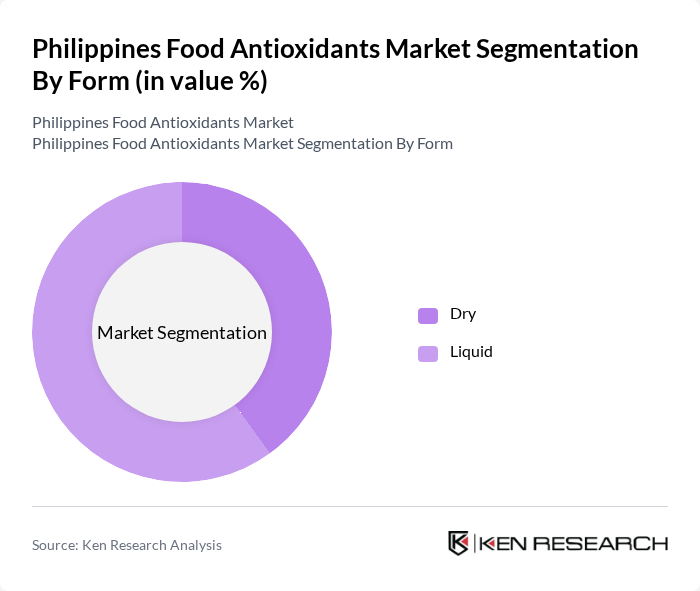
By Form:The market is categorized into Dry and Liquid forms. The Liquid form is currently prominent in applications such as edible oils, dressings, beverages, and liquid-seasoning systems due to its ease of dispersion, compatibility with oil-based and emulsion systems, and effectiveness in maintaining freshness and preventing rancidity during storage and distribution. Dry forms, including powders and encapsulated formats, remain important for bakery, snacks, powdered mixes, and meat applications, but are less favored in ready-to-drink beverages and certain convenience food categories where liquid dosing and in-line blending are operationally simpler. The trend toward convenient, ready-to-drink, and ready-to-eat products in the Philippines, together with increased use of liquid oil systems and emulsions, is supporting stronger uptake of liquid antioxidant formulations while also stimulating interest in microencapsulated dry formats for functionality and handling benefits.
Philippines Food Antioxidants Market Competitive Landscape
The Philippines Food Antioxidants Market is characterized by a dynamic mix of regional and international players. Leading participants such as BASF SE, Koninklijke DSM N.V., Archer Daniels Midland Company (ADM), Cargill, Incorporated, Kemin Industries, Inc., DuPont (E. I. du Pont de Nemours and Company), Corbion N.V., Naturex (Givaudan Group), Sabinsa Corporation, Frutarom (IFF), Aker BioMarine, Ginkgo Bioworks, BioCare Copenhagen, Herbalife Ltd., Green Science Alliance Co., Ltd. contribute to innovation, geographic expansion, and service delivery in this space, including development of plant-based antioxidant systems, microencapsulated blends, and customized premixes for oils, bakery, snacks, and meat products tailored to the Philippine processed food sector.
Philippines Food Antioxidants Market Industry Analysis
Growth Drivers
- Increasing Health Consciousness Among Consumers:The Philippines has seen a significant rise in health awareness, with 70% of consumers actively seeking healthier food options. This trend is supported by the World Health Organization's report indicating that non-communicable diseases account for 72% of total deaths in the country. As a result, the demand for food antioxidants, known for their health benefits, is expected to increase, driving market growth significantly in future.
- Rising Demand for Natural Food Preservatives:The global shift towards natural ingredients is reflected in the Philippines, where the natural food preservatives market is projected to reach PHP 15 billion in future. This growth is fueled by consumer preferences for clean-label products, as 65% of Filipinos express a preference for natural over synthetic preservatives. Consequently, food antioxidants are increasingly sought after for their preservative qualities, enhancing market potential.
- Growth in the Food and Beverage Industry:The Philippines' food and beverage industry is projected to grow to PHP 1.2 trillion in future, driven by a burgeoning middle class and urbanization. This expansion is accompanied by a rising demand for innovative food products, including those enriched with antioxidants. The increasing number of food startups and investments in food technology further supports the integration of antioxidants into various food products, propelling market growth.
Market Challenges
- High Cost of Natural Antioxidants:The price of natural antioxidants can be significantly higher than synthetic alternatives, with costs reaching up to PHP 1,500 per kilogram for premium sources like rosemary extract. This price disparity poses a challenge for manufacturers aiming to keep product prices competitive. As a result, many companies may hesitate to incorporate natural antioxidants, limiting market growth potential in the Philippines.
- Regulatory Hurdles in Food Safety:The Philippines has stringent food safety regulations, which can complicate the approval process for new antioxidant products. The Food and Drug Administration (FDA) requires extensive testing and documentation, often leading to delays. In future, the FDA is expected to increase scrutiny on health claims, making it essential for companies to navigate these regulations effectively to ensure compliance and market entry.
Philippines Food Antioxidants Market Future Outlook
The Philippines food antioxidants market is poised for significant growth, driven by increasing health consciousness and a shift towards natural ingredients. As consumers demand more functional foods, manufacturers are likely to innovate and incorporate antioxidants into their products. Additionally, the rise of e-commerce platforms will facilitate broader access to antioxidant-rich foods, enhancing market penetration. Collaborations with health brands will further amplify awareness and acceptance, positioning the market for robust expansion in future.
Market Opportunities
- Expansion of Organic Food Products:The organic food market in the Philippines is expected to grow to PHP 10 billion in future, creating opportunities for antioxidant-rich organic products. As consumers increasingly prioritize organic options, manufacturers can leverage this trend by developing and marketing antioxidant-infused organic foods, tapping into a lucrative segment of health-conscious consumers.
- Increasing Export Potential:The Philippines is strategically positioned to export food products enriched with antioxidants, particularly to markets in Asia and North America. With the global demand for health-oriented food products rising, the country can capitalize on its rich biodiversity to source unique antioxidants, enhancing its export portfolio and contributing to economic growth.
Scope of the Report
| Segment | Sub-Segments |
|---|---|
| By Type | Synthetic Antioxidants (BHA, BHT, TBHQ, Propyl Gallate) Natural Antioxidants (Tocopherols, Ascorbates, Rosemary Extract, Green Tea Polyphenols, Others) Blended / Composite Antioxidant Systems |
| By Form | Dry Liquid |
| By Source | Fruits & Vegetables Oils Spices & Herbs Botanical Extracts Gallic Acid & Petroleum-derived |
| By Application | Fats & Oils Prepared Meat, Poultry & Seafood Bakery & Confectionery Beverages Ready-to-Eat / Convenience Foods Dairy & Infant Nutrition Nutraceuticals & Dietary Supplements Other Food Applications |
| By End-User | Food & Beverage Manufacturers Ingredient & Additive Suppliers Contract Packagers & Private Labels Others |
| By Distribution Channel | Direct Sales to F&B Companies Ingredient Distributors / Brokers Online Ingredient Platforms Others |
| By Region | Luzon Visayas Mindanao Others |
Key Target Audience
Investors and Venture Capitalist Firms
Government and Regulatory Bodies (e.g., Department of Health, Food and Drug Administration)
Manufacturers and Producers of Food Antioxidants
Distributors and Retailers of Food Products
Food and Beverage Industry Stakeholders
Health and Wellness Product Companies
Food Safety and Quality Assurance Organizations
Importers and Exporters of Food Ingredients
Players Mentioned in the Report:
BASF SE
Koninklijke DSM N.V.
Archer Daniels Midland Company (ADM)
Cargill, Incorporated
Kemin Industries, Inc.
DuPont (E. I. du Pont de Nemours and Company)
Corbion N.V.
Naturex (Givaudan Group)
Sabinsa Corporation
Frutarom (IFF)
Aker BioMarine
Ginkgo Bioworks
BioCare Copenhagen
Herbalife Ltd.
Green Science Alliance Co., Ltd.
Table of Contents
Market Assessment Phase
1. Executive Summary and Approach
2. Philippines Food Antioxidants Market Overview
2.1 Key Insights and Strategic Recommendations
2.2 Philippines Food Antioxidants Market Overview
2.3 Definition and Scope
2.4 Evolution of Market Ecosystem
2.5 Timeline of Key Regulatory Milestones
2.6 Value Chain & Stakeholder Mapping
2.7 Business Cycle Analysis
2.8 Policy & Incentive Landscape
3. Philippines Food Antioxidants Market Analysis
3.1 Growth Drivers
3.1.1 Increasing health consciousness among consumers
3.1.2 Rising demand for natural food preservatives
3.1.3 Growth in the food and beverage industry
3.1.4 Expanding research on health benefits of antioxidants
3.2 Market Challenges
3.2.1 High cost of natural antioxidants
3.2.2 Regulatory hurdles in food safety
3.2.3 Limited consumer awareness
3.2.4 Competition from synthetic alternatives
3.3 Market Opportunities
3.3.1 Expansion of organic food products
3.3.2 Increasing export potential
3.3.3 Development of innovative antioxidant formulations
3.3.4 Collaborations with health and wellness brands
3.4 Market Trends
3.4.1 Shift towards plant-based antioxidants
3.4.2 Growing popularity of functional foods
3.4.3 Rise in online sales channels
3.4.4 Increased focus on sustainability in sourcing
3.5 Government Regulation
3.5.1 Implementation of food safety standards
3.5.2 Regulations on labeling of antioxidant content
3.5.3 Guidelines for health claims on food products
3.5.4 Support for research and development initiatives
4. SWOT Analysis
5. Stakeholder Analysis
6. Porter's Five Forces Analysis
7. Philippines Food Antioxidants Market Market Size, 2019-2024
7.1 By Value
7.2 By Volume
7.3 By Average Selling Price
8. Philippines Food Antioxidants Market Segmentation
8.1 By Type
8.1.1 Synthetic Antioxidants (BHA, BHT, TBHQ, Propyl Gallate)
8.1.2 Natural Antioxidants (Tocopherols, Ascorbates, Rosemary Extract, Green Tea Polyphenols, Others)
8.1.3 Blended / Composite Antioxidant Systems
8.2 By Form
8.2.1 Dry
8.2.2 Liquid
8.3 By Source
8.3.1 Fruits & Vegetables
8.3.2 Oils
8.3.3 Spices & Herbs
8.3.4 Botanical Extracts
8.3.5 Gallic Acid & Petroleum-derived
8.4 By Application
8.4.1 Fats & Oils
8.4.2 Prepared Meat, Poultry & Seafood
8.4.3 Bakery & Confectionery
8.4.4 Beverages
8.4.5 Ready-to-Eat / Convenience Foods
8.4.6 Dairy & Infant Nutrition
8.4.7 Nutraceuticals & Dietary Supplements
8.4.8 Other Food Applications
8.5 By End-User
8.5.1 Food & Beverage Manufacturers
8.5.2 Ingredient & Additive Suppliers
8.5.3 Contract Packagers & Private Labels
8.5.4 Others
8.6 By Distribution Channel
8.6.1 Direct Sales to F&B Companies
8.6.2 Ingredient Distributors / Brokers
8.6.3 Online Ingredient Platforms
8.6.4 Others
8.7 By Region
8.7.1 Luzon
8.7.2 Visayas
8.7.3 Mindanao
8.7.4 Others
9. Philippines Food Antioxidants Market Competitive Analysis
9.1 Market Share of Key Players
9.2 Cross Comparison of Key Players
9.2.1 Company Name
9.2.2 Group Size (Large, Medium, or Small as per industry convention)
9.2.3 Philippines Food Antioxidants Revenue (USD Million)
9.2.4 3–5 Year Philippines Revenue CAGR (%)
9.2.5 Philippines Market Share (%)
9.2.6 Volume Sold in Philippines (Tons)
9.2.7 Average Realized Price per Kg (USD/Kg)
9.2.8 R&D Intensity (% of Sales)
9.2.9 New Product Launches in Last 3 Years (Number)
9.2.10 Share of Natural / Clean-Label Portfolio (% of SKUs)
9.2.11 Key Local Partnerships / Distributors (Number)
9.2.12 EBITDA Margin in Philippines Antioxidants Business (%)
9.3 SWOT Analysis of Top Players
9.4 Pricing Analysis
9.5 Detailed Profile of Major Companies
9.5.1 BASF SE
9.5.2 Koninklijke DSM N.V.
9.5.3 Archer Daniels Midland Company (ADM)
9.5.4 Cargill, Incorporated
9.5.5 Kemin Industries, Inc.
9.5.6 DuPont (E. I. du Pont de Nemours and Company)
9.5.7 Corbion N.V.
9.5.8 Naturex (Givaudan Group)
9.5.9 Sabinsa Corporation
9.5.10 Frutarom (IFF)
9.5.11 Aker BioMarine
9.5.12 Ginkgo Bioworks
9.5.13 BioCare Copenhagen
9.5.14 Herbalife Ltd.
9.5.15 Green Science Alliance Co., Ltd.
10. Philippines Food Antioxidants Market End-User Analysis
10.1 Procurement Behavior of Key Ministries
10.1.1 Government procurement policies
10.1.2 Budget allocation for food safety
10.1.3 Collaboration with private sectors
10.1.4 Others
10.2 Corporate Spend on Infrastructure & Energy
10.2.1 Investment in food processing facilities
10.2.2 Funding for research and development
10.2.3 Expenditure on quality control measures
10.2.4 Others
10.3 Pain Point Analysis by End-User Category
10.3.1 Quality assurance challenges
10.3.2 Supply chain disruptions
10.3.3 Cost management issues
10.3.4 Others
10.4 User Readiness for Adoption
10.4.1 Awareness of antioxidant benefits
10.4.2 Willingness to pay for quality
10.4.3 Availability of alternatives
10.4.4 Others
10.5 Post-Deployment ROI and Use Case Expansion
10.5.1 Measurement of health outcomes
10.5.2 Cost savings analysis
10.5.3 Market expansion opportunities
10.5.4 Others
11. Philippines Food Antioxidants Market Future Size, 2025-2030
11.1 By Value
11.2 By Volume
11.3 By Average Selling Price
Go-To-Market Strategy Phase
1. Whitespace Analysis + Business Model Canvas
1.1 Market gaps identification
1.2 Value proposition development
1.3 Revenue model exploration
1.4 Customer segmentation analysis
1.5 Competitive landscape overview
1.6 Key partnerships identification
1.7 Risk assessment
2. Marketing and Positioning Recommendations
2.1 Branding strategies
2.2 Product USPs
2.3 Target audience definition
2.4 Communication strategy
2.5 Digital marketing approach
2.6 Trade marketing initiatives
2.7 Performance metrics
3. Distribution Plan
3.1 Urban retail strategies
3.2 Rural NGO tie-ups
3.3 E-commerce integration
3.4 Logistics optimization
3.5 Channel partner selection
3.6 Inventory management
3.7 Performance tracking
4. Channel & Pricing Gaps
4.1 Underserved routes
4.2 Pricing bands analysis
4.3 Competitor pricing comparison
4.4 Value-based pricing strategy
4.5 Discounting strategies
4.6 Price elasticity assessment
4.7 Customer feedback integration
5. Unmet Demand & Latent Needs
5.1 Category gaps identification
5.2 Consumer segments analysis
5.3 Product development opportunities
5.4 Market entry barriers
5.5 Innovation potential
5.6 Customer engagement strategies
5.7 Future trends forecasting
6. Customer Relationship
6.1 Loyalty programs
6.2 After-sales service
6.3 Customer feedback mechanisms
6.4 Community engagement
6.5 Relationship management tools
6.6 Customer education initiatives
6.7 Performance evaluation
7. Value Proposition
7.1 Sustainability initiatives
7.2 Integrated supply chains
7.3 Unique selling points
7.4 Customer-centric approach
7.5 Competitive advantages
7.6 Brand loyalty factors
7.7 Market differentiation strategies
8. Key Activities
8.1 Regulatory compliance
8.2 Branding efforts
8.3 Distribution setup
8.4 Marketing campaigns
8.5 Training and development
8.6 Performance monitoring
8.7 Stakeholder engagement
9. Entry Strategy Evaluation
9.1 Domestic Market Entry Strategy
9.1.1 Product mix considerations
9.1.2 Pricing band analysis
9.1.3 Packaging strategies
9.2 Export Entry Strategy
9.2.1 Target countries identification
9.2.2 Compliance roadmap development
10. Entry Mode Assessment
10.1 Joint Ventures
10.2 Greenfield Investments
10.3 Mergers & Acquisitions
10.4 Distributor Model
10.5 Risk assessment
10.6 Market entry timelines
10.7 Performance metrics
11. Capital and Timeline Estimation
11.1 Capital requirements
11.2 Timelines for market entry
11.3 Financial projections
11.4 Funding sources
11.5 Cost management strategies
11.6 Risk mitigation plans
11.7 Performance tracking
12. Control vs Risk Trade-Off
12.1 Ownership considerations
12.2 Partnerships evaluation
12.3 Risk assessment
12.4 Control mechanisms
12.5 Performance metrics
12.6 Long-term sustainability
12.7 Strategic alignment
13. Profitability Outlook
13.1 Breakeven analysis
13.2 Long-term sustainability
13.3 Financial health indicators
13.4 Market growth projections
13.5 Cost management strategies
13.6 Revenue diversification
13.7 Performance evaluation
14. Potential Partner List
14.1 Distributors
14.2 Joint Ventures
14.3 Acquisition targets
14.4 Strategic alliances
14.5 Collaboration opportunities
14.6 Market entry facilitators
14.7 Performance metrics
15. Execution Roadmap
15.1 Phased Plan for Market Entry
15.1.1 Market Setup
15.1.2 Market Entry
15.1.3 Growth Acceleration
15.1.4 Scale & Stabilize
15.2 Key Activities and Milestones
15.2.1 Activity timelines
15.2.2 Milestone tracking
15.2.3 Performance evaluation
Research Methodology
Phase 1: Approach1
Desk Research
- Analysis of industry reports from local agricultural and food safety authorities
- Review of academic journals focusing on food science and antioxidant research
- Compilation of market data from trade associations and food industry publications
Primary Research
- Interviews with food scientists and researchers specializing in antioxidants
- Surveys with manufacturers of food products rich in antioxidants
- Focus groups with consumers to gauge awareness and preferences regarding antioxidant-rich foods
Validation & Triangulation
- Cross-validation of findings with multiple data sources, including government statistics
- Triangulation of consumer insights with sales data from major retailers
- Sanity checks through expert panel discussions and feedback sessions
Phase 2: Market Size Estimation1
Top-down Assessment
- Estimation of the overall food market size in the Philippines as a baseline
- Segmentation of the market by product categories rich in antioxidants
- Incorporation of growth trends in health-conscious consumer behavior
Bottom-up Modeling
- Collection of sales data from key players in the antioxidant food sector
- Estimation of average pricing for antioxidant-rich products
- Volume estimates based on production capacities and market demand
Forecasting & Scenario Analysis
- Utilization of historical growth rates to project future market trends
- Scenario modeling based on potential regulatory changes affecting food safety
- Development of optimistic, pessimistic, and most likely market growth scenarios through 2030
Phase 3: CATI Sample Composition1
| Scope Item/Segment | Sample Size | Target Respondent Profiles |
|---|---|---|
| Retail Sales of Antioxidant Foods | 120 | Store Managers, Category Buyers |
| Manufacturers of Health Supplements | 90 | Product Development Managers, Quality Assurance Officers |
| Food Scientists and Researchers | 60 | Academic Researchers, Industry Experts |
| Consumer Awareness and Preferences | 150 | Health-Conscious Consumers, Nutritionists |
| Food Retailers and Distributors | 80 | Distribution Managers, Marketing Executives |
Frequently Asked Questions
What is the current value of the Philippines Food Antioxidants Market?
The Philippines Food Antioxidants Market is valued at approximately USD 3.2 billion, reflecting a significant growth trend driven by increasing consumer awareness of health benefits, demand for natural preservatives, and the expansion of the processed food and beverage industry.
What are the main types of antioxidants used in the Philippines?
Which regions dominate the Philippines Food Antioxidants Market?
What are the regulatory frameworks governing food antioxidants in the Philippines?
Other Regional/Country Reports
Other Adjacent Reports
Belgium Natural Ingredients Market
GCC Nutraceuticals MarketMalaysia Functional Foods Market Edible Oils MarketEgypt Processed Foods Market
Philippines Beverage Ingredients Market
Philippines Herbal Extracts Market
Vietnam Organic Food Market Outlook to 2030Why Buy From Us?

What makes us stand out is that our consultants follow Robust, Refine and Result (RRR) methodology. Robust for clear definitions, approaches and sanity checking, Refine for differentiating respondents' facts and opinions, and Result for presenting data with story.

We have set a benchmark in the industry by offering our clients with syndicated and customized market research reports featuring coverage of entire market as well as meticulous research and analyst insights.

While we don't replace traditional research, we flip the method upside down. Our dual approach of Top Bottom & Bottom Top ensures quality deliverable by not just verifying company fundamentals but also looking at the sector and macroeconomic factors.

With one step in the future, our research team constantly tries to show you the bigger picture. We help with some of the tough questions you may encounter along the way: How is the industry positioned? Best marketing channel? KPI's of competitors? By aligning every element, we help maximize success.

Our report gives you instant access to the answers and sources that other companies might choose to hide. We elaborate each steps of research methodology we have used and showcase you the sample size to earn your trust.

If you need any support, we are here! We pride ourselves on universe strength, data quality, and quick, friendly, and professional service.