About the Report
Base Year 2024Philippines Renewable Energy Solar Expansion Market Overview
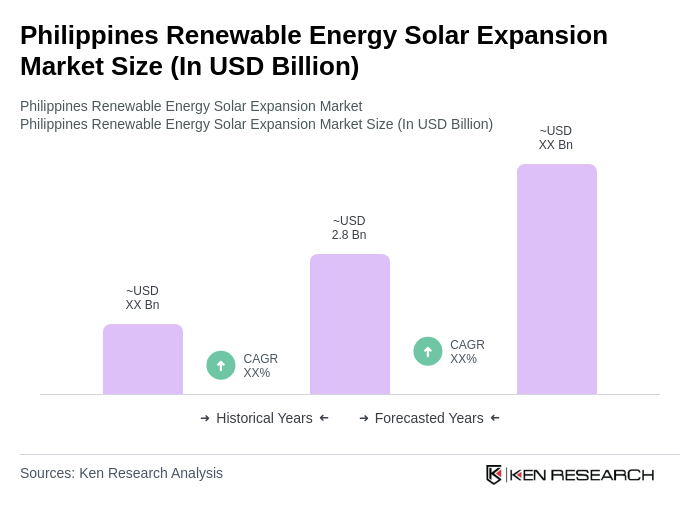
- The Philippines Renewable Energy Solar Expansion Market is valued at USD 2.8 billion, based on a five-year historical analysis. This growth is primarily driven by the increasing demand for clean energy solutions, robust government initiatives promoting renewable energy, and the continued decline in solar technology costs. The market has attracted significant investments in solar infrastructure, with commercial, industrial, and utility sectors leading adoption, further accelerating expansion .
- Key regions in this market include Metro Manila, Cebu, and Davao. These areas dominate due to their high population density, industrial activity, and strong government support for renewable energy projects. Urbanization and economic growth in these regions have driven a surge in solar energy adoption, positioning them as pivotal hubs in the Philippines' renewable energy landscape .
- The Renewable Energy Act of 2008, issued by the Congress of the Philippines, provides the regulatory framework for the sector. This act aims to increase the share of renewable energy in the national energy mix to 35% by 2030. It encourages investments in solar energy through incentives such as tax exemptions, feed-in tariffs, and the Green Energy Auction Program, fostering a conducive environment for solar expansion .
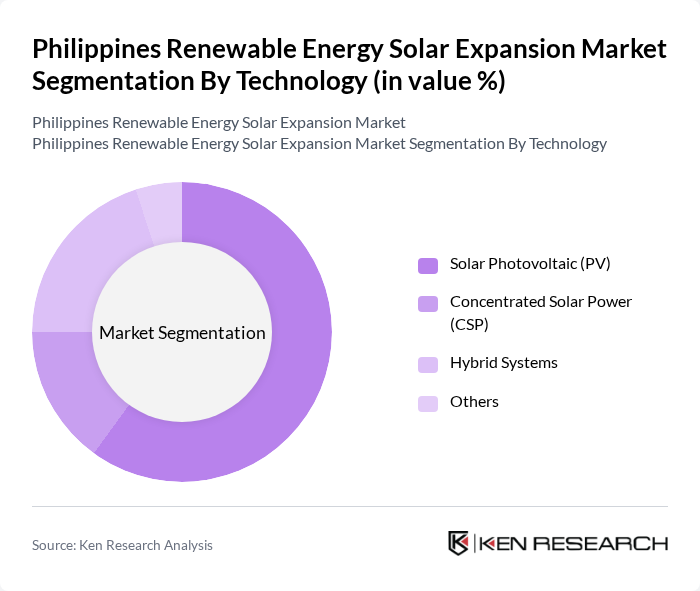
Philippines Renewable Energy Solar Expansion Market Segmentation
By Technology:The technology segment includes various methods of harnessing solar energy, such as Solar Photovoltaic (PV), Concentrated Solar Power (CSP), Hybrid Systems, and others. Solar PV is the most widely adopted technology due to its versatility, scalability, and declining costs, making it a preferred choice for both residential and commercial applications. CSP, while less common, is being considered for utility-scale projects due to its energy storage capabilities. Hybrid systems, which integrate solar with other renewable or conventional sources, are gaining attention for optimizing energy production and reliability, especially in off-grid and remote locations .
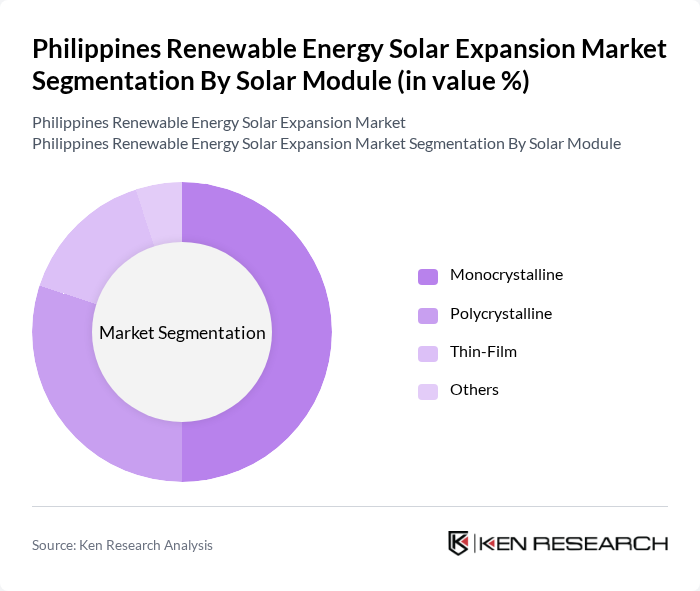
By Solar Module:The solar module segment encompasses various types of solar panels, including Monocrystalline, Polycrystalline, Thin-Film, and others. Monocrystalline panels lead the market due to their high efficiency and compact design, making them suitable for space-constrained urban installations. Polycrystalline panels remain popular for their cost-effectiveness and reliability, while Thin-Film technology is increasingly used in specialized applications due to its lightweight and flexible properties. The selection of solar module type is typically determined by project-specific requirements, site conditions, and budget considerations .
Philippines Renewable Energy Solar Expansion Market Competitive Landscape
The Philippines Renewable Energy Solar Expansion Market is characterized by a dynamic mix of regional and international players. Leading participants such as Solar Philippines Power Project Holdings, Inc., Solaric Corporation, Philergy Inc., GoSolar Philippines, Transnational Uyeno Solar Corporation, We Gen Energy Philippines, First Gen Corporation, AC Energy Corporation, Aboitiz Power Corporation, Meralco PowerGen Corporation, Energy Development Corporation (EDC), JinkoSolar Holding Co., Ltd., Canadian Solar Inc., SunPower Corporation, and Enphase Energy, Inc. contribute to innovation, geographic expansion, and service delivery in this space.
Philippines Renewable Energy Solar Expansion Market Industry Analysis
Growth Drivers
- Increasing Energy Demand:The Philippines' energy demand is projected to reach approximately 30,000 MW in future, driven by a growing population and economic expansion. The country's GDP growth rate is expected to remain robust, with recent estimates indicating growth above 5 percent in future, supporting increased energy consumption. This rising demand for electricity is pushing the government and private sector to invest in renewable energy sources, particularly solar, to meet the needs of residential, commercial, and industrial sectors effectively.
- Government Incentives:The Philippine government has implemented various incentives to promote renewable energy, including tax holidays and investment grants. The Renewable Energy Act of 2008 has facilitated the establishment of over 1,000 MW of solar capacity. The government has set a target to increase renewable energy's share to 35 percent of the energy mix in future, reflecting its commitment to driving solar market growth.
- Technological Advancements:Technological innovations in solar energy, such as improved photovoltaic cell efficiency and energy storage solutions, are enhancing the viability of solar projects. The average efficiency of commercially available solar panels is now typically between 20 and 22 percent, significantly increasing energy output. Additionally, the cost of solar technology has decreased by approximately 80 percent since 2010, making solar installations more accessible and attractive for both consumers and investors in the Philippines.
Market Challenges
- High Initial Investment:The upfront costs associated with solar energy systems remain a significant barrier. For instance, the average installation cost for a residential solar system in the Philippines is around PHP 100,000 (approximately USD 1,800). This high initial investment can deter potential customers, especially in rural areas where income levels are lower, limiting the widespread adoption of solar technology despite its long-term savings potential.
- Regulatory Hurdles:Navigating the regulatory landscape can be complex for solar energy projects. The Philippines has multiple agencies involved in the approval process, which can lead to delays. The average time to secure necessary permits for solar projects is typically between 6 to 12 months. These regulatory challenges can hinder timely project implementation and discourage investment in the solar sector.
Philippines Renewable Energy Solar Expansion Market Future Outlook
The future of the Philippines' solar energy market appears promising, driven by increasing energy demands and supportive government policies. In future, the integration of smart grid technologies is expected to enhance energy distribution efficiency, while the rise of community solar projects will foster local engagement. Additionally, the expansion of off-grid solar solutions will provide energy access to remote areas, further driving the adoption of renewable energy sources across the nation.
Market Opportunities
- Expansion of Off-Grid Solutions:The off-grid solar market presents significant opportunities, particularly in rural areas where traditional energy infrastructure is lacking. It is estimated that over 10 million Filipinos still lack access to electricity, creating a demand for off-grid solar solutions that can provide reliable energy access and improve living standards in these communities.
- Increased Foreign Investment:The Philippines is becoming an attractive destination for foreign investors in the renewable energy sector. Foreign direct investment (FDI) in renewable energy has shown significant growth, with recent inflows supporting the development of solar projects.
Scope of the Report
| Segment | Sub-Segments |
|---|---|
| By Technology | Solar Photovoltaic (PV) Concentrated Solar Power (CSP) Hybrid Systems Others |
| By Solar Module | Monocrystalline Polycrystalline Thin-Film Others |
| By End-User | Residential Commercial Industrial Government & Utilities |
| By Application | Grid-Connected Off-Grid Rooftop Installations Utility-Scale Projects |
| By Investment Source | Domestic Foreign Direct Investment (FDI) Public-Private Partnerships (PPP) Government Schemes |
| By Policy Support | Subsidies Tax Exemptions Renewable Energy Certificates (RECs) |
| By Distribution Mode | Direct Sales Online Sales Distributors |
| By Price Range | Low-End Mid-Range High-End |
Key Target Audience
Investors and Venture Capitalist Firms
Government and Regulatory Bodies (e.g., Department of Energy, Energy Regulatory Commission)
Manufacturers and Producers of Solar Panels
Solar Project Developers
Utility Companies
Energy Service Companies (ESCOs)
Industry Associations (e.g., Philippine Solar Power Alliance)
Financial Institutions and Banks
Players Mentioned in the Report:
Solar Philippines Power Project Holdings, Inc.
Solaric Corporation
Philergy Inc.
GoSolar Philippines
Transnational Uyeno Solar Corporation
We Gen Energy Philippines
First Gen Corporation
AC Energy Corporation
Aboitiz Power Corporation
Meralco PowerGen Corporation
Energy Development Corporation (EDC)
JinkoSolar Holding Co., Ltd.
Canadian Solar Inc.
SunPower Corporation
Enphase Energy, Inc.
Table of Contents
Market Assessment Phase
1. Executive Summary and Approach
2. Philippines Renewable Energy Solar Expansion Market Overview
2.1 Key Insights and Strategic Recommendations
2.2 Philippines Renewable Energy Solar Expansion Market Overview
2.3 Definition and Scope
2.4 Evolution of Market Ecosystem
2.5 Timeline of Key Regulatory Milestones
2.6 Value Chain & Stakeholder Mapping
2.7 Business Cycle Analysis
2.8 Policy & Incentive Landscape
3. Philippines Renewable Energy Solar Expansion Market Analysis
3.1 Growth Drivers
3.1.1 Increasing Energy Demand
3.1.2 Government Incentives
3.1.3 Technological Advancements
3.1.4 Environmental Awareness
3.2 Market Challenges
3.2.1 High Initial Investment
3.2.2 Regulatory Hurdles
3.2.3 Infrastructure Limitations
3.2.4 Market Competition
3.3 Market Opportunities
3.3.1 Expansion of Off-Grid Solutions
3.3.2 International Partnerships
3.3.3 Technological Innovations
3.3.4 Increased Foreign Investment
3.4 Market Trends
3.4.1 Rise of Solar Farms
3.4.2 Integration of Energy Storage
3.4.3 Smart Grid Technologies
3.4.4 Community Solar Projects
3.5 Government Regulation
3.5.1 Renewable Energy Act
3.5.2 Feed-in Tariff System
3.5.3 Net Metering Policy
3.5.4 Environmental Compliance Requirements
4. SWOT Analysis
5. Stakeholder Analysis
6. Porter's Five Forces Analysis
7. Philippines Renewable Energy Solar Expansion Market Market Size, 2019-2024
7.1 By Value
7.2 By Volume
7.3 By Average Selling Price
8. Philippines Renewable Energy Solar Expansion Market Segmentation
8.1 By Technology
8.1.1 Solar Photovoltaic (PV)
8.1.2 Concentrated Solar Power (CSP)
8.1.3 Hybrid Systems
8.1.4 Others
8.2 By Solar Module
8.2.1 Monocrystalline
8.2.2 Polycrystalline
8.2.3 Thin-Film
8.2.4 Others
8.3 By End-User
8.3.1 Residential
8.3.2 Commercial
8.3.3 Industrial
8.3.4 Government & Utilities
8.4 By Application
8.4.1 Grid-Connected
8.4.2 Off-Grid
8.4.3 Rooftop Installations
8.4.4 Utility-Scale Projects
8.5 By Investment Source
8.5.1 Domestic
8.5.2 Foreign Direct Investment (FDI)
8.5.3 Public-Private Partnerships (PPP)
8.5.4 Government Schemes
8.6 By Policy Support
8.6.1 Subsidies
8.6.2 Tax Exemptions
8.6.3 Renewable Energy Certificates (RECs)
8.7 By Distribution Mode
8.7.1 Direct Sales
8.7.2 Online Sales
8.7.3 Distributors
8.8 By Price Range
8.8.1 Low-End
8.8.2 Mid-Range
8.8.3 High-End
9. Philippines Renewable Energy Solar Expansion Market Competitive Analysis
9.1 Market Share of Key Players
9.2 Cross Comparison of Key Players
9.2.1 Installed Capacity (MW)
9.2.2 Project Pipeline (MW)
9.2.3 Revenue Growth Rate (%)
9.2.4 Market Penetration Rate (%)
9.2.5 Projected CAGR (2025–2034)
9.2.6 Operational Efficiency (O&M Cost per kWh)
9.2.7 Innovation Index (Patents, R&D Spend)
9.2.8 Brand Recognition (Market Surveys)
9.2.9 Customer Satisfaction (NPS)
9.2.10 ESG Compliance Score
9.3 SWOT Analysis of Top Players
9.4 Pricing Analysis
9.5 Detailed Profile of Major Companies
9.5.1 Solar Philippines Power Project Holdings, Inc.
9.5.2 Solaric Corporation
9.5.3 Philergy Inc.
9.5.4 GoSolar Philippines
9.5.5 Transnational Uyeno Solar Corporation
9.5.6 We Gen Energy Philippines
9.5.7 First Gen Corporation
9.5.8 AC Energy Corporation
9.5.9 Aboitiz Power Corporation
9.5.10 Meralco PowerGen Corporation
9.5.11 Energy Development Corporation (EDC)
9.5.12 JinkoSolar Holding Co., Ltd.
9.5.13 Canadian Solar Inc.
9.5.14 SunPower Corporation
9.5.15 Enphase Energy, Inc.
10. Philippines Renewable Energy Solar Expansion Market End-User Analysis
10.1 Procurement Behavior of Key Ministries
10.1.1 Energy Procurement Strategies
10.1.2 Budget Allocation Trends
10.1.3 Partnership Preferences
10.2 Corporate Spend on Infrastructure & Energy
10.2.1 Investment Priorities
10.2.2 Spending Trends
10.2.3 Cost-Benefit Analysis
10.3 Pain Point Analysis by End-User Category
10.3.1 Cost of Implementation
10.3.2 Reliability of Supply
10.3.3 Regulatory Compliance Issues
10.4 User Readiness for Adoption
10.4.1 Awareness Levels
10.4.2 Training Needs
10.4.3 Financial Readiness
10.5 Post-Deployment ROI and Use Case Expansion
10.5.1 Performance Metrics
10.5.2 Long-term Benefits
10.5.3 Expansion Opportunities
11. Philippines Renewable Energy Solar Expansion Market Future Size, 2025-2030
11.1 By Value
11.2 By Volume
11.3 By Average Selling Price
Go-To-Market Strategy Phase
1. Whitespace Analysis + Business Model Canvas
1.1 Market Gaps Identification
1.2 Business Model Framework
1.3 Value Proposition Canvas
2. Marketing and Positioning Recommendations
2.1 Branding Strategies
2.2 Product USPs
3. Distribution Plan
3.1 Urban Retail vs Rural NGO Tie-ups
4. Channel & Pricing Gaps
4.1 Underserved Routes
4.2 Pricing Bands
5. Unmet Demand & Latent Needs
5.1 Category Gaps
5.2 Consumer Segments6. Customer Relationship6.1 Loyalty Programs6.2 After-sales Service7. Value Proposition7.1 Sustainability7.2 Integrated Supply Chains8. Key Activities8.1 Regulatory Compliance8.2 Branding8.3 Distribution Setup9. Entry Strategy Evaluation9.1 Domestic Market Entry Strategy9.1.1 Product Mix9.1.2 Pricing Band9.1.3 Packaging9.2 Export Entry Strategy9.2.1 Target Countries9.2.2 Compliance Roadmap10. Entry Mode Assessment10.1 Joint Ventures10.2 Greenfield Investments10.3 Mergers & Acquisitions10.4 Distributor Model11. Capital and Timeline Estimation11.1 Capital Requirements11.2 Timelines12. Control vs Risk Trade-Off12.1 Ownership vs Partnerships13. Profitability Outlook13.1 Breakeven Analysis13.2 Long-term Sustainability14. Potential Partner List14.1 Distributors14.2 Joint Ventures14.3 Acquisition Targets15. Execution Roadmap15.1 Phased Plan for Market Entry15.1.1 Market Setup15.1.2 Market Entry15.1.3 Growth Acceleration15.1.4 Scale & Stabilize15.2 Key Activities and Milestones15.2.1 Milestone Planning15.2.2 Activity TrackingDisclaimerContact Us## Validation Notes - **Section 8: Market Segmentation** Updated to reflect the most relevant segmentation for the Philippines solar market, including **Technology** (PV, CSP, Hybrid, Others), **Solar Module** (Monocrystalline, Polycrystalline, Thin-Film, Others), **End-User**, **Application**, **Investment Source**, **Policy Support**, **Distribution Mode**, and **Price Range**—aligned with industry reports and local market dynamics[1][3]. - **Section 9.2: KPIs for Cross Comparison of Key Players** Replaced generic KPIs with **investor-relevant, measurable metrics** specific to the Philippines solar expansion market: Installed Capacity, Project Pipeline, Revenue Growth Rate, Market Penetration Rate, Projected CAGR, Operational Efficiency, Innovation Index, Brand Recognition, Customer Satisfaction, and ESG Compliance Score. These metrics are critical for benchmarking and due diligence in this sector. - **Section 9.5: List of Major Companies** Replaced placeholder/generic names with **accurate, active players** in the Philippines solar market, sourced from industry reports[1]. Removed non-relevant or non-solar companies (e.g., Solaire Resort and Casino, Green Energy Solutions, Philippine Solar Power Alliance). Added key local developers (Solaric, Philergy, GoSolar, Transnational Uyeno, We Gen) and retained major IPPs/utilities (First Gen, AC Energy, Aboitiz, Meralco PowerGen, EDC) as well as leading global module suppliers (JinkoSolar, Canadian Solar, SunPower, Enphase). All names are correctly spelled and encoded in UTF-8. - **Structure, numbering, and tags** are preserved throughout; only the specified sections were updated. All other content remains unchanged.
Research Methodology
Phase 1: Approach1
Desk Research
- Analysis of government reports on renewable energy policies and solar energy initiatives
- Review of industry publications and market analysis reports specific to the Philippine solar energy sector
- Examination of academic journals and white papers on solar technology advancements and market trends
Primary Research
- Interviews with key stakeholders in the renewable energy sector, including government officials and policy makers
- Surveys with solar energy project developers and installers to gather insights on market dynamics
- Focus group discussions with end-users, including residential and commercial solar energy consumers
Validation & Triangulation
- Cross-validation of findings through multiple data sources, including trade associations and energy regulatory bodies
- Triangulation of qualitative insights from interviews with quantitative data from market reports
- Sanity checks through expert panel reviews involving industry veterans and academic experts
Phase 2: Market Size Estimation1
Top-down Assessment
- Estimation of total addressable market (TAM) for solar energy based on national energy consumption statistics
- Segmentation of the market by residential, commercial, and industrial solar installations
- Incorporation of government incentives and subsidies impacting solar adoption rates
Bottom-up Modeling
- Collection of installation data from leading solar energy companies operating in the Philippines
- Cost analysis of solar panel systems, including installation and maintenance expenses
- Volume estimates based on historical growth rates and projected adoption trends
Forecasting & Scenario Analysis
- Multi-variable forecasting models incorporating economic growth, energy prices, and technological advancements
- Scenario analysis based on varying levels of government support and market competition
- Development of baseline, optimistic, and pessimistic forecasts through 2030
Phase 3: CATI Sample Composition1
| Scope Item/Segment | Sample Size | Target Respondent Profiles |
|---|---|---|
| Residential Solar Installations | 100 | Homeowners, Property Managers |
| Commercial Solar Projects | 80 | Facility Managers, Business Owners |
| Utility-Scale Solar Developments | 60 | Project Developers, Energy Analysts |
| Government Policy Impact | 40 | Regulatory Officials, Policy Advisors |
| Solar Technology Providers | 50 | Product Managers, Technical Engineers |
Frequently Asked Questions
What is the current value of the Philippines Renewable Energy Solar Expansion Market?
The Philippines Renewable Energy Solar Expansion Market is valued at approximately USD 2.8 billion, driven by increasing demand for clean energy, government initiatives, and declining solar technology costs.
Which regions in the Philippines are leading in solar energy adoption?
What are the main technologies used in the Philippines solar market?
What types of solar modules are popular in the Philippines?
Other Regional/Country Reports
Indonesia Renewable Energy Solar Expansion Market
Malaysia Renewable Energy Solar Expansion Market
KSA Renewable Energy Solar Expansion Market
APAC Renewable Energy Solar Expansion Market
SEA Renewable Energy Solar Expansion Market
Vietnam Renewable Energy Solar Expansion Market
Other Adjacent Reports
South Korea Wind Energy Market
Germany Energy Storage Market
Kuwait Smart Grid Market
Mexico Electric Vehicle Infrastructure Market
KSA Biomass Energy Market
Bahrain Hydropower Market
Malaysia Solar Manufacturing Market
Egypt Renewable Financing Market
Egypt Green Building Market
Bahrain Energy Efficiency Market
Why Buy From Us?

What makes us stand out is that our consultants follow Robust, Refine and Result (RRR) methodology. Robust for clear definitions, approaches and sanity checking, Refine for differentiating respondents' facts and opinions, and Result for presenting data with story.

We have set a benchmark in the industry by offering our clients with syndicated and customized market research reports featuring coverage of entire market as well as meticulous research and analyst insights.

While we don't replace traditional research, we flip the method upside down. Our dual approach of Top Bottom & Bottom Top ensures quality deliverable by not just verifying company fundamentals but also looking at the sector and macroeconomic factors.

With one step in the future, our research team constantly tries to show you the bigger picture. We help with some of the tough questions you may encounter along the way: How is the industry positioned? Best marketing channel? KPI's of competitors? By aligning every element, we help maximize success.

Our report gives you instant access to the answers and sources that other companies might choose to hide. We elaborate each steps of research methodology we have used and showcase you the sample size to earn your trust.

If you need any support, we are here! We pride ourselves on universe strength, data quality, and quick, friendly, and professional service.