About the Report
Base Year 2024Listen to the audio summary
Philippines Soil Moisture Sensors Market Overview
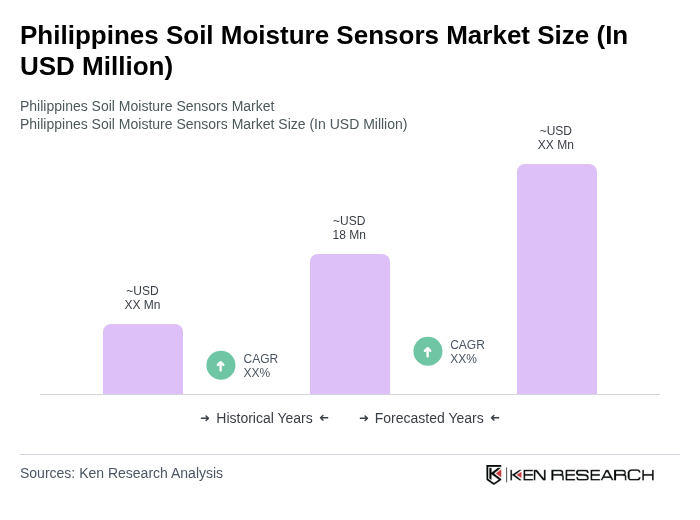
- The Philippines Soil Moisture Sensors Market is valued at USD 18 million, based on a five-year historical analysis. This growth is primarily driven by the increasing adoption of precision agriculture practices, such as smart irrigation and real-time monitoring, which enhance crop yield and resource efficiency. The integration of IoT-enabled sensors and wireless technologies, along with the rising awareness of water conservation and sustainable farming techniques, has further propelled the demand for advanced soil moisture monitoring solutions .
- Key cities such as Manila, Cebu, and Davao dominate the market due to their significant agricultural activities, urbanization, and adoption of modern farming technologies. Manila, being the capital, serves as a hub for agricultural technology providers, while Cebu and Davao are recognized for their diverse crop production and active agribusiness sectors, making them critical areas for soil moisture sensor deployment .
- The "Philippine Sustainable Agriculture and Water Resources Act, 2023" issued by the Department of Agriculture mandates the integration of efficient irrigation systems and soil moisture monitoring technologies in large-scale agricultural operations. This regulation requires farms exceeding five hectares to implement certified soil moisture sensors as part of their compliance with sustainable water resource management and reporting standards.
Philippines Soil Moisture Sensors Market Segmentation
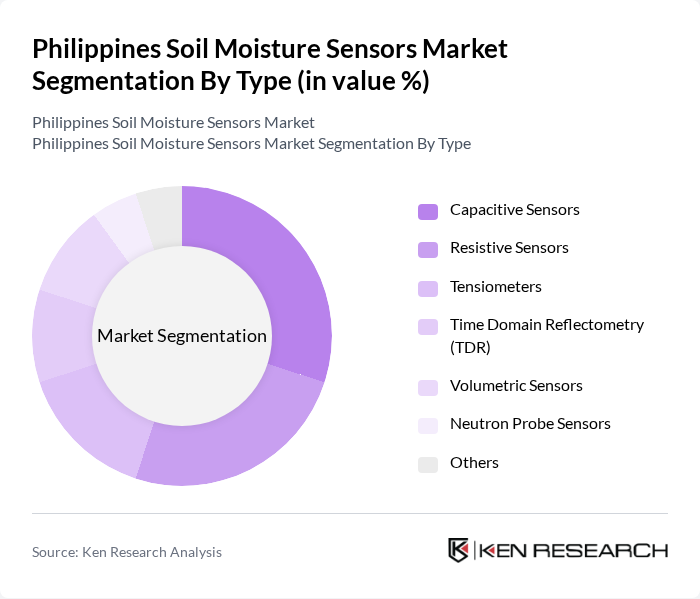
By Type:The market is segmented into various types of soil moisture sensors, including capacitive sensors, resistive sensors, tensiometers, time domain reflectometry (TDR), volumetric sensors, neutron probe sensors, and others. Capacitive sensors are gaining traction due to their accuracy, low maintenance, and durability, while resistive sensors remain popular for their cost-effectiveness and ease of integration. Tensiometers are preferred for monitoring soil water potential in specialty crops, and TDR technology is increasingly adopted for its precision and suitability in both research and commercial farming applications. Volumetric sensors, which measure the volumetric water content, are widely used in smart irrigation systems and environmental monitoring .
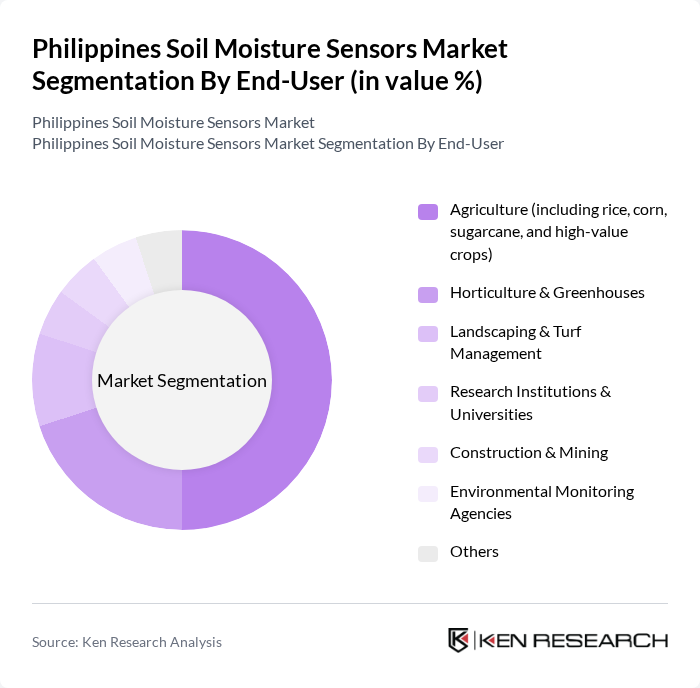
By End-User:The end-user segmentation includes agriculture (covering rice, corn, sugarcane, and high-value crops), horticulture and greenhouses, landscaping and turf management, research institutions and universities, construction and mining, environmental monitoring agencies, and others. Agriculture remains the dominant sector, driven by the need for efficient irrigation, yield optimization, and climate resilience. Horticulture and greenhouses are significant users, requiring precise moisture control for high-value crops and ornamental plants. The construction and mining sectors increasingly use soil moisture sensors for site preparation, slope stability, and environmental compliance, while research institutions and environmental agencies deploy these sensors for data-driven land management and monitoring .
Philippines Soil Moisture Sensors Market Competitive Landscape
The Philippines Soil Moisture Sensors Market is characterized by a dynamic mix of regional and international players. Leading participants such as AquaSpy, METER Group (formerly Decagon Devices), Irrometer Company, Inc., Sentek Technologies, CropX Technologies, Vegetronix, Inc., Delta-T Devices Ltd., Stevens Water Monitoring Systems, Inc., HydroPoint Data Systems, Inc., Smart Watering Systems, Soil Scout Oy, Teralytic, Inc., PlantLink (Osmo Systems), Parrot SA, GreenIQ Ltd. contribute to innovation, geographic expansion, and service delivery in this space.
Philippines Soil Moisture Sensors Market Industry Analysis
Growth Drivers
- Increasing Agricultural Productivity:The Philippines aims to boost agricultural productivity, targeting a 3% annual growth rate in future. This growth is driven by the need to feed a population projected to reach 120 million. The government has allocated approximately PHP 50 billion (USD 1 billion) for agricultural modernization, which includes the adoption of soil moisture sensors to optimize irrigation and enhance crop yields, thereby addressing food security challenges.
- Rising Awareness of Water Conservation:With the Philippines experiencing a water crisis, awareness of water conservation is increasing among farmers. The Department of Agriculture reported that 70% of irrigation water is wasted due to inefficient practices. Soil moisture sensors can reduce water usage by up to 30%, aligning with the government's goal to improve water management and sustainability in agriculture, which is crucial for the country's long-term agricultural viability.
- Government Initiatives for Smart Farming:The Philippine government has launched initiatives to promote smart farming technologies, investing around PHP 10 billion (USD 200 million) in future. These initiatives include training programs for farmers on the use of soil moisture sensors and other precision agriculture tools. The aim is to enhance productivity and sustainability, making the agricultural sector more resilient to climate change and market fluctuations, thus driving sensor adoption.
Market Challenges
- High Initial Investment Costs:The adoption of soil moisture sensors involves significant upfront costs, often exceeding PHP 15,000 (USD 300) per unit. Many smallholder farmers, who constitute about 80% of the agricultural sector, struggle to afford these investments. This financial barrier limits the widespread adoption of advanced technologies, hindering overall market growth and the potential benefits of improved irrigation practices.
- Limited Awareness Among Farmers:Despite the benefits, only 25% of farmers in the Philippines are aware of soil moisture sensors and their advantages. This lack of awareness is compounded by insufficient training and education programs. The Philippine Statistics Authority indicates that only 15% of farmers have received training on modern agricultural technologies, which restricts the market's growth potential and the effective implementation of these tools in farming practices.
Philippines Soil Moisture Sensors Market Future Outlook
The future of the Philippines soil moisture sensors market appears promising, driven by increasing government support and technological advancements. As farmers become more aware of the benefits of precision agriculture, the adoption of these sensors is expected to rise. Additionally, the integration of IoT technologies will enhance data collection and analysis, leading to more efficient farming practices. The focus on sustainable agriculture will further propel the market, aligning with global trends towards environmental responsibility and resource conservation.
Market Opportunities
- Expansion of Precision Agriculture:The growing trend towards precision agriculture presents a significant opportunity for soil moisture sensors. With the Philippine government promoting this approach, farmers can leverage these technologies to optimize resource use, potentially increasing crop yields by 20% while reducing input costs, thus enhancing profitability and sustainability in farming.
- Integration with IoT and Smart Devices:The integration of soil moisture sensors with IoT devices is a burgeoning opportunity. The number of connected agricultural devices in the Philippines is expected to reach 1 million in future. This integration allows for real-time monitoring and data-driven decision-making, improving irrigation efficiency and crop management, which can significantly enhance agricultural productivity.
Scope of the Report
| Segment | Sub-Segments |
|---|---|
| By Type | Capacitive Sensors Resistive Sensors Tensiometers Time Domain Reflectometry (TDR) Volumetric Sensors Neutron Probe Sensors Others |
| By End-User | Agriculture (including rice, corn, sugarcane, and high-value crops) Horticulture & Greenhouses Landscaping & Turf Management Research Institutions & Universities Construction & Mining Environmental Monitoring Agencies Others |
| By Region | Luzon Visayas Mindanao |
| By Technology | Analog Sensors Digital Sensors Wireless Sensors IoT-Enabled Sensors Others |
| By Application | Soil Moisture Monitoring Irrigation Management Crop Health Monitoring Water Resource Management Construction Site Monitoring Others |
| By Investment Source | Private Investments Government Funding International Aid NGO/Development Agency Support Others |
| By Policy Support | Government Subsidies Tax Incentives Research Grants Technology Adoption Programs Others |
Key Target Audience
Investors and Venture Capitalist Firms
Government and Regulatory Bodies (e.g., Department of Agriculture, Department of Environment and Natural Resources)
Agricultural Cooperatives and Associations
Farm Equipment Manufacturers
Environmental NGOs and Advocacy Groups
Irrigation and Water Management Companies
Agri-tech Startups and Innovators
Local Government Units (LGUs) involved in agricultural development
Players Mentioned in the Report:
AquaSpy
METER Group (formerly Decagon Devices)
Irrometer Company, Inc.
Sentek Technologies
CropX Technologies
Vegetronix, Inc.
Delta-T Devices Ltd.
Stevens Water Monitoring Systems, Inc.
HydroPoint Data Systems, Inc.
Smart Watering Systems
Soil Scout Oy
Teralytic, Inc.
PlantLink (Osmo Systems)
Parrot SA
GreenIQ Ltd.
Table of Contents
Market Assessment Phase
1. Executive Summary and Approach
2. Philippines Soil Moisture Sensors Market Overview
2.1 Key Insights and Strategic Recommendations
2.2 Philippines Soil Moisture Sensors Market Overview
2.3 Definition and Scope
2.4 Evolution of Market Ecosystem
2.5 Timeline of Key Regulatory Milestones
2.6 Value Chain & Stakeholder Mapping
2.7 Business Cycle Analysis
2.8 Policy & Incentive Landscape
3. Philippines Soil Moisture Sensors Market Analysis
3.1 Growth Drivers
3.1.1 Increasing agricultural productivity
3.1.2 Rising awareness of water conservation
3.1.3 Government initiatives for smart farming
3.1.4 Technological advancements in sensor technology
3.2 Market Challenges
3.2.1 High initial investment costs
3.2.2 Limited awareness among farmers
3.2.3 Dependence on weather conditions
3.2.4 Maintenance and technical support issues
3.3 Market Opportunities
3.3.1 Expansion of precision agriculture
3.3.2 Integration with IoT and smart devices
3.3.3 Development of affordable sensor solutions
3.3.4 Partnerships with agricultural cooperatives
3.4 Market Trends
3.4.1 Adoption of wireless sensor networks
3.4.2 Increasing focus on sustainable farming practices
3.4.3 Growth of data analytics in agriculture
3.4.4 Rise in mobile applications for farm management
3.5 Government Regulation
3.5.1 Standards for agricultural technology
3.5.2 Subsidies for smart farming technologies
3.5.3 Environmental regulations on water usage
3.5.4 Policies promoting research and development
4. SWOT Analysis
5. Stakeholder Analysis
6. Porter's Five Forces Analysis
7. Philippines Soil Moisture Sensors Market Market Size, 2019-2024
7.1 By Value
7.2 By Volume
7.3 By Average Selling Price
8. Philippines Soil Moisture Sensors Market Segmentation
8.1 By Type
8.1.1 Capacitive Sensors
8.1.2 Resistive Sensors
8.1.3 Tensiometers
8.1.4 Time Domain Reflectometry (TDR)
8.1.5 Volumetric Sensors
8.1.6 Neutron Probe Sensors
8.1.7 Others
8.2 By End-User
8.2.1 Agriculture (including rice, corn, sugarcane, and high-value crops)
8.2.2 Horticulture & Greenhouses
8.2.3 Landscaping & Turf Management
8.2.4 Research Institutions & Universities
8.2.5 Construction & Mining
8.2.6 Environmental Monitoring Agencies
8.2.7 Others
8.3 By Region
8.3.1 Luzon
8.3.2 Visayas
8.3.3 Mindanao
8.4 By Technology
8.4.1 Analog Sensors
8.4.2 Digital Sensors
8.4.3 Wireless Sensors
8.4.4 IoT-Enabled Sensors
8.4.5 Others
8.5 By Application
8.5.1 Soil Moisture Monitoring
8.5.2 Irrigation Management
8.5.3 Crop Health Monitoring
8.5.4 Water Resource Management
8.5.5 Construction Site Monitoring
8.5.6 Others
8.6 By Investment Source
8.6.1 Private Investments
8.6.2 Government Funding
8.6.3 International Aid
8.6.4 NGO/Development Agency Support
8.6.5 Others
8.7 By Policy Support
8.7.1 Government Subsidies
8.7.2 Tax Incentives
8.7.3 Research Grants
8.7.4 Technology Adoption Programs
8.7.5 Others
9. Philippines Soil Moisture Sensors Market Competitive Analysis
9.1 Market Share of Key Players
9.2 Cross Comparison of Key Players
9.2.1 Company Name
9.2.2 Company Size (Large, Medium, Small)
9.2.3 Revenue from Soil Moisture Sensors (Philippines, latest fiscal year)
9.2.4 Market Share in Philippines Soil Moisture Sensors Market (%)
9.2.5 Number of Distribution/Channel Partners in Philippines
9.2.6 Product Portfolio Breadth (Number of Sensor Types Offered)
9.2.7 R&D Expenditure as % of Revenue
9.2.8 Local Partnerships/Collaborations (Count or Notable Names)
9.2.9 Average Lead Time (Order to Delivery, days)
9.2.10 Customer Satisfaction Score (Philippines, latest survey)
9.2.11 Return on Investment (ROI) for End-Users (%)
9.2.12 After-Sales Service Coverage (Regions/Provinces)
9.3 SWOT Analysis of Top Players
9.4 Pricing Analysis
9.5 Detailed Profile of Major Companies
9.5.1 AquaSpy
9.5.2 METER Group (formerly Decagon Devices)
9.5.3 Irrometer Company, Inc.
9.5.4 Sentek Technologies
9.5.5 CropX Technologies
9.5.6 Vegetronix, Inc.
9.5.7 Delta-T Devices Ltd.
9.5.8 Stevens Water Monitoring Systems, Inc.
9.5.9 HydroPoint Data Systems, Inc.
9.5.10 Smart Watering Systems
9.5.11 Soil Scout Oy
9.5.12 Teralytic, Inc.
9.5.13 PlantLink (Osmo Systems)
9.5.14 Parrot SA
9.5.15 GreenIQ Ltd.
10. Philippines Soil Moisture Sensors Market End-User Analysis
10.1 Procurement Behavior of Key Ministries
10.1.1 Ministry of Agriculture
10.1.2 Department of Environment and Natural Resources
10.1.3 Local Government Units
10.2 Corporate Spend on Infrastructure & Energy
10.2.1 Investment in Smart Agriculture
10.2.2 Funding for Research and Development
10.3 Pain Point Analysis by End-User Category
10.3.1 Farmers
10.3.2 Agricultural Cooperatives
10.4 User Readiness for Adoption
10.4.1 Training and Support Needs
10.4.2 Technology Acceptance Levels
10.5 Post-Deployment ROI and Use Case Expansion
10.5.1 Measurement of Water Savings
10.5.2 Crop Yield Improvements
11. Philippines Soil Moisture Sensors Market Future Size, 2025-2030
11.1 By Value
11.2 By Volume
11.3 By Average Selling Price
Go-To-Market Strategy Phase
1. Whitespace Analysis + Business Model Canvas
1.1 Market Gaps Identification
1.2 Business Model Development
2. Marketing and Positioning Recommendations
2.1 Branding Strategies
2.2 Product USPs
3. Distribution Plan
3.1 Urban Retail Strategies
3.2 Rural NGO Tie-ups
4. Channel & Pricing Gaps
4.1 Underserved Routes
4.2 Pricing Bands
5. Unmet Demand & Latent Needs
5.1 Category Gaps
5.2 Consumer Segments
6. Customer Relationship
6.1 Loyalty Programs
6.2 After-sales Service
7. Value Proposition
7.1 Sustainability
7.2 Integrated Supply Chains
8. Key Activities
8.1 Regulatory Compliance
8.2 Branding
8.3 Distribution Setup
9. Entry Strategy Evaluation
9.1 Domestic Market Entry Strategy
9.1.1 Product Mix
9.1.2 Pricing Band
9.1.3 Packaging
9.2 Export Entry Strategy
9.2.1 Target Countries
9.2.2 Compliance Roadmap
10. Entry Mode Assessment
10.1 Joint Ventures
10.2 Greenfield Investments
10.3 Mergers & Acquisitions
10.4 Distributor Model
11. Capital and Timeline Estimation
11.1 Capital Requirements
11.2 Timelines
12. Control vs Risk Trade-Off
12.1 Ownership vs Partnerships
13. Profitability Outlook
13.1 Breakeven Analysis
13.2 Long-term Sustainability
14. Potential Partner List
14.1 Distributors
14.2 Joint Ventures
14.3 Acquisition Targets
15. Execution Roadmap
15.1 Phased Plan for Market Entry
15.1.1 Market Setup
15.1.2 Market Entry
15.1.3 Growth Acceleration
15.1.4 Scale & Stabilize
15.2 Key Activities and Milestones
15.2.1 Milestone Planning
Research Methodology
Phase 1: Approach1
Desk Research
- Analysis of government agricultural reports and soil moisture data from the Philippine Statistics Authority
- Review of academic journals and publications on soil moisture sensor technology and its applications in agriculture
- Examination of industry reports from agricultural technology associations and environmental agencies
Primary Research
- Interviews with agricultural extension officers and agronomists to understand market needs and sensor applications
- Surveys with farmers and agricultural cooperatives regarding their experiences and preferences for soil moisture sensors
- Discussions with technology providers and distributors to gather insights on market trends and product offerings
Validation & Triangulation
- Cross-validation of findings through comparison with existing market studies and reports
- Triangulation of data from primary interviews, secondary research, and market trends
- Sanity checks conducted through expert panel reviews involving agritech specialists and market analysts
Phase 2: Market Size Estimation1
Top-down Assessment
- Estimation of total addressable market based on national agricultural spending and technology adoption rates
- Segmentation of market size by crop type, region, and sensor technology used
- Incorporation of government initiatives promoting precision agriculture and sustainable farming practices
Bottom-up Modeling
- Collection of sales data from leading soil moisture sensor manufacturers and distributors
- Estimation of market penetration rates based on farmer demographics and technology adoption barriers
- Volume and pricing analysis to derive revenue projections for different sensor types
Forecasting & Scenario Analysis
- Multi-variable forecasting using factors such as climate change impact, agricultural productivity, and technology advancements
- Scenario analysis based on varying levels of government support and farmer education initiatives
- Development of baseline, optimistic, and pessimistic market growth projections through 2030
Phase 3: CATI Sample Composition1
| Scope Item/Segment | Sample Size | Target Respondent Profiles |
|---|---|---|
| Smallholder Farmers | 100 | Crop Farmers, Agricultural Cooperative Members |
| Agricultural Technology Providers | 60 | Product Managers, Sales Executives |
| Government Agricultural Agencies | 50 | Policy Makers, Agricultural Extension Workers |
| Research Institutions | 40 | Soil Scientists, Agronomists |
| Distributors and Retailers | 40 | Supply Chain Managers, Retail Executives |
Frequently Asked Questions
What is the current value of the Philippines Soil Moisture Sensors Market?
The Philippines Soil Moisture Sensors Market is valued at approximately USD 18 million, reflecting a growing trend towards precision agriculture and advanced monitoring technologies that enhance crop yield and resource efficiency.
What factors are driving the growth of soil moisture sensors in the Philippines?
Which cities in the Philippines are leading in soil moisture sensor adoption?
What types of soil moisture sensors are available in the Philippines?
Other Regional/Country Reports
Indonesia Soil Moisture Sensors Market
Malaysia Soil Moisture Sensors Market
KSA Soil Moisture Sensors Market
APAC Soil Moisture Sensors Market
SEA Soil Moisture Sensors Market
Vietnam Soil Moisture Sensors Market
Other Adjacent Reports
KSA Agricultural IoT Market
Oman Soil Testing Equipment Market
Malaysia Smart Farming Technology Market
Oman Water Conservation Devices Market
Brazil Crop Monitoring Solutions Market
Mexico Environmental Monitoring Sensors Market
Mexico Horticulture Equipment Market
Mexico Agribusiness Analytics Market
Why Buy From Us?

What makes us stand out is that our consultants follow Robust, Refine and Result (RRR) methodology. Robust for clear definitions, approaches and sanity checking, Refine for differentiating respondents' facts and opinions, and Result for presenting data with story.

We have set a benchmark in the industry by offering our clients with syndicated and customized market research reports featuring coverage of entire market as well as meticulous research and analyst insights.

While we don't replace traditional research, we flip the method upside down. Our dual approach of Top Bottom & Bottom Top ensures quality deliverable by not just verifying company fundamentals but also looking at the sector and macroeconomic factors.

With one step in the future, our research team constantly tries to show you the bigger picture. We help with some of the tough questions you may encounter along the way: How is the industry positioned? Best marketing channel? KPI's of competitors? By aligning every element, we help maximize success.

Our report gives you instant access to the answers and sources that other companies might choose to hide. We elaborate each steps of research methodology we have used and showcase you the sample size to earn your trust.

If you need any support, we are here! We pride ourselves on universe strength, data quality, and quick, friendly, and professional service.