Opportunities in a Rapidly Scaling Data Centre Market in the Middle East: An AI- and Sovereign-Led Infrastructure Shift
Download the Full Consulting POV Now
Executive Summary
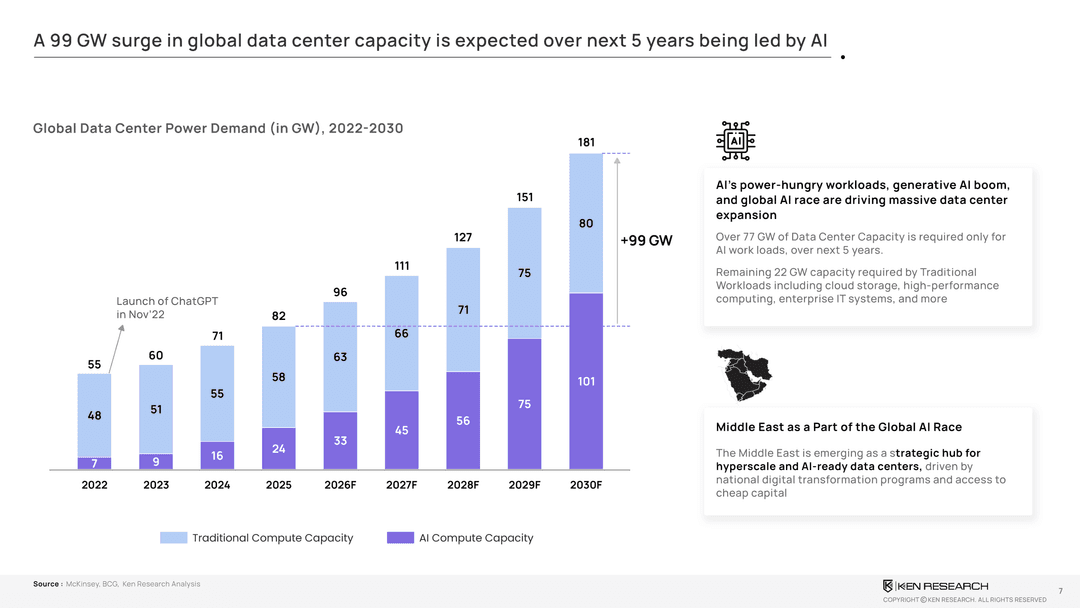
The Middle East data centre market is entering a phase ofstructural hyper-growth, driven by a convergence ofAI-led compute demand, sovereign capital deployment, and hyperscale expansion. Following the acceleration of generative AI adoption post-November 2022, global data centre demand has entered a new scale regime, with AI workloads alone expected to require~77 GW of incremental capacity over the next five years, compared to~22 GW from traditional workloads.
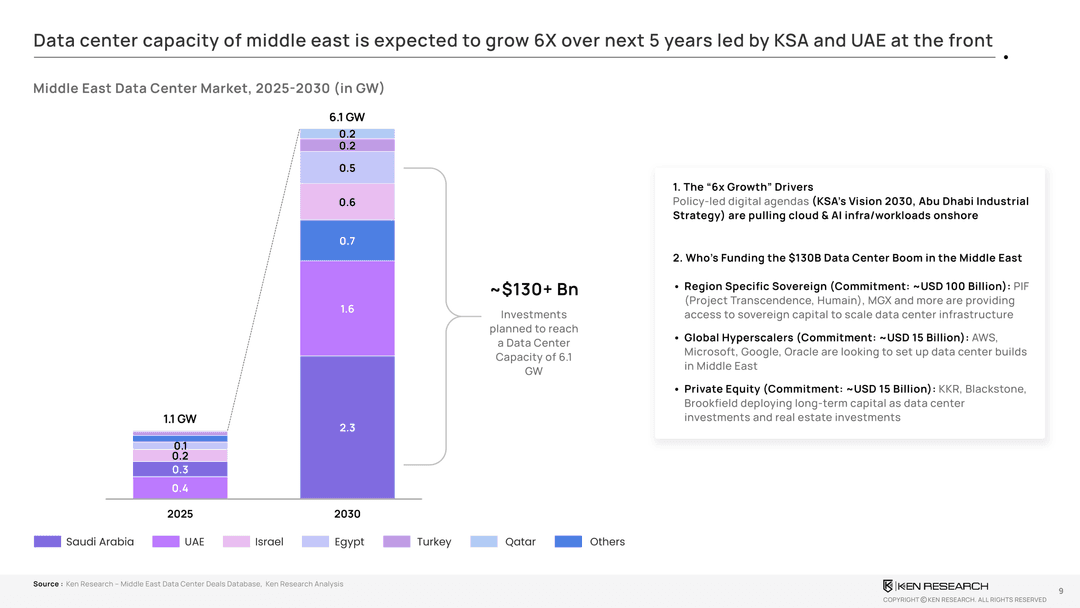
Within this context, the Middle East—led bySaudi Arabia (KSA) and the UAE—is emerging as one of the fastest-growing global data centre regions. Installed and planned capacity in the region is projected to grow~6x over the next five years, reaching approximately6.1 GW, supported byUSD 130+ billion in announced and planned investments. This expansion is underpinned by low-cost power, land availability, strategic subsea connectivity, and direct sovereign participation, positioning the region as a global data infrastructure hub rather than a peripheral market.
The Global Demand Reset: AI Is Redefining Data Centre Scale
The PPT establishes a clear inflection point in global data centre demand:
- AI workloads are expected to drive~77 GWof new data centre capacity over the next five years
- Traditional workloads (cloud, enterprise IT, HPC, storage) contribute an additional~22 GW
- Total incremental demand:~99 GW globally, triggered by the commercialization of generative AI post-2022
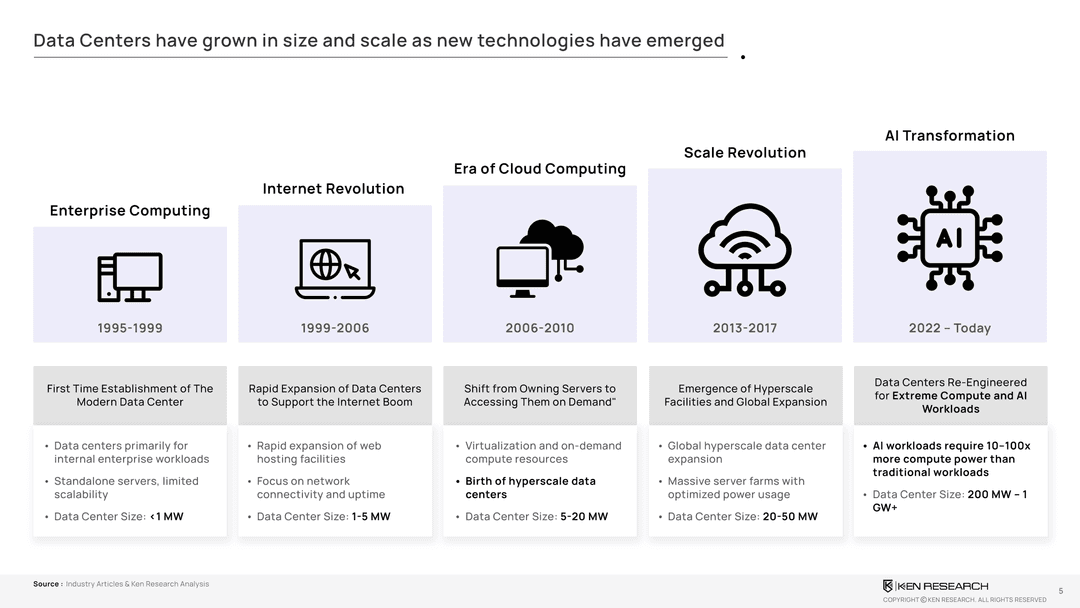
AI workloads require10–100x higher compute densitycompared to traditional applications, leading to:
- Larger facility sizes (200 MW to 1 GW+ campuses)
- Higher power density per rack
- Increased demand for advanced cooling and power infrastructure
This demand reset is forcing hyperscale’s and operators to seeknew geographies capable of delivering scale rapidly.
Why the Middle East Is Structurally Positioned for Data Centre Growth
The PPT highlights four structural advantages that make the Middle East—particularly KSA and UAE—attractive for large-scale data centre deployment:
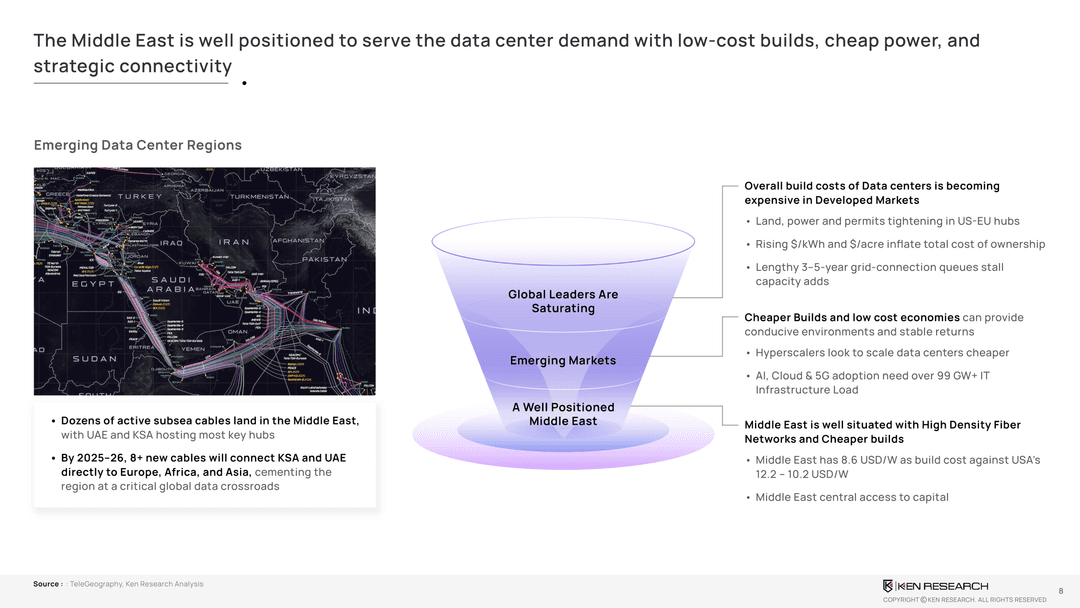
- Low-Cost Power AvailabilityCompetitive electricity tariffs, supported by fossil and renewable energy mix.
- Land Availability at ScaleAbility to develop large data centre campuses without urban land constraints.
- Strategic Connectivity
- Ease of Development and Sovereign BackingStreamlined approvals and direct government participation reduce execution risk.
Together, these factors position the Middle East as aglobal data transit and compute hub, not merely a regional consumption market.
Market Scale: A 6x Capacity Expansion Story
The Middle East data centre market is projected to expand aggressively:
- Capacity expected to grow~6x in the next five years
- Target installed and planned capacity:~6.1 GW
- Total planned and announced investments:USD 130+ billion
This growth is already visible through:
- Announced hyperscale campuses
- Sovereign-led platform creation
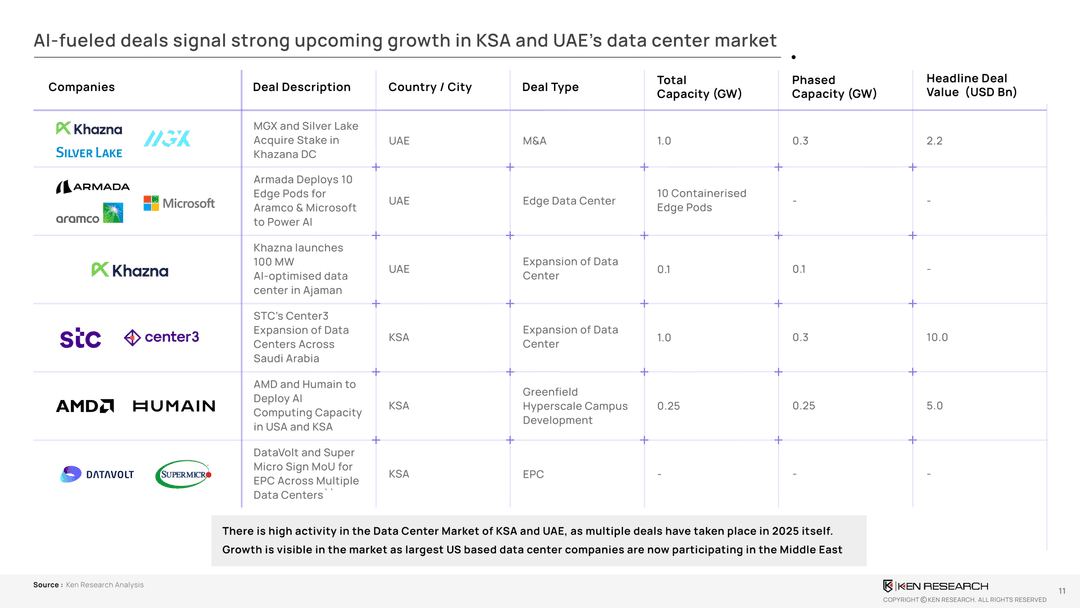
- Accelerating deal activity across 2024–2025
Unlike speculative markets, this expansion is backed bycommitted capital and anchor customers.
Access the Middle East Data Centre Capacity & Investment Tracker
Capital Stack: Who Is Funding the Expansion
The PPT clearly segments theUSD 130+ billionopportunity:
1. Sovereign Capital (~USD 100 billion)
- Saudi PIF initiatives (including Project Transcendence, Humain)
- UAE-backed platforms (MGX)
- Long-term, patient capital focused on national digital infrastructure
2. Hyperscalers (~USD 15 billion)
- AWS
- Microsoft
- Oracle
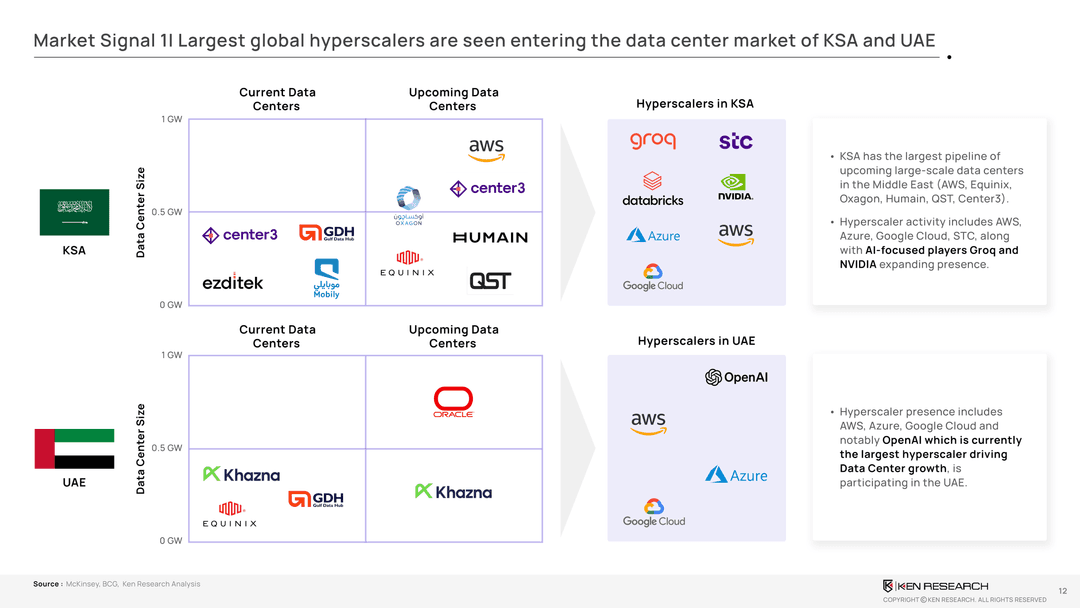
Hyperscalers act asanchor tenants, de-risking capacity build-outs.
3. Private Equity (~USD 15 billion)
- KKR
- Blackstone
- Brookfield
PE participation brings execution discipline, operational efficiency, and exit optionality.
This diversified capital structure supportsrapid scaling with controlled risk.
KSA vs UAE: Two Distinct Growth Archetypes
The PPT differentiates growth models clearly:
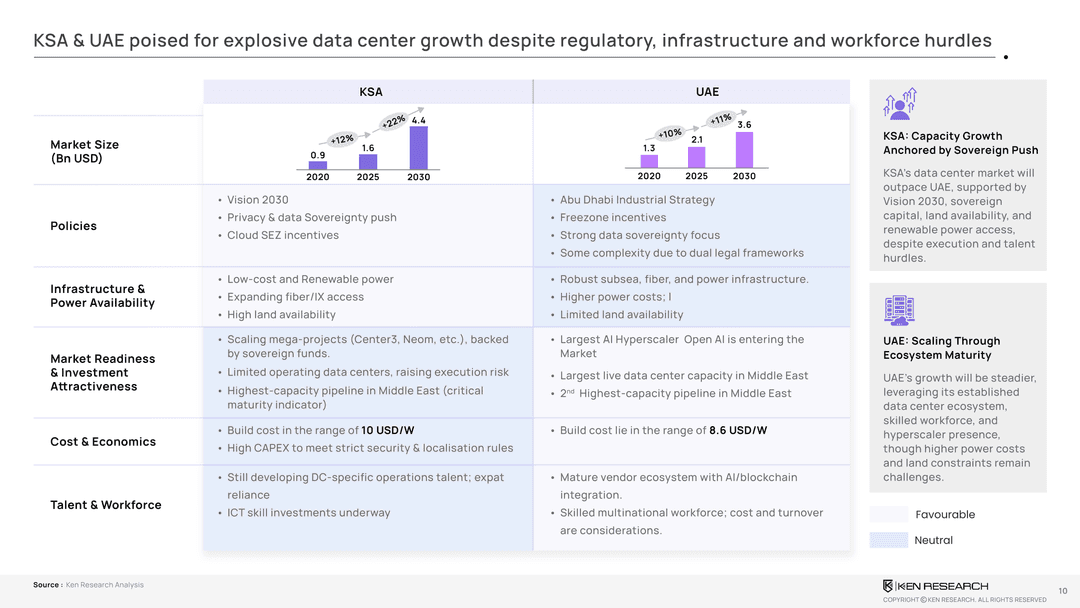
Saudi Arabia (KSA)
- Faster capacity ramp-up
- Driven by Vision 2030 and sovereign investment
- Advantages:
- Key risks:
United Arab Emirates (UAE)
- Slower but more stable growth
- Advantages:
- Constraints:
KSA represents scale-led growth, whileUAE represents ecosystem-led growth.
Data Centre Models That Will Capture Demand
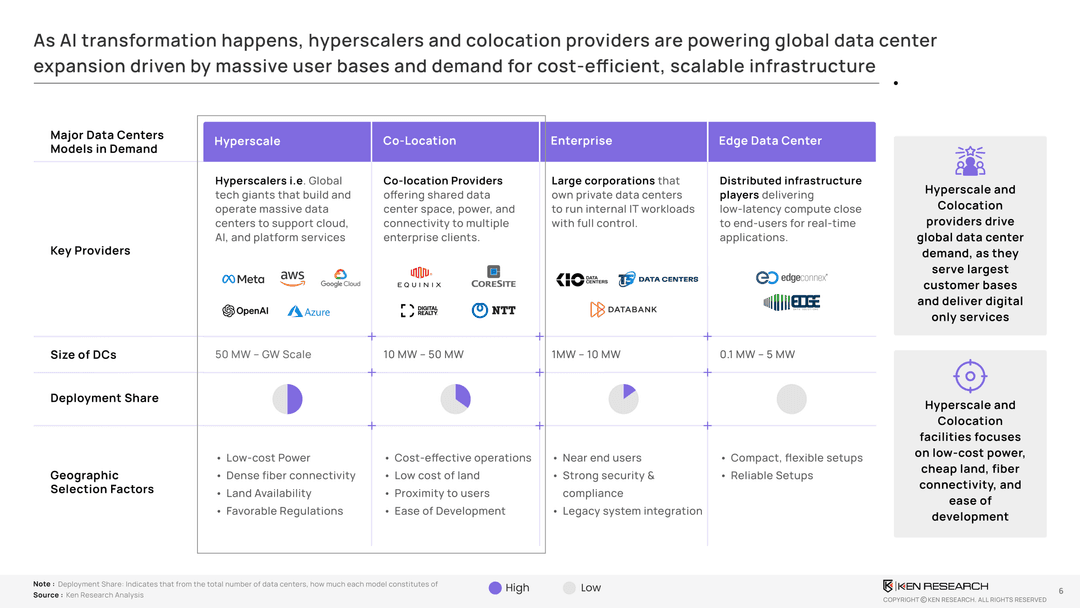
The PPT identifies three dominant models:
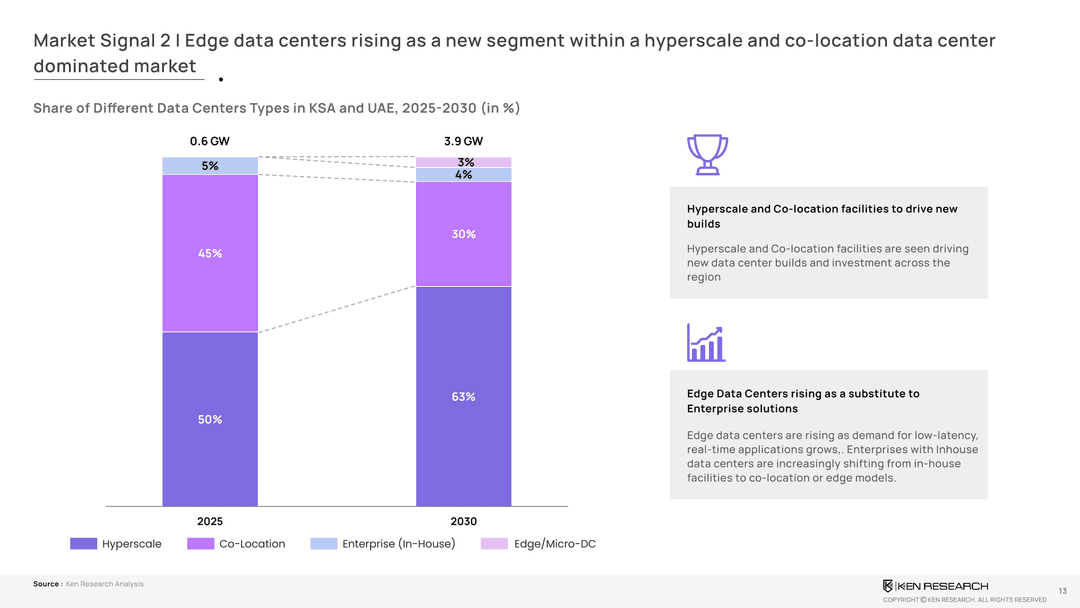
Hyperscale & Co-Location Data Centres
Edge Data Centres
Enterprise-Owned Data Centres
This reflects astructural change in enterprise infrastructure consumption.
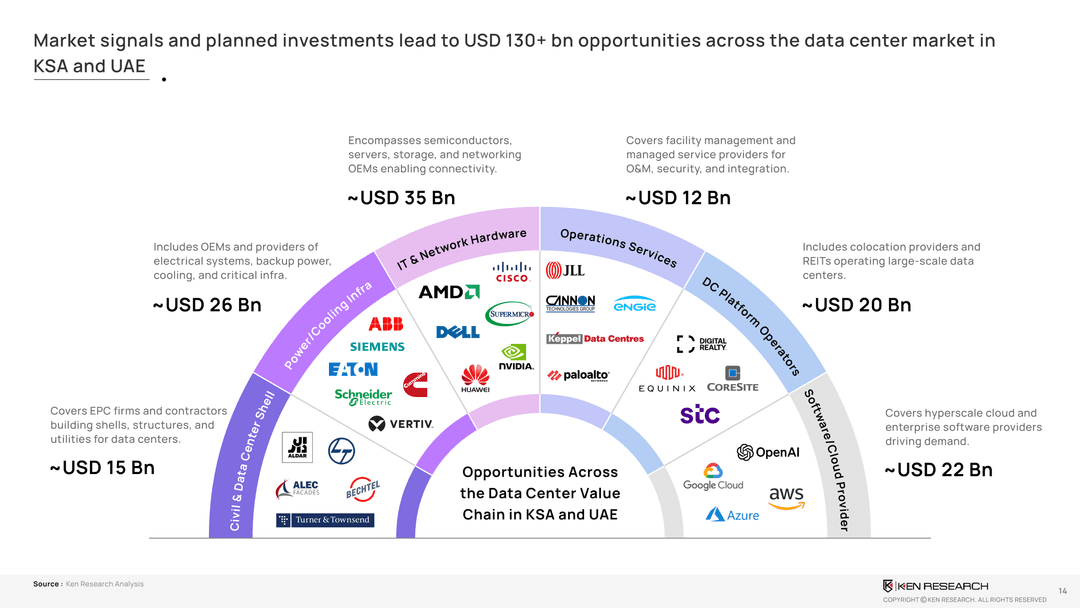
Where the USD 130+ Billion Opportunity Sits Across the Value Chain
The PPT explicitly distributes opportunity across multiple layers:
- Data centre developers & operators
- Hyperscalers and cloud platforms
- Power, cooling, electrical, and infrastructure OEMs
- Operations & maintenance (O&M) and managed services
Each segment representsUSD ~12–35 billionin addressable opportunity, collectively exceedingUSD 130 billion.
This createsmultiple entry pointsfor investors and operating partners, rather than a single winner-takes-all outcome.
Strategic Implications for Market Participants
To capture value in the Middle East data centre boom, stakeholders must:
- Align capacity build-out with hyperscaler demand profiles
- Secure long-term power and land access early
- Differentiate through energy efficiency and cooling innovation
- Partner with sovereign platforms to accelerate scale
- Build execution capabilities across large-format campuses
Timing and positioning will determine who captures the outsized returns in this cycle.
The Middle East Is Entering the Global Data Centre Top Tier
AI-driven demand, sovereign-backed capital, and hyperscaler commitments are converging to reposition the Middle East—particularly KSA and UAE—as atop-tierglobal data center market. With6x capacity growth,USD 130+ billion in investments, and expanding connectivity, the region is transitioning from a nascent market to acore node in the global digital infrastructure network.
Download the Full POV:Opportunities in a Growing Data Centre Market in the Middle East