About the Report
Base Year 2024Qatar E-Learning & Upskilling Platforms Market Overview
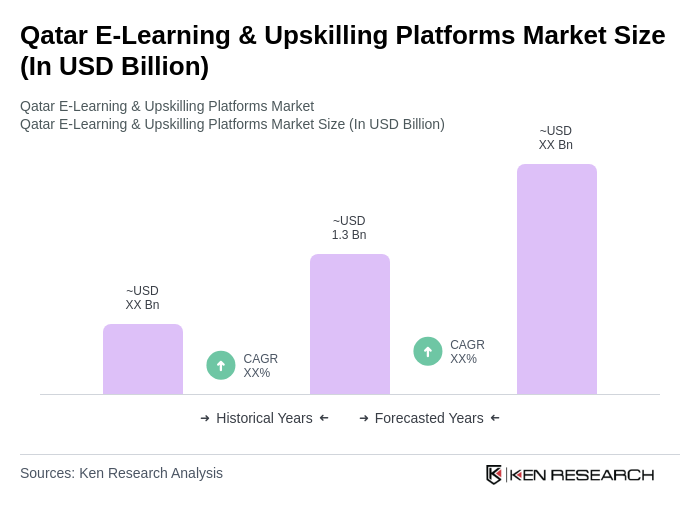
- The Qatar E-Learning & Upskilling Platforms Market is valued at USD 1.3 billion, based on a five-year historical analysis. This growth is primarily driven by the increasing demand for flexible learning solutions, the rise of digital literacy, and the government's focus on enhancing educational infrastructure. The market has seen a significant uptick in online learning adoption, particularly in response to the global shift towards remote education and the integration of advanced technologies such as artificial intelligence and gamification to personalize learning experiences .
- Doha is the dominant city in the Qatar E-Learning & Upskilling Platforms Market, attributed to its status as the capital and a hub for educational institutions and technology. The presence of numerous universities and training centers, along with government initiatives to promote digital education, has positioned Doha as a leader in this sector. Additionally, the city's investment in technology and innovation further supports its market dominance .
- In 2023, the Qatari government implemented the "National E-Learning Strategy" under the Ministry of Education and Higher Education, allocating a budget of USD 200 million to develop digital infrastructure and promote online learning resources across schools and universities. This initiative mandates the integration of advanced e-learning platforms and digital content, ensuring that students have access to high-quality educational materials and training programs .
Qatar E-Learning & Upskilling Platforms Market Segmentation
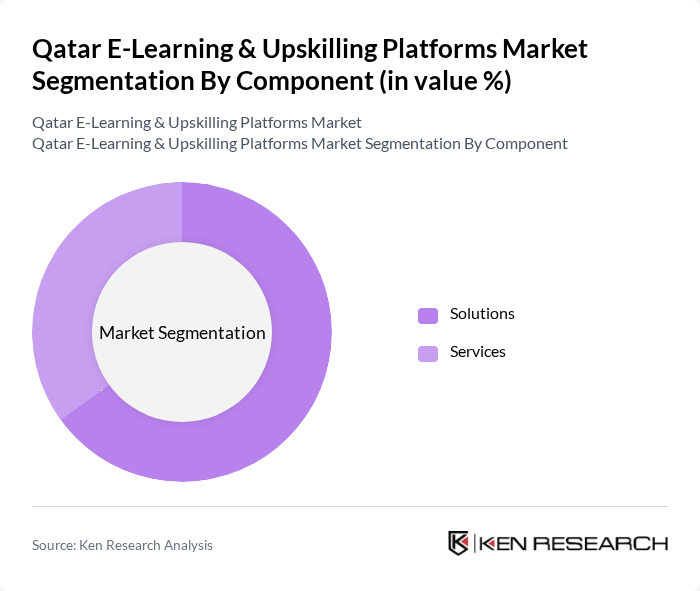
By Component:The market is segmented into two primary components: Solutions and Services. Solutions encompass the software and platforms used for e-learning, while Services include the support and training provided to users. The Solutions segment is currently leading the market due to the increasing adoption of advanced learning management systems, interactive educational tools, and the integration of AI-driven personalized learning modules that enhance the learning experience .
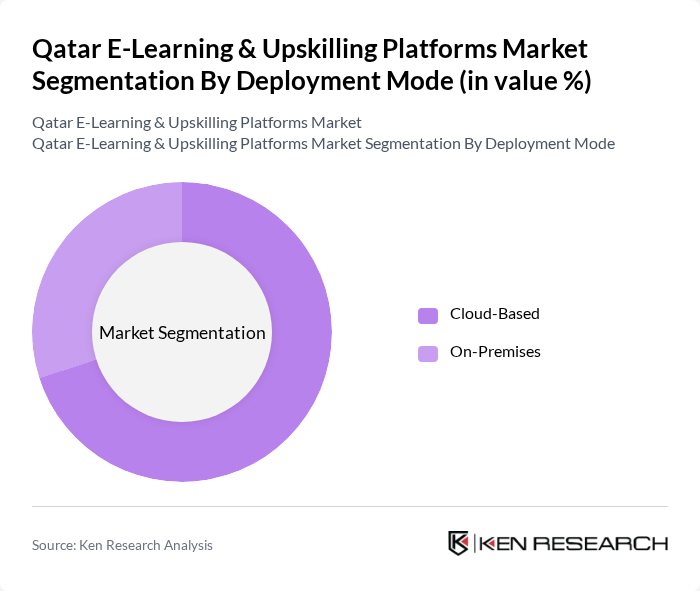
By Deployment Mode:The market is divided into Cloud-Based and On-Premises deployment modes. Cloud-Based solutions are gaining traction due to their scalability, cost-effectiveness, and ease of access, especially in a region where mobile and internet penetration is high. This segment is expected to dominate the market as educational institutions and corporates increasingly prefer flexible and remote learning options. The demand for mobile-first and adaptive learning platforms is also driving the adoption of cloud-based solutions .
Qatar E-Learning & Upskilling Platforms Market Competitive Landscape
The Qatar E-Learning & Upskilling Platforms Market is characterized by a dynamic mix of regional and international players. Leading participants such as Qatar University, Edraak, Qatar Skills Academy, Al Jazeera Media Institute, Doha Institute for Graduate Studies, Skillsoft (Qatar), LearnQatar, Qatar Finance and Business Academy (QFBA), Qatar Digital Learning (QDL), Blackboard Inc., Moodle Pty Ltd, FutureLearn (Regional), Coursera (Regional/Qatar), Udacity (Regional/Qatar), LinkedIn Learning (Regional/Qatar) contribute to innovation, geographic expansion, and service delivery in this space .
Qatar E-Learning & Upskilling Platforms Market Industry Analysis
Growth Drivers
- Increasing Demand for Remote Learning Solutions:The demand for remote learning solutions in Qatar has surged, with over 70% of students preferring online education options as of in future. This shift is driven by the COVID-19 pandemic, which accelerated digital adoption. The Ministry of Education reported a 40% increase in online course enrollments, reflecting a growing acceptance of e-learning. Additionally, the global e-learning market is projected to reach $375 billion in future, indicating a robust trend that Qatar is poised to capitalize on.
- Government Initiatives Promoting Digital Education:The Qatari government has invested approximately $1 billion in digital education initiatives, aiming to enhance the quality of e-learning platforms. Programs like the Qatar National Vision 2030 emphasize the importance of technology in education, leading to the establishment of partnerships with tech companies. In future, the government launched a digital literacy campaign that reached over 500,000 citizens, significantly boosting awareness and participation in e-learning programs across the nation.
- Rise in Workforce Upskilling Needs:With Qatar's economy diversifying, there is a pressing need for workforce upskilling. The Qatar Chamber of Commerce reported that 60% of employers are seeking candidates with advanced digital skills. In response, e-learning platforms are increasingly offering tailored courses to meet these demands. The corporate training sector is expected to grow by 25% in future, driven by the need for continuous professional development in a rapidly changing job market.
Market Challenges
- Limited Internet Penetration in Rural Areas:Despite Qatar's high overall internet penetration rate of 99%, rural areas still face challenges, with only 70% connectivity. This disparity limits access to e-learning resources for a significant portion of the population. The Qatar Communications Regulatory Authority has identified this issue, prompting initiatives to improve infrastructure. However, until these challenges are addressed, the growth of e-learning platforms in rural regions will remain constrained.
- Resistance to Change from Traditional Learning Methods:Many educators and institutions in Qatar are hesitant to adopt e-learning due to a strong preference for traditional teaching methods. A survey conducted in future indicated that 55% of teachers believe face-to-face instruction is more effective. This resistance can hinder the integration of innovative e-learning solutions, slowing down the overall market growth. Overcoming this cultural barrier will be essential for the successful expansion of digital education.
Qatar E-Learning & Upskilling Platforms Market Future Outlook
The future of the Qatar e-learning and upskilling platforms market appears promising, driven by technological advancements and increasing acceptance of digital education. As the government continues to invest in digital literacy and infrastructure, more citizens will gain access to online learning resources. Additionally, the integration of AI and personalized learning experiences will enhance engagement and effectiveness. The market is expected to evolve rapidly, with innovative solutions catering to diverse learning needs and preferences, positioning Qatar as a regional leader in e-learning.
Market Opportunities
- Expansion of Mobile Learning Solutions:With mobile penetration in Qatar exceeding 90%, there is a significant opportunity for e-learning platforms to develop mobile-friendly solutions. This shift can enhance accessibility, allowing users to learn on-the-go. In future, mobile learning is projected to account for 50% of all e-learning activities, making it a critical area for investment and development.
- Partnerships with Educational Institutions:Collaborating with local universities and colleges presents a valuable opportunity for e-learning platforms. In future, partnerships can lead to the creation of accredited online courses, increasing credibility and attracting more learners. Such collaborations can also facilitate the customization of content to meet local educational needs, enhancing the relevance and appeal of e-learning offerings.
Scope of the Report
| Segment | Sub-Segments |
|---|---|
| By Component | Solutions Services |
| By Deployment Mode | Cloud-Based On-Premises |
| By Delivery Mode | Blended Learning Distance Learning Instructor-led Training |
| By End-User | Academic Institutions Corporates Government & Public Sector |
| By Content Type | Academic Content Professional Development Technical Skills Soft Skills Language Learning Others |
| By Pricing Model | Subscription-Based Pay-Per-Course Freemium Corporate Licensing Others |
| By Geographic Reach | Local Regional International Others |
| By User Demographics | Age Group Educational Background Professional Experience Others |
Key Target Audience
Investors and Venture Capitalist Firms
Government and Regulatory Bodies (e.g., Ministry of Education and Higher Education, Qatar Financial Centre Regulatory Authority)
Corporate Training and Development Departments
Technology Providers and Software Developers
Content Creators and Course Developers
Telecommunications Companies
Industry Associations and Professional Bodies
Financial Institutions and Banks
Players Mentioned in the Report:
Qatar University
Edraak
Qatar Skills Academy
Al Jazeera Media Institute
Doha Institute for Graduate Studies
Skillsoft (Qatar)
LearnQatar
Qatar Finance and Business Academy (QFBA)
Qatar Digital Learning (QDL)
Blackboard Inc.
Moodle Pty Ltd
FutureLearn (Regional)
Coursera (Regional/Qatar)
Udacity (Regional/Qatar)
LinkedIn Learning (Regional/Qatar)
Table of Contents
Market Assessment Phase
1. Executive Summary and Approach
2. Qatar E-Learning & Upskilling Platforms Market Overview
2.1 Key Insights and Strategic Recommendations
2.2 Qatar E-Learning & Upskilling Platforms Market Overview
2.3 Definition and Scope
2.4 Evolution of Market Ecosystem
2.5 Timeline of Key Regulatory Milestones
2.6 Value Chain & Stakeholder Mapping
2.7 Business Cycle Analysis
2.8 Policy & Incentive Landscape
3. Qatar E-Learning & Upskilling Platforms Market Analysis
3.1 Growth Drivers
3.1.1 Increasing demand for remote learning solutions
3.1.2 Government initiatives promoting digital education
3.1.3 Rise in workforce upskilling needs
3.1.4 Technological advancements in e-learning platforms
3.2 Market Challenges
3.2.1 Limited internet penetration in rural areas
3.2.2 Resistance to change from traditional learning methods
3.2.3 High competition among local and international players
3.2.4 Regulatory hurdles in content delivery
3.3 Market Opportunities
3.3.1 Expansion of mobile learning solutions
3.3.2 Partnerships with educational institutions
3.3.3 Customization of learning content for local needs
3.3.4 Growth in corporate training programs
3.4 Market Trends
3.4.1 Increased use of AI and machine learning in e-learning
3.4.2 Gamification of learning experiences
3.4.3 Focus on microlearning and bite-sized content
3.4.4 Rise of social learning platforms
3.5 Government Regulation
3.5.1 Implementation of quality standards for e-learning
3.5.2 Support for digital literacy initiatives
3.5.3 Regulations on data privacy and security
3.5.4 Incentives for local content development
4. SWOT Analysis
5. Stakeholder Analysis
6. Porter's Five Forces Analysis
7. Qatar E-Learning & Upskilling Platforms Market Market Size, 2019-2024
7.1 By Value
7.2 By Volume
7.3 By Average Selling Price
8. Qatar E-Learning & Upskilling Platforms Market Segmentation
8.1 By Component
8.1.1 Solutions
8.1.2 Services
8.2 By Deployment Mode
8.2.1 Cloud-Based
8.2.2 On-Premises
8.3 By Delivery Mode
8.3.1 Blended Learning
8.3.2 Distance Learning
8.3.3 Instructor-led Training
8.4 By End-User
8.4.1 Academic Institutions
8.4.2 Corporates
8.4.3 Government & Public Sector
8.5 By Content Type
8.5.1 Academic Content
8.5.2 Professional Development
8.5.3 Technical Skills
8.5.4 Soft Skills
8.5.5 Language Learning
8.5.6 Others
8.6 By Pricing Model
8.6.1 Subscription-Based
8.6.2 Pay-Per-Course
8.6.3 Freemium
8.6.4 Corporate Licensing
8.6.5 Others
8.7 By Geographic Reach
8.7.1 Local
8.7.2 Regional
8.7.3 International
8.7.4 Others
8.8 By User Demographics
8.8.1 Age Group
8.8.2 Educational Background
8.8.3 Professional Experience
8.8.4 Others
9. Qatar E-Learning & Upskilling Platforms Market Competitive Analysis
9.1 Market Share of Key Players
9.2 Cross Comparison of Key Players
9.2.1 Company Name
9.2.2 Group Size (Large, Medium, or Small as per industry convention)
9.2.3 Number of Active Users (Qatar)
9.2.4 Customer Acquisition Cost
9.2.5 Customer Retention Rate
9.2.6 Average Revenue Per User (ARPU)
9.2.7 Pricing Strategy
9.2.8 Course Completion Rate
9.2.9 User Engagement Metrics (e.g., daily/monthly active users, session duration)
9.2.10 Market Penetration Rate (Qatar)
9.2.11 Brand Awareness Index
9.2.12 Local Content Ratio
9.2.13 Mobile App Adoption Rate
9.2.14 Corporate/Institutional Partnerships (Qatar)
9.3 SWOT Analysis of Top Players
9.4 Pricing Analysis
9.5 Detailed Profile of Major Companies
9.5.1 Qatar University
9.5.2 Edraak
9.5.3 Qatar Skills Academy
9.5.4 Al Jazeera Media Institute
9.5.5 Doha Institute for Graduate Studies
9.5.6 Skillsoft (Qatar)
9.5.7 LearnQatar
9.5.8 Qatar Finance and Business Academy (QFBA)
9.5.9 Qatar Digital Learning (QDL)
9.5.10 Blackboard Inc.
9.5.11 Moodle Pty Ltd
9.5.12 FutureLearn (Regional)
9.5.13 Coursera (Regional/Qatar)
9.5.14 Udacity (Regional/Qatar)
9.5.15 LinkedIn Learning (Regional/Qatar)
10. Qatar E-Learning & Upskilling Platforms Market End-User Analysis
10.1 Procurement Behavior of Key Ministries
10.1.1 Ministry of Education and Higher Education
10.1.2 Ministry of Labor
10.1.3 Ministry of Communications and Information Technology
10.1.4 Others
10.2 Corporate Spend on Infrastructure & Energy
10.2.1 Investment in E-Learning Infrastructure
10.2.2 Budget Allocation for Employee Training
10.2.3 Partnerships with E-Learning Providers
10.2.4 Others
10.3 Pain Point Analysis by End-User Category
10.3.1 Lack of Customization in Learning Solutions
10.3.2 Difficulty in Tracking Learning Progress
10.3.3 Limited Access to Quality Content
10.3.4 Others
10.4 User Readiness for Adoption
10.4.1 Familiarity with Digital Tools
10.4.2 Willingness to Engage in Online Learning
10.4.3 Support from Management
10.4.4 Others
10.5 Post-Deployment ROI and Use Case Expansion
10.5.1 Measurement of Learning Outcomes
10.5.2 Feedback Mechanisms for Continuous Improvement
10.5.3 Expansion of Learning Programs
10.5.4 Others
11. Qatar E-Learning & Upskilling Platforms Market Future Size, 2025-2030
11.1 By Value
11.2 By Volume
11.3 By Average Selling Price
Go-To-Market Strategy Phase
1. Whitespace Analysis + Business Model Canvas
1.1
2. Marketing and Positioning Recommendations
2.1
3. Distribution Plan
3.1
4. Channel & Pricing Gaps
4.1
5. Unmet Demand & Latent Needs
5.1
6. Customer Relationship
6.1
7. Value Proposition
7.1
8. Key Activities
8.1
9. Entry Strategy Evaluation
9.1 Domestic Market Entry Strategy
9.1.1
9.2 Export Entry Strategy
9.2.1
10. Entry Mode Assessment
10.1
11. Capital and Timeline Estimation
11.1
12. Control vs Risk Trade-Off
12.1
13. Profitability Outlook
13.1
14. Potential Partner List
14.1
15. Execution Roadmap
15.1 Phased Plan for Market Entry
15.1.1
15.2 Key Activities and Milestones
15.2.1
Research Methodology
Phase 1: Approach1
Desk Research
- Analysis of government reports and publications on e-learning initiatives in Qatar
- Review of industry reports from educational institutions and e-learning associations
- Examination of market trends and statistics from online education platforms and technology adoption studies
Primary Research
- Interviews with key stakeholders in the education sector, including university administrators and e-learning platform executives
- Surveys targeting educators and trainers to understand their experiences and needs regarding upskilling
- Focus groups with learners to gather insights on user experience and preferences in e-learning
Validation & Triangulation
- Cross-validation of findings through multiple data sources, including academic publications and market surveys
- Triangulation of qualitative insights from interviews with quantitative data from surveys
- Sanity checks conducted through expert panel reviews comprising industry veterans and educational technologists
Phase 2: Market Size Estimation1
Top-down Assessment
- Estimation of the total addressable market based on national education budgets and digital transformation initiatives
- Segmentation of the market by user demographics, including students, professionals, and corporate training sectors
- Incorporation of growth rates from regional e-learning market analyses and global trends
Bottom-up Modeling
- Collection of data on subscription rates and user engagement metrics from leading e-learning platforms operating in Qatar
- Estimation of revenue streams based on course offerings, certification programs, and corporate partnerships
- Volume x pricing analysis to determine average revenue per user (ARPU) across different segments
Forecasting & Scenario Analysis
- Multi-factor regression analysis incorporating variables such as internet penetration, smartphone usage, and educational policy changes
- Scenario modeling based on potential shifts in government funding and private sector investment in e-learning
- Development of baseline, optimistic, and pessimistic forecasts through 2030
Phase 3: CATI Sample Composition1
| Scope Item/Segment | Sample Size | Target Respondent Profiles |
|---|---|---|
| Higher Education Institutions | 100 | University Administrators, Curriculum Developers |
| Corporate Training Programs | 60 | HR Managers, Training Managers |
| Freelance Educators and Trainers | 50 | Independent Trainers, Online Course Creators |
| Students Engaged in E-Learning | 120 | Undergraduate and Graduate Students |
| Government Education Officials | 40 | Policy Makers, Education Program Directors |
Frequently Asked Questions
What is the current value of the Qatar E-Learning & Upskilling Platforms Market?
The Qatar E-Learning & Upskilling Platforms Market is valued at approximately USD 1.3 billion, reflecting significant growth driven by the demand for flexible learning solutions and government initiatives to enhance educational infrastructure.
What factors are driving the growth of e-learning in Qatar?
Which city is the leader in the Qatar E-Learning Market?
What is the National E-Learning Strategy in Qatar?
Other Regional/Country Reports
Indonesia E-Learning & Upskilling Platforms Market
Malaysia E-Learning & Upskilling Platforms Market
KSA E-Learning & Upskilling Platforms Market
APAC E-Learning & Upskilling Platforms Market
SEA E-Learning & Upskilling Platforms Market
Vietnam E-Learning & Upskilling Platforms Market
Other Adjacent Reports
Vietnam Learning Management Systems Market
Vietnam Corporate Training Market (2023-2030)Belgium Educational Technology Market
UAE Mobile Learning MarketJapan Online Certification Market
Egypt Virtual Classroom Market
Philippines Skill Development Platforms Market
Europe Digital Content Creation Market Outlook to 2030: Size, Share, Growth and TrendsUSA AI in Education Market Outlook to 2030Egypt Remote Workforce Training Market
Why Buy From Us?

What makes us stand out is that our consultants follow Robust, Refine and Result (RRR) methodology. Robust for clear definitions, approaches and sanity checking, Refine for differentiating respondents' facts and opinions, and Result for presenting data with story.

We have set a benchmark in the industry by offering our clients with syndicated and customized market research reports featuring coverage of entire market as well as meticulous research and analyst insights.

While we don't replace traditional research, we flip the method upside down. Our dual approach of Top Bottom & Bottom Top ensures quality deliverable by not just verifying company fundamentals but also looking at the sector and macroeconomic factors.

With one step in the future, our research team constantly tries to show you the bigger picture. We help with some of the tough questions you may encounter along the way: How is the industry positioned? Best marketing channel? KPI's of competitors? By aligning every element, we help maximize success.

Our report gives you instant access to the answers and sources that other companies might choose to hide. We elaborate each steps of research methodology we have used and showcase you the sample size to earn your trust.

If you need any support, we are here! We pride ourselves on universe strength, data quality, and quick, friendly, and professional service.