About the Report
Base Year 2024Qatar Polydextrose Market Overview
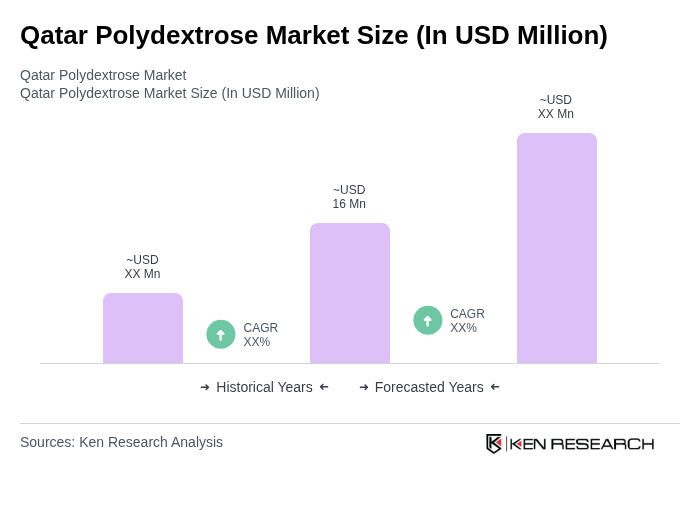
- The Qatar Polydextrose Market is valued at approximately USD 16 million, based on a five-year historical analysis and correlation with global polydextrose demand and regional soluble dietary fiber uptake in the Middle East. This growth is primarily driven by the increasing demand for low-calorie sweeteners and dietary fibers in food and beverage applications, in line with global trends toward fiber-enriched, low-calorie ingredients. The rising health consciousness among consumers, growth of functional and nutritional foods, and the trend of clean label products have further propelled the market, as polydextrose serves as a versatile bulking agent, sugar replacer, and dietary fiber in bakery, beverages, dairy, and nutritional applications.
- Key demand hubs for polydextrose within Qatar include major urban and industrial centers such as Doha, Al Rayyan, and Al Wakrah, which lead due to their concentration of food and beverage manufacturing, processing facilities, and logistics infrastructure. These cities are central to Qatar's food and beverage industry, facilitating access to imported raw materials and regional distribution channels across retail, foodservice, and institutional segments. The presence of large-scale food manufacturers, rising per capita income, and a growing, health-aware population also contribute to the expansion of polydextrose demand in these regions through increased consumption of functional and convenience foods.
- In 2023, the Qatari government continued to strengthen its broader nutrition and food standards framework, within which the use of dietary fibers such as polydextrose is aligned with national health policy objectives. The key binding instrument is the Qatar Dietary Guidelines issued by the Ministry of Public Health in 2015, which promote higher intake of dietary fiber and reduced free sugar consumption as part of noncommunicable disease prevention. In parallel, food products positioned as low-calorie or healthier options are required to comply with Gulf Standardization Organization nutrient claims standards, including GSO 654 “General Requirements for Prepackaged Foods” and GSO 2233 “Requirements of Nutritional Labeling,” which set conditions for nutrition claims, fiber and sugar declarations, and composition criteria for reduced-energy foods, driving manufacturers to incorporate ingredients like polydextrose to help meet fiber and sugar-reduction targets.
Qatar Polydextrose Market Segmentation
By Form:
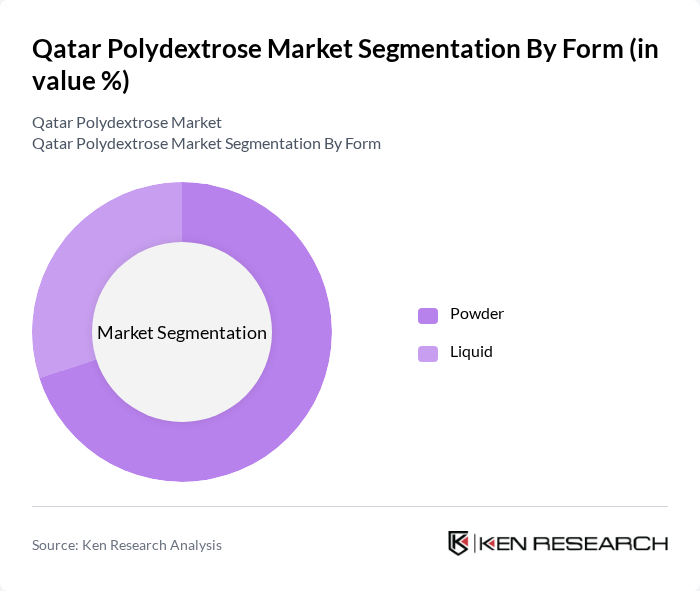
The market is segmented into two primary forms: Powder and Liquid, consistent with global polydextrose product categorization. The Powder subsegment is currently leading the market due to its versatility, better shelf stability, and ease of incorporation into dry-mix and solid food products. It is widely used in baked goods, snacks, breakfast cereals, and dietary supplements, appealing to health-conscious consumers seeking low-calorie, high-fiber options. The Liquid form, while growing, is primarily utilized in beverages, cultured dairy and dairy alternatives, and ready-to-drink or ready-to-eat meals, where its solubility, mouthfeel, and texture-enhancing properties are advantageous. Overall, the Powder form dominates due to its broader application range, compatibility with bakery and nutritional formulations, and strong adoption by food and beverage manufacturers in the region.
By Application:
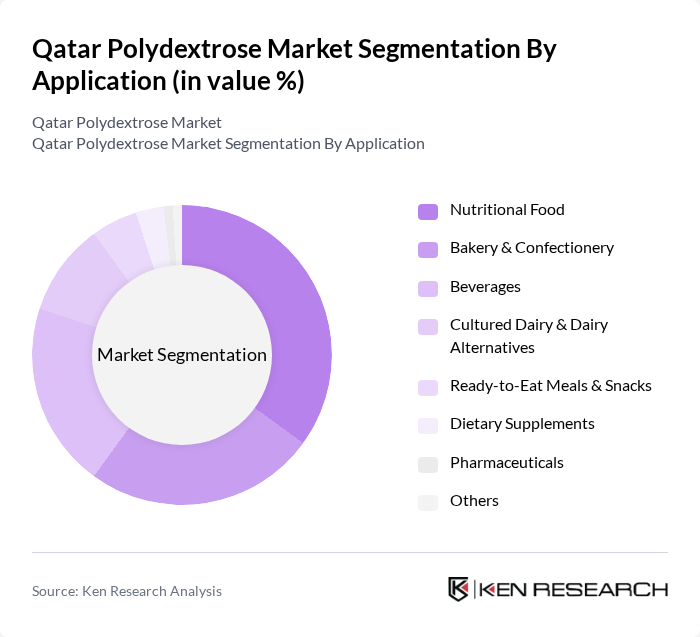
The applications of polydextrose are diverse, including Nutritional Food, Bakery & Confectionery, Beverages, Cultured Dairy & Dairy Alternatives, Ready-to-Eat Meals & Snacks, Dietary Supplements, Pharmaceuticals, and Others, in line with global end-use patterns for the ingredient. The Nutritional Food segment is the largest, driven by the increasing demand for functional foods, weight-management products, and fiber-enriched formulations positioned for digestive health and glycemic control. Bakery & Confectionery follows closely, as polydextrose is used to reduce sugar and calorie content while maintaining bulk, texture, and sweetness profile in cakes, biscuits, chocolates, and sugar-reduced treats. The Beverages segment is also significant, with a growing trend towards low-calorie, reduced-sugar soft drinks, juices, and dairy beverages where polydextrose functions as a soluble fiber and mouthfeel enhancer. Overall, the Nutritional Food application leads the market due to rising health awareness, lifestyle-related diseases, and consumer preference for fiber-fortified, clean label products in Qatar and the wider Middle East.
Qatar Polydextrose Market Competitive Landscape
The Qatar Polydextrose Market is characterized by a dynamic mix of regional and international players. Leading participants such as Tate & Lyle PLC, DuPont (IFF Nutrition & Biosciences), Ingredion Incorporated, Roquette Frères, Archer Daniels Midland Company (ADM), Cargill, Incorporated, Südzucker AG (BENEO), Beneo GmbH, Samyang Corporation, Henan Tailijie Biotech Co., Ltd., Shandong Bailong Chuangyuan Bio-Tech Co., Ltd., Nexira, Fiberstar, Inc., Tereos Group, and local and regional GCC suppliers contribute to innovation, geographic expansion, and service delivery in this space.
Qatar Polydextrose Market Industry Analysis
Growth Drivers
- Increasing Demand for Low-Calorie Sweeteners:The Qatar polydextrose market is experiencing a surge in demand for low-calorie sweeteners, driven by a growing population of health-conscious consumers. In future, the demand for low-calorie sweeteners is projected to reach approximately 15,000 tons, reflecting a significant increase from previous years. This trend is supported by the rising prevalence of obesity and diabetes, with Qatar's obesity rate estimated at 45% in 2023, prompting consumers to seek healthier alternatives.
- Rising Health Consciousness Among Consumers:Health consciousness is a key driver in the Qatar polydextrose market, with consumers increasingly prioritizing dietary choices that promote well-being. In future, the health food sector is expected to grow by 8%, indicating a shift towards products that contain dietary fibers like polydextrose. This trend is further supported by the Qatar National Health Strategy 2018-2022, which emphasizes the importance of nutrition in public health, encouraging the consumption of fiber-rich foods.
- Expansion of the Food and Beverage Industry:The food and beverage industry in Qatar is projected to grow significantly, with an estimated market value of $2.7 billion in future. This expansion is driven by increased consumer spending and a growing expatriate population, which is expected to reach 2.7 million by future. As manufacturers seek to innovate and meet consumer preferences, the incorporation of polydextrose as a functional ingredient in various products is likely to rise, further boosting market demand.
Market Challenges
- High Production Costs:One of the significant challenges facing the Qatar polydextrose market is the high production costs associated with its manufacturing. The cost of raw materials, including glucose and sorbitol, has increased by approximately 15% over the past year due to supply chain disruptions. This rise in production costs can hinder profitability for manufacturers, making it difficult to offer competitive pricing in a market increasingly dominated by lower-cost alternative sweeteners.
- Limited Consumer Awareness:Despite the health benefits of polydextrose, consumer awareness remains limited in Qatar. A recent survey indicated that only 30% of consumers are familiar with polydextrose and its advantages as a dietary fiber. This lack of awareness poses a challenge for market growth, as consumers may opt for more familiar sweeteners. Educational initiatives and marketing strategies are essential to increase consumer knowledge and acceptance of polydextrose in food products.
Qatar Polydextrose Market Future Outlook
The future of the Qatar polydextrose market appears promising, driven by increasing health awareness and a growing demand for functional food products. As consumers continue to seek healthier alternatives, the market is likely to witness innovations in product formulations that incorporate polydextrose. Additionally, the expansion into emerging markets within the Gulf Cooperation Council (GCC) region presents significant growth potential, allowing manufacturers to tap into new consumer bases and diversify their offerings.
Market Opportunities
- Growth in the Functional Food Sector:The functional food sector in Qatar is expected to grow by 10% in future, creating opportunities for polydextrose as a key ingredient. This growth is driven by consumer demand for products that offer health benefits, such as improved digestion and weight management, positioning polydextrose as a valuable addition to functional food formulations.
- Collaborations with Health-Focused Brands:Collaborations between polydextrose manufacturers and health-focused brands can enhance market penetration. By partnering with established health brands, manufacturers can leverage their distribution networks and consumer trust, facilitating the introduction of polydextrose-enriched products. This strategy can significantly increase market visibility and consumer acceptance in the health-conscious segment.
Scope of the Report
| Segment | Sub-Segments |
|---|---|
| By Form | Powder Liquid |
| By Application | Nutritional Food Bakery & Confectionery Beverages Cultured Dairy & Dairy Alternatives Ready-to-Eat Meals & Snacks Dietary Supplements Pharmaceuticals Others |
| By End Use Industry | Food & Beverage Manufacturers Nutraceutical & Dietary Supplement Companies Pharmaceutical Manufacturers Animal Nutrition & Pet Food Producers Others |
| By Function | Dietary Fiber Enrichment Sugar Replacement & Calorie Reduction Texturizing & Bulking Agent Prebiotic & Gut Health Others |
| By Distribution Channel | Direct Sales (B2B) Distributors & Traders Online Channels Others |
| By Region | Doha Al Rayyan Al Wakrah Umm Salal Others |
Key Target Audience
Investors and Venture Capitalist Firms
Government and Regulatory Bodies (e.g., Ministry of Public Health, Qatar Food Safety Department)
Manufacturers and Producers of Food Ingredients
Distributors and Retailers of Food Products
Food and Beverage Companies
Health and Wellness Product Manufacturers
Industry Associations (e.g., Qatar Chamber of Commerce)
Financial Institutions and Banks
Players Mentioned in the Report:
Tate & Lyle PLC
DuPont (IFF Nutrition & Biosciences)
Ingredion Incorporated
Roquette Freres
Archer Daniels Midland Company (ADM)
Cargill, Incorporated
Sudzucker AG (BENEO)
Beneo GmbH
Samyang Corporation
Henan Tailijie Biotech Co., Ltd.
Shandong Bailong Chuangyuan Bio-Tech Co., Ltd.
Nexira
Fiberstar, Inc.
Tereos Group
Local and Regional GCC Suppliers (Overview)
Table of Contents
Market Assessment Phase
1. Executive Summary and Approach
2. Qatar Polydextrose Market Overview
2.1 Key Insights and Strategic Recommendations
2.2 Qatar Polydextrose Market Overview
2.3 Definition and Scope
2.4 Evolution of Market Ecosystem
2.5 Timeline of Key Regulatory Milestones
2.6 Value Chain & Stakeholder Mapping
2.7 Business Cycle Analysis
2.8 Policy & Incentive Landscape
3. Qatar Polydextrose Market Analysis
3.1 Growth Drivers
3.1.1 Increasing demand for low-calorie sweeteners
3.1.2 Rising health consciousness among consumers
3.1.3 Expansion of the food and beverage industry
3.1.4 Government initiatives promoting dietary fiber
3.2 Market Challenges
3.2.1 High production costs
3.2.2 Limited consumer awareness
3.2.3 Regulatory hurdles
3.2.4 Competition from alternative sweeteners
3.3 Market Opportunities
3.3.1 Growth in the functional food sector
3.3.2 Innovations in product formulations
3.3.3 Expansion into emerging markets
3.3.4 Collaborations with health-focused brands
3.4 Market Trends
3.4.1 Increasing use of polydextrose in dietary supplements
3.4.2 Shift towards clean label products
3.4.3 Rising popularity of plant-based diets
3.4.4 Enhanced focus on sustainability in sourcing
3.5 Government Regulation
3.5.1 Food safety standards compliance
3.5.2 Labeling requirements for food products
3.5.3 Regulations on health claims
3.5.4 Import/export restrictions on food additives
4. SWOT Analysis
5. Stakeholder Analysis
6. Porter's Five Forces Analysis
7. Qatar Polydextrose Market Market Size, 2019-2024
7.1 By Value
7.2 By Volume
7.3 By Average Selling Price
8. Qatar Polydextrose Market Segmentation
8.1 By Form
8.1.1 Powder
8.1.2 Liquid
8.2 By Application
8.2.1 Nutritional Food
8.2.2 Bakery & Confectionery
8.2.3 Beverages
8.2.4 Cultured Dairy & Dairy Alternatives
8.2.5 Ready-to-Eat Meals & Snacks
8.2.6 Dietary Supplements
8.2.7 Pharmaceuticals
8.2.8 Others
8.3 By End Use Industry
8.3.1 Food & Beverage Manufacturers
8.3.2 Nutraceutical & Dietary Supplement Companies
8.3.3 Pharmaceutical Manufacturers
8.3.4 Animal Nutrition & Pet Food Producers
8.3.5 Others
8.4 By Function
8.4.1 Dietary Fiber Enrichment
8.4.2 Sugar Replacement & Calorie Reduction
8.4.3 Texturizing & Bulking Agent
8.4.4 Prebiotic & Gut Health
8.4.5 Others
8.5 By Distribution Channel
8.5.1 Direct Sales (B2B)
8.5.2 Distributors & Traders
8.5.3 Online Channels
8.5.4 Others
8.6 By Region
8.6.1 Doha
8.6.2 Al Rayyan
8.6.3 Al Wakrah
8.6.4 Umm Salal
8.6.5 Others
9. Qatar Polydextrose Market Competitive Analysis
9.1 Market Share of Key Players
9.2 Cross Comparison of Key Players
9.2.1 Company Name
9.2.2 Revenue from Polydextrose in Qatar (USD Million)
9.2.3 Polydextrose Revenue CAGR in Qatar (Historical & Forecast)
9.2.4 Polydextrose Volume Sold in Qatar (Tonnes)
9.2.5 Gross Margin on Polydextrose Portfolio (%)
9.2.6 EBITDA Margin for Polydextrose Business (%)
9.2.7 Market Share in Qatar Polydextrose Market (%)
9.2.8 Share of Polydextrose in Company’s Regional Revenue (%)
9.2.9 R&D Spend on Fiber/Sweetener Ingredients (% of Sales)
9.2.10 Capex Intensity in Qatar and GCC (% of Sales)
9.2.11 Average Selling Price Positioning (vs. Market Average)
9.2.12 Number of Key B2B Accounts in Qatar (Food, Beverage, Pharma)
9.2.13 Product Portfolio Breadth (Forms, Applications Served)
9.2.14 Supply Reliability / On-time Delivery Rate (%)
9.3 SWOT Analysis of Top Players
9.4 Pricing Analysis
9.5 Detailed Profile of Major Companies
9.5.1 Tate & Lyle PLC
9.5.2 DuPont (IFF Nutrition & Biosciences)
9.5.3 Ingredion Incorporated
9.5.4 Roquette Frères
9.5.5 Archer Daniels Midland Company (ADM)
9.5.6 Cargill, Incorporated
9.5.7 Südzucker AG (BENEO)
9.5.8 Beneo GmbH
9.5.9 Samyang Corporation
9.5.10 Henan Tailijie Biotech Co., Ltd.
9.5.11 Shandong Bailong Chuangyuan Bio-Tech Co., Ltd.
9.5.12 Nexira
9.5.13 Fiberstar, Inc.
9.5.14 Tereos Group
9.5.15 Local and Regional GCC Suppliers (Overview)
10. Qatar Polydextrose Market End-User Analysis
10.1 Procurement Behavior of Key Ministries
10.1.1 Ministry of Public Health
10.1.2 Ministry of Economy and Commerce
10.1.3 Ministry of Municipality and Environment
10.1.4 Others
10.2 Corporate Spend on Infrastructure & Energy
10.2.1 Food Processing Sector
10.2.2 Pharmaceutical Sector
10.2.3 Nutraceutical Sector
10.2.4 Others
10.3 Pain Point Analysis by End-User Category
10.3.1 Food Manufacturers
10.3.2 Beverage Producers
10.3.3 Health Supplement Companies
10.3.4 Others
10.4 User Readiness for Adoption
10.4.1 Awareness Levels
10.4.2 Training and Support Needs
10.4.3 Infrastructure Readiness
10.4.4 Others
10.5 Post-Deployment ROI and Use Case Expansion
10.5.1 Performance Metrics
10.5.2 Customer Feedback Mechanisms
10.5.3 Future Use Cases
10.5.4 Others
11. Qatar Polydextrose Market Future Size, 2025-2030
11.1 By Value
11.2 By Volume
11.3 By Average Selling Price
Go-To-Market Strategy Phase
1. Whitespace Analysis + Business Model Canvas
1.1 Market Gaps Identification
1.2 Business Model Development
2. Marketing and Positioning Recommendations
2.1 Branding Strategies
2.2 Product USPs
3. Distribution Plan
3.1 Urban Retail Strategies
3.2 Rural NGO Tie-ups
4. Channel & Pricing Gaps
4.1 Underserved Routes
4.2 Pricing Bands
5. Unmet Demand & Latent Needs
5.1 Category Gaps
5.2 Consumer Segments
6. Customer Relationship
6.1 Loyalty Programs
6.2 After-sales Service
7. Value Proposition
7.1 Sustainability Initiatives
7.2 Integrated Supply Chains
8. Key Activities
8.1 Regulatory Compliance
8.2 Branding
8.3 Distribution Setup
9. Entry Strategy Evaluation
9.1 Domestic Market Entry Strategy
9.1.1 Product Mix
9.1.2 Pricing Band
9.1.3 Packaging
9.2 Export Entry Strategy
9.2.1 Target Countries
9.2.2 Compliance Roadmap
10. Entry Mode Assessment
10.1 Joint Ventures
10.2 Greenfield Investments
10.3 Mergers & Acquisitions
10.4 Distributor Model
11. Capital and Timeline Estimation
11.1 Capital Requirements
11.2 Timelines
12. Control vs Risk Trade-Off
12.1 Ownership vs Partnerships
13. Profitability Outlook
13.1 Breakeven Analysis
13.2 Long-term Sustainability
14. Potential Partner List
14.1 Distributors
14.2 Joint Ventures
14.3 Acquisition Targets
15. Execution Roadmap
15.1 Phased Plan for Market Entry
15.1.1 Market Setup
15.1.2 Market Entry
15.1.3 Growth Acceleration
15.1.4 Scale & Stabilize
15.2 Key Activities and Milestones
15.2.1 Milestone Planning
15.2.2 Activity Tracking
Research Methodology
Phase 1: Approach1
Desk Research
- Analysis of market reports from industry associations such as the Qatar Chamber of Commerce
- Review of academic journals and publications focusing on food additives and dietary fibers
- Examination of trade statistics and import/export data from Qatar's Ministry of Economy and Commerce
Primary Research
- Interviews with key stakeholders in the food and beverage industry, including product developers and nutritionists
- Surveys conducted with distributors and retailers of polydextrose products in Qatar
- Focus group discussions with consumers to understand preferences and awareness of polydextrose
Validation & Triangulation
- Cross-validation of findings through multiple data sources, including trade publications and market surveys
- Triangulation of qualitative insights from interviews with quantitative data from surveys
- Sanity checks performed by consulting with industry experts and academic professionals
Phase 2: Market Size Estimation1
Top-down Assessment
- Estimation of the total addressable market for polydextrose based on overall food additive market size in Qatar
- Segmentation of the market by application areas such as bakery, dairy, and dietary supplements
- Incorporation of growth trends in health-conscious consumer behavior and dietary fiber demand
Bottom-up Modeling
- Collection of sales data from major suppliers and manufacturers of polydextrose in Qatar
- Estimation of average pricing and volume sold across different distribution channels
- Analysis of consumption patterns based on product usage in various food applications
Forecasting & Scenario Analysis
- Development of forecasting models using historical sales data and market growth rates
- Scenario analysis based on potential regulatory changes affecting food additives
- Projections of market growth under different economic conditions and consumer trends through 2030
Phase 3: CATI Sample Composition1
| Scope Item/Segment | Sample Size | Target Respondent Profiles |
|---|---|---|
| Food and Beverage Manufacturers | 120 | Product Development Managers, Quality Assurance Specialists |
| Retailers of Health Foods | 90 | Store Managers, Category Buyers |
| Nutritionists and Dieticians | 70 | Registered Dieticians, Health Coaches |
| Food Scientists and Researchers | 50 | Food Technologists, Research Analysts |
| Consumers of Dietary Supplements | 100 | Health-Conscious Consumers, Fitness Enthusiasts |
Frequently Asked Questions
What is the current value of the Qatar Polydextrose Market?
The Qatar Polydextrose Market is valued at approximately USD 16 million, reflecting a historical analysis of demand for polydextrose and soluble dietary fibers in the region, driven by trends towards low-calorie and fiber-enriched food products.
What factors are driving the growth of the Qatar Polydextrose Market?
Which cities in Qatar are major demand hubs for polydextrose?
What are the primary forms of polydextrose available in the market?
Other Regional/Country Reports
Indonesia Polydextrose Market Size Share Growth Drivers Trends Opportunities & Forecast 2025–2030
Malaysia Polydextrose Market Size Share Growth Drivers Trends Opportunities & Forecast 2025–2030
KSA Polydextrose Market Size Share Growth Drivers Trends Opportunities & Forecast 2025–2030
APAC Polydextrose Market Size Share Growth Drivers Trends Opportunities & Forecast 2025–2030
SEA Polydextrose Market Size Share Growth Drivers Trends Opportunities & Forecast 2025–2030
Vietnam Polydextrose Market Size Share Growth Drivers Trends Opportunities & Forecast 2025–2030
Other Adjacent Reports
South Africa Dietary Fiber Market
Japan Low-Calorie Sweetener Market
UAE Functional Food MarketMalaysia Bakery Ingredient Market
Mexico Beverage Ingredient Market
Belgium Dairy Alternative Market
Belgium Nutritional Supplement Market
Egypt Confectionery Ingredient Market
UAE Sugar Substitute MarketQatar prebiotic ingredient market report size, share, growth drivers, trends, opportunities & forecast 2025–2030Why Buy From Us?

What makes us stand out is that our consultants follow Robust, Refine and Result (RRR) methodology. Robust for clear definitions, approaches and sanity checking, Refine for differentiating respondents' facts and opinions, and Result for presenting data with story.

We have set a benchmark in the industry by offering our clients with syndicated and customized market research reports featuring coverage of entire market as well as meticulous research and analyst insights.

While we don't replace traditional research, we flip the method upside down. Our dual approach of Top Bottom & Bottom Top ensures quality deliverable by not just verifying company fundamentals but also looking at the sector and macroeconomic factors.

With one step in the future, our research team constantly tries to show you the bigger picture. We help with some of the tough questions you may encounter along the way: How is the industry positioned? Best marketing channel? KPI's of competitors? By aligning every element, we help maximize success.

Our report gives you instant access to the answers and sources that other companies might choose to hide. We elaborate each steps of research methodology we have used and showcase you the sample size to earn your trust.

If you need any support, we are here! We pride ourselves on universe strength, data quality, and quick, friendly, and professional service.