About the Report
Base Year 2024Saudi Arabia Cranberries Market Overview
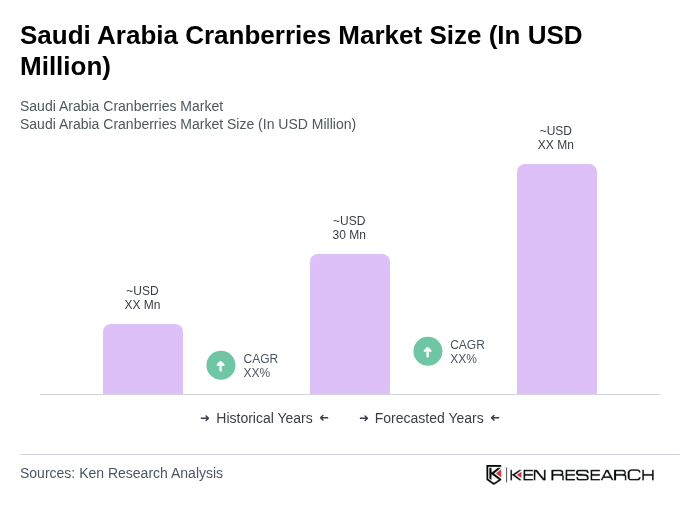
- The Saudi Arabia Cranberries Market is valued at USD 30 million, based on a five-year historical analysis. This growth is primarily driven by increasing health consciousness among consumers, rising demand for natural ingredients in food and beverages, and the expanding modern retail and e?commerce landscape in key urban centers. The positioning of cranberries as a superfruit rich in antioxidants, vitamins, and urinary-tract–health benefits continues to support their use in juices, dried snacks, breakfast cereals, and fortified products.
- Key demand hubs in this market include major cities such as Riyadh, Jeddah, and Dammam. These cities dominate due to their large populations, higher disposable incomes, robust hypermarket/supermarket and specialty retail infrastructure, and higher penetration of imported packaged foods. The presence of international brands and local distributors in these urban centers, supported by modern trade chains and online grocery platforms, also contributes to their market dominance.
- In 2023, the Saudi government strengthened the regulatory framework for organic and health-oriented food imports, including products such as cranberries, through instruments such as the Technical Regulation for Organic Products issued by the Saudi Standards, Metrology and Quality Organization (SASO) and the Ministry of Environment, Water and Agriculture in 2020, which sets rules for certification, labeling, and control of imported organic foods. These measures, together with Saudi Food and Drug Authority import requirements for packaged foods and beverages, aim to enhance food safety standards, promote certified organic and clean?label offerings, and encourage the consumption of healthier options, thereby supporting growth in the cranberries market.
Saudi Arabia Cranberries Market Segmentation
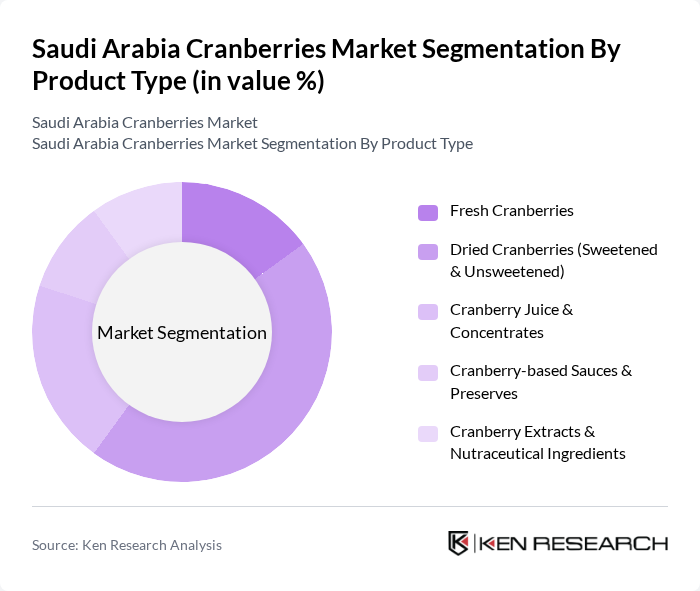
By Product Type:The product type segmentation includes various forms of cranberries, each catering to different consumer preferences and market demands. The subsegments are Fresh Cranberries, Dried Cranberries (Sweetened & Unsweetened), Cranberry Juice & Concentrates, Cranberry-based Sauces & Preserves, and Cranberry Extracts & Nutraceutical Ingredients. Dried formats and juices are the most established in the Saudi market, with dried cranberries in particular gaining traction in bakery, confectionery, breakfast cereals, and snacking due to their convenience, longer shelf life, and alignment with on?the?go healthy snacking trends. Sweetened dried cranberries and juice blends are especially popular, while cranberry extracts and nutraceutical ingredients are increasingly used in functional foods and dietary supplements targeting urinary tract and antioxidant benefits.
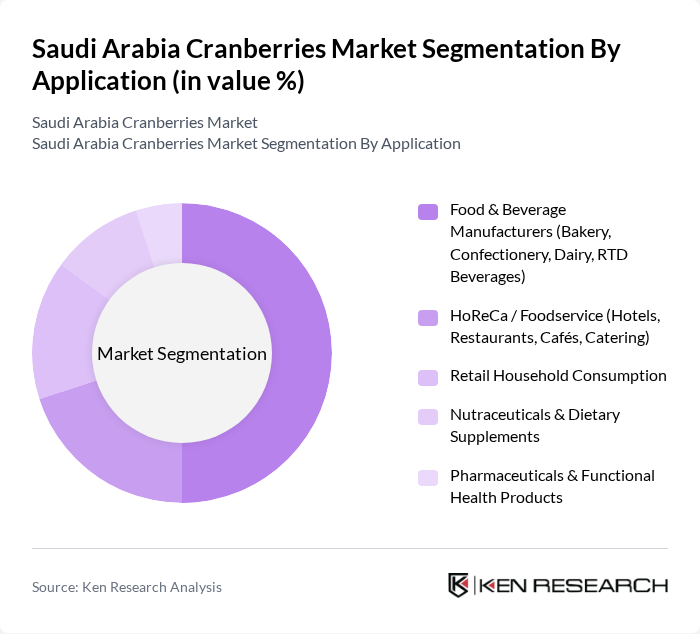
By Application:The application segmentation encompasses various sectors utilizing cranberries, including Food & Beverage Manufacturers, HoReCa (Hotels, Restaurants, Cafés, Catering), Retail Household Consumption, Nutraceuticals & Dietary Supplements, and Pharmaceuticals & Functional Health Products. The Food & Beverage Manufacturers segment leads the market, supported by the increasing incorporation of cranberries in bakery and confectionery products, breakfast cereals, yogurts and dairy drinks, and ready-to-drink juices and juice blends that respond to rising demand for better-for-you and fruit?based offerings. Growth in nutraceutical and functional health applications is also evident, with cranberry extracts used in supplements positioned for urinary tract health and antioxidant support.
Saudi Arabia Cranberries Market Competitive Landscape
The Saudi Arabia Cranberries Market is characterized by a dynamic mix of regional and international players. Leading participants such as Ocean Spray Cranberries, Inc., Fruit d'Or Inc., Decas Cranberry Products, Inc. (a member of Ocean Spray), Cape Cod Select LLC, Stoneridge Orchards (Royal Ridge Fruits), R.W. Knudsen Family (a brand of The J.M. Smucker Co.), Northland Cranberries, Inc. (brand presence via licensed products), The Berry Company Ltd (UK), Sunsweet Growers Inc., Almarai Company (importer/user of cranberry ingredients in beverages & dairy), National Food Industries Company Ltd. (Saudi Arabia), Savola Foods Company (Saudi Arabia), Carrefour Saudi Arabia (Majid Al Futtaim Retail), Lulu Group International (Saudi Arabia Operations), Danube Co. Ltd. (BinDawood Holding) contribute to innovation, geographic expansion, and service delivery in this space.
Saudi Arabia Cranberries Market Industry Analysis
Growth Drivers
- Increasing Health Awareness:The Saudi Arabian population is becoming increasingly health-conscious, with a reported 60% of adults actively seeking healthier food options. This trend is supported by the World Health Organization's findings that highlight rising obesity rates, prompting consumers to choose nutrient-rich foods like cranberries. The demand for antioxidant-rich products is expected to drive cranberry consumption, as they are known to support heart health and urinary tract function, aligning with the public's health goals.
- Rising Demand for Natural Ingredients:The natural food market in Saudi Arabia is projected to reach $1.8 billion in future, reflecting a significant shift towards organic and natural ingredients. This trend is fueled by consumer preferences for products free from artificial additives. Cranberries, being a natural superfood, are well-positioned to benefit from this demand. The increasing availability of cranberries in various forms, such as dried and juiced, further enhances their appeal among health-conscious consumers.
- Expansion of Retail Channels:The retail landscape in Saudi Arabia is evolving, with a 25% increase in modern retail formats, including supermarkets and online platforms. This expansion facilitates greater access to cranberries, allowing consumers to purchase them conveniently. The rise of e-commerce, which is expected to grow by 35% in future, provides additional opportunities for cranberry brands to reach a wider audience, enhancing market penetration and consumer awareness of cranberry products.
Market Challenges
- Limited Local Production:Saudi Arabia's local cranberry production is minimal, with only 600 tons produced annually, primarily due to unsuitable climatic conditions. This reliance on imports, which account for over 90% of the market supply, poses a challenge for market stability. The lack of domestic cultivation limits the availability of fresh cranberries and increases vulnerability to supply chain disruptions, impacting pricing and accessibility for consumers.
- High Import Costs:Importing cranberries incurs significant costs, with tariffs averaging 12% on agricultural products. This financial burden is exacerbated by fluctuating international shipping rates, which can increase prices by up to 20%. Consequently, high import costs can lead to elevated retail prices, potentially deterring price-sensitive consumers. This challenge necessitates strategic pricing and marketing efforts to maintain competitiveness in the market.
Saudi Arabia Cranberries Market Future Outlook
The Saudi Arabia cranberries market is poised for growth, driven by increasing health awareness and a shift towards natural ingredients. As consumers prioritize health and wellness, the demand for cranberries is expected to rise. Additionally, the expansion of retail channels, particularly e-commerce, will enhance product accessibility. Companies that innovate in product offerings and marketing strategies, particularly through collaborations with health influencers, will likely capture a larger market share, positioning themselves favorably for future growth.
Market Opportunities
- Export Potential to Neighboring Countries:Saudi Arabia's strategic location offers significant export opportunities for cranberries to neighboring markets, such as the UAE and Kuwait. With a combined population of over 15 million and increasing health trends, these markets present a lucrative avenue for growth. Establishing trade agreements could facilitate smoother export processes, enhancing market reach and profitability for local cranberry producers.
- Product Innovation in Snacks and Beverages:The demand for innovative cranberry-based snacks and beverages is on the rise, with the snack food market projected to reach $1.2 billion in future. Companies can capitalize on this trend by developing unique products, such as cranberry-infused energy bars and beverages. This innovation not only caters to health-conscious consumers but also aligns with the growing trend of convenient, on-the-go food options.
Scope of the Report
| Segment | Sub-Segments |
|---|---|
| By Product Type | Fresh Cranberries Dried Cranberries (Sweetened & Unsweetened) Cranberry Juice & Concentrates Cranberry-based Sauces & Preserves Cranberry Extracts & Nutraceutical Ingredients |
| By Application | Food & Beverage Manufacturers (Bakery, Confectionery, Dairy, RTD Beverages) HoReCa / Foodservice (Hotels, Restaurants, Cafés, Catering) Retail Household Consumption Nutraceuticals & Dietary Supplements Pharmaceuticals & Functional Health Products |
| By Distribution Channel | Supermarkets/Hypermarkets (e.g., Carrefour, Lulu, Danube, Tamimi) Convenience Stores & Groceries (Baqqala) Specialty & Health Food Stores Online Retail & E?commerce Platforms Foodservice & Institutional Distribution |
| By Packaging Type | Flexible Pouches & Bags Rigid Bottles & Cartons Bulk Industrial Packaging Eco-friendly & Recyclable Packaging |
| By Region | Central Region (Including Riyadh) Western Region (Including Jeddah, Makkah, Madinah) Eastern Region (Including Dammam, Al Khobar, Dhahran) Southern & Northern Regions |
| By Consumer Profile | Health-conscious & Wellness-oriented Consumers Premium & Expatriate Consumers Mass-market Value-seeking Consumers Diabetic / Sugar-conscious & Functional Food Users |
| By Product Form | Whole Berries Sliced / Infused Pieces Powdered Form Liquid Form (Juices, Concentrates, Extracts) |
Key Target Audience
Investors and Venture Capitalist Firms
Government and Regulatory Bodies (e.g., Saudi Food and Drug Authority, Ministry of Environment, Water and Agriculture)
Manufacturers and Producers
Distributors and Retailers
Importers and Exporters
Food and Beverage Companies
Health and Wellness Brands
Market Analysts and Industry Experts
Players Mentioned in the Report:
Ocean Spray Cranberries, Inc.
Fruit d'Or Inc.
Decas Cranberry Products, Inc. (a member of Ocean Spray)
Cape Cod Select LLC
Stoneridge Orchards (Royal Ridge Fruits)
R.W. Knudsen Family (a brand of The J.M. Smucker Co.)
Northland Cranberries, Inc. (brand presence via licensed products)
The Berry Company Ltd (UK)
Sunsweet Growers Inc.
Almarai Company (importer/user of cranberry ingredients in beverages & dairy)
National Food Industries Company Ltd. (Saudi Arabia)
Savola Foods Company (Saudi Arabia)
Carrefour Saudi Arabia (Majid Al Futtaim Retail)
Lulu Group International (Saudi Arabia Operations)
Danube Co. Ltd. (BinDawood Holding)
Table of Contents
Market Assessment Phase
1. Executive Summary and Approach
2. Saudi Arabia Cranberries Market Overview
2.1 Key Insights and Strategic Recommendations
2.2 Saudi Arabia Cranberries Market Overview
2.3 Definition and Scope
2.4 Evolution of Market Ecosystem
2.5 Timeline of Key Regulatory Milestones
2.6 Value Chain & Stakeholder Mapping
2.7 Business Cycle Analysis
2.8 Policy & Incentive Landscape
3. Saudi Arabia Cranberries Market Analysis
3.1 Growth Drivers
3.1.1 Increasing Health Awareness
3.1.2 Rising Demand for Natural Ingredients
3.1.3 Expansion of Retail Channels
3.1.4 Government Support for Agricultural Products
3.2 Market Challenges
3.2.1 Limited Local Production
3.2.2 High Import Costs
3.2.3 Competition from Other Berries
3.2.4 Regulatory Hurdles
3.3 Market Opportunities
3.3.1 Export Potential to Neighboring Countries
3.3.2 Product Innovation in Snacks and Beverages
3.3.3 E-commerce Growth
3.3.4 Health and Wellness Trends
3.4 Market Trends
3.4.1 Organic and Non-GMO Products
3.4.2 Sustainable Packaging Solutions
3.4.3 Increased Online Marketing Strategies
3.4.4 Collaborations with Health Influencers
3.5 Government Regulation
3.5.1 Import Tariffs on Agricultural Products
3.5.2 Food Safety Standards
3.5.3 Labeling Requirements
3.5.4 Subsidies for Local Farmers
4. SWOT Analysis
5. Stakeholder Analysis
6. Porter's Five Forces Analysis
7. Saudi Arabia Cranberries Market Market Size, 2019-2024
7.1 By Value
7.2 By Volume
7.3 By Average Selling Price
8. Saudi Arabia Cranberries Market Segmentation
8.1 By Product Type
8.1.1 Fresh Cranberries
8.1.2 Dried Cranberries (Sweetened & Unsweetened)
8.1.3 Cranberry Juice & Concentrates
8.1.4 Cranberry-based Sauces & Preserves
8.1.5 Cranberry Extracts & Nutraceutical Ingredients
8.2 By Application
8.2.1 Food & Beverage Manufacturers (Bakery, Confectionery, Dairy, RTD Beverages)
8.2.2 HoReCa / Foodservice (Hotels, Restaurants, Cafés, Catering)
8.2.3 Retail Household Consumption
8.2.4 Nutraceuticals & Dietary Supplements
8.2.5 Pharmaceuticals & Functional Health Products
8.3 By Distribution Channel
8.3.1 Supermarkets/Hypermarkets (e.g., Carrefour, Lulu, Danube, Tamimi)
8.3.2 Convenience Stores & Groceries (Baqqala)
8.3.3 Specialty & Health Food Stores
8.3.4 Online Retail & E?commerce Platforms
8.3.5 Foodservice & Institutional Distribution
8.4 By Packaging Type
8.4.1 Flexible Pouches & Bags
8.4.2 Rigid Bottles & Cartons
8.4.3 Bulk Industrial Packaging
8.4.4 Eco-friendly & Recyclable Packaging
8.5 By Region
8.5.1 Central Region (Including Riyadh)
8.5.2 Western Region (Including Jeddah, Makkah, Madinah)
8.5.3 Eastern Region (Including Dammam, Al Khobar, Dhahran)
8.5.4 Southern & Northern Regions
8.6 By Consumer Profile
8.6.1 Health-conscious & Wellness-oriented Consumers
8.6.2 Premium & Expatriate Consumers
8.6.3 Mass-market Value-seeking Consumers
8.6.4 Diabetic / Sugar-conscious & Functional Food Users
8.7 By Product Form
8.7.1 Whole Berries
8.7.2 Sliced / Infused Pieces
8.7.3 Powdered Form
8.7.4 Liquid Form (Juices, Concentrates, Extracts)
9. Saudi Arabia Cranberries Market Competitive Analysis
9.1 Market Share of Key Players
9.2 Cross Comparison of Key Players
9.2.1 Company Name
9.2.2 Regional Presence in Saudi Arabia (Number of Cities/Regions Served)
9.2.3 Saudi Arabia Cranberry-related Revenue & 3-year CAGR
9.2.4 Share of Imported Cranberry Portfolio in Total Product Mix (%)
9.2.5 SKU Count across Key Cranberry Formats (Fresh, Dried, Juice, Extracts)
9.2.6 Average Retail Price Positioning vs Category Average
9.2.7 Channel Coverage Index (Modern Trade, Traditional Trade, HoReCa, E?commerce)
9.2.8 Private Label & Co-branding Partnerships in KSA
9.2.9 Marketing & Promotion Intensity (In-store, Digital, Nutrition Campaigns)
9.2.10 Compliance & Certification Portfolio (SFDA, Halal, Organic, HACCP, ISO)
9.3 SWOT Analysis of Top Players
9.4 Pricing Analysis
9.5 Detailed Profile of Major Companies
9.5.1 Ocean Spray Cranberries, Inc.
9.5.2 Fruit d'Or Inc.
9.5.3 Decas Cranberry Products, Inc. (a member of Ocean Spray)
9.5.4 Cape Cod Select LLC
9.5.5 Stoneridge Orchards (Royal Ridge Fruits)
9.5.6 R.W. Knudsen Family (a brand of The J.M. Smucker Co.)
9.5.7 Northland Cranberries, Inc. (brand presence via licensed products)
9.5.8 The Berry Company Ltd (UK)
9.5.9 Sunsweet Growers Inc.
9.5.10 Almarai Company (importer/user of cranberry ingredients in beverages & dairy)
9.5.11 National Food Industries Company Ltd. (Saudi Arabia)
9.5.12 Savola Foods Company (Saudi Arabia)
9.5.13 Carrefour Saudi Arabia (Majid Al Futtaim Retail)
9.5.14 Lulu Group International (Saudi Arabia Operations)
9.5.15 Danube Co. Ltd. (BinDawood Holding)
10. Saudi Arabia Cranberries Market End-User Analysis
10.1 Procurement Behavior of Key Ministries
10.1.1 Ministry of Health
10.1.2 Ministry of Agriculture
10.1.3 Ministry of Commerce
10.1.4 Others
10.2 Corporate Spend on Infrastructure & Energy
10.2.1 Investment in Food Processing
10.2.2 Infrastructure Development for Distribution
10.2.3 Energy Efficiency Initiatives
10.2.4 Others
10.3 Pain Point Analysis by End-User Category
10.3.1 Supply Chain Disruptions
10.3.2 Quality Assurance Issues
10.3.3 Pricing Volatility
10.3.4 Others
10.4 User Readiness for Adoption
10.4.1 Awareness of Health Benefits
10.4.2 Availability of Products
10.4.3 Consumer Education Initiatives
10.4.4 Others
10.5 Post-Deployment ROI and Use Case Expansion
10.5.1 Measurement of Health Outcomes
10.5.2 Market Feedback Mechanisms
10.5.3 Expansion into New Product Lines
10.5.4 Others
11. Saudi Arabia Cranberries Market Future Size, 2025-2030
11.1 By Value
11.2 By Volume
11.3 By Average Selling Price
Go-To-Market Strategy Phase
1. Whitespace Analysis + Business Model Canvas
1.1 Market Gaps Identification
1.2 Value Proposition Development
1.3 Revenue Streams Analysis
1.4 Cost Structure Evaluation
1.5 Key Partnerships Exploration
1.6 Customer Segmentation
1.7 Channels of Distribution
2. Marketing and Positioning Recommendations
2.1 Branding Strategies
2.2 Product USPs
2.3 Target Market Identification
2.4 Communication Strategies
2.5 Digital Marketing Approaches
2.6 Customer Engagement Tactics
2.7 Performance Metrics
3. Distribution Plan
3.1 Urban Retail Strategies
3.2 Rural NGO Tie-ups
3.3 Logistics and Supply Chain Management
3.4 Distribution Partnerships
3.5 Inventory Management Solutions
3.6 Channel Optimization
3.7 Performance Tracking
4. Channel & Pricing Gaps
4.1 Underserved Routes
4.2 Pricing Bands Analysis
4.3 Competitor Pricing Strategies
4.4 Consumer Price Sensitivity
4.5 Value-Based Pricing Models
4.6 Discounting Strategies
4.7 Pricing Optimization Techniques
5. Unmet Demand & Latent Needs
5.1 Category Gaps
5.2 Consumer Segments Analysis
5.3 Product Development Opportunities
5.4 Market Entry Strategies
5.5 Customer Feedback Mechanisms
5.6 Innovation Opportunities
5.7 Market Trends Alignment
6. Customer Relationship
6.1 Loyalty Programs
6.2 After-sales Service
6.3 Customer Feedback Systems
6.4 Relationship Management Tools
6.5 Engagement Strategies
6.6 Retention Strategies
6.7 Performance Metrics
7. Value Proposition
7.1 Sustainability Initiatives
7.2 Integrated Supply Chains
7.3 Customer-Centric Approaches
7.4 Competitive Differentiation
7.5 Value-Added Services
7.6 Market Positioning
7.7 Performance Metrics
8. Key Activities
8.1 Regulatory Compliance
8.2 Branding Initiatives
8.3 Distribution Setup
8.4 Marketing Campaigns
8.5 Training and Development
8.6 Performance Monitoring
8.7 Continuous Improvement
9. Entry Strategy Evaluation
9.1 Domestic Market Entry Strategy
9.1.1 Product Mix
9.1.2 Pricing Band
9.1.3 Packaging Considerations
9.2 Export Entry Strategy
9.2.1 Target Countries
9.2.2 Compliance Roadmap
10. Entry Mode Assessment
10.1 Joint Ventures
10.2 Greenfield Investments
10.3 Mergers & Acquisitions
10.4 Distributor Model
10.5 Risk Assessment
10.6 Strategic Fit Evaluation
10.7 Performance Metrics
11. Capital and Timeline Estimation
11.1 Capital Requirements
11.2 Timelines for Implementation
11.3 Financial Projections
11.4 Funding Sources
11.5 Risk Management Strategies
11.6 Performance Metrics
12. Control vs Risk Trade-Off
12.1 Ownership Considerations
12.2 Partnership Dynamics
12.3 Risk Mitigation Strategies
12.4 Performance Metrics
13. Profitability Outlook
13.1 Breakeven Analysis
13.2 Long-term Sustainability
13.3 Financial Health Indicators
13.4 Market Positioning
13.5 Performance Metrics
14. Potential Partner List
14.1 Distributors
14.2 Joint Ventures
14.3 Acquisition Targets
14.4 Strategic Alliances
14.5 Performance Metrics
15. Execution Roadmap
15.1 Phased Plan for Market Entry
15.1.1 Market Setup
15.1.2 Market Entry
15.1.3 Growth Acceleration
15.1.4 Scale & Stabilize
15.2 Key Activities and Milestones
15.2.1 Timeline for Key Activities
Research Methodology
Phase 1: Approach1
Desk Research
- Analysis of market reports from industry associations and government publications on agricultural imports
- Review of trade statistics and import/export data specific to cranberries in Saudi Arabia
- Examination of consumer behavior studies and health trend reports related to berry consumption
Primary Research
- Interviews with key stakeholders in the food and beverage sector, including importers and distributors of cranberries
- Surveys conducted with retailers and grocery chains to understand product placement and consumer preferences
- Field interviews with nutritionists and health experts to gauge the perception of cranberries among consumers
Validation & Triangulation
- Cross-validation of findings through comparison with international cranberry market trends
- Triangulation of data from trade, consumer surveys, and expert interviews to ensure consistency
- Sanity checks through expert panel reviews involving industry veterans and market analysts
Phase 2: Market Size Estimation1
Top-down Assessment
- Estimation of total market size based on national fruit consumption statistics and growth rates
- Segmentation of the market by distribution channels, including retail, online, and food service
- Incorporation of demographic data to assess potential market expansion among health-conscious consumers
Bottom-up Modeling
- Volume estimates derived from sales data of cranberry products across various retail formats
- Cost analysis based on pricing strategies of leading cranberry suppliers and importers
- Calculation of market size using volume x price methodology for different product categories
Forecasting & Scenario Analysis
- Multi-factor regression analysis incorporating economic indicators, health trends, and consumer preferences
- Scenario modeling based on potential changes in import regulations and health awareness campaigns
- Development of baseline, optimistic, and pessimistic forecasts through 2030
Phase 3: CATI Sample Composition1
| Scope Item/Segment | Sample Size | Target Respondent Profiles |
|---|---|---|
| Retail Sector Insights | 100 | Store Managers, Category Buyers |
| Food Service Industry Feedback | 80 | Restaurant Owners, Menu Planners |
| Health and Nutrition Perspectives | 60 | Dietitians, Health Coaches |
| Consumer Behavior Analysis | 140 | General Consumers, Health-Conscious Shoppers |
| Import and Distribution Insights | 70 | Import Managers, Supply Chain Analysts |
Frequently Asked Questions
What is the current value of the Saudi Arabia Cranberries Market?
The Saudi Arabia Cranberries Market is valued at approximately USD 30 million, reflecting a growing trend driven by health consciousness, demand for natural ingredients, and the expansion of modern retail and e-commerce in urban areas.
What factors are driving the growth of the cranberries market in Saudi Arabia?
Which cities are the main demand hubs for cranberries in Saudi Arabia?
What are the main product types available in the Saudi Arabia Cranberries Market?
Other Regional/Country Reports
Indonesia Cranberries Market
Malaysia Cranberries Market
Other Adjacent Reports
Indonesia Fruit Juices Market
GCC Nutraceuticals MarketIndonesia Superfoods Market
Organic Foods MarketVietnam Health Supplements Market Outlook to 2030 Functional Beverages MarketEgypt Snack Foods Market
Indonesia Imported Produce Market
Oman Dietary Ingredients Market
Why Buy From Us?

What makes us stand out is that our consultants follow Robust, Refine and Result (RRR) methodology. Robust for clear definitions, approaches and sanity checking, Refine for differentiating respondents' facts and opinions, and Result for presenting data with story.

We have set a benchmark in the industry by offering our clients with syndicated and customized market research reports featuring coverage of entire market as well as meticulous research and analyst insights.

While we don't replace traditional research, we flip the method upside down. Our dual approach of Top Bottom & Bottom Top ensures quality deliverable by not just verifying company fundamentals but also looking at the sector and macroeconomic factors.

With one step in the future, our research team constantly tries to show you the bigger picture. We help with some of the tough questions you may encounter along the way: How is the industry positioned? Best marketing channel? KPI's of competitors? By aligning every element, we help maximize success.

Our report gives you instant access to the answers and sources that other companies might choose to hide. We elaborate each steps of research methodology we have used and showcase you the sample size to earn your trust.

If you need any support, we are here! We pride ourselves on universe strength, data quality, and quick, friendly, and professional service.