About the Report
Base Year 2024Saudi Arabia Drone Market Overview
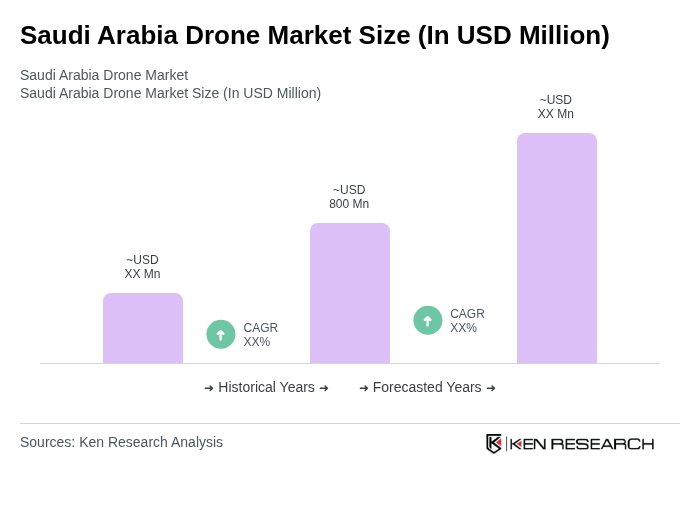
- The Saudi Arabia Drone Market is valued at USD 800 million, based on a five-year historical analysis.This growth is primarily driven by increasing investments in defense and security, rapid expansion of commercial drone programs in sectors such as oil and gas, construction, utilities, logistics, and media, as well as ongoing smart city and megaproject initiatives under Vision 2030 that actively integrate unmanned systems for surveying, monitoring, and infrastructure management.The market is witnessing a surge in adoption due to the integration of drones in urban planning, large-scale projects like NEOM and Red Sea developments, and smart city initiatives that require high-frequency aerial data and automated inspection capabilities.
- Key hubs in this market include Riyadh, Jeddah, and Dammam, which dominate due to their strategic locations, robust transport and industrial infrastructure, and government support for technological advancements and digital transformation.These cities are also focal points for major industries such as oil and gas, defense, construction, and logistics, which further drives the demand for drone applications in pipeline monitoring, flare stack inspection, mapping, port operations, security surveillance, and media production across various sectors.
- The Saudi Arabian government has implemented regulations to streamline the use of drones for civil and commercial purposes through the Unmanned Aircraft Systems Regulation issued by the General Authority of Civil Aviation (GACA) in 2020, which establishes a comprehensive framework for drone registration, classification, and operational approval.This framework requires operators to obtain authorization and, where applicable, remote pilot licenses, comply with safety and airspace restrictions, and adhere to technical standards related to maximum altitude, operational zones, and visual line-of-sight.The initiative aims to promote innovation while ensuring public safety and security in drone usage across the kingdom by mandating registration of most unmanned aircraft, defining prohibited and restricted areas, and enabling controlled deployment of drones for commercial services.
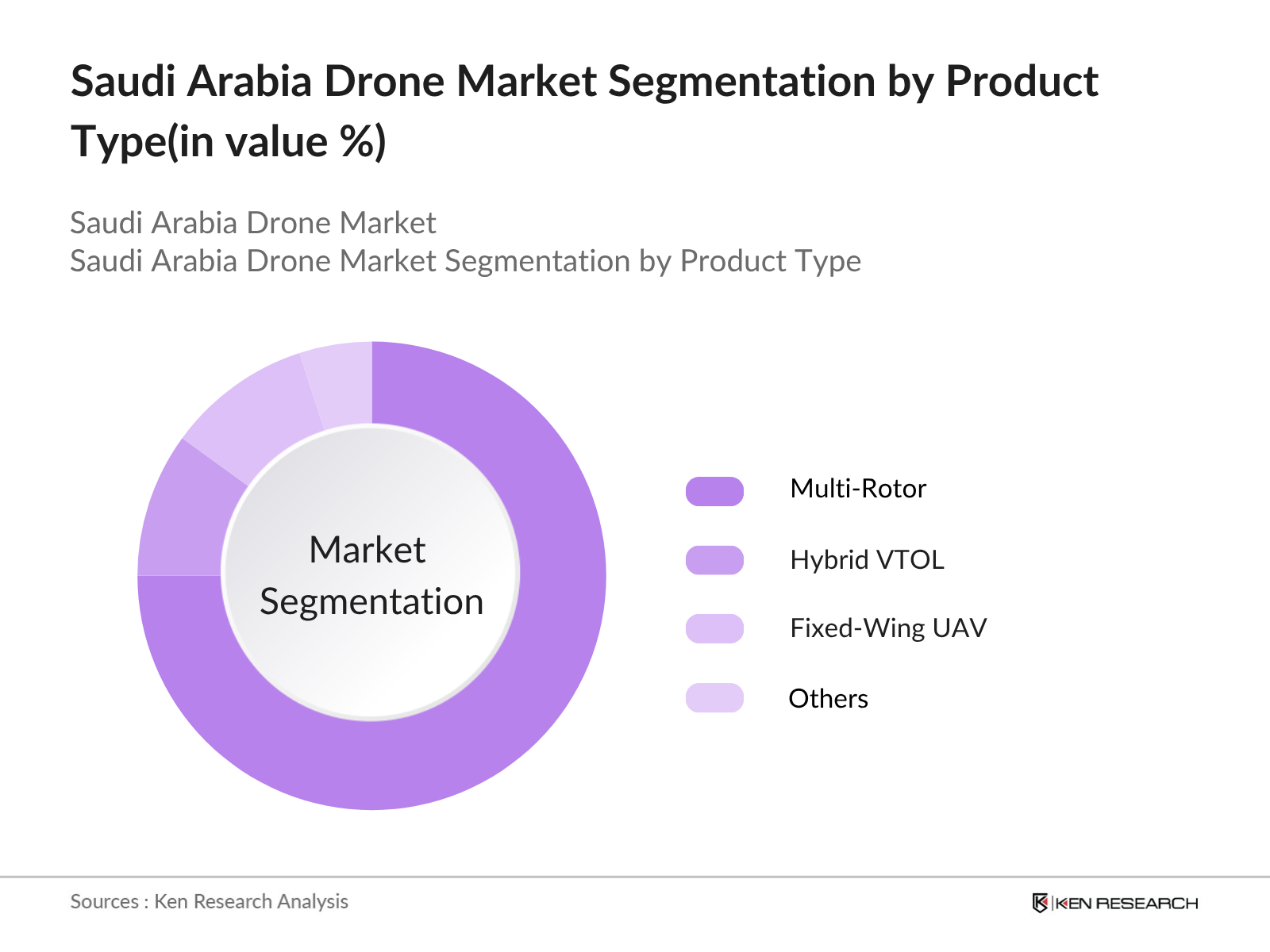
Saudi Arabia Drone Market Segmentation
By ProductType:The product type segmentation includes Multi-Rotor Drones, Hybrid VTOLs, Fixed-Wing UAVs, and Others. Multi-Rotor Drones dominate Saudi Arabia’s drone market due to their lower pricing, operational simplicity, ease of deployment, and strong adoption across construction, logistics, security, media, and inspection-led applications. Their ability to hover, maneuver in compact spaces, and operate efficiently in urban and industrial environments makes them highly preferred for commercial use cases. Hybrid VTOLs represent the second-dominant category, supported by rising enterprise demand for long-endurance, BVLOS, and corridor-based operations. These platforms are gaining relevance in logistics, infrastructure monitoring, and large-area inspection. Fixed-Wing UAVs remain concentrated in defense and strategic surveillance applications, where long-range coverage and endurance are critical.
By End User:The end-user segmentation includes Defense & Security, Oil & Gas, Construction, Consumer/Recreational, Precision Agriculture, Logistics & Delivery, and Others. Defense & Security dominates Saudi Arabia’s drone market, supported by rising adoption of UAVs for surveillance, border monitoring, reconnaissance, critical infrastructure protection, and security-led intelligence operations. Oil & Gas is the second-most dominant segment, driven by drone deployment for pipeline inspection, refinery monitoring, offshore asset surveillance, leak detection, and remote site assessment. Construction also remains a key demand area, with drones being used for site mapping, progress tracking, safety monitoring, and infrastructure inspection. Consumer/Recreational drones hold relevance through personal, media, and event applications, while precision agriculture and logistics are gradually expanding as commercial use cases mature.
Saudi Arabia Drone Market Competitive Landscape
The Saudi Arabia Drone Market is characterized by a dynamic mix of regional and international players. Leading participants such as DJI (Da-Jiang Innovations), Aerodyne Group, Wingcopter, STC, and Percepto contribute to innovation, geographic expansion, and service delivery in this space.
Saudi Arabia Drone Market Industry Analysis
Growth Drivers
- Policy and Defense Push:Saudi Arabia’s drone market is being accelerated by Vision 2030, defense modernization, and localization reforms. The country’s USD 78 Bn defense budget in 2025, supported by 21 R&D centers focused on drones and electronic warfare, is strengthening UAV adoption across surveillance, logistics, and defense. The 50% defense localization target by 2030 is also encouraging partnerships with Lockheed Martin, Baykar, Boeing, and BAE Systems.
- Commercial Demand Pull:Commercial drone adoption is expanding as Saudi Arabia’s giga-projects, oil & gas operations, agriculture, and logistics sectors seek faster inspection, monitoring, and delivery capabilities. The USD 70 Bn construction market in 2024, growing at a CAGR of 5.0%, is creating demand for surveying, BIM integration, and real-time monitoring. Aramco’s USD 14 Mn investment in Terra Drone Arabia further highlights rising demand for localized inspection and operational drone services.
- Technology Adoption:Technology-led innovation is creating new drone use cases across emergency response, autonomous monitoring, and smart surveillance. The AI-powered Falcon drone used during Hajj 2025 demonstrates the role of drones in public safety and high-endurance operations. Drone-in-a-box systems, AI-enabled monitoring, and autonomous platforms are also improving situational awareness across Saudi Arabia’s energy assets, agriculture, maritime surveillance, and critical infrastructure.
Market Challenges
- Regulatory Compliance Complexity:Regulatory Hurdles and Compliance Issues: The regulatory environment for drone operations in Saudi Arabia remains challenging, as GACA classifies BVLOS, industrial, and higher-risk drone activities under specific authorization categories. Larger UAV deployments face stricter compliance requirements, while VLOS limitations, altitude restrictions, airport no-fly zones, and incomplete national UTM deployment continue to slow autonomous and urban drone operations.
- High Initial Investment Costs:Capital Intensity and Commercial Scalability Barriers: Industrial drone adoption in Saudi Arabia remains constrained by high Capex requirements, especially for advanced UAV platforms, supporting software, trained operators, and mission-specific deployment infrastructure. Fragmented procurement practices and immature Drone-as-a-Service models further limit SME participation, delaying commercial scalability despite strong ROI potential across industrial, security, infrastructure, and logistics applications.
Saudi Arabia Drone Market Future Outlook
The future of the drone market in Saudi Arabia appears promising, driven by technological advancements and increasing applications across various sectors. As the government continues to support smart city initiatives and enhance regulatory frameworks, the integration of drones into logistics, agriculture, and surveillance will likely accelerate. Furthermore, the growing emphasis on sustainability will push for eco-friendly drone solutions, fostering innovation and attracting investments in the sector, ultimately transforming the operational landscape.
Market Opportunities
- Defense Drone Localization and Sovereign Manufacturing:Saudi Arabia presents a strong opportunity for localized UAV manufacturing, supported by Made in Saudi initiatives, Saudi-China military drone cooperation, Turkish OEM partnerships, and Baykar localization. Domestic production of drone structures, sensors, ammunition, testing, and support services can strengthen self-reliance and defense ecosystem depth.
- Commercial Drone Logistics and Industrial Deployment:Commercial drone deployment is gaining momentum through the DJI FlyCart 30 introduction, Terra Drone–Aramco inspection partnerships backed by a USD 14 Mn Wa’ed investment, and drone delivery trials for postal and logistics applications. These milestones create opportunities in energy infrastructure inspection, industrial cargo movement, and last-mile logistics.
Scope of the Report
| Segment | Sub-Segments |
|---|---|
| By Product Type | Multi-Rotor Hybrid VTOL Fixed-Wing UAV Others |
| By End User | Defense & Security Oil & Gas Construction Consumer / Recreational Precision Agriculture Logistics & Delivery Others |
| By Component Type | Hardware Services Software & Analytics |
| By Revenue Model | Project Based Subscription-Based |
Key Target Audience
Investors and Venture Capitalist Firms
Government and Regulatory Bodies (e.g., General Authority of Civil Aviation, Ministry of Interior)
Manufacturers and Producers
Drone Service Providers
Logistics and Delivery Companies
Agricultural Technology Firms
Energy and Utility Companies
Defense and Security Agencies
Players Mentioned in the Report:
DJI (Da-Jiang Innovations)
Aerodyne Group
Wingcopter
STC
Percepto
Quantum Systems
Skydio
Terra Drone
FalconViz
Flyability
Table of Contents
Market Assessment Phase
1. Executive Summary and Approach
2. Saudi Arabia Drone Market Overview
2.1 Key Insights and Strategic Recommendations
2.2 Saudi Arabia Drone Market Overview
2.3 Definition and Scope
2.4 Evolution of Market Ecosystem
2.5 Timeline of Key Regulatory Milestones
2.6 Value Chain & Stakeholder Mapping
2.7 Business Cycle Analysis
2.8 Policy & Incentive Landscape
3. Saudi Arabia Drone Market Analysis
3.1 Growth Drivers
3.1.1 Increasing demand for aerial surveillance
3.1.2 Expansion of logistics and delivery services
3.1.3 Government investments in smart city initiatives
3.1.4 Advancements in drone technology
3.2 Market Challenges
3.2.1 Regulatory hurdles and compliance issues
3.2.2 High initial investment costs
3.2.3 Limited public awareness and acceptance
3.2.4 Competition from traditional delivery methods
3.3 Market Opportunities
3.3.1 Growth in agricultural applications
3.3.2 Potential for drone-based infrastructure inspection
3.3.3 Expansion into entertainment and media sectors
3.3.4 Development of drone training and certification programs
3.4 Market Trends
3.4.1 Increasing integration of AI in drone operations
3.4.2 Rise of drone delivery services
3.4.3 Focus on sustainability and eco-friendly drones
3.4.4 Growth of drone data analytics services
3.5 Government Regulation
3.5.1 Implementation of drone registration requirements
3.5.2 Establishment of no-fly zones
3.5.3 Licensing requirements for commercial drone operators
3.5.4 Safety and operational guidelines for drone usage
4. SWOT Analysis
5. Stakeholder Analysis
6. Porter's Five Forces Analysis
7. Saudi Arabia Drone Market Size, 2019-2024
7.1 By Value
7.2 By Volume
7.3 By Average Selling Price
8. Saudi Arabia Drone Market Segmentation
8.1 By Product Type
8.1.1 Multi-Rotor
8.1.2 Hybrid VTOL
8.1.3 Fixed-Wing UAV
8.1.4 Others
8.2 By End User
8.2.1 Defense & Security
8.2.2 Oil & Gas
8.2.3 Construction
8.2.4 Consumer / Recreational
8.2.5 Precision Agriculture
8.2.6 Logistics & Delivery
8.2.7 Others
8.3 By Component Type
8.3.1 Hardware
8.3.2 Services
8.3.3 Software & Analytics
8.4 By Revenue Model
8.4.1 Project Based
8.4.2 Subscription-Based
9. Saudi Arabia Drone Market Competitive Analysis
9.1 Market Share of Key Players
9.2 Cross Comparison of Key Players
9.2.1 Company Name
9.2.2 Scale (Global, Regional, or Local Player)
9.2.3 Saudi Arabia Drone Revenue (Latest Year, USD Million)
9.2.4 3-Year Saudi Revenue CAGR (%)
9.2.5 Market Share in Saudi Drone Market (%)
9.2.6 Contract Win Rate in KSA Tenders (%)
9.2.7 Average Deal Size / Contract Value (USD)
9.2.8 Gross Margin from Drone Business (%)
9.2.9 R&D Spend on Drones (% of Drone Revenue)
9.2.10 Fleet Size Deployed in Saudi Arabia (Number of Drones)
9.2.11 Number of KSA Strategic Partnerships (Oil & Gas, Gov, Telecom)
9.2.12 Average Project Payback Period (Years)
9.3 SWOT Analysis of Top Players
9.4 Pricing Analysis
9.5 Detailed Profile of Major Companies
9.5.1 DJI (Da-Jiang Innovations)
9.5.2 Aerodyne Group
9.5.3 Wingcopter
9.5.4 STC
9.5.5 Percepto
9.5.6 Quantum Systems
9.5.7 Skydio
9.5.8 Terra Drone
9.5.9 FalconViz
9.5.10 Flyability
10. Saudi Arabia Drone Market End-User Analysis
10.1 Procurement Behavior of Key Ministries
10.1.1 Ministry of Interior
10.1.2 Ministry of Agriculture
10.1.3 Ministry of Transport
10.1.4 Others
10.2 Corporate Spend on Infrastructure & Energy
10.2.1 Investment in Smart Infrastructure
10.2.2 Funding for Renewable Energy Projects
10.2.3 Budget Allocation for Technology Upgrades
10.2.4 Others
10.3 Pain Point Analysis by End-User Category
10.3.1 Cost of Implementation
10.3.2 Technical Support and Maintenance
10.3.3 Integration with Existing Systems
10.3.4 Others
10.4 User Readiness for Adoption
10.4.1 Awareness of Drone Technology
10.4.2 Training and Skill Development
10.4.3 Infrastructure Readiness
10.4.4 Others
10.5 Post-Deployment ROI and Use Case Expansion
10.5.1 Measurement of Operational Efficiency
10.5.2 Expansion into New Use Cases
10.5.3 Long-term Cost Savings
10.5.4 Others
11. Saudi Arabia Drone Market Future Size, 2025-2030
11.1 By Value
11.2 By Volume
11.3 By Average Selling Price
Go-To-Market Strategy Phase
1. Whitespace Analysis + Business Model Canvas
1.1 Market Gaps Identification
1.2 Business Model Development
2. Marketing and Positioning Recommendations
2.1 Branding Strategies
2.2 Product USPs
3. Distribution Plan
3.1 Urban Retail Strategies
3.2 Rural NGO Tie-ups
4. Channel & Pricing Gaps
4.1 Underserved Routes
4.2 Pricing Bands
5. Unmet Demand & Latent Needs
5.1 Category Gaps
5.2 Consumer Segments
6. Customer Relationship
6.1 Loyalty Programs
6.2 After-sales Service
7. Value Proposition
7.1 Sustainability Initiatives
7.2 Integrated Supply Chains
8. Key Activities
8.1 Regulatory Compliance
8.2 Branding Efforts
8.3 Distribution Setup
9. Entry Strategy Evaluation
9.1 Domestic Market Entry Strategy
9.1.1 Product Mix
9.1.2 Pricing Band
9.1.3 Packaging
9.2 Export Entry Strategy
9.2.1 Target Countries
9.2.2 Compliance Roadmap
10. Entry Mode Assessment
10.1 Joint Ventures
10.2 Greenfield Investments
10.3 Mergers & Acquisitions
10.4 Distributor Model
11. Capital and Timeline Estimation
11.1 Capital Requirements
11.2 Timelines
12. Control vs Risk Trade-Off
12.1 Ownership vs Partnerships
13. Profitability Outlook
13.1 Breakeven Analysis
13.2 Long-term Sustainability
14. Potential Partner List
14.1 Distributors
14.2 Joint Ventures
14.3 Acquisition Targets
15. Execution Roadmap
15.1 Phased Plan for Market Entry
15.1.1 Market Setup
15.1.2 Market Entry
15.1.3 Growth Acceleration
15.1.4 Scale & Stabilize
15.2 Key Activities and Milestones
15.2.1 Milestone Planning
15.2.2 Activity Tracking
Research Methodology
Phase 1: Approach1
Desk Research
- Analysis of government reports and publications on drone regulations and policies in Saudi Arabia
- Review of industry reports from aviation and drone associations detailing market trends and forecasts
- Examination of trade publications and news articles covering technological advancements and market dynamics in the drone sector
Primary Research
- Interviews with key stakeholders in the drone manufacturing sector, including executives and product managers
- Surveys conducted with end-users across various industries utilizing drones for commercial purposes
- Field interviews with regulatory bodies and aviation authorities to understand compliance and operational challenges
Validation & Triangulation
- Cross-validation of findings through multiple data sources, including market reports and expert opinions
- Triangulation of data from primary interviews and secondary research to ensure consistency and reliability
- Sanity checks through expert panel reviews comprising industry veterans and academic professionals
Phase 2: Market Size Estimation1
Top-down Assessment
- Estimation of the overall drone market size based on national spending on aviation and technology
- Segmentation of the market by application areas such as agriculture, surveillance, and logistics
- Incorporation of government initiatives promoting drone usage in various sectors
Bottom-up Modeling
- Collection of sales data from leading drone manufacturers and service providers in Saudi Arabia
- Operational cost analysis based on pricing models of drone services and products
- Volume estimates derived from user adoption rates and projected growth in specific applications
Forecasting & Scenario Analysis
- Multi-factor regression analysis incorporating economic indicators, technological advancements, and regulatory impacts
- Scenario modeling based on varying levels of market adoption and potential regulatory changes
- Development of baseline, optimistic, and pessimistic forecasts through 2030
Phase 3: CATI Sample Composition1
| Scope Item/Segment | Sample Size | Target Respondent Profiles |
|---|---|---|
| Agricultural Drone Usage | 100 | Agronomists, Farm Managers |
| Drone Delivery Services | 80 | Logistics Managers, Operations Directors |
| Surveillance and Security Applications | 70 | Security Managers, Facility Directors |
| Drone Maintenance and Repair Services | 60 | Service Technicians, Workshop Managers |
| Regulatory Compliance and Policy Insights | 50 | Regulatory Officials, Aviation Experts |
Frequently Asked Questions
What is the current value of the Saudi Arabia Drone Market?
The Saudi Arabia Drone Market is valued at approximately USD 800 million, reflecting significant growth driven by investments in defense, commercial applications, and smart city initiatives under Vision 2030.
What factors are driving the growth of the drone market in Saudi Arabia?
Which cities are the main hubs for the Saudi Arabia Drone Market?
What are the main applications of drones in Saudi Arabia?
Other Regional/Country Reports
Malaysia Drone Market
APAC Drone Market
Other Adjacent Reports
Thailand Surveillance and Security Systems Market
Asia Pacific Logistics Automation MarketThailand Oil and Gas Inspection Services Market
Germany Construction Management Technology Market
Germany Remote Sensing and Geospatial Services Market
Singapore Unmanned Aerial Vehicle (UAV) Training Market
Brazil Energy Infrastructure Monitoring Market
KSA Military Drones and Defense Technology Market
Why Buy From Us?

What makes us stand out is that our consultants follow Robust, Refine and Result (RRR) methodology. Robust for clear definitions, approaches and sanity checking, Refine for differentiating respondents' facts and opinions, and Result for presenting data with story.

We have set a benchmark in the industry by offering our clients with syndicated and customized market research reports featuring coverage of entire market as well as meticulous research and analyst insights.

While we don't replace traditional research, we flip the method upside down. Our dual approach of Top Bottom & Bottom Top ensures quality deliverable by not just verifying company fundamentals but also looking at the sector and macroeconomic factors.

With one step in the future, our research team constantly tries to show you the bigger picture. We help with some of the tough questions you may encounter along the way: How is the industry positioned? Best marketing channel? KPI's of competitors? By aligning every element, we help maximize success.

Our report gives you instant access to the answers and sources that other companies might choose to hide. We elaborate each steps of research methodology we have used and showcase you the sample size to earn your trust.

If you need any support, we are here! We pride ourselves on universe strength, data quality, and quick, friendly, and professional service.