About the Report
Base Year 2024Saudi Arabia Healthcare Professional Training Market Overview
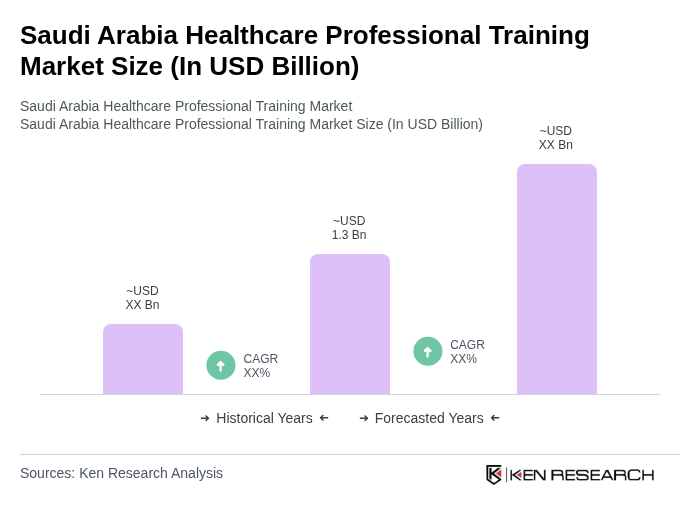
- The Saudi Arabia Healthcare Professional Training Market is valued at USD 1.3 billion, based on a five-year historical analysis and triangulation from overall healthcare services spending and corporate training demand in pharmaceutical and healthcare segments. This growth is primarily driven by the increasing demand for skilled healthcare professionals, rapid expansion of hospital and clinic capacity, the scale?up of the health workforce under Vision 2030, advancements in medical and digital health technology, and the government's commitment to enhancing healthcare services through structured training and education initiatives.
- Key cities such as Riyadh, Jeddah, and Dammam dominate the market due to their concentration of tertiary hospitals, academic medical centers, universities with medical and health faculties, and specialized training centers. These urban areas are pivotal in attracting both local and international healthcare professionals, hosting major public and private healthcare providers, and concentrating corporate training investments, thereby fostering a robust training ecosystem aligned with national health transformation priorities.
- In 2023, the Saudi government implemented the "National Health Workforce Strategy" under the Health Sector Transformation Program to expand and upskill the health workforce, enhance skills and competencies of healthcare professionals through structured training and residency programs, and raise nationalization levels in critical specialties. This initiative emphasizes the importance of continuous professional development and aims to align training with the evolving needs of the healthcare sector, including targets to recruit and train around 175,000 additional healthcare professionals across doctors, nurses, and allied health roles by 2030.
Saudi Arabia Healthcare Professional Training Market Segmentation
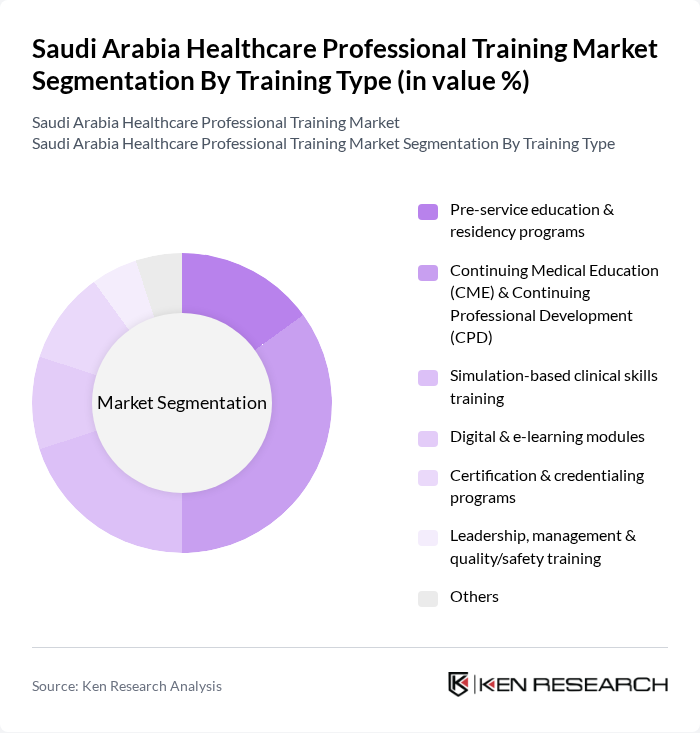
By Training Type:The training type segmentation includes various educational formats designed to enhance the skills of healthcare professionals. The subsegments include Pre-service education & residency programs, Continuing Medical Education (CME) & Continuing Professional Development (CPD), Simulation-based clinical skills training, Digital & e-learning modules, Certification & credentialing programs, Leadership, management & quality/safety training, and Others. CME and CPD remain the leading subsegment, supported by mandatory continuous professional development requirements set by national regulators, increasing accreditation of programs, and the need for healthcare professionals to stay updated with evolving clinical guidelines, new therapies, and health technologies.
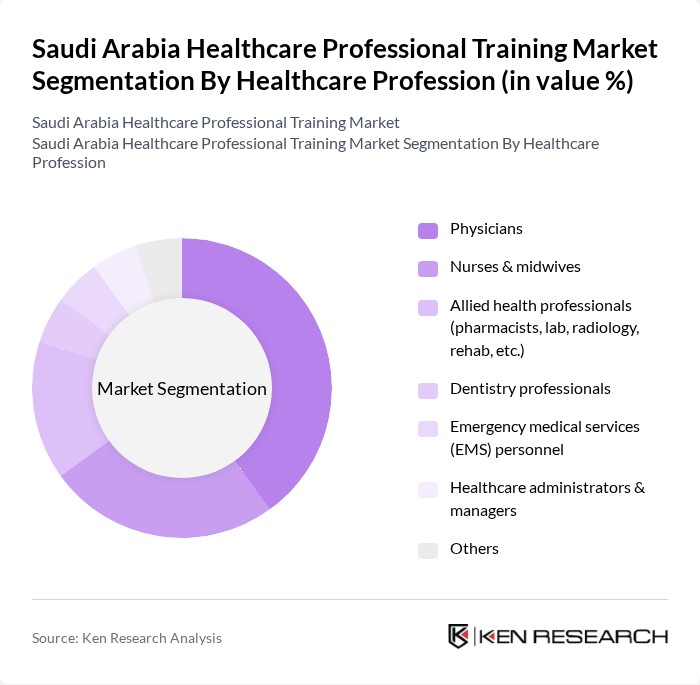
By Healthcare Profession:This segmentation focuses on the various healthcare professions that require specialized training. The subsegments include Physicians, Nurses & midwives, Allied health professionals (pharmacists, lab, radiology, rehab, etc.), Dentistry professionals, Emergency medical services (EMS) personnel, Healthcare administrators & managers, and Others. The Physicians subsegment is the most significant, reflecting the large and growing need for specialist and subspecialist training as the country expands tertiary and quaternary care services, alongside strong demand for structured residency and fellowship programs across major medical disciplines.
Saudi Arabia Healthcare Professional Training Market Competitive Landscape
The Saudi Arabia Healthcare Professional Training Market is characterized by a dynamic mix of regional and international players. Leading participants such as Saudi Commission for Health Specialties (SCFHS), Saudi Health Council, Ministry of Health (Saudi Arabia), King Saud University – College of Medicine & affiliated training centers, King Abdulaziz University – Faculty of Medicine & training centers, Imam Abdulrahman Bin Faisal University – College of Medicine & allied health, King Fahad Medical City, King Abdulaziz Medical City (National Guard Health Affairs), Prince Sultan Military Medical City, King Faisal Specialist Hospital & Research Centre, Saudi German Health (Saudi German Hospital Group), Dr. Sulaiman Al Habib Medical Group, Dallah Health Company, Fakeeh Care Group, Specialized healthcare training academies and institutes (e.g., Future Healthcare Academy, private simulation & CPD providers) contribute to innovation, geographic expansion, and service delivery in this space by offering accredited residency programs, CME/CPD activities, simulation-based training, and digital learning solutions across major clinical and management disciplines.
Saudi Arabia Healthcare Professional Training Market Industry Analysis
Growth Drivers
- Increasing Demand for Skilled Healthcare Professionals:The healthcare sector in Saudi Arabia is projected to require an additional 120,000 healthcare professionals in future, driven by an aging population and rising chronic diseases. The Ministry of Health reported that the number of healthcare workers must increase to meet the growing patient needs, emphasizing the urgency for enhanced training programs. This demand is further supported by the Vision 2030 initiative, which aims to improve healthcare services across the nation.
- Government Initiatives to Enhance Healthcare Education:The Saudi government allocated approximately SAR 25 billion (USD 6.7 billion) in future to improve healthcare education and training facilities. This funding is part of a broader strategy to enhance the quality of healthcare services. The establishment of new medical schools and training centers is expected to increase the number of qualified healthcare professionals, thereby addressing the skills gap in the industry and improving overall healthcare delivery.
- Rising Healthcare Expenditure:Saudi Arabia's healthcare expenditure is projected to reach SAR 250 billion (USD 66.7 billion) in future, reflecting a 15% increase from previous years. This rise in spending is aimed at expanding healthcare infrastructure and training programs. Increased investment in healthcare not only enhances service delivery but also creates a demand for skilled professionals, thereby driving the need for comprehensive training initiatives across the sector.
Market Challenges
- Limited Access to Training Facilities in Rural Areas:Approximately 25% of Saudi Arabia's population resides in rural areas, where access to healthcare training facilities is severely limited. This geographical disparity creates a significant barrier to education for aspiring healthcare professionals. The lack of infrastructure and resources in these regions hampers the development of a skilled workforce, ultimately affecting the quality of healthcare services available to rural communities.
- High Costs Associated with Advanced Training Programs:Advanced healthcare training programs can cost upwards of SAR 60,000 (USD 16,000) per participant, making them financially inaccessible for many potential candidates. This high cost limits the number of individuals who can pursue specialized training, thereby exacerbating the shortage of skilled professionals in critical areas of healthcare. Financial barriers hinder the overall growth of the healthcare training market in Saudi Arabia.
Saudi Arabia Healthcare Professional Training Market Future Outlook
The future of the healthcare professional training market in Saudi Arabia appears promising, driven by ongoing government investments and a commitment to improving healthcare quality. The integration of technology in training methodologies, such as e-learning and simulation-based training, is expected to enhance accessibility and effectiveness. Additionally, the focus on continuous professional development will ensure that healthcare professionals remain updated with the latest practices, ultimately leading to improved patient outcomes and a more robust healthcare system.
Market Opportunities
- Expansion of Online Training Platforms:The rise of digital learning solutions presents a significant opportunity for the healthcare training market. With an estimated 90% of the population having internet access, online platforms can provide flexible and affordable training options, particularly for those in remote areas. This shift can help bridge the skills gap and increase the number of trained professionals in the healthcare sector.
- Partnerships with International Training Organizations:Collaborating with established international training organizations can enhance the quality of healthcare education in Saudi Arabia. Such partnerships can facilitate knowledge transfer, introduce best practices, and provide access to advanced training resources. This collaboration can significantly improve the skill set of healthcare professionals, aligning local training programs with global standards.
Scope of the Report
| Segment | Sub-Segments |
|---|---|
| By Training Type | Pre-service education & residency programs Continuing Medical Education (CME) & Continuing Professional Development (CPD) Simulation-based clinical skills training Digital & e-learning modules Certification & credentialing programs Leadership, management & quality/safety training Others |
| By Healthcare Profession | Physicians Nurses & midwives Allied health professionals (pharmacists, lab, radiology, rehab, etc.) Dentistry professionals Emergency medical services (EMS) personnel Healthcare administrators & managers Others |
| By Provider Type | Universities & medical colleges Teaching and tertiary care hospitals Specialized training centers & academies Professional councils & government bodies Private training companies & edtech platforms International organizations & partners Others |
| By Training Modality | Onsite / classroom-based training Online / virtual instructor-led training Self-paced e-learning Blended learning High-fidelity simulation & skills labs On-the-job / in-situ training Others |
| By Clinical Area / Specialty | Primary care & family medicine Critical care, emergency & trauma Surgery & anesthesiology Obstetrics, gynecology & neonatology Cardiology & internal medicine Infection prevention & control Digital health, telemedicine & health IT Others |
| By Payer | Government & public sector funding Private hospitals & healthcare groups Individual self-funded professionals Corporate & industry-sponsored programs International & NGO-funded programs Others |
| By Region | Central Region (including Riyadh) Western Region (including Makkah & Madinah) Eastern Region Northern Region Southern Region |
Key Target Audience
Investors and Venture Capitalist Firms
Government and Regulatory Bodies (e.g., Ministry of Health, Saudi Commission for Health Specialties)
Healthcare Providers and Institutions
Medical Equipment and Technology Manufacturers
Pharmaceutical Companies
Healthcare Training Organizations
Insurance Companies
Health Policy Makers
Players Mentioned in the Report:
Saudi Commission for Health Specialties (SCFHS)
Saudi Health Council
Ministry of Health (Saudi Arabia)
King Saud University College of Medicine & affiliated training centers
King Abdulaziz University Faculty of Medicine & training centers
Imam Abdulrahman Bin Faisal University College of Medicine & allied health
King Fahad Medical City
King Abdulaziz Medical City (National Guard Health Affairs)
Prince Sultan Military Medical City
King Faisal Specialist Hospital & Research Centre
Saudi German Health (Saudi German Hospital Group)
Dr. Sulaiman Al Habib Medical Group
Dallah Health Company
Fakeeh Care Group
Specialized healthcare training academies and institutes (e.g., Future Healthcare Academy, private simulation & CPD providers)
Table of Contents
Market Assessment Phase
1. Executive Summary and Approach
2. Saudi Arabia Healthcare Professional Training Market Overview
2.1 Key Insights and Strategic Recommendations
2.2 Saudi Arabia Healthcare Professional Training Market Overview
2.3 Definition and Scope
2.4 Evolution of Market Ecosystem
2.5 Timeline of Key Regulatory Milestones
2.6 Value Chain & Stakeholder Mapping
2.7 Business Cycle Analysis
2.8 Policy & Incentive Landscape
3. Saudi Arabia Healthcare Professional Training Market Analysis
3.1 Growth Drivers
3.1.1 Increasing demand for skilled healthcare professionals
3.1.2 Government initiatives to enhance healthcare education
3.1.3 Rising healthcare expenditure
3.1.4 Technological advancements in training methodologies
3.2 Market Challenges
3.2.1 Limited access to training facilities in rural areas
3.2.2 High costs associated with advanced training programs
3.2.3 Regulatory hurdles in establishing training institutions
3.2.4 Shortage of qualified trainers and educators
3.3 Market Opportunities
3.3.1 Expansion of online training platforms
3.3.2 Partnerships with international training organizations
3.3.3 Development of specialized training programs
3.3.4 Increased focus on continuous professional development
3.4 Market Trends
3.4.1 Growing adoption of e-learning in healthcare training
3.4.2 Emphasis on simulation-based training
3.4.3 Integration of AI and VR in training programs
3.4.4 Shift towards competency-based training models
3.5 Government Regulation
3.5.1 Licensing requirements for training institutions
3.5.2 Accreditation standards for healthcare training programs
3.5.3 Funding and grants for healthcare education
3.5.4 Policies promoting public-private partnerships in training
4. SWOT Analysis
5. Stakeholder Analysis
6. Porter's Five Forces Analysis
7. Saudi Arabia Healthcare Professional Training Market Market Size, 2019-2024
7.1 By Value
7.2 By Volume
7.3 By Average Selling Price
8. Saudi Arabia Healthcare Professional Training Market Segmentation
8.1 By Training Type
8.1.1 Pre-service education & residency programs
8.1.2 Continuing Medical Education (CME) & Continuing Professional Development (CPD)
8.1.3 Simulation-based clinical skills training
8.1.4 Digital & e-learning modules
8.1.5 Certification & credentialing programs
8.1.6 Leadership, management & quality/safety training
8.1.7 Others
8.2 By Healthcare Profession
8.2.1 Physicians
8.2.2 Nurses & midwives
8.2.3 Allied health professionals (pharmacists, lab, radiology, rehab, etc.)
8.2.4 Dentistry professionals
8.2.5 Emergency medical services (EMS) personnel
8.2.6 Healthcare administrators & managers
8.2.7 Others
8.3 By Provider Type
8.3.1 Universities & medical colleges
8.3.2 Teaching and tertiary care hospitals
8.3.3 Specialized training centers & academies
8.3.4 Professional councils & government bodies
8.3.5 Private training companies & edtech platforms
8.3.6 International organizations & partners
8.3.7 Others
8.4 By Training Modality
8.4.1 Onsite / classroom-based training
8.4.2 Online / virtual instructor-led training
8.4.3 Self-paced e-learning
8.4.4 Blended learning
8.4.5 High-fidelity simulation & skills labs
8.4.6 On-the-job / in-situ training
8.4.7 Others
8.5 By Clinical Area / Specialty
8.5.1 Primary care & family medicine
8.5.2 Critical care, emergency & trauma
8.5.3 Surgery & anesthesiology
8.5.4 Obstetrics, gynecology & neonatology
8.5.5 Cardiology & internal medicine
8.5.6 Infection prevention & control
8.5.7 Digital health, telemedicine & health IT
8.5.8 Others
8.6 By Payer
8.6.1 Government & public sector funding
8.6.2 Private hospitals & healthcare groups
8.6.3 Individual self-funded professionals
8.6.4 Corporate & industry-sponsored programs
8.6.5 International & NGO-funded programs
8.6.6 Others
8.7 By Region
8.7.1 Central Region (including Riyadh)
8.7.2 Western Region (including Makkah & Madinah)
8.7.3 Eastern Region
8.7.4 Northern Region
8.7.5 Southern Region
9. Saudi Arabia Healthcare Professional Training Market Competitive Analysis
9.1 Market Share of Key Players
9.2 Cross Comparison of Key Players
9.2.1 Company name
9.2.2 Ownership type (public, private, government, non-profit)
9.2.3 Estimated training revenue from healthcare professional programs
9.2.4 3-year revenue CAGR from training services
9.2.5 EBITDA margin from training business
9.2.6 Number of learners trained annually
9.2.7 Number of accredited programs (SCFHS, international bodies, etc.)
9.2.8 Geographic reach within Saudi Arabia (number of regions/cities covered)
9.2.9 Digital delivery capability (online users, LMS / platform metrics)
9.2.10 Average price per learner / per course
9.2.11 Contract win rate in institutional tenders
9.2.12 Renewal rate of institutional contracts
9.2.13 Learner satisfaction / NPS score
9.2.14 Trainer-to-learner ratio
9.3 SWOT Analysis of Top Players
9.4 Pricing Analysis
9.5 Detailed Profile of Major Companies
9.5.1 Saudi Commission for Health Specialties (SCFHS)
9.5.2 Saudi Health Council
9.5.3 Ministry of Health (Saudi Arabia)
9.5.4 King Saud University – College of Medicine & affiliated training centers
9.5.5 King Abdulaziz University – Faculty of Medicine & training centers
9.5.6 Imam Abdulrahman Bin Faisal University – College of Medicine & allied health
9.5.7 King Fahad Medical City
9.5.8 King Abdulaziz Medical City (National Guard Health Affairs)
9.5.9 Prince Sultan Military Medical City
9.5.10 King Faisal Specialist Hospital & Research Centre
9.5.11 Saudi German Health (Saudi German Hospital Group)
9.5.12 Dr. Sulaiman Al Habib Medical Group
9.5.13 Dallah Health Company
9.5.14 Fakeeh Care Group
9.5.15 Specialized healthcare training academies and institutes (e.g., Future Healthcare Academy, private simulation & CPD providers)
10. Saudi Arabia Healthcare Professional Training Market End-User Analysis
10.1 Procurement Behavior of Key Ministries
10.1.1 Ministry of Health
10.1.2 Ministry of Education
10.1.3 Ministry of Defense
10.1.4 Ministry of National Guard
10.2 Corporate Spend on Infrastructure & Energy
10.2.1 Investment in Training Facilities
10.2.2 Budget Allocation for Professional Development
10.2.3 Partnerships with Educational Institutions
10.2.4 Others
10.3 Pain Point Analysis by End-User Category
10.3.1 Hospitals
10.3.2 Medical Schools
10.3.3 Private Clinics
10.3.4 Government Health Departments
10.4 User Readiness for Adoption
10.4.1 Awareness of Training Programs
10.4.2 Willingness to Invest in Training
10.4.3 Availability of Resources
10.4.4 Others
10.5 Post-Deployment ROI and Use Case Expansion
10.5.1 Evaluation of Training Effectiveness
10.5.2 Long-term Impact on Patient Care
10.5.3 Opportunities for Further Training
10.5.4 Others
11. Saudi Arabia Healthcare Professional Training Market Future Size, 2025-2030
11.1 By Value
11.2 By Volume
11.3 By Average Selling Price
Go-To-Market Strategy Phase
1. Whitespace Analysis + Business Model Canvas
1.1 Market Gaps Identification
1.2 Business Model Development
2. Marketing and Positioning Recommendations
2.1 Branding Strategies
2.2 Product USPs
3. Distribution Plan
3.1 Urban Retail vs Rural NGO Tie-ups
4. Channel & Pricing Gaps
4.1 Underserved Routes
4.2 Pricing Bands
5. Unmet Demand & Latent Needs
5.1 Category Gaps
5.2 Consumer Segments
6. Customer Relationship
6.1 Loyalty Programs
6.2 After-sales Service
7. Value Proposition
7.1 Sustainability
7.2 Integrated Supply Chains
8. Key Activities
8.1 Regulatory Compliance
8.2 Branding
8.3 Distribution Setup
9. Entry Strategy Evaluation
9.1 Domestic Market Entry Strategy
9.1.1 Product Mix
9.1.2 Pricing Band
9.1.3 Packaging
9.2 Export Entry Strategy
9.2.1 Target Countries
9.2.2 Compliance Roadmap
10. Entry Mode Assessment
10.1 JV
10.2 Greenfield
10.3 M&A
10.4 Distributor Model
11. Capital and Timeline Estimation
11.1 Capital Requirements
11.2 Timelines
12. Control vs Risk Trade-Off
12.1 Ownership vs Partnerships
13. Profitability Outlook
13.1 Breakeven Analysis
13.2 Long-term Sustainability
14. Potential Partner List
14.1 Distributors
14.2 JVs
14.3 Acquisition Targets
15. Execution Roadmap
15.1 Phased Plan for Market Entry
15.1.1 Market Setup
15.1.2 Market Entry
15.1.3 Growth Acceleration
15.1.4 Scale & Stabilize
15.2 Key Activities and Milestones
15.2.1 Milestone Planning
15.2.2 Activity Tracking
Research Methodology
Phase 1: Approach1
Desk Research
- Analysis of government healthcare reports and statistics from the Saudi Ministry of Health
- Review of academic journals and publications focusing on healthcare training methodologies in Saudi Arabia
- Examination of industry white papers and market analysis reports from healthcare associations
Primary Research
- Interviews with healthcare training program directors at major hospitals and medical institutions
- Surveys with healthcare professionals regarding their training needs and preferences
- Focus groups with educators and trainers in the healthcare sector to gather insights on curriculum effectiveness
Validation & Triangulation
- Cross-validation of findings through comparison with international healthcare training standards
- Triangulation of data from government sources, industry reports, and expert interviews
- Sanity checks through feedback from a panel of healthcare training experts
Phase 2: Market Size Estimation1
Top-down Assessment
- Estimation of total healthcare expenditure in Saudi Arabia as a basis for training market size
- Segmentation of the market by healthcare professional categories (doctors, nurses, allied health professionals)
- Incorporation of government initiatives aimed at enhancing healthcare workforce capabilities
Bottom-up Modeling
- Collection of data on the number of healthcare professionals and their training requirements
- Estimation of training costs based on existing training programs and their pricing structures
- Volume x cost analysis to determine the overall market potential for healthcare training services
Forecasting & Scenario Analysis
- Multi-factor regression analysis incorporating population growth, healthcare demand, and training needs
- Scenario modeling based on potential changes in healthcare policies and funding
- Development of baseline, optimistic, and pessimistic forecasts through 2030
Phase 3: CATI Sample Composition1
| Scope Item/Segment | Sample Size | Target Respondent Profiles |
|---|---|---|
| Healthcare Training Programs | 120 | Program Directors, Training Coordinators |
| Nursing Education Initiatives | 90 | Nursing Educators, Clinical Instructors |
| Continuing Medical Education (CME) | 80 | Medical Professionals, CME Administrators |
| Allied Health Training | 70 | Allied Health Educators, Program Managers |
| Healthcare Policy Impact on Training | 60 | Healthcare Policy Analysts, Government Officials |
Frequently Asked Questions
What is the current value of the Saudi Arabia Healthcare Professional Training Market?
The Saudi Arabia Healthcare Professional Training Market is valued at approximately USD 1.3 billion, driven by the increasing demand for skilled healthcare professionals and government initiatives aimed at enhancing healthcare services through structured training and education programs.
What factors are driving the growth of the healthcare training market in Saudi Arabia?
Which cities are the primary hubs for healthcare professional training in Saudi Arabia?
What is the National Health Workforce Strategy in Saudi Arabia?
Other Regional/Country Reports
Other Adjacent Reports
Vietnam Healthcare Services Market
Bahrain Medical Education Market
South Africa Continuing Medical Education Market
South Korea Healthcare Simulation Market
Indonesia E-Learning Platforms Market
Belgium Nursing Education Market
South Africa Allied Health Professionals Market
Kuwait Hospital Management Market
Brazil Digital Health Technology Market
Egypt Pharmaceutical Training Market
Why Buy From Us?

What makes us stand out is that our consultants follow Robust, Refine and Result (RRR) methodology. Robust for clear definitions, approaches and sanity checking, Refine for differentiating respondents' facts and opinions, and Result for presenting data with story.

We have set a benchmark in the industry by offering our clients with syndicated and customized market research reports featuring coverage of entire market as well as meticulous research and analyst insights.

While we don't replace traditional research, we flip the method upside down. Our dual approach of Top Bottom & Bottom Top ensures quality deliverable by not just verifying company fundamentals but also looking at the sector and macroeconomic factors.

With one step in the future, our research team constantly tries to show you the bigger picture. We help with some of the tough questions you may encounter along the way: How is the industry positioned? Best marketing channel? KPI's of competitors? By aligning every element, we help maximize success.

Our report gives you instant access to the answers and sources that other companies might choose to hide. We elaborate each steps of research methodology we have used and showcase you the sample size to earn your trust.

If you need any support, we are here! We pride ourselves on universe strength, data quality, and quick, friendly, and professional service.