About the Report
Base Year 2024Saudi Arabia Mining Equipment Market Overview
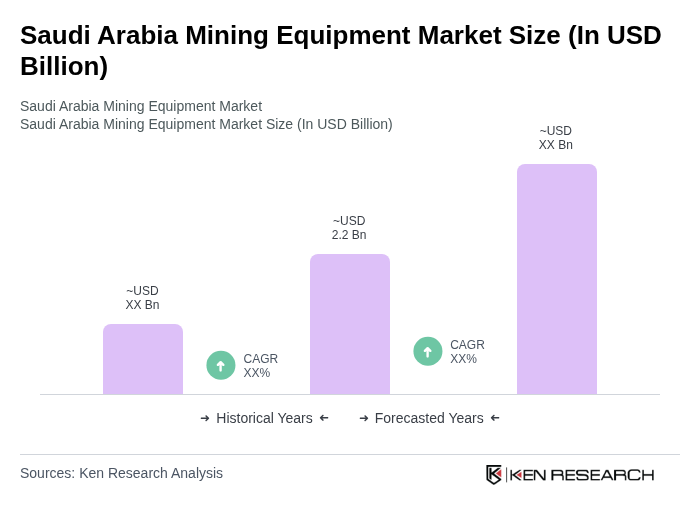
- The Saudi Arabia Mining Equipment Market is valued at USD 2.2 billion, based on a five-year historical analysis. This growth is primarily driven by the country's ambitious Vision 2030 initiative, which aims to diversify the economy and reduce dependence on oil. Increased investments in mining infrastructure and technology, along with rising demand for minerals such as gold, copper, and phosphate, have significantly contributed to the market's expansion. Recent discoveries, such as the gold reserves at Mansourah-Massarah, and Saudi Arabia’s estimated mineral wealth of USD 2.5 trillion, are further fueling equipment demand and sector growth .
- Key cities such as Riyadh, Jeddah, and Dammam dominate the mining equipment market due to their strategic locations and proximity to major mining sites. Riyadh serves as the administrative and economic hub, while Jeddah and Dammam provide essential logistics and transportation services, facilitating the efficient movement of mining equipment and resources across the region. Jeddah’s seaport, the second-largest in the Middle East, is a critical logistics node for mining equipment distribution .
- In 2023, the Saudi government implemented the Mining Investment Law (Royal Decree No. M/140, issued by the Ministry of Industry and Mineral Resources, 2020), aimed at attracting foreign investments and enhancing local production capabilities. This law includes provisions for streamlined licensing processes, mandatory environmental compliance, and incentives for companies investing in advanced mining technologies, thereby fostering a more competitive and sustainable mining sector .
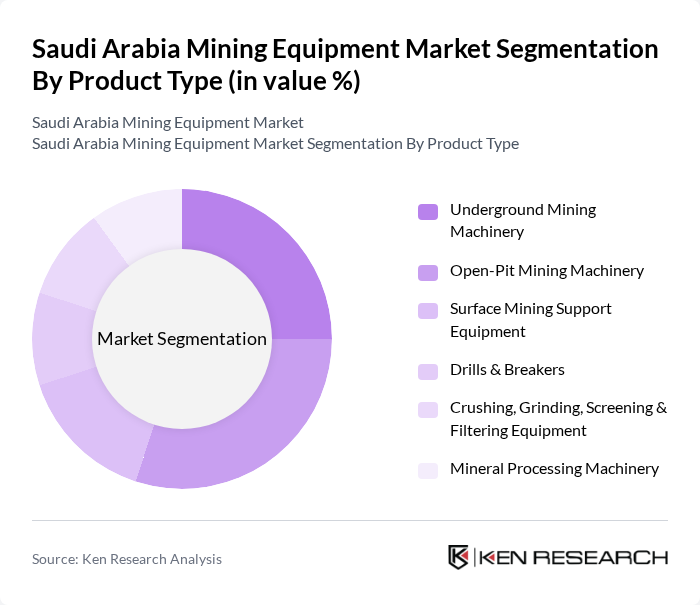
Saudi Arabia Mining Equipment Market Segmentation
By Product Type:The product type segmentation includes various categories of mining equipment that cater to different operational needs. The subsegments include Underground Mining Machinery, Open-Pit Mining Machinery, Surface Mining Support Equipment, Drills & Breakers, Crushing, Grinding, Screening & Filtering Equipment, and Mineral Processing Machinery. Each of these subsegments plays a crucial role in the mining process, with specific equipment designed for distinct applications. Recent market trends indicate rising demand for autonomous and electric mining vehicles, digital twin technology for equipment simulation, and modular equipment designs, reflecting the sector’s shift toward operational efficiency and sustainability .
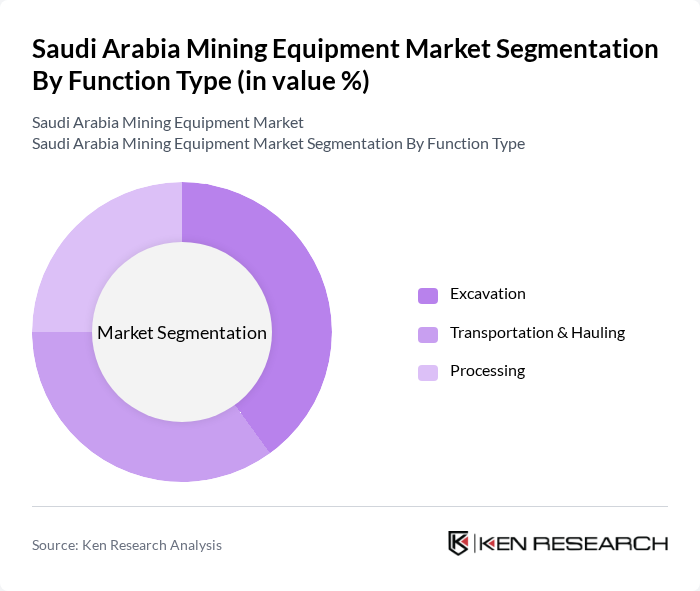
By Function Type:The function type segmentation categorizes mining equipment based on their operational roles. The subsegments include Excavation, Transportation & Hauling, and Processing. Each function type is essential for the overall efficiency of mining operations, with specific equipment designed to optimize performance in these areas. Excavation equipment, such as high-capacity excavators and tunneling rigs, is in high demand due to ongoing mega-projects and mineral exploration initiatives. Transportation & hauling equipment is increasingly integrated with telematics and remote operation modules, while processing equipment is evolving toward automation and real-time monitoring capabilities .
Saudi Arabia Mining Equipment Market Competitive Landscape
The Saudi Arabia Mining Equipment Market is characterized by a dynamic mix of regional and international players. Leading participants such as Caterpillar Inc., Komatsu Ltd., Sandvik AB, Hitachi Construction Machinery Co., Ltd., Volvo Construction Equipment, Liebherr Group, Terex Corporation, Doosan Infracore, Atlas Copco AB, Epiroc AB, Wirtgen GmbH, JCB, Case Construction Equipment, SANY Group, XCMG Group, Normet Oy, Ma’aden (Saudi Arabian Mining Company), Arabian Machinery & Heavy Equipment Co. (AMHEC), Zahid Tractor & Heavy Machinery Co. Ltd., Abdul Latif Jameel Machinery contribute to innovation, geographic expansion, and service delivery in this space. International OEMs increasingly partner with local distributors for market access and aftersales support, while local firms leverage global expertise to enhance service quality and product offerings .
Saudi Arabia Mining Equipment Market Industry Analysis
Growth Drivers
- Increasing Demand for Minerals and Metals:The demand for minerals and metals in Saudi Arabia is projected to reach 50 million tons in future, driven by the country's Vision 2030 initiative. This initiative aims to diversify the economy, reducing reliance on oil. The construction sector alone is expected to consume approximately 30% of these minerals, highlighting the critical role of mining equipment in meeting this demand. The growth in urbanization and infrastructure projects further fuels this trend, necessitating advanced mining technologies.
- Government Investment in Mining Infrastructure:The Saudi government has allocated over $3.8 billion for mining infrastructure development in future, focusing on enhancing transportation and processing facilities. This investment is part of a broader strategy to increase the mining sector's contribution to GDP from 2.3% to 6.4% in future. Improved infrastructure will facilitate easier access to mining sites, thereby boosting the demand for modern mining equipment and technologies, which are essential for efficient operations.
- Technological Advancements in Mining Equipment:The Saudi mining sector is witnessing a significant shift towards automation and advanced technologies, with an estimated investment of $1.5 billion in smart mining solutions in future. Innovations such as autonomous vehicles and AI-driven analytics are enhancing operational efficiency and safety. This trend is supported by the increasing need for cost-effective and environmentally friendly mining practices, driving the demand for state-of-the-art mining equipment that can adapt to these technological advancements.
Market Challenges
- High Initial Capital Investment:The mining equipment sector in Saudi Arabia faces challenges due to the high initial capital investment required, which can exceed $10 million for advanced machinery. This financial barrier limits entry for smaller companies and can deter investment in new technologies. Additionally, the long payback periods associated with mining projects can further complicate financing, making it essential for stakeholders to seek innovative funding solutions to overcome these challenges.
- Regulatory Compliance Complexities:Navigating the regulatory landscape in Saudi Arabia can be challenging for mining companies, with over 50 regulations governing the sector. Compliance with environmental protection laws and safety standards requires significant resources and expertise. The complexities of obtaining necessary permits can delay project timelines, leading to increased costs. Companies must invest in legal and compliance teams to ensure adherence to these regulations, which can strain operational budgets and resources.
Saudi Arabia Mining Equipment Market Future Outlook
The future of the Saudi Arabia mining equipment market appears promising, driven by ongoing government initiatives and technological advancements. As the country continues to diversify its economy, the mining sector is expected to play a pivotal role in achieving these goals. The integration of automation and AI technologies will enhance operational efficiency, while a growing emphasis on sustainable practices will shape equipment development. Overall, the market is poised for significant growth, supported by strategic investments and partnerships within the industry.
Market Opportunities
- Expansion of Mining Operations in Remote Areas:The exploration of remote mining sites presents a significant opportunity, with an estimated 20% of Saudi Arabia's mineral resources located in these regions. Investment in mobile and adaptable mining equipment will be crucial to tap into these resources, potentially increasing production capacity and profitability for mining companies.
- Adoption of Automation and AI Technologies:The shift towards automation in mining operations is expected to create a market opportunity worth $1 billion in future. Companies that invest in AI-driven technologies can enhance productivity and reduce operational costs, positioning themselves competitively in a rapidly evolving market landscape focused on efficiency and sustainability.
Scope of the Report
| Segment | Sub-Segments |
|---|---|
| By Product Type | Underground Mining Machinery Open-Pit Mining Machinery Surface Mining Support Equipment Drills & Breakers Crushing, Grinding, Screening & Filtering Equipment Mineral Processing Machinery |
| By Function Type | Excavation Transportation & Hauling Processing |
| By Application | Metals Mining Industrial Minerals Mining Coal Mining |
| By Power Source | Diesel Hybrid-Electric Battery-Electric |
| By Region | Central Region Eastern Region Western Region Southern Region |
Key Target Audience
Investors and Venture Capitalist Firms
Government and Regulatory Bodies (e.g., Ministry of Industry and Mineral Resources, Saudi Geological Survey)
Mining Equipment Manufacturers
Mining Companies and Operators
Distributors and Suppliers of Mining Equipment
Construction and Infrastructure Firms
Industry Associations (e.g., Saudi Mining and Minerals Conference)
Financial Institutions and Banks
Players Mentioned in the Report:
Caterpillar Inc.
Komatsu Ltd.
Sandvik AB
Hitachi Construction Machinery Co., Ltd.
Volvo Construction Equipment
Liebherr Group
Terex Corporation
Doosan Infracore
Atlas Copco AB
Epiroc AB
Wirtgen GmbH
JCB
Case Construction Equipment
SANY Group
XCMG Group
Normet Oy
Maaden (Saudi Arabian Mining Company)
Arabian Machinery & Heavy Equipment Co. (AMHEC)
Zahid Tractor & Heavy Machinery Co. Ltd.
Abdul Latif Jameel Machinery
Table of Contents
Market Assessment Phase
1. Executive Summary and Approach
2. Saudi Arabia Mining Equipment Market Overview
2.1 Key Insights and Strategic Recommendations
2.2 Saudi Arabia Mining Equipment Market Overview
2.3 Definition and Scope
2.4 Evolution of Market Ecosystem
2.5 Timeline of Key Regulatory Milestones
2.6 Value Chain & Stakeholder Mapping
2.7 Business Cycle Analysis
2.8 Policy & Incentive Landscape
3. Saudi Arabia Mining Equipment Market Analysis
3.1 Growth Drivers
3.1.1 Increasing demand for minerals and metals
3.1.2 Government investment in mining infrastructure
3.1.3 Technological advancements in mining equipment
3.1.4 Strategic partnerships with international firms
3.2 Market Challenges
3.2.1 High initial capital investment
3.2.2 Regulatory compliance complexities
3.2.3 Fluctuating commodity prices
3.2.4 Limited skilled workforce
3.3 Market Opportunities
3.3.1 Expansion of mining operations in remote areas
3.3.2 Adoption of automation and AI technologies
3.3.3 Growing focus on sustainable mining practices
3.3.4 Development of local manufacturing capabilities
3.4 Market Trends
3.4.1 Shift towards electric and hybrid mining equipment
3.4.2 Increasing use of data analytics in mining operations
3.4.3 Rise in demand for environmentally friendly practices
3.4.4 Integration of IoT in mining equipment
3.5 Government Regulation
3.5.1 Mining investment law reforms
3.5.2 Environmental protection regulations
3.5.3 Safety standards for mining operations
3.5.4 Local content requirements for equipment procurement
4. SWOT Analysis
5. Stakeholder Analysis
6. Porter's Five Forces Analysis
7. Saudi Arabia Mining Equipment Market Market Size, 2019-2024
7.1 By Value
7.2 By Volume
7.3 By Average Selling Price
8. Saudi Arabia Mining Equipment Market Segmentation
8.1 By Product Type
8.1.1 Underground Mining Machinery
8.1.2 Open-Pit Mining Machinery
8.1.3 Surface Mining Support Equipment
8.1.4 Drills & Breakers
8.1.5 Crushing, Grinding, Screening & Filtering Equipment
8.1.6 Mineral Processing Machinery
8.2 By Function Type
8.2.1 Excavation
8.2.2 Transportation & Hauling
8.2.3 Processing
8.3 By Application
8.3.1 Metals Mining
8.3.2 Industrial Minerals Mining
8.3.3 Coal Mining
8.4 By Power Source
8.4.1 Diesel
8.4.2 Hybrid-Electric
8.4.3 Battery-Electric
8.5 By Region
8.5.1 Central Region
8.5.2 Eastern Region
8.5.3 Western Region
8.5.4 Southern Region
9. Saudi Arabia Mining Equipment Market Competitive Analysis
9.1 Market Share of Key Players
9.2 Cross Comparison of Key Players
9.2.1 Company Name
9.2.2 Group Size (Large, Medium, or Small as per industry convention)
9.2.3 Revenue in Saudi Arabia (USD Million)
9.2.4 Market Share (%)
9.2.5 Installed Equipment Base (Units)
9.2.6 Aftermarket Service Network Coverage
9.2.7 Product Portfolio Breadth (by Equipment Type)
9.2.8 Local Content/Localization Level (%)
9.2.9 Technology Adoption (Automation, Electrification, Digitalization)
9.2.10 Customer Segments Served (Mining Majors, Contractors, etc.)
9.2.11 R&D/Innovation Investment (% of Revenue)
9.2.12 ESG/Sustainability Initiatives
9.3 SWOT Analysis of Top Players
9.4 Pricing Analysis
9.5 Detailed Profile of Major Companies
9.5.1 Caterpillar Inc.
9.5.2 Komatsu Ltd.
9.5.3 Sandvik AB
9.5.4 Hitachi Construction Machinery Co., Ltd.
9.5.5 Volvo Construction Equipment
9.5.6 Liebherr Group
9.5.7 Terex Corporation
9.5.8 Doosan Infracore
9.5.9 Atlas Copco AB
9.5.10 Epiroc AB
9.5.11 Wirtgen GmbH
9.5.12 JCB
9.5.13 Case Construction Equipment
9.5.14 SANY Group
9.5.15 XCMG Group
9.5.16 Normet Oy
9.5.17 Ma’aden (Saudi Arabian Mining Company)
9.5.18 Arabian Machinery & Heavy Equipment Co. (AMHEC)
9.5.19 Zahid Tractor & Heavy Machinery Co. Ltd.
9.5.20 Abdul Latif Jameel Machinery
10. Saudi Arabia Mining Equipment Market End-User Analysis
10.1 Procurement Behavior of Key Ministries
10.1.1 Ministry of Industry and Mineral Resources
10.1.2 Ministry of Energy
10.1.3 Ministry of Finance
10.1.4 Ministry of Environment, Water and Agriculture
10.2 Corporate Spend on Infrastructure & Energy
10.2.1 Investment in Mining Projects
10.2.2 Budget Allocation for Equipment Procurement
10.2.3 Funding for Research and Development
10.2.4 Others
10.3 Pain Point Analysis by End-User Category
10.3.1 Equipment Reliability Issues
10.3.2 High Maintenance Costs
10.3.3 Delays in Equipment Delivery
10.3.4 Others
10.4 User Readiness for Adoption
10.4.1 Training and Skill Development Needs
10.4.2 Technology Acceptance Levels
10.4.3 Financial Readiness
10.4.4 Others
10.5 Post-Deployment ROI and Use Case Expansion
10.5.1 Performance Metrics Tracking
10.5.2 Case Studies of Successful Deployments
10.5.3 Feedback Mechanisms for Improvement
10.5.4 Others
11. Saudi Arabia Mining Equipment Market Future Size, 2025-2030
11.1 By Value
11.2 By Volume
11.3 By Average Selling Price
Go-To-Market Strategy Phase
1. Whitespace Analysis + Business Model Canvas
1.1 Market Gaps Identification
1.2 Business Model Development
2. Marketing and Positioning Recommendations
2.1 Branding Strategies
2.2 Product USPs
3. Distribution Plan
3.1 Urban Retail vs Rural NGO Tie-ups
4. Channel & Pricing Gaps
4.1 Underserved Routes
4.2 Pricing Bands
5. Unmet Demand & Latent Needs
5.1 Category Gaps
5.2 Consumer Segments
6. Customer Relationship
6.1 Loyalty Programs
6.2 After-sales Service
7. Value Proposition
7.1 Sustainability
7.2 Integrated Supply Chains
8. Key Activities
8.1 Regulatory Compliance
8.2 Branding
8.3 Distribution Setup
9. Entry Strategy Evaluation
9.1 Domestic Market Entry Strategy
9.1.1 Product Mix
9.1.2 Pricing Band
9.1.3 Packaging
9.2 Export Entry Strategy
9.2.1 Target Countries
9.2.2 Compliance Roadmap
10. Entry Mode Assessment
10.1 JV
10.2 Greenfield
10.3 M&A
10.4 Distributor Model
11. Capital and Timeline Estimation
11.1 Capital Requirements
11.2 Timelines
12. Control vs Risk Trade-Off
12.1 Ownership vs Partnerships
13. Profitability Outlook
13.1 Breakeven Analysis
13.2 Long-term Sustainability
14. Potential Partner List
14.1 Distributors
14.2 JVs
14.3 Acquisition Targets
15. Execution Roadmap
15.1 Phased Plan for Market Entry
15.1.1 Market Setup
15.1.2 Market Entry
15.1.3 Growth Acceleration
15.1.4 Scale & Stabilize
15.2 Key Activities and Milestones
15.2.1 Milestone Tracking
15.2.2 Activity Scheduling
Research Methodology
Phase 1: Approach1
Desk Research
- Industry reports from the Saudi Arabian Mining and Minerals sector
- Government publications and mining regulations from the Ministry of Industry and Mineral Resources
- Market analysis from trade associations and mining councils in Saudi Arabia
Primary Research
- Interviews with executives from leading mining equipment manufacturers
- Surveys with procurement managers in mining companies
- Field visits to mining sites to gather firsthand insights on equipment usage
Validation & Triangulation
- Cross-validation of data from multiple industry reports and government statistics
- Triangulation of findings from primary interviews with secondary data sources
- Sanity checks through expert panels comprising industry veterans
Phase 2: Market Size Estimation1
Top-down Assessment
- Analysis of national mining output and its correlation with equipment demand
- Segmentation of the market by equipment type and end-user industries
- Incorporation of government initiatives aimed at boosting the mining sector
Bottom-up Modeling
- Estimation of equipment sales based on historical data from major suppliers
- Operational cost analysis for different types of mining equipment
- Volume and pricing analysis to derive revenue projections for the sector
Forecasting & Scenario Analysis
- Multi-variable regression analysis considering economic growth and mining sector investments
- Scenario planning based on potential regulatory changes and technological advancements
- Development of baseline, optimistic, and pessimistic forecasts through 2030
Phase 3: CATI Sample Composition1
| Scope Item/Segment | Sample Size | Target Respondent Profiles |
|---|---|---|
| Mining Equipment Suppliers | 100 | Sales Managers, Product Development Heads |
| Mining Operations | 70 | Site Managers, Equipment Operators |
| Regulatory Bodies | 45 | Policy Makers, Compliance Officers |
| Mining Industry Consultants | 50 | Industry Analysts, Strategic Advisors |
| End-User Companies | 80 | Procurement Officers, Operations Directors |
Frequently Asked Questions
What is the current value of the Saudi Arabia Mining Equipment Market?
The Saudi Arabia Mining Equipment Market is valued at approximately USD 2.2 billion, reflecting significant growth driven by the Vision 2030 initiative, which aims to diversify the economy and reduce reliance on oil.
What factors are driving the growth of the mining equipment market in Saudi Arabia?
Which cities are the main hubs for mining equipment in Saudi Arabia?
What is the impact of the Mining Investment Law on the Saudi mining sector?
Other Regional/Country Reports
Indonesia Mining Equipment Industry
Malaysia Mining Equipment Industry
KSA Mining Equipment Industry
APAC Mining Equipment Industry
SEA Mining Equipment Industry
Vietnam Mining Equipment Industry
Other Adjacent Reports
Mexico Mineral Processing Equipment Market
Philippines Construction Machinery Market
Oman Heavy Duty Vehicles Market
Germany Drilling Tools Market
Indonesia Material Handling Systems Market
Germany Industrial Automation Market
Japan Safety Equipment Market
Mexico Environmental Monitoring Market
UAE Mining Software Market
UAE Logistics Services Market
Why Buy From Us?

What makes us stand out is that our consultants follow Robust, Refine and Result (RRR) methodology. Robust for clear definitions, approaches and sanity checking, Refine for differentiating respondents' facts and opinions, and Result for presenting data with story.

We have set a benchmark in the industry by offering our clients with syndicated and customized market research reports featuring coverage of entire market as well as meticulous research and analyst insights.

While we don't replace traditional research, we flip the method upside down. Our dual approach of Top Bottom & Bottom Top ensures quality deliverable by not just verifying company fundamentals but also looking at the sector and macroeconomic factors.

With one step in the future, our research team constantly tries to show you the bigger picture. We help with some of the tough questions you may encounter along the way: How is the industry positioned? Best marketing channel? KPI's of competitors? By aligning every element, we help maximize success.

Our report gives you instant access to the answers and sources that other companies might choose to hide. We elaborate each steps of research methodology we have used and showcase you the sample size to earn your trust.

If you need any support, we are here! We pride ourselves on universe strength, data quality, and quick, friendly, and professional service.