About the Report
Base Year 2024Saudi Arabia Soap Dispenser Market Overview
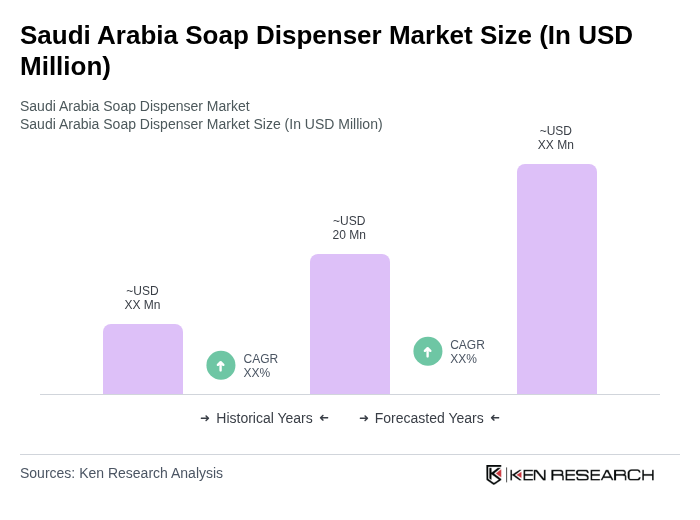
- The Saudi Arabia Soap Dispenser Market is valued at USD 20 million, based on a five-year historical analysis and its share within the wider Middle East and Africa and global soap dispenser market estimations. This growth is primarily driven by increasing hygiene awareness, particularly in public spaces, and the rising demand for touchless solutions in response to health concerns. The market has seen a significant uptick in the adoption of automatic dispensers, which are favored for their convenience and reduced risk of cross-contamination.
- Key cities such as Riyadh, Jeddah, and Dammam dominate the market due to their high population density and concentration of commercial establishments, including large-scale retail, hospitality, healthcare, and office complexes. The urbanization and development of infrastructure in these cities, supported by Vision 2030 investments in tourism, healthcare, and education facilities, have led to a greater demand for hygiene products, including soap dispensers, in various sectors such as hospitality, healthcare, and education.
- Hand hygiene facilities, including handwashing stations and dispensers for soap and sanitizers, are required in a wide range of public and commercial buildings under Saudi health, municipal, and building standards, such as the Executive Regulations for the Private Health Institutions Law issued by the Ministry of Health and related facility design guidelines, which mandate adequate handwashing and infection-prevention infrastructure in hospitals, clinics, and similar facilities. These regulatory and standards-based requirements in healthcare and other public-facing facilities are aimed at enhancing public health standards and promoting hygiene practices, thereby supporting sustained demand for soap dispensers across the country.
Saudi Arabia Soap Dispenser Market Segmentation
By Mounting Type:The market is segmented into Wall-Mounted and Counter-Mounted / Tabletop dispensers. Wall-mounted dispensers are gaining popularity due to their space-saving design, ease of maintenance, and suitability for high-traffic public restrooms and commercial spaces. Counter-mounted dispensers, on the other hand, are preferred in residential settings and premium hospitality venues for their aesthetic integration with washbasins and perceived higher-end appearance. The wall-mounted segment is currently leading the market due to its widespread adoption in public facilities, corporate offices, educational institutions, hospitals, and retail centers where durability and vandal-resistance are prioritized.

By Product Type:The product type segmentation includes Manual Dispensers and Automatic Sensor Dispensers. Manual dispensers are traditionally used in various settings due to their cost-effectiveness, mechanical simplicity, and lower maintenance needs. Automatic sensor dispensers are increasingly preferred for their touchless operation, which enhances hygiene, supports infection prevention protocols, and aligns with consumer expectations for contactless fixtures in modern restrooms. The automatic sensor dispensers are currently dominating the market in key commercial and institutional applications as consumers and businesses prioritize health and safety and adopt smart and electronic bathroom fixtures in line with broader smart building and smart bathroom trends in Saudi Arabia.

Saudi Arabia Soap Dispenser Market Competitive Landscape
The Saudi Arabia Soap Dispenser Market is characterized by a dynamic mix of regional and international players. Leading participants such as Bobrick Washroom Equipment, Inc., American Specialties, Inc. (ASI), Georgia-Pacific LLC (GP PRO), Bradley Corporation, Kohler Co., Simplehuman LLC, ORCHIDS International, Kutol Products Company, SVAVO Intelligent Technology Co., Ltd., Local Saudi Hygiene & Washroom Fixture Manufacturers, Regional Distributors & Importers (GCC Focused), Private Label & Retail Brands (Modern Trade), Online-First / E-commerce-focused Brands, Facility Management & Integrated Hygiene Solution Providers, OEM / ODM Manufacturing Partners contribute to innovation, geographic expansion, and service delivery in this space.
Saudi Arabia Soap Dispenser Market Industry Analysis
Growth Drivers
- Increasing Hygiene Awareness:The heightened focus on hygiene, particularly post-pandemic, has led to a significant increase in demand for soap dispensers. In future, the Saudi Arabian government allocated approximately SAR 1.8 billion to public health initiatives, emphasizing cleanliness in public spaces. This investment is expected to drive the adoption of modern dispensing systems, as consumers and businesses prioritize hygiene, resulting in a projected increase in soap dispenser sales by 25% annually.
- Government Initiatives for Public Health:The Saudi government has implemented various health campaigns aimed at improving sanitation standards across the nation. In future, the Ministry of Health plans to launch a nationwide initiative to install soap dispensers in all public facilities, with an estimated budget of SAR 1 billion. This initiative is expected to enhance public health infrastructure, thereby increasing the demand for soap dispensers in both urban and rural areas.
- Rise in Commercial Establishments:The growth of commercial establishments, including hotels, restaurants, and shopping malls, is a significant driver for the soap dispenser market. In future, the hospitality sector in Saudi Arabia is projected to grow by 20%, leading to an increased need for hygiene solutions. This surge in commercial activity is expected to result in the installation of over 60,000 new soap dispensers across various sectors, further boosting market demand.
Market Challenges
- High Initial Investment Costs:The initial costs associated with purchasing and installing modern soap dispensers can be a barrier for many businesses. In future, the average cost of a high-quality automated soap dispenser is estimated to be around SAR 1,500. This upfront investment can deter small and medium-sized enterprises from upgrading their facilities, limiting market growth potential in this segment.
- Limited Consumer Awareness:Despite the growing emphasis on hygiene, there remains a significant gap in consumer awareness regarding the benefits of modern soap dispensers. In future, surveys indicate that only 35% of consumers are familiar with the advantages of automated systems over traditional methods. This lack of awareness can hinder market penetration and slow down the adoption of innovative dispensing solutions in various sectors.
Saudi Arabia Soap Dispenser Market Future Outlook
The future of the Saudi Arabia soap dispenser market appears promising, driven by ongoing technological advancements and increasing consumer demand for hygiene solutions. As the market evolves, the integration of smart technology and IoT capabilities in dispensers is expected to enhance user experience and operational efficiency. Additionally, the growing emphasis on sustainability will likely lead to the development of eco-friendly products, aligning with global trends and consumer preferences for environmentally responsible options.
Market Opportunities
- Expansion in the Hospitality Sector:The hospitality sector's growth presents a significant opportunity for soap dispenser manufacturers. With an expected increase in hotel occupancy rates to 80% in future, there will be a heightened demand for hygiene solutions, including soap dispensers, to meet guest expectations and health standards.
- Growth in E-commerce Platforms:The rise of e-commerce in Saudi Arabia is creating new avenues for soap dispenser sales. In future, online retail is projected to account for 25% of total retail sales, providing manufacturers with a platform to reach a broader audience and cater to the increasing demand for hygiene products through digital channels.
Scope of the Report
| Segment | Sub-Segments |
|---|---|
| By Mounting Type | Wall-Mounted Counter-Mounted / Tabletop |
| By Product Type | Manual Dispensers Automatic Sensor Dispensers |
| By Soap Type | Liquid Soap Dispensers Foam Soap Dispensers Spray / Sanitizer Dispensers |
| By End-User | Residential Hospitality (Hotels, Restaurants, Malls) Healthcare Facilities Corporate & Offices Government & Public Infrastructure Industrial & Manufacturing Educational Institutions Others |
| By Material | Plastic Stainless Steel Glass Ceramic Others |
| By Distribution Channel | Offline (Modern Trade, Specialty Stores, B2B) Online (E-commerce, Marketplaces) |
| By Price Range | Economy Mid-Range Premium |
Key Target Audience
Investors and Venture Capitalist Firms
Government and Regulatory Bodies (e.g., Saudi Standards, Metrology and Quality Organization)
Manufacturers and Producers
Distributors and Retailers
Hospitality Industry Stakeholders
Healthcare Facilities and Institutions
Facility Management Companies
Building Contractors and Developers
Players Mentioned in the Report:
Bobrick Washroom Equipment, Inc.
American Specialties, Inc. (ASI)
Georgia-Pacific LLC (GP PRO)
Bradley Corporation
Kohler Co.
Simplehuman LLC
ORCHIDS International
Kutol Products Company
SVAVO Intelligent Technology Co., Ltd.
Local Saudi Hygiene & Washroom Fixture Manufacturers
Regional Distributors & Importers (GCC Focused)
Private Label & Retail Brands (Modern Trade)
Online-First / E-commerce-focused Brands
Facility Management & Integrated Hygiene Solution Providers
OEM / ODM Manufacturing Partners
Table of Contents
Market Assessment Phase
1. Executive Summary and Approach
2. Saudi Arabia Soap Dispenser Market Overview
2.1 Key Insights and Strategic Recommendations
2.2 Saudi Arabia Soap Dispenser Market Overview
2.3 Definition and Scope
2.4 Evolution of Market Ecosystem
2.5 Timeline of Key Regulatory Milestones
2.6 Value Chain & Stakeholder Mapping
2.7 Business Cycle Analysis
2.8 Policy & Incentive Landscape
3. Saudi Arabia Soap Dispenser Market Analysis
3.1 Growth Drivers
3.1.1 Increasing hygiene awareness
3.1.2 Government initiatives for public health
3.1.3 Rise in commercial establishments
3.1.4 Technological advancements in dispensing systems
3.2 Market Challenges
3.2.1 High initial investment costs
3.2.2 Limited consumer awareness
3.2.3 Competition from traditional dispensing methods
3.2.4 Supply chain disruptions
3.3 Market Opportunities
3.3.1 Expansion in the hospitality sector
3.3.2 Growth in e-commerce platforms
3.3.3 Customization and personalization trends
3.3.4 Eco-friendly product demand
3.4 Market Trends
3.4.1 Smart and automated dispensers
3.4.2 Integration of IoT in dispensing solutions
3.4.3 Sustainable materials usage
3.4.4 Increased focus on design and aesthetics
3.5 Government Regulation
3.5.1 Health and safety standards compliance
3.5.2 Environmental regulations on materials
3.5.3 Import/export regulations for dispensers
3.5.4 Incentives for local manufacturing
4. SWOT Analysis
5. Stakeholder Analysis
6. Porter's Five Forces Analysis
7. Saudi Arabia Soap Dispenser Market Market Size, 2019-2024
7.1 By Value
7.2 By Volume
7.3 By Average Selling Price
8. Saudi Arabia Soap Dispenser Market Segmentation
8.1 By Mounting Type
8.1.1 Wall-Mounted
8.1.2 Counter-Mounted / Tabletop
8.2 By Product Type
8.2.1 Manual Dispensers
8.2.2 Automatic Sensor Dispensers
8.3 By Soap Type
8.3.1 Liquid Soap Dispensers
8.3.2 Foam Soap Dispensers
8.3.3 Spray / Sanitizer Dispensers
8.4 By End-User
8.4.1 Residential
8.4.2 Hospitality (Hotels, Restaurants, Malls)
8.4.3 Healthcare Facilities
8.4.4 Corporate & Offices
8.4.5 Government & Public Infrastructure
8.4.6 Industrial & Manufacturing
8.4.7 Educational Institutions
8.4.8 Others
8.5 By Material
8.5.1 Plastic
8.5.2 Stainless Steel
8.5.3 Glass
8.5.4 Ceramic
8.5.5 Others
8.6 By Distribution Channel
8.6.1 Offline (Modern Trade, Specialty Stores, B2B)
8.6.2 Online (E-commerce, Marketplaces)
8.7 By Price Range
8.7.1 Economy
8.7.2 Mid-Range
8.7.3 Premium
9. Saudi Arabia Soap Dispenser Market Competitive Analysis
9.1 Market Share of Key Players
9.2 Cross Comparison of Key Players
9.2.1 Company Name
9.2.2 Company Size (Revenue in SAR / Global Category: Large, Mid, Emerging)
9.2.3 Saudi Arabia Soap Dispenser Revenue (SAR Million)
9.2.4 3-Year Revenue CAGR in Saudi Arabia (%)
9.2.5 EBITDA Margin from Soap Dispenser Business (%)
9.2.6 Market Share in Saudi Arabia Soap Dispenser Market (%)
9.2.7 Number of Active SKUs in Saudi Arabia
9.2.8 Distribution Reach (No. of Cities / Key Channels Covered)
9.2.9 Average Realized Price per Unit (SAR/unit)
9.2.10 R&D / Innovation Intensity (% of Revenue)
9.2.11 Key Institutional Contracts Won (Hospitals, Hotels, Govt., etc.)
9.2.12 Warranty & After-Sales Coverage (Months / Service Footprint)
9.3 SWOT Analysis of Top Players
9.4 Pricing Analysis
9.5 Detailed Profile of Major Companies
9.5.1 Bobrick Washroom Equipment, Inc.
9.5.2 American Specialties, Inc. (ASI)
9.5.3 Georgia-Pacific LLC (GP PRO)
9.5.4 Bradley Corporation
9.5.5 Kohler Co.
9.5.6 Simplehuman LLC
9.5.7 ORCHIDS International
9.5.8 Kutol Products Company
9.5.9 SVAVO Intelligent Technology Co., Ltd.
9.5.10 Local Saudi Hygiene & Washroom Fixture Manufacturers
9.5.11 Regional Distributors & Importers (GCC Focused)
9.5.12 Private Label & Retail Brands (Modern Trade)
9.5.13 Online-First / E-commerce-focused Brands
9.5.14 Facility Management & Integrated Hygiene Solution Providers
9.5.15 OEM / ODM Manufacturing Partners
10. Saudi Arabia Soap Dispenser Market End-User Analysis
10.1 Procurement Behavior of Key Ministries
10.1.1 Key procurement policies
10.1.2 Budget allocation trends
10.1.3 Preferred suppliers
10.1.4 Procurement cycles
10.2 Corporate Spend on Infrastructure & Energy
10.2.1 Investment trends in hygiene solutions
10.2.2 Budget priorities
10.2.3 Spending patterns
10.3 Pain Point Analysis by End-User Category
10.3.1 Common challenges faced
10.3.2 User feedback and expectations
10.3.3 Areas for improvement
10.4 User Readiness for Adoption
10.4.1 Awareness levels
10.4.2 Training and support needs
10.4.3 Adoption barriers
10.5 Post-Deployment ROI and Use Case Expansion
10.5.1 ROI measurement criteria
10.5.2 Use case success stories
10.5.3 Future expansion opportunities
11. Saudi Arabia Soap Dispenser Market Future Size, 2025-2030
11.1 By Value
11.2 By Volume
11.3 By Average Selling Price
Go-To-Market Strategy Phase
1. Whitespace Analysis + Business Model Canvas
1.1 Market gaps identification
1.2 Business model components
2. Marketing and Positioning Recommendations
2.1 Branding strategies
2.2 Product USPs
3. Distribution Plan
3.1 Urban retail vs rural NGO tie-ups
4. Channel & Pricing Gaps
4.1 Underserved routes
4.2 Pricing bands
5. Unmet Demand & Latent Needs
5.1 Category gaps
5.2 Consumer segments
6. Customer Relationship
6.1 Loyalty programs
6.2 After-sales service
7. Value Proposition
7.1 Sustainability
7.2 Integrated supply chains
8. Key Activities
8.1 Regulatory compliance
8.2 Branding
8.3 Distribution setup
9. Entry Strategy Evaluation
9.1 Domestic Market Entry Strategy
9.1.1 Product mix
9.1.2 Pricing band
9.1.3 Packaging
9.2 Export Entry Strategy
9.2.1 Target countries
9.2.2 Compliance roadmap
10. Entry Mode Assessment
10.1 JV
10.2 Greenfield
10.3 M&A
10.4 Distributor Model
11. Capital and Timeline Estimation
11.1 Capital requirements
11.2 Timelines
12. Control vs Risk Trade-Off
12.1 Ownership vs Partnerships
13. Profitability Outlook
13.1 Breakeven analysis
13.2 Long-term sustainability
14. Potential Partner List
14.1 Distributors
14.2 JVs
14.3 Acquisition targets
15. Execution Roadmap
15.1 Phased Plan for Market Entry
15.1.1 Market Setup
15.1.2 Market Entry
15.1.3 Growth Acceleration
15.1.4 Scale & Stabilize
15.2 Key Activities and Milestones
15.2.1 Milestone tracking
15.2.2 Activity scheduling
Research Methodology
Phase 1: Approach1
Desk Research
- Analysis of market reports from industry associations and government publications
- Review of trade journals and articles focusing on the soap dispenser market in Saudi Arabia
- Examination of demographic and economic data from the Saudi Arabian General Authority for Statistics
Primary Research
- Interviews with key stakeholders in the soap dispenser manufacturing sector
- Surveys targeting facility managers in hospitals, schools, and public restrooms
- Field visits to retail outlets and distributors to gather firsthand insights
Validation & Triangulation
- Cross-validation of findings with multiple data sources including sales data and market trends
- Triangulation of insights from primary interviews with secondary research findings
- Sanity checks through expert reviews from industry veterans and market analysts
Phase 2: Market Size Estimation1
Top-down Assessment
- Estimation of total addressable market based on national hygiene and sanitation spending
- Segmentation of market size by end-user categories such as healthcare, hospitality, and education
- Incorporation of growth rates from related sectors such as cleaning and sanitation products
Bottom-up Modeling
- Collection of sales data from leading soap dispenser manufacturers in the region
- Estimation of average selling prices and volume sold across different segments
- Analysis of distribution channels and their impact on market penetration
Forecasting & Scenario Analysis
- Development of forecasts based on historical growth trends and market drivers
- Scenario analysis considering factors such as regulatory changes and consumer behavior shifts
- Creation of multiple growth scenarios (baseline, optimistic, and pessimistic) through 2030
Phase 3: CATI Sample Composition1
| Scope Item/Segment | Sample Size | Target Respondent Profiles |
|---|---|---|
| Healthcare Facilities | 80 | Facility Managers, Infection Control Officers |
| Hospitality Sector | 60 | Operations Managers, Housekeeping Supervisors |
| Educational Institutions | 50 | School Administrators, Facility Coordinators |
| Public Restroom Management | 40 | Maintenance Supervisors, Sanitation Managers |
| Retail Outlets | 50 | Store Managers, Procurement Officers |
Frequently Asked Questions
What is the current value of the Saudi Arabia Soap Dispenser Market?
The Saudi Arabia Soap Dispenser Market is valued at approximately USD 20 million, reflecting a significant growth trend driven by increased hygiene awareness and the demand for touchless solutions in public spaces.
What factors are driving the growth of the soap dispenser market in Saudi Arabia?
Which cities in Saudi Arabia are leading in soap dispenser demand?
What types of soap dispensers are popular in Saudi Arabia?
Other Regional/Country Reports
Indonesia Soap Dispenser Market
Malaysia Soap Dispenser Market
KSA Soap Dispenser Market
APAC Soap Dispenser Market
SEA Soap Dispenser Market
Vietnam Soap Dispenser Market
Other Adjacent Reports
KSA Hand Sanitizer Dispenser Market
Germany Paper Towel Dispenser Market
UAE Washroom Accessories Market
Malaysia Automatic Faucet Market
UAE Hygiene Products Market
Thailand Infection Control Equipment Market
South Africa Smart Bathroom Technology Market
Indonesia Commercial Cleaning Supplies Market
Vietnam Hospitality Supplies Market
Germany Healthcare Sanitation Market
Why Buy From Us?

What makes us stand out is that our consultants follow Robust, Refine and Result (RRR) methodology. Robust for clear definitions, approaches and sanity checking, Refine for differentiating respondents' facts and opinions, and Result for presenting data with story.

We have set a benchmark in the industry by offering our clients with syndicated and customized market research reports featuring coverage of entire market as well as meticulous research and analyst insights.

While we don't replace traditional research, we flip the method upside down. Our dual approach of Top Bottom & Bottom Top ensures quality deliverable by not just verifying company fundamentals but also looking at the sector and macroeconomic factors.

With one step in the future, our research team constantly tries to show you the bigger picture. We help with some of the tough questions you may encounter along the way: How is the industry positioned? Best marketing channel? KPI's of competitors? By aligning every element, we help maximize success.

Our report gives you instant access to the answers and sources that other companies might choose to hide. We elaborate each steps of research methodology we have used and showcase you the sample size to earn your trust.

If you need any support, we are here! We pride ourselves on universe strength, data quality, and quick, friendly, and professional service.