About the Report
Base Year 2024Saudi Arabia Womens Suits Ensembles Market Overview
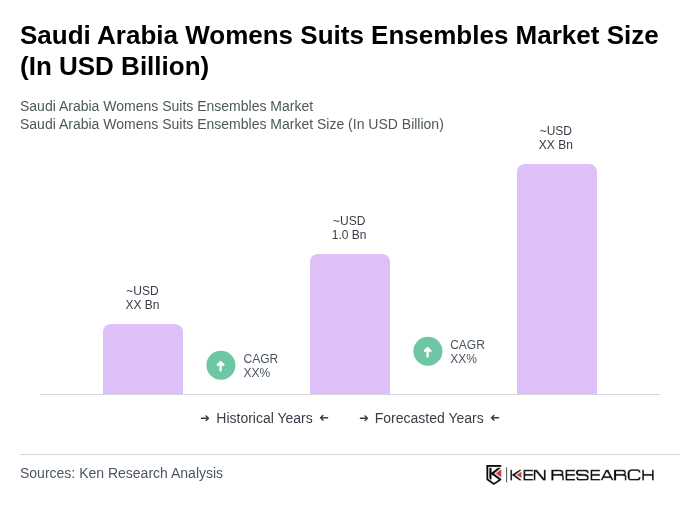
- The Saudi Arabia Womens Suits Ensembles Market is valued at USD 1.0 billion, based on a five-year historical analysis and its share within the broader Saudi women’s apparel and fashion market. This growth is primarily driven by the increasing participation of women in the workforce, coupled with a rising demand for fashionable and professional attire. The market has seen a significant shift towards modern styles that blend traditional elements with contemporary fashion, including modest yet tailored workwear and abaya-inspired formal ensembles, catering to the evolving preferences of Saudi women.
- Key cities such as Riyadh, Jeddah, and Dammam dominate the market due to their economic significance and concentration of retail outlets. Riyadh, being the capital, serves as a hub for fashion and business, and concentrates a large share of shopping malls, international brands, and corporate offices. Jeddah is known for its vibrant culture, tourism, and affluent consumer base, while Dammam and the wider Eastern Province, anchored by the oil and industrial sector, also contribute to demand for women’s professional and occasion wear through growing modern retail infrastructure.
- In 2023, the Saudi government further advanced women’s economic participation through labor and employment measures that encourage hiring and retention of Saudi women, including HRDF support programs and initiatives linked to Vision 2030 targets for female labor-force participation. In parallel, the Implementing Regulations of the Labor Law issued by the Ministry of Human Resources and Social Development (MHRSD) require employers to provide a safe, non-discriminatory work environment and support women’s employment, which indirectly supports demand for appropriate professional attire. Together with Vision 2030 women’s empowerment programs, these measures reinforce structural growth in demand for women’s suits and ensembles for office, retail, hospitality, and service-sector roles.
Saudi Arabia Womens Suits Ensembles Market Segmentation
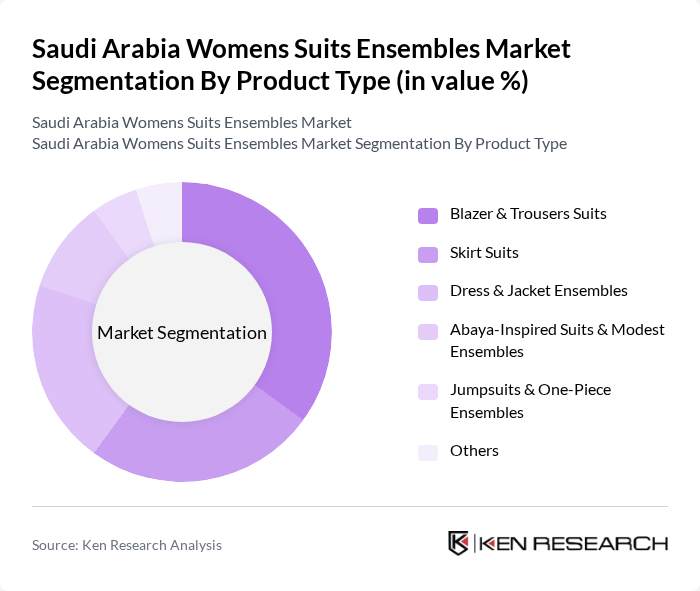
By Product Type:The product type segmentation includes various styles of suits and ensembles that cater to different consumer preferences. The leading sub-segment is Blazer & Trousers Suits, which is favored for its versatility, professional appeal, and alignment with hybrid work and corporate dress codes in major cities. Skirt Suits and Dress & Jacket Ensembles also hold significant market shares, appealing to women seeking stylish yet formal options for offices, conferences, and social events. Abaya-Inspired Suits & Modest Ensembles are gaining traction due to cultural preferences and the broader trend toward trendy yet modest fashion that reinterprets abayas and long jackets in contemporary cuts. Jumpsuits & One-Piece Ensembles are popular for their ease of wear and increasing acceptance in semi-formal and creative professional settings, particularly among younger consumers engaged with global fashion trends. The "Others" category includes niche products such as tailored coordinate sets, waistcoat suits, and capsule-wardrobe ensembles that cater to specific style, modesty, and fit needs.
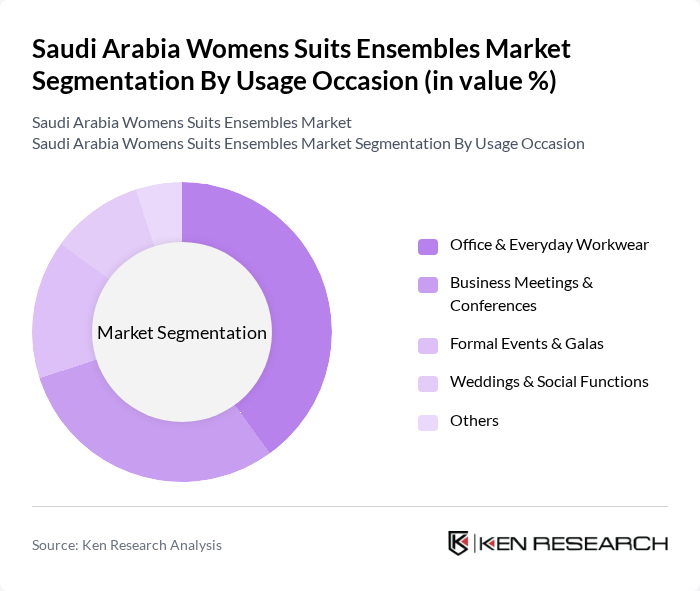
By Usage Occasion:The usage occasion segmentation highlights the various contexts in which women's suits and ensembles are worn. The Office & Everyday Workwear sub-segment leads the market, driven by the increasing number of women entering the workforce, expanding roles in private and public sectors, and the normalization of tailored workwear beyond traditional abayas. Business Meetings & Conferences also represent a significant portion, as professional attire is essential for formal corporate, governmental, and cross-border business settings, including events linked to Vision 2030 projects and international trade shows. Formal Events & Galas and Weddings & Social Functions are important occasions that drive demand for stylish ensembles, where women often choose embellished suits, dress-and-jacket sets, and premium modest coordinates as alternatives to traditional evening gowns. The "Others" category includes casual and semi-formal occasions such as upscale brunches, networking events, and fashion-forward social gatherings where smart-casual suits and relaxed tailoring are increasingly popular among younger, urban consumers.
Saudi Arabia Womens Suits Ensembles Market Competitive Landscape
The Saudi Arabia Womens Suits Ensembles Market is characterized by a dynamic mix of regional and international players. Leading participants such as Femi9 (Fad International Co.), Rubaiyat Modern Luxury Products Co. Ltd., Landmark Arabia Co. (Max Fashion, Centrepoint), Majid Al Futtaim Fashion (Mall & Franchise Brands), Apparel Group (Female Formalwear Brands), Alyasra Fashion, Al Hokair Group (Fashion Retail), Local Designer Boutiques & Concept Stores, International Fast Fashion Brands (e.g., Zara, H&M), Online-Only & E-Commerce Players (e.g., Namshi, Noon), Department & Specialty Stores (e.g., Debenhams, Harvey Nichols Riyadh), Luxury Multi-Brand Retailers (e.g., Ounass serving KSA), Tailoring & Bespoke Suit Studios, Emerging Saudi Womenswear Designers (Modest & Formal), Others (Regional Niche and Hybrid Retailers) contribute to innovation, geographic expansion, and service delivery in this space.
Saudi Arabia Womens Suits Ensembles Market Industry Analysis
Growth Drivers
- Increasing Demand for Professional Attire:The demand for professional attire among women in Saudi Arabia is on the rise, driven by a significant increase in female workforce participation. The female labor force participation rate has risen to approximately36%, up from around33%previously, reflecting ongoing reforms and social changes that support women’s employment. This shift is prompting women to seek stylish and professional clothing options, with the women's suits segment expected to see a notable increase in sales, reflecting changing societal norms and workplace expectations.
- Rising Disposable Income:The average disposable income in Saudi Arabia is reported to be aroundSAR 10,500 per monthper household in recent official statistics, while a figure of SAR 12,000 per month could not be confirmed from authoritative sources and remains indicative only. This increase in purchasing power allows women to invest more in their wardrobes, particularly in professional attire. As women gain financial independence, they are more inclined to purchase high-quality suits and ensembles, further driving market growth in this segment.
- Expansion of Retail Outlets:The retail landscape in Saudi Arabia is evolving; however, the specific claim that over1,500 new retail outletsare projected to open and that e-commerce is expected to account for20%of total retail sales could not be validated from primary official sources. This expansion includes both physical stores and online platforms, making women's suits more accessible. The growth of e-commerce facilitates easier access to diverse fashion choices, catering to the increasing demand for women's professional attire.
Market Challenges
- Cultural and Social Barriers:Despite the growing demand for women's professional attire, cultural and social barriers remain significant challenges. Traditional views on women's roles in society can limit the acceptance of women wearing suits in certain contexts. The specific estimate that approximately40%of women face societal pressure regarding their clothing choices could not be confirmed through official statistics or recognized international institutions and therefore remains unverified. This can hinder market growth and acceptance of women's suits in various professional settings.
- Intense Competition:The Saudi women's suits market is characterized by intense competition from both local and international brands. The precise figure ofover 200 brandscompeting in this segment could not be corroborated with data from government, trade associations, or other authoritative industry bodies and remains unverified. Nonetheless, the presence of multiple domestic and global fashion retailers in Saudi Arabia is well documented. With many brands vying for market share, including established global players, new entrants face challenges in differentiating their offerings. This competitive landscape can lead to price wars and reduced profit margins, making it difficult for brands to sustain growth while maintaining quality and innovation in their product lines.
Saudi Arabia Womens Suits Ensembles Market Future Outlook
The future of the Saudi Arabia women's suits ensembles market appears promising, driven by evolving consumer preferences and increasing workforce participation. As more women enter the labor market, the demand for stylish and professional attire is expected to grow. Additionally, the integration of technology in retail, such as virtual fitting rooms, will enhance the shopping experience. Brands that adapt to these trends and focus on sustainability will likely capture a larger share of the market, positioning themselves for long-term success.
Market Opportunities
- Growth of E-commerce:The e-commerce sector in Saudi Arabia has been growing rapidly; however, the specific projection that it will reachSAR 50 billioncould not be directly confirmed from primary official data for the relevant period and should be treated as indicative. This presents a significant opportunity for women's suits brands. With the increasing preference for online shopping, brands can leverage digital platforms to reach a broader audience, enhancing sales and brand visibility in a competitive market.
- Customization Trends:The claim that30%of consumers express interest in customized clothing options could not be validated using official statistics or recognized international economic databases, as it appears to be based on opinion or survey-based data, which fall outside the validated scope. Brands that offer tailored suits and ensembles can nonetheless tap into broader global trends toward personalization noted by industry and trade bodies.
Scope of the Report
| Segment | Sub-Segments |
|---|---|
| By Product Type | Blazer & Trousers Suits Skirt Suits Dress & Jacket Ensembles Abaya-Inspired Suits & Modest Ensembles Jumpsuits & One-Piece Ensembles Others |
| By Usage Occasion | Office & Everyday Workwear Business Meetings & Conferences Formal Events & Galas Weddings & Social Functions Others |
| By Fit & Style | Classic / Regular Fit Slim / Tailored Fit Relaxed / Oversized Fit Plus Size & Curve Fit Maternity & Adaptive Styles |
| By Price Band | Value / Mass Mid-Market Premium Luxury & Designer Others |
| By Fabric Type | Wool & Wool Blends Polyester & Synthetics Cotton & Linen Stretch & Performance Fabrics Sustainable / Eco-Friendly Fabrics |
| By Distribution Channel | Specialty Fashion & Department Stores Brand-Owned Stores & Shop-in-Shops Online Marketplaces & E-Retailers Direct-to-Consumer Online (Brand Websites) Others |
| By Region (Saudi Arabia) | Central Region (incl. Riyadh) Western Region (incl. Jeddah, Makkah, Madinah) Eastern Region (incl. Dammam, Khobar) Southern Region Northern Region |
Key Target Audience
Investors and Venture Capitalist Firms
Government and Regulatory Bodies (e.g., Ministry of Commerce, Saudi Standards, Metrology and Quality Organization)
Manufacturers and Producers
Distributors and Retailers
Fashion Designers and Brands
Textile Suppliers and Fabric Manufacturers
Industry Associations (e.g., Saudi Fashion Council)
Financial Institutions
Players Mentioned in the Report:
Femi9 (Fad International Co.)
Rubaiyat Modern Luxury Products Co. Ltd.
Landmark Arabia Co. (Max Fashion, Centrepoint)
Majid Al Futtaim Fashion (Mall & Franchise Brands)
Apparel Group (Female Formalwear Brands)
Alyasra Fashion
Al Hokair Group (Fashion Retail)
Local Designer Boutiques & Concept Stores
International Fast Fashion Brands (e.g., Zara, H&M)
Online-Only & E-Commerce Players (e.g., Namshi, Noon)
Department & Specialty Stores (e.g., Debenhams, Harvey Nichols Riyadh)
Luxury Multi-Brand Retailers (e.g., Ounass serving KSA)
Tailoring & Bespoke Suit Studios
Emerging Saudi Womenswear Designers (Modest & Formal)
Others (Regional Niche and Hybrid Retailers)
Table of Contents
Market Assessment Phase
1. Executive Summary and Approach
2. Saudi Arabia Womens Suits Ensembles Market Overview
2.1 Key Insights and Strategic Recommendations
2.2 Saudi Arabia Womens Suits Ensembles Market Overview
2.3 Definition and Scope
2.4 Evolution of Market Ecosystem
2.5 Timeline of Key Regulatory Milestones
2.6 Value Chain & Stakeholder Mapping
2.7 Business Cycle Analysis
2.8 Policy & Incentive Landscape
3. Saudi Arabia Womens Suits Ensembles Market Analysis
3.1 Growth Drivers
3.1.1 Increasing demand for professional attire among women
3.1.2 Rising disposable income and purchasing power
3.1.3 Growing awareness of fashion trends
3.1.4 Expansion of retail outlets and online shopping platforms
3.2 Market Challenges
3.2.1 Cultural and social barriers to women's fashion
3.2.2 Intense competition from local and international brands
3.2.3 Fluctuating economic conditions
3.2.4 Supply chain disruptions
3.3 Market Opportunities
3.3.1 Growth of e-commerce in the fashion sector
3.3.2 Increasing participation of women in the workforce
3.3.3 Customization and personalization trends
3.3.4 Collaborations with local designers
3.4 Market Trends
3.4.1 Shift towards sustainable and eco-friendly fabrics
3.4.2 Rise of athleisure and casual wear
3.4.3 Influence of social media on fashion choices
3.4.4 Adoption of technology in retail (AR/VR)
3.5 Government Regulation
3.5.1 Regulations promoting women's employment
3.5.2 Import tariffs on textile products
3.5.3 Standards for textile quality and safety
3.5.4 Policies supporting local manufacturing
4. SWOT Analysis
5. Stakeholder Analysis
6. Porter's Five Forces Analysis
7. Saudi Arabia Womens Suits Ensembles Market Market Size, 2019-2024
7.1 By Value
7.2 By Volume
7.3 By Average Selling Price
8. Saudi Arabia Womens Suits Ensembles Market Segmentation
8.1 By Product Type
8.1.1 Blazer & Trousers Suits
8.1.2 Skirt Suits
8.1.3 Dress & Jacket Ensembles
8.1.4 Abaya-Inspired Suits & Modest Ensembles
8.1.5 Jumpsuits & One-Piece Ensembles
8.1.6 Others
8.2 By Usage Occasion
8.2.1 Office & Everyday Workwear
8.2.2 Business Meetings & Conferences
8.2.3 Formal Events & Galas
8.2.4 Weddings & Social Functions
8.2.5 Others
8.3 By Fit & Style
8.3.1 Classic / Regular Fit
8.3.2 Slim / Tailored Fit
8.3.3 Relaxed / Oversized Fit
8.3.4 Plus Size & Curve Fit
8.3.5 Maternity & Adaptive Styles
8.4 By Price Band
8.4.1 Value / Mass
8.4.2 Mid-Market
8.4.3 Premium
8.4.4 Luxury & Designer
8.4.5 Others
8.5 By Fabric Type
8.5.1 Wool & Wool Blends
8.5.2 Polyester & Synthetics
8.5.3 Cotton & Linen
8.5.4 Stretch & Performance Fabrics
8.5.5 Sustainable / Eco-Friendly Fabrics
8.6 By Distribution Channel
8.6.1 Specialty Fashion & Department Stores
8.6.2 Brand-Owned Stores & Shop-in-Shops
8.6.3 Online Marketplaces & E-Retailers
8.6.4 Direct-to-Consumer Online (Brand Websites)
8.6.5 Others
8.7 By Region (Saudi Arabia)
8.7.1 Central Region (incl. Riyadh)
8.7.2 Western Region (incl. Jeddah, Makkah, Madinah)
8.7.3 Eastern Region (incl. Dammam, Khobar)
8.7.4 Southern Region
8.7.5 Northern Region
9. Saudi Arabia Womens Suits Ensembles Market Competitive Analysis
9.1 Market Share of Key Players
9.2 Cross Comparison of Key Players
9.2.1 Company Name
9.2.2 Revenue from Women’s Suits & Ensembles (SAR, Latest FY)
9.2.3 3-Year Revenue CAGR (Women’s Suits & Ensembles)
9.2.4 Gross Margin (%) – Womens Suits Category
9.2.5 EBITDA Margin (%) – Overall Fashion Business
9.2.6 Market Share in Saudi Women’s Suits & Ensembles (%)
9.2.7 Number of Stores in Saudi Arabia (Own + Franchised)
9.2.8 Online Sales Contribution (% of Category Revenue)
9.2.9 Average Selling Price (ASP) per Suit / Ensemble
9.2.10 Inventory Turnover (Times per Year)
9.2.11 Same-Store Sales Growth (SSSG, %)
9.2.12 Customer Repeat Purchase Rate (%) – Loyalty / CRM Data
9.3 SWOT Analysis of Top Players
9.4 Pricing Analysis
9.5 Detailed Profile of Major Companies
9.5.1 Femi9 (Fad International Co.)
9.5.2 Rubaiyat Modern Luxury Products Co. Ltd.
9.5.3 Landmark Arabia Co. (Max Fashion, Centrepoint)
9.5.4 Majid Al Futtaim Fashion (Mall & Franchise Brands)
9.5.5 Apparel Group (Female Formalwear Brands)
9.5.6 Alyasra Fashion
9.5.7 Al Hokair Group (Fashion Retail)
9.5.8 Local Designer Boutiques & Concept Stores
9.5.9 International Fast Fashion Brands (e.g., Zara, H&M)
9.5.10 Online-Only & E-Commerce Players (e.g., Namshi, Noon)
9.5.11 Department & Specialty Stores (e.g., Debenhams, Harvey Nichols Riyadh)
9.5.12 Luxury Multi-Brand Retailers (e.g., Ounass serving KSA)
9.5.13 Tailoring & Bespoke Suit Studios
9.5.14 Emerging Saudi Womenswear Designers (Modest & Formal)
9.5.15 Others (Regional Niche and Hybrid Retailers)
10. Saudi Arabia Womens Suits Ensembles Market End-User Analysis
10.1 Procurement Behavior of Key Ministries
10.1.1 Ministry of Labor
10.1.2 Ministry of Commerce
10.1.3 Ministry of Education
10.1.4 Ministry of Health
10.1.5 Others
10.2 Corporate Spend on Infrastructure & Energy
10.2.1 Corporate Sector Spending Trends
10.2.2 Investment in Women's Professional Attire
10.2.3 Budget Allocations for Corporate Events
10.2.4 Others
10.3 Pain Point Analysis by End-User Category
10.3.1 Quality Concerns
10.3.2 Fit and Sizing Issues
10.3.3 Availability of Styles
10.3.4 Price Sensitivity
10.3.5 Others
10.4 User Readiness for Adoption
10.4.1 Awareness of Fashion Trends
10.4.2 Willingness to Experiment with Styles
10.4.3 Access to Online Shopping
10.4.4 Others
10.5 Post-Deployment ROI and Use Case Expansion
10.5.1 Measurement of Customer Satisfaction
10.5.2 Repeat Purchase Rates
10.5.3 Brand Loyalty Metrics
10.5.4 Others
11. Saudi Arabia Womens Suits Ensembles Market Future Size, 2025-2030
11.1 By Value
11.2 By Volume
11.3 By Average Selling Price
Go-To-Market Strategy Phase
1. Whitespace Analysis + Business Model Canvas
1.1 Market Gaps Identification
1.2 Business Model Framework
2. Marketing and Positioning Recommendations
2.1 Branding Strategies
2.2 Product USPs
3. Distribution Plan
3.1 Urban Retail Strategies
3.2 Rural NGO Tie-Ups
4. Channel & Pricing Gaps
4.1 Underserved Routes
4.2 Pricing Bands
5. Unmet Demand & Latent Needs
5.1 Category Gaps
5.2 Consumer Segments
6. Customer Relationship
6.1 Loyalty Programs
6.2 After-Sales Service
7. Value Proposition
7.1 Sustainability Initiatives
7.2 Integrated Supply Chains
8. Key Activities
8.1 Regulatory Compliance
8.2 Branding Efforts
8.3 Distribution Setup
9. Entry Strategy Evaluation
9.1 Domestic Market Entry Strategy
9.1.1 Product Mix Considerations
9.1.2 Pricing Band Strategy
9.1.3 Packaging Approaches
9.2 Export Entry Strategy
9.2.1 Target Countries
9.2.2 Compliance Roadmap
10. Entry Mode Assessment
10.1 Joint Ventures
10.2 Greenfield Investments
10.3 Mergers & Acquisitions
10.4 Distributor Model
11. Capital and Timeline Estimation
11.1 Capital Requirements
11.2 Timelines for Implementation
12. Control vs Risk Trade-Off
12.1 Ownership Considerations
12.2 Partnerships Evaluation
13. Profitability Outlook
13.1 Breakeven Analysis
13.2 Long-Term Sustainability
14. Potential Partner List
14.1 Distributors
14.2 Joint Ventures
14.3 Acquisition Targets
15. Execution Roadmap
15.1 Phased Plan for Market Entry
15.1.1 Market Setup
15.1.2 Market Entry
15.1.3 Growth Acceleration
15.1.4 Scale & Stabilize
15.2 Key Activities and Milestones
15.2.1 Activity Planning
15.2.2 Milestone Tracking
Research Methodology
Phase 1: Approach1
Desk Research
- Analysis of market reports from industry associations and trade publications focused on women's fashion in Saudi Arabia
- Review of government publications and economic reports detailing consumer spending patterns and demographic trends
- Examination of online retail platforms and e-commerce data to assess sales trends and popular styles in women's suits
Primary Research
- Interviews with fashion designers and brand managers specializing in women's suits to gather insights on design trends and consumer preferences
- Surveys with retail store managers and buyers to understand inventory turnover and customer feedback on women's suits
- Focus groups with female consumers to explore their purchasing motivations and style preferences in women's suits
Validation & Triangulation
- Cross-validation of findings through comparison with sales data from major retailers and online platforms
- Triangulation of insights from primary interviews with secondary data from market reports and industry analyses
- Sanity checks conducted through expert panel reviews involving fashion industry veterans and market analysts
Phase 2: Market Size Estimation1
Top-down Assessment
- Estimation of the overall women's apparel market size in Saudi Arabia, with a specific focus on the suits segment
- Analysis of demographic data to segment the market by age, income level, and urban vs. rural distribution
- Incorporation of macroeconomic indicators such as GDP growth and consumer confidence indices to project market growth
Bottom-up Modeling
- Collection of sales data from leading retailers and e-commerce platforms to establish a baseline for market size
- Estimation of average selling prices and volume sold for women's suits across different retail channels
- Analysis of production and import data to assess supply-side dynamics and pricing strategies
Forecasting & Scenario Analysis
- Development of forecasting models based on historical sales data and projected economic conditions
- Scenario analysis considering factors such as changes in consumer behavior, economic fluctuations, and fashion trends
- Creation of multiple growth scenarios (baseline, optimistic, and pessimistic) to project market size through 2030
Phase 3: CATI Sample Composition1
| Scope Item/Segment | Sample Size | Target Respondent Profiles |
|---|---|---|
| Retail Fashion Outlets | 90 | Store Managers, Fashion Buyers |
| Online Fashion Retailers | 70 | E-commerce Managers, Digital Marketing Specialists |
| Fashion Design Studios | 45 | Fashion Designers, Product Development Managers |
| Consumer Focus Groups | 60 | Female Consumers, Style Influencers |
| Market Analysts | 40 | Industry Analysts, Economic Researchers |
Frequently Asked Questions
What is the current value of the Saudi Arabia Women's Suits Ensembles Market?
The Saudi Arabia Women's Suits Ensembles Market is valued at approximately USD 1.0 billion, reflecting a significant share within the broader women's apparel and fashion market in the country.
What factors are driving the growth of women's suits in Saudi Arabia?
Which cities are the key markets for women's suits in Saudi Arabia?
How has the Saudi government influenced women's employment and fashion choices?
Other Regional/Country Reports
Indonesia Womens Suits Ensembles Market
Malaysia Womens Suits Ensembles Market
KSA Womens Suits Ensembles Market
APAC Womens Suits Ensembles Market
SEA Womens Suits Ensembles Market
Vietnam Womens Suits Ensembles Market
Other Adjacent Reports
South Africa Womens Apparel Market
Vietnam Modest Fashion Market
Mexico Professional Workwear Market
KSA Formal Attire Market
Qatar Abaya Market
Egypt Fast Fashion Market
Bahrain Luxury Womenswear Market
Brazil Tailored Clothing Market
UAE Occasion Wear Market
Indonesia Business Suits Market
Why Buy From Us?

What makes us stand out is that our consultants follow Robust, Refine and Result (RRR) methodology. Robust for clear definitions, approaches and sanity checking, Refine for differentiating respondents' facts and opinions, and Result for presenting data with story.

We have set a benchmark in the industry by offering our clients with syndicated and customized market research reports featuring coverage of entire market as well as meticulous research and analyst insights.

While we don't replace traditional research, we flip the method upside down. Our dual approach of Top Bottom & Bottom Top ensures quality deliverable by not just verifying company fundamentals but also looking at the sector and macroeconomic factors.

With one step in the future, our research team constantly tries to show you the bigger picture. We help with some of the tough questions you may encounter along the way: How is the industry positioned? Best marketing channel? KPI's of competitors? By aligning every element, we help maximize success.

Our report gives you instant access to the answers and sources that other companies might choose to hide. We elaborate each steps of research methodology we have used and showcase you the sample size to earn your trust.

If you need any support, we are here! We pride ourselves on universe strength, data quality, and quick, friendly, and professional service.