About the Report
Base Year 2024South Africa Executive Education in Mining Market Overview
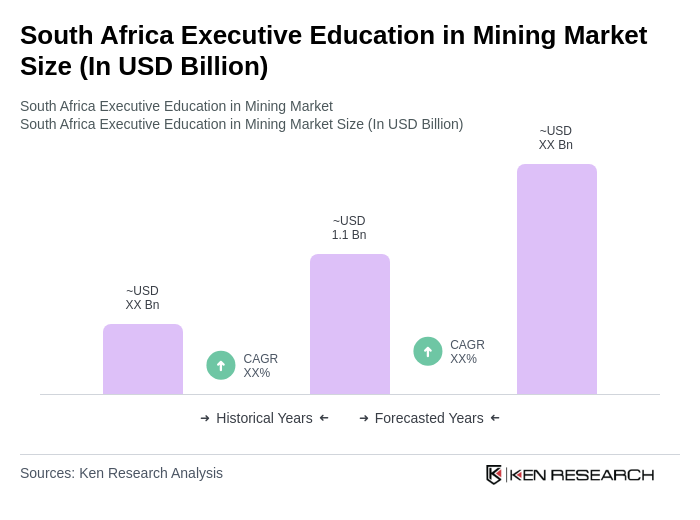
- The South Africa Executive Education in Mining Market is valued at USD 1.1 billion, based on a five-year historical analysis. This market is experiencing robust growth, driven by the increasing demand for skilled professionals in the mining sector, ongoing digital transformation, and the need for continuous education to adapt to new technologies and evolving industry regulations. Additional growth drivers include the expansion of multinational mining operations, the rising importance of sustainability, and the strategic focus on leadership development within the sector .
- Key cities dominating this market include Johannesburg, Cape Town, and Pretoria. Johannesburg is the principal hub of mining activity in South Africa, hosting a concentration of mining companies and educational institutions that offer specialized executive programs. Cape Town and Pretoria also play significant roles due to their established universities and proximity to major mining operations .
- The Mining Charter, 2018, issued by the Department of Mineral Resources and Energy (DMRE), mandates that mining companies invest in skills development and education for their workforce. The Charter requires companies to allocate a percentage of annual payroll to skills development, including executive and leadership training, to enhance the capabilities of local professionals and ensure the mining sector’s competitiveness and sustainability .
South Africa Executive Education in Mining Market Segmentation
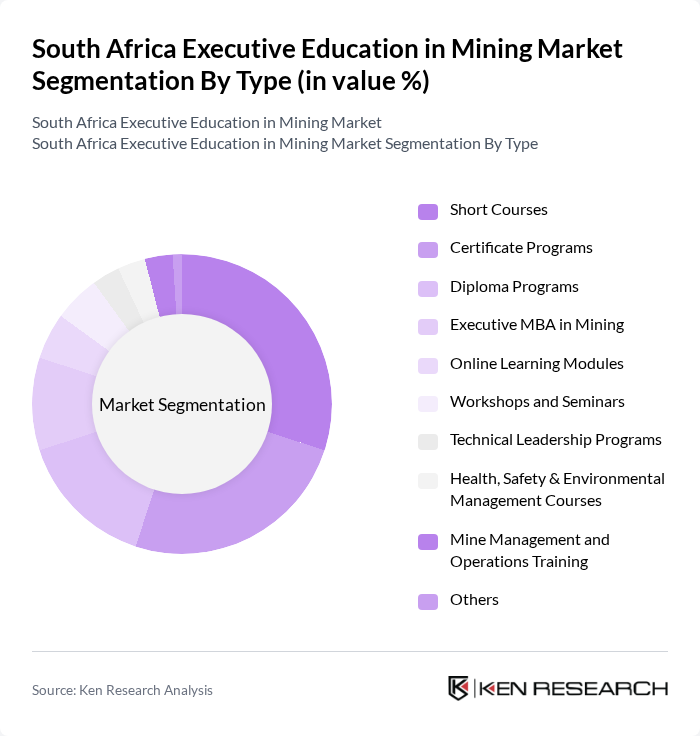
By Type:The market is segmented into various types of educational offerings, including Short Courses, Certificate Programs, Diploma Programs, Executive MBA in Mining, Online Learning Modules, Workshops and Seminars, Technical Leadership Programs, Health, Safety & Environmental Management Courses, Mine Management and Operations Training, and Others. Among these, Short Courses and Certificate Programs are particularly popular due to their flexibility, alignment with industry needs, and ability to address rapidly evolving skills requirements in the mining sector .
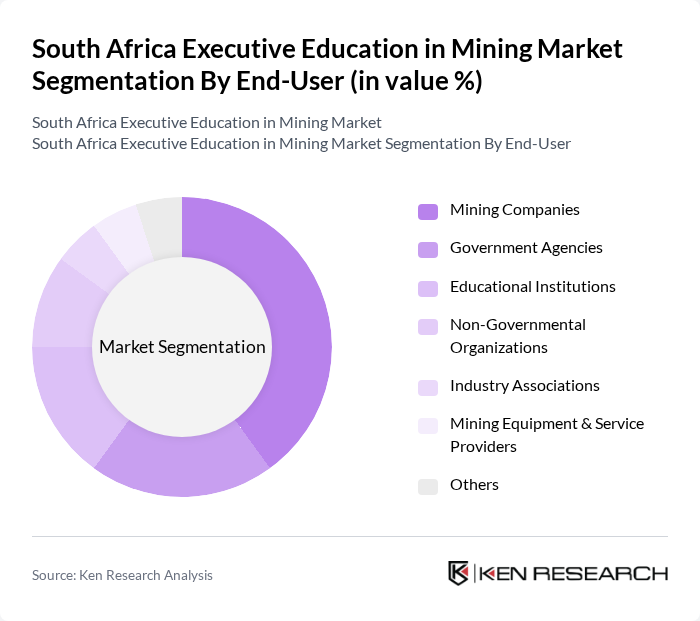
By End-User:The end-users of executive education in mining include Mining Companies, Government Agencies, Educational Institutions, Non-Governmental Organizations, Industry Associations, Mining Equipment & Service Providers, and Others. Mining Companies represent the largest segment, driven by their ongoing need for skilled personnel to enhance operational efficiency, safety standards, and compliance with regulatory requirements .
South Africa Executive Education in Mining Market Competitive Landscape
The South Africa Executive Education in Mining Market is characterized by a dynamic mix of regional and international players. Leading participants such as University of the Witwatersrand (Wits Mining Institute), University of Cape Town (UCT Graduate School of Business, Mining Leadership Program), Stellenbosch University (USB Executive Development), North-West University (NWU Mining Engineering and Executive Education), University of Pretoria (Department of Mining Engineering, Enterprises UP), Mining Qualifications Authority (MQA), Southern African Institute of Mining and Metallurgy (SAIMM), GIBS (Gordon Institute of Business Science, Mining Leadership Programs), University of Johannesburg (UJ Mining Engineering and Executive Education), University of the Free State (Centre for Sustainable Mining, Executive Education), Tshwane University of Technology (TUT Mining and Process Engineering), Cape Peninsula University of Technology (CPUT, Engineering Faculty), University of Limpopo (School of Physical and Mineral Sciences), University of KwaZulu-Natal (UKZN, School of Engineering), Central University of Technology (CUT, Faculty of Engineering, Built Environment and Information Technology) contribute to innovation, geographic expansion, and service delivery in this space.
South Africa Executive Education in Mining Market Industry Analysis
Growth Drivers
- Increasing Demand for Skilled Professionals:The South African mining sector employs approximately475,000individuals, with a significant demand for skilled professionals projected to rise by 20% in future. This demand is driven by the need for advanced technical skills and leadership capabilities to navigate complex mining operations. The government's focus on enhancing workforce competency through education is crucial, as the industry seeks to address skill shortages and improve productivity, thereby fostering economic growth in the region.
- Government Initiatives to Enhance Mining Education:The South African government has allocatedR1.5 billion (approximately $80 million)for mining education initiatives in future. This funding aims to support the development of specialized training programs and partnerships with educational institutions. Such initiatives are designed to align educational outcomes with industry needs, ensuring that graduates possess the necessary skills to contribute effectively to the mining sector, thus enhancing overall industry performance and sustainability.
- Partnerships Between Educational Institutions and Mining Companies:Collaborative efforts between universities and mining companies have increased significantly, with over25 active partnershipsreported in future. These collaborations focus on curriculum development, internships, and research projects that address real-world mining challenges. By integrating practical experience with academic learning, these partnerships enhance the employability of graduates and ensure that educational programs remain relevant to the evolving demands of the mining industry.
Market Challenges
- High Costs of Executive Education Programs:The average cost of executive education programs in South Africa's mining sector ranges fromR40,000 to R120,000 (approximately $2,200 to $6,600)per participant. These high costs can deter potential candidates, particularly from smaller mining companies or those in economically disadvantaged regions. As a result, access to quality education remains limited, hindering the development of a skilled workforce necessary for the industry's growth and innovation.
- Limited Access to Remote Areas for Training:Approximately50%of South Africa's mining operations are located in remote areas, making access to training facilities challenging. This geographical barrier affects the ability of professionals to participate in executive education programs, leading to a skills gap in the workforce. The lack of infrastructure and transportation options further exacerbates this issue, limiting the reach of educational initiatives and the overall effectiveness of training efforts in the mining sector.
South Africa Executive Education in Mining Market Future Outlook
The future of executive education in South Africa's mining sector appears promising, driven by technological advancements and a growing emphasis on sustainability. As digital learning platforms gain traction, more professionals will have access to flexible training options. Additionally, the increasing focus on sustainable mining practices will necessitate the development of specialized programs that address environmental and social governance, ensuring that the workforce is equipped to meet future challenges while promoting responsible mining practices.
Market Opportunities
- Growth of Online and Blended Learning Formats:The shift towards online and blended learning formats is expected to expand access to executive education, particularly for professionals in remote areas. With an estimated60%of mining professionals expressing interest in online courses, this trend presents a significant opportunity for educational institutions to develop innovative, accessible programs that cater to the needs of the industry.
- Increased Focus on Sustainability in Mining Education:As sustainability becomes a priority in the mining sector, there is a growing demand for educational programs that incorporate sustainable practices. Institutions that develop specialized courses focusing on environmental management and social responsibility can tap into this emerging market, attracting both students and industry partnerships aimed at fostering sustainable development in mining operations.
Scope of the Report
| Segment | Sub-Segments |
|---|---|
| By Type | Short Courses Certificate Programs Diploma Programs Executive MBA in Mining Online Learning Modules Workshops and Seminars Technical Leadership Programs Health, Safety & Environmental Management Courses Mine Management and Operations Training Others |
| By End-User | Mining Companies Government Agencies Educational Institutions Non-Governmental Organizations Industry Associations Mining Equipment & Service Providers Others |
| By Delivery Mode | In-Person Training Online Training Hybrid Training On-Site Training Simulation-Based Training Others |
| By Duration | Short-Term Programs (Less than 3 months) Medium-Term Programs (3 to 6 months) Long-Term Programs (More than 6 months) Modular/Stackable Programs Others |
| By Certification Level | Non-Certified Programs Certified Programs Accredited Programs Internationally Recognized Certifications Others |
| By Geographic Focus | Local Mining Operations Regional Mining Operations Pan-African Mining Operations International Mining Operations Others |
| By Price Range | Low-Cost Programs Mid-Range Programs Premium Programs Corporate-Sponsored Programs Others |
Key Target Audience
Investors and Venture Capitalist Firms
Government and Regulatory Bodies (e.g., Department of Mineral Resources and Energy, South African Revenue Service)
Mining Companies and Operators
Mining Equipment Suppliers
Industry Associations (e.g., Minerals Council South Africa)
Environmental and Sustainability Organizations
Trade Unions and Labor Organizations
Financial Institutions and Banks
Players Mentioned in the Report:
University of the Witwatersrand (Wits Mining Institute)
University of Cape Town (UCT Graduate School of Business, Mining Leadership Program)
Stellenbosch University (USB Executive Development)
North-West University (NWU Mining Engineering and Executive Education)
University of Pretoria (Department of Mining Engineering, Enterprises UP)
Mining Qualifications Authority (MQA)
Southern African Institute of Mining and Metallurgy (SAIMM)
GIBS (Gordon Institute of Business Science, Mining Leadership Programs)
University of Johannesburg (UJ Mining Engineering and Executive Education)
University of the Free State (Centre for Sustainable Mining, Executive Education)
Tshwane University of Technology (TUT Mining and Process Engineering)
Cape Peninsula University of Technology (CPUT, Engineering Faculty)
University of Limpopo (School of Physical and Mineral Sciences)
University of KwaZulu-Natal (UKZN, School of Engineering)
Central University of Technology (CUT, Faculty of Engineering, Built Environment and Information Technology)
Table of Contents
Market Assessment Phase
1. Executive Summary and Approach
2. South Africa Executive Education in Mining Market Overview
2.1 Key Insights and Strategic Recommendations
2.2 South Africa Executive Education in Mining Market Overview
2.3 Definition and Scope
2.4 Evolution of Market Ecosystem
2.5 Timeline of Key Regulatory Milestones
2.6 Value Chain & Stakeholder Mapping
2.7 Business Cycle Analysis
2.8 Policy & Incentive Landscape
3. South Africa Executive Education in Mining Market Analysis
3.1 Growth Drivers
3.1.1 Increasing demand for skilled professionals in mining
3.1.2 Government initiatives to enhance mining education
3.1.3 Partnerships between educational institutions and mining companies
3.1.4 Technological advancements in mining education delivery
3.2 Market Challenges
3.2.1 High costs of executive education programs
3.2.2 Limited access to remote areas for training
3.2.3 Competition from international education providers
3.2.4 Regulatory hurdles in the education sector
3.3 Market Opportunities
3.3.1 Growth of online and blended learning formats
3.3.2 Expansion of mining operations in Africa
3.3.3 Increased focus on sustainability in mining education
3.3.4 Development of customized training programs for companies
3.4 Market Trends
3.4.1 Rise of digital learning platforms
3.4.2 Emphasis on leadership and management skills in mining
3.4.3 Integration of soft skills training in technical programs
3.4.4 Collaboration between academia and industry for curriculum development
3.5 Government Regulation
3.5.1 Mining Charter compliance requirements
3.5.2 Accreditation standards for educational institutions
3.5.3 Funding and grants for mining education initiatives
3.5.4 Policies promoting local content in mining education
4. SWOT Analysis
5. Stakeholder Analysis
6. Porter's Five Forces Analysis
7. South Africa Executive Education in Mining Market Market Size, 2019-2024
7.1 By Value
7.2 By Volume
7.3 By Average Selling Price
8. South Africa Executive Education in Mining Market Segmentation
8.1 By Type
8.1.1 Short Courses
8.1.2 Certificate Programs
8.1.3 Diploma Programs
8.1.4 Executive MBA in Mining
8.1.5 Online Learning Modules
8.1.6 Workshops and Seminars
8.1.7 Technical Leadership Programs
8.1.8 Health, Safety & Environmental Management Courses
8.1.9 Mine Management and Operations Training
8.1.10 Others
8.2 By End-User
8.2.1 Mining Companies
8.2.2 Government Agencies
8.2.3 Educational Institutions
8.2.4 Non-Governmental Organizations
8.2.5 Industry Associations
8.2.6 Mining Equipment & Service Providers
8.2.7 Others
8.3 By Delivery Mode
8.3.1 In-Person Training
8.3.2 Online Training
8.3.3 Hybrid Training
8.3.4 On-Site Training
8.3.5 Simulation-Based Training
8.3.6 Others
8.4 By Duration
8.4.1 Short-Term Programs (Less than 3 months)
8.4.2 Medium-Term Programs (3 to 6 months)
8.4.3 Long-Term Programs (More than 6 months)
8.4.4 Modular/Stackable Programs
8.4.5 Others
8.5 By Certification Level
8.5.1 Non-Certified Programs
8.5.2 Certified Programs
8.5.3 Accredited Programs
8.5.4 Internationally Recognized Certifications
8.5.5 Others
8.6 By Geographic Focus
8.6.1 Local Mining Operations
8.6.2 Regional Mining Operations
8.6.3 Pan-African Mining Operations
8.6.4 International Mining Operations
8.6.5 Others
8.7 By Price Range
8.7.1 Low-Cost Programs
8.7.2 Mid-Range Programs
8.7.3 Premium Programs
8.7.4 Corporate-Sponsored Programs
8.7.5 Others
9. South Africa Executive Education in Mining Market Competitive Analysis
9.1 Market Share of Key Players
9.2 Cross Comparison of Key Players
9.2.1 Company Name
9.2.2 Number of Mining-Focused Executive Programs Offered
9.2.3 Annual Enrollment in Mining Executive Programs
9.2.4 Revenue from Mining Executive Education (ZAR)
9.2.5 Percentage of Programs Accredited by Mining Authorities
9.2.6 Corporate Client Portfolio Size (Number of Mining Companies Served)
9.2.7 Graduate Placement Rate in Mining Sector
9.2.8 Industry Partnership Index (Number and Quality of Mining Sector Partnerships)
9.2.9 Student Satisfaction Score (Mining Programs)
9.2.10 Alumni Network Strength in Mining Sector
9.3 SWOT Analysis of Top Players
9.4 Pricing Analysis
9.5 Detailed Profile of Major Companies
9.5.1 University of the Witwatersrand (Wits Mining Institute)
9.5.2 University of Cape Town (UCT Graduate School of Business, Mining Leadership Program)
9.5.3 Stellenbosch University (USB Executive Development)
9.5.4 North-West University (NWU Mining Engineering and Executive Education)
9.5.5 University of Pretoria (Department of Mining Engineering, Enterprises UP)
9.5.6 Mining Qualifications Authority (MQA)
9.5.7 Southern African Institute of Mining and Metallurgy (SAIMM)
9.5.8 GIBS (Gordon Institute of Business Science, Mining Leadership Programs)
9.5.9 University of Johannesburg (UJ Mining Engineering and Executive Education)
9.5.10 University of the Free State (Centre for Sustainable Mining, Executive Education)
9.5.11 Tshwane University of Technology (TUT Mining and Process Engineering)
9.5.12 Cape Peninsula University of Technology (CPUT, Engineering Faculty)
9.5.13 University of Limpopo (School of Physical and Mineral Sciences)
9.5.14 University of KwaZulu-Natal (UKZN, School of Engineering)
9.5.15 Central University of Technology (CUT, Faculty of Engineering, Built Environment and Information Technology)
10. South Africa Executive Education in Mining Market End-User Analysis
10.1 Procurement Behavior of Key Ministries
10.1.1 Key Ministries Involved in Mining Education
10.1.2 Budget Allocation Trends
10.1.3 Decision-Making Processes
10.1.4 Collaboration with Educational Institutions
10.2 Corporate Spend on Infrastructure & Energy
10.2.1 Investment in Training Facilities
10.2.2 Funding for Executive Education Programs
10.2.3 Partnerships with Educational Providers
10.3 Pain Point Analysis by End-User Category
10.3.1 Skills Gap in the Mining Sector
10.3.2 Accessibility of Training Programs
10.3.3 Cost of Executive Education
10.4 User Readiness for Adoption
10.4.1 Awareness of Available Programs
10.4.2 Willingness to Invest in Education
10.4.3 Perceived Value of Executive Education
10.5 Post-Deployment ROI and Use Case Expansion
10.5.1 Measurement of Training Effectiveness
10.5.2 Long-Term Benefits of Education
10.5.3 Opportunities for Further Training
11. South Africa Executive Education in Mining Market Future Size, 2025-2030
11.1 By Value
11.2 By Volume
11.3 By Average Selling Price
Go-To-Market Strategy Phase
1. Whitespace Analysis + Business Model Canvas
1.1 Identification of Market Gaps
1.2 Value Proposition Development
1.3 Revenue Streams Analysis
1.4 Key Partnerships
1.5 Customer Segments
1.6 Cost Structure
1.7 Channels
2. Marketing and Positioning Recommendations
2.1 Branding Strategies
2.2 Product USPs
3. Distribution Plan
3.1 Urban Retail vs Rural NGO Tie-Ups
4. Channel & Pricing Gaps
4.1 Underserved Routes
4.2 Pricing Bands
5. Unmet Demand & Latent Needs
5.1 Category Gaps
5.2 Consumer Segments
6. Customer Relationship
6.1 Loyalty Programs
6.2 After-Sales Service
7. Value Proposition
7.1 Sustainability
7.2 Integrated Supply Chains
8. Key Activities
8.1 Regulatory Compliance
8.2 Branding
8.3 Distribution Setup
9. Entry Strategy Evaluation
9.1 Domestic Market Entry Strategy
9.1.1 Product Mix
9.1.2 Pricing Band
9.1.3 Packaging
9.2 Export Entry Strategy
9.2.1 Target Countries
9.2.2 Compliance Roadmap
10. Entry Mode Assessment
10.1 JV
10.2 Greenfield
10.3 M&A
10.4 Distributor Model
11. Capital and Timeline Estimation
11.1 Capital Requirements
11.2 Timelines
12. Control vs Risk Trade-Off
12.1 Ownership vs Partnerships
13. Profitability Outlook
13.1 Breakeven Analysis
13.2 Long-Term Sustainability
14. Potential Partner List
14.1 Distributors
14.2 JVs
14.3 Acquisition Targets
15. Execution Roadmap
15.1 Phased Plan for Market Entry
15.1.1 Market Setup
15.1.2 Market Entry
15.1.3 Growth Acceleration
15.1.4 Scale & Stabilize
15.2 Key Activities and Milestones
15.2.1 Milestone Planning
15.2.2 Activity Scheduling
Research Methodology
Phase 1: Approach1
Desk Research
- Analysis of industry reports from mining education institutions in South Africa
- Review of government publications and mining sector regulations
- Examination of academic journals and white papers on executive education trends in mining
Primary Research
- Interviews with program directors of leading executive education programs in mining
- Surveys with alumni of mining executive education courses to assess impact and satisfaction
- Focus groups with industry professionals to understand training needs and gaps
Validation & Triangulation
- Cross-validation of findings through multiple expert interviews and industry reports
- Triangulation of data from educational institutions, industry bodies, and participant feedback
- Sanity checks through expert panel reviews to ensure data reliability
Phase 2: Market Size Estimation1
Top-down Assessment
- Estimation of market size based on national education expenditure in the mining sector
- Analysis of enrollment trends in mining executive education programs over the past five years
- Incorporation of government initiatives aimed at enhancing skills in the mining industry
Bottom-up Modeling
- Collection of data on course fees and enrollment numbers from major institutions
- Estimation of revenue generated from corporate training programs in the mining sector
- Analysis of partnerships between educational institutions and mining companies for tailored programs
Forecasting & Scenario Analysis
- Multi-factor regression analysis considering economic growth, mining sector performance, and educational trends
- Scenario planning based on potential changes in mining regulations and workforce demands
- Baseline, optimistic, and pessimistic projections for the growth of executive education in mining through 2030
Phase 3: CATI Sample Composition1
| Scope Item/Segment | Sample Size | Target Respondent Profiles |
|---|---|---|
| Mining Executive Education Programs | 60 | Program Directors, Curriculum Developers |
| Corporate Training Partnerships | 50 | HR Managers, Training Coordinators |
| Alumni Feedback on Programs | 90 | Graduates, Industry Professionals |
| Industry Needs Assessment | 70 | Mining Executives, Operations Managers |
| Government and Regulatory Insights | 40 | Policy Makers, Regulatory Officials |
Frequently Asked Questions
What is the current value of the South Africa Executive Education in Mining Market?
The South Africa Executive Education in Mining Market is valued at approximately USD 1.1 billion, reflecting robust growth driven by the demand for skilled professionals, digital transformation, and the need for continuous education in the mining sector.
What are the key cities for executive education in mining in South Africa?
What is the Mining Charter, 2018, and its significance?
What types of educational offerings are available in the South Africa mining sector?
Other Regional/Country Reports
Indonesia Executive Education in Mining Market
Malaysia Executive Education in Mining Market
KSA Executive Education in Mining Market
APAC Executive Education in Mining Market
SEA Executive Education in Mining Market
Vietnam Executive Education in Mining Market
Other Adjacent Reports
South Africa Mining Services Market
Brazil Mineral Processing Market
Oman Sustainable Mining Market
Bahrain Mining Technology Market
Germany Vocational Training in Mining Market
Egypt Environmental Management in Mining Market
Germany Health and Safety in Mining Market
Singapore Digital Transformation in Mining Market
South Africa Mining Consultancy Market
Why Buy From Us?

What makes us stand out is that our consultants follow Robust, Refine and Result (RRR) methodology. Robust for clear definitions, approaches and sanity checking, Refine for differentiating respondents' facts and opinions, and Result for presenting data with story.

We have set a benchmark in the industry by offering our clients with syndicated and customized market research reports featuring coverage of entire market as well as meticulous research and analyst insights.

While we don't replace traditional research, we flip the method upside down. Our dual approach of Top Bottom & Bottom Top ensures quality deliverable by not just verifying company fundamentals but also looking at the sector and macroeconomic factors.

With one step in the future, our research team constantly tries to show you the bigger picture. We help with some of the tough questions you may encounter along the way: How is the industry positioned? Best marketing channel? KPI's of competitors? By aligning every element, we help maximize success.

Our report gives you instant access to the answers and sources that other companies might choose to hide. We elaborate each steps of research methodology we have used and showcase you the sample size to earn your trust.

If you need any support, we are here! We pride ourselves on universe strength, data quality, and quick, friendly, and professional service.