About the Report
Base Year 2024Taiwan Retail Industry Market Overview
- The Taiwan Retail Industry Market is valued at approximately USD 38–40 billion, based on a five-year analysis of reputable industry estimates and official retail sales trends, with recent third-party market sizing indicating around USD 36–38 billion and steady low-single-digit growth in retail activity. This growth is primarily driven by increasing consumer spending resilience, the rise of e-commerce (with online shopping penetration near half of internet users), and a persistent shift toward convenience formats and omnichannel fulfillment. The market has seen significant technology integration across payments, logistics, and data-driven merchandising, improving customer experience and operational efficiency (e.g., mobile wallets, installment credit, and app-based ordering).
- Key demand centers include Taipei, Taichung, and Kaohsiung, supported by their large populations, higher income levels, concentration of commercial districts, and logistics connectivity that make them focal points for retail investment and store networks. Taipei functions as the primary commercial hub, while Taichung and Kaohsiung provide strategic central and southern distribution bases for national coverage and last-mile efficiency.
- In 2023, Taiwan advanced national single-use plastic reduction policies through phased restrictions that expand bans, paid-bag schemes, and cutlery rules across retail and foodservice, but there is no authoritative government mandate requiring all retail businesses to reduce plastic usage by exactly 50 percent by 2025; policy focuses on incremental category bans, fees, and expanded venue coverage toward long-term waste reduction targets.
Taiwan Retail Industry Market Segmentation
By Type:
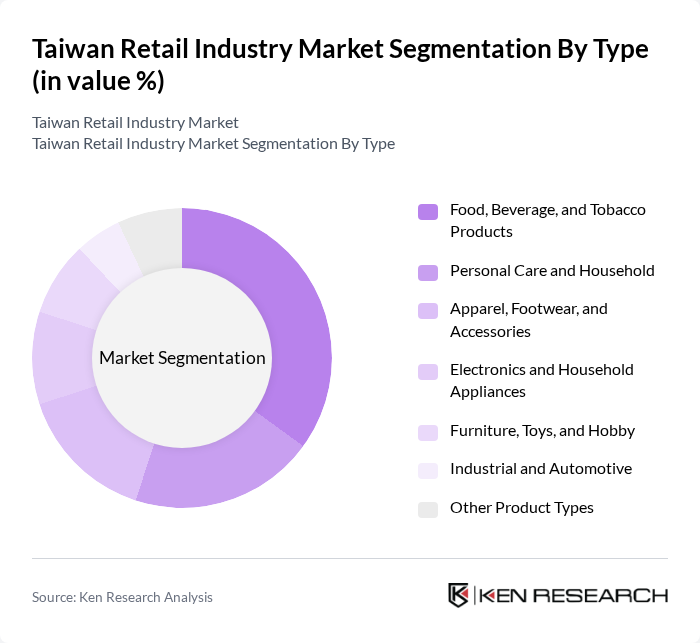
The retail market in Taiwan is segmented into various types, including Food, Beverage, and Tobacco Products; Personal Care and Household; Apparel, Footwear, and Accessories; Electronics and Household Appliances; Furniture, Toys, and Hobby; Industrial and Automotive; and Other Product Types. Among these, Food, Beverage, and Tobacco Products dominate the market due to the high frequency of purchase and the strength of convenience and supermarket channels that anchor daily-needs baskets. Consumers increasingly prioritize quality, freshness, and variety in packaged and ready-to-eat foods, aided by robust cold-chain and convenience-store prepared food programs.
By Sales Channel:
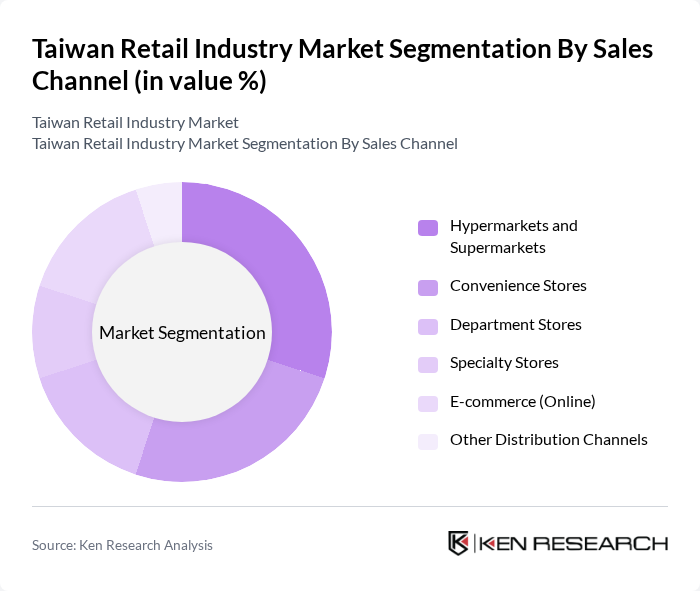
The sales channels in the Taiwan retail market include Hypermarkets and Supermarkets, Convenience Stores, Department Stores, Specialty Stores, E-commerce (Online), and Other Distribution Channels. E-commerce has grown quickly on the back of near-ubiquitous smartphones, high internet penetration, and strong payment adoption (credit card installments, LINE Pay, Apple Pay), complemented by shopping festivals such as Double 11 and 618. Convenience stores maintain a leading offline role through dense networks and expanded services (bill pay, pickup/returns, fresh food), while supermarkets/hypermarkets capture planned grocery missions.
Taiwan Retail Industry Market Competitive Landscape
The Taiwan Retail Industry Market is characterized by a dynamic mix of regional and international players. Leading participants such as PX Mart Co., Ltd. (??????????), Carrefour Taiwan (???; Carrefour S.A. Taiwan operations), 7?Eleven Taiwan (??????????), FamilyMart Taiwan (????????????), RT?Mart Taiwan (???; RT?Mart International Ltd. Taiwan), Costco Wholesale Taiwan (?????????), A.S. Watsons Taiwan (???; Watsons Taiwan), Simple Mart (???), Eslite Spectrum Corporation (??????????), Far Eastern SOGO Department Stores Co., Ltd. (??SOGO??), Shin Kong Mitsukoshi Department Store Co., Ltd. (??????), Miramar Department Store (??????), Breeze Center / Breeze Group (???? / ????), PChome Online Inc. (??????????????), Momo.com Inc. (????????????; momo???) contribute to innovation, geographic expansion, and service delivery in this space.
Taiwan Retail Industry Market Industry Analysis
Growth Drivers
- Increasing Urbanization:Taiwan's urban population is projected to reach approximately 23 million, accounting for over 90% of the total population. This urbanization trend drives demand for retail services, as urban residents typically have higher spending power and access to diverse shopping options. The concentration of consumers in urban areas facilitates the growth of retail outlets, enhancing competition and variety in product offerings, which is crucial for attracting consumers in a densely populated market.
- Rising Disposable Income:The average disposable income in Taiwan is expected to reach NT$1.1 million (approximately USD 36,000), reflecting a steady increase from previous periods. This rise in disposable income enables consumers to spend more on retail goods, particularly in sectors such as fashion, electronics, and dining. As consumers have more financial flexibility, they are likely to seek premium products and services, further stimulating retail growth and encouraging retailers to innovate their offerings.
- Growth of E-commerce:E-commerce sales in Taiwan are projected to exceed NT$2 trillion (approximately USD 66 billion), driven by increased internet penetration and mobile device usage. The convenience of online shopping, coupled with the rise of digital payment solutions, has transformed consumer purchasing behavior. Retailers are increasingly investing in their online platforms to capture this growing segment, leading to enhanced customer experiences and broader market reach, which is essential for sustaining competitive advantage in the retail sector.
Market Challenges
- Intense Competition:The Taiwanese retail market is characterized by fierce competition, with over 30,000 retail establishments vying for consumer attention. Major players include both local and international brands, leading to price wars and aggressive marketing strategies. This competitive landscape pressures profit margins, forcing retailers to continuously innovate and differentiate their offerings. As a result, maintaining market share becomes increasingly challenging, particularly for smaller retailers lacking the resources to compete effectively.
- Supply Chain Disruptions:Taiwan's retail sector faces significant supply chain challenges, exacerbated by global events such as the COVID-19 pandemic and geopolitical tensions. In future, disruptions in logistics and transportation are expected to impact inventory levels, leading to stock shortages and delayed product availability. Retailers must navigate these complexities while managing costs, which can strain operational efficiency and customer satisfaction. Addressing supply chain vulnerabilities is crucial for sustaining retail performance in this dynamic environment.
Taiwan Retail Industry Market Future Outlook
The future of the Taiwan retail industry appears promising, driven by technological advancements and evolving consumer preferences. Retailers are increasingly adopting omnichannel strategies to enhance customer engagement and streamline operations. Additionally, the focus on sustainability is expected to shape product offerings, as consumers become more environmentally conscious. As the market adapts to these trends, businesses that prioritize innovation and customer-centric approaches will likely thrive, positioning themselves for long-term success in a competitive landscape.
Market Opportunities
- Expansion of Online Retail:The rapid growth of online retail presents a significant opportunity for businesses to reach a broader audience. With e-commerce sales projected to surpass NT$2 trillion, retailers can leverage digital platforms to enhance visibility and accessibility. Investing in user-friendly websites and mobile applications can attract tech-savvy consumers, driving sales and fostering brand loyalty in an increasingly digital marketplace.
- Investment in Sustainable Practices:As consumer awareness of environmental issues rises, retailers have the opportunity to invest in sustainable practices. By adopting eco-friendly sourcing and packaging, businesses can appeal to the growing segment of environmentally conscious consumers. This shift not only enhances brand reputation but also aligns with global sustainability trends, positioning retailers favorably in a market that increasingly values corporate responsibility and ethical practices.
Scope of the Report
| Segment | Sub-Segments |
|---|---|
| By Type | Food, Beverage, and Tobacco Products Personal Care and Household Apparel, Footwear, and Accessories Electronics and Household Appliances Furniture, Toys, and Hobby Industrial and Automotive Other Product Types |
| By Sales Channel | Hypermarkets and Supermarkets Convenience Stores Department Stores Specialty Stores E-commerce (Online) Other Distribution Channels |
| By Consumer Demographics | Age Group Gender Income Level Lifestyle Preferences |
| By Geographic Distribution | Northern Taiwan Central Taiwan Southern Taiwan Eastern Taiwan |
| By Product Category | Food, Beverage, and Tobacco Beauty, Personal Care, and Household Apparel, Footwear, and Accessories Electronics and Appliances Furniture, Toys, and Hobby Other Product Categories |
| By Pricing Strategy | Premium Products Mid-Range Products Budget Products |
| By Brand Loyalty | Brand-Loyal Consumers Price-Sensitive Consumers Trend-Focused Consumers |
Key Target Audience
Investors and Venture Capitalist Firms
Government and Regulatory Bodies (e.g., Ministry of Economic Affairs, National Development Council)
Manufacturers and Producers
Distributors and Retailers
Logistics and Supply Chain Companies
Technology Providers
Industry Associations (e.g., Taiwan Chain Stores and Franchise Association)
Financial Institutions
Players Mentioned in the Report:
PX Mart Co., Ltd. ()
Carrefour Taiwan (; Carrefour S.A. Taiwan operations)
7Eleven Taiwan ()
FamilyMart Taiwan ()
RTMart Taiwan (; RTMart International Ltd. Taiwan)
Costco Wholesale Taiwan ()
A.S. Watsons Taiwan (; Watsons Taiwan)
Simple Mart ()
Eslite Spectrum Corporation ()
Far Eastern SOGO Department Stores Co., Ltd. (SOGO)
Shin Kong Mitsukoshi Department Store Co., Ltd. ()
Miramar Department Store ()
Breeze Center / Breeze Group ( / )
PChome Online Inc. ()
Momo.com Inc. (; momo)
Table of Contents
Market Assessment Phase
1. Executive Summary and Approach
2. Taiwan Retail Industry Market Overview
2.1 Key Insights and Strategic Recommendations
2.2 Taiwan Retail Industry Market Overview
2.3 Definition and Scope
2.4 Evolution of Market Ecosystem
2.5 Timeline of Key Regulatory Milestones
2.6 Value Chain & Stakeholder Mapping
2.7 Business Cycle Analysis
2.8 Policy & Incentive Landscape
3. Taiwan Retail Industry Market Analysis
3.1 Growth Drivers
3.1.1 Increasing Urbanization
3.1.2 Rising Disposable Income
3.1.3 Growth of E-commerce
3.1.4 Consumer Preference for Convenience
3.2 Market Challenges
3.2.1 Intense Competition
3.2.2 Supply Chain Disruptions
3.2.3 Regulatory Compliance Costs
3.2.4 Changing Consumer Preferences
3.3 Market Opportunities
3.3.1 Expansion of Online Retail
3.3.2 Development of Omnichannel Strategies
3.3.3 Investment in Sustainable Practices
3.3.4 Growth in Health and Wellness Products
3.4 Market Trends
3.4.1 Personalization in Retail
3.4.2 Integration of Technology in Shopping
3.4.3 Focus on Sustainability
3.4.4 Rise of Local Brands
3.5 Government Regulation
3.5.1 Consumer Protection Laws
3.5.2 E-commerce Regulations
3.5.3 Taxation Policies
3.5.4 Labor Laws
4. SWOT Analysis
5. Stakeholder Analysis
6. Porter's Five Forces Analysis
7. Taiwan Retail Industry Market Market Size, 2019-2024
7.1 By Value
7.2 By Volume
7.3 By Average Selling Price
8. Taiwan Retail Industry Market Segmentation
8.1 By Type
8.1.1 Food, Beverage, and Tobacco Products
8.1.2 Personal Care and Household
8.1.3 Apparel, Footwear, and Accessories
8.1.4 Electronics and Household Appliances
8.1.5 Furniture, Toys, and Hobby
8.1.6 Industrial and Automotive
8.1.7 Other Product Types
8.2 By Sales Channel
8.2.1 Hypermarkets and Supermarkets
8.2.2 Convenience Stores
8.2.3 Department Stores
8.2.4 Specialty Stores
8.2.5 E-commerce (Online)
8.2.6 Other Distribution Channels
8.3 By Consumer Demographics
8.3.1 Age Group
8.3.2 Gender
8.3.3 Income Level
8.3.4 Lifestyle Preferences
8.4 By Geographic Distribution
8.4.1 Northern Taiwan
8.4.2 Central Taiwan
8.4.3 Southern Taiwan
8.4.4 Eastern Taiwan
8.5 By Product Category
8.5.1 Food, Beverage, and Tobacco
8.5.2 Beauty, Personal Care, and Household
8.5.3 Apparel, Footwear, and Accessories
8.5.4 Electronics and Appliances
8.5.5 Furniture, Toys, and Hobby
8.5.6 Other Product Categories
8.6 By Pricing Strategy
8.6.1 Premium Products
8.6.2 Mid-Range Products
8.6.3 Budget Products
8.7 By Brand Loyalty
8.7.1 Brand-Loyal Consumers
8.7.2 Price-Sensitive Consumers
8.7.3 Trend-Focused Consumers
9. Taiwan Retail Industry Market Competitive Analysis
9.1 Market Share of Key Players
9.2 Cross Comparison of Key Players
9.2.1 Company Name
9.2.2 Group Size (Large, Medium, Small)
9.2.3 Taiwan Retail Revenue (latest fiscal year, USD/TWD)
9.2.4 Same-Store Sales Growth (YoY, %)
9.2.5 Store Count in Taiwan (No.)
9.2.6 Average Sales per Square Meter (or per Store)
9.2.7 E-commerce GMV / Online Sales Mix (%)
9.2.8 Customer Retention / Loyalty Members (No., % of sales)
9.2.9 Inventory Turnover (x)
9.2.10 Private-Label Share of Sales (%)
9.2.11 Pricing Positioning (Value, Mid, Premium)
9.2.12 Market Penetration (Stores per 100k population)
9.3 SWOT Analysis of Top Players
9.4 Pricing Analysis
9.5 Detailed Profile of Major Companies
9.5.1 PX Mart Co., Ltd. (??????????)
9.5.2 Carrefour Taiwan (???; Carrefour S.A. Taiwan operations)
9.5.3 7?Eleven Taiwan (??????????)
9.5.4 FamilyMart Taiwan (????????????)
9.5.5 RT?Mart Taiwan (???; RT?Mart International Ltd. Taiwan)
9.5.6 Costco Wholesale Taiwan (?????????)
9.5.7 A.S. Watsons Taiwan (???; Watsons Taiwan)
9.5.8 Simple Mart (???)
9.5.9 Eslite Spectrum Corporation (??????????)
9.5.10 Far Eastern SOGO Department Stores Co., Ltd. (??SOGO??)
9.5.11 Shin Kong Mitsukoshi Department Store Co., Ltd. (??????)
9.5.12 Miramar Department Store (??????)
9.5.13 Breeze Center / Breeze Group (???? / ????)
9.5.14 PChome Online Inc. (??????????????)
9.5.15 Momo.com Inc. (????????????; momo???)
10. Taiwan Retail Industry Market End-User Analysis
10.1 Procurement Behavior of Key Ministries
10.1.1 Government Procurement Policies
10.1.2 Budget Allocation Trends
10.1.3 Supplier Selection Criteria
10.1.4 Contract Management Practices
10.2 Corporate Spend on Infrastructure & Energy
10.2.1 Investment in Retail Infrastructure
10.2.2 Energy Efficiency Initiatives
10.2.3 Technology Upgrades
10.2.4 Sustainability Investments
10.3 Pain Point Analysis by End-User Category
10.3.1 Supply Chain Inefficiencies
10.3.2 Customer Experience Challenges
10.3.3 Regulatory Compliance Issues
10.3.4 Cost Management Difficulties
10.4 User Readiness for Adoption
10.4.1 Technology Adoption Rates
10.4.2 Training and Support Needs
10.4.3 Change Management Strategies
10.4.4 Feedback Mechanisms
10.5 Post-Deployment ROI and Use Case Expansion
10.5.1 Performance Metrics
10.5.2 Customer Satisfaction Levels
10.5.3 Use Case Diversification
10.5.4 Long-term Value Realization
11. Taiwan Retail Industry Market Future Size, 2025-2030
11.1 By Value
11.2 By Volume
11.3 By Average Selling Price
Go-To-Market Strategy Phase
1. Whitespace Analysis + Business Model Canvas
1.1 Market Gaps Identification
1.2 Value Proposition Development
1.3 Revenue Streams Analysis
1.4 Cost Structure Evaluation
1.5 Key Partnerships Exploration
1.6 Customer Segments Definition
1.7 Channels Strategy
2. Marketing and Positioning Recommendations
2.1 Branding Strategies
2.2 Product USPs
2.3 Target Audience Identification
2.4 Communication Strategy
2.5 Digital Marketing Tactics
2.6 Offline Marketing Approaches
3. Distribution Plan
3.1 Urban Retail Strategies
3.2 Rural NGO Tie-ups
3.3 Logistics and Supply Chain Management
3.4 Distribution Channel Optimization
3.5 Partnership Opportunities
4. Channel & Pricing Gaps
4.1 Underserved Routes
4.2 Pricing Bands Analysis
4.3 Competitor Pricing Strategies
4.4 Consumer Price Sensitivity
4.5 Value-Based Pricing Opportunities
5. Unmet Demand & Latent Needs
5.1 Category Gaps Identification
5.2 Consumer Segments Analysis
5.3 Emerging Trends Exploration
5.4 Product Development Opportunities
6. Customer Relationship
6.1 Loyalty Programs
6.2 After-sales Service Enhancements
6.3 Customer Feedback Mechanisms
6.4 Community Engagement Strategies
7. Value Proposition
7.1 Sustainability Initiatives
7.2 Integrated Supply Chains
7.3 Customer-Centric Approaches
7.4 Innovation in Offerings
8. Key Activities
8.1 Regulatory Compliance
8.2 Branding Initiatives
8.3 Distribution Setup
8.4 Training and Development
9. Entry Strategy Evaluation
9.1 Domestic Market Entry Strategy
9.1.1 Product Mix Considerations
9.1.2 Pricing Band Strategy
9.1.3 Packaging Innovations
9.2 Export Entry Strategy
9.2.1 Target Countries Analysis
9.2.2 Compliance Roadmap Development
10. Entry Mode Assessment
10.1 Joint Ventures
10.2 Greenfield Investments
10.3 Mergers & Acquisitions
10.4 Distributor Model Evaluation
11. Capital and Timeline Estimation
11.1 Capital Requirements Analysis
11.2 Timelines for Implementation
12. Control vs Risk Trade-Off
12.1 Ownership vs Partnerships
13. Profitability Outlook
13.1 Breakeven Analysis
13.2 Long-term Sustainability Strategies
14. Potential Partner List
14.1 Distributors
14.2 Joint Ventures
14.3 Acquisition Targets
15. Execution Roadmap
15.1 Phased Plan for Market Entry
15.1.1 Market Setup
15.1.2 Market Entry
15.1.3 Growth Acceleration
15.1.4 Scale & Stabilize
15.2 Key Activities and Milestones
15.2.1 Milestone Planning
15.2.2 Activity Tracking
Research Methodology
Phase 1: Approach1
Desk Research
- Analysis of government publications and reports on retail trends in Taiwan
- Review of industry reports from trade associations and market research firms
- Examination of financial statements and annual reports from leading retail companies
Primary Research
- Interviews with retail executives and managers across various sectors
- Surveys targeting consumers to understand shopping behaviors and preferences
- Focus groups with industry experts to discuss emerging trends and challenges
Validation & Triangulation
- Cross-validation of findings through multiple data sources, including sales data and consumer insights
- Triangulation of qualitative insights from interviews with quantitative data from surveys
- Sanity checks conducted through expert panel reviews to ensure data reliability
Phase 2: Market Size Estimation1
Top-down Assessment
- Estimation of total retail market size based on national economic indicators
- Segmentation of the market by product categories and consumer demographics
- Incorporation of growth rates from historical data and economic forecasts
Bottom-up Modeling
- Collection of sales data from a representative sample of retail outlets
- Estimation of average transaction values and customer footfall metrics
- Calculation of market size based on aggregated data from various retail segments
Forecasting & Scenario Analysis
- Development of forecasting models using historical sales data and economic indicators
- Scenario analysis based on potential impacts of regulatory changes and consumer trends
- Creation of multiple growth scenarios (baseline, optimistic, and pessimistic) through 2030
Phase 3: CATI Sample Composition1
| Scope Item/Segment | Sample Size | Target Respondent Profiles |
|---|---|---|
| General Retail Market Insights | 120 | Retail Managers, Store Owners |
| Consumer Electronics Retail | 90 | Sales Representatives, Product Managers |
| Fashion and Apparel Sector | 80 | Brand Managers, Merchandising Directors |
| Grocery and Supermarket Chains | 110 | Operations Managers, Supply Chain Analysts |
| E-commerce Retail Trends | 85 | eCommerce Managers, Digital Marketing Specialists |
Frequently Asked Questions
What is the current value of the Taiwan retail industry market?
The Taiwan retail industry market is valued at approximately USD 3840 billion, with recent estimates indicating around USD 3638 billion. The market has experienced steady low-single-digit growth, primarily driven by increasing consumer spending and the rise of e-commerce.
Which cities are key demand centers in Taiwan's retail market?
What are the main product types in the Taiwan retail market?
How has e-commerce impacted the Taiwan retail industry?
Other Regional/Country Reports
Indonesia Retail Industry
Malaysia Retail Industry
KSA Retail Industry
APAC Retail Industry
SEA Retail Industry
Why Buy From Us?

What makes us stand out is that our consultants follow Robust, Refine and Result (RRR) methodology. Robust for clear definitions, approaches and sanity checking, Refine for differentiating respondents' facts and opinions, and Result for presenting data with story.

We have set a benchmark in the industry by offering our clients with syndicated and customized market research reports featuring coverage of entire market as well as meticulous research and analyst insights.

While we don't replace traditional research, we flip the method upside down. Our dual approach of Top Bottom & Bottom Top ensures quality deliverable by not just verifying company fundamentals but also looking at the sector and macroeconomic factors.

With one step in the future, our research team constantly tries to show you the bigger picture. We help with some of the tough questions you may encounter along the way: How is the industry positioned? Best marketing channel? KPI's of competitors? By aligning every element, we help maximize success.

Our report gives you instant access to the answers and sources that other companies might choose to hide. We elaborate each steps of research methodology we have used and showcase you the sample size to earn your trust.

If you need any support, we are here! We pride ourselves on universe strength, data quality, and quick, friendly, and professional service.