About the Report
Base Year 2024UAE 5G Infrastructure Market Overview
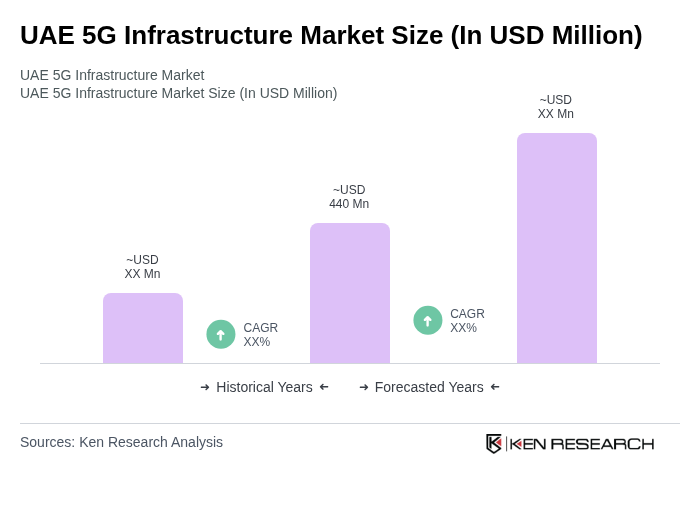
- The UAE 5G Infrastructure Market is valued at USD 440 million, based on a five-year historical analysis. This growth is primarily driven by the increasing demand for high-speed internet, the proliferation of IoT devices, and the government's commitment to digital transformation initiatives. The rapid deployment of 5G technology is expected to enhance connectivity across various sectors, including telecommunications, healthcare, and transportation.
- Key cities such as Dubai and Abu Dhabi dominate the UAE 5G Infrastructure Market due to their status as economic hubs and their advanced technological ecosystems. Dubai's strategic investments in smart city initiatives and Abu Dhabi's focus on innovation and sustainability contribute significantly to the market's growth. The presence of major telecommunications companies in these cities further strengthens their position in the market.
- The UAE government has established a comprehensive regulatory framework to facilitate the deployment of 5G infrastructure. The Telecommunications Regulatory Authority (TRA) of the UAE oversees spectrum allocation, infrastructure sharing guidelines, and safety standards, aimed at accelerating the rollout of 5G networks while ensuring compliance with international standards. This regulatory oversight enhances the overall quality of telecommunications services in the country and supports the UAE's broader digital transformation agenda.
UAE 5G Infrastructure Market Segmentation
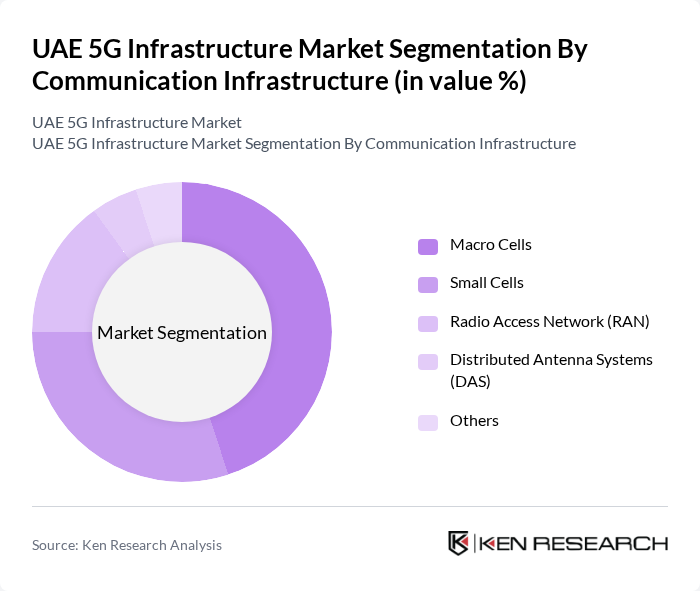
By Communication Infrastructure:The communication infrastructure segment includes various sub-segments such as Macro Cells, Small Cells, Radio Access Network (RAN), Distributed Antenna Systems (DAS), and Others. Among these, Macro Cells are currently leading the market due to their extensive coverage capabilities, which are essential for urban areas with high population density. Small Cells are also gaining traction as they complement Macro Cells by enhancing network capacity and coverage in specific locations. The demand for RAN solutions is increasing as operators seek to optimize their networks for better performance.
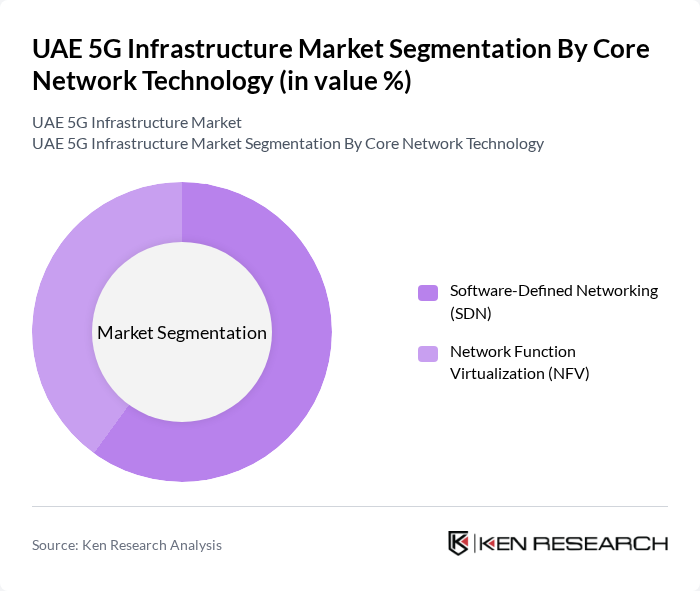
By Core Network Technology:This segment encompasses Software-Defined Networking (SDN) and Network Function Virtualization (NFV). SDN is currently the dominant technology due to its ability to enhance network flexibility and efficiency, allowing operators to manage their networks more effectively. NFV is also gaining importance as it enables the virtualization of network services, reducing the need for dedicated hardware. The increasing adoption of cloud-based solutions is further driving the growth of both SDN and NFV technologies in the market.
UAE 5G Infrastructure Market Competitive Landscape
The UAE 5G Infrastructure Market is characterized by a dynamic mix of regional and international players. Leading participants such as Etisalat by e& (Emirates Telecommunications Group Company PJSC), du (Emirates Integrated Telecommunications Company PJSC), Huawei Technologies Co., Ltd., Nokia Corporation, Ericsson (Telefonaktiebolaget LM Ericsson), ZTE Corporation, Cisco Systems, Inc., Qualcomm Technologies, Inc., Samsung Electronics Co., Ltd., Intel Corporation, Fujitsu Limited, NEC Corporation, Ciena Corporation, CommScope Holding Company, Inc., Keysight Technologies, Inc. contribute to innovation, geographic expansion, and service delivery in this space.
UAE 5G Infrastructure Market Industry Analysis
Growth Drivers
- Increased Demand for High-Speed Connectivity:The UAE's internet penetration rate reached 99% in future, with mobile subscriptions exceeding 19 million. This surge in connectivity demand is driven by the growing reliance on digital services, particularly in sectors like e-commerce and remote work. The World Bank projects that the UAE's digital economy could contribute up to $140 billion to GDP in future, further fueling the need for robust 5G infrastructure to support high-speed connectivity.
- Government Initiatives and Investments:The UAE government has committed over $1 billion to enhance its telecommunications infrastructure, including 5G deployment. The National Digital Strategy aims to position the UAE among the top 10 countries in the Global Innovation Index in future. This strategic investment is expected to create a conducive environment for 5G adoption, with the Telecommunications Regulatory Authority (TRA) facilitating regulatory frameworks that encourage innovation and infrastructure development.
- Rise of IoT and Smart City Projects:The UAE's Smart City initiatives, such as Dubai's Smart City Strategy, aim to integrate IoT technologies across various sectors. With over 1 million IoT devices projected to be connected in future, the demand for 5G infrastructure is critical. The UAE's investment in smart technologies is expected to reach $20 billion in future, driving the need for high-speed, low-latency networks that 5G can provide, thus enhancing urban living and operational efficiency.
Market Challenges
- High Infrastructure Costs:The deployment of 5G infrastructure in the UAE is estimated to require investments exceeding $3 billion in future. This significant financial burden poses a challenge for telecom operators, particularly smaller players. The high costs associated with upgrading existing networks and establishing new infrastructure can hinder the pace of 5G rollout, potentially delaying the benefits of enhanced connectivity for consumers and businesses alike.
- Regulatory Hurdles:The regulatory landscape in the UAE presents challenges for 5G deployment, with complex approval processes for infrastructure development. The TRA's stringent regulations can slow down the rollout of new technologies. Additionally, the need for compliance with international standards can create delays, as operators navigate the regulatory framework while striving to meet the growing demand for 5G services in a competitive market.
UAE 5G Infrastructure Market Future Outlook
The future of the UAE's 5G infrastructure market appears promising, driven by ongoing government support and technological advancements. As the demand for high-speed connectivity continues to rise, telecom operators are expected to invest significantly in expanding their 5G networks. Furthermore, the integration of AI and edge computing will enhance network efficiency and security, paving the way for innovative applications. The collaboration between public and private sectors will be crucial in overcoming existing challenges and maximizing the potential of 5G technology in the UAE.
Market Opportunities
- Expansion of 5G Use Cases:The growing adoption of 5G technology presents opportunities for diverse applications, including autonomous vehicles and telemedicine. The UAE's investment in smart infrastructure is expected to create a market for innovative solutions, with potential revenues reaching $10 billion in future. This expansion will drive demand for 5G services, enhancing operational efficiencies across various sectors.
- Partnerships with Tech Companies:Collaborations between telecom operators and technology firms can accelerate 5G deployment and innovation. Strategic partnerships are anticipated to enhance the development of 5G-enabled applications, particularly in sectors like healthcare and logistics. By leveraging expertise and resources, these partnerships can unlock new revenue streams and improve service delivery, positioning the UAE as a leader in 5G technology.
Scope of the Report
| Segment | Sub-Segments |
|---|---|
| By Communication Infrastructure | Macro Cells Small Cells Radio Access Network (RAN) Distributed Antenna Systems (DAS) Others |
| By Core Network Technology | Software-Defined Networking (SDN) Network Function Virtualization (NFV) |
| By Network Architecture | Standalone (SA) Non-Standalone (NSA) |
| By End-User Industry | Telecommunications Healthcare Transportation Manufacturing Entertainment & Media Government Others |
| By Application | Smart Cities Autonomous Vehicles Industrial Automation IoT Connectivity Others |
| By Spectrum | mmWave Sub-6 GHz |
| By Investment Source | Private Investments Government Funding International Investments |
| By Region | Abu Dhabi Dubai Sharjah Others |
Key Target Audience
Investors and Venture Capitalist Firms
Government and Regulatory Bodies (e.g., Telecommunications Regulatory Authority)
Telecommunications Service Providers
Network Equipment Manufacturers
Infrastructure Development Companies
Smart City Development Agencies
Public Safety and Emergency Services Agencies
Real Estate Developers and Property Management Firms
Players Mentioned in the Report:
Etisalat by e& (Emirates Telecommunications Group Company PJSC)
du (Emirates Integrated Telecommunications Company PJSC)
Huawei Technologies Co., Ltd.
Nokia Corporation
Ericsson (Telefonaktiebolaget LM Ericsson)
ZTE Corporation
Cisco Systems, Inc.
Qualcomm Technologies, Inc.
Samsung Electronics Co., Ltd.
Intel Corporation
Fujitsu Limited
NEC Corporation
Ciena Corporation
CommScope Holding Company, Inc.
Keysight Technologies, Inc.
Table of Contents
Market Assessment Phase
1. Executive Summary and Approach
2. UAE 5G Infrastructure Market Overview
2.1 Key Insights and Strategic Recommendations
2.2 UAE 5G Infrastructure Market Overview
2.3 Definition and Scope
2.4 Evolution of Market Ecosystem
2.5 Timeline of Key Regulatory Milestones
2.6 Value Chain & Stakeholder Mapping
2.7 Business Cycle Analysis
2.8 Policy & Incentive Landscape
3. UAE 5G Infrastructure Market Analysis
3.1 Growth Drivers
3.1.1 Increased Demand for High-Speed Connectivity
3.1.2 Government Initiatives and Investments
3.1.3 Rise of IoT and Smart City Projects
3.1.4 Enhanced Mobile Broadband Services
3.2 Market Challenges
3.2.1 High Infrastructure Costs
3.2.2 Regulatory Hurdles
3.2.3 Limited Consumer Awareness
3.2.4 Competition from Alternative Technologies
3.3 Market Opportunities
3.3.1 Expansion of 5G Use Cases
3.3.2 Partnerships with Tech Companies
3.3.3 Development of 5G-Enabled Applications
3.3.4 International Collaborations
3.4 Market Trends
3.4.1 Adoption of Network Slicing
3.4.2 Growth of Edge Computing
3.4.3 Increased Focus on Cybersecurity
3.4.4 Integration of AI in Network Management
3.5 Government Regulation
3.5.1 Spectrum Allocation Policies
3.5.2 Infrastructure Sharing Regulations
3.5.3 Data Privacy Laws
3.5.4 Compliance with International Standards
4. SWOT Analysis
5. Stakeholder Analysis
6. Porter's Five Forces Analysis
7. UAE 5G Infrastructure Market Size, 2019-2024
7.1 By Value
7.2 By Volume
7.3 By Average Selling Price
8. UAE 5G Infrastructure Market Segmentation
8.1 By Communication Infrastructure
8.1.1 Macro Cells
8.1.2 Small Cells
8.1.3 Radio Access Network (RAN)
8.1.4 Distributed Antenna Systems (DAS)
8.1.5 Others
8.2 By Core Network Technology
8.2.1 Software-Defined Networking (SDN)
8.2.2 Network Function Virtualization (NFV)
8.3 By Network Architecture
8.3.1 Standalone (SA)
8.3.2 Non-Standalone (NSA)
8.4 By End-User Industry
8.4.1 Telecommunications
8.4.2 Healthcare
8.4.3 Transportation
8.4.4 Manufacturing
8.4.5 Entertainment & Media
8.4.6 Government
8.4.7 Others
8.5 By Application
8.5.1 Smart Cities
8.5.2 Autonomous Vehicles
8.5.3 Industrial Automation
8.5.4 IoT Connectivity
8.5.5 Others
8.6 By Spectrum
8.6.1 mmWave
8.6.2 Sub-6 GHz
8.7 By Investment Source
8.7.1 Private Investments
8.7.2 Government Funding
8.7.3 International Investments
8.8 By Region
8.8.1 Abu Dhabi
8.8.2 Dubai
8.8.3 Sharjah
8.8.4 Others
9. UAE 5G Infrastructure Market Competitive Analysis
9.1 Market Share of Key Players
9.2 Cross Comparison of Key Players
9.2.1 Company Name
9.2.2 Group Size (Large, Medium, or Small as per industry convention)
9.2.3 Revenue Growth Rate (5G Segment)
9.2.4 Market Share in UAE 5G Infrastructure
9.2.5 5G Network Coverage (% of UAE population or area)
9.2.6 Number of 5G Sites/Nodes Deployed
9.2.7 Average Revenue Per User (ARPU) – 5G Services
9.2.8 Capital Expenditure on 5G Infrastructure
9.2.9 Service Quality Metrics (Latency, Uptime, Throughput)
9.2.10 Key 5G Partnerships & Collaborations
9.2.11 Innovation Index (Patents, R&D Investment)
9.2.12 Customer Retention Rate (5G Segment)
9.3 SWOT Analysis of Top Players
9.4 Pricing Analysis
9.5 Detailed Profile of Major Companies
9.5.1 Etisalat by e& (Emirates Telecommunications Group Company PJSC)
9.5.2 du (Emirates Integrated Telecommunications Company PJSC)
9.5.3 Huawei Technologies Co., Ltd.
9.5.4 Nokia Corporation
9.5.5 Ericsson (Telefonaktiebolaget LM Ericsson)
9.5.6 ZTE Corporation
9.5.7 Cisco Systems, Inc.
9.5.8 Qualcomm Technologies, Inc.
9.5.9 Samsung Electronics Co., Ltd.
9.5.10 Intel Corporation
9.5.11 Fujitsu Limited
9.5.12 NEC Corporation
9.5.13 Ciena Corporation
9.5.14 CommScope Holding Company, Inc.
9.5.15 Keysight Technologies, Inc.
10. UAE 5G Infrastructure Market End-User Analysis
10.1 Procurement Behavior of Key Ministries
10.1.1 Ministry of Telecommunications
10.1.2 Ministry of Health
10.1.3 Ministry of Transportation
10.2 Corporate Spend on Infrastructure & Energy
10.2.1 Telecommunications Sector Spending
10.2.2 Government Infrastructure Projects
10.3 Pain Point Analysis by End-User Category
10.3.1 Telecommunications Providers
10.3.2 Healthcare Providers
10.4 User Readiness for Adoption
10.4.1 Consumer Awareness Levels
10.4.2 Business Readiness for 5G
10.5 Post-Deployment ROI and Use Case Expansion
10.5.1 ROI Measurement Techniques
10.5.2 Use Case Development Strategies
11. UAE 5G Infrastructure Market Future Size, 2025-2030
11.1 By Value
11.2 By Volume
11.3 By Average Selling Price
Go-To-Market Strategy Phase
1. Whitespace Analysis + Business Model Canvas
1.1 Market Gaps Identification
1.2 Business Model Development
2. Marketing and Positioning Recommendations
2.1 Branding Strategies
2.2 Product USPs
3. Distribution Plan
3.1 Urban Retail Strategies
3.2 Rural NGO Tie-ups
4. Channel & Pricing Gaps
4.1 Underserved Routes
4.2 Pricing Bands
5. Unmet Demand & Latent Needs
5.1 Category Gaps
5.2 Consumer Segments
6. Customer Relationship
6.1 Loyalty Programs
6.2 After-sales Service
7. Value Proposition
7.1 Sustainability Initiatives
7.2 Integrated Supply Chains
8. Key Activities
8.1 Regulatory Compliance
8.2 Branding
8.3 Distribution Setup
9. Entry Strategy Evaluation
9.1 Domestic Market Entry Strategy
9.1.1 Product Mix
9.1.2 Pricing Band
9.1.3 Packaging
9.2 Export Entry Strategy
9.2.1 Target Countries
9.2.2 Compliance Roadmap
10. Entry Mode Assessment
10.1 JV
10.2 Greenfield
10.3 M&A
10.4 Distributor Model
11. Capital and Timeline Estimation
11.1 Capital Requirements
11.2 Timelines
12. Control vs Risk Trade-Off
12.1 Ownership vs Partnerships
13. Profitability Outlook
13.1 Breakeven Analysis
13.2 Long-term Sustainability
14. Potential Partner List
14.1 Distributors
14.2 JVs
14.3 Acquisition Targets
15. Execution Roadmap
15.1 Phased Plan for Market Entry
15.1.1 Market Setup
15.1.2 Market Entry
15.1.3 Growth Acceleration
15.1.4 Scale & Stabilize
15.2 Key Activities and Milestones
15.2.1 Activity Planning
15.2.2 Milestone Tracking
Research Methodology
Phase 1: Approach1
Desk Research
- Analysis of government publications and reports on 5G infrastructure initiatives in the UAE
- Review of industry white papers and market analysis reports from telecommunications authorities
- Examination of academic journals and conference proceedings related to 5G technology advancements
Primary Research
- Interviews with key stakeholders in telecommunications companies and network providers
- Surveys conducted with technology experts and consultants specializing in 5G deployment
- Field interviews with infrastructure project managers involved in 5G rollout
Validation & Triangulation
- Cross-validation of findings through multiple data sources including government and industry reports
- Triangulation of qualitative insights from interviews with quantitative data from market surveys
- Sanity checks through expert panel reviews comprising industry veterans and academic researchers
Phase 2: Market Size Estimation1
Top-down Assessment
- Estimation of total addressable market based on national telecommunications expenditure
- Segmentation of market size by verticals such as healthcare, transportation, and smart cities
- Incorporation of government initiatives and investments in 5G technology
Bottom-up Modeling
- Collection of data on infrastructure investments from leading telecom operators in the UAE
- Estimation of deployment costs based on current market pricing for 5G equipment and services
- Volume x cost analysis for projected 5G service adoption rates across different sectors
Forecasting & Scenario Analysis
- Multi-factor regression analysis incorporating factors such as population growth and urbanization rates
- Scenario modeling based on varying levels of regulatory support and technological advancements
- Development of baseline, optimistic, and pessimistic forecasts through 2030
Phase 3: CATI Sample Composition1
| Scope Item/Segment | Sample Size | Target Respondent Profiles |
|---|---|---|
| Telecom Operators | 100 | Network Engineers, Operations Managers |
| Government Regulatory Bodies | 50 | Policy Makers, Regulatory Affairs Specialists |
| Technology Vendors | 80 | Product Managers, Sales Directors |
| End-User Industries (Healthcare, Transportation) | 60 | IT Managers, Project Managers |
| Research Institutions | 40 | Academic Researchers, Industry Analysts |
Frequently Asked Questions
What is the current value of the UAE 5G Infrastructure Market?
The UAE 5G Infrastructure Market is valued at approximately USD 440 million, reflecting significant growth driven by high-speed internet demand, IoT proliferation, and government digital transformation initiatives.
Which cities are leading in the UAE 5G Infrastructure Market?
What are the key drivers of growth in the UAE 5G Infrastructure Market?
What challenges does the UAE 5G Infrastructure Market face?
Other Regional/Country Reports
Indonesia 5g infrastructure market
Malaysia 5g infrastructure market
KSA 5g infrastructure market
APAC 5g infrastructure market
Other Adjacent Reports
Kuwait IoT Devices Market
Japan Smart City Technology Market
Brazil Telecommunications Services Market
Indonesia Cloud Computing Market
UAE Edge Computing Market
Germany Cybersecurity Solutions Market
KSA Autonomous Vehicles Market
Mexico Telemedicine Market
Belgium E-Commerce Platforms Market
South Africa Digital Transformation Services Market
Why Buy From Us?

What makes us stand out is that our consultants follow Robust, Refine and Result (RRR) methodology. Robust for clear definitions, approaches and sanity checking, Refine for differentiating respondents' facts and opinions, and Result for presenting data with story.

We have set a benchmark in the industry by offering our clients with syndicated and customized market research reports featuring coverage of entire market as well as meticulous research and analyst insights.

While we don't replace traditional research, we flip the method upside down. Our dual approach of Top Bottom & Bottom Top ensures quality deliverable by not just verifying company fundamentals but also looking at the sector and macroeconomic factors.

With one step in the future, our research team constantly tries to show you the bigger picture. We help with some of the tough questions you may encounter along the way: How is the industry positioned? Best marketing channel? KPI's of competitors? By aligning every element, we help maximize success.

Our report gives you instant access to the answers and sources that other companies might choose to hide. We elaborate each steps of research methodology we have used and showcase you the sample size to earn your trust.

If you need any support, we are here! We pride ourselves on universe strength, data quality, and quick, friendly, and professional service.