About the Report
Base Year 2024United Arab Emirates Aquaculture Industry Market Overview
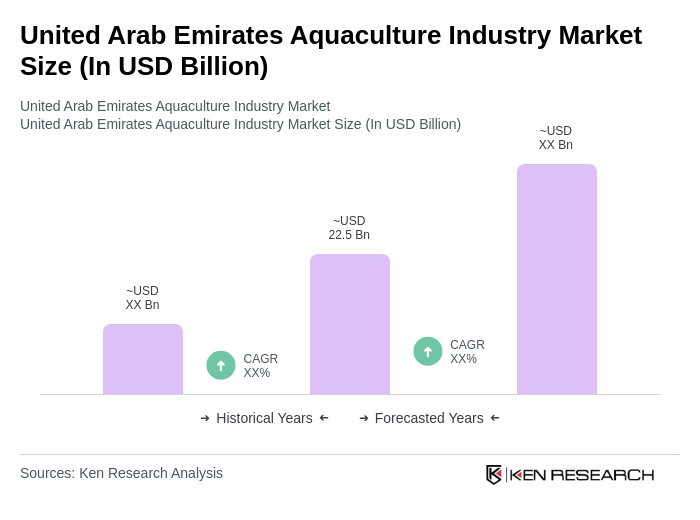
- The United Arab Emirates Aquaculture Industry Market is valued at USD 22.5 billion, based on a five-year historical analysis. This level aligns with recent industry assessments that place the broader UAE fisheries and aquaculture market in the low?twenties billions in value and reflects sustained demand and investment in the sector .
- Key players in this market include Abu Dhabi, Dubai, and Ras Al Khaimah. These regions dominate due to their strategic coastal locations, advanced infrastructure, aquaculture investments, and supportive public initiatives across the UAE’s principal coastal emirates .
- In 2023, the UAE government implemented the National Aquaculture Strategy, aiming to increase local fish production to 200,000 tonnes by 2030. This initiative is positioned within wider government programs to expand aquaculture, provide incentives, and enhance food security through research centers and targeted accelerators supporting sector growth .
United Arab Emirates Aquaculture Industry Market Segmentation
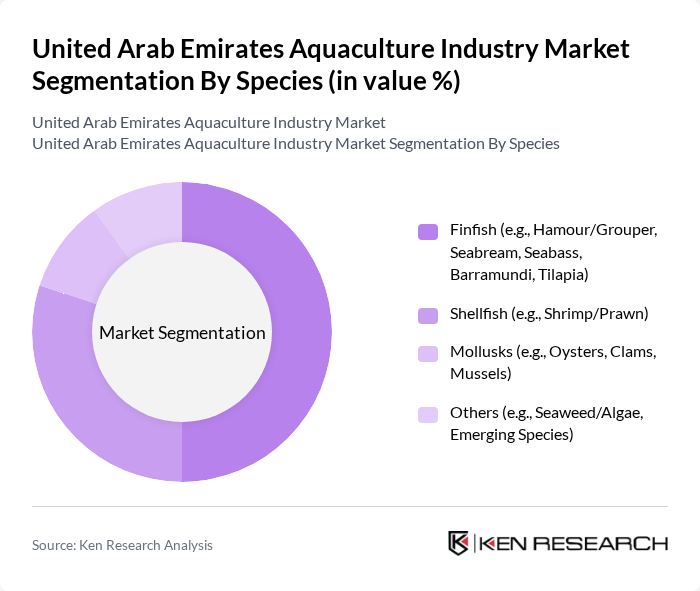
By Species:The aquaculture market in the UAE is segmented by species, which includes Finfish, Shellfish, Mollusks, and Others. Finfish, such as Hamour and Seabream, dominate the market due to their high demand in local cuisine and ongoing investments in marine finfish farming. Shellfish, particularly shrimp, also hold a significant share, supported by growing brackish-water production and processing activity. Mollusks and other species, including seaweed and emerging species, are smaller but developing niches aligned with sustainability and diversification goals .
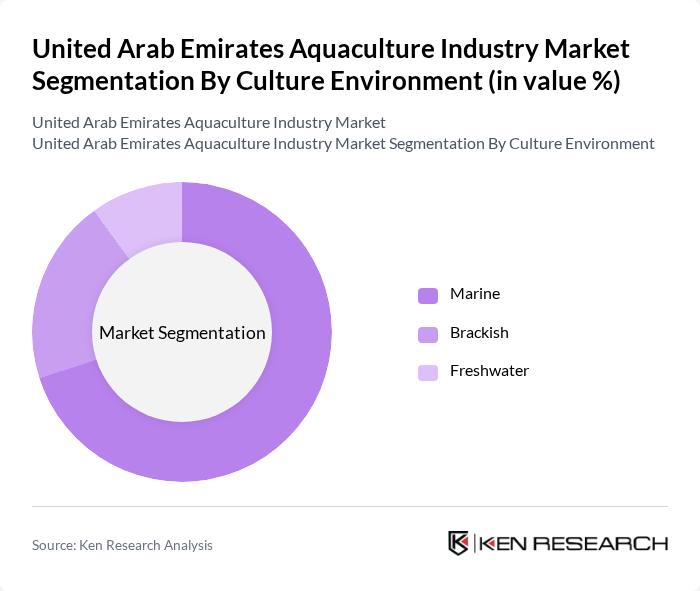
By Culture Environment:The culture environment segmentation includes Marine, Brackish, and Freshwater systems. Marine aquaculture is the most prevalent due to the UAE's extensive coastline and focus on marine finfish and shellfish. Brackish water systems are expanding for shrimp farming and related species, while freshwater aquaculture remains limited to ponds, tanks, and select irrigation channels near agricultural areas, with tilapia as a leading option .
United Arab Emirates Aquaculture Industry Market Competitive Landscape
The United Arab Emirates Aquaculture Industry Market is characterized by a dynamic mix of regional and international players. Leading participants such as Asmak (International Fish Farming Holding Co. PJSC), Fish Farm LLC (Jebel Ali, Dubai), Emirates National Fish Farming Co. (ENFFC), Ras Al Khaimah, Emirates AquaTech Caviar Farm (Emirates AquaTech), Al Jaraf Fisheries LLC, Al Jarwani Group – Oceanic Shrimp Aquaculture (UAE operations), Royal Fish Farming LLC, International Seafood Company LLC (UAE), Al Islami Foods (seafood processing, UAE), Al Seer Marine Aquaculture Initiatives (Abu Dhabi), Ocean Fish Farm LLC, Umm Al Quwain Fish Hatchery (Sheikh Khalifa Marine Research Center), Abu Dhabi Fish Farming Company, Delmonte Foods UAE – Fresh & Fish (distribution partner), Global Aquaculture Company FZE (RAS projects, UAE) contribute to innovation, geographic expansion, and service delivery in this space.
United Arab Emirates Aquaculture Industry Market Industry Analysis
Growth Drivers
- Increasing Demand for Sustainable Seafood:The United Arab Emirates (UAE) has witnessed a significant rise in the demand for sustainable seafood, with consumption reaching approximately 220,000 tons in future. This trend is driven by a growing awareness of overfishing and environmental degradation. The UAE government aims to increase local aquaculture production to 120,000 tons in future, reflecting a commitment to sustainability and food security. This demand is further supported by initiatives promoting responsible sourcing and eco-labeling, appealing to health-conscious consumers.
- Government Support and Investment:The UAE government has allocated over AED 1.5 billion (approximately USD 408 million) to enhance the aquaculture sector through various initiatives. This includes funding for research and development, infrastructure improvements, and subsidies for sustainable practices. The National Food Security Strategy aims to increase local seafood production by 40% in future, fostering a favorable environment for aquaculture growth. Such investments are crucial for establishing a robust aquaculture industry that meets both local and export demands.
- Technological Advancements in Aquaculture:The integration of advanced technologies in aquaculture, such as recirculating aquaculture systems (RAS) and automated feeding systems, has revolutionized production efficiency. In future, the UAE saw a 20% increase in aquaculture yield attributed to these innovations. The adoption of IoT and AI for monitoring water quality and fish health is expected to further enhance productivity. These technological advancements not only improve sustainability but also reduce operational costs, making aquaculture more viable in the region.
Market Challenges
- Environmental Concerns and Sustainability Issues:The aquaculture industry in the UAE faces significant environmental challenges, including water scarcity and habitat degradation. With the UAE's arid climate, freshwater availability is limited, impacting aquaculture sustainability. In future, approximately 70% of aquaculture operations reported concerns regarding water quality and availability. Addressing these issues is critical for ensuring long-term viability and compliance with environmental regulations, which are becoming increasingly stringent.
- High Initial Investment Costs:The high capital investment required for establishing aquaculture facilities poses a significant barrier to entry. Initial costs can exceed AED 6 million (around USD 1.63 million) for modern systems, which deters potential investors. Additionally, ongoing operational costs, including feed and technology maintenance, can strain financial resources. This financial burden limits the growth of small to medium-sized enterprises, which are essential for diversifying the aquaculture sector in the UAE.
United Arab Emirates Aquaculture Industry Market Future Outlook
The future of the UAE aquaculture industry appears promising, driven by increasing consumer demand for locally sourced seafood and government initiatives aimed at enhancing production capabilities. As sustainability becomes a priority, the industry is likely to see a shift towards more eco-friendly practices and technologies. Furthermore, collaboration with research institutions will foster innovation, leading to improved production methods. The focus on traceability and transparency will also enhance consumer trust, positioning the UAE as a leader in sustainable aquaculture in the region.
Market Opportunities
- Expansion of Aquaculture Technology:The ongoing development of aquaculture technology presents significant opportunities for growth. Innovations such as biofloc technology and integrated multi-trophic aquaculture can enhance productivity and sustainability. By future, the UAE aims to implement these technologies across 60% of its aquaculture farms, potentially increasing output and reducing environmental impact, thus attracting more investors to the sector.
- Development of Organic Aquaculture:The rising consumer preference for organic products offers a lucrative opportunity for the UAE aquaculture market. With organic seafood sales projected to reach AED 600 million (approximately USD 163 million) in future, producers can capitalize on this trend by adopting organic farming practices. This shift not only meets consumer demand but also aligns with global sustainability goals, enhancing the UAE's reputation in the international seafood market.
Scope of the Report
| Segment | Sub-Segments |
|---|---|
| By Species | Finfish (e.g., Hamour/Grouper, Seabream, Seabass, Barramundi, Tilapia) Shellfish (e.g., Shrimp/Prawn) Mollusks (e.g., Oysters, Clams, Mussels) Others (e.g., Seaweed/Algae, Emerging Species) |
| By Culture Environment | Marine Brackish Freshwater |
| By Rearing System/Technology | Recirculating Aquaculture Systems (RAS) Cage Culture (offshore/inshore) Pond/Tank Culture Integrated/IMTA and Biofloc |
| By Application | Food Consumption Broodstock & Hatchery/Seed Production Restocking & Stock Enhancement |
| By Distribution Channel | Supermarkets & Hypermarkets Fish Markets & Wet Markets HoReCa (Hotels, Restaurants, Catering) Online & Direct-to-Consumer Wholesale/Institutional |
| By Emirate | Abu Dhabi Dubai Sharjah Ras Al Khaimah Ajman, Umm Al Quwain & Fujairah |
| By Product Form | Fresh/Chilled Frozen Processed/Value-Added (fillets, smoked, marinated) |
| By Packaging Type | Bulk/HoReCa Retail Packs (vacuum/MAP) Sustainable/Eco-Friendly Packaging |
| By Price Range | Premium Mid-Range Value/Budget |
Key Target Audience
Investors and Venture Capitalist Firms
Government and Regulatory Bodies (e.g., Ministry of Climate Change and Environment, Abu Dhabi Food Control Authority)
Manufacturers and Producers
Distributors and Retailers
Aquaculture Equipment Suppliers
Industry Associations (e.g., Emirates Aquaculture Association)
Financial Institutions
Export and Import Agencies
Players Mentioned in the Report:
Asmak (International Fish Farming Holding Co. PJSC)
Fish Farm LLC (Jebel Ali, Dubai)
Emirates National Fish Farming Co. (ENFFC), Ras Al Khaimah
Emirates AquaTech Caviar Farm (Emirates AquaTech)
Al Jaraf Fisheries LLC
Al Jarwani Group Oceanic Shrimp Aquaculture (UAE operations)
Royal Fish Farming LLC
International Seafood Company LLC (UAE)
Al Islami Foods (seafood processing, UAE)
Al Seer Marine Aquaculture Initiatives (Abu Dhabi)
Ocean Fish Farm LLC
Umm Al Quwain Fish Hatchery (Sheikh Khalifa Marine Research Center)
Abu Dhabi Fish Farming Company
Delmonte Foods UAE Fresh & Fish (distribution partner)
Global Aquaculture Company FZE (RAS projects, UAE)
Table of Contents
Market Assessment Phase
1. Executive Summary and Approach
2. United Arab Emirates Aquaculture Industry Market Overview
2.1 Key Insights and Strategic Recommendations
2.2 United Arab Emirates Aquaculture Industry Market Overview
2.3 Definition and Scope
2.4 Evolution of Market Ecosystem
2.5 Timeline of Key Regulatory Milestones
2.6 Value Chain & Stakeholder Mapping
2.7 Business Cycle Analysis
2.8 Policy & Incentive Landscape
3. United Arab Emirates Aquaculture Industry Market Analysis
3.1 Growth Drivers
3.1.1 Increasing Demand for Sustainable Seafood
3.1.2 Government Support and Investment
3.1.3 Technological Advancements in Aquaculture
3.1.4 Rising Health Consciousness Among Consumers
3.2 Market Challenges
3.2.1 Environmental Concerns and Sustainability Issues
3.2.2 High Initial Investment Costs
3.2.3 Regulatory Compliance and Bureaucracy
3.2.4 Competition from Imported Seafood
3.3 Market Opportunities
3.3.1 Expansion of Aquaculture Technology
3.3.2 Development of Organic Aquaculture
3.3.3 Export Potential to Neighboring Regions
3.3.4 Collaboration with Research Institutions
3.4 Market Trends
3.4.1 Shift Towards Integrated Aquaculture Systems
3.4.2 Growth of Online Seafood Retailing
3.4.3 Increasing Focus on Traceability and Transparency
3.4.4 Adoption of Circular Economy Practices
3.5 Government Regulation
3.5.1 Aquaculture Licensing Requirements
3.5.2 Environmental Protection Regulations
3.5.3 Food Safety Standards
3.5.4 Subsidies for Sustainable Practices
4. SWOT Analysis
5. Stakeholder Analysis
6. Porter's Five Forces Analysis
7. United Arab Emirates Aquaculture Industry Market Market Size, 2019-2024
7.1 By Value
7.2 By Volume
7.3 By Average Selling Price
8. United Arab Emirates Aquaculture Industry Market Segmentation
8.1 By Species
8.1.1 Finfish (e.g., Hamour/Grouper, Seabream, Seabass, Barramundi, Tilapia)
8.1.2 Shellfish (e.g., Shrimp/Prawn)
8.1.3 Mollusks (e.g., Oysters, Clams, Mussels)
8.1.4 Others (e.g., Seaweed/Algae, Emerging Species)
8.2 By Culture Environment
8.2.1 Marine
8.2.2 Brackish
8.2.3 Freshwater
8.3 By Rearing System/Technology
8.3.1 Recirculating Aquaculture Systems (RAS)
8.3.2 Cage Culture (offshore/inshore)
8.3.3 Pond/Tank Culture
8.3.4 Integrated/IMTA and Biofloc
8.4 By Application
8.4.1 Food Consumption
8.4.2 Broodstock & Hatchery/Seed Production
8.4.3 Restocking & Stock Enhancement
8.5 By Distribution Channel
8.5.1 Supermarkets & Hypermarkets
8.5.2 Fish Markets & Wet Markets
8.5.3 HoReCa (Hotels, Restaurants, Catering)
8.5.4 Online & Direct-to-Consumer
8.5.5 Wholesale/Institutional
8.6 By Emirate
8.6.1 Abu Dhabi
8.6.2 Dubai
8.6.3 Sharjah
8.6.4 Ras Al Khaimah
8.6.5 Ajman, Umm Al Quwain & Fujairah
8.7 By Product Form
8.7.1 Fresh/Chilled
8.7.2 Frozen
8.7.3 Processed/Value-Added (fillets, smoked, marinated)
8.8 By Packaging Type
8.8.1 Bulk/HoReCa
8.8.2 Retail Packs (vacuum/MAP)
8.8.3 Sustainable/Eco-Friendly Packaging
8.9 By Price Range
8.9.1 Premium
8.9.2 Mid-Range
8.9.3 Value/Budget
9. United Arab Emirates Aquaculture Industry Market Competitive Analysis
9.1 Market Share of Key Players
9.2 Cross Comparison of Key Players
9.2.1 Company Name
9.2.2 Production Capacity (tonnes/year)
9.2.3 Species Portfolio Breadth (count of species farmed)
9.2.4 Culture Technology Mix (% RAS, % cages, % ponds/tanks)
9.2.5 Biosecurity & Certification (e.g., HACCP, ASC/BAP status)
9.2.6 Revenue and 3-Year CAGR
9.2.7 Domestic Market Coverage (number of emirates served/outlets)
9.2.8 Export Footprint (destinations, share of exports %)
9.2.9 Distribution Partnerships (retail/HoReCa contracts)
9.2.10 Cost per kg at farm-gate (AED/kg)
9.2.11 Feed Conversion Ratio (FCR) and Survival Rate (%)
9.2.12 R&D/Innovation Intensity (pilot systems, hatchery tech, patents)
9.3 SWOT Analysis of Top Players
9.4 Pricing Analysis
9.5 Detailed Profile of Major Companies
9.5.1 Asmak (International Fish Farming Holding Co. PJSC)
9.5.2 Fish Farm LLC (Jebel Ali, Dubai)
9.5.3 Emirates National Fish Farming Co. (ENFFC), Ras Al Khaimah
9.5.4 Emirates AquaTech Caviar Farm (Emirates AquaTech)
9.5.5 Al Jaraf Fisheries LLC
9.5.6 Al Jarwani Group – Oceanic Shrimp Aquaculture (UAE operations)
9.5.7 Royal Fish Farming LLC
9.5.8 International Seafood Company LLC (UAE)
9.5.9 Al Islami Foods (seafood processing, UAE)
9.5.10 Al Seer Marine Aquaculture Initiatives (Abu Dhabi)
9.5.11 Ocean Fish Farm LLC
9.5.12 Umm Al Quwain Fish Hatchery (Sheikh Khalifa Marine Research Center)
9.5.13 Abu Dhabi Fish Farming Company
9.5.14 Delmonte Foods UAE – Fresh & Fish (distribution partner)
9.5.15 Global Aquaculture Company FZE (RAS projects, UAE)
10. United Arab Emirates Aquaculture Industry Market End-User Analysis
10.1 Procurement Behavior of Key Ministries
10.1.1 Ministry of Climate Change and Environment
10.1.2 Ministry of Economy
10.1.3 Ministry of Health and Prevention
10.2 Corporate Spend on Infrastructure & Energy
10.2.1 Investment in Aquaculture Facilities
10.2.2 Energy Consumption Patterns
10.2.3 Infrastructure Development Costs
10.3 Pain Point Analysis by End-User Category
10.3.1 Supply Chain Disruptions
10.3.2 Quality Control Issues
10.3.3 Regulatory Compliance Challenges
10.4 User Readiness for Adoption
10.4.1 Awareness of Aquaculture Benefits
10.4.2 Training and Skill Development Needs
10.4.3 Financial Readiness for Investment
10.5 Post-Deployment ROI and Use Case Expansion
10.5.1 Measurement of ROI Metrics
10.5.2 Expansion into New Markets
10.5.3 Long-term Sustainability Practices
11. United Arab Emirates Aquaculture Industry Market Future Size, 2025-2030
11.1 By Value
11.2 By Volume
11.3 By Average Selling Price
Go-To-Market Strategy Phase
1. Whitespace Analysis + Business Model Canvas
1.1 Market Gaps Identification
1.2 Business Model Framework
2. Marketing and Positioning Recommendations
2.1 Branding Strategies
2.2 Product USPs
3. Distribution Plan
3.1 Urban Retail vs Rural NGO Tie-ups
4. Channel & Pricing Gaps
4.1 Underserved Routes
4.2 Pricing Bands
5. Unmet Demand & Latent Needs
5.1 Category Gaps
5.2 Consumer Segments
6. Customer Relationship
6.1 Loyalty Programs
6.2 After-sales Service
7. Value Proposition
7.1 Sustainability
7.2 Integrated Supply Chains
8. Key Activities
8.1 Regulatory Compliance
8.2 Branding
8.3 Distribution Setup
9. Entry Strategy Evaluation
9.1 Domestic Market Entry Strategy
9.1.1 Product Mix
9.1.2 Pricing Band
9.1.3 Packaging
9.2 Export Entry Strategy
9.2.1 Target Countries
9.2.2 Compliance Roadmap
10. Entry Mode Assessment
10.1 JV
10.2 Greenfield
10.3 M&A
10.4 Distributor Model
11. Capital and Timeline Estimation
11.1 Capital Requirements
11.2 Timelines
12. Control vs Risk Trade-Off
12.1 Ownership vs Partnerships
13. Profitability Outlook
13.1 Breakeven Analysis
13.2 Long-term Sustainability
14. Potential Partner List
14.1 Distributors
14.2 JVs
14.3 Acquisition Targets
15. Execution Roadmap
15.1 Phased Plan for Market Entry
15.1.1 Market Setup
15.1.2 Market Entry
15.1.3 Growth Acceleration
15.1.4 Scale & Stabilize
15.2 Key Activities and Milestones
15.2.1 Activity Planning
15.2.2 Milestone Tracking
Research Methodology
Phase 1: Approach1
Desk Research
- Analysis of government reports and publications on aquaculture regulations in the UAE
- Review of industry reports from organizations such as FAO and local aquaculture associations
- Examination of market trends and statistics from trade journals and aquaculture-focused publications
Primary Research
- Interviews with aquaculture farm operators and managers across various regions in the UAE
- Surveys conducted with suppliers of aquaculture feed and equipment
- Field visits to aquaculture facilities to gather firsthand insights on operational practices
Validation & Triangulation
- Cross-validation of data through multiple sources including government statistics and industry reports
- Triangulation of findings from primary interviews with secondary data insights
- Sanity checks through expert panel discussions with aquaculture specialists and economists
Phase 2: Market Size Estimation1
Top-down Assessment
- Estimation of market size based on national aquaculture production statistics and growth rates
- Segmentation of the market by species cultivated and production methods used
- Incorporation of government initiatives aimed at boosting local aquaculture production
Bottom-up Modeling
- Collection of data on production volumes from leading aquaculture farms in the UAE
- Cost analysis based on operational expenses and pricing strategies of aquaculture products
- Volume x price calculations to derive revenue estimates for different aquaculture segments
Forecasting & Scenario Analysis
- Multi-factor regression analysis incorporating factors such as population growth and seafood consumption trends
- Scenario modeling based on potential regulatory changes and environmental impacts on aquaculture
- Development of baseline, optimistic, and pessimistic forecasts through 2030
Phase 3: CATI Sample Composition1
| Scope Item/Segment | Sample Size | Target Respondent Profiles |
|---|---|---|
| Marine Fish Farming | 100 | Aquaculture Farm Owners, Production Managers |
| Freshwater Aquaculture | 80 | Farm Operators, Supply Chain Managers |
| Aquaculture Feed Suppliers | 60 | Sales Managers, Product Development Specialists |
| Regulatory Bodies and Associations | 50 | Policy Makers, Industry Analysts |
| Research Institutions and Universities | 40 | Researchers, Aquaculture Professors |
Frequently Asked Questions
What is the current value of the United Arab Emirates Aquaculture Industry Market?
The United Arab Emirates Aquaculture Industry Market is valued at approximately USD 22.5 billion, reflecting sustained demand and investment in the sector, as well as alignment with broader industry assessments of the UAE fisheries and aquaculture market.
Which regions in the UAE are key players in the aquaculture industry?
What is the National Aquaculture Strategy implemented by the UAE government?
What species dominate the UAE aquaculture market?
Other Regional/Country Reports
Indonesia Aquaculture Industry Market
Malaysia Aquaculture Industry Market
KSA Aquaculture Industry Market
APAC Aquaculture Industry Market
SEA Aquaculture Industry Market
Why Buy From Us?

What makes us stand out is that our consultants follow Robust, Refine and Result (RRR) methodology. Robust for clear definitions, approaches and sanity checking, Refine for differentiating respondents' facts and opinions, and Result for presenting data with story.

We have set a benchmark in the industry by offering our clients with syndicated and customized market research reports featuring coverage of entire market as well as meticulous research and analyst insights.

While we don't replace traditional research, we flip the method upside down. Our dual approach of Top Bottom & Bottom Top ensures quality deliverable by not just verifying company fundamentals but also looking at the sector and macroeconomic factors.

With one step in the future, our research team constantly tries to show you the bigger picture. We help with some of the tough questions you may encounter along the way: How is the industry positioned? Best marketing channel? KPI's of competitors? By aligning every element, we help maximize success.

Our report gives you instant access to the answers and sources that other companies might choose to hide. We elaborate each steps of research methodology we have used and showcase you the sample size to earn your trust.

If you need any support, we are here! We pride ourselves on universe strength, data quality, and quick, friendly, and professional service.