About the Report
Base Year 2024United States EV Charging Robotics and Automation Market Overview
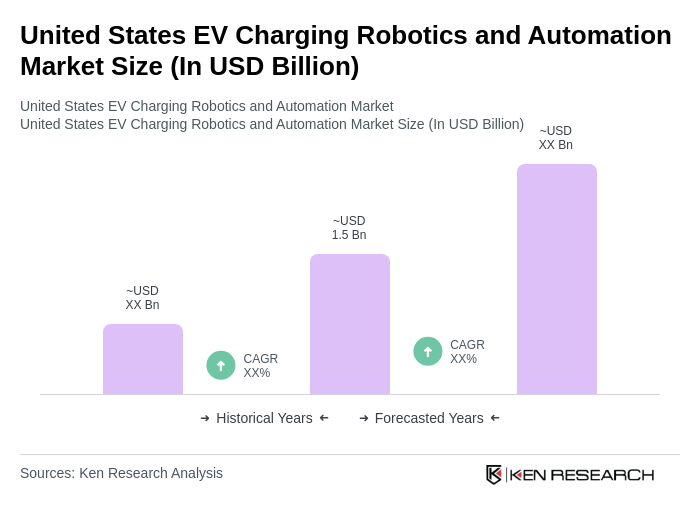
- The United States EV Charging Robotics and Automation Market is valued at USD 1.5 billion, based on a five-year historical analysis. This growth is primarily driven by the increasing adoption of electric vehicles, rapid advancements in automated charging technology, and the rising demand for efficient, user-friendly charging solutions. The market is further supported by strong government initiatives aimed at promoting electric mobility, reducing carbon emissions, and expanding smart infrastructure investments.
- Key states in this market include California, Texas, and New York, which lead due to their large populations, extensive EV infrastructure, and robust government support for electric vehicle adoption. These states have implemented a range of incentives and regulatory policies to accelerate the installation of charging stations, positioning them as attractive markets for advanced EV charging solutions.
- The Infrastructure Investment and Jobs Act, enacted in 2021 by the U.S. Congress, allocates USD 7.5 billion for the development of a nationwide network of EV charging stations. Administered by the U.S. Department of Transportation and the Federal Highway Administration, this regulation mandates the deployment of reliable, accessible, and interoperable charging infrastructure, with compliance requirements for minimum station standards, geographic coverage, and open access to all EV users.
United States EV Charging Robotics and Automation Market Segmentation
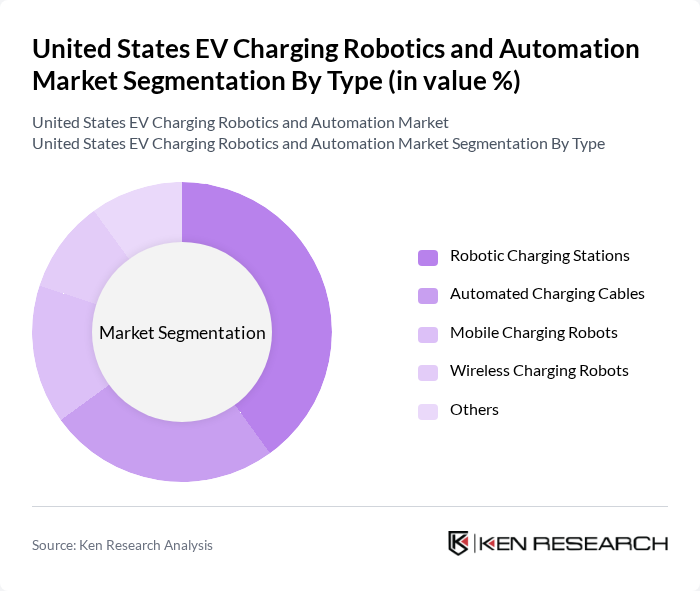
By Type:The market is segmented into Robotic Charging Stations, Automated Charging Cables, Mobile Charging Robots, Wireless Charging Robots, and Others. Robotic Charging Stations are gaining significant traction due to their ability to automate the charging process, reduce human intervention, and enhance operational efficiency. Automated Charging Cables are also in demand, offering flexibility and ease of use for both residential and commercial applications. The sector is witnessing increased investment in wireless and mobile charging robots, driven by the need for seamless, contactless, and on-the-go charging solutions. Industry players are focusing on integrating AI and IoT technologies to improve charging speed, reliability, and user experience.
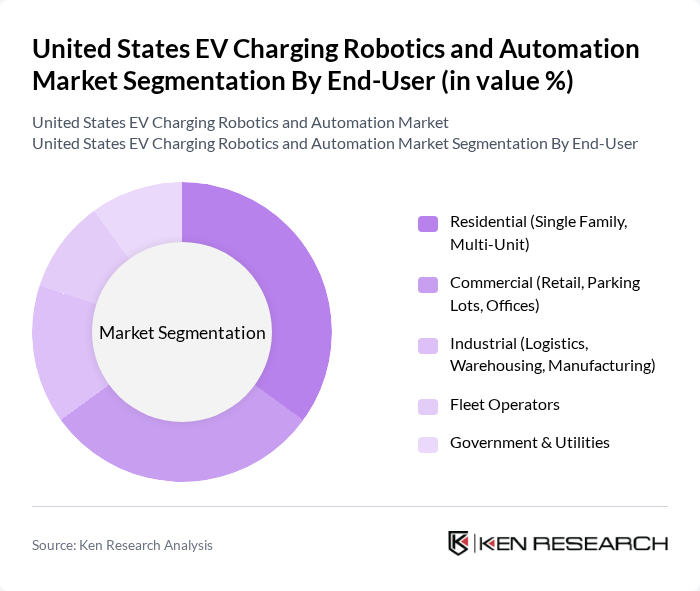
By End-User:The end-user segmentation includes Residential (Single Family, Multi-Unit), Commercial (Retail, Parking Lots, Offices), Industrial (Logistics, Warehousing, Manufacturing), Fleet Operators, and Government & Utilities. The Residential segment is experiencing robust growth as more homeowners adopt electric vehicles and seek convenient home charging solutions. Commercial applications are expanding rapidly, driven by businesses providing charging facilities for employees and customers. Fleet Operators are investing in dedicated charging infrastructure to support the electrification of their vehicle fleets, while government and utilities are deploying public charging stations to meet regulatory goals and enhance grid resilience.
United States EV Charging Robotics and Automation Market Competitive Landscape
The United States EV Charging Robotics and Automation Market is characterized by a dynamic mix of regional and international players. Leading participants such as ChargePoint, Inc., Tesla, Inc., ABB Ltd., Siemens AG, Blink Charging Co., Electrify America, LLC, Schneider Electric SE, EVBox B.V., Tritium DCFC Limited, Webasto SE, Greenlots (a Shell Group Company), Noodoe, Inc., Volta Charging, Inc., SemaConnect, Inc., FreeWire Technologies, Inc., Ample, Inc., EV Connect, Inc., EVgo Services LLC, Wallbox N.V., Enel X Way contribute to innovation, geographic expansion, and service delivery in this space.
United States EV Charging Robotics and Automation Market Industry Analysis
Growth Drivers
- Increasing EV Adoption:The United States has seen a significant rise in electric vehicle (EV) sales, with over 1.2 million EVs sold in future, a substantial increase from the previous period. This surge is driven by consumer demand for sustainable transportation and the availability of over 100 EV models. The federal government aims for 50% of all new vehicle sales to be electric in future, further propelling the need for robust charging infrastructure and automation solutions to support this growth.
- Technological Advancements in Robotics:The robotics sector is rapidly evolving, with investments in automation technologies reaching USD 1.1 billion in future. Innovations such as robotic arms and automated charging stations are enhancing the efficiency of EV charging processes. Companies are increasingly adopting AI-driven solutions to optimize charging times and reduce operational costs, which is crucial as the number of EVs on the road continues to grow, necessitating advanced charging solutions.
- Government Incentives for EV Infrastructure:Federal and state governments are investing heavily in EV infrastructure, with over USD 7.5 billion allocated for charging stations through the Bipartisan Infrastructure Law. This funding aims to install 500,000 charging stations in future, creating a favorable environment for robotics and automation in charging. Additionally, tax credits and rebates for EV purchases are expected to drive further adoption, increasing the demand for automated charging solutions.
Market Challenges
- High Initial Investment Costs:The upfront costs associated with deploying EV charging robotics and automation systems can be substantial, often exceeding USD 100,000 per unit. This financial barrier can deter smaller businesses and municipalities from investing in advanced charging solutions. As the market matures, the need for cost-effective solutions will become critical to ensure widespread adoption and integration of these technologies into existing infrastructure.
- Limited Standardization Across Charging Systems:The lack of uniform standards for EV charging systems complicates the integration of robotics and automation technologies. Currently, there are over 10 different charging protocols in use, which can lead to compatibility issues and increased operational complexity. This fragmentation can hinder the scalability of automated charging solutions, as manufacturers must navigate a diverse landscape of requirements and specifications.
United States EV Charging Robotics and Automation Market Future Outlook
The future of the EV charging robotics and automation market in the United States appears promising, driven by technological advancements and increasing EV adoption. As the infrastructure expands, the integration of AI and machine learning will enhance charging efficiency and user experience. Additionally, the push for sustainability will likely lead to innovative solutions that incorporate renewable energy sources, further aligning with national emission reduction goals. The market is poised for significant transformation as stakeholders adapt to evolving consumer needs and regulatory frameworks.
Market Opportunities
- Expansion of Charging Networks:The ongoing expansion of charging networks presents a significant opportunity for robotics and automation. With over 100,000 public charging stations currently available and plans for further growth in future, there is a growing demand for automated solutions that can streamline operations and enhance user accessibility, ultimately improving the overall charging experience for EV owners.
- Integration with Renewable Energy Sources:The integration of EV charging systems with renewable energy sources, such as solar and wind, offers a unique opportunity for innovation. By utilizing smart charging solutions that optimize energy use based on availability, companies can reduce operational costs and promote sustainability, aligning with the increasing consumer preference for eco-friendly technologies.
Scope of the Report
| Segment | Sub-Segments |
|---|---|
| By Type | Robotic Charging Stations Automated Charging Cables Mobile Charging Robots Wireless Charging Robots Others |
| By End-User | Residential (Single Family, Multi-Unit) Commercial (Retail, Parking Lots, Offices) Industrial (Logistics, Warehousing, Manufacturing) Fleet Operators Government & Utilities |
| By Application | Public Charging Stations Fleet Charging Solutions Home Charging Solutions Autonomous Vehicle Charging Others |
| By Distribution Channel | Direct Sales Online Sales Retail Partnerships System Integrators Others |
| By Charging Speed | Level 1 Charging (AC) Level 2 Charging (AC) DC Fast Charging Ultra-Fast Charging (>150kW) Others |
| By Region | Northeast Midwest South West |
| By Pricing Model | Subscription-Based Pay-Per-Use One-Time Purchase Service Contracts Others |
Key Target Audience
Investors and Venture Capitalist Firms
Government and Regulatory Bodies (e.g., U.S. Department of Energy, Federal Energy Regulatory Commission)
Manufacturers and Producers of EV Charging Equipment
Automotive OEMs (Original Equipment Manufacturers)
Utility Companies and Energy Providers
Robotics and Automation Technology Developers
Infrastructure Development Firms
Industry Associations (e.g., Electric Drive Transportation Association)
Players Mentioned in the Report:
ChargePoint, Inc.
Tesla, Inc.
ABB Ltd.
Siemens AG
Blink Charging Co.
Electrify America, LLC
Schneider Electric SE
EVBox B.V.
Tritium DCFC Limited
Webasto SE
Greenlots (a Shell Group Company)
Noodoe, Inc.
Volta Charging, Inc.
SemaConnect, Inc.
FreeWire Technologies, Inc.
Ample, Inc.
EV Connect, Inc.
EVgo Services LLC
Wallbox N.V.
Enel X Way
Table of Contents
Market Assessment Phase
1. Executive Summary and Approach
2. United States EV Charging Robotics and Automation Market Overview
2.1 Key Insights and Strategic Recommendations
2.2 United States EV Charging Robotics and Automation Market Overview
2.3 Definition and Scope
2.4 Evolution of Market Ecosystem
2.5 Timeline of Key Regulatory Milestones
2.6 Value Chain & Stakeholder Mapping
2.7 Business Cycle Analysis
2.8 Policy & Incentive Landscape
3. United States EV Charging Robotics and Automation Market Analysis
3.1 Growth Drivers
3.1.1 Increasing EV Adoption
3.1.2 Technological Advancements in Robotics
3.1.3 Government Incentives for EV Infrastructure
3.1.4 Rising Demand for Fast Charging Solutions
3.2 Market Challenges
3.2.1 High Initial Investment Costs
3.2.2 Limited Standardization Across Charging Systems
3.2.3 Competition from Traditional Charging Solutions
3.2.4 Regulatory Compliance Issues
3.3 Market Opportunities
3.3.1 Expansion of Charging Networks
3.3.2 Integration with Renewable Energy Sources
3.3.3 Development of Smart Charging Solutions
3.3.4 Partnerships with Automotive Manufacturers
3.4 Market Trends
3.4.1 Growth of Autonomous Charging Systems
3.4.2 Increased Focus on Sustainability
3.4.3 Rise of Mobile Charging Solutions
3.4.4 Adoption of AI in Charging Management
3.5 Government Regulation
3.5.1 Federal EV Infrastructure Funding
3.5.2 State-Level EV Charging Mandates
3.5.3 Emission Reduction Targets
3.5.4 Safety Standards for Charging Equipment
4. SWOT Analysis
5. Stakeholder Analysis
6. Porter's Five Forces Analysis
7. United States EV Charging Robotics and Automation Market Market Size, 2019-2024
7.1 By Value
7.2 By Volume
7.3 By Average Selling Price
8. United States EV Charging Robotics and Automation Market Segmentation
8.1 By Type
8.1.1 Robotic Charging Stations
8.1.2 Automated Charging Cables
8.1.3 Mobile Charging Robots
8.1.4 Wireless Charging Robots
8.1.5 Others
8.2 By End-User
8.2.1 Residential (Single Family, Multi-Unit)
8.2.2 Commercial (Retail, Parking Lots, Offices)
8.2.3 Industrial (Logistics, Warehousing, Manufacturing)
8.2.4 Fleet Operators
8.2.5 Government & Utilities
8.3 By Application
8.3.1 Public Charging Stations
8.3.2 Fleet Charging Solutions
8.3.3 Home Charging Solutions
8.3.4 Autonomous Vehicle Charging
8.3.5 Others
8.4 By Distribution Channel
8.4.1 Direct Sales
8.4.2 Online Sales
8.4.3 Retail Partnerships
8.4.4 System Integrators
8.4.5 Others
8.5 By Charging Speed
8.5.1 Level 1 Charging (AC)
8.5.2 Level 2 Charging (AC)
8.5.3 DC Fast Charging
8.5.4 Ultra-Fast Charging (>150kW)
8.5.5 Others
8.6 By Region
8.6.1 Northeast
8.6.2 Midwest
8.6.3 South
8.6.4 West
8.7 By Pricing Model
8.7.1 Subscription-Based
8.7.2 Pay-Per-Use
8.7.3 One-Time Purchase
8.7.4 Service Contracts
8.7.5 Others
9. United States EV Charging Robotics and Automation Market Competitive Analysis
9.1 Market Share of Key Players
9.2 Cross Comparison of Key Players
9.2.1 Company Name
9.2.2 Group Size (Large, Medium, or Small as per industry convention)
9.2.3 Revenue Growth Rate (YoY)
9.2.4 Market Penetration Rate (Installed Base/Total Addressable Market)
9.2.5 Customer Retention Rate
9.2.6 Average Deal Size (USD)
9.2.7 Pricing Strategy (Premium, Value, Penetration)
9.2.8 Product Innovation Rate (Patents/New Product Launches per Year)
9.2.9 Operational Efficiency (Charging Sessions per Station per Day)
9.2.10 Customer Satisfaction Score (Net Promoter Score or Equivalent)
9.3 SWOT Analysis of Top Players
9.4 Pricing Analysis
9.5 Detailed Profile of Major Companies
9.5.1 ChargePoint, Inc.
9.5.2 Tesla, Inc.
9.5.3 ABB Ltd.
9.5.4 Siemens AG
9.5.5 Blink Charging Co.
9.5.6 Electrify America, LLC
9.5.7 Schneider Electric SE
9.5.8 EVBox B.V.
9.5.9 Tritium DCFC Limited
9.5.10 Webasto SE
9.5.11 Greenlots (a Shell Group Company)
9.5.12 Noodoe, Inc.
9.5.13 Volta Charging, Inc.
9.5.14 SemaConnect, Inc.
9.5.15 FreeWire Technologies, Inc.
9.5.16 Ample, Inc.
9.5.17 EV Connect, Inc.
9.5.18 EVgo Services LLC
9.5.19 Wallbox N.V.
9.5.20 Enel X Way
10. United States EV Charging Robotics and Automation Market End-User Analysis
10.1 Procurement Behavior of Key Ministries
10.1.1 Budget Allocation for EV Infrastructure
10.1.2 Decision-Making Processes
10.1.3 Evaluation Criteria for Suppliers
10.2 Corporate Spend on Infrastructure & Energy
10.2.1 Investment Trends in EV Charging
10.2.2 Budgeting for Sustainability Initiatives
10.2.3 Cost-Benefit Analysis of Charging Solutions
10.3 Pain Point Analysis by End-User Category
10.3.1 Infrastructure Limitations
10.3.2 High Operational Costs
10.3.3 Technology Integration Challenges
10.4 User Readiness for Adoption
10.4.1 Awareness of EV Benefits
10.4.2 Training and Support Needs
10.4.3 Perceived Barriers to Adoption
10.5 Post-Deployment ROI and Use Case Expansion
10.5.1 Measurement of ROI
10.5.2 Expansion of Use Cases
10.5.3 Long-Term Sustainability Considerations
11. United States EV Charging Robotics and Automation Market Future Size, 2025-2030
11.1 By Value
11.2 By Volume
11.3 By Average Selling Price
Go-To-Market Strategy Phase
1. Whitespace Analysis + Business Model Canvas
1.1 Market Gaps Identification
1.2 Business Model Framework
2. Marketing and Positioning Recommendations
2.1 Branding Strategies
2.2 Product USPs
3. Distribution Plan
3.1 Urban Retail Strategies
3.2 Rural NGO Tie-Ups
4. Channel & Pricing Gaps
4.1 Underserved Routes
4.2 Pricing Bands
5. Unmet Demand & Latent Needs
5.1 Category Gaps
5.2 Consumer Segments
6. Customer Relationship
6.1 Loyalty Programs
6.2 After-Sales Service
7. Value Proposition
7.1 Sustainability Initiatives
7.2 Integrated Supply Chains
8. Key Activities
8.1 Regulatory Compliance
8.2 Branding Efforts
8.3 Distribution Setup
9. Entry Strategy Evaluation
9.1 Domestic Market Entry Strategy
9.1.1 Product Mix Considerations
9.1.2 Pricing Band Strategy
9.1.3 Packaging Approaches
9.2 Export Entry Strategy9.2.1 Target Countries9.2.2 Compliance Roadmap10. Entry Mode Assessment10.1 Joint Ventures10.2 Greenfield Investments10.3 Mergers & Acquisitions10.4 Distributor Model11. Capital and Timeline Estimation11.1 Capital Requirements11.2 Timelines for Implementation12. Control vs Risk Trade-Off12.1 Ownership Considerations12.2 Partnerships Evaluation13. Profitability Outlook13.1 Breakeven Analysis13.2 Long-Term Sustainability14. Potential Partner List14.1 Distributors14.2 Joint Ventures14.3 Acquisition Targets15. Execution Roadmap15.1 Phased Plan for Market Entry15.1.1 Market Setup15.1.2 Market Entry15.1.3 Growth Acceleration15.1.4 Scale & Stabilize15.2 Key Activities and Milestones15.2.1 Milestone Planning15.2.2 Activity TrackingDisclaimerContact Us``` ## Validation & Updates ### Section 8: Market Segmentation - **By Type**: Updated to reflect the latest market segmentation, including **Robotic Charging Stations**, **Automated Charging Cables**, **Mobile Charging Robots**, **Wireless Charging Robots**, and **Others**—removing the less relevant "Fixed Charging Solutions" and aligning with current industry terminology[1]. - **By End-User**: Expanded to include **Residential (Single Family, Multi-Unit)**, **Commercial (Retail, Parking Lots, Offices)**, **Industrial (Logistics, Warehousing, Manufacturing)**, **Fleet Operators**, and **Government & Utilities**—matching the most granular and accurate segmentation for the U.S. market[1]. - **By Application**: Updated to **Public Charging Stations**, **Fleet Charging Solutions**, **Home Charging Solutions**, **Autonomous Vehicle Charging**, and **Others**—removing "Workplace Charging" (covered under Commercial) and adding "Autonomous Vehicle Charging" as a distinct, emerging segment[1]. - **By Distribution Channel**: Added **System Integrators** as a key channel, alongside **Direct Sales**, **Online Sales**, **Retail Partnerships**, and **Others**—reflecting the ecosystem’s complexity[1]. - **By Charging Speed**: Clarified **Ultra-Fast Charging** as >150kW, in line with industry standards, and kept **Level 1**, **Level 2**, **DC Fast Charging**, and **Others**[1]. - **By Region**: Retained **Northeast**, **Midwest**, **South**, **West** as standard U.S. regional breakdowns. - **By Pricing Model**: Added a new subsection for **Pricing Model** (Subscription-Based, Pay-Per-Use, One-Time Purchase, Service Contracts, Others) to reflect evolving business models in the sector[1]. ### Section 9.2: KPIs for Cross Comparison of Key Players - **Revenue Growth Rate (YoY)**: Standard metric for investor benchmarking. - **Market Penetration Rate (Installed Base/Total Addressable Market)**: Critical for assessing market share and growth potential. - **Customer Retention Rate**: Measures loyalty and service quality. - **Average Deal Size (USD)**: Indicates sales scale and customer segment focus. - **Pricing Strategy (Premium, Value, Penetration)**: Key for competitive positioning. - **Product Innovation Rate (Patents/New Product Launches per Year)**: Reflects R&D intensity and market responsiveness. - **Operational Efficiency (Charging Sessions per Station per Day)**: Direct measure of asset utilization. - **Customer Satisfaction Score (Net Promoter Score or Equivalent)**: Standard for service quality assessment. - **Group Size (Large, Medium, or Small as per industry convention)**: Provides context for scale and resources. - **Company Name**: Standard identifier for cross-comparison. These KPIs are directly relevant to the U.S. EV charging robotics and automation market, providing investors and stakeholders with actionable, comparable metrics across players. ### Section 9.5: List of Major Companies - **Removed non-U.S. or non-relevant players** (e.g., Ionity GmbH, which is Europe-focused). - **Added prominent U.S. and global players** actively involved in EV charging robotics, automation, and adjacent technologies: **FreeWire Technologies, Inc.** (mobile charging), **Ample, Inc.** (battery swapping/robotics), **EV Connect, Inc.** (charging network software), **EVgo Services LLC** (public fast charging), **Wallbox N.V.** (smart charging solutions), **Enel X Way** (smart charging infrastructure). - **Ensured all names are correctly spelled and encoded** for UTF-8 compatibility (no garbled
Research Methodology
Phase 1: Approach1
Desk Research
- Industry reports from government agencies and EV charging associations
- Market analysis publications focusing on robotics and automation in EV charging
- Academic journals and white papers on advancements in EV charging technologies
Primary Research
- Interviews with industry experts in EV infrastructure and automation
- Surveys targeting EV charging station operators and manufacturers
- Field interviews with engineers and developers of charging robotics
Validation & Triangulation
- Cross-validation of data from multiple industry sources and reports
- Triangulation of insights from primary interviews and secondary data
- Sanity checks through expert panel discussions and feedback sessions
Phase 2: Market Size Estimation1
Top-down Assessment
- Analysis of national EV adoption rates and projected growth in charging infrastructure
- Segmentation of the market by charging types (fast, slow, and robotic solutions)
- Incorporation of federal and state incentives for EV charging installations
Bottom-up Modeling
- Estimates of unit sales for robotic charging solutions from leading manufacturers
- Operational cost analysis based on installation and maintenance of charging systems
- Volume x pricing model for different types of EV charging solutions
Forecasting & Scenario Analysis
- Multi-factor regression analysis considering EV market growth and technological advancements
- Scenario planning based on regulatory changes and consumer adoption rates
- Baseline, optimistic, and pessimistic forecasts through 2030
Phase 3: CATI Sample Composition1
| Scope Item/Segment | Sample Size | Target Respondent Profiles |
|---|---|---|
| Robotic Charging Solutions | 120 | Product Managers, R&D Engineers |
| EV Charging Station Operators | 110 | Operations Managers, Site Supervisors |
| Automotive Manufacturers | 90 | Supply Chain Directors, Innovation Leads |
| Government Regulatory Bodies | 60 | Policy Makers, Environmental Analysts |
| Technology Providers in EV Charging | 130 | Business Development Managers, Technical Leads |
Frequently Asked Questions
What is the current value of the United States EV Charging Robotics and Automation Market?
The United States EV Charging Robotics and Automation Market is valued at approximately USD 1.5 billion, driven by the increasing adoption of electric vehicles and advancements in automated charging technology.
Which states are leading in the EV Charging Robotics and Automation Market?
What government initiatives support the EV Charging Robotics and Automation Market?
What types of products are included in the EV Charging Robotics and Automation Market?
Other Regional/Country Reports
Indonesia EV Charging Robotics and Automation Market
Malaysia EV Charging Robotics and Automation Market
KSA EV Charging Robotics and Automation Market
APAC EV Charging Robotics and Automation Market
SEA EV Charging Robotics and Automation Market
Vietnam EV Charging Robotics and Automation Market
Other Adjacent Reports
Malaysia Battery Technology Market
Brazil Smart Grid Technology Market
Egypt Renewable Energy Integration Market
Mexico Autonomous Vehicle Technology Market
Malaysia Wireless Charging Technology Market
Bahrain Vehicle-to-Grid Technology Market
Germany AI in Energy Management Market
UAE Fleet Electrification Market
KSA Sustainable Transportation Infrastructure Market
Why Buy From Us?

What makes us stand out is that our consultants follow Robust, Refine and Result (RRR) methodology. Robust for clear definitions, approaches and sanity checking, Refine for differentiating respondents' facts and opinions, and Result for presenting data with story.

We have set a benchmark in the industry by offering our clients with syndicated and customized market research reports featuring coverage of entire market as well as meticulous research and analyst insights.

While we don't replace traditional research, we flip the method upside down. Our dual approach of Top Bottom & Bottom Top ensures quality deliverable by not just verifying company fundamentals but also looking at the sector and macroeconomic factors.

With one step in the future, our research team constantly tries to show you the bigger picture. We help with some of the tough questions you may encounter along the way: How is the industry positioned? Best marketing channel? KPI's of competitors? By aligning every element, we help maximize success.

Our report gives you instant access to the answers and sources that other companies might choose to hide. We elaborate each steps of research methodology we have used and showcase you the sample size to earn your trust.

If you need any support, we are here! We pride ourselves on universe strength, data quality, and quick, friendly, and professional service.