About the Report
Base Year 2024United States Laundry Facilities Dry Cleaning Services Market Overview
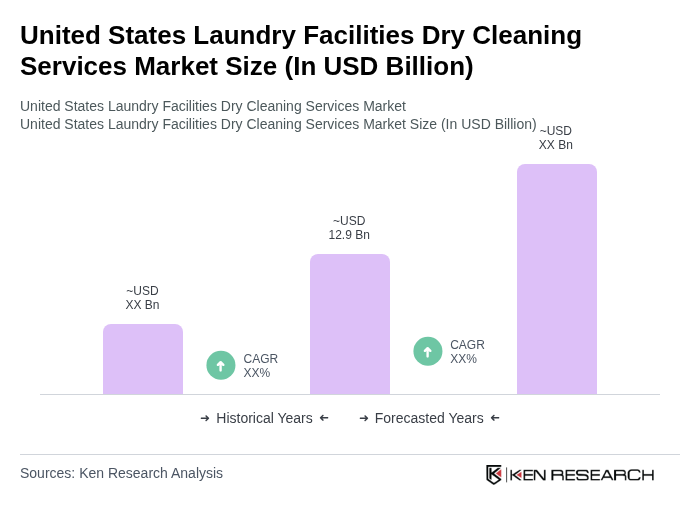
- The United States Laundry Facilities Dry Cleaning Services Market is valued at USD 12.9 billion, based on a five-year historical analysis. This growth is primarily driven by increasing urbanization, a rise in disposable income, and a growing demand for convenience in laundry services, particularly among dual-income and time-constrained households. The market has seen a pronounced shift towards eco-friendly practices, digital/on-demand app-based services, subscription models, and contactless pickup and delivery, catering to the evolving preferences of consumers.
- Key cities dominating this market include New York, Los Angeles, and Chicago, which are among the largest U.S. metropolitan areas by population and household density and have high concentrations of working professionals. These metropolitan areas also host extensive hospitality, healthcare, corporate, and retail clusters, leading to increased demand for both retail and commercial laundry and dry cleaning services, including bulk processing for hotels, restaurants, and healthcare facilities.
- The U.S. Environmental Protection Agency (EPA) has progressively tightened controls on harmful solvents used in dry cleaning, particularly perchloroethylene (perc), through rules such as the National Emission Standards for Hazardous Air Pollutants (NESHAP) for Perchloroethylene Dry Cleaning Facilities under the Clean Air Act, first issued by the U.S. EPA and later strengthened, which restricts perc emissions, mandates equipment standards, and sets monitoring and recordkeeping requirements for dry cleaning facilities. In addition, several states, including California, have enacted measures such as the Airborne Toxic Control Measure for Emissions of Perchloroethylene from Dry Cleaning Operations issued by the California Air Resources Board in 2007, which phases out traditional perc machines and promotes the transition to alternative, greener cleaning technologies. These regulatory frameworks aim to reduce environmental pollution and occupational exposure while encouraging adoption of liquid carbon dioxide, professional wet cleaning, and other eco-friendly solutions.
United States Laundry Facilities Dry Cleaning Services Market Segmentation
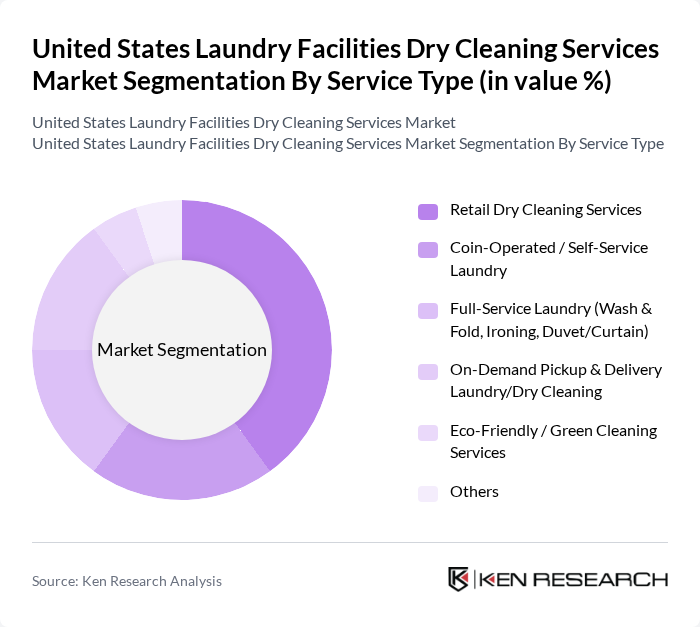
By Service Type:The service type segmentation includes various offerings that cater to different consumer needs. The primary subsegments are Retail Dry Cleaning Services, Coin-Operated / Self-Service Laundry, Full-Service Laundry (Wash & Fold, Ironing, Duvet/Curtain), On-Demand Pickup & Delivery Laundry/Dry Cleaning, Eco-Friendly / Green Cleaning Services, and Others. Among these, Retail Dry Cleaning Services remains an important subsegment, driven by demand for professional garment care, stain treatment, and handling of delicate fabrics, though volumes have been pressured by casualization of workwear and remote work patterns. Consumers increasingly prefer comprehensive full-service and on-demand options (including wash-and-fold and pickup/delivery) that save time, integrate mobile booking and digital payment, and offer flexible turnaround times, with many operators differentiating through eco-friendly detergents and wet-cleaning technologies.
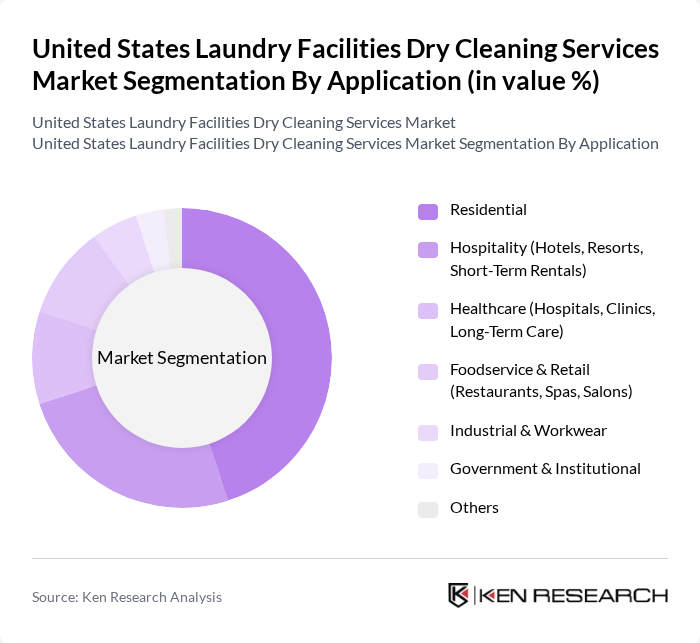
By Application:The application segmentation encompasses various sectors utilizing laundry and dry cleaning services, including Residential, Hospitality (Hotels, Resorts, Short-Term Rentals), Healthcare (Hospitals, Clinics, Long-Term Care), Foodservice & Retail (Restaurants, Spas, Salons), Industrial & Workwear, Government & Institutional, and Others. The Residential segment is the largest in terms of number of transactions, as households increasingly seek convenient laundry solutions such as wash-and-fold, subscription-based weekly services, and app-enabled pickup and delivery. The growing hospitality and healthcare sectors also significantly contribute to the demand for outsourced laundry, driven by stringent hygiene standards, high linen turnover, and the need for consistent quality and timely service for bed linens, towels, uniforms, and workwear.
United States Laundry Facilities Dry Cleaning Services Market Competitive Landscape
The United States Laundry Facilities Dry Cleaning Services Market is characterized by a dynamic mix of regional and international players. Leading participants such as Tide Cleaners, Lapels Dry Cleaning (Lapels Cleaners), Martinizing Dry Cleaning, ZIPS Cleaners, CD One Price Cleaners, Rinse, Mulberrys Garment Care, ByNext, Bolt Laundry, 2ULaundry, OXXO Care Cleaners, Sparklean Laundry, Laundry Genie, Laundry Care, Pressed4Time contribute to innovation, geographic expansion, and service delivery in this space.
United States Laundry Facilities Dry Cleaning Services Market Industry Analysis
Growth Drivers
- Increasing Demand for Convenience:The demand for convenience in laundry services is surging, with the U.S. dry cleaning industry generating approximately $9 billion in revenue in future. This growth is driven by busy lifestyles, where consumers prioritize time-saving services. The National Retail Federation reported that 70% of consumers prefer outsourcing laundry tasks, indicating a strong market for dry cleaning services that cater to this need for efficiency and convenience.
- Rising Awareness of Fabric Care:As consumers become more knowledgeable about fabric care, the demand for professional dry cleaning services is increasing. The American Cleaning Institute noted that 60% of consumers are now more conscious of how to maintain their garments. This trend is particularly evident in urban areas, where high-value garments are prevalent, leading to a projected increase in dry cleaning service usage by 15% in future, as consumers seek expert care for their clothing.
- Urban Population Growth:The expansion of urban populations is significantly impacting the dry cleaning market. According to the U.S. Census Bureau, urban areas are expected to grow by 2.5 million residents annually in future. This demographic shift leads to increased demand for laundry services, as urban dwellers often have limited space and time for laundry, driving the need for professional dry cleaning services that cater to their fast-paced lifestyles.
Market Challenges
- High Operational Costs:The dry cleaning industry faces significant operational costs, with average expenses reaching $1.5 million per establishment annually. These costs include labor, equipment maintenance, and utilities, which can pressure pricing strategies. As a result, many dry cleaners struggle to maintain profitability, especially in competitive markets where price sensitivity is high, leading to potential service reductions or closures.
- Environmental Regulations:Increasing environmental regulations pose a challenge for the dry cleaning industry. The Environmental Protection Agency (EPA) has implemented stricter guidelines on chemical usage, particularly concerning perchloroethylene, a common solvent. Compliance costs can exceed $100,000 for small businesses, forcing many to invest in costly eco-friendly alternatives, which may not be financially viable for all operators, impacting their competitiveness.
United States Laundry Facilities Dry Cleaning Services Market Future Outlook
The future of the U.S. dry cleaning market appears promising, driven by technological advancements and evolving consumer preferences. The integration of automation and eco-friendly practices is expected to enhance operational efficiency and attract environmentally conscious consumers. Additionally, the rise of subscription-based services is likely to reshape the market landscape, providing convenience and fostering customer loyalty. As urbanization continues, the demand for specialized cleaning services will also grow, presenting opportunities for businesses to innovate and expand their offerings.
Market Opportunities
- Adoption of Eco-Friendly Technologies:The shift towards sustainable practices presents a significant opportunity for dry cleaners. By adopting eco-friendly cleaning technologies, businesses can attract a growing segment of environmentally conscious consumers. The market for green cleaning products is projected to reach $4 billion in future, indicating a strong potential for dry cleaners to differentiate themselves through sustainable offerings.
- Expansion of Online Service Platforms:The growth of e-commerce and mobile applications offers dry cleaning businesses a chance to expand their reach. With online service platforms projected to increase by 20% in future, companies that invest in digital solutions can enhance customer convenience and streamline operations. This trend allows for better customer engagement and can significantly boost revenue through increased service accessibility.
Scope of the Report
| Segment | Sub-Segments |
|---|---|
| By Service Type | Retail Dry Cleaning Services Coin-Operated / Self-Service Laundry Full-Service Laundry (Wash & Fold, Ironing, Duvet/Curtain) On-Demand Pickup & Delivery Laundry/Dry Cleaning Eco-Friendly / Green Cleaning Services Others |
| By Application | Residential Hospitality (Hotels, Resorts, Short-Term Rentals) Healthcare (Hospitals, Clinics, Long-Term Care) Foodservice & Retail (Restaurants, Spas, Salons) Industrial & Workwear Government & Institutional Others |
| By Operation Format | Standalone Laundromats Dry Cleaning Stores & Plants Franchise Chains On-Site / On-Premise Laundry Facilities Hybrid (Retail + Pickup & Delivery) Others |
| By Ownership Model | Independent Operators Franchisee-Owned Locations Corporate-Owned Chains Multi-Location Regional Operators Others |
| By Technology & Automation Level | Conventional Equipment & Manual Processes Card / App-Based Machines & Kiosks Smart / IoT-Enabled Laundromats Automated Conveyors, Sorting & Packaging Systems Others |
| By Distribution & Access Channel | Walk-In / Storefront Services Mobile App & Web-Based Platforms Locker & Kiosk-Based Services B2B Contract Services Others |
| By Pricing Model | Pay-Per-Use (Per Garment / Per Pound) Subscription & Membership Plans Contract-Based / Volume Pricing (B2B) Dynamic & Promotional Pricing Others |
Key Target Audience
Investors and Venture Capitalist Firms
Government and Regulatory Bodies (e.g., Environmental Protection Agency, Occupational Safety and Health Administration)
Manufacturers and Producers of Dry Cleaning Equipment
Distributors and Retailers of Cleaning Supplies
Franchise Owners and Operators of Dry Cleaning Chains
Real Estate Developers and Property Management Firms
Industry Associations (e.g., Drycleaning & Laundry Institute)
Financial Institutions and Banks Providing Loans for Business Expansion
Players Mentioned in the Report:
Tide Cleaners
Lapels Dry Cleaning (Lapels Cleaners)
Martinizing Dry Cleaning
ZIPS Cleaners
CD One Price Cleaners
Rinse
Mulberrys Garment Care
ByNext
Bolt Laundry
2ULaundry
OXXO Care Cleaners
Sparklean Laundry
Laundry Genie
Laundry Care
Pressed4Time
Table of Contents
Market Assessment Phase
1. Executive Summary and Approach
2. United States Laundry Facilities Dry Cleaning Services Market Overview
2.1 Key Insights and Strategic Recommendations
2.2 United States Laundry Facilities Dry Cleaning Services Market Overview
2.3 Definition and Scope
2.4 Evolution of Market Ecosystem
2.5 Timeline of Key Regulatory Milestones
2.6 Value Chain & Stakeholder Mapping
2.7 Business Cycle Analysis
2.8 Policy & Incentive Landscape
3. United States Laundry Facilities Dry Cleaning Services Market Analysis
3.1 Growth Drivers
3.1.1 Increasing demand for convenience and time-saving services
3.1.2 Rising awareness of fabric care and maintenance
3.1.3 Growth in the fashion industry and high-value garments
3.1.4 Expansion of urban populations and lifestyles
3.2 Market Challenges
3.2.1 High operational costs and pricing pressures
3.2.2 Environmental regulations and sustainability concerns
3.2.3 Competition from alternative cleaning methods
3.2.4 Fluctuating demand due to economic conditions
3.3 Market Opportunities
3.3.1 Adoption of eco-friendly cleaning technologies
3.3.2 Expansion of online and mobile service platforms
3.3.3 Partnerships with fashion retailers and hotels
3.3.4 Growth in specialized cleaning services
3.4 Market Trends
3.4.1 Increasing use of automation and technology
3.4.2 Shift towards sustainable and green cleaning practices
3.4.3 Rise in subscription-based service models
3.4.4 Enhanced customer experience through personalized services
3.5 Government Regulation
3.5.1 Compliance with environmental protection standards
3.5.2 Regulations on chemical usage in dry cleaning
3.5.3 Labor laws affecting operational practices
3.5.4 Health and safety regulations for employees
4. SWOT Analysis
5. Stakeholder Analysis
6. Porter's Five Forces Analysis
7. United States Laundry Facilities Dry Cleaning Services Market Market Size, 2019-2024
7.1 By Value
7.2 By Volume
7.3 By Average Selling Price
8. United States Laundry Facilities Dry Cleaning Services Market Segmentation
8.1 By Service Type
8.1.1 Retail Dry Cleaning Services
8.1.2 Coin-Operated / Self-Service Laundry
8.1.3 Full-Service Laundry (Wash & Fold, Ironing, Duvet/Curtain)
8.1.4 On-Demand Pickup & Delivery Laundry/Dry Cleaning
8.1.5 Eco-Friendly / Green Cleaning Services
8.1.6 Others
8.2 By Application
8.2.1 Residential
8.2.2 Hospitality (Hotels, Resorts, Short-Term Rentals)
8.2.3 Healthcare (Hospitals, Clinics, Long-Term Care)
8.2.4 Foodservice & Retail (Restaurants, Spas, Salons)
8.2.5 Industrial & Workwear
8.2.6 Government & Institutional
8.2.7 Others
8.3 By Operation Format
8.3.1 Standalone Laundromats
8.3.2 Dry Cleaning Stores & Plants
8.3.3 Franchise Chains
8.3.4 On-Site / On-Premise Laundry Facilities
8.3.5 Hybrid (Retail + Pickup & Delivery)
8.3.6 Others
8.4 By Ownership Model
8.4.1 Independent Operators
8.4.2 Franchisee-Owned Locations
8.4.3 Corporate-Owned Chains
8.4.4 Multi-Location Regional Operators
8.4.5 Others
8.5 By Technology & Automation Level
8.5.1 Conventional Equipment & Manual Processes
8.5.2 Card / App-Based Machines & Kiosks
8.5.3 Smart / IoT-Enabled Laundromats
8.5.4 Automated Conveyors, Sorting & Packaging Systems
8.5.5 Others
8.6 By Distribution & Access Channel
8.6.1 Walk-In / Storefront Services
8.6.2 Mobile App & Web-Based Platforms
8.6.3 Locker & Kiosk-Based Services
8.6.4 B2B Contract Services
8.6.5 Others
8.7 By Pricing Model
8.7.1 Pay-Per-Use (Per Garment / Per Pound)
8.7.2 Subscription & Membership Plans
8.7.3 Contract-Based / Volume Pricing (B2B)
8.7.4 Dynamic & Promotional Pricing
8.7.5 Others
9. United States Laundry Facilities Dry Cleaning Services Market Competitive Analysis
9.1 Market Share of Key Players
9.2 Cross Comparison of Key Players
9.2.1 Company Name
9.2.2 Scale of Operations (Number of Locations / States Covered)
9.2.3 Revenue & Revenue Growth Rate
9.2.4 Share of Revenue from B2B vs B2C Clients
9.2.5 Average Ticket Size (Per Order / Per Pound)
9.2.6 Store-Level EBITDA Margin
9.2.7 Same-Store Sales Growth
9.2.8 Market Penetration in Core Metropolitan Areas
9.2.9 Digital Adoption Rate (App/Online Orders as % of Total)
9.2.10 Service Mix (Laundry vs Dry Cleaning vs Ancillary Services)
9.2.11 Customer Retention / Repeat Usage Rate
9.2.12 Average Turnaround Time (Order to Delivery)
9.2.13 Net Promoter Score (NPS) / Customer Satisfaction Score
9.2.14 Investment in Eco-Friendly Technologies (% of Capex)
9.3 SWOT Analysis of Top Players
9.4 Pricing Analysis
9.5 Detailed Profile of Major Companies
9.5.1 Tide Cleaners
9.5.2 Lapels Dry Cleaning (Lapels Cleaners)
9.5.3 Martinizing Dry Cleaning
9.5.4 ZIPS Cleaners
9.5.5 CD One Price Cleaners
9.5.6 Rinse
9.5.7 Mulberrys Garment Care
9.5.8 ByNext
9.5.9 Bolt Laundry
9.5.10 2ULaundry
9.5.11 OXXO Care Cleaners
9.5.12 Sparklean Laundry
9.5.13 Laundry Genie
9.5.14 Laundry Care
9.5.15 Pressed4Time
10. United States Laundry Facilities Dry Cleaning Services Market End-User Analysis
10.1 Procurement Behavior of Key Ministries
10.1.1 Budget Allocation Trends
10.1.2 Preferred Service Providers
10.1.3 Contracting Processes
10.1.4 Compliance Requirements
10.2 Corporate Spend on Infrastructure & Energy
10.2.1 Investment in Sustainable Practices
10.2.2 Budgeting for Cleaning Services
10.2.3 Cost-Benefit Analysis of Services
10.2.4 Trends in Corporate Partnerships
10.3 Pain Point Analysis by End-User Category
10.3.1 Quality of Service Issues
10.3.2 Timeliness of Service Delivery
10.3.3 Pricing Concerns
10.3.4 Availability of Specialized Services
10.4 User Readiness for Adoption
10.4.1 Awareness of Services
10.4.2 Willingness to Pay
10.4.3 Adoption of Technology
10.4.4 Feedback Mechanisms
10.5 Post-Deployment ROI and Use Case Expansion
10.5.1 Measurement of Service Effectiveness
10.5.2 Customer Retention Strategies
10.5.3 Expansion of Service Offerings
10.5.4 Long-term Partnerships
11. United States Laundry Facilities Dry Cleaning Services Market Future Size, 2025-2030
11.1 By Value
11.2 By Volume
11.3 By Average Selling Price
Go-To-Market Strategy Phase
1. Whitespace Analysis + Business Model Canvas
1.1 Market Gaps Identification
1.2 Business Model Development
2. Marketing and Positioning Recommendations
2.1 Branding Strategies
2.2 Product USPs
3. Distribution Plan
3.1 Urban Retail vs Rural NGO Tie-ups
4. Channel & Pricing Gaps
4.1 Underserved Routes
4.2 Pricing Bands
5. Unmet Demand & Latent Needs
5.1 Category Gaps
5.2 Consumer Segments
6. Customer Relationship
6.1 Loyalty Programs
6.2 After-Sales Service
7. Value Proposition
7.1 Sustainability
7.2 Integrated Supply Chains
8. Key Activities
8.1 Regulatory Compliance
8.2 Branding
8.3 Distribution Setup
9. Entry Strategy Evaluation
9.1 Domestic Market Entry Strategy
9.1.1 Product Mix
9.1.2 Pricing Band
9.1.3 Packaging
9.2 Export Entry Strategy
9.2.1 Target Countries
9.2.2 Compliance Roadmap
10. Entry Mode Assessment
10.1 JV
10.2 Greenfield
10.3 M&A
10.4 Distributor Model
11. Capital and Timeline Estimation
11.1 Capital Requirements
11.2 Timelines
12. Control vs Risk Trade-Off
12.1 Ownership vs Partnerships
13. Profitability Outlook
13.1 Breakeven Analysis
13.2 Long-Term Sustainability
14. Potential Partner List
14.1 Distributors
14.2 JVs
14.3 Acquisition Targets
15. Execution Roadmap
15.1 Phased Plan for Market Entry
15.1.1 Market Setup
15.1.2 Market Entry
15.1.3 Growth Acceleration
15.1.4 Scale & Stabilize
15.2 Key Activities and Milestones
15.2.1 Milestone Planning
15.2.2 Activity Tracking
Research Methodology
Phase 1: Approach1
Desk Research
- Industry reports from the Dry Cleaning and Laundry Institute and other relevant associations
- Market analysis from government publications and trade journals
- Statistical data from the U.S. Bureau of Labor Statistics and Census Bureau
Primary Research
- Interviews with owners and managers of dry cleaning facilities across various states
- Surveys targeting customers to understand preferences and service usage
- Focus groups with industry experts and stakeholders to gather insights on market trends
Validation & Triangulation
- Cross-validation of findings through multiple data sources including trade publications and expert opinions
- Triangulation of quantitative data with qualitative insights from interviews
- Sanity checks through expert panel reviews to ensure data accuracy and relevance
Phase 2: Market Size Estimation1
Top-down Assessment
- Analysis of national revenue figures for the dry cleaning industry from financial reports
- Segmentation of the market by service type, including wet cleaning and traditional dry cleaning
- Incorporation of demographic trends and urbanization effects on service demand
Bottom-up Modeling
- Estimation of average revenue per facility based on service pricing and volume
- Data collection on the number of operational dry cleaning facilities across the U.S.
- Calculation of market size based on facility count and average service frequency
Forecasting & Scenario Analysis
- Multi-variable regression analysis incorporating economic indicators and consumer behavior trends
- Scenario modeling based on potential impacts of environmental regulations and technological advancements
- Development of baseline, optimistic, and pessimistic forecasts through 2030
Phase 3: CATI Sample Composition1
| Scope Item/Segment | Sample Size | Target Respondent Profiles |
|---|---|---|
| Urban Dry Cleaning Facilities | 120 | Facility Owners, Operations Managers |
| Suburban Laundry Services | 100 | Service Managers, Customer Relations Heads |
| Commercial Laundry Accounts | 80 | Account Managers, Business Development Executives |
| Consumer Preferences in Dry Cleaning | 150 | Regular Customers, Occasional Users |
| Environmental Impact Awareness | 75 | Sustainability Advocates, Industry Experts |
Frequently Asked Questions
What is the current value of the United States Laundry Facilities Dry Cleaning Services Market?
The United States Laundry Facilities Dry Cleaning Services Market is valued at approximately USD 12.9 billion, reflecting a significant growth trend driven by urbanization, rising disposable incomes, and the demand for convenient laundry services.
What factors are driving growth in the dry cleaning services market?
Which cities are the largest markets for dry cleaning services in the U.S.?
What are the main service types offered in the dry cleaning market?
Other Regional/Country Reports
Indonesia Laundry Facilities Dry Cleaning Services Market
Malaysia Laundry Facilities Dry Cleaning Services Market
KSA Laundry Facilities Dry Cleaning Services Market
APAC Laundry Facilities Dry Cleaning Services Market
SEA Laundry Facilities Dry Cleaning Services Market
Other Adjacent Reports
Oman Commercial Cleaning Services Market
Mexico Textile Care Products MarketThailand Home Laundry Appliances Market
KSA On-Demand Delivery Services Market
Singapore Eco-Friendly Cleaning Solutions Market
Indonesia Hospitality Linen Services Market
Egypt Uniform Rental Services Market
KSA Fabric Protection Services Market
Brazil Industrial Laundry Equipment Market
Bahrain Apparel Repair Services Market
Why Buy From Us?

What makes us stand out is that our consultants follow Robust, Refine and Result (RRR) methodology. Robust for clear definitions, approaches and sanity checking, Refine for differentiating respondents' facts and opinions, and Result for presenting data with story.

We have set a benchmark in the industry by offering our clients with syndicated and customized market research reports featuring coverage of entire market as well as meticulous research and analyst insights.

While we don't replace traditional research, we flip the method upside down. Our dual approach of Top Bottom & Bottom Top ensures quality deliverable by not just verifying company fundamentals but also looking at the sector and macroeconomic factors.

With one step in the future, our research team constantly tries to show you the bigger picture. We help with some of the tough questions you may encounter along the way: How is the industry positioned? Best marketing channel? KPI's of competitors? By aligning every element, we help maximize success.

Our report gives you instant access to the answers and sources that other companies might choose to hide. We elaborate each steps of research methodology we have used and showcase you the sample size to earn your trust.

If you need any support, we are here! We pride ourselves on universe strength, data quality, and quick, friendly, and professional service.