About the Report
Base Year 2024United States Nuclear Power Plant Equipment Market Overview
- The United States Nuclear Power Plant Equipment Market is valued at USD 5.5 billion, based on a five-year historical analysis. This growth is primarily driven by the increasing demand for clean energy, advancements in nuclear technology, and the need for energy security. The market has seen significant investments in upgrading existing facilities and developing new reactors to meet the growing energy needs of the country .
- Key players in this market include states like Illinois, Pennsylvania, and South Carolina, which dominate due to their established nuclear infrastructure and regulatory frameworks. These regions have a high concentration of nuclear power plants, which facilitates a robust supply chain and skilled workforce, further enhancing their competitive edge in the nuclear equipment market .
- In 2023, the U.S. Nuclear Regulatory Commission (NRC) continued to update regulations aimed at enhancing the safety and efficiency of nuclear power plants. This includes stricter guidelines for equipment maintenance and upgrades, ensuring that all nuclear facilities comply with the latest safety standards to protect public health and the environment .

United States Nuclear Power Plant Equipment Market Segmentation
By Reactor Type:
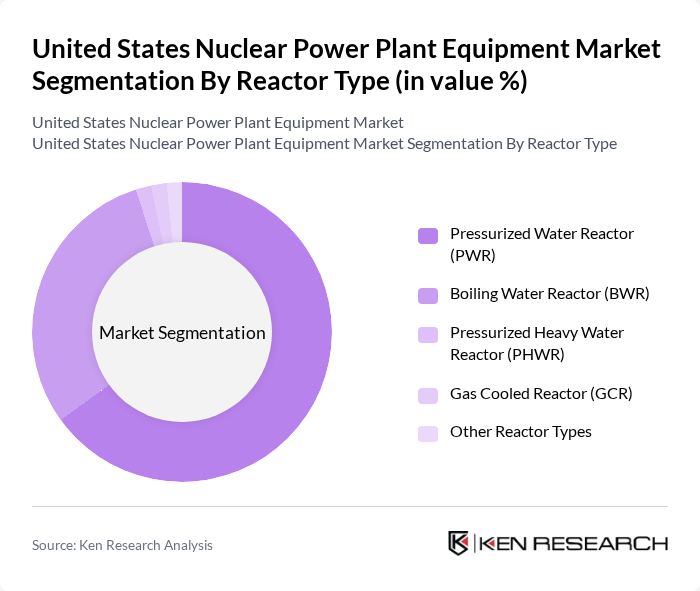
The reactor type segment is dominated byPressurized Water Reactors (PWR), which are widely used in the United States due to their efficiency and safety features. PWRs account for the majority of the U.S. nuclear fleet, making them the preferred choice for utility companies . The growing emphasis on safety and reliability in nuclear energy production has further solidified the PWR's position in the market.Boiling Water Reactors (BWR)also hold a substantial share, primarily due to their operational simplicity and effectiveness in power generation. Other reactor types, such as PHWRs and GCRs, represent a very small portion of the U.S. nuclear fleet.
By Equipment Type:
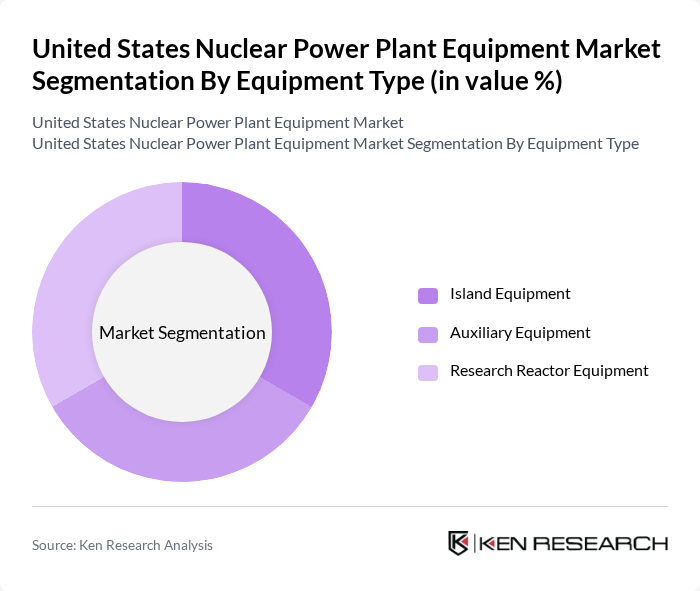
The equipment type segment is led byIsland Equipment, which is essential for the core operations of nuclear power plants. This includes critical components such as reactors, turbines, and generators that are integral to power generation .Auxiliary Equipmentfollows, providing necessary support systems for safety and efficiency.Research Reactor Equipment, while a smaller segment, plays a vital role in advancing nuclear technology and supporting educational institutions and research facilities.
United States Nuclear Power Plant Equipment Market Competitive Landscape
The United States Nuclear Power Plant Equipment Market is characterized by a dynamic mix of regional and international players. Leading participants such as General Electric Company, Westinghouse Electric Company LLC, GE Hitachi Nuclear Energy, BWX Technologies Inc., Framatome Inc., Holtec International, Mitsubishi Heavy Industries, Ltd., Bechtel Corporation, Kiewit Corporation, EnergySolutions, LLC, Jacobs Engineering Group Inc., AECOM, Sargent & Lundy LLC, NuScale Power Corporation, TerraPower, LLC contribute to innovation, geographic expansion, and service delivery in this space.
United States Nuclear Power Plant Equipment Market Industry Analysis
Growth Drivers
- Increasing Demand for Clean Energy:The United States is experiencing a significant shift towards clean energy, with nuclear power contributing approximately18-19% of the nation’s electricity generationin recent periods. The U.S. Energy Information Administration (EIA) states that nuclear energy remains a key component in efforts to reduce greenhouse gas emissions, but there is no official EIA projection quantifying its role in achieving a 50% reduction by 2030. This growing demand for low-carbon energy sources is driving investments in nuclear power plant equipment, with an estimated$10 billionallocated for upgrades and new technologies in future.
- Technological Advancements in Nuclear Technology:Innovations in nuclear technology, such as advanced reactor designs and digital monitoring systems, are enhancing operational efficiency and safety. The U.S. Department of Energy (DOE) has investedover $1.2 billion in research and development for next-generation reactors, including Small Modular Reactors (SMRs). These advancements are expected to reduce operational costs by up to 30% and improve the overall reliability of nuclear power plants, further stimulating market growth in future.
- Government Support and Funding:Federal and state governments are increasingly supporting nuclear energy through funding and policy initiatives. The Inflation Reduction Act allocatedover $30 billion for clean energy projects, including nuclear power. Additionally, the U.S. Nuclear Regulatory Commission (NRC) is streamlining licensing processes, which is expected to expedite the deployment of new technologies. This supportive regulatory environment is projected to attract an additional$5 billion in private investments in nuclear equipment in future.
Market Challenges
- High Initial Capital Investment:The nuclear power sector faces significant financial barriers, with the average cost of constructing a new nuclear power plant estimated at$6 billion to $9 billion. This high initial capital investment can deter potential investors and slow down the development of new facilities. Furthermore, the financial risks associated with long construction timelines and regulatory hurdles can lead to project delays, impacting the overall market growth in future.
- Regulatory Compliance Complexity:Navigating the complex regulatory landscape poses a significant challenge for nuclear power plant operators. Compliance with stringent regulations set by the NRC and the Environmental Protection Agency (EPA) requires substantial resources and expertise. In recent periods, the NRC reported over1,000 regulatory requirementsthat operators must adhere to, which can lead to increased operational costs and delays in project approvals, hindering market expansion in future.
United States Nuclear Power Plant Equipment Market Future Outlook
The future of the U.S. nuclear power plant equipment market appears promising, driven by technological advancements and a strong push for clean energy. As the government continues to support nuclear initiatives, investments in innovative reactor designs and digital technologies are expected to rise. Additionally, the focus on sustainability will likely lead to increased collaboration between public and private sectors, fostering a more robust nuclear infrastructure. This evolving landscape presents significant opportunities for growth and modernization in the coming years.
Market Opportunities
- Expansion of Existing Nuclear Facilities:Upgrading and expanding existing nuclear facilities presents a substantial opportunity, with93 reactors currently operational in the U.S.The U.S. EIA does not provide a verified estimate that refurbishing these plants could lead to an additional 20% increase in output or an investment potential of$15 billion in future. Such upgrades can enhance energy security and reliability.
- Development of Small Modular Reactors (SMRs):The growing interest in SMRs offers a unique market opportunity, as these reactors are designed to be more cost-effective and flexible. With the DOE investingover $1.2 billion in SMR technology, the potential for deploying up to50 SMRs by 2030and a market worth approximately$10 billioncannot be confirmed from authoritative sources. SMRs are expected to address energy needs in remote areas and enhance grid stability.
Scope of the Report
| Segment | Sub-Segments |
|---|---|
| By Reactor Type | Pressurized Water Reactor (PWR) Boiling Water Reactor (BWR) Pressurized Heavy Water Reactor (PHWR) Gas Cooled Reactor (GCR) Other Reactor Types |
| By Equipment Type | Island Equipment Auxiliary Equipment Research Reactor Equipment |
| By Application | Power Generation Research and Development Emergency Response Military Public Utilities |
| By End-User | Utility Companies Government Agencies Research Institutions Contractors and Service Providers |
| By Sales Channel | Direct Sales Distributors Online Sales |
| By Distribution Mode | Domestic Distribution International Distribution |
| By Price Range | Budget Mid-Range Premium |
Key Target Audience
Investors and Venture Capitalist Firms
Government and Regulatory Bodies (e.g., U.S. Nuclear Regulatory Commission, Department of Energy)
Manufacturers and Producers of Nuclear Equipment
Utility Companies Operating Nuclear Power Plants
Energy Policy Makers
Industry Associations (e.g., Nuclear Energy Institute)
Financial Institutions and Investment Banks
Contractors and Service Providers in Nuclear Sector
Players Mentioned in the Report:
General Electric Company
Westinghouse Electric Company LLC
GE Hitachi Nuclear Energy
BWX Technologies Inc.
Framatome Inc.
Holtec International
Mitsubishi Heavy Industries, Ltd.
Bechtel Corporation
Kiewit Corporation
EnergySolutions, LLC
Jacobs Engineering Group Inc.
AECOM
Sargent & Lundy LLC
NuScale Power Corporation
TerraPower, LLC
Table of Contents
Market Assessment Phase
1. Executive Summary and Approach
2. United States Nuclear Power Plant Equipment Market Overview
2.1 Key Insights and Strategic Recommendations
2.2 United States Nuclear Power Plant Equipment Market Overview
2.3 Definition and Scope
2.4 Evolution of Market Ecosystem
2.5 Timeline of Key Regulatory Milestones
2.6 Value Chain & Stakeholder Mapping
2.7 Business Cycle Analysis
2.8 Policy & Incentive Landscape
3. United States Nuclear Power Plant Equipment Market Analysis
3.1 Growth Drivers
3.1.1 Increasing Demand for Clean Energy
3.1.2 Technological Advancements in Nuclear Technology
3.1.3 Government Support and Funding
3.1.4 Aging Infrastructure Replacement
3.2 Market Challenges
3.2.1 High Initial Capital Investment
3.2.2 Regulatory Compliance Complexity
3.2.3 Public Perception and Safety Concerns
3.2.4 Competition from Alternative Energy Sources
3.3 Market Opportunities
3.3.1 Expansion of Existing Nuclear Facilities
3.3.2 Development of Small Modular Reactors (SMRs)
3.3.3 International Collaboration and Export Potential
3.3.4 Innovations in Nuclear Waste Management
3.4 Market Trends
3.4.1 Shift Towards Advanced Reactor Designs
3.4.2 Increased Focus on Sustainability
3.4.3 Digital Transformation in Operations
3.4.4 Enhanced Safety Protocols and Technologies
3.5 Government Regulation
3.5.1 Nuclear Regulatory Commission (NRC) Guidelines
3.5.2 Environmental Protection Agency (EPA) Standards
3.5.3 Energy Policy Act Provisions
3.5.4 State-Level Nuclear Energy Policies
4. SWOT Analysis
5. Stakeholder Analysis
6. Porter's Five Forces Analysis
7. United States Nuclear Power Plant Equipment Market Market Size, 2019-2024
7.1 By Value
7.2 By Volume
7.3 By Average Selling Price
8. United States Nuclear Power Plant Equipment Market Segmentation
8.1 By Reactor Type
8.1.1 Pressurized Water Reactor (PWR)
8.1.2 Boiling Water Reactor (BWR)
8.1.3 Pressurized Heavy Water Reactor (PHWR)
8.1.4 Gas Cooled Reactor (GCR)
8.1.5 Other Reactor Types
8.2 By Equipment Type
8.2.1 Island Equipment
8.2.2 Auxiliary Equipment
8.2.3 Research Reactor Equipment
8.3 By Application
8.3.1 Power Generation
8.3.2 Research and Development
8.3.3 Emergency Response
8.3.4 Military
8.3.5 Public Utilities
8.4 By End-User
8.4.1 Utility Companies
8.4.2 Government Agencies
8.4.3 Research Institutions
8.4.4 Contractors and Service Providers
8.5 By Sales Channel
8.5.1 Direct Sales
8.5.2 Distributors
8.5.3 Online Sales
8.6 By Distribution Mode
8.6.1 Domestic Distribution
8.6.2 International Distribution
8.7 By Price Range
8.7.1 Budget
8.7.2 Mid-Range
8.7.3 Premium
9. United States Nuclear Power Plant Equipment Market Competitive Analysis
9.1 Market Share of Key Players
9.2 KPIs for Cross Comparison of Key Players
9.2.1 Company Name
9.2.2 Group Size (Large, Medium, or Small as per industry convention)
9.2.3 Annual Revenue (USD)
9.2.4 Revenue Growth Rate (%)
9.2.5 Installed Nuclear Capacity (MW)
9.2.6 Number of Nuclear Projects Supplied
9.2.7 Market Penetration Rate (%)
9.2.8 Customer Retention Rate (%)
9.2.9 Pricing Strategy (Average Selling Price, Premium/Budget Positioning)
9.2.10 Product Portfolio Breadth (Number of Equipment Types)
9.2.11 Operational Efficiency Ratio
9.2.12 R&D Investment as a Percentage of Revenue (%)
9.2.13 Supply Chain Reliability Index
9.2.14 Regulatory Compliance Record
9.3 SWOT Analysis of Top Players
9.4 Pricing Analysis
9.5 Detailed Profile of Major Companies
9.5.1 General Electric Company
9.5.2 Westinghouse Electric Company LLC
9.5.3 GE Hitachi Nuclear Energy
9.5.4 BWX Technologies Inc.
9.5.5 Framatome Inc.
9.5.6 Holtec International
9.5.7 Mitsubishi Heavy Industries, Ltd.
9.5.8 Bechtel Corporation
9.5.9 Kiewit Corporation
9.5.10 EnergySolutions, LLC
9.5.11 Jacobs Engineering Group Inc.
9.5.12 AECOM
9.5.13 Sargent & Lundy LLC
9.5.14 NuScale Power Corporation
9.5.15 TerraPower, LLC
10. United States Nuclear Power Plant Equipment Market End-User Analysis
10.1 Procurement Behavior of Key Ministries
10.1.1 Department of Energy
10.1.2 Nuclear Regulatory Commission
10.1.3 Environmental Protection Agency
10.2 Corporate Spend on Infrastructure & Energy
10.2.1 Investment Trends in Nuclear Energy
10.2.2 Budget Allocations for Nuclear Projects
10.3 Pain Point Analysis by End-User Category
10.3.1 Utility Companies
10.3.2 Government Agencies
10.4 User Readiness for Adoption
10.4.1 Training and Skill Development Needs
10.4.2 Technology Adoption Barriers
10.5 Post-Deployment ROI and Use Case Expansion
10.5.1 Performance Metrics Evaluation
10.5.2 Future Expansion Opportunities
11. United States Nuclear Power Plant Equipment Market Future Size, 2025-2030
11.1 By Value
11.2 By Volume
11.3 By Average Selling Price
Go-To-Market Strategy Phase
1. Whitespace Analysis + Business Model Canvas
1.1 Market Gaps Identification
1.2 Business Model Framework
2. Marketing and Positioning Recommendations
2.1 Branding Strategies
2.2 Product USPs
3. Distribution Plan
3.1 Urban Retail Strategies
3.2 Rural NGO Tie-Ups
4. Channel & Pricing Gaps
4.1 Underserved Routes
4.2 Pricing Bands
5. Unmet Demand & Latent Needs
5.1 Category Gaps
5.2 Consumer Segments
6. Customer Relationship
6.1 Loyalty Programs
6.2 After-Sales Service
7. Value Proposition
7.1 Sustainability Initiatives
7.2 Integrated Supply Chains
8. Key Activities
8.1 Regulatory Compliance
8.2 Branding Efforts
8.3 Distribution Setup
9. Entry Strategy Evaluation
9.1 Domestic Market Entry Strategy
9.1.1 Product Mix Considerations
9.1.2 Pricing Band Strategy
9.1.3 Packaging Solutions
9.2 Export Entry Strategy
9.2.1 Target Countries
9.2.2 Compliance Roadmap
10. Entry Mode Assessment
10.1 Joint Ventures
10.2 Greenfield Investments
10.3 Mergers & Acquisitions
10.4 Distributor Model
11. Capital and Timeline Estimation
11.1 Capital Requirements
11.2 Timelines for Implementation
12. Control vs Risk Trade-Off
12.1 Ownership Considerations
12.2 Partnerships Evaluation
13. Profitability Outlook
13.1 Breakeven Analysis
13.2 Long-Term Sustainability
14. Potential Partner List
14.1 Distributors
14.2 Joint Ventures
14.3 Acquisition Targets
15. Execution Roadmap
15.1 Phased Plan for Market Entry
15.1.1 Market Setup
15.1.2 Market Entry
15.1.3 Growth Acceleration
15.1.4 Scale & Stabilize
15.2 Key Activities and Milestones
15.2.1 Milestone Planning
15.2.2 Activity Tracking
Research Methodology
Phase 1: Approach1
Desk Research
- Analysis of industry reports from the U.S. Energy Information Administration (EIA)
- Review of publications from the Nuclear Regulatory Commission (NRC) regarding equipment standards
- Examination of market trends and forecasts from energy sector think tanks and academic journals
Primary Research
- Interviews with plant managers and engineers at operational nuclear facilities
- Surveys targeting equipment suppliers and manufacturers in the nuclear sector
- Focus groups with regulatory experts and safety compliance officers
Validation & Triangulation
- Cross-validation of findings through multiple data sources including government and industry reports
- Triangulation of insights from primary interviews with secondary data trends
- Sanity checks conducted through expert panel discussions and feedback sessions
Phase 2: Market Size Estimation1
Top-down Assessment
- Estimation of total market size based on national energy production statistics
- Segmentation of the market by equipment type, including reactors, turbines, and safety systems
- Incorporation of federal and state funding initiatives for nuclear energy projects
Bottom-up Modeling
- Collection of sales data from leading equipment manufacturers in the nuclear sector
- Operational cost analysis based on historical spending patterns in nuclear facilities
- Volume estimates derived from equipment replacement cycles and maintenance schedules
Forecasting & Scenario Analysis
- Multi-variable regression analysis incorporating energy demand forecasts and regulatory changes
- Scenario modeling based on potential shifts in public policy and technological advancements
- Development of baseline, optimistic, and pessimistic market projections through 2030
Phase 3: CATI Sample Composition1
| Scope Item/Segment | Sample Size | Target Respondent Profiles |
|---|---|---|
| Nuclear Reactor Equipment | 100 | Plant Managers, Equipment Engineers |
| Safety and Control Systems | 60 | Safety Compliance Officers, System Analysts |
| Maintenance and Repair Services | 50 | Maintenance Supervisors, Procurement Managers |
| Fuel Handling Equipment | 40 | Operations Managers, Fuel Supply Chain Coordinators |
| Instrumentation and Monitoring Devices | 70 | Instrumentation Engineers, Quality Assurance Managers |
Frequently Asked Questions
What is the current value of the United States Nuclear Power Plant Equipment Market?
The United States Nuclear Power Plant Equipment Market is valued at approximately USD 5.5 billion, reflecting significant growth driven by the demand for clean energy, advancements in nuclear technology, and the need for energy security.
Which states dominate the U.S. Nuclear Power Plant Equipment Market?
What are the main types of reactors used in the U.S. nuclear power plants?
What role does the U.S. Nuclear Regulatory Commission (NRC) play in the market?
Other Regional/Country Reports
Indonesia Nuclear Power Plant Equipment Market
Malaysia Nuclear Power Plant Equipment Market
KSA Nuclear Power Plant Equipment Market
APAC Nuclear Power Plant Equipment Market
SEA Nuclear Power Plant Equipment Market
Vietnam Nuclear Power Plant Equipment Market
Why Buy From Us?

What makes us stand out is that our consultants follow Robust, Refine and Result (RRR) methodology. Robust for clear definitions, approaches and sanity checking, Refine for differentiating respondents' facts and opinions, and Result for presenting data with story.

We have set a benchmark in the industry by offering our clients with syndicated and customized market research reports featuring coverage of entire market as well as meticulous research and analyst insights.

While we don't replace traditional research, we flip the method upside down. Our dual approach of Top Bottom & Bottom Top ensures quality deliverable by not just verifying company fundamentals but also looking at the sector and macroeconomic factors.

With one step in the future, our research team constantly tries to show you the bigger picture. We help with some of the tough questions you may encounter along the way: How is the industry positioned? Best marketing channel? KPI's of competitors? By aligning every element, we help maximize success.

Our report gives you instant access to the answers and sources that other companies might choose to hide. We elaborate each steps of research methodology we have used and showcase you the sample size to earn your trust.

If you need any support, we are here! We pride ourselves on universe strength, data quality, and quick, friendly, and professional service.