About the Report
Base Year 2024US Degaussing System Market Overview
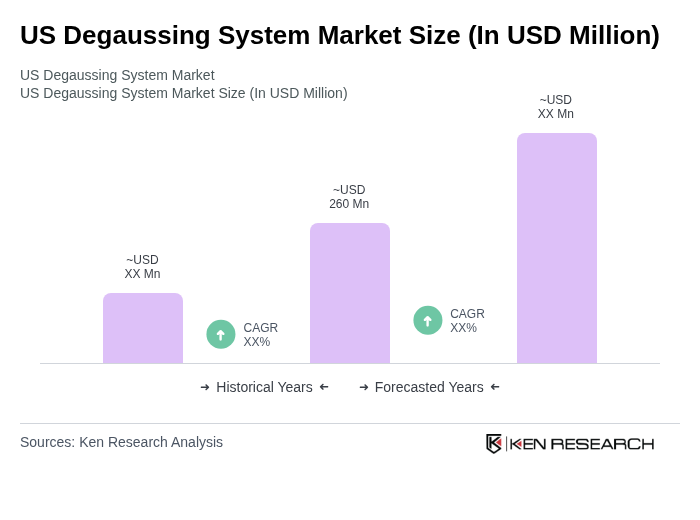
- The US Degaussing System Market is valued at USD 260 million, based on a five-year historical analysis and its share within the broader North American and global degaussing system market. This growth is primarily driven by increasing defense budgets, advancements in naval technology, and the rising need for maritime security, with North America identified as a leading region for degaussing investments. The demand for degaussing systems is particularly influenced by the modernization of naval fleets and the growing focus on countering underwater threats, including magnetic mines and sophisticated undersea warfare capabilities.
- The United States dominates the Degaussing System Market within North America due to its extensive naval operations and significant investments in defense technologies, supported by one of the largest defense budgets globally and a large blue?water navy. Key cities such as Washington D.C., Norfolk, and San Diego serve as major hubs for naval activities and shipyards, contributing to the market's growth through ongoing fleet maintenance, upgrades, and newbuild programs. The presence of leading defense contractors and a robust supply chain for naval electronics and signature management solutions further solidify the US's position in this market.
- The National Defense Authorization Act for Fiscal Year 2023, enacted by the United States Congress, authorizes continued funding for Navy shipbuilding, fleet modernization, and survivability enhancements, including provisions that support integration of advanced shipboard systems and signatures management technologies such as degaussing on surface combatants and submarines. This legislation, issued by the US Congress and administered through the Department of Defense, underpins programs to maintain the US Navy’s technological edge and operational readiness against evolving maritime threats by funding upgrades, retrofit efforts, and new construction that incorporate modern degaussing and magnetic ranging capabilities.
US Degaussing System Market Segmentation
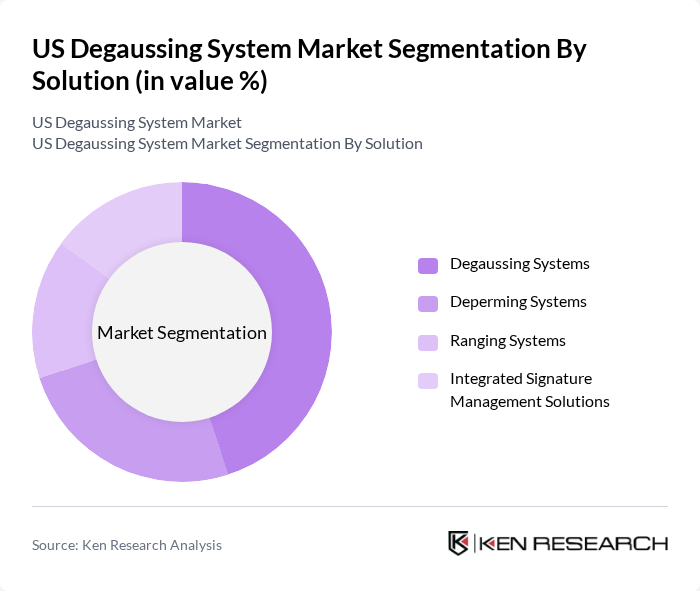
By Solution:The segmentation by solution includes various types of systems designed to mitigate magnetic signatures of naval vessels. The subsegments are Degaussing Systems, Deperming Systems, Ranging Systems, and Integrated Signature Management Solutions, which aligns with common industry groupings of magnetic signature control technologies for naval platforms. Among these, Degaussing Systems are the most prominent due to their critical role in naval operations, ensuring vessels remain less detectable to magnetic mines and influence torpedoes during routine deployments and high?risk transits. The increasing focus on naval modernization, life?extension programs for existing ships, and the need for enhanced stealth and survivability capabilities drive the demand for these systems across surface combatants, auxiliaries, and submarines.
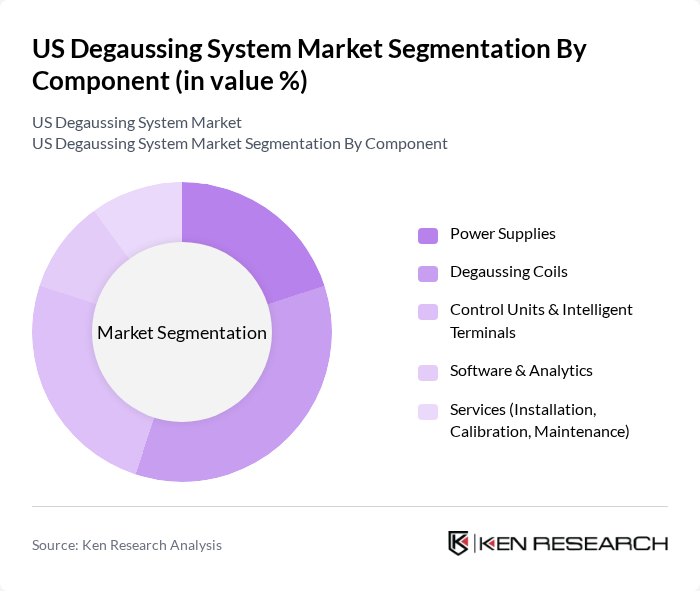
By Component:This segmentation focuses on the various components that make up degaussing systems. The subsegments include Power Supplies, Degaussing Coils, Control Units & Intelligent Terminals, Software & Analytics, and Services (Installation, Calibration, Maintenance), which reflects the typical architecture of modern automated degaussing solutions. The leading subsegment is Degaussing Coils, as they are essential for the operation of degaussing systems, directly influencing their effectiveness in reducing magnetic signatures across different ship classes. The increasing complexity of naval vessels, the use of high?strength steels and composite materials, and the shift toward digitally controlled, energy?efficient coil configurations necessitate advanced coil technologies and smart control electronics, further driving this segment's growth.
US Degaussing System Market Competitive Landscape
The US Degaussing System Market is characterized by a dynamic mix of regional and international players. Leading participants such as American Superconductor Corporation (AMSC), L3Harris Technologies, Inc., Ultra Electronics Holdings plc, General Dynamics Corporation, Lockheed Martin Corporation, Northrop Grumman Corporation, Raytheon Technologies Corporation, BAE Systems plc, Thales Group, Naval Group, Kongsberg Gruppen ASA, Saab AB, Leonardo S.p.A., Wärtsilä Corporation, Huntington Ingalls Industries, Inc. (HII) contribute to innovation, geographic expansion, and service delivery in this space, with several of these firms supplying degaussing equipment, integration services, and broader naval combat system solutions to the US Navy.
US Degaussing System Market Industry Analysis
Growth Drivers
- Increasing Demand for Maritime Security:The US defense budget for the future is projected to reach $886 billion, reflecting a significant commitment to enhancing maritime security. This increase is driven by geopolitical tensions and the need for robust naval capabilities. The US Navy's focus on countering asymmetric threats has led to a heightened demand for advanced degaussing systems, which are essential for protecting naval vessels from magnetic mines and other electromagnetic threats, ensuring operational readiness and safety.
- Technological Advancements in Degaussing Systems:The US degaussing system market is witnessing rapid technological advancements, with investments in R&D expected to exceed $1.5 billion in future. Innovations such as automated degaussing solutions and AI integration are enhancing system efficiency and effectiveness. These advancements not only improve the operational capabilities of naval fleets but also reduce maintenance costs, making modern degaussing systems more attractive to defense operators looking to upgrade their fleets.
- Rising Naval Fleet Modernization Initiatives:The US Navy's ongoing fleet modernization initiatives, with an estimated budget of $21 billion for shipbuilding in future, are driving the demand for advanced degaussing systems. As older vessels are replaced or upgraded, the integration of state-of-the-art degaussing technology becomes crucial. This modernization effort aims to enhance the Navy's operational capabilities and ensure that vessels are equipped to handle contemporary threats, thereby boosting the degaussing system market.
Market Challenges
- High Initial Investment Costs:The high initial investment required for advanced degaussing systems poses a significant challenge for many naval operators. The cost of implementing a comprehensive degaussing system can range from $500,000 to over $2 million per vessel, depending on the technology and integration complexity. This financial barrier can deter smaller naval operators from adopting these systems, limiting market growth and innovation in the sector.
- Limited Awareness Among Smaller Naval Operators:Many smaller naval operators lack awareness of the benefits and necessity of degaussing systems, which hampers market penetration. With over 70% of the global naval fleet comprising smaller operators, this knowledge gap represents a significant challenge. Efforts to educate these operators about electromagnetic threats and the advantages of degaussing technology are essential for expanding the market and ensuring comprehensive maritime security.
US Degaussing System Market Future Outlook
The US degaussing system market is poised for significant growth as technological advancements continue to reshape the landscape. The integration of AI and automation in degaussing solutions is expected to enhance operational efficiency and reduce costs. Additionally, increased government funding for naval upgrades will likely drive demand for modern degaussing systems. As awareness of electromagnetic threats grows, the market is anticipated to expand, particularly among smaller naval operators seeking to enhance their maritime security capabilities.
Market Opportunities
- Expansion into Emerging Markets:Emerging markets, particularly in Asia-Pacific and the Middle East, present significant opportunities for degaussing system manufacturers. With defense budgets in these regions projected to grow by 5% annually, there is an increasing demand for advanced naval technologies, including degaussing systems, to enhance maritime security and counter regional threats.
- Development of Hybrid Degaussing Systems:The development of hybrid degaussing systems that combine traditional and modern technologies offers a unique market opportunity. These systems can cater to a broader range of naval operators, providing cost-effective solutions that meet varying operational needs. This innovation can attract interest from both established and emerging naval forces looking to enhance their capabilities without incurring prohibitive costs.
Scope of the Report
| Segment | Sub-Segments |
|---|---|
| By Solution | Degaussing Systems Deperming Systems Ranging Systems Integrated Signature Management Solutions |
| By Component | Power Supplies Degaussing Coils Control Units & Intelligent Terminals Software & Analytics Services (Installation, Calibration, Maintenance) |
| By Vessel Type | Small Vessels (Patrol Boats, MCMV, OPV, FAC) Medium Vessels (Submarines, Corvettes, Destroyers) Large Vessels (Aircraft Carriers, Frigates, Amphibious Ships) Auxiliary & Support Vessels |
| By End Use | OEM Installations Aftermarket Retrofits Lifecycle Services & Upgrades |
| By Application | US Navy Surface Combatants US Navy Submarines Coast Guard & Homeland Security Vessels Commercial & Research Vessels Operating in US Waters |
| By Procurement & Funding Source | Department of Defense (US Navy, DARPA, Other DoD Agencies) US Coast Guard & Department of Homeland Security Foreign Military Sales (FMS) via US Prime Contractors Commercial Shipyards & Private Operators |
| By Installation Mode | New-Build Installations at US Shipyards Mid-Life Upgrade & Modernization Programs Repair, Overhaul & Recalibration Activities |
Key Target Audience
Investors and Venture Capitalist Firms
Government and Regulatory Bodies (e.g., Department of Defense, National Oceanic and Atmospheric Administration)
Manufacturers and Producers
Defense Contractors
Maritime Security Agencies
Naval Research Laboratories
Industry Associations (e.g., American Society of Naval Engineers)
Financial Institutions
Players Mentioned in the Report:
American Superconductor Corporation (AMSC)
L3Harris Technologies, Inc.
Ultra Electronics Holdings plc
General Dynamics Corporation
Lockheed Martin Corporation
Northrop Grumman Corporation
Raytheon Technologies Corporation
BAE Systems plc
Thales Group
Naval Group
Kongsberg Gruppen ASA
Saab AB
Leonardo S.p.A.
Wartsila Corporation
Huntington Ingalls Industries, Inc. (HII)
Table of Contents
Market Assessment Phase
1. Executive Summary and Approach
2. US Degaussing System Market Overview
2.1 Key Insights and Strategic Recommendations
2.2 US Degaussing System Market Overview
2.3 Definition and Scope
2.4 Evolution of Market Ecosystem
2.5 Timeline of Key Regulatory Milestones
2.6 Value Chain & Stakeholder Mapping
2.7 Business Cycle Analysis
2.8 Policy & Incentive Landscape
3. US Degaussing System Market Analysis
3.1 Growth Drivers
3.1.1 Increasing demand for maritime security
3.1.2 Technological advancements in degaussing systems
3.1.3 Rising naval fleet modernization initiatives
3.1.4 Growing awareness of electromagnetic threats
3.2 Market Challenges
3.2.1 High initial investment costs
3.2.2 Limited awareness among smaller naval operators
3.2.3 Regulatory compliance complexities
3.2.4 Competition from alternative technologies
3.3 Market Opportunities
3.3.1 Expansion into emerging markets
3.3.2 Development of hybrid degaussing systems
3.3.3 Partnerships with defense contractors
3.3.4 Government funding for naval upgrades
3.4 Market Trends
3.4.1 Shift towards automated degaussing solutions
3.4.2 Integration of AI in degaussing systems
3.4.3 Increased focus on cybersecurity measures
3.4.4 Adoption of modular degaussing systems
3.5 Government Regulation
3.5.1 Compliance with the Department of Defense standards
3.5.2 Environmental regulations on electromagnetic emissions
3.5.3 International maritime safety regulations
3.5.4 Procurement policies for defense contracts
4. SWOT Analysis
5. Stakeholder Analysis
6. Porter's Five Forces Analysis
7. US Degaussing System Market Market Size, 2019-2024
7.1 By Value
7.2 By Volume
7.3 By Average Selling Price
8. US Degaussing System Market Segmentation
8.1 By Solution
8.1.1 Degaussing Systems
8.1.2 Deperming Systems
8.1.3 Ranging Systems
8.1.4 Integrated Signature Management Solutions
8.2 By Component
8.2.1 Power Supplies
8.2.2 Degaussing Coils
8.2.3 Control Units & Intelligent Terminals
8.2.4 Software & Analytics
8.2.5 Services (Installation, Calibration, Maintenance)
8.3 By Vessel Type
8.3.1 Small Vessels (Patrol Boats, MCMV, OPV, FAC)
8.3.2 Medium Vessels (Submarines, Corvettes, Destroyers)
8.3.3 Large Vessels (Aircraft Carriers, Frigates, Amphibious Ships)
8.3.4 Auxiliary & Support Vessels
8.4 By End Use
8.4.1 OEM Installations
8.4.2 Aftermarket Retrofits
8.4.3 Lifecycle Services & Upgrades
8.5 By Application
8.5.1 US Navy Surface Combatants
8.5.2 US Navy Submarines
8.5.3 Coast Guard & Homeland Security Vessels
8.5.4 Commercial & Research Vessels Operating in US Waters
8.6 By Procurement & Funding Source
8.6.1 Department of Defense (US Navy, DARPA, Other DoD Agencies)
8.6.2 US Coast Guard & Department of Homeland Security
8.6.3 Foreign Military Sales (FMS) via US Prime Contractors
8.6.4 Commercial Shipyards & Private Operators
8.7 By Installation Mode
8.7.1 New-Build Installations at US Shipyards
8.7.2 Mid-Life Upgrade & Modernization Programs
8.7.3 Repair, Overhaul & Recalibration Activities
9. US Degaussing System Market Competitive Analysis
9.1 Market Share of Key Players
9.2 Cross Comparison of Key Players
9.2.1 Company Name
9.2.2 Primary Role in Value Chain (OEM, System Integrator, Component Supplier, Service Provider)
9.2.3 US Degaussing System Revenue (Latest Fiscal Year)
9.2.4 US Market Share in Degaussing & Signature Management
9.2.5 3-Year CAGR in US Degaussing Revenues
9.2.6 Order Backlog / Funded Contract Value with US Navy & DoD
9.2.7 R&D Intensity (% of Revenue Spent on Degaussing-Related R&D)
9.2.8 Breadth of Portfolio (Solutions, Vessel Types, Lifecycle Services)
9.2.9 Installed Base in US Fleet (Number of Vessels Equipped)
9.2.10 Win Rate in Recent US Naval & Coast Guard Tenders
9.2.11 Partnership & Alliance Network Strength in the US
9.3 SWOT Analysis of Top Players
9.4 Pricing Analysis
9.5 Detailed Profile of Major Companies
9.5.1 American Superconductor Corporation (AMSC)
9.5.2 L3Harris Technologies, Inc.
9.5.3 Ultra Electronics Holdings plc
9.5.4 General Dynamics Corporation
9.5.5 Lockheed Martin Corporation
9.5.6 Northrop Grumman Corporation
9.5.7 Raytheon Technologies Corporation
9.5.8 BAE Systems plc
9.5.9 Thales Group
9.5.10 Naval Group
9.5.11 Kongsberg Gruppen ASA
9.5.12 Saab AB
9.5.13 Leonardo S.p.A.
9.5.14 Wärtsilä Corporation
9.5.15 Huntington Ingalls Industries, Inc. (HII)
10. US Degaussing System Market End-User Analysis
10.1 Procurement Behavior of Key Ministries
10.1.1 Defense Ministry Procurement Trends
10.1.2 Coast Guard Budget Allocations
10.1.3 Research Vessel Funding Sources
10.1.4 Others
10.2 Corporate Spend on Infrastructure & Energy
10.2.1 Investment in Naval Infrastructure
10.2.2 Spending on Security Enhancements
10.2.3 Budget for Technological Upgrades
10.2.4 Others
10.3 Pain Point Analysis by End-User Category
10.3.1 Military Challenges
10.3.2 Commercial Shipping Concerns
10.3.3 Regulatory Compliance Issues
10.3.4 Others
10.4 User Readiness for Adoption
10.4.1 Assessment of Current Capabilities
10.4.2 Training and Support Needs
10.4.3 Technology Adoption Barriers
10.4.4 Others
10.5 Post-Deployment ROI and Use Case Expansion
10.5.1 Evaluation of System Effectiveness
10.5.2 Long-term Cost Savings
10.5.3 Opportunities for System Upgrades
10.5.4 Others
11. US Degaussing System Market Future Size, 2025-2030
11.1 By Value
11.2 By Volume
11.3 By Average Selling Price
Go-To-Market Strategy Phase
1. Whitespace Analysis + Business Model Canvas
1.1 Market Gaps Identification
1.2 Business Model Development
2. Marketing and Positioning Recommendations
2.1 Branding Strategies
2.2 Product USPs
3. Distribution Plan
3.1 Urban Retail Strategies
3.2 Rural NGO Tie-ups
4. Channel & Pricing Gaps
4.1 Underserved Routes
4.2 Pricing Bands Analysis
5. Unmet Demand & Latent Needs
5.1 Category Gaps
5.2 Consumer Segments
6. Customer Relationship
6.1 Loyalty Programs
6.2 After-sales Service
7. Value Proposition
7.1 Sustainability Initiatives
7.2 Integrated Supply Chains
8. Key Activities
8.1 Regulatory Compliance
8.2 Branding Efforts
8.3 Distribution Setup
9. Entry Strategy Evaluation
9.1 Domestic Market Entry Strategy
9.1.1 Product Mix Considerations
9.1.2 Pricing Band Strategy
9.1.3 Packaging Solutions
9.2 Export Entry Strategy
9.2.1 Target Countries Identification
9.2.2 Compliance Roadmap Development
10. Entry Mode Assessment
10.1 Joint Ventures
10.2 Greenfield Investments
10.3 Mergers & Acquisitions
10.4 Distributor Model Evaluation
11. Capital and Timeline Estimation
11.1 Capital Requirements
11.2 Timelines for Implementation
12. Control vs Risk Trade-Off
12.1 Ownership Considerations
12.2 Partnerships Evaluation
13. Profitability Outlook
13.1 Breakeven Analysis
13.2 Long-term Sustainability Strategies
14. Potential Partner List
14.1 Distributors
14.2 Joint Ventures
14.3 Acquisition Targets
15. Execution Roadmap
15.1 Phased Plan for Market Entry
15.1.1 Market Setup Activities
15.1.2 Market Entry Steps
15.1.3 Growth Acceleration Strategies
15.1.4 Scale & Stabilize Actions
15.2 Key Activities and Milestones
15.2.1 Milestone Identification
15.2.2 Activity Scheduling
Research Methodology
Phase 1: Approach1
Desk Research
- Analysis of industry reports from defense and maritime organizations
- Review of government publications on naval defense spending and technology upgrades
- Examination of academic journals focusing on electromagnetic systems and naval applications
Primary Research
- Interviews with naval engineers specializing in degaussing systems
- Surveys with procurement officers from defense contractors
- Field interviews with military personnel involved in degaussing operations
Validation & Triangulation
- Cross-validation of findings with historical market data and trends
- Triangulation of insights from primary interviews and secondary data sources
- Sanity checks through expert panels comprising industry veterans
Phase 2: Market Size Estimation1
Top-down Assessment
- Analysis of total defense budgets allocated to naval technology
- Segmentation of market size by naval fleet types and operational requirements
- Incorporation of international defense agreements impacting degaussing system procurement
Bottom-up Modeling
- Estimation of unit costs based on leading degaussing system manufacturers
- Volume estimates derived from naval fleet sizes and modernization plans
- Cost analysis based on maintenance and operational expenditures for degaussing systems
Forecasting & Scenario Analysis
- Multi-factor regression analysis incorporating geopolitical tensions and naval expansion
- Scenario modeling based on technological advancements and regulatory changes
- Baseline, optimistic, and pessimistic projections through 2035
Phase 3: CATI Sample Composition1
| Scope Item/Segment | Sample Size | Target Respondent Profiles |
|---|---|---|
| Naval Fleet Modernization Programs | 100 | Naval Architects, Defense Program Managers |
| Defense Procurement Strategies | 80 | Procurement Officers, Contract Managers |
| Electromagnetic System Integration | 70 | Systems Engineers, Technical Directors |
| Operational Degaussing Procedures | 60 | Naval Operations Officers, Training Coordinators |
| International Defense Collaborations | 90 | Policy Analysts, Defense Attachés |
Frequently Asked Questions
What is the current value of the US Degaussing System Market?
The US Degaussing System Market is valued at approximately USD 260 million, reflecting its significant role within the broader North American and global degaussing system markets, driven by advancements in naval technology and increasing defense budgets.
What factors are driving the growth of the US Degaussing System Market?
Which regions are leading in degaussing system investments?
What are the main components of degaussing systems?
Other Regional/Country Reports
Indonesia Degaussing System Market
Malaysia Degaussing System Market
KSA Degaussing System Market
APAC Degaussing System Market
SEA Degaussing System Market
Vietnam Degaussing System Market
Other Adjacent Reports
Japan Naval Signature Management Market
South Korea Maritime Security Systems Market
Germany Shipbuilding and Repair Market
KSA Defense Electronics Market
South Africa Underwater Warfare Systems Market
South Africa Magnetic Sensor Technology Market
Mexico Naval Vessel MRO Market
Bahrain Electromagnetic Compatibility Market
Qatar Anti-Submarine Warfare Market
South Africa Naval Combat Systems Market
Why Buy From Us?

What makes us stand out is that our consultants follow Robust, Refine and Result (RRR) methodology. Robust for clear definitions, approaches and sanity checking, Refine for differentiating respondents' facts and opinions, and Result for presenting data with story.

We have set a benchmark in the industry by offering our clients with syndicated and customized market research reports featuring coverage of entire market as well as meticulous research and analyst insights.

While we don't replace traditional research, we flip the method upside down. Our dual approach of Top Bottom & Bottom Top ensures quality deliverable by not just verifying company fundamentals but also looking at the sector and macroeconomic factors.

With one step in the future, our research team constantly tries to show you the bigger picture. We help with some of the tough questions you may encounter along the way: How is the industry positioned? Best marketing channel? KPI's of competitors? By aligning every element, we help maximize success.

Our report gives you instant access to the answers and sources that other companies might choose to hide. We elaborate each steps of research methodology we have used and showcase you the sample size to earn your trust.

If you need any support, we are here! We pride ourselves on universe strength, data quality, and quick, friendly, and professional service.