About the Report
Base Year 2024US Personal Protective Equipment PPE Distribution Market Overview
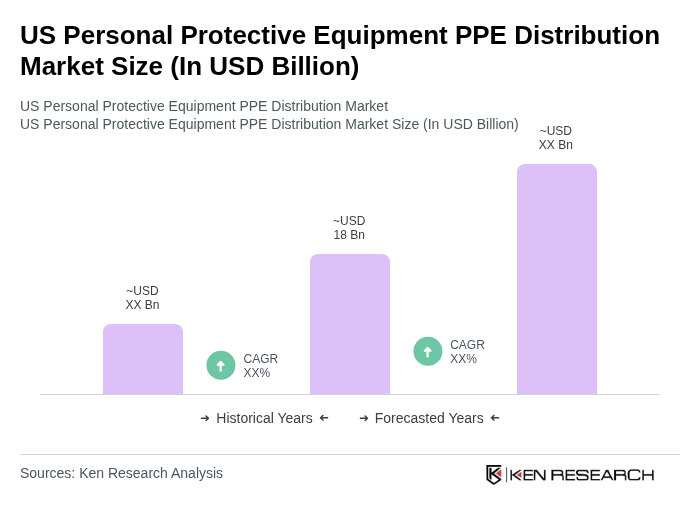
- The US Personal Protective Equipment (PPE) Distribution Market is valued at USD 18 billion, based on a five-year historical analysis of the share of the United States within the North America PPE market and the role of distributors relative to overall PPE revenue. This growth is primarily driven by increasing workplace safety regulations issued by the Occupational Safety and Health Administration (OSHA), heightened awareness of occupational hazards, and the ongoing demand for protective gear across various industries, including healthcare, construction, and manufacturing.
- Key demand hubs for PPE distribution in the US include major metropolitan areas such as New York, Los Angeles, and Chicago, which host extensive industrial, healthcare, logistics, and service-sector bases with high PPE consumption. Additionally, states like California and Texas are significant contributors, supported by their large workforces in construction, manufacturing, energy, and healthcare and by state-level occupational safety requirements that reinforce federal OSHA standards.
- OSHA continues to update and enforce PPE-related requirements under binding rules such as the Occupational Safety and Health Administration standard “Personal Protective Equipment,” 29 CFR 1910 Subpart I, issued by the US Department of Labor, which obliges employers in general industry, construction, and healthcare to assess workplace hazards, provide appropriate PPE (including eye, face, head, hand, respiratory, and fall protection), ensure proper training, and maintain compliance documentation. Recent enforcement emphasis on sectors such as construction, healthcare, oil and gas, and manufacturing has further increased demand for compliant PPE products in the US distribution market.
US Personal Protective Equipment PPE Distribution Market Segmentation
By Product Category:The product category segmentation includes various types of PPE that cater to different safety needs in the workplace. The subsegments include Hand Protection (Gloves), Protective Clothing, Eye & Face Protection, Respiratory Protection, Head & Face Protection (Helmets, Hardhats), Hearing Protection, Protective Footwear, Fall Protection, and Others (Accessories, Smart PPE, etc.).
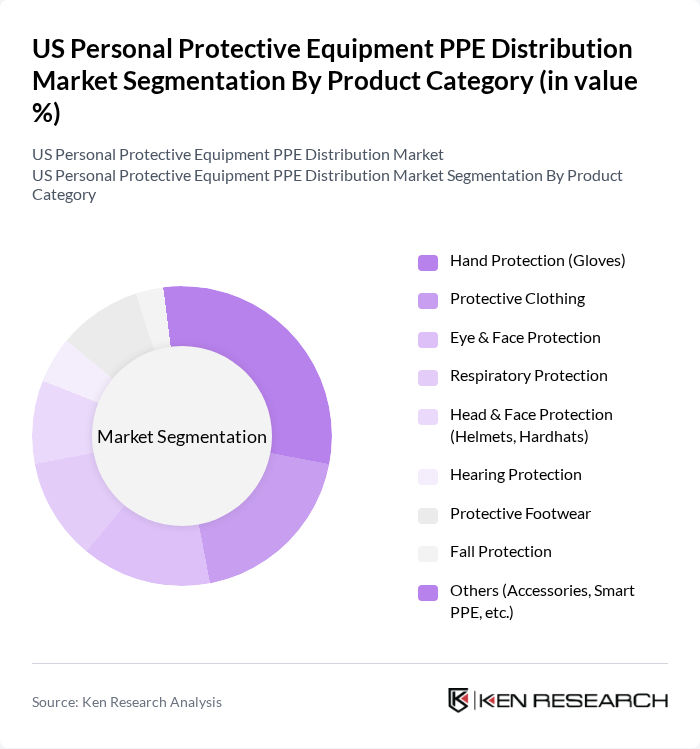
The Hand Protection (Gloves) subsegment is currently dominating the market, aligning with regional trends where hand protection accounts for the largest product share in North America PPE due to its intensive use in healthcare, food processing, manufacturing, and construction. The rise in regulations and standards mandating appropriate hand protection in workplaces, coupled with growing awareness of hygiene, infection control, and cut or chemical resistance, has led to a surge in demand for disposable and reusable gloves. Additionally, advancements in glove technology, such as lightweight cut-resistant materials, chemical-resistant nitrile formulations, and integration of sensors and connectivity in emerging smart gloves, are further driving this segment's growth. The Protective Clothing subsegment also shows significant demand, especially in industries like construction, oil and gas, and chemicals, where workers are exposed to hazardous environments and rely heavily on coveralls, flame-resistant garments, and chemical-protective apparel.
By End-Use Industry:The end-use industry segmentation encompasses various sectors that utilize PPE to ensure worker safety. The subsegments include Manufacturing, Construction, Healthcare & Life Sciences, Oil & Gas & Petrochemicals, Mining, Transportation & Logistics, Food & Beverage / Food Processing, Government, Defense & Public Safety, and Others (Utilities, Agriculture, etc.).
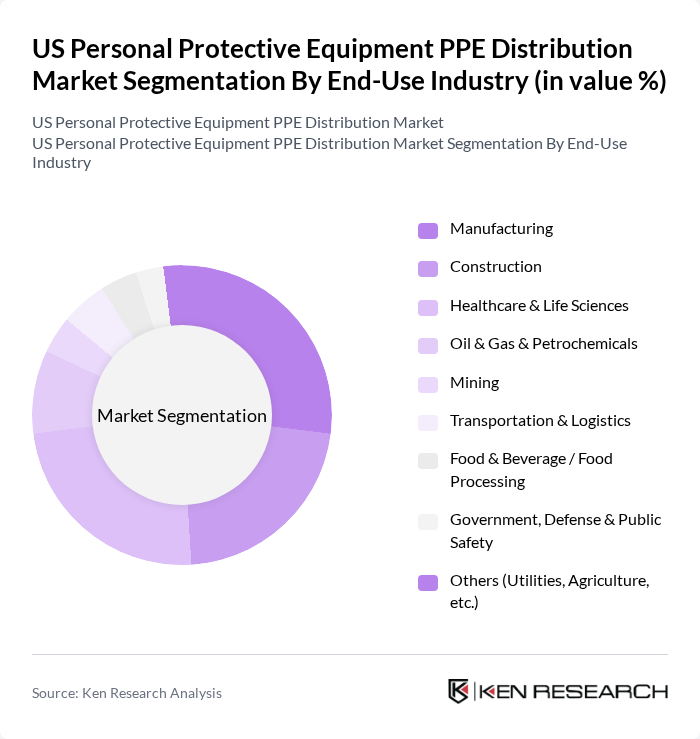
The Manufacturing sector remains one of the leading end-use industries for PPE in the US, supported by OSHA’s machinery, hazard communication, and PPE standards that require protection against mechanical, chemical, and noise hazards in industrial facilities. The Construction industry follows closely, with sustained high demand for head, eye, respiratory, fall, and hand protection due to the inherently hazardous nature of construction and infrastructure projects and strong enforcement of construction safety regulations. The Healthcare & Life Sciences sector has seen structurally higher PPE usage since the COVID-19 pandemic, and remains a major consumer of gloves, masks, gowns, and eye protection as hospitals, laboratories, and long-term care facilities maintain heightened infection-prevention protocols. Other sectors, such as Oil & Gas and Mining, also contribute to the demand due to risks of chemical exposure, fire, explosions, and confined-space work, driving the use of flame-resistant clothing, respiratory protection, and specialized head and fall protection.
US Personal Protective Equipment PPE Distribution Market Competitive Landscape
The US Personal Protective Equipment PPE Distribution Market is characterized by a dynamic mix of regional and international players. Leading participants such as 3M Company, Honeywell International Inc., DuPont de Nemours, Inc., Kimberly-Clark Corporation, MCR Safety, Ansell Limited, Lakeland Industries, Inc., Alpha Pro Tech, Ltd., Radians, Inc., Bullard, Protective Industrial Products, Inc., Medline Industries, LP, Ergodyne (A Tenacious Holdings, Inc. Brand), Safety Products Inc., Cintas Corporation contribute to innovation, geographic expansion, and service delivery in this space.
US Personal Protective Equipment PPE Distribution Market Industry Analysis
Growth Drivers
- Increasing Workplace Safety Regulations:The US has seen a significant rise in workplace safety regulations, with the Occupational Safety and Health Administration (OSHA) reporting over 1,000 new safety standards in the recent past. This regulatory environment mandates the use of PPE across various industries, particularly in construction and manufacturing, which employ approximately 15 million workers. As compliance becomes essential, the demand for PPE is projected to increase, driving market growth significantly.
- Rising Awareness of Health and Safety:Public awareness regarding health and safety has surged, especially post-pandemic. According to the National Safety Council, workplace injuries cost employers over $170 billion annually. This financial burden has prompted companies to invest more in PPE to protect their workforce. As organizations prioritize employee safety, the demand for high-quality PPE is expected to rise, further propelling market expansion in the coming years.
- Growth in Construction and Manufacturing Sectors:The construction sector in the US is projected to reach $1.8 trillion in the near future, while manufacturing output is expected to grow by 3.5% annually. This growth directly correlates with increased PPE demand, as these sectors require extensive protective gear to ensure worker safety. With over 7 million construction workers and 15 million in manufacturing, the need for PPE is critical, driving market dynamics positively.
Market Challenges
- Supply Chain Disruptions:The PPE market faces significant challenges due to ongoing supply chain disruptions, exacerbated by global events such as the COVID-19 pandemic. According to the Institute for Supply Management, a substantial share of manufacturers reported supply chain issues in the recent past. These disruptions lead to delays and increased costs, hindering the timely availability of essential PPE and impacting overall market growth.
- High Costs of Advanced PPE:Advanced PPE technologies, such as smart helmets and respirators, often come with high price tags, limiting accessibility for smaller businesses. The average cost of high-end PPE can exceed $200 per unit, which is a significant investment for companies with tight budgets. This financial barrier can restrict market penetration and slow down the adoption of innovative safety solutions across various industries.
US Personal Protective Equipment PPE Distribution Market Future Outlook
The future of the US PPE distribution market appears promising, driven by technological advancements and a heightened focus on workplace safety. As industries increasingly adopt smart PPE solutions, the integration of AI and IoT technologies will enhance product functionality and user experience. Additionally, the push for sustainable practices will likely lead to the development of eco-friendly PPE, aligning with consumer preferences and regulatory requirements, thus fostering market growth in the coming years.
Market Opportunities
- Expansion into Emerging Markets:Companies have a significant opportunity to expand into emerging markets, where industrial growth is accelerating. Regions such as Southeast Asia and Africa are experiencing rapid urbanization, leading to increased demand for PPE. This expansion can enhance revenue streams and diversify market presence, capitalizing on the growing need for safety equipment in developing economies.
- Customization of PPE for Specific Industries:There is a growing demand for customized PPE tailored to specific industry needs, such as healthcare and construction. By developing specialized products that meet unique safety requirements, manufacturers can differentiate themselves in a competitive market. This customization not only enhances user satisfaction but also opens new revenue channels, driving overall market growth.
Scope of the Report
| Segment | Sub-Segments |
|---|---|
| By Product Category | Hand Protection (Gloves) Protective Clothing Eye & Face Protection Respiratory Protection Head & Face Protection (Helmets, Hardhats) Hearing Protection Protective Footwear Fall Protection Others (Accessories, Smart PPE, etc.) |
| By End-Use Industry | Manufacturing Construction Healthcare & Life Sciences Oil & Gas & Petrochemicals Mining Transportation & Logistics Food & Beverage / Food Processing Government, Defense & Public Safety Others (Utilities, Agriculture, etc.) |
| By Customer Type | Industrial / Commercial Enterprises Group Purchasing Organizations (GPOs) & Hospital Systems Government & Municipal Agencies Small & Medium Businesses Individual / Retail Consumers |
| By Distribution Channel | Direct-to-End User (Manufacturer-to-End Customer) National / Regional Distributors Distributors / Wholesalers Safety Supply Specialists Online Platforms & E-commerce Marketplaces Retail Stores & Home Improvement Chains Others |
| By Order & Service Model | Spot / Transactional Purchases Long-Term Supply Contracts & Framework Agreements PPE Vending & Onsite Managed Inventory Programs Rental & Leasing Models Subscription & Consumption-Based Models |
| By Compliance & Certification Requirements | OSHA-Compliant PPE ANSI / ISEA Standards NIOSH-Certified Respiratory PPE FDA-Cleared Medical PPE Other National & International Standards (ISO, ASTM, CSA, etc.) |
Key Target Audience
Investors and Venture Capitalist Firms
Government and Regulatory Bodies (e.g., Occupational Safety and Health Administration, National Institute for Occupational Safety and Health)
Manufacturers and Producers
Distributors and Retailers
Healthcare Providers and Facilities
Emergency Services and First Responders
Industry Associations (e.g., American National Standards Institute, National Safety Council)
Financial Institutions
Players Mentioned in the Report:
3M Company
Honeywell International Inc.
DuPont de Nemours, Inc.
Kimberly-Clark Corporation
MCR Safety
Ansell Limited
Lakeland Industries, Inc.
Alpha Pro Tech, Ltd.
Radians, Inc.
Bullard
Protective Industrial Products, Inc.
Medline Industries, LP
Ergodyne (A Tenacious Holdings, Inc. Brand)
Safety Products Inc.
Cintas Corporation
Table of Contents
Market Assessment Phase
1. Executive Summary and Approach
2. US Personal Protective Equipment PPE Distribution Market Overview
2.1 Key Insights and Strategic Recommendations
2.2 US Personal Protective Equipment PPE Distribution Market Overview
2.3 Definition and Scope
2.4 Evolution of Market Ecosystem
2.5 Timeline of Key Regulatory Milestones
2.6 Value Chain & Stakeholder Mapping
2.7 Business Cycle Analysis
2.8 Policy & Incentive Landscape
3. US Personal Protective Equipment PPE Distribution Market Analysis
3.1 Growth Drivers
3.1.1 Increasing workplace safety regulations
3.1.2 Rising awareness of health and safety
3.1.3 Growth in construction and manufacturing sectors
3.1.4 Technological advancements in PPE
3.2 Market Challenges
3.2.1 Supply chain disruptions
3.2.2 High costs of advanced PPE
3.2.3 Lack of standardization
3.2.4 Competition from low-cost imports
3.3 Market Opportunities
3.3.1 Expansion into emerging markets
3.3.2 Development of eco-friendly PPE
3.3.3 Customization of PPE for specific industries
3.3.4 E-commerce growth for PPE distribution
3.4 Market Trends
3.4.1 Increased use of smart PPE
3.4.2 Focus on sustainability in manufacturing
3.4.3 Integration of AI in PPE design
3.4.4 Rise of direct-to-consumer sales models
3.5 Government Regulation
3.5.1 OSHA regulations on workplace safety
3.5.2 FDA guidelines for medical PPE
3.5.3 State-specific PPE mandates
3.5.4 Environmental regulations affecting materials used
4. SWOT Analysis
5. Stakeholder Analysis
6. Porter's Five Forces Analysis
7. US Personal Protective Equipment PPE Distribution Market Market Size, 2019-2024
7.1 By Value
7.2 By Volume
7.3 By Average Selling Price
8. US Personal Protective Equipment PPE Distribution Market Segmentation
8.1 By Product Category
8.1.1 Hand Protection (Gloves)
8.1.2 Protective Clothing
8.1.3 Eye & Face Protection
8.1.4 Respiratory Protection
8.1.5 Head & Face Protection (Helmets, Hardhats)
8.1.6 Hearing Protection
8.1.7 Protective Footwear
8.1.8 Fall Protection
8.1.9 Others (Accessories, Smart PPE, etc.)
8.2 By End-Use Industry
8.2.1 Manufacturing
8.2.2 Construction
8.2.3 Healthcare & Life Sciences
8.2.4 Oil & Gas & Petrochemicals
8.2.5 Mining
8.2.6 Transportation & Logistics
8.2.7 Food & Beverage / Food Processing
8.2.8 Government, Defense & Public Safety
8.2.9 Others (Utilities, Agriculture, etc.)
8.3 By Customer Type
8.3.1 Industrial / Commercial Enterprises
8.3.2 Group Purchasing Organizations (GPOs) & Hospital Systems
8.3.3 Government & Municipal Agencies
8.3.4 Small & Medium Businesses
8.3.5 Individual / Retail Consumers
8.4 By Distribution Channel
8.4.1 Direct-to-End User (Manufacturer-to-End Customer)
8.4.2 National / Regional Distributors
8.4.3 Distributors / Wholesalers
8.4.4 Safety Supply Specialists
8.4.5 Online Platforms & E-commerce Marketplaces
8.4.6 Retail Stores & Home Improvement Chains
8.4.7 Others
8.5 By Order & Service Model
8.5.1 Spot / Transactional Purchases
8.5.2 Long-Term Supply Contracts & Framework Agreements
8.5.3 PPE Vending & Onsite Managed Inventory Programs
8.5.4 Rental & Leasing Models
8.5.5 Subscription & Consumption-Based Models
8.6 By Compliance & Certification Requirements
8.6.1 OSHA-Compliant PPE
8.6.2 ANSI / ISEA Standards
8.6.3 NIOSH-Certified Respiratory PPE
8.6.4 FDA-Cleared Medical PPE
8.6.5 Other National & International Standards (ISO, ASTM, CSA, etc.)
9. US Personal Protective Equipment PPE Distribution Market Competitive Analysis
9.1 Market Share of Key Players(Micro, Small, Medium, Large Enterprises)
9.2 Cross Comparison of Key Players
9.2.1 Company Name
9.2.2 Group Size (Large, Medium, or Small as per industry convention)
9.2.3 US PPE Distribution Revenue (Latest Year, USD Million)
9.2.4 3-Year Revenue CAGR in US PPE Distribution (%)
9.2.5 Gross Margin in PPE Category (%)
9.2.6 Share of Revenue from Contracted / Recurring Accounts (%)
9.2.7 Average Order Value per Customer Segment (USD)
9.2.8 Market Coverage (Number of States / Distribution Centers)
9.2.9 Channel Mix (Share of Online vs Offline Sales, %)
9.2.10 Inventory Turnover (Times per Year)
9.2.11 On-Time Delivery Rate (%)
9.2.12 Key Industry Vertical Exposure (Top 3 End-Use Segments by Revenue)
9.2.13 Customer Retention / Renewal Rate (%)
9.2.14 New Customer Acquisition Rate (YoY, %)
9.2.15 Average Days Sales Outstanding (DSO)
9.3 SWOT Analysis of Top Players
9.4 Pricing Analysis(By Class and Payload)
9.5 Detailed Profile of Major Companies
9.5.1 3M Company
9.5.2 Honeywell International Inc.
9.5.3 DuPont de Nemours, Inc.
9.5.4 Kimberly-Clark Corporation
9.5.5 MCR Safety
9.5.6 Ansell Limited
9.5.7 Lakeland Industries, Inc.
9.5.8 Alpha Pro Tech, Ltd.
9.5.9 Radians, Inc.
9.5.10 Bullard
9.5.11 Protective Industrial Products, Inc.
9.5.12 Medline Industries, LP
9.5.13 Ergodyne (A Tenacious Holdings, Inc. Brand)
9.5.14 Safety Products Inc.
9.5.15 Cintas Corporation
10. US Personal Protective Equipment PPE Distribution Market End-User Analysis
10.1 Procurement Behavior of Key Ministries
10.1.1 Government procurement policies
10.1.2 Budget allocation for PPE
10.1.3 Supplier selection criteria
10.1.4 Contract management practices
10.2 Corporate Spend on Infrastructure & Energy
10.2.1 Investment trends in safety equipment
10.2.2 Budgeting for PPE in corporate sectors
10.2.3 Impact of economic conditions on spending
10.3 Pain Point Analysis by End-User Category
10.3.1 Safety compliance challenges
10.3.2 Quality concerns with PPE
10.3.3 Availability of suitable products
10.3.4 Cost management issues
10.4 User Readiness for Adoption
10.4.1 Training and education needs
10.4.2 Awareness of PPE benefits
10.4.3 Adoption barriers in various sectors
10.5 Post-Deployment ROI and Use Case Expansion
10.5.1 Measuring effectiveness of PPE
10.5.2 Long-term cost savings analysis
10.5.3 Expansion into new applications
11. US Personal Protective Equipment PPE Distribution Market Future Size, 2025-2030
11.1 By Value
11.2 By Volume
11.3 By Average Selling Price
Go-To-Market Strategy Phase
1. Whitespace Analysis + Business Model Canvas
1.1 Market gaps identification
1.2 Value proposition development
1.3 Revenue model exploration
1.4 Customer segmentation analysis
1.5 Competitive landscape overview
1.6 Key partnerships identification
1.7 Risk assessment
2. Marketing and Positioning Recommendations
2.1 Branding strategies
2.2 Product USPs
2.3 Target audience definition
2.4 Marketing channels selection
2.5 Messaging and communication strategy
3. Distribution Plan
3.1 Urban retail vs rural NGO tie-ups
3.2 Logistics and supply chain management
3.3 Distribution partnerships
3.4 Inventory management strategies
4. Channel & Pricing Gaps
4.1 Underserved routes
4.2 Pricing bands
4.3 Competitor pricing analysis
4.4 Value-based pricing strategies
5. Unmet Demand & Latent Needs
5.1 Category gaps
5.2 Consumer segments
5.3 Emerging trends analysis
5.4 Future demand forecasting
6. Customer Relationship
6.1 Loyalty programs
6.2 After-sales service
6.3 Customer feedback mechanisms
6.4 Community engagement strategies
7. Value Proposition
7.1 Sustainability
7.2 Integrated supply chains
7.3 Innovation in product offerings
7.4 Customer-centric approach
8. Key Activities
8.1 Regulatory compliance
8.2 Branding
8.3 Distribution setup
8.4 Training and development
9. Entry Strategy Evaluation
9.1 Domestic Market Entry Strategy
9.1.1 Product mix
9.1.2 Pricing band
9.1.3 Packaging
9.2 Export Entry Strategy
9.2.1 Target countries
9.2.2 Compliance roadmap
10. Entry Mode Assessment
10.1 JV
10.2 Greenfield
10.3 M&A
10.4 Distributor Model
11. Capital and Timeline Estimation
11.1 Capital requirements
11.2 Timelines
12. Control vs Risk Trade-Off
12.1 Ownership vs Partnerships
13. Profitability Outlook
13.1 Breakeven analysis
13.2 Long-term sustainability
14. Potential Partner List
14.1 Distributors
14.2 JVs
14.3 Acquisition targets
15. Execution Roadmap
15.1 Phased Plan for Market Entry
15.1.1 Market Setup
15.1.2 Market Entry
15.1.3 Growth Acceleration
15.1.4 Scale & Stabilize
15.2 Key Activities and Milestones
15.2.1 Milestone tracking
15.2.2 Performance metrics
Research Methodology
Phase 1: Approach1
Desk Research
- Analysis of industry reports from OSHA and NIOSH regarding PPE usage trends
- Review of market data from the Bureau of Labor Statistics on workplace safety regulations
- Examination of trade publications and white papers on PPE innovations and market dynamics
Primary Research
- Interviews with safety officers in various industries such as healthcare, construction, and manufacturing
- Surveys with procurement managers at companies specializing in PPE distribution
- Field interviews with end-users to understand PPE effectiveness and satisfaction levels
Validation & Triangulation
- Cross-validation of findings through multiple data sources including sales data and regulatory reports
- Triangulation of insights from primary interviews with secondary research findings
- Sanity checks conducted through expert panel reviews comprising industry veterans
Phase 2: Market Size Estimation1
Top-down Assessment
- Estimation of total market size based on national expenditure on workplace safety
- Segmentation of the market by industry verticals and PPE product categories
- Incorporation of government initiatives promoting PPE usage in high-risk sectors
Bottom-up Modeling
- Volume estimates derived from sales data of leading PPE manufacturers and distributors
- Operational cost analysis based on pricing models of various PPE products
- Calculation of market size based on unit sales and average selling prices across segments
Forecasting & Scenario Analysis
- Multi-factor regression analysis considering factors like workplace safety regulations and industry growth
- Scenario modeling based on potential changes in labor laws and economic conditions
- Development of baseline, optimistic, and pessimistic forecasts through 2030
Phase 3: CATI Sample Composition1
| Scope Item/Segment | Sample Size | Target Respondent Profiles |
|---|---|---|
| Healthcare PPE Usage | 120 | Healthcare Safety Officers, Procurement Managers |
| Construction Industry PPE Distribution | 90 | Site Managers, Safety Coordinators |
| Manufacturing Sector PPE Needs | 110 | Production Managers, Safety Compliance Officers |
| Retail Sector PPE Supply Chain | 80 | Supply Chain Managers, Inventory Control Specialists |
| Emergency Services PPE Requirements | 70 | Fire Chiefs, Emergency Response Coordinators |
Frequently Asked Questions
What is the current value of the US Personal Protective Equipment (PPE) Distribution Market?
The US Personal Protective Equipment (PPE) Distribution Market is valued at approximately USD 18 billion, reflecting significant growth driven by workplace safety regulations, increased awareness of occupational hazards, and demand across various industries such as healthcare, construction, and manufacturing.
What factors are driving the growth of the US PPE Distribution Market?
Which industries are the largest consumers of PPE in the US?
What are the main product categories in the US PPE Distribution Market?
Other Regional/Country Reports
Indonesia Personal Protective Equipment PPE Distribution Market
Malaysia Personal Protective Equipment PPE Distribution Market
KSA Personal Protective Equipment PPE Distribution Market
APAC Personal Protective Equipment PPE Distribution Market
SEA Personal Protective Equipment PPE Distribution Market
Vietnam Personal Protective Equipment PPE Distribution Market
Other Adjacent Reports
Brazil Industrial Safety Equipment Market
Oman Workplace Safety Training Market
Malaysia Construction Tools Market
Japan Healthcare Supplies Market
Bahrain Oil and Gas Equipment Market
Brazil Manufacturing Supplies Market
South Africa Respiratory Devices Market
Qatar Fall Protection Systems Market
Germany Protective Clothing Market
KSA Occupational Health Services Market
Why Buy From Us?

What makes us stand out is that our consultants follow Robust, Refine and Result (RRR) methodology. Robust for clear definitions, approaches and sanity checking, Refine for differentiating respondents' facts and opinions, and Result for presenting data with story.

We have set a benchmark in the industry by offering our clients with syndicated and customized market research reports featuring coverage of entire market as well as meticulous research and analyst insights.

While we don't replace traditional research, we flip the method upside down. Our dual approach of Top Bottom & Bottom Top ensures quality deliverable by not just verifying company fundamentals but also looking at the sector and macroeconomic factors.

With one step in the future, our research team constantly tries to show you the bigger picture. We help with some of the tough questions you may encounter along the way: How is the industry positioned? Best marketing channel? KPI's of competitors? By aligning every element, we help maximize success.

Our report gives you instant access to the answers and sources that other companies might choose to hide. We elaborate each steps of research methodology we have used and showcase you the sample size to earn your trust.

If you need any support, we are here! We pride ourselves on universe strength, data quality, and quick, friendly, and professional service.