About the Report
Base Year 2024Vietnam Agricultural Fencing Market Overview
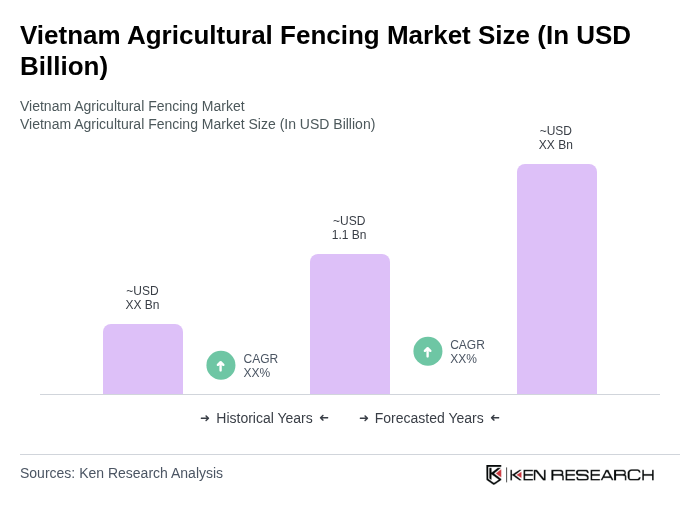
- The Vietnam Agricultural Fencing Market is valued at USD 1.1 billion, based on a five-year historical analysis, in the context of the broader Asia-Pacific fencing market which is estimated at around USD 9–10 billion and where agriculture is an important end-use segment. This growth is primarily driven by the increasing demand for agricultural productivity, the rise in livestock farming, and the need for effective crop and perimeter protection, supported by rising investments in rural infrastructure and farm mechanization programs in Vietnam.
- Key demand clusters for agricultural fencing are anchored around major economic regions linked to cities such as Ho Chi Minh City, Hanoi, and Da Nang, which dominate as distribution, processing, and logistics hubs for surrounding agricultural provinces rather than as primary production areas themselves. These urban centers host steel, wire mesh, plastic, and concrete manufacturers and distributors, facilitating availability of fencing solutions to livestock, cash crop, and plantation belts in the Mekong Delta, Central Highlands, and Red River Delta.
- In 2023, the Vietnamese government strengthened the policy framework for sustainable agricultural practices through instruments such as the Law on Environmental Protection 2020 (issued by the National Assembly) and Decree 08/2022/ND-CP guiding its implementation, which set out requirements on pollution control, solid waste management, and environmentally preferable materials in production and construction activities in rural and agricultural areas. Within this framework, provincial agricultural and rural development plans increasingly encourage the use of durable, recyclable, and lower-impact fencing materials (such as galvanized steel mesh, precast concrete posts, and long-life plastics) to enhance farm security and productivity while aligning with environmental protection objectives.
Vietnam Agricultural Fencing Market Segmentation
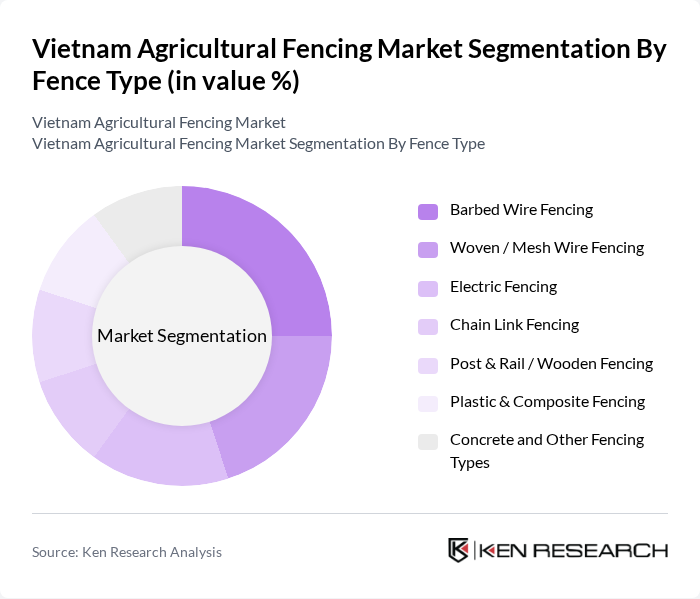
By Fence Type:The fencing market can be segmented into various types, including Barbed Wire Fencing, Woven / Mesh Wire Fencing, Electric Fencing, Chain Link Fencing, Post & Rail / Wooden Fencing, Plastic & Composite Fencing, and Concrete and Other Fencing Types. Each type serves different agricultural needs, with specific advantages in terms of durability, cost, and application. Barbed wire and woven/mesh wire are widely used around livestock paddocks and crop fields for cost-effective perimeter control; chain link and welded mesh are preferred near farm buildings and high-value crops; concrete posts and panels are often used in more permanent boundary structures, while plastics and composites are gaining ground for corrosion resistance and reduced maintenance in humid tropical conditions.
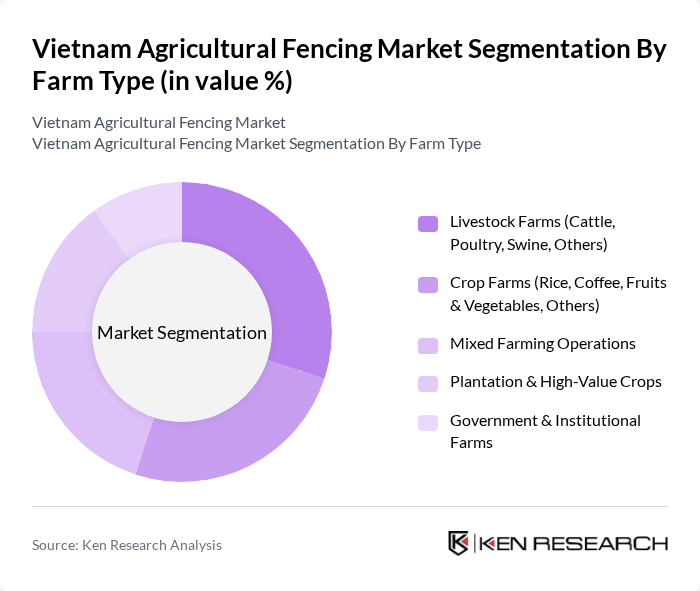
By Farm Type:The market can also be segmented based on farm types, including Livestock Farms (Cattle, Poultry, Swine, Others), Crop Farms (Rice, Coffee, Fruits & Vegetables, Others), Mixed Farming Operations, Plantation & High-Value Crops, and Government & Institutional Farms. Each farm type has unique fencing requirements based on the specific agricultural practices and livestock management, with livestock and mixed farms demanding stronger containment and predator-control solutions, plantation and high-value crop farms emphasizing protection from trespass, theft, and animal encroachment, and government or institutional farms using fencing for demonstration plots, research stations, and public rural infrastructure.
Vietnam Agricultural Fencing Market Competitive Landscape
The Vietnam Agricultural Fencing Market is characterized by a dynamic mix of regional and international players. Leading participants such as Hoa Phat Group, Hoa Sen Group, Nam Kim Steel, Ton Dong A Corporation, Dong A Steel Joint Stock Company, Binh Minh Plastic Joint Stock Company, An Phat Holdings, VICEM Cement / Concrete Producers (Representative Players), Regional Wire & Mesh Manufacturers (Representative Players), Local Agricultural Fencing Contractors (Representative Players), Vietnam Fencing & Metal Works Co., Ltd. (Representative), Import-Distribution Partners for Electric Fencing Systems, Leading Agricultural Cooperatives Procuring Fencing Solutions, International Brands Active in Vietnam (Representative), Emerging Technology Providers (Smart / Electric Fencing) contribute to innovation, geographic expansion, and service delivery in this space.
Vietnam Agricultural Fencing Market Industry Analysis
Growth Drivers
- Increasing Agricultural Activities:Vietnam's agricultural sector is projected to contribute approximately12%to the GDP in the future, driven by a rise in crop production and diversification. The area under cultivation is expected to reach11 million hectares, reflecting a3%increase from the previous year. This growth necessitates enhanced fencing solutions to protect crops from wildlife and ensure efficient land management, thereby boosting demand for agricultural fencing products.
- Rising Demand for Livestock Protection:With livestock production valued at around$8 billionin the future, the need for effective fencing to safeguard animals is paramount. The livestock population is anticipated to grow by5%annually, leading to increased investments in fencing solutions. Farmers are increasingly recognizing the importance of secure enclosures to prevent theft and protect livestock from predators, driving the agricultural fencing market forward.
- Government Initiatives for Rural Development:The Vietnamese government has allocated approximately$1.2 billionfor rural development projects in the future, focusing on enhancing agricultural infrastructure. This includes funding for fencing solutions to improve farm security and productivity. Such initiatives are expected to stimulate demand for modern fencing materials, as farmers seek to comply with new standards and improve their operational efficiency.
Market Challenges
- High Initial Investment Costs:The upfront costs associated with modern fencing solutions can be significant, often exceeding$1,000per hectare. Many smallholder farmers, who constitute about70%of the agricultural sector, struggle to afford these investments. This financial barrier limits the adoption of advanced fencing technologies, hindering market growth despite the evident benefits of improved fencing systems.
- Limited Awareness Among Farmers:A substantial portion of farmers in Vietnam remains unaware of the benefits of modern fencing solutions. Approximately60%of farmers still rely on traditional methods, which are often less effective. This lack of awareness, coupled with insufficient training programs, poses a significant challenge to market penetration for innovative fencing products, stalling potential growth in the sector.
Vietnam Agricultural Fencing Market Future Outlook
The Vietnam agricultural fencing market is poised for significant transformation, driven by increasing awareness of modern farming practices and the adoption of sustainable materials. As farmers seek to enhance productivity and protect their investments, the integration of smart technology in fencing solutions is expected to gain traction. Additionally, government support for rural development will likely facilitate the transition towards more efficient fencing systems, creating a favorable environment for market expansion in the future.
Market Opportunities
- Expansion of Organic Farming:The organic farming sector in Vietnam is projected to grow by20%annually, creating a demand for specialized fencing solutions that protect crops without harming the environment. This trend presents an opportunity for manufacturers to develop eco-friendly fencing options tailored to organic farmers' needs, enhancing market potential.
- Collaborations with Agricultural Cooperatives:With over20,000agricultural cooperatives in Vietnam, partnerships can facilitate the distribution of advanced fencing solutions. By collaborating with these cooperatives, fencing manufacturers can tap into a broader customer base, ensuring that innovative products reach farmers who need them most, thereby driving market growth.
Scope of the Report
| Segment | Sub-Segments |
|---|---|
| By Fence Type | Barbed Wire Fencing Woven / Mesh Wire Fencing Electric Fencing Chain Link Fencing Post & Rail / Wooden Fencing Plastic & Composite Fencing Concrete and Other Fencing Types |
| By Farm Type | Livestock Farms (Cattle, Poultry, Swine, Others) Crop Farms (Rice, Coffee, Fruits & Vegetables, Others) Mixed Farming Operations Plantation & High-Value Crops Government & Institutional Farms |
| By Material | Metal (Steel, Galvanized Iron, Others) Wood / Bamboo Plastic & Composite Concrete Others |
| By Application | Perimeter & Boundary Fencing Livestock Containment & Grazing Management Crop & Orchard Protection Farm Infrastructure & Asset Protection Biosecurity & Controlled Access Zones |
| By Region | Northern Vietnam Central Vietnam Southern Vietnam Mekong Delta Central Highlands |
| By Installation Type | Permanent Fencing Temporary / Mobile Fencing Contractor / Professional Installation Farmer / DIY Installation Hybrid Models |
| By Price Band | Economy Solutions Mid-Range Solutions Premium & Technologically Advanced Solutions Customized / Project-Based Solutions Others |
Key Target Audience
Investors and Venture Capitalist Firms
Government and Regulatory Bodies (e.g., Ministry of Agriculture and Rural Development, Ministry of Industry and Trade)
Manufacturers and Producers of Agricultural Fencing
Distributors and Retailers of Agricultural Supplies
Farmers' Cooperatives and Associations
Technology Providers for Agricultural Solutions
Environmental NGOs and Sustainability Organizations
Financial Institutions and Banks specializing in Agricultural Financing
Players Mentioned in the Report:
Hoa Phat Group
Hoa Sen Group
Nam Kim Steel
Ton Dong A Corporation
Dong A Steel Joint Stock Company
Binh Minh Plastic Joint Stock Company
An Phat Holdings
VICEM Cement / Concrete Producers (Representative Players)
Regional Wire & Mesh Manufacturers (Representative Players)
Local Agricultural Fencing Contractors (Representative Players)
Vietnam Fencing & Metal Works Co., Ltd. (Representative)
Import-Distribution Partners for Electric Fencing Systems
Leading Agricultural Cooperatives Procuring Fencing Solutions
International Brands Active in Vietnam (Representative)
Emerging Technology Providers (Smart / Electric Fencing)
Table of Contents
Market Assessment Phase
1. Executive Summary and Approach
2. Vietnam Agricultural Fencing Market Overview
2.1 Key Insights and Strategic Recommendations
2.2 Vietnam Agricultural Fencing Market Overview
2.3 Definition and Scope
2.4 Evolution of Market Ecosystem
2.5 Timeline of Key Regulatory Milestones
2.6 Value Chain & Stakeholder Mapping
2.7 Business Cycle Analysis
2.8 Policy & Incentive Landscape
3. Vietnam Agricultural Fencing Market Analysis
3.1 Growth Drivers
3.1.1 Increasing agricultural activities
3.1.2 Rising demand for livestock protection
3.1.3 Government initiatives for rural development
3.1.4 Technological advancements in fencing materials
3.2 Market Challenges
3.2.1 High initial investment costs
3.2.2 Limited awareness among farmers
3.2.3 Competition from traditional fencing methods
3.2.4 Regulatory hurdles in material sourcing
3.3 Market Opportunities
3.3.1 Expansion of organic farming
3.3.2 Increasing export potential of agricultural products
3.3.3 Development of eco-friendly fencing solutions
3.3.4 Collaborations with agricultural cooperatives
3.4 Market Trends
3.4.1 Shift towards sustainable materials
3.4.2 Integration of smart technology in fencing
3.4.3 Growing preference for customized fencing solutions
3.4.4 Rise in DIY fencing projects among farmers
3.5 Government Regulation
3.5.1 Standards for fencing materials
3.5.2 Subsidies for agricultural infrastructure
3.5.3 Environmental regulations on material usage
3.5.4 Safety regulations for livestock fencing
4. SWOT Analysis
5. Stakeholder Analysis
6. Porter's Five Forces Analysis
7. Vietnam Agricultural Fencing Market Market Size, 2019-2024
7.1 By Value
7.2 By Volume
7.3 By Average Selling Price
8. Vietnam Agricultural Fencing Market Segmentation
8.1 By Fence Type
8.1.1 Barbed Wire Fencing
8.1.2 Woven / Mesh Wire Fencing
8.1.3 Electric Fencing
8.1.4 Chain Link Fencing
8.1.5 Post & Rail / Wooden Fencing
8.1.6 Plastic & Composite Fencing
8.1.7 Concrete and Other Fencing Types
8.2 By Farm Type
8.2.1 Livestock Farms (Cattle, Poultry, Swine, Others)
8.2.2 Crop Farms (Rice, Coffee, Fruits & Vegetables, Others)
8.2.3 Mixed Farming Operations
8.2.4 Plantation & High-Value Crops
8.2.5 Government & Institutional Farms
8.3 By Material
8.3.1 Metal (Steel, Galvanized Iron, Others)
8.3.2 Wood / Bamboo
8.3.3 Plastic & Composite
8.3.4 Concrete
8.3.5 Others
8.4 By Application
8.4.1 Perimeter & Boundary Fencing
8.4.2 Livestock Containment & Grazing Management
8.4.3 Crop & Orchard Protection
8.4.4 Farm Infrastructure & Asset Protection
8.4.5 Biosecurity & Controlled Access Zones
8.5 By Region
8.5.1 Northern Vietnam
8.5.2 Central Vietnam
8.5.3 Southern Vietnam
8.5.4 Mekong Delta
8.5.5 Central Highlands
8.6 By Installation Type
8.6.1 Permanent Fencing
8.6.2 Temporary / Mobile Fencing
8.6.3 Contractor / Professional Installation
8.6.4 Farmer / DIY Installation
8.6.5 Hybrid Models
8.7 By Price Band
8.7.1 Economy Solutions
8.7.2 Mid-Range Solutions
8.7.3 Premium & Technologically Advanced Solutions
8.7.4 Customized / Project-Based Solutions
8.7.5 Others
9. Vietnam Agricultural Fencing Market Competitive Analysis
9.1 Market Share of Key Players
9.2 Cross Comparison of Key Players
9.2.1 Company Name
9.2.2 Company Size (Revenue Tier)
9.2.3 3-Year Revenue CAGR in Agricultural Fencing
9.2.4 Share of Revenue from Agricultural Fencing (%)
9.2.5 Vietnam Agricultural Fencing Market Share (%)
9.2.6 Installed Fencing Length / Projects Executed (km per year)
9.2.7 EBITDA Margin (%) from Agricultural Fencing
9.2.8 Average Selling Price Benchmark vs Market (%)
9.2.9 Distribution Reach (Provinces / Dealers Covered)
9.2.10 Key Customer Segments Served (No. of Large Farms / Cooperatives)
9.2.11 R&D / Innovation Intensity (% of Revenue)
9.2.12 On-time Delivery & Fulfilment Rate (%)
9.3 SWOT Analysis of Top Players
9.4 Pricing Analysis
9.5 Detailed Profile of Major Companies
9.5.1 Hoa Phat Group
9.5.2 Hoa Sen Group
9.5.3 Nam Kim Steel
9.5.4 Ton Dong A Corporation
9.5.5 Dong A Steel Joint Stock Company
9.5.6 Binh Minh Plastic Joint Stock Company
9.5.7 An Phat Holdings
9.5.8 VICEM Cement / Concrete Producers (Representative Players)
9.5.9 Regional Wire & Mesh Manufacturers (Representative Players)
9.5.10 Local Agricultural Fencing Contractors (Representative Players)
9.5.11 Vietnam Fencing & Metal Works Co., Ltd. (Representative)
9.5.12 Import-Distribution Partners for Electric Fencing Systems
9.5.13 Leading Agricultural Cooperatives Procuring Fencing Solutions
9.5.14 International Brands Active in Vietnam (Representative)
9.5.15 Emerging Technology Providers (Smart / Electric Fencing)
10. Vietnam Agricultural Fencing Market End-User Analysis
10.1 Procurement Behavior of Key Ministries
10.1.1 Ministry of Agriculture and Rural Development
10.1.2 Ministry of Industry and Trade
10.1.3 Ministry of Natural Resources and Environment
10.1.4 Ministry of Finance
10.2 Corporate Spend on Infrastructure & Energy
10.2.1 Investment in Agricultural Infrastructure
10.2.2 Budget Allocation for Fencing Projects
10.2.3 Funding from International Organizations
10.2.4 Corporate Social Responsibility Initiatives
10.3 Pain Point Analysis by End-User Category
10.3.1 Smallholder Farmers
10.3.2 Large Agricultural Enterprises
10.3.3 Government Programs
10.3.4 NGOs and Cooperatives
10.4 User Readiness for Adoption
10.4.1 Awareness of Modern Fencing Solutions
10.4.2 Financial Capability for Investment
10.4.3 Training and Support Needs
10.4.4 Perceived Benefits of Fencing
10.5 Post-Deployment ROI and Use Case Expansion
10.5.1 Cost Savings from Livestock Protection
10.5.2 Increased Crop Yields
10.5.3 Enhanced Security Measures
10.5.4 Opportunities for Expansion into New Markets
11. Vietnam Agricultural Fencing Market Future Size, 2025-2030
11.1 By Value
11.2 By Volume
11.3 By Average Selling Price
Go-To-Market Strategy Phase
1. Whitespace Analysis + Business Model Canvas
1.1 Market Gaps Identification
1.2 Business Model Development
2. Marketing and Positioning Recommendations
2.1 Branding Strategies
2.2 Product USPs
3. Distribution Plan
3.1 Urban Retail vs Rural NGO Tie-ups
4. Channel & Pricing Gaps
4.1 Underserved Routes
4.2 Pricing Bands
5. Unmet Demand & Latent Needs
5.1 Category Gaps
5.2 Consumer Segments
6. Customer Relationship
6.1 Loyalty Programs
6.2 After-sales Service
7. Value Proposition
7.1 Sustainability
7.2 Integrated Supply Chains
8. Key Activities
8.1 Regulatory Compliance
8.2 Branding
8.3 Distribution Setup
9. Entry Strategy Evaluation
9.1 Domestic Market Entry Strategy
9.1.1 Product Mix
9.1.2 Pricing Band
9.1.3 Packaging
9.2 Export Entry Strategy
9.2.1 Target Countries
9.2.2 Compliance Roadmap
10. Entry Mode Assessment
10.1 JV
10.2 Greenfield
10.3 M&A
10.4 Distributor Model
11. Capital and Timeline Estimation
11.1 Capital Requirements
11.2 Timelines
12. Control vs Risk Trade-Off
12.1 Ownership vs Partnerships
13. Profitability Outlook
13.1 Breakeven Analysis
13.2 Long-term Sustainability
14. Potential Partner List
14.1 Distributors
14.2 JVs
14.3 Acquisition Targets
15. Execution Roadmap
15.1 Phased Plan for Market Entry
15.1.1 Market Setup
15.1.2 Market Entry
15.1.3 Growth Acceleration
15.1.4 Scale & Stabilize
15.2 Key Activities and Milestones
15.2.1 Activity Planning
15.2.2 Milestone Tracking
Research Methodology
Phase 1: Approach1
Desk Research
- Analysis of agricultural production statistics from the Vietnam Ministry of Agriculture and Rural Development
- Review of market reports and publications from agricultural associations and trade bodies
- Examination of import/export data related to agricultural fencing materials from customs databases
Primary Research
- Interviews with farmers and agricultural producers to understand fencing needs and preferences
- Surveys with distributors and retailers of agricultural fencing products
- Field visits to agricultural exhibitions and trade fairs to gather insights on market trends
Validation & Triangulation
- Cross-validation of findings through multiple data sources including government reports and industry publications
- Triangulation of qualitative insights from interviews with quantitative data from surveys
- Sanity checks through expert panel reviews involving agronomists and market analysts
Phase 2: Market Size Estimation1
Top-down Assessment
- Estimation of market size based on national agricultural output and fencing requirements
- Segmentation of the market by type of fencing (e.g., barbed wire, electric fencing) and application (e.g., livestock, crop protection)
- Incorporation of government initiatives promoting sustainable farming practices
Bottom-up Modeling
- Collection of sales data from leading fencing manufacturers and suppliers in Vietnam
- Estimation of average fencing costs based on material and installation expenses
- Volume estimates derived from the number of farms and agricultural land area in Vietnam
Forecasting & Scenario Analysis
- Multi-factor regression analysis considering factors such as agricultural growth rates and rural development policies
- Scenario modeling based on potential changes in agricultural practices and fencing technology adoption
- Development of baseline, optimistic, and pessimistic forecasts through 2030
Phase 3: CATI Sample Composition1
| Scope Item/Segment | Sample Size | Target Respondent Profiles |
|---|---|---|
| Livestock Farming Fencing Needs | 120 | Farm Owners, Livestock Managers |
| Crop Protection Fencing Solutions | 90 | Agricultural Producers, Crop Managers |
| Retail Distribution of Fencing Products | 75 | Retail Managers, Supply Chain Coordinators |
| Fencing Material Suppliers | 85 | Sales Representatives, Product Managers |
| Government Agricultural Policy Impact | 60 | Policy Makers, Agricultural Advisors |
Frequently Asked Questions
What is the current value of the Vietnam Agricultural Fencing Market?
The Vietnam Agricultural Fencing Market is valued at approximately USD 1.1 billion, reflecting a significant segment within the broader Asia-Pacific fencing market, which is estimated to be around USD 910 billion.
What factors are driving the growth of the Vietnam Agricultural Fencing Market?
Which regions in Vietnam are major demand clusters for agricultural fencing?
What types of fencing are commonly used in Vietnam's agricultural sector?
Other Regional/Country Reports
Indonesia Agricultural Fencing Market
Malaysia Agricultural Fencing Market
KSA Agricultural Fencing Market
APAC Agricultural Fencing Market
SEA Agricultural Fencing Market
Thailand Agricultural Fencing Market
Other Adjacent Reports
Belgium Livestock Farming Market
France Crop Protection Market Outlook to 2030: Size, Share, Growth and TrendsThailand Irrigation Systems MarketBahrain Steel Wire Market Report Size Share Growth Drivers Trends Opportunities & Forecast 2025–2030UAE Plastic Composites Market
Bahrain Concrete Products Market
Egypt Wire Mesh Market
UAE Rural Infrastructure Market
Indonesia Sustainable Farming Market
Why Buy From Us?

What makes us stand out is that our consultants follow Robust, Refine and Result (RRR) methodology. Robust for clear definitions, approaches and sanity checking, Refine for differentiating respondents' facts and opinions, and Result for presenting data with story.

We have set a benchmark in the industry by offering our clients with syndicated and customized market research reports featuring coverage of entire market as well as meticulous research and analyst insights.

While we don't replace traditional research, we flip the method upside down. Our dual approach of Top Bottom & Bottom Top ensures quality deliverable by not just verifying company fundamentals but also looking at the sector and macroeconomic factors.

With one step in the future, our research team constantly tries to show you the bigger picture. We help with some of the tough questions you may encounter along the way: How is the industry positioned? Best marketing channel? KPI's of competitors? By aligning every element, we help maximize success.

Our report gives you instant access to the answers and sources that other companies might choose to hide. We elaborate each steps of research methodology we have used and showcase you the sample size to earn your trust.

If you need any support, we are here! We pride ourselves on universe strength, data quality, and quick, friendly, and professional service.