About the Report
Base Year 2024Listen to the audio summary
Vietnam Beverage Filling Capping Machine Market Overview
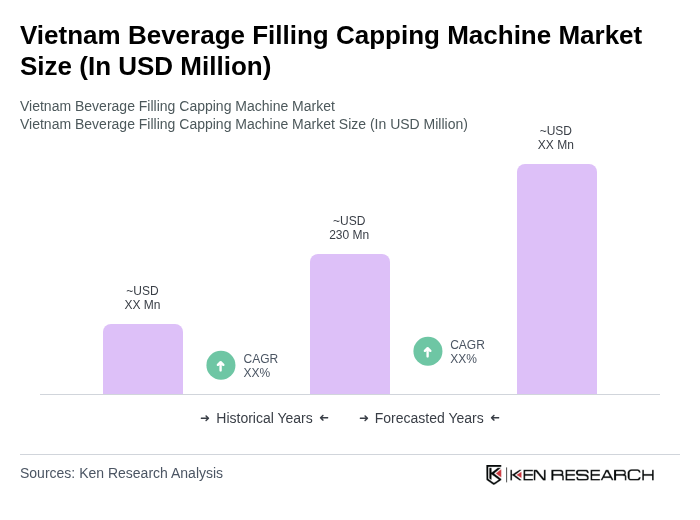
- The Vietnam Beverage Filling Capping Machine market is valued at USD 230 million, based on a five-year historical analysis of investments and machinery demand aligned with the expansion of the national beverage sector, which reached more than USD 5 billion in refreshment beverages and over USD 24 billion in overall food and beverages. This growth is primarily driven by the increasing demand for packaged beverages, coupled with the rise in consumer preferences for convenience, ready-to-drink products, and healthier low-sugar and functional beverages, which are reshaping product portfolios and accelerating investments in modern filling and capping lines. The expansion of the beverage industry, including soft drinks, bottled water, energy drinks, ready-to-drink tea, coffee, and alcoholic beverages such as beer, has significantly contributed to the market’s growth through continuous capacity additions and line upgrades.
- Key cities such as Ho Chi Minh City and Hanoi dominate the market due to their high population density, strong manufacturing base, and robust economic activities, with both cities consistently ranking among Vietnam’s largest consumption and distribution hubs for beverages. These urban centers are home to numerous beverage manufacturers, co-packers, and distributors, as well as major modern retail formats, facilitating a vibrant supply chain and high utilization of automated filling and capping equipment. Additionally, the growing middle class and youthful population in these regions, combined with rising disposable income and out-of-home consumption, is driving the demand for diverse beverage options and premium packaging formats, further solidifying their market dominance.
- In 2023, the Vietnamese government continued to strengthen regulations aimed at enhancing food safety standards in the beverage industry, building on the framework of the Law on Food Safety 2010 and its guiding instruments, notably Decree No. 15/2018/ND-CP on the implementation of a number of articles of the Law on Food Safety, issued by the Government of Vietnam. This includes mandatory compliance with hygiene and quality control measures for beverage filling and capping processes, such as Good Manufacturing Practices (GMP), Hazard Analysis and Critical Control Points (HACCP), strict control of contact materials, and product traceability in line with international standards like ISO 22000 and Codex principles, ensuring that manufacturers adhere to rigorous safety requirements. Such regulations are expected to improve consumer confidence, encourage investments in high-standard filling and capping technologies, and promote sustainable practices such as hygienic design, reduced product losses, and resource-efficient operations within the industry.
Vietnam Beverage Filling Capping Machine Market Segmentation
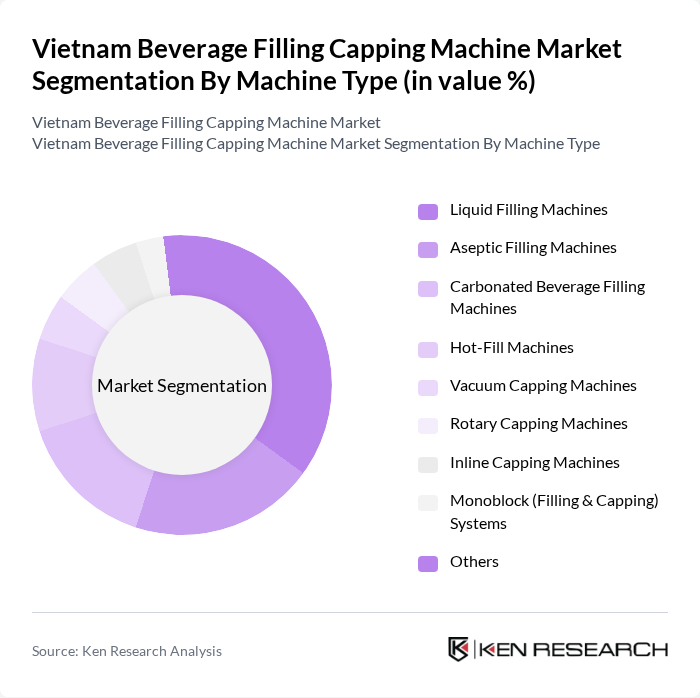
By Machine Type:The market is segmented into various machine types, including Liquid Filling Machines, Aseptic Filling Machines, Carbonated Beverage Filling Machines, Hot-Fill Machines, Vacuum Capping Machines, Rotary Capping Machines, Inline Capping Machines, Monoblock (Filling & Capping) Systems, and Others. Among these, Liquid Filling Machines are the most widely used due to their versatility and efficiency in handling different types of beverages across categories such as bottled water, carbonated soft drinks, juices, dairy-based drinks, and ready-to-drink tea and coffee, which together account for a major share of packaged refreshment volume in Vietnam. The increasing demand for bottled water and soft drinks, along with growing consumption of functional and low-sugar beverages, has further propelled the adoption of these machines, making them a dominant force in the market as producers seek flexible, high-speed, and quick-changeover filling solutions to serve multiple SKUs and packaging sizes.
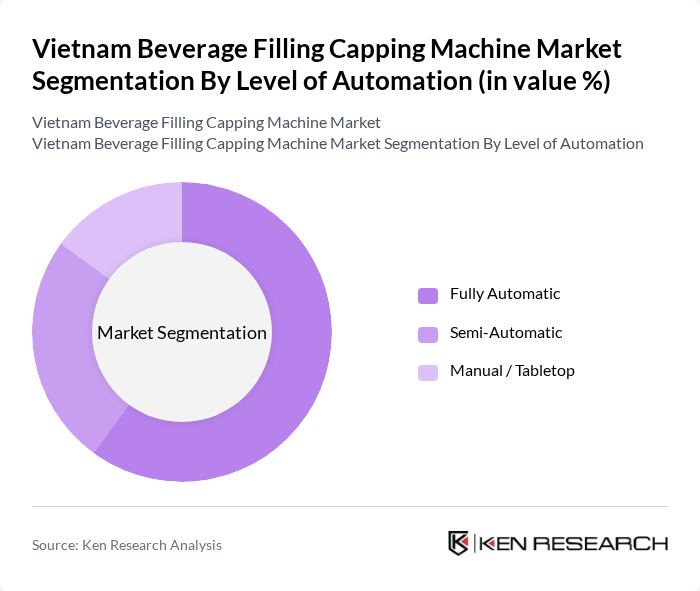
By Level of Automation:The market is categorized based on the level of automation into Fully Automatic, Semi-Automatic, and Manual / Tabletop systems. Fully Automatic machines dominate the market due to their efficiency, higher throughput, and ability to handle high production volumes, which is essential for large-scale beverage manufacturers and co-packers seeking to optimize line efficiency and comply with stringent food safety and hygiene standards. The trend towards automation is driven by the need for increased productivity, reduced labor costs, consistent product quality, and digital monitoring of line performance, making these systems highly sought after in the industry as producers modernize from older, more manual equipment to integrated, smart filling and capping solutions.
Vietnam Beverage Filling Capping Machine Market Competitive Landscape
The Vietnam Beverage Filling Capping Machine Market is characterized by a dynamic mix of regional and international players. Leading participants such as Krones AG, Sidel Group, Tetra Pak, GEA Group, KHS GmbH, AROL S.p.A., ABE Beverage Equipment, CFT Group, SACMI Imola S.C., Aseptic Technologies, Biner Ellison, Bausch+Ströbel, BHS-Sonthofen, BOCK GmbH, Sipa S.p.A. contribute to innovation, geographic expansion, and service delivery in this space.
Vietnam Beverage Filling Capping Machine Market Industry Analysis
Growth Drivers
- Increasing Demand for Packaged Beverages:The Vietnamese beverage market is projected to reach approximately 6.1 billion liters in future, driven by a growing urban population and rising disposable incomes. The World Bank reports that Vietnam's GDP per capita is expected to increase to $4,800, enhancing consumer purchasing power. This surge in demand for packaged beverages, including soft drinks and bottled water, is a significant growth driver for the filling and capping machine market, as manufacturers seek efficient production solutions.
- Technological Advancements in Filling and Capping:The introduction of advanced technologies, such as automated filling systems and smart capping solutions, is revolutionizing the beverage industry in Vietnam. In future, investments in automation are expected to exceed $1.2 billion, according to industry reports. These innovations not only enhance production efficiency but also improve product quality and reduce operational costs, making them essential for manufacturers aiming to stay competitive in a rapidly evolving market.
- Expansion of the Beverage Industry in Vietnam:The beverage industry in Vietnam is experiencing robust growth, with a projected annual growth rate of 9% through future. This expansion is fueled by increasing consumer preferences for diverse beverage options, including health-oriented products. The Vietnam Industry and Trade Information Center indicates that the number of beverage manufacturers has increased by 18% over the past three years, creating a higher demand for efficient filling and capping machinery to meet production needs.
Market Challenges
- High Initial Investment Costs:The capital required for acquiring advanced filling and capping machinery can be a significant barrier for many manufacturers in Vietnam. The initial investment for high-quality machinery can range from $120,000 to $550,000, depending on the technology and capacity. This financial burden can deter small and medium-sized enterprises from upgrading their production lines, limiting their competitiveness in the growing beverage market.
- Stringent Regulatory Requirements:Compliance with food safety and quality regulations poses a challenge for beverage manufacturers in Vietnam. The Ministry of Health mandates strict adherence to safety standards, which can involve costly certifications and inspections. In future, the cost of compliance is estimated to increase by 25%, impacting profit margins. These regulatory hurdles can slow down the adoption of new technologies and machinery, hindering market growth.
Vietnam Beverage Filling Capping Machine Market Future Outlook
The future of the Vietnam beverage filling capping machine market appears promising, driven by technological advancements and evolving consumer preferences. As manufacturers increasingly adopt automation and smart technologies, production efficiency is expected to improve significantly. Additionally, the growing trend towards eco-friendly packaging solutions will likely influence machinery design and functionality. With the beverage industry poised for continued expansion, companies that invest in innovative filling and capping solutions will be well-positioned to capitalize on emerging market opportunities.
Market Opportunities
- Growth in E-commerce for Beverage Sales:The rise of e-commerce platforms in Vietnam is creating new sales channels for beverage manufacturers. In future, online beverage sales are projected to reach $600 million, driven by increased internet penetration and consumer preference for convenience. This shift presents an opportunity for manufacturers to invest in flexible filling and capping solutions that cater to diverse packaging needs for online orders.
- Adoption of Sustainable Packaging Solutions:As consumers become more environmentally conscious, the demand for sustainable packaging is rising. The market for eco-friendly packaging materials is expected to grow by 35% in future. This trend encourages manufacturers to invest in filling and capping machines that accommodate biodegradable and recyclable materials, positioning them favorably in a competitive landscape focused on sustainability.
Scope of the Report
| Segment | Sub-Segments |
|---|---|
| By Machine Type | Liquid Filling Machines Aseptic Filling Machines Carbonated Beverage Filling Machines Hot-Fill Machines Vacuum Capping Machines Rotary Capping Machines Inline Capping Machines Monoblock (Filling & Capping) Systems Others |
| By Level of Automation | Fully Automatic Semi-Automatic Manual / Tabletop |
| By Beverage Type | Carbonated Soft Drinks Bottled Water Juices and Nectars Ready-to-Drink Tea & Coffee Energy & Sports Drinks Dairy & Functional Beverages Beer Spirits & Wine Others |
| By Packaging Material | PET Glass Metal (Cans) Aseptic Cartons Others |
| By Technology | Rotary Linear / Inline Gravity Filling Pressure Filling Vacuum Filling Others |
| By Cap / Closure Type | Screw Caps ROPP Caps Crown Caps Snap-On / Press-On Caps Sports Caps & Specialty Closures Others |
| By Region | Northern Vietnam Southern Vietnam Central Vietnam Others |
Key Target Audience
Investors and Venture Capitalist Firms
Government and Regulatory Bodies (e.g., Ministry of Industry and Trade, General Department of Customs)
Manufacturers and Producers of Beverage Products
Distributors and Retailers of Beverage Equipment
Packaging Material Suppliers
Technology Providers for Automation and Robotics
Industry Associations (e.g., Vietnam Beverage Association)
Financial Institutions and Banks
Players Mentioned in the Report:
Krones AG
Sidel Group
Tetra Pak
GEA Group
KHS GmbH
AROL S.p.A.
ABE Beverage Equipment
CFT Group
SACMI Imola S.C.
Aseptic Technologies
Biner Ellison
Bausch+Strobel
BHS-Sonthofen
BOCK GmbH
Sipa S.p.A.
Table of Contents
Market Assessment Phase
1. Executive Summary and Approach
2. Vietnam Beverage Filling Capping Machine Market Overview
2.1 Key Insights and Strategic Recommendations
2.2 Vietnam Beverage Filling Capping Machine Market Overview
2.3 Definition and Scope
2.4 Evolution of Market Ecosystem
2.5 Timeline of Key Regulatory Milestones
2.6 Value Chain & Stakeholder Mapping
2.7 Business Cycle Analysis
2.8 Policy & Incentive Landscape
3. Vietnam Beverage Filling Capping Machine Market Analysis
3.1 Growth Drivers
3.1.1 Increasing demand for packaged beverages
3.1.2 Technological advancements in filling and capping
3.1.3 Expansion of the beverage industry in Vietnam
3.1.4 Rising consumer preference for convenience products
3.2 Market Challenges
3.2.1 High initial investment costs
3.2.2 Stringent regulatory requirements
3.2.3 Competition from low-cost manufacturers
3.2.4 Supply chain disruptions
3.3 Market Opportunities
3.3.1 Growth in e-commerce for beverage sales
3.3.2 Increasing health-conscious consumer trends
3.3.3 Adoption of sustainable packaging solutions
3.3.4 Potential for automation in production lines
3.4 Market Trends
3.4.1 Shift towards eco-friendly packaging
3.4.2 Integration of IoT in manufacturing processes
3.4.3 Customization of beverage products
3.4.4 Growth of craft beverage producers
3.5 Government Regulation
3.5.1 Compliance with food safety standards
3.5.2 Regulations on packaging materials
3.5.3 Import/export tariffs on machinery
3.5.4 Environmental regulations on waste management
4. SWOT Analysis
5. Stakeholder Analysis
6. Porter's Five Forces Analysis
7. Vietnam Beverage Filling Capping Machine Market Market Size, 2019-2024
7.1 By Value
7.2 By Volume
7.3 By Average Selling Price
8. Vietnam Beverage Filling Capping Machine Market Segmentation
8.1 By Machine Type
8.1.1 Liquid Filling Machines
8.1.2 Aseptic Filling Machines
8.1.3 Carbonated Beverage Filling Machines
8.1.4 Hot-Fill Machines
8.1.5 Vacuum Capping Machines
8.1.6 Rotary Capping Machines
8.1.7 Inline Capping Machines
8.1.8 Monoblock (Filling & Capping) Systems
8.1.9 Others
8.2 By Level of Automation
8.2.1 Fully Automatic
8.2.2 Semi-Automatic
8.2.3 Manual / Tabletop
8.3 By Beverage Type
8.3.1 Carbonated Soft Drinks
8.3.2 Bottled Water
8.3.3 Juices and Nectars
8.3.4 Ready-to-Drink Tea & Coffee
8.3.5 Energy & Sports Drinks
8.3.6 Dairy & Functional Beverages
8.3.7 Beer
8.3.8 Spirits & Wine
8.3.9 Others
8.4 By Packaging Material
8.4.1 PET
8.4.2 Glass
8.4.3 Metal (Cans)
8.4.4 Aseptic Cartons
8.4.5 Others
8.5 By Technology
8.5.1 Rotary
8.5.2 Linear / Inline
8.5.3 Gravity Filling
8.5.4 Pressure Filling
8.5.5 Vacuum Filling
8.5.6 Others
8.6 By Cap / Closure Type
8.6.1 Screw Caps
8.6.2 ROPP Caps
8.6.3 Crown Caps
8.6.4 Snap-On / Press-On Caps
8.6.5 Sports Caps & Specialty Closures
8.6.6 Others
8.7 By Region
8.7.1 Northern Vietnam
8.7.2 Southern Vietnam
8.7.3 Central Vietnam
8.7.4 Others
9. Vietnam Beverage Filling Capping Machine Market Competitive Analysis
9.1 Market Share of Key Players
9.2 Cross Comparison of Key Players
9.2.1 Company Name
9.2.2 Group Size (Large, Medium, or Small as per industry convention)
9.2.3 Vietnam Revenue (USD Million)
9.2.4 3-Year Revenue CAGR in Vietnam (%)
9.2.5 Installed Filling & Capping Capacity in Vietnam (Units per Hour)
9.2.6 Market Share in Vietnam Beverage Filling & Capping Machinery (%)
9.2.7 Order Backlog / Order Book Visibility (Months)
9.2.8 EBITDA Margin in Vietnam Operations (%)
9.2.9 Average Selling Price per Line (USD)
9.2.10 R&D Spend as % of Revenue
9.2.11 Number of Active Beverage OEM/End-User Accounts in Vietnam
9.2.12 Service Network Coverage (Number of Service Centers / Technicians)
9.2.13 On-Time Delivery Rate (%)
9.2.14 Warranty / After-Sales Claim Ratio (%)
9.3 SWOT Analysis of Top Players
9.4 Pricing Analysis
9.5 Detailed Profile of Major Companies
9.5.1 Krones AG
9.5.2 Sidel Group
9.5.3 Tetra Pak
9.5.4 GEA Group
9.5.5 KHS GmbH
9.5.6 AROL S.p.A.
9.5.7 ABE Beverage Equipment
9.5.8 CFT Group
9.5.9 SACMI Imola S.C.
9.5.10 Aseptic Technologies
9.5.11 Biner Ellison
9.5.12 Bausch+Ströbel
9.5.13 BHS-Sonthofen
9.5.14 BOCK GmbH
9.5.15 Sipa S.p.A.
10. Vietnam Beverage Filling Capping Machine Market End-User Analysis
10.1 Procurement Behavior of Key Ministries
10.1.1 Budget Allocation Trends
10.1.2 Procurement Processes
10.1.3 Supplier Selection Criteria
10.1.4 Others
10.2 Corporate Spend on Infrastructure & Energy
10.2.1 Investment Trends
10.2.2 Budget Prioritization
10.2.3 Spending on Technology Upgrades
10.2.4 Others
10.3 Pain Point Analysis by End-User Category
10.3.1 Operational Inefficiencies
10.3.2 Cost Management Issues
10.3.3 Quality Control Challenges
10.3.4 Others
10.4 User Readiness for Adoption
10.4.1 Training Needs
10.4.2 Technology Acceptance Levels
10.4.3 Infrastructure Readiness
10.4.4 Others
10.5 Post-Deployment ROI and Use Case Expansion
10.5.1 ROI Measurement Techniques
10.5.2 Use Case Scenarios
10.5.3 Long-term Benefits Analysis
10.5.4 Others
11. Vietnam Beverage Filling Capping Machine Market Future Size, 2025-2030
11.1 By Value
11.2 By Volume
11.3 By Average Selling Price
Go-To-Market Strategy Phase
1. Whitespace Analysis + Business Model Canvas
1.1 Market Gaps Identification
1.2 Business Model Development
2. Marketing and Positioning Recommendations
2.1 Branding Strategies
2.2 Product USPs
3. Distribution Plan
3.1 Urban Retail Strategies
3.2 Rural NGO Tie-ups
4. Channel & Pricing Gaps
4.1 Underserved Routes
4.2 Pricing Bands
5. Unmet Demand & Latent Needs
5.1 Category Gaps
5.2 Consumer Segments
6. Customer Relationship
6.1 Loyalty Programs
6.2 After-sales Service
7. Value Proposition
7.1 Sustainability Initiatives
7.2 Integrated Supply Chains
8. Key Activities
8.1 Regulatory Compliance
8.2 Branding Efforts
8.3 Distribution Setup
9. Entry Strategy Evaluation
9.1 Domestic Market Entry Strategy
9.1.1 Product Mix Considerations
9.1.2 Pricing Band Strategy
9.1.3 Packaging Innovations
9.2 Export Entry Strategy
9.2.1 Target Countries Analysis
9.2.2 Compliance Roadmap
10. Entry Mode Assessment
10.1 Joint Ventures
10.2 Greenfield Investments
10.3 Mergers & Acquisitions
10.4 Distributor Model
11. Capital and Timeline Estimation
11.1 Capital Requirements
11.2 Timelines for Implementation
12. Control vs Risk Trade-Off
12.1 Ownership Considerations
12.2 Partnerships Evaluation
13. Profitability Outlook
13.1 Breakeven Analysis
13.2 Long-term Sustainability Strategies
14. Potential Partner List
14.1 Distributors
14.2 Joint Ventures
14.3 Acquisition Targets
15. Execution Roadmap
15.1 Phased Plan for Market Entry
15.1.1 Market Setup
15.1.2 Market Entry
15.1.3 Growth Acceleration
15.1.4 Scale & Stabilize
15.2 Key Activities and Milestones
15.2.1 Milestone Planning
15.2.2 Activity Tracking
Research Methodology
Phase 1: Approach1
Desk Research
- Industry reports from Vietnamese beverage associations and market research firms
- Government publications on manufacturing regulations and standards in Vietnam
- Trade statistics and import/export data from the General Department of Customs of Vietnam
Primary Research
- Interviews with production managers at leading beverage manufacturers in Vietnam
- Surveys with equipment suppliers and distributors in the beverage filling and capping sector
- Field visits to manufacturing plants to observe operational practices and equipment usage
Validation & Triangulation
- Cross-validation of findings through multiple data sources including trade publications and expert opinions
- Triangulation of market size estimates using both top-down and bottom-up approaches
- Sanity checks through feedback from industry experts and stakeholders
Phase 2: Market Size Estimation1
Top-down Assessment
- Analysis of the overall beverage market size in Vietnam to estimate the filling and capping segment
- Segmentation by beverage type (e.g., soft drinks, juices, alcoholic beverages) to refine estimates
- Incorporation of growth trends in the beverage industry and consumer preferences
Bottom-up Modeling
- Collection of data on the number of filling and capping machines in operation across various beverage plants
- Estimation of average machine costs and operational expenses based on supplier quotes
- Volume of beverages produced and packaged to calculate market potential
Forecasting & Scenario Analysis
- Multi-factor analysis considering economic growth, urbanization, and changing consumer habits
- Scenario modeling based on potential regulatory changes and technological advancements
- Development of baseline, optimistic, and pessimistic forecasts through 2030
Phase 3: CATI Sample Composition1
| Scope Item/Segment | Sample Size | Target Respondent Profiles |
|---|---|---|
| Soft Drink Manufacturers | 120 | Production Managers, Operations Directors |
| Juice and Beverage Producers | 100 | Quality Control Managers, Supply Chain Coordinators |
| Alcoholic Beverage Companies | 90 | Plant Managers, Equipment Procurement Officers |
| Filling and Capping Equipment Suppliers | 80 | Sales Managers, Technical Support Engineers |
| Industry Experts and Consultants | 60 | Market Analysts, Industry Advisors |
Frequently Asked Questions
What is the current value of the Vietnam Beverage Filling Capping Machine market?
The Vietnam Beverage Filling Capping Machine market is valued at approximately USD 230 million, reflecting significant growth driven by the expanding beverage sector, which includes a diverse range of products such as soft drinks, bottled water, and functional beverages.
What factors are driving the growth of the beverage filling capping machine market in Vietnam?
Which cities are the primary markets for beverage filling capping machines in Vietnam?
What types of machines are included in the Vietnam Beverage Filling Capping Machine market?
Other Regional/Country Reports
Other Adjacent Reports
Belgium Bottling Equipment Market
Philippines Aseptic Processing Equipment Market
Singapore Labeling Machinery Market
United Arab Emirates Conveyor Systems Market Size Share Growth Drivers Trends Opportunities & Forecast 2025–2030Germany Palletizing Equipment Market
Vietnam Blow Molding Machinery Market
Brazil Water Treatment Equipment Market
Singapore Pasteurization Systems Market
Why Buy From Us?

What makes us stand out is that our consultants follow Robust, Refine and Result (RRR) methodology. Robust for clear definitions, approaches and sanity checking, Refine for differentiating respondents' facts and opinions, and Result for presenting data with story.

We have set a benchmark in the industry by offering our clients with syndicated and customized market research reports featuring coverage of entire market as well as meticulous research and analyst insights.

While we don't replace traditional research, we flip the method upside down. Our dual approach of Top Bottom & Bottom Top ensures quality deliverable by not just verifying company fundamentals but also looking at the sector and macroeconomic factors.

With one step in the future, our research team constantly tries to show you the bigger picture. We help with some of the tough questions you may encounter along the way: How is the industry positioned? Best marketing channel? KPI's of competitors? By aligning every element, we help maximize success.

Our report gives you instant access to the answers and sources that other companies might choose to hide. We elaborate each steps of research methodology we have used and showcase you the sample size to earn your trust.

If you need any support, we are here! We pride ourselves on universe strength, data quality, and quick, friendly, and professional service.