About the Report
Base Year 2024Vietnam Digital Brokerage and Online Trading Market Overview
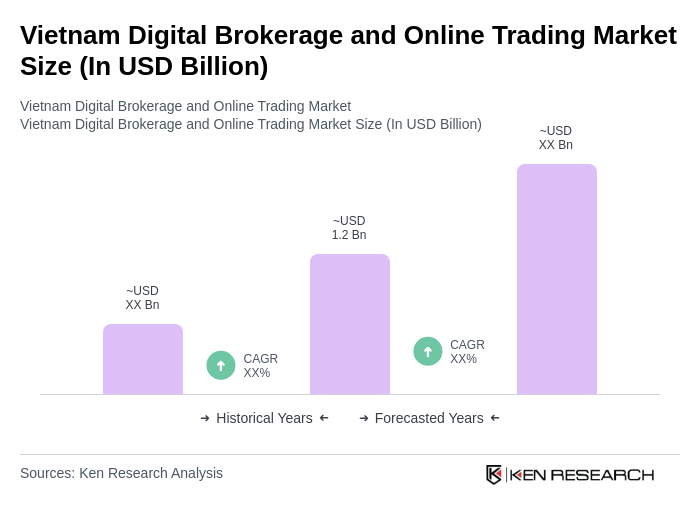
- The Vietnam Digital Brokerage and Online Trading Market is valued at USD 1.2 billion, based on a five-year historical analysis. This growth is primarily driven by the increasing adoption of technology in financial services, a surge in retail investor participation, and the rise of mobile trading platforms. The market has seen a significant influx of new investors, particularly among the younger demographic, who are more inclined to engage in online trading. Additionally, Vietnam's growing e-commerce sector, which is expected to reach significant milestones by 2025, reflects a broader digital transformation that could influence financial services.
- Key cities dominating this market include Ho Chi Minh City and Hanoi, which serve as financial hubs with a concentration of brokerage firms and financial institutions. The presence of a robust infrastructure, coupled with a growing number of tech-savvy investors, has positioned these cities as leaders in the digital brokerage landscape. Additionally, the increasing availability of internet access and mobile devices has further fueled market growth in these regions.
- In recent years, the Vietnamese government has focused on enhancing investor protection in the financial sector. While specific regulations for digital brokerage may not be detailed, the government's emphasis on transparency and risk disclosure is crucial for building investor confidence. For instance, Resolution 05/2025 highlights Vietnam's efforts to regulate virtual asset exchanges, which could set a precedent for broader financial regulations.
Vietnam Digital Brokerage and Online Trading Market Segmentation
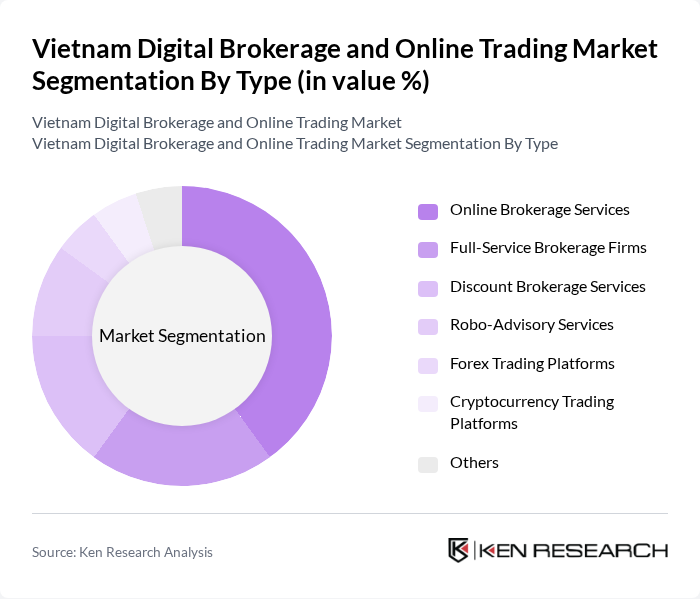
By Type:The market is segmented into various types, including Online Brokerage Services, Full-Service Brokerage Firms, Discount Brokerage Services, Robo-Advisory Services, Forex Trading Platforms, Cryptocurrency Trading Platforms, and Others. Among these, Online Brokerage Services have emerged as the dominant segment due to their accessibility and lower fees, appealing to a broad range of investors. The rise of digital platforms has also seen an increase in cryptocurrency trading platforms, driven by Vietnam's growing interest in virtual assets.
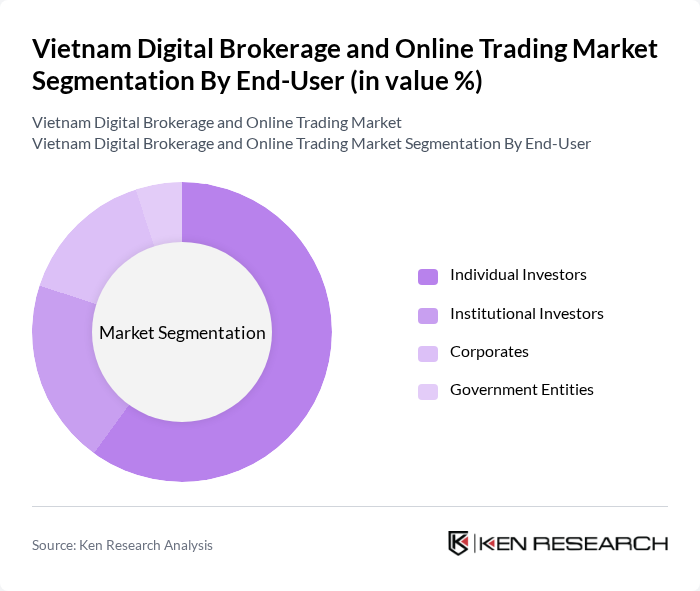
By End-User:The market is segmented by end-user into Individual Investors, Institutional Investors, Corporates, and Government Entities. Individual Investors represent the largest segment, driven by the increasing number of retail investors entering the market, attracted by the ease of access and the potential for high returns.
Vietnam Digital Brokerage and Online Trading Market Competitive Landscape
The Vietnam Digital Brokerage and Online Trading Market is characterized by a dynamic mix of regional and international players. Leading participants such as Viet Capital Securities, SSI Securities Corporation, HSC Securities Corporation, BIDV Securities Company, VNDirect Securities Corporation, Mirae Asset Securities Vietnam, FPT Securities, Saigon Securities Inc., Agribank Securities, ACB Securities, Vietcombank Securities, BSC Securities, Techcom Securities, KIS Vietnam Securities contribute to innovation, geographic expansion, and service delivery in this space.
Vietnam Digital Brokerage and Online Trading Market Industry Analysis
Growth Drivers
- Increasing Internet Penetration:Vietnam's internet penetration rate is approximately78%, with over77 millionusers accessing online services. This growth is driven by affordable mobile data plans and expanding infrastructure, particularly in urban areas. The World Bank projects that byin future, the number of internet users will exceed80 million, facilitating greater access to digital brokerage platforms. This surge in connectivity is crucial for attracting new investors and enhancing trading activities in the digital brokerage sector.
- Rise of Mobile Trading Applications:The number of mobile trading app downloads in Vietnam is estimated atover 5 million, reflecting a growing preference for mobile trading solutions. With smartphone penetration at approximately73%and increasing user engagement, these applications provide convenient access to trading services. According to the Ministry of Information and Communications, mobile trading is expected to account for a significant share of trading volume in future, indicating a shift towards mobile-first investment strategies among Vietnamese investors.
- Growing Interest in Stock Market Investments:The number of retail investor accounts in Vietnam's stock market surpassed7 million, reflecting continued growth in individual participation. This surge is attributed to rising disposable incomes and a cultural shift towards investment. The State Securities Commission reported that retail trading accounted for approximately85%of total market transactions, highlighting the increasing engagement of individual investors. This trend is expected to continue in future, further driving the demand for digital brokerage services.
Market Challenges
- Regulatory Compliance Issues:The digital brokerage sector in Vietnam faces significant regulatory challenges, with a substantial proportion of firms struggling to meet compliance requirements. The State Securities Commission has implemented stringent regulations, including licensing and reporting obligations, which can hinder operational efficiency. As of the latest available data, only about30%of digital brokers are reported to fully comply with these regulations, creating barriers for new entrants and limiting market growth potential in the competitive landscape.
- Market Volatility:Vietnam's stock market has experienced significant volatility, with the VN-Index fluctuating by over20%in recent periods. This instability can deter potential investors, particularly retail investors who may lack experience in navigating turbulent markets. The World Bank noted that such volatility can lead to decreased trading volumes, impacting the profitability of digital brokerage firms. As a result, managing market risks remains a critical challenge for the industry moving forward.
Vietnam Digital Brokerage and Online Trading Market Future Outlook
The future of Vietnam's digital brokerage and online trading market appears promising, driven by technological advancements and increasing investor participation. The integration of artificial intelligence in trading platforms is expected to enhance decision-making processes, while the rise of social trading platforms will foster community-driven investment strategies. Additionally, as more investors prioritize sustainable investing, firms that incorporate environmental, social, and governance (ESG) factors into their offerings will likely gain a competitive edge, further shaping the market landscape.
Market Opportunities
- Expansion of Financial Products:The introduction of diverse financial products, such as ETFs and mutual funds, presents a significant opportunity for digital brokers. With the Vietnamese stock market expanding, the demand for innovative investment options is increasing. The availability of these products could attract a broader range of investors, enhancing market liquidity and driving growth in the digital brokerage sector.
- Increasing Foreign Investment:Foreign direct investment (FDI) in Vietnam reached approximatelyUSD 23 billion, with a growing interest in the financial sector. This influx of capital can provide digital brokerage firms with the necessary resources to expand their services and improve technology. As foreign investors seek to capitalize on Vietnam's economic growth, digital brokers that cater to this demographic will likely experience increased demand and market share.
Scope of the Report
| Segment | Sub-Segments |
|---|---|
| By Type | Online Brokerage Services Full-Service Brokerage Firms Discount Brokerage Services Robo-Advisory Services Forex Trading Platforms Cryptocurrency Trading Platforms Others |
| By End-User | Individual Investors Institutional Investors Corporates Government Entities |
| By Investment Type | Equities Bonds Derivatives Commodities ETFs Others |
| By Trading Platform | Web-Based Platforms Mobile Applications Desktop Software |
| By Customer Segment | Retail Investors High Net-Worth Individuals Small and Medium Enterprises |
| By Service Model | Commission-Based Services Fee-Based Services Hybrid Models |
Key Target Audience
Investors and Venture Capitalist Firms
Government and Regulatory Bodies (e.g., State Securities Commission of Vietnam)
Brokerage Firms and Online Trading Platforms
Financial Technology (FinTech) Companies
Investment Advisors and Wealth Management Firms
Stock Exchanges (e.g., Ho Chi Minh Stock Exchange)
Insurance Companies
Private Equity Firms
Players Mentioned in the Report:
Viet Capital Securities
SSI Securities Corporation
HSC Securities Corporation
BIDV Securities Company
VNDirect Securities Corporation
Mirae Asset Securities Vietnam
FPT Securities
Saigon Securities Inc.
Agribank Securities
ACB Securities
Vietcombank Securities
BSC Securities
Techcom Securities
KIS Vietnam Securities
Table of Contents
Market Assessment Phase
1. Executive Summary and Approach
2. Vietnam Digital Brokerage and Online Trading Market Overview
2.1 Key Insights and Strategic Recommendations
2.2 Vietnam Digital Brokerage and Online Trading Market Overview
2.3 Definition and Scope
2.4 Evolution of Market Ecosystem
2.5 Timeline of Key Regulatory Milestones
2.6 Value Chain & Stakeholder Mapping
2.7 Business Cycle Analysis
2.8 Policy & Incentive Landscape
3. Vietnam Digital Brokerage and Online Trading Market Analysis
3.1 Growth Drivers
3.1.1 Increasing Internet Penetration
3.1.2 Rise of Mobile Trading Applications
3.1.3 Growing Interest in Stock Market Investments
3.1.4 Supportive Government Policies
3.2 Market Challenges
3.2.1 Regulatory Compliance Issues
3.2.2 Market Volatility
3.2.3 Limited Financial Literacy
3.2.4 Competition from Traditional Brokerage Firms
3.3 Market Opportunities
3.3.1 Expansion of Financial Products
3.3.2 Increasing Foreign Investment
3.3.3 Development of Blockchain Technology
3.3.4 Growth of Retail Investor Base
3.4 Market Trends
3.4.1 Adoption of AI in Trading
3.4.2 Rise of Social Trading Platforms
3.4.3 Integration of ESG Factors in Investment Decisions
3.4.4 Shift Towards Sustainable Investing
3.5 Government Regulation
3.5.1 Enhanced Investor Protection Laws
3.5.2 Tax Incentives for Investors
3.5.3 Regulations on Margin Trading
3.5.4 Licensing Requirements for Brokers
4. SWOT Analysis
5. Stakeholder Analysis
6. Porter's Five Forces Analysis
7. Vietnam Digital Brokerage and Online Trading Market Market Size, 2019-2024
7.1 By Value
7.2 By Volume
7.3 By Average Selling Price
8. Vietnam Digital Brokerage and Online Trading Market Segmentation
8.1 By Type
8.1.1 Online Brokerage Services
8.1.2 Full-Service Brokerage Firms
8.1.3 Discount Brokerage Services
8.1.4 Robo-Advisory Services
8.1.5 Forex Trading Platforms
8.1.6 Cryptocurrency Trading Platforms
8.1.7 Others
8.2 By End-User
8.2.1 Individual Investors
8.2.2 Institutional Investors
8.2.3 Corporates
8.2.4 Government Entities
8.3 By Investment Type
8.3.1 Equities
8.3.2 Bonds
8.3.3 Derivatives
8.3.4 Commodities
8.3.5 ETFs
8.3.6 Others
8.4 By Trading Platform
8.4.1 Web-Based Platforms
8.4.2 Mobile Applications
8.4.3 Desktop Software
8.5 By Customer Segment
8.5.1 Retail Investors
8.5.2 High Net-Worth Individuals
8.5.3 Small and Medium Enterprises
8.6 By Service Model
8.6.1 Commission-Based Services
8.6.2 Fee-Based Services
8.6.3 Hybrid Models
9. Vietnam Digital Brokerage and Online Trading Market Competitive Analysis
9.1 Market Share of Key Players
9.2 Cross Comparison of Key Players
9.2.1 Company Name
9.2.2 Group Size (Large, Medium, or Small as per industry convention)
9.2.3 Customer Acquisition Cost
9.2.4 Average Revenue Per User (ARPU)
9.2.5 Trading Volume Growth Rate
9.2.6 Client Retention Rate
9.2.7 Pricing Strategy
9.2.8 Market Penetration Rate
9.2.9 Return on Investment (ROI)
9.2.10 Customer Satisfaction Score
9.3 SWOT Analysis of Top Players
9.4 Pricing Analysis
9.5 Detailed Profile of Major Companies
9.5.1 Viet Capital Securities
9.5.2 SSI Securities Corporation
9.5.3 HSC Securities Corporation
9.5.4 BIDV Securities Company
9.5.5 VNDirect Securities Corporation
9.5.6 Mirae Asset Securities Vietnam
9.5.7 FPT Securities
9.5.8 Saigon Securities Inc.
9.5.9 Agribank Securities
9.5.10 ACB Securities
9.5.11 Vietcombank Securities
9.5.12 BSC Securities
9.5.13 Techcom Securities
9.5.14 KIS Vietnam Securities
10. Vietnam Digital Brokerage and Online Trading Market End-User Analysis
10.1 Procurement Behavior of Key Ministries
10.1.1 Investment Strategies
10.1.2 Budget Allocation
10.1.3 Risk Management Practices
10.2 Corporate Spend on Infrastructure & Energy
10.2.1 Investment in Digital Platforms
10.2.2 Spending on Compliance and Regulation
10.2.3 Budget for Training and Development
10.3 Pain Point Analysis by End-User Category
10.3.1 Lack of User-Friendly Platforms
10.3.2 High Transaction Fees
10.3.3 Limited Access to Information
10.4 User Readiness for Adoption
10.4.1 Awareness of Digital Trading
10.4.2 Technical Skills Assessment
10.4.3 Trust in Digital Platforms
10.5 Post-Deployment ROI and Use Case Expansion
10.5.1 Performance Metrics Evaluation
10.5.2 User Feedback Collection
10.5.3 Future Investment Plans
11. Vietnam Digital Brokerage and Online Trading Market Future Size, 2025-2030
11.1 By Value
11.2 By Volume
11.3 By Average Selling Price
Go-To-Market Strategy Phase
1. Whitespace Analysis + Business Model Canvas
1.1 Market Gaps Identification
1.2 Business Model Development
1.3 Value Proposition Analysis
1.4 Revenue Streams Exploration
1.5 Cost Structure Assessment
1.6 Key Partnerships Identification
1.7 Customer Segmentation
2. Marketing and Positioning Recommendations
2.1 Branding Strategies
2.2 Product USPs
2.3 Target Market Identification
2.4 Communication Strategy
2.5 Digital Marketing Tactics
2.6 Customer Engagement Plans
3. Distribution Plan
3.1 Urban Retail Strategies
3.2 Rural NGO Tie-Ups
3.3 Online Distribution Channels
3.4 Partnerships with Financial Institutions
3.5 Direct Sales Approaches
4. Channel & Pricing Gaps4.1 Underserved Routes4.2 Pricing Bands Analysis4.3 Competitor Pricing Comparison4.4 Customer Willingness to Pay4.5 Value-Based Pricing Strategies5. Unmet Demand & Latent Needs5.1 Category Gaps Identification5.2 Consumer Segments Analysis5.3 Emerging Trends Exploration5.4 Customer Feedback Mechanisms6. Customer Relationship6.1 Loyalty Programs6.2 After-Sales Service6.3 Customer Support Strategies6.4 Feedback and Improvement Processes7. Value Proposition7.1 Sustainability Initiatives7.2 Integrated Supply Chains7.3 Customer-Centric Approaches7.4 Competitive Differentiation8. Key Activities8.1 Regulatory Compliance8.2 Branding Efforts8.3 Distribution Setup8.4 Training and Development9. Entry Strategy Evaluation9.1 Domestic Market Entry Strategy9.1.1 Product Mix9.1.2 Pricing Band9.1.3 Packaging9.2 Export Entry Strategy9.2.1 Target Countries9.2.2 Compliance Roadmap10. Entry Mode Assessment10.1 Joint Ventures10.2 Greenfield Investments10.3 Mergers & Acquisitions10.4 Distributor Model11. Capital and Timeline Estimation11.1 Capital Requirements11.2 Timelines12. Control vs Risk Trade-Off12.1 Ownership vs Partnerships13. Profitability Outlook13.1 Breakeven Analysis13.2 Long-Term Sustainability14. Potential Partner List14.1 Distributors14.2 Joint Ventures14.3 Acquisition Targets15. Execution Roadmap15.1 Phased Plan for Market Entry15.1.1 Market Setup15.1.2 Market Entry15.1.3 Growth Acceleration15.1.4 Scale & Stabilize15.2 Key Activities and Milestones15.2.1 Milestone Planning15.2.2 Activity TrackingDisclaimerContact Us``` ### Key Changes: 1. **Section 8: Market Segmentation** - **By Type**: Updated to include **Online Brokerage Services**, **Full-Service Brokerage Firms**, **Discount Brokerage Services**, **Robo-Advisory Services**, **Forex Trading Platforms**, **Cryptocurrency Trading Platforms**, and **Others**. - **By End-User**: Includes **Individual Investors**, **Institutional Investors**, **Corporates**, and **Government Entities**. - **By Investment Type**: Includes **Equities**, **Bonds**, **Derivatives**, **Commodities**, **ETFs**, and **Others**. - **By Trading Platform**: Includes **Web-Based Platforms**, **Mobile Applications**, and **Desktop Software**. - **By Customer Segment**: Includes **Retail Investors**, **High Net-Worth Individuals**, and **Small and Medium Enterprises**. - **By Service Model**: Includes **Commission-Based Services**, **Fee-Based Services**, and **Hybrid Models**. 2. **Section 9.2: KPIs for Cross Comparison of Key Players** - Retains meaningful metrics such as **Company Name**, **Group Size**, **Customer Acquisition Cost**, **Average Revenue Per User (ARPU)**, **Trading Volume Growth Rate**, **Client Retention Rate**, **Pricing Strategy**, **Market Penetration Rate**, **Return on Investment (ROI)**, and **Customer Satisfaction Score**. 3. **Section 9.5: List of Major Companies** - Corrected and updated with real-world company names relevant to the Vietnam Digital Brokerage and Online Trading Market: - **Viet Capital Securities** - **SSI Securities Corporation** - **HSC Securities Corporation** - **BIDV Securities Company** - **VNDirect Securities Corporation** - **Mirae Asset Securities Vietnam** - **FPT Securities** - **Saigon Securities Inc.** - **Agribank Securities** - **ACB Securities** - **Vietcombank Securities** - **BSC Securities** - **Techcom Securities** - **KIS Vietnam Securities**
Research Methodology
Phase 1: Approach1
Desk Research
- Analysis of market reports from financial institutions and industry associations in Vietnam
- Review of regulatory frameworks and guidelines from the State Securities Commission of Vietnam
- Examination of online trading platforms' user statistics and transaction volumes from public financial disclosures
Primary Research
- Interviews with executives from leading digital brokerage firms in Vietnam
- Surveys targeting retail investors to understand trading behaviors and preferences
- Focus groups with financial advisors to gather insights on market trends and client needs
Validation & Triangulation
- Cross-validation of findings through multiple data sources, including financial reports and expert opinions
- Triangulation of market size estimates using both qualitative and quantitative data
- Sanity checks through feedback from industry experts and stakeholders
Phase 2: Market Size Estimation1
Top-down Assessment
- Estimation of total market size based on national economic indicators and digital adoption rates
- Segmentation of the market by investor demographics and trading volumes
- Incorporation of growth projections from the fintech sector and online trading adoption trends
Bottom-up Modeling
- Collection of transaction data from major online trading platforms to establish baseline metrics
- Analysis of commission structures and fee models to estimate revenue generation
- Volume x average commission calculations to derive market potential
Forecasting & Scenario Analysis
- Multi-variable forecasting using economic growth, regulatory changes, and technology adoption rates
- Scenario analysis based on varying levels of market penetration and investor engagement
- Development of baseline, optimistic, and pessimistic forecasts through 2028
Phase 3: CATI Sample Composition1
| Scope Item/Segment | Sample Size | Target Respondent Profiles |
|---|---|---|
| Retail Investor Insights | 100 | Individual Traders, Investment Enthusiasts |
| Institutional Brokerage Perspectives | 60 | Institutional Investors, Fund Managers |
| Regulatory Impact Assessment | 40 | Compliance Officers, Regulatory Analysts |
| Technology Adoption in Trading | 50 | IT Managers, Digital Transformation Leads |
| Market Trends and Forecasting | 70 | Market Analysts, Financial Advisors |
Frequently Asked Questions
What is the current value of the Vietnam Digital Brokerage and Online Trading Market?
The Vietnam Digital Brokerage and Online Trading Market is valued at approximately USD 1.2 billion, reflecting significant growth driven by technological advancements, increased retail investor participation, and the rise of mobile trading platforms.
What factors are driving the growth of online trading in Vietnam?
Which cities are the main hubs for digital brokerage in Vietnam?
What types of brokerage services are available in Vietnam?
Other Regional/Country Reports
Indonesia Digital Brokerage and Online Trading Market
Malaysia Digital Brokerage and Online Trading Market
KSA Digital Brokerage and Online Trading Market
SEA Digital Brokerage and Online Trading Market
Thailand Digital Brokerage and Online Trading Market
Other Adjacent Reports
Mexico Fintech Solutions Market
Vietnam Mobile Banking Market
Singapore Cryptocurrency Exchange Market
Bahrain Robo-Advisory Services Market
South Korea Investment Management Software Market
Indonesia Financial Data Analytics Market
Belgium Wealth Management Market
KSA Forex Trading Platform Market
Malaysia Digital Payment Gateway Market
Qatar Blockchain Technology Market
Why Buy From Us?

What makes us stand out is that our consultants follow Robust, Refine and Result (RRR) methodology. Robust for clear definitions, approaches and sanity checking, Refine for differentiating respondents' facts and opinions, and Result for presenting data with story.

We have set a benchmark in the industry by offering our clients with syndicated and customized market research reports featuring coverage of entire market as well as meticulous research and analyst insights.

While we don't replace traditional research, we flip the method upside down. Our dual approach of Top Bottom & Bottom Top ensures quality deliverable by not just verifying company fundamentals but also looking at the sector and macroeconomic factors.

With one step in the future, our research team constantly tries to show you the bigger picture. We help with some of the tough questions you may encounter along the way: How is the industry positioned? Best marketing channel? KPI's of competitors? By aligning every element, we help maximize success.

Our report gives you instant access to the answers and sources that other companies might choose to hide. We elaborate each steps of research methodology we have used and showcase you the sample size to earn your trust.

If you need any support, we are here! We pride ourselves on universe strength, data quality, and quick, friendly, and professional service.