About the Report
Base Year 2024Vietnam Drone Detection Market Overview
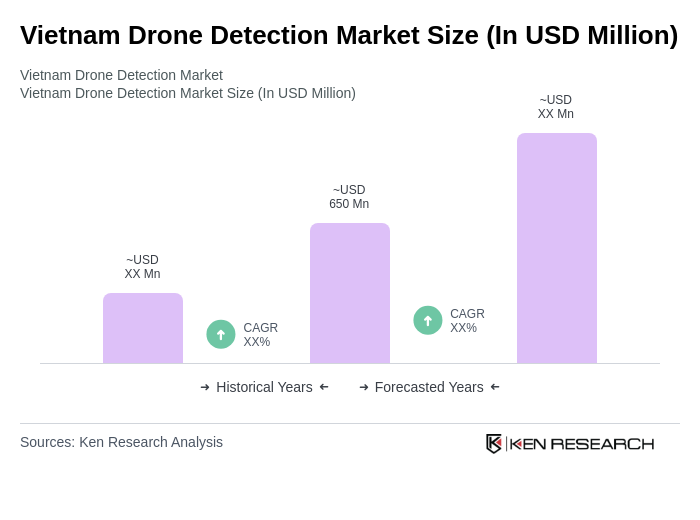
- The Vietnam Drone Detection Market is valued at approximately USD 650 million, based on a five-year historical analysis. This growth is primarily driven by increasing concerns over airspace security, the rise in drone usage for commercial and recreational purposes, and the need for effective surveillance systems. The market is also supported by advancements in detection technologies—such as radar, RF sensors, and AI-powered analytics—and government initiatives aimed at regulating drone operations, reflecting global trends where the accessibility and affordability of drones have led to heightened security risks and regulatory responses.
- Key cities such as Hanoi and Ho Chi Minh City dominate the market due to their high population density, significant commercial activities, and the presence of critical infrastructure. These urban centers are also focal points for government and defense operations, leading to a higher demand for drone detection systems to ensure safety and security in densely populated areas.
- In 2023, the Vietnamese government implemented the Circular No. 01/2023/TT-BGTVT issued by the Ministry of Transport, which requires all drone operators to register their drones and comply with specific operational guidelines, including flight altitude restrictions, no-fly zones around airports and sensitive areas, and mandatory licensing for commercial operations. This regulation aims to enhance airspace safety and security, ensuring that drone activities do not interfere with manned aircraft operations or pose risks to public safety.
Vietnam Drone Detection Market Segmentation
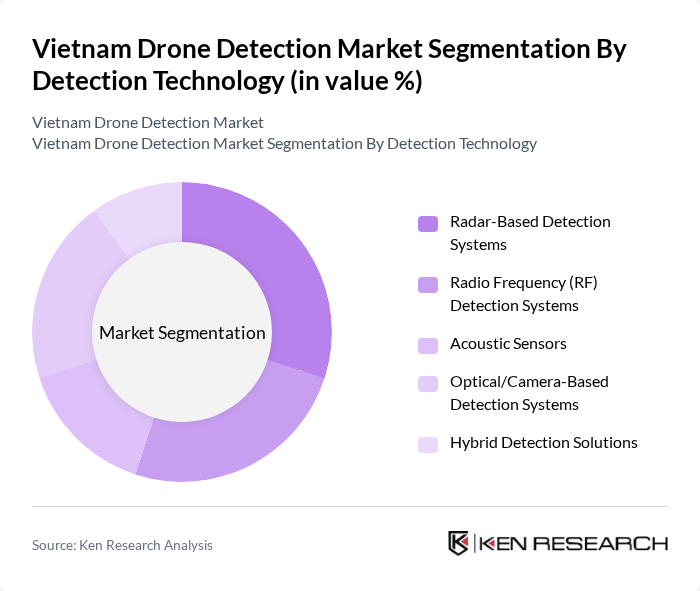
By Detection Technology:The detection technology segment includes various methods used to identify and track drones. The subsegments are Radar-Based Detection Systems, Radio Frequency (RF) Detection Systems, Acoustic Sensors, Optical/Camera-Based Detection Systems, and Hybrid Detection Solutions. Each of these technologies has unique advantages, with radar systems being favored for their long-range capabilities, while RF detection is popular for its ability to intercept drone communications. Hybrid solutions, combining multiple technologies, are increasingly adopted for comprehensive coverage in complex environments.
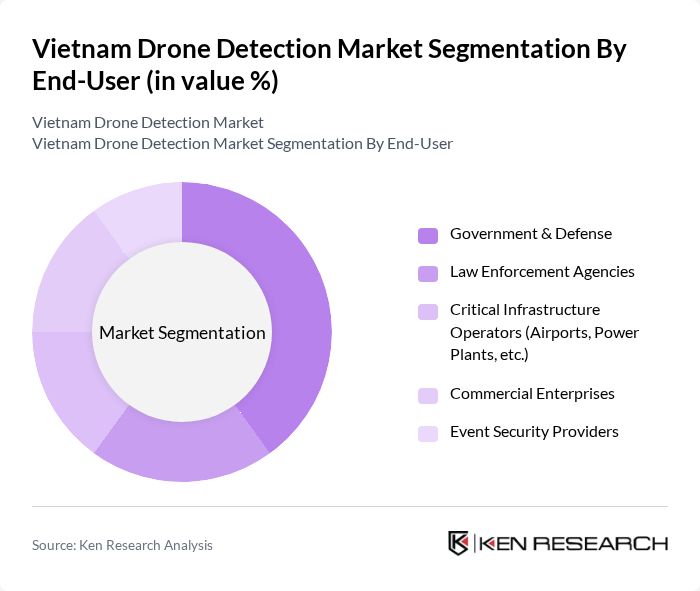
By End-User:The end-user segment encompasses various sectors utilizing drone detection systems, including Government & Defense, Law Enforcement Agencies, Critical Infrastructure Operators (Airports, Power Plants, etc.), Commercial Enterprises, Event Security Providers, and Others. The government and defense sectors are the largest consumers due to their need for national security and public safety, while commercial enterprises are increasingly adopting these systems to protect their assets, especially in sectors such as energy, logistics, and large-scale events.
Vietnam Drone Detection Market Competitive Landscape
The Vietnam Drone Detection Market is characterized by a dynamic mix of regional and international players. Leading participants such as DJI Technology Co., Ltd., DroneShield Ltd., Thales Group, Dedrone GmbH, Rohde & Schwarz GmbH & Co. KG, Leonardo S.p.A., Elbit Systems Ltd., Fortem Technologies, Inc., D-Fend Solutions Ltd., QinetiQ Group plc, Aaronia AG, Raytheon Technologies Corporation, Northrop Grumman Corporation, Teledyne FLIR LLC, Viettel High Tech Industries Corporation contribute to innovation, geographic expansion, and service delivery in this space.
Vietnam Drone Detection Market Industry Analysis
Growth Drivers
- Increasing Security Concerns:The rise in security threats, including unauthorized drone activities, has heightened the demand for drone detection systems in Vietnam. In future, the Vietnamese government reported a 25% increase in drone-related incidents, prompting a need for enhanced surveillance. The national security budget is projected to reach approximately $5.5 billion in future, with a significant portion allocated to advanced detection technologies, reflecting the urgency to address these security challenges effectively.
- Government Initiatives for Drone Regulation:The Vietnamese government is actively developing regulatory frameworks to manage drone operations, which is expected to drive the drone detection market. In future, the Ministry of Transport plans to implement new regulations requiring all commercial drones to be registered, impacting over 12,000 operators. This regulatory push is anticipated to create a robust market for detection systems, as compliance will necessitate investment in advanced technologies to ensure safety and security.
- Technological Advancements in Detection Systems:Rapid advancements in drone detection technologies, including AI and machine learning, are propelling market growth. In future, the global market for AI-driven detection systems is expected to exceed $1.5 billion, with Vietnam's share projected to grow significantly. Local companies are increasingly adopting these technologies, enhancing their capabilities to identify and neutralize unauthorized drones, thus fostering a competitive edge in the security landscape.
Market Challenges
- High Initial Investment Costs:The high costs associated with deploying drone detection systems pose a significant barrier to market entry. In Vietnam, the average cost of a comprehensive detection system can range from $120,000 to $550,000, depending on the technology used. This financial burden can deter small and medium-sized enterprises from investing in such systems, limiting market growth and adoption rates across various sectors.
- Regulatory Compliance Issues:Navigating the complex regulatory landscape presents challenges for companies in the drone detection market. As of future, Vietnam's evolving drone regulations require compliance with stringent safety and operational standards. Companies face potential fines exceeding $60,000 for non-compliance, which can hinder their ability to operate effectively. This uncertainty may discourage investment and slow the adoption of necessary detection technologies in the market.
Vietnam Drone Detection Market Future Outlook
The Vietnam drone detection market is poised for significant growth as security concerns escalate and regulatory frameworks evolve. By future, the integration of AI technologies is expected to enhance detection capabilities, making systems more efficient and reliable. Additionally, the increasing use of drones in sectors like agriculture and e-commerce will drive demand for detection solutions. As urban areas expand, the need for effective drone management will create opportunities for innovative solutions, positioning Vietnam as a key player in the regional drone detection landscape.
Market Opportunities
- Expansion in Urban Areas:The rapid urbanization in Vietnam, with cities like Ho Chi Minh City and Hanoi growing at rates of approximately 3.5% annually, presents a significant opportunity for drone detection systems. As urban areas become more congested, the need for effective drone management solutions will increase, driving demand for advanced detection technologies to ensure public safety and security.
- Collaborations with Security Agencies:Partnerships between private companies and government security agencies can enhance the development and deployment of drone detection systems. In future, collaborative initiatives are expected to increase by 30%, fostering innovation and improving response strategies to unauthorized drone activities, ultimately benefiting both public safety and market growth.
Scope of the Report
| Segment | Sub-Segments |
|---|---|
| By Detection Technology | Radar-Based Detection Systems Radio Frequency (RF) Detection Systems Acoustic Sensors Optical/Camera-Based Detection Systems Hybrid Detection Solutions |
| By End-User | Government & Defense Law Enforcement Agencies Critical Infrastructure Operators (Airports, Power Plants, etc.) Commercial Enterprises Event Security Providers Others |
| By Application | Perimeter Security Airport & Airspace Protection Public Event Surveillance Industrial Site Protection Border Security Others |
| By Component | Hardware (Sensors, Cameras, RF Detectors, etc.) Software (Analytics, AI Algorithms, User Interface) Services (Installation, Maintenance, Training) Others |
| By Sales Channel | Direct Sales Distributors Online Sales System Integrators Others |
| By Range | Short-Range Detection Medium-Range Detection Long-Range Detection Others |
| By Price Range | Entry-Level Systems Mid-Range Systems High-End Systems Others |
Key Target Audience
Investors and Venture Capitalist Firms
Government and Regulatory Bodies (e.g., Ministry of National Defense, Ministry of Public Security)
Manufacturers and Producers of Drone Detection Systems
Security and Surveillance Service Providers
Aerospace and Defense Contractors
Telecommunications Companies
Local Law Enforcement Agencies
Airport and Aviation Authorities
Players Mentioned in the Report:
DJI Technology Co., Ltd.
DroneShield Ltd.
Thales Group
Dedrone GmbH
Rohde & Schwarz GmbH & Co. KG
Leonardo S.p.A.
Elbit Systems Ltd.
Fortem Technologies, Inc.
D-Fend Solutions Ltd.
QinetiQ Group plc
Aaronia AG
Raytheon Technologies Corporation
Northrop Grumman Corporation
Teledyne FLIR LLC
Viettel High Tech Industries Corporation
Table of Contents
Market Assessment Phase
1. Executive Summary and Approach
2. Vietnam Drone Detection Market Overview
2.1 Key Insights and Strategic Recommendations
2.2 Vietnam Drone Detection Market Overview
2.3 Definition and Scope
2.4 Evolution of Market Ecosystem
2.5 Timeline of Key Regulatory Milestones
2.6 Value Chain & Stakeholder Mapping
2.7 Business Cycle Analysis
2.8 Policy & Incentive Landscape
3. Vietnam Drone Detection Market Analysis
3.1 Growth Drivers
3.1.1 Increasing Security Concerns
3.1.2 Government Initiatives for Drone Regulation
3.1.3 Technological Advancements in Detection Systems
3.1.4 Rising Demand from Commercial Sectors
3.2 Market Challenges
3.2.1 High Initial Investment Costs
3.2.2 Regulatory Compliance Issues
3.2.3 Limited Awareness Among End-Users
3.2.4 Competition from Alternative Technologies
3.3 Market Opportunities
3.3.1 Expansion in Urban Areas
3.3.2 Collaborations with Security Agencies
3.3.3 Development of Customized Solutions
3.3.4 Integration with Smart City Initiatives
3.4 Market Trends
3.4.1 Adoption of AI in Detection Systems
3.4.2 Increasing Use of Drones in Agriculture
3.4.3 Growth of the E-commerce Sector
3.4.4 Focus on Sustainable Practices
3.5 Government Regulation
3.5.1 Drone Registration Requirements
3.5.2 Airspace Management Policies
3.5.3 Safety Standards for Drone Operations
3.5.4 Data Privacy Regulations
4. SWOT Analysis
5. Stakeholder Analysis
6. Porter's Five Forces Analysis
7. Vietnam Drone Detection Market Market Size, 2019-2024
7.1 By Value
7.2 By Volume
7.3 By Average Selling Price
8. Vietnam Drone Detection Market Segmentation
8.1 By Detection Technology
8.1.1 Radar-Based Detection Systems
8.1.2 Radio Frequency (RF) Detection Systems
8.1.3 Acoustic Sensors
8.1.4 Optical/Camera-Based Detection Systems
8.1.5 Hybrid Detection Solutions
8.2 By End-User
8.2.1 Government & Defense
8.2.2 Law Enforcement Agencies
8.2.3 Critical Infrastructure Operators (Airports, Power Plants, etc.)
8.2.4 Commercial Enterprises
8.2.5 Event Security Providers
8.2.6 Others
8.3 By Application
8.3.1 Perimeter Security
8.3.2 Airport & Airspace Protection
8.3.3 Public Event Surveillance
8.3.4 Industrial Site Protection
8.3.5 Border Security
8.3.6 Others
8.4 By Component
8.4.1 Hardware (Sensors, Cameras, RF Detectors, etc.)
8.4.2 Software (Analytics, AI Algorithms, User Interface)
8.4.3 Services (Installation, Maintenance, Training)
8.4.4 Others
8.5 By Sales Channel
8.5.1 Direct Sales
8.5.2 Distributors
8.5.3 Online Sales
8.5.4 System Integrators
8.5.5 Others
8.6 By Range
8.6.1 Short-Range Detection
8.6.2 Medium-Range Detection
8.6.3 Long-Range Detection
8.6.4 Others
8.7 By Price Range
8.7.1 Entry-Level Systems
8.7.2 Mid-Range Systems
8.7.3 High-End Systems
8.7.4 Others
9. Vietnam Drone Detection Market Competitive Analysis
9.1 Market Share of Key Players
9.2 KPIs for Cross Comparison of Key Players
9.2.1 Company Name
9.2.2 Group Size (Large, Medium, or Small as per industry convention)
9.2.3 Revenue Growth Rate (Vietnam Market)
9.2.4 Market Penetration Rate (Number of Installations/Sites in Vietnam)
9.2.5 Customer Retention Rate (Repeat Contracts/Service Renewals)
9.2.6 Pricing Strategy (Relative to Market Average)
9.2.7 Product Innovation Rate (Number of Patents/New Features per Year)
9.2.8 Operational Efficiency (Deployment Time, Service Uptime)
9.2.9 Brand Recognition (Industry Awards, Local Partnerships)
9.2.10 Customer Satisfaction Score (Surveyed End-User Ratings)
9.2.11 Regulatory Compliance (Vietnam Aviation & Security Standards)
9.2.12 Local Support Capability (Vietnam-based Service/Support Centers)
9.3 SWOT Analysis of Top Players
9.4 Pricing Analysis
9.5 Detailed Profile of Major Companies
9.5.1 DJI Technology Co., Ltd.
9.5.2 DroneShield Ltd.
9.5.3 Thales Group
9.5.4 Dedrone GmbH
9.5.5 Rohde & Schwarz GmbH & Co. KG
9.5.6 Leonardo S.p.A.
9.5.7 Elbit Systems Ltd.
9.5.8 Fortem Technologies, Inc.
9.5.9 D-Fend Solutions Ltd.
9.5.10 QinetiQ Group plc
9.5.11 Aaronia AG
9.5.12 Raytheon Technologies Corporation
9.5.13 Northrop Grumman Corporation
9.5.14 Teledyne FLIR LLC
9.5.15 Viettel High Tech Industries Corporation
10. Vietnam Drone Detection Market End-User Analysis
10.1 Procurement Behavior of Key Ministries
10.1.1 Budget Allocation Trends
10.1.2 Decision-Making Processes
10.1.3 Preferred Procurement Channels
10.2 Corporate Spend on Infrastructure & Energy
10.2.1 Investment Priorities
10.2.2 Spending Patterns
10.2.3 Impact of Regulations on Spending
10.3 Pain Point Analysis by End-User Category
10.3.1 Security Concerns
10.3.2 Budget Constraints
10.3.3 Technology Integration Issues
10.4 User Readiness for Adoption
10.4.1 Training and Support Needs
10.4.2 Awareness Levels
10.4.3 Infrastructure Readiness
10.5 Post-Deployment ROI and Use Case Expansion
10.5.1 Performance Metrics
10.5.2 Case Studies of Successful Implementations
10.5.3 Future Use Case Potential
11. Vietnam Drone Detection Market Future Size, 2025-2030
11.1 By Value
11.2 By Volume
11.3 By Average Selling Price
Go-To-Market Strategy Phase
1. Whitespace Analysis + Business Model Canvas
1.1 Market Gaps Identification
1.2 Business Model Development
2. Marketing and Positioning Recommendations
2.1 Branding Strategies
2.2 Product USPs
3. Distribution Plan
3.1 Urban Retail Strategies
3.2 Rural NGO Tie-Ups
4. Channel & Pricing Gaps
4.1 Underserved Routes
4.2 Pricing Bands
5. Unmet Demand & Latent Needs
5.1 Category Gaps
5.2 Consumer Segments
6. Customer Relationship
6.1 Loyalty Programs
6.2 After-Sales Service
7. Value Proposition
7.1 Sustainability
7.2 Integrated Supply Chains
8. Key Activities
8.1 Regulatory Compliance
8.2 Branding
8.3 Distribution Setup
9. Entry Strategy Evaluation
9.1 Domestic Market Entry Strategy
9.1.1 Product Mix
9.1.2 Pricing Band
9.1.3 Packaging
9.2 Export Entry Strategy
9.2.1 Target Countries
9.2.2 Compliance Roadmap
10. Entry Mode Assessment
10.1 JV
10.2 Greenfield
10.3 M&A
10.4 Distributor Model
11. Capital and Timeline Estimation
11.1 Capital Requirements
11.2 Timelines
12. Control vs Risk Trade-Off
12.1 Ownership vs Partnerships
13. Profitability Outlook
13.1 Breakeven Analysis
13.2 Long-Term Sustainability
14. Potential Partner List
14.1 Distributors
14.2 JVs
14.3 Acquisition Targets
15. Execution Roadmap
15.1 Phased Plan for Market Entry
15.1.1 Market Setup
15.1.2 Market Entry
15.1.3 Growth Acceleration
15.1.4 Scale & Stabilize
15.2 Key Activities and Milestones
15.2.1 Milestone Planning
15.2.2 Activity Tracking
Research Methodology
Phase 1: Approach1
Desk Research
- Analysis of government reports on drone regulations and airspace management in Vietnam
- Review of industry publications and white papers on drone technology and applications
- Examination of market reports from trade associations related to UAV (Unmanned Aerial Vehicle) usage
Primary Research
- Interviews with key stakeholders in the defense and security sectors regarding drone detection needs
- Surveys with technology providers specializing in drone detection systems
- Field interviews with law enforcement agencies utilizing drone detection technologies
Validation & Triangulation
- Cross-validation of findings through multiple data sources including market reports and expert opinions
- Triangulation of data from regulatory bodies, industry experts, and market participants
- Sanity checks through expert panel reviews to ensure data accuracy and relevance
Phase 2: Market Size Estimation1
Top-down Assessment
- Estimation of the total addressable market based on national defense budgets and security spending
- Segmentation of the market by application areas such as military, commercial, and public safety
- Incorporation of growth trends in drone usage and corresponding detection technology adoption
Bottom-up Modeling
- Collection of sales data from leading drone detection technology providers in Vietnam
- Estimation of market penetration rates based on current adoption levels in various sectors
- Volume and pricing analysis to derive revenue projections for drone detection systems
Forecasting & Scenario Analysis
- Multi-factor regression analysis incorporating factors such as drone market growth and regulatory changes
- Scenario modeling based on potential shifts in government policy and technological advancements
- Development of baseline, optimistic, and pessimistic forecasts through 2030
Phase 3: CATI Sample Composition1
| Scope Item/Segment | Sample Size | Target Respondent Profiles |
|---|---|---|
| Military Applications of Drone Detection | 100 | Defense Analysts, Military Procurement Officers |
| Commercial Drone Detection Solutions | 75 | Security Managers, Facility Operations Directors |
| Public Safety and Law Enforcement | 60 | Police Chiefs, Public Safety Coordinators |
| Regulatory Bodies and Policy Makers | 45 | Government Officials, Regulatory Compliance Officers |
| Technology Providers in Drone Detection | 80 | Product Managers, R&D Engineers |
Frequently Asked Questions
What is the current value of the Vietnam Drone Detection Market?
The Vietnam Drone Detection Market is valued at approximately USD 650 million, driven by increasing airspace security concerns, the rise in drone usage, and advancements in detection technologies such as radar and AI-powered analytics.
What are the key drivers of growth in the Vietnam Drone Detection Market?
Which cities in Vietnam are leading in drone detection system demand?
What regulations has the Vietnamese government implemented regarding drone operations?
Other Regional/Country Reports
Indonesia Drone Detection Market
Malaysia Drone Detection Market
KSA Drone Detection Market
APAC Drone Detection Market
SEA Drone Detection Market
Thailand Drone Detection Market
Other Adjacent Reports
Singapore Drone Countermeasures Market
Indonesia UAV Manufacturing Market
Brazil Airspace Management Market
Kuwait Surveillance Technology Market
UAE Radar Systems MarketKuwait RF Sensor Market
UAE AI Security Solutions Market
Qatar Critical Infrastructure Protection Market
KSA Aviation Security Market
Bahrain Drone Regulation Services Market
Why Buy From Us?

What makes us stand out is that our consultants follow Robust, Refine and Result (RRR) methodology. Robust for clear definitions, approaches and sanity checking, Refine for differentiating respondents' facts and opinions, and Result for presenting data with story.

We have set a benchmark in the industry by offering our clients with syndicated and customized market research reports featuring coverage of entire market as well as meticulous research and analyst insights.

While we don't replace traditional research, we flip the method upside down. Our dual approach of Top Bottom & Bottom Top ensures quality deliverable by not just verifying company fundamentals but also looking at the sector and macroeconomic factors.

With one step in the future, our research team constantly tries to show you the bigger picture. We help with some of the tough questions you may encounter along the way: How is the industry positioned? Best marketing channel? KPI's of competitors? By aligning every element, we help maximize success.

Our report gives you instant access to the answers and sources that other companies might choose to hide. We elaborate each steps of research methodology we have used and showcase you the sample size to earn your trust.

If you need any support, we are here! We pride ourselves on universe strength, data quality, and quick, friendly, and professional service.