About the Report
Base Year 2024APAC Distributed Temperature Sensing Market Overview
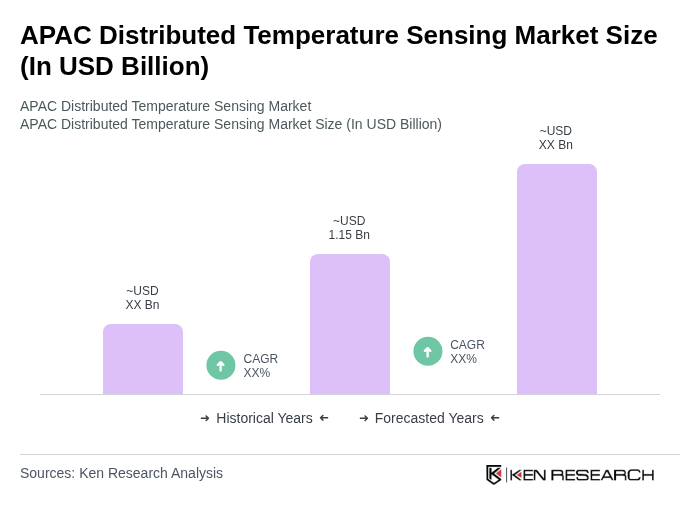
- The APAC Distributed Temperature Sensing Market is valued at USD 1.15 billion, based on a five-year historical analysis. This growth is primarily driven by the increasing demand for real-time monitoring solutions across various industries, including oil and gas, power generation, and manufacturing. The need for enhanced safety measures and operational efficiency has further propelled the adoption of distributed temperature sensing technologies in the region.
- Key players in this market include China, India, and Japan, which dominate due to their robust industrial sectors and significant investments in infrastructure development. China leads with its extensive manufacturing capabilities and achieved a market value of USD 94.2 million, while India is rapidly expanding its energy sector with a projected CAGR of 9.8%. Japan's advanced technology landscape also contributes to its strong position in the market, making these countries pivotal in driving growth in the distributed temperature sensing sector.
- The regulatory framework supporting distributed temperature sensing adoption has strengthened across the region. India has implemented stringent regulations regarding emission control and leakage detection in critical infrastructure projects, mandating the use of advanced monitoring systems in oil and gas, power generation, and transportation sectors. These initiatives aim to enhance safety and efficiency, thereby boosting the demand for distributed temperature sensing technologies across the country.
APAC Distributed Temperature Sensing Market Segmentation
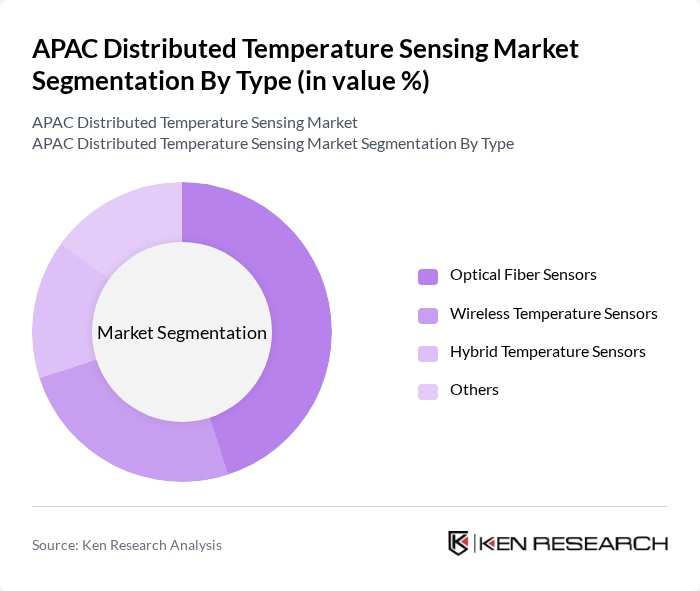
By Type:The market is segmented into various types, including Optical Fiber Sensors, Wireless Temperature Sensors, Hybrid Temperature Sensors, and Others. Among these, Optical Fiber Sensors are leading due to their high accuracy and reliability in temperature measurement over long distances. Single-mode fiber technology dominates this segment, attributed to its high effectiveness in long-distance and high-precision temperature monitoring, with its small core diameter enabling signal transmission over extended distances without signal loss. The increasing adoption of these sensors in critical applications such as pipeline monitoring and fire detection is driving their dominance in the market.
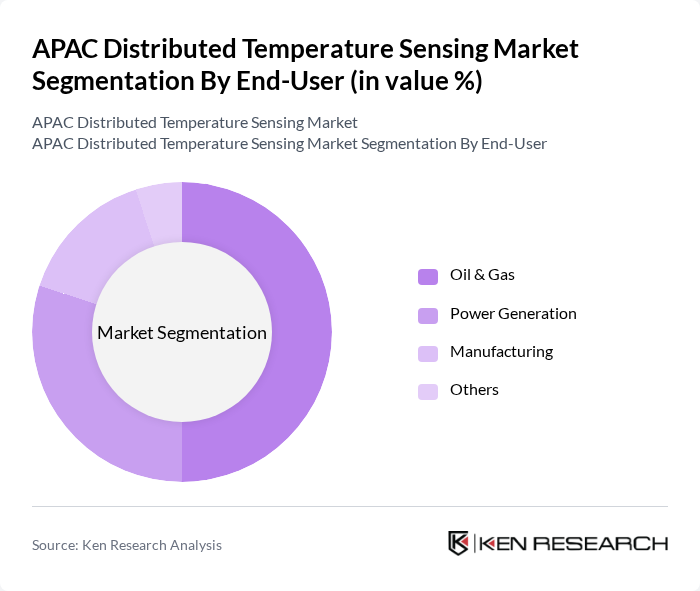
By End-User:The end-user segmentation includes Oil & Gas, Power Generation, Manufacturing, and Others. The Oil & Gas sector is the leading segment, driven by the need for continuous monitoring of pipelines and facilities to prevent leaks and ensure safety. The increasing investments in energy infrastructure and the growing focus on operational efficiency are further propelling the demand for distributed temperature sensing solutions in this sector. Additionally, power cable monitoring and process & pipeline monitoring applications are experiencing significant growth, with the process and pipeline monitoring segment expected to grow at a substantial CAGR in the coming years, largely attributed to the increasing need for real-time monitoring and leakage detection in industries such as oil and gas, chemical processing, and power generation.
APAC Distributed Temperature Sensing Market Competitive Landscape
The APAC Distributed Temperature Sensing Market is characterized by a dynamic mix of regional and international players. Leading participants such as Yokogawa Electric Corporation, Siemens AG, Halliburton Company, Schlumberger Limited, Baker Hughes Company, Omnisens SA, AP Sensing GmbH, FiberSense, QinetiQ Group plc, Neoptix Inc., Sensornet Limited, NKT Photonics, TTK, OptaSense, TeraSense, Fotech Solutions, Sensuron, and others contribute to innovation, geographic expansion, and service delivery in this space.
APAC Distributed Temperature Sensing Market Industry Analysis
Growth Drivers
- Increasing Demand for Real-Time Monitoring:The APAC region is witnessing a surge in demand for real-time monitoring solutions, particularly in sectors like oil and gas, where temperature fluctuations can lead to significant operational risks. In future, the oil and gas industry in APAC is projected to invest approximately $150 billion in monitoring technologies, driven by the need for enhanced safety and efficiency. This trend is further supported by the increasing number of pipeline projects, which require advanced temperature sensing to prevent failures and ensure compliance with safety regulations.
- Advancements in Fiber Optic Technology:The development of advanced fiber optic technologies is significantly enhancing the capabilities of distributed temperature sensing systems. In future, the global fiber optic market is expected to reach $8 billion, with APAC accounting for a substantial share due to its robust telecommunications infrastructure. These advancements enable higher sensitivity and accuracy in temperature measurements, making them essential for industries such as manufacturing and energy, where precise monitoring is critical for operational efficiency and safety.
- Rising Investments in Infrastructure Development:The APAC region is experiencing a boom in infrastructure development, with governments allocating over $1 trillion for projects in future. This investment is particularly evident in urban development and transportation sectors, where temperature sensing technologies are crucial for monitoring structural integrity. The integration of distributed temperature sensing in these projects not only enhances safety but also optimizes maintenance schedules, thereby reducing long-term operational costs and improving overall infrastructure resilience.
Market Challenges
- High Initial Installation Costs:One of the primary challenges facing the distributed temperature sensing market in APAC is the high initial installation costs associated with these systems. For instance, the average cost of deploying a distributed temperature sensing system can range from $50,000 to $200,000, depending on the complexity and scale of the application. This financial barrier can deter smaller companies from adopting these technologies, limiting market growth and innovation in the region.
- Limited Awareness Among End-Users:Despite the benefits of distributed temperature sensing, there remains a significant knowledge gap among potential end-users in APAC. A recent survey indicated that over 60% of industrial operators are unaware of the advantages of these systems. This lack of awareness can hinder adoption rates, as companies may opt for traditional monitoring methods that do not provide the same level of accuracy or efficiency, ultimately affecting their operational performance and safety standards.
APAC Distributed Temperature Sensing Market Future Outlook
The future of the APAC distributed temperature sensing market appears promising, driven by technological advancements and increasing demand for efficient monitoring solutions. As industries continue to embrace digital transformation, the integration of IoT with temperature sensing technologies is expected to enhance data collection and analysis capabilities. Furthermore, the focus on sustainability and energy efficiency will likely propel investments in advanced sensing technologies, ensuring that companies can meet regulatory requirements while optimizing their operations for better performance and reduced environmental impact.
Market Opportunities
- Expansion in Renewable Energy Projects:The growing emphasis on renewable energy in APAC presents significant opportunities for distributed temperature sensing technologies. With investments projected to exceed $300 billion in renewable energy projects in future, these systems can play a crucial role in monitoring the performance and safety of solar and wind installations, ensuring optimal energy production and compliance with environmental standards.
- Increasing Adoption in Smart Cities:The rise of smart city initiatives across APAC is creating new avenues for distributed temperature sensing applications. As cities invest in smart infrastructure, the demand for real-time monitoring solutions is expected to grow, with an estimated $100 billion allocated for smart city projects in future. This trend will drive the adoption of temperature sensing technologies to enhance urban management, energy efficiency, and public safety.
Scope of the Report
| Segment | Sub-Segments |
|---|---|
| By Type | Optical Fiber Sensors Wireless Temperature Sensors Hybrid Temperature Sensors Others |
| By End-User | Oil & Gas Power Generation Manufacturing Others |
| By Region | China India Japan South Korea Southeast Asia Australia & New Zealand |
| By Technology | DTS (Distributed Temperature Sensing) DAS (Distributed Acoustic Sensing) Others |
| By Application | Pipeline Monitoring Fire Detection Environmental Monitoring Power Cable Monitoring Geothermal Monitoring Others |
| By Investment Source | Private Investments Government Funding International Aid Others |
| By Policy Support | Government Subsidies Tax Incentives Research Grants Others |
Key Target Audience
Investors and Venture Capitalist Firms
Government and Regulatory Bodies (e.g., Ministry of Electronics and Information Technology, Environmental Protection Agency)
Manufacturers and Producers
Energy and Utility Companies
Telecommunications Providers
Oil and Gas Companies
Infrastructure Development Agencies
Environmental Monitoring Organizations
Players Mentioned in the Report:
Yokogawa Electric Corporation
Siemens AG
Halliburton Company
Schlumberger Limited
Baker Hughes Company
Omnisens SA
AP Sensing GmbH
FiberSense
QinetiQ Group plc
Neoptix Inc.
Sensornet Limited
NKT Photonics
TTK
OptaSense
TeraSense
Fotech Solutions
Sensuron
Yokogawa Electric Corporation (China)
Yokogawa Electric Corporation (India)
Yokogawa Electric Corporation (Japan)
Yokogawa Electric Corporation (South Korea)
Yokogawa Electric Corporation (Southeast Asia)
Yokogawa Electric Corporation (Australia)
Yokogawa Electric Corporation (New Zealand)
Yokogawa Electric Corporation (Hong Kong)
Yokogawa Electric Corporation (Taiwan)
Yokogawa Electric Corporation (Singapore)
Yokogawa Electric Corporation (Malaysia)
Yokogawa Electric Corporation (Thailand)
Yokogawa Electric Corporation (Indonesia)
Yokogawa Electric Corporation (Philippines)
Yokogawa Electric Corporation (Vietnam)
Yokogawa Electric Corporation (Sri Lanka)
Yokogawa Electric Corporation (Bangladesh)
Yokogawa Electric Corporation (Pakistan)
Yokogawa Electric Corporation (Nepal)
Yokogawa Electric Corporation (Bhutan)
Yokogawa Electric Corporation (Mongolia)
Yokogawa Electric Corporation (Cambodia)
Yokogawa Electric Corporation (Laos)
Yokogawa Electric Corporation (Myanmar)
Yokogawa Electric Corporation (Brunei)
Yokogawa Electric Corporation (Timor-Leste)
Yokogawa Electric Corporation (Papua New Guinea)
Yokogawa Electric Corporation (Fiji)
Yokogawa Electric Corporation (Samoa)
Yokogawa Electric Corporation (Tonga)
Yokogawa Electric Corporation (Vanuatu)
Yokogawa Electric Corporation (Solomon Islands)
Yokogawa Electric Corporation (Kiribati)
Yokogawa Electric Corporation (Tuvalu)
Yokogawa Electric Corporation (Nauru)
Yokogawa Electric Corporation (Palau)
Yokogawa Electric Corporation (Marshall Islands)
Yokogawa Electric Corporation (Micronesia)
Yokogawa Electric Corporation (Guam)
Yokogawa Electric Corporation (Northern Mariana Islands)
Yokogawa Electric Corporation (American Samoa)
Yokogawa Electric Corporation (Cook Islands)
Yokogawa Electric Corporation (Niue)
Yokogawa Electric Corporation (Tokelau)
Yokogawa Electric Corporation (Wallis and Futuna)
Yokogawa Electric Corporation (French Polynesia)
Yokogawa Electric Corporation (New Caledonia)
Yokogawa Electric Corporation (Pitcairn Islands)
Yokogawa Electric Corporation (Norfolk Island)
Yokogawa Electric Corporation (Christmas Island)
Yokogawa Electric Corporation (Cocos (Keeling) Islands)
Yokogawa Electric Corporation (Ashmore and Cartier Islands)
Yokogawa Electric Corporation (Heard Island and McDonald Islands)
Yokogawa Electric Corporation (Macquarie Island)
Yokogawa Electric Corporation (Lord Howe Island)
Yokogawa Electric Corporation (Norfolk Island
Table of Contents
Market Assessment Phase
1. Executive Summary and Approach
2. APAC Distributed Temperature Sensing Market Overview
2.1 Key Insights and Strategic Recommendations
2.2 APAC Distributed Temperature Sensing Market Overview
2.3 Definition and Scope
2.4 Evolution of Market Ecosystem
2.5 Timeline of Key Regulatory Milestones
2.6 Value Chain & Stakeholder Mapping
2.7 Business Cycle Analysis
2.8 Policy & Incentive Landscape
3. APAC Distributed Temperature Sensing Market Analysis
3.1 Growth Drivers
3.1.1 Increasing demand for real-time monitoring
3.1.2 Advancements in fiber optic technology
3.1.3 Rising investments in infrastructure development
3.1.4 Growing applications in oil and gas sector
3.2 Market Challenges
3.2.1 High initial installation costs
3.2.2 Limited awareness among end-users
3.2.3 Technical complexities in integration
3.2.4 Regulatory hurdles in various regions
3.3 Market Opportunities
3.3.1 Expansion in renewable energy projects
3.3.2 Increasing adoption in smart cities
3.3.3 Development of advanced sensing technologies
3.3.4 Collaborations with technology providers
3.4 Market Trends
3.4.1 Shift towards digitalization in monitoring
3.4.2 Integration of IoT with temperature sensing
3.4.3 Focus on sustainability and energy efficiency
3.4.4 Growth in demand for predictive maintenance
3.5 Government Regulation
3.5.1 Standards for environmental monitoring
3.5.2 Incentives for renewable energy projects
3.5.3 Regulations on data privacy and security
3.5.4 Compliance requirements for industrial applications
4. SWOT Analysis
5. Stakeholder Analysis
6. Porter's Five Forces Analysis
7. APAC Distributed Temperature Sensing Market Market Size, 2019-2024
7.1 By Value
7.2 By Volume
7.3 By Average Selling Price
8. APAC Distributed Temperature Sensing Market Segmentation
8.1 By Type
8.1.1 Optical Fiber Sensors
8.1.2 Wireless Temperature Sensors
8.1.3 Hybrid Temperature Sensors
8.1.4 Others
8.2 By End-User
8.2.1 Oil & Gas
8.2.2 Power Generation
8.2.3 Manufacturing
8.2.4 Others
8.3 By Region
8.3.1 China
8.3.2 India
8.3.3 Japan
8.3.4 South Korea
8.3.5 Southeast Asia
8.3.6 Australia & New Zealand
8.4 By Technology
8.4.1 DTS (Distributed Temperature Sensing)
8.4.2 DAS (Distributed Acoustic Sensing)
8.4.3 Others
8.5 By Application
8.5.1 Pipeline Monitoring
8.5.2 Fire Detection
8.5.3 Environmental Monitoring
8.5.4 Power Cable Monitoring
8.5.5 Geothermal Monitoring
8.5.6 Others
8.6 By Investment Source
8.6.1 Private Investments
8.6.2 Government Funding
8.6.3 International Aid
8.6.4 Others
8.7 By Policy Support
8.7.1 Government Subsidies
8.7.2 Tax Incentives
8.7.3 Research Grants
8.7.4 Others
9. APAC Distributed Temperature Sensing Market Competitive Analysis
9.1 Market Share of Key Players
9.2 Cross Comparison of Key Players
9.2.1 Company Name
9.2.2 Revenue (APAC Region)
9.2.3 Market Share (APAC Region)
9.2.4 Number of Deployed Systems
9.2.5 R&D Investment (APAC)
9.2.6 Customer Base Size
9.2.7 Product Portfolio Breadth
9.2.8 Regional Presence
9.2.9 Strategic Partnerships
9.2.10 Customer Satisfaction Index
9.3 SWOT Analysis of Top Players
9.4 Pricing Analysis
9.5 Detailed Profile of Major Companies
9.5.1 Yokogawa Electric Corporation
9.5.2 Siemens AG
9.5.3 Halliburton Company
9.5.4 Schlumberger Limited
9.5.5 Baker Hughes Company
9.5.6 Omnisens SA
9.5.7 AP Sensing GmbH
9.5.8 FiberSense
9.5.9 QinetiQ Group plc
9.5.10 Neoptix Inc.
9.5.11 Sensornet Limited
9.5.12 NKT Photonics
9.5.13 TTK
9.5.14 OptaSense
9.5.15 TeraSense
9.5.16 Fotech Solutions
9.5.17 Sensuron
9.5.18 Yokogawa Electric Corporation (China)
9.5.19 Yokogawa Electric Corporation (India)
9.5.20 Yokogawa Electric Corporation (Japan)
9.5.21 Yokogawa Electric Corporation (South Korea)
9.5.22 Yokogawa Electric Corporation (Southeast Asia)
9.5.23 Yokogawa Electric Corporation (Australia)
9.5.24 Yokogawa Electric Corporation (New Zealand)
9.5.25 Yokogawa Electric Corporation (Hong Kong)
9.5.26 Yokogawa Electric Corporation (Taiwan)
9.5.27 Yokogawa Electric Corporation (Singapore)
9.5.28 Yokogawa Electric Corporation (Malaysia)
9.5.29 Yokogawa Electric Corporation (Thailand)
9.5.30 Yokogawa Electric Corporation (Indonesia)
9.5.31 Yokogawa Electric Corporation (Philippines)
9.5.32 Yokogawa Electric Corporation (Vietnam)
9.5.33 Yokogawa Electric Corporation (Sri Lanka)
9.5.34 Yokogawa Electric Corporation (Bangladesh)
9.5.35 Yokogawa Electric Corporation (Pakistan)
9.5.36 Yokogawa Electric Corporation (Nepal)
9.5.37 Yokogawa Electric Corporation (Bhutan)
9.5.38 Yokogawa Electric Corporation (Mongolia)
9.5.39 Yokogawa Electric Corporation (Cambodia)
9.5.40 Yokogawa Electric Corporation (Laos)
9.5.41 Yokogawa Electric Corporation (Myanmar)
9.5.42 Yokogawa Electric Corporation (Brunei)
9.5.43 Yokogawa Electric Corporation (Timor-Leste)
9.5.44 Yokogawa Electric Corporation (Papua New Guinea)
9.5.45 Yokogawa Electric Corporation (Fiji)
9.5.46 Yokogawa Electric Corporation (Samoa)
9.5.47 Yokogawa Electric Corporation (Tonga)
9.5.48 Yokogawa Electric Corporation (Vanuatu)
9.5.49 Yokogawa Electric Corporation (Solomon Islands)
9.5.50 Yokogawa Electric Corporation (Kiribati)
9.5.51 Yokogawa Electric Corporation (Tuvalu)
9.5.52 Yokogawa Electric Corporation (Nauru)
9.5.53 Yokogawa Electric Corporation (Palau)
9.5.54 Yokogawa Electric Corporation (Marshall Islands)
9.5.55 Yokogawa Electric Corporation (Micronesia)
9.5.56 Yokogawa Electric Corporation (Guam)
9.5.57 Yokogawa Electric Corporation (Northern Mariana Islands)
9.5.58 Yokogawa Electric Corporation (American Samoa)
9.5.59 Yokogawa Electric Corporation (Cook Islands)
9.5.60 Yokogawa Electric Corporation (Niue)
9.5.61 Yokogawa Electric Corporation (Tokelau)
9.5.62 Yokogawa Electric Corporation (Wallis and Futuna)
9.5.63 Yokogawa Electric Corporation (French Polynesia)
9.5.64 Yokogawa Electric Corporation (New Caledonia)
9.5.65 Yokogawa Electric Corporation (Pitcairn Islands)
9.5.66 Yokogawa Electric Corporation (Norfolk Island)
9.5.67 Yokogawa Electric Corporation (Christmas Island)
9.5.68 Yokogawa Electric Corporation (Cocos (Keeling) Islands)
9.5.69 Yokogawa Electric Corporation (Ashmore and Cartier Islands)
9.5.70 Yokogawa Electric Corporation (Heard Island and McDonald Islands)
9.5.71 Yokogawa Electric Corporation (Macquarie Island)
9.5.72 Yokogawa Electric Corporation (Lord Howe Island)
9.5.73 Yokogawa Electric Corporation (Norfolk Island)
9.5.74 Yokogawa Electric Corporation (Cocos (Keeling) Islands)
9.5.75 Yokogawa Electric Corporation (Ashmore and Cartier Islands)
9.5.76 Yokogawa Electric Corporation (Heard Island and McDonald Islands)
9.5.77 Yokogawa Electric Corporation (Macquarie Island)
9.5.78 Yokogawa Electric Corporation (Lord Howe Island)
9.5.79 Yokogawa Electric Corporation (Norfolk Island)
9.5.80 Yokogawa Electric Corporation (Cocos (Keeling) Islands)
9.5.81 Yokogawa Electric Corporation (Ashmore and Cartier Islands)
9.5.82 Yokogawa Electric Corporation (Heard Island and McDonald Islands)
9.5.83 Yokogawa Electric Corporation (Macquarie Island)
9.5.84 Yokogawa Electric Corporation (Lord Howe Island)
9.5.85 Yokogawa Electric Corporation (Norfolk Island)
9.5.86 Yokogawa Electric Corporation (Cocos (Keeling) Islands)
9.5.87 Yokogawa Electric Corporation (Ashmore and Cartier Islands)
9.5.88 Yokogawa Electric Corporation (Heard Island and McDonald Islands)
9.5.89 Yokogawa Electric Corporation (Macquarie Island)
9.5.90 Yokogawa Electric Corporation (Lord Howe Island)
9.5.91 Yokogawa Electric Corporation (Norfolk Island)
9.5.92 Yokogawa Electric Corporation (Cocos (Keeling) Islands)
9.5.93 Yokogawa Electric Corporation (Ashmore and Cartier Islands)
9.5.94 Yokogawa Electric Corporation (Heard Island and McDonald Islands)
9.5.95 Yokogawa Electric Corporation (Macquarie Island)
9.5.96 Yokogawa Electric Corporation (Lord Howe Island)
9.5.97 Yokogawa Electric Corporation (Norfolk Island)
9.5.98 Yokogawa Electric Corporation (Cocos (Keeling) Islands)
9.5.99 Yokogawa Electric Corporation (Ashmore and Cartier Islands)
9.5.100 Yokogawa Electric Corporation (Heard Island and McDonald Islands)
9.5.101 Yokogawa Electric Corporation (Macquarie Island)
9.5.102 Yokogawa Electric Corporation (Lord Howe Island)
9.5.103 Yokogawa Electric Corporation (Norfolk Island)
9.5.104 Yokogawa Electric Corporation (Cocos (Keeling) Islands)
9.5.105 Yokogawa Electric Corporation (Ashmore and Cartier Islands)
9.5.106 Yokogawa Electric Corporation (Heard Island and McDonald Islands)
9.5.107 Yokogawa Electric Corporation (Macquarie Island)
9.5.108 Yokogawa Electric Corporation (Lord Howe Island)
9.5.109 Yokogawa Electric Corporation (Norfolk Island)
9.5.110 Yokogawa Electric Corporation (Cocos (Keeling) Islands)
9.5.111 Yokogawa Electric Corporation (Ashmore and Cartier Islands)
9.5.112 Yokogawa Electric Corporation (Heard Island and McDonald Islands)
9.5.113 Yokogawa Electric Corporation (Macquarie Island)
9.5.114 Yokogawa Electric Corporation (Lord Howe Island)
9.5.115 Yokogawa Electric Corporation (Norfolk Island
Research Methodology
Phase 1: Approach1
Desk Research
- Industry reports from relevant trade associations in the APAC region
- Market analysis publications focusing on Distributed Temperature Sensing technologies
- Government publications and white papers on infrastructure and energy projects
Primary Research
- Interviews with technical experts in the field of temperature sensing technologies
- Surveys with end-users in industries such as oil & gas, utilities, and construction
- Field interviews with installation and maintenance professionals in temperature sensing
Validation & Triangulation
- Cross-validation of data from multiple industry sources and expert opinions
- Triangulation of market size estimates using both qualitative and quantitative data
- Sanity checks through feedback from industry panels and focus groups
Phase 2: Market Size Estimation1
Top-down Assessment
- Analysis of the overall APAC market for temperature sensing technologies
- Segmentation by application areas such as oil & gas, power generation, and civil engineering
- Incorporation of regional growth trends and government initiatives in infrastructure
Bottom-up Modeling
- Estimation of market size based on unit sales data from leading manufacturers
- Operational cost analysis based on installation and maintenance requirements
- Volume x pricing model for different temperature sensing applications
Forecasting & Scenario Analysis
- Multi-variable forecasting using economic indicators and industry growth rates
- Scenario analysis based on technological advancements and regulatory changes
- Development of baseline, optimistic, and pessimistic market projections through 2030
Phase 3: CATI Sample Composition1
| Scope Item/Segment | Sample Size | Target Respondent Profiles |
|---|---|---|
| Oil & Gas Industry Applications | 100 | Field Engineers, Operations Managers |
| Power Generation Sector | 80 | Plant Managers, Safety Officers |
| Civil Engineering Projects | 70 | Project Managers, Site Engineers |
| Utility Monitoring Systems | 90 | Utility Managers, Technical Directors |
| Research & Development in Temperature Sensing | 60 | R&D Managers, Product Development Engineers |
Frequently Asked Questions
What is the current value of the APAC Distributed Temperature Sensing Market?
The APAC Distributed Temperature Sensing Market is valued at approximately USD 1.15 billion, driven by the increasing demand for real-time monitoring solutions across various industries, including oil and gas, power generation, and manufacturing.
Which countries are leading in the APAC Distributed Temperature Sensing Market?
What are the main drivers of growth in the APAC Distributed Temperature Sensing Market?
What are the challenges faced by the APAC Distributed Temperature Sensing Market?
Other Regional/Country Reports
Indonesia Distributed Temperature Sensing Market
Malaysia Distributed Temperature Sensing Market
KSA Distributed Temperature Sensing Market
SEA Distributed Temperature Sensing Market
Vietnam Distributed Temperature Sensing Market
Thailand Distributed Temperature Sensing Market
Other Adjacent Reports
Belgium Fiber Optic Sensing Market
Mexico Pipeline Monitoring Market
UAE Oil and Gas Sensing Market
Japan Power Generation Monitoring Market
Indonesia Manufacturing Temperature Control Market
South Korea Infrastructure Safety Monitoring Market
Brazil Renewable Energy Sensing Market
Oman Smart Grid Technology Market
Saudi Arabia environmental monitoring market report Size, Share, Growth Drivers, Trends, Opportunities & Forecast 2025–2030Bahrain Industrial Process Automation Market
Why Buy From Us?

What makes us stand out is that our consultants follow Robust, Refine and Result (RRR) methodology. Robust for clear definitions, approaches and sanity checking, Refine for differentiating respondents' facts and opinions, and Result for presenting data with story.

We have set a benchmark in the industry by offering our clients with syndicated and customized market research reports featuring coverage of entire market as well as meticulous research and analyst insights.

While we don't replace traditional research, we flip the method upside down. Our dual approach of Top Bottom & Bottom Top ensures quality deliverable by not just verifying company fundamentals but also looking at the sector and macroeconomic factors.

With one step in the future, our research team constantly tries to show you the bigger picture. We help with some of the tough questions you may encounter along the way: How is the industry positioned? Best marketing channel? KPI's of competitors? By aligning every element, we help maximize success.

Our report gives you instant access to the answers and sources that other companies might choose to hide. We elaborate each steps of research methodology we have used and showcase you the sample size to earn your trust.

If you need any support, we are here! We pride ourselves on universe strength, data quality, and quick, friendly, and professional service.