9.1% Market Growth, 18% Revenue Decline: Why 3D Systems Is Losing Ground in the USD 22 Billion 3D Printing Market?
Ken Research
February 3, 2026 - 6 min read

February 3, 2026
by Khushi RastogiThe global additive manufacturing (3D printing) market grew 9.1% year-on-year in 2024, reaching USD 21.9 billion globally, reinforcing the continued adoption of industrial and professional 3D printing technologies.
However, this growth was unevenly distributed across regions and revenue streams. Incremental demand was concentrated in Asia-Pacific, led by China, while North America and Europe, Middle East & Africa (EMEA) experienced flat to declining spending.
At the same time, value creation shifted away from hardware toward services, software, and materials, disadvantaging system-led OEMs. As a result, overall market expansion increasingly failed to translate into proportional revenue growth for hardware-centric players such as 3D Systems.
Accelerating Revenue Decline Indicates Structural Share Loss Rather Than Cyclical Volatility
Against this backdrop, 3D Systems’ revenue performance between 2022 and 2024 reflects a sustained deterioration that extends beyond cyclical demand softness, with total revenue declining from USD 538.0 million in 2022 to USD 488.1 million in 2023 and further to USD 440.1 million in 2024, translating into an 18% cumulative revenue contraction over two years.
Notably, the pace of decline accelerated rather than stabilised, as the 9.8% year-on-year drop in 2024 exceeded the 9.3% decline recorded in 2023, suggesting that pricing pressure, product mix deterioration, and weakening system demand continued to intensify rather than normalise.
By comparison, Proto Labs generated USD 500.9 million in revenue in 2024, reflecting a marginal 0.6% year-on-year decline, while Stratasys reported USD 572.5 million, down 8.8% year-on-year, indicating that although broader OEM pressure exists, 3D Systems’ revenue erosion remains more severe in relative and cumulative terms. The contrast is further illustrated by Proto Labs’ 2024 revenue breakdown by product line, shown below.
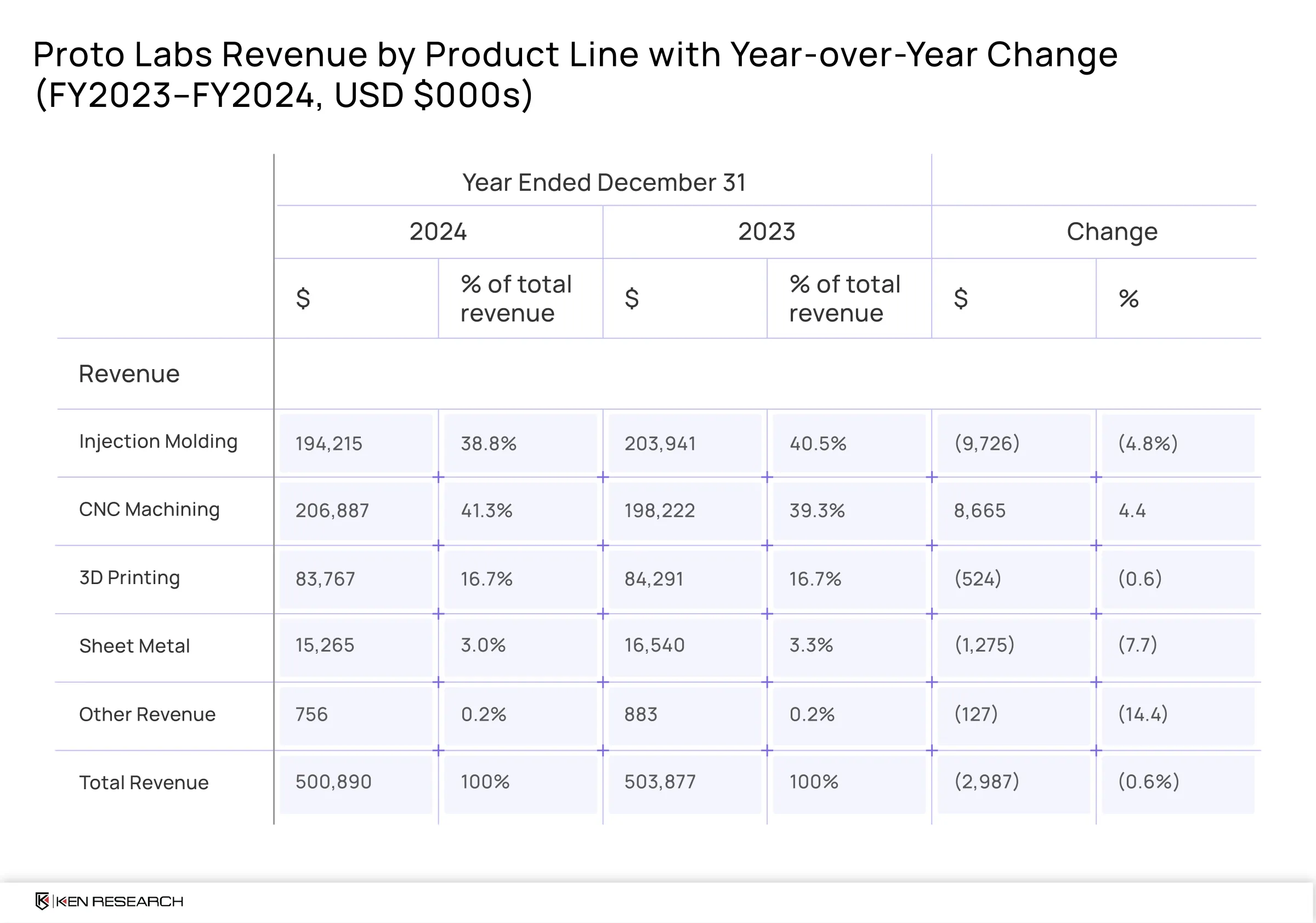
Within Proto Labs’ portfolio, CNC Machining revenue increased 4.4% year-on-year to USD 206.9 million, expanding its share of total revenue from 39.3% in 2023 to 41.3% in 2024, reflecting sustained demand for flexible, short-cycle manufacturing solutions. This growth partially offset declines in Injection Moulding, which fell 4.8% year-on-year, and Sheet Metal, which declined 7.7%, indicating selective end-market softness rather than broad-based demand erosion.
Notably, 3D Printing revenue at Proto Labs remained effectively flat, declining only 0.6% year-on-year to USD 83.8 million, maintaining a stable 16.7% revenue contribution. While this indicates limited acceleration in additive manufacturing demand, it contrasts with the sharper revenue contraction experienced by 3D Systems across both healthcare and industrial end markets, underscoring differences in execution and portfolio balance rather than market exposure alone.
Persistent Losses and Margin Compression Undermine Earnings Quality and Capital Efficiency
Profitability trends further reinforce concerns regarding structural performance, as 3D Systems’ net loss widened from USD (122.7) million in 2022 to USD (362.7) million in 2023, before narrowing modestly to USD (255.6) million in 2024, a level that still represents more than double the loss recorded two years earlier, underscoring the absence of a sustained earnings recovery.
Gross margin performance deteriorated concurrently, declining from approximately 40.2% in 2023 to 37.3% in 2024, placing 3D Systems at an approximate 700 basis point disadvantage relative to key peers, including Proto Labs at 44.6% and Stratasys at 44.9% during the same fiscal year.
These results were materially affected by significant goodwill and asset impairment charges, particularly within the Industrial Solutions reporting unit, which distorted reported earnings while simultaneously raising questions regarding historical capital allocation decisions and the long-term return profile of acquired assets.
Segment-Level Financials Reveal Broad-Based Weakness Across Core End Markets
A closer examination of segment-level performance confirms that revenue and margin pressure are not isolated to a single business line, as Healthcare Solutions revenue declined from USD261.0 million in 2022 to USD213.2 million in 2023 and further to USD189.7 million in 2024, representing a 27% decline over two years.
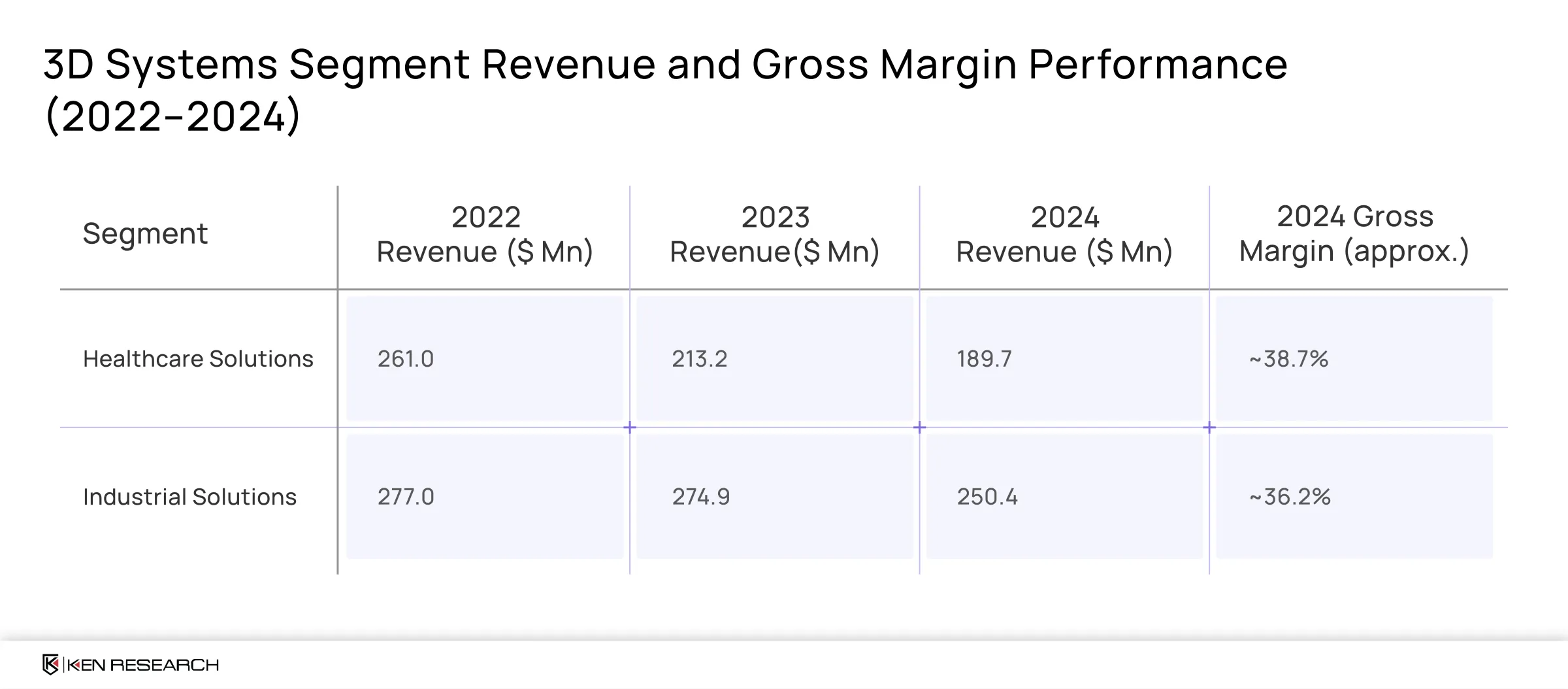
This contraction was driven by lower dental sales, reduced printer demand in non-dental medical markets, and service revenue impacts linked to changes in collaboration-related variable consideration, while the segment’s gross margin settled at approximately 38.7% in 2024, below historical levels.
Industrial Solutions followed a similar trajectory, with revenue decreasing from USD 277.0 million in 2022 to USD 274.9 million in 2023 and USD 250.4 million in 2024, while gross margin compressed to roughly 36.2%, reflecting unfavourable product mix, declining volumes, and intensified competitive pricing pressure, with margins down an estimated 400 basis points from prior 40%+ levels.
Operating Cash Flow Remains Negative Despite Tactical Improvement
Although 3D Systems reported an improvement in operating cash flow during 2024, the underlying drivers highlight ongoing execution risk, as net cash used in operating activities improved from USD (80.7) million in 2023 to USD (44.9) million in 2024, largely due to inventory reductions rather than sustained operating profitability.
This distinction is critical when contrasted with Proto Labs’ operating cash generation of USD 77.8 million in 2024 and USD 73.3 million in 2023, which demonstrates consistent internal funding capacity and reinforces a structural divergence in capital efficiency between the two companies.
As a result, 3D Systems continues to operate with constrained strategic flexibility, relying on balance-sheet actions and cost initiatives rather than organic cash generation to support operations and investment priorities.
Strategic Actions Improve Liquidity but Increase Dependence on Execution Discipline
In response to mounting financial pressure, 3D Systems completed the USD123 million sale of its Geomagic software portfolio, generating approximately USD100 million in net proceeds, which provided near-term liquidity support while simultaneously removing a higher-margin software revenue stream from the business mix.
Despite this transaction, cash and cash equivalents declined to USD 116.4 million as of June 30, 2025, down USD 55.0 million from December 2024, with the decrease primarily attributed to USD 59.6 million in cash used in operations, underscoring the continued drag from core business performance.
Management has also announced a cost-reduction initiative expected to deliver more than USD 50 million in incremental annualised savings, with benefits anticipated across 2025 and the first half of 2026, although the long-term impact will depend on whether these savings translate into durable margin recovery without impairing innovation capacity or commercial execution.
Conclusion
The financial path of 3D Systems over the 2022–2025 period highlights a structural divergence between headline industry growth and company-level value creation, while 3D Systems experienced an 18% cumulative revenue decline, a gross margin drop of roughly 300 basis points, and continued negative operating cash flow of USD (44.9) million. These metrics signal that growth within the 3D printing ecosystem is increasingly accruing to players with stronger pricing power, recurring revenue exposure, and disciplined capital deployment, rather than to hardware-led OEMs operating under margin and utilisation pressure.
Ken Research Insight indicates that the next phase of competition in the global 3D printing market will be defined less by adoption rates and more by financial execution, particularly the ability to translate cost-reduction programs exceeding USD 50 million annually, balance-sheet actions such as the USD 123 million Geomagic divestiture, and segment-level stabilisation into sustained profitability. Our analysis further suggests that capital efficiency, cash conversion, and portfolio focus will increasingly determine long-term competitiveness and consolidation outcomes across the industry.
Related tags
Software and Devices
IT and ITES
Technology and Telecom
Get started
We've helped companies around the world future-proof
their businesses - and we can do the same for you.