China’s Economic Reset: 32+ Months of Deflation, 29% Industrial Losses, and a Global Supply Chain Shift
Ken Research
December 30, 2025 - 5 min read
December 30, 2025
by Ken ResearchChina is entering one of its most consequential economic transitions in decades. The traditional pillars of growth, including property development, export dependence, and heavy investment, are no longer delivering the growth they once did.
The nearly 20% collapse in new construction starts, prolonged producer price deflation, and the fact that 29% of industrial firms are now operating at a loss all point to a fundamental restructuring of China’s economy.
China’s working-age population has shrunk by more than 40 million since 2015, net foreign direct investment turned negative in 2023 for the first time in modern statistical history, and tariffs are as high as 145% on China-bound exports. These factors have intensified the effects of global trade fragmentation. Supply chains are diversifying across Southeast Asia, India, and Mexico, accelerating the need for a new resilient economic architecture.
Deflation is No Longer Temporary as Producer Prices Stay Negative
China’s traditional drivers, such as investment-driven expansion, rapid urban migration, and a booming property sector, have reached their limits.
Factors reshaping the outlook include:
- Investment Collapse: Investment in real estate development saw a year-on-year decrease of 14.7%. Residential building investment decreased by 13.8%.
- Weak Household Sentiment: Consumers continue to repair balance sheets following real estate price declines, keeping spending muted despite rate cuts, tax incentives, or subsidies.
- Persistent Deflationary Pressure: Producer prices have stayed negative for 32 consecutive months, driven by excess capacity, weak demand, and declining export orders under tariff exposure.
- Industrial Stress: Nearly 29% of industrial enterprises are operating at a loss, almost double the share recorded in 2018, reflecting margin erosion and a slowdown in global demand.
- Shrinking Demographic Dividend: A declining and aging population will structurally pressure labor markets, productivity, and long-term growth potential.
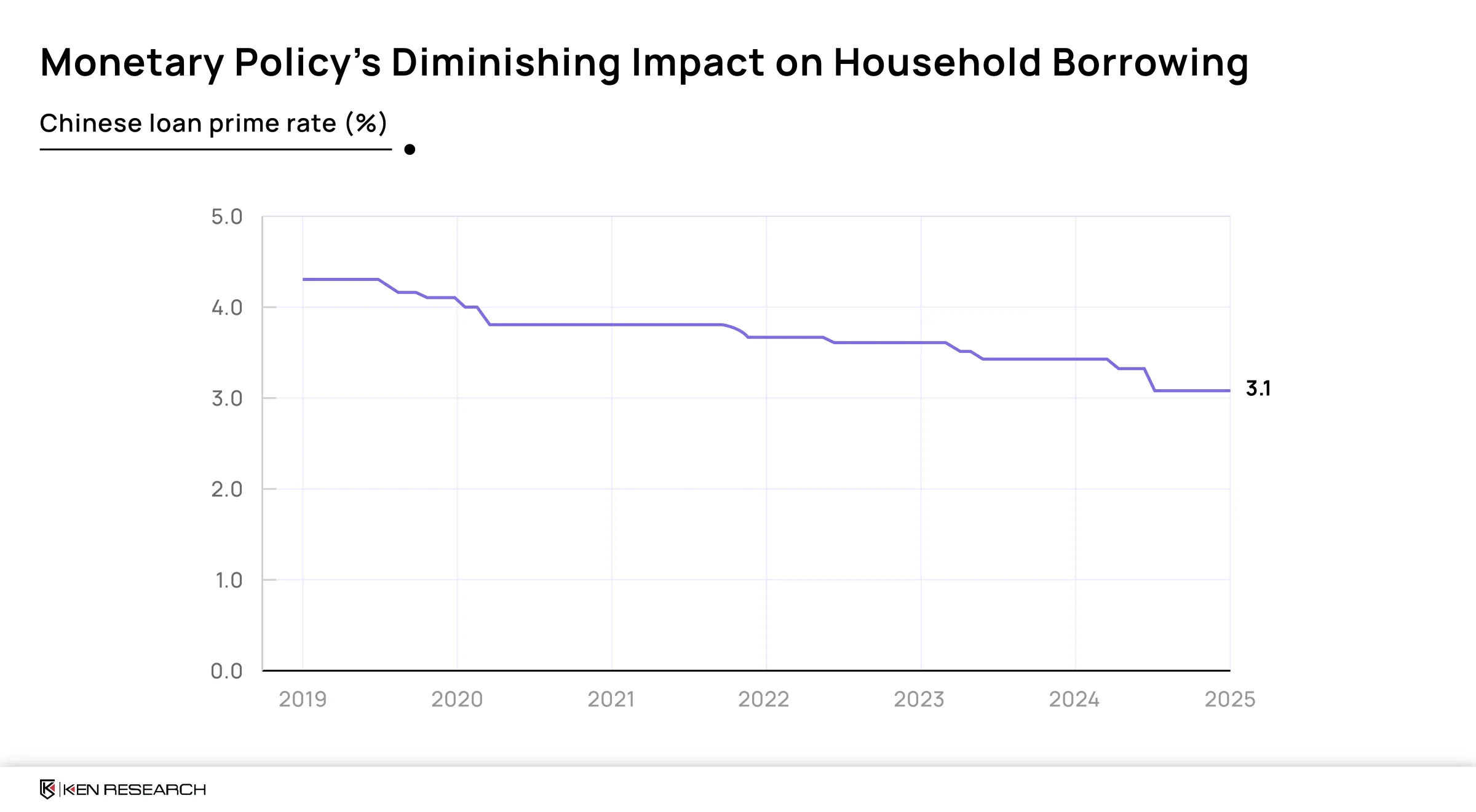
The signals are consistent with the early stages of a potential balance-sheet recession in which households and firms prioritize deleveraging, rendering traditional monetary stimulus less effective.
Moving Towards Rebalanced Growth Internally and Externally
China is repositioning itself around a dual economic system designed to reduce external vulnerability while fostering internal resilience.
Internal Circulation
This pillar seeks to counter weak property-driven consumption and encourage more stable, middle-class-led spending through:
- Comprehensive Social Safety Net Expansion: Broader healthcare subsidies, pension enhancements, and unemployment protection to reduce precautionary savings.
- Targeted Consumption Incentives: Subsidies for vehicles, home appliances, digital devices, and energy-efficient upgrades to spark short-term demand recovery.
- Market Stabilization Measures: Focused liquidity injections, credit relending programs, and controlled easing to prevent disorder in the property market while avoiding speculative risks.
- Urbanization 2.0: Continued integration of rural migrants into urban centers through residency reforms, improving consumption potential and labor mobility.
External Circulation
This pillar addresses global trade headwinds and aims to position China as a resilient economic hub amid increasing decoupling by:
- Diversified Export Markets: Stronger ties with Global South economies across Asia, Africa, and Latin America to offset U.S./European containment pressures.
- Supply-chain Security: Building redundancy in critical inputs, such as energy, semiconductors, and strategic minerals, to reduce exposure to sanctions and trade restrictions.
- Selective Global Integration: Encouraging outbound investments that strengthen access to technology, logistics, and resources across multiple continents.
The combination of these two systems reflects China’s ambition to build a growth model less dependent on foreign demand and high-leverage domestic investment cycles.
Overtaking the US in 57 of 64 Critical Technologies
The US-China tech rivalry has triggered historic innovation momentum across Chinese industries, catalyzing one of the largest localization drives in modern industrial history.
Key technological developments include:
- Artificial Intelligence Breakthroughs: Chinese frontier models such as DeepSeek have demonstrated competitive performance at dramatically lower computational costs, challenging the high Capital Expenditure AI paradigm of traditional Western players.
- Domestic Chip Substitution: Huawei’s successes with the Kirin 9000S and Ascend 910B, supported by SMIC’s rapid advancement in 7 nm fabrication, mark a turning point in domestic capability despite yield constraints.
- Critical Technology Leadership: China now leads in 57 out of 64 critical technologies measured over the period 2019-2023.
- High-Tech Investment Resilience: A slowdown in aggregate fixed asset investment has contrasted with robust growth in high-tech manufacturing, which recorded investment increases of approximately 7%-12% over 2024-2025.
- AI-chip Synergy Cycle: Domestic AI companies increasingly adopt Chinese chips, creating a revenue base that accelerates iterative improvement across China’s semiconductor and computing ecosystem.
Building Capacity Outside its Borders
As domestic headwinds intensify, Chinese firms are recalibrating their global strategies, moving from export dependency to localized operations across key international markets.
The following are some emerging industry patterns:
1. Traditional Manufacturing
Brands like Haier, Hisense, and Midea have transitioned from OEM production to global brand ownership by:
- Acquiring European and American consumer electronics assets
- Setting up R&D centres in Japan, Europe, and the US
- Leveraging sports sponsorships to build global brand equity
- Diversifying manufacturing bases across emerging markets to reduce tariff risks
2. Electronics & Precision Machinery
Leading suppliers to Apple and global tech giants, such as BOE, Luxshare, Goertek, and Sunny Optical, are building facilities across Vietnam, Malaysia, India, and Mexico to:
- Align with “China+1” restructuring
- Protect order flows from geopolitical disruptions
- Secure access to US and European client segments via local assembly
3. Automotive & EV Ecosystems
With China becoming the world’s largest auto exporter, companies like BYD, SAIC, and Great Wall Motors are investing in Thailand, Indonesia, Brazil, the UAE, and Europe to create:
- Localized EV production hubs
- Regional battery ecosystems
- Post-sales and distribution networks compliant with local regulations
4. Clean Energy & Battery Value Chains
Solar and battery giants are expanding across Europe, the Middle East, and Africa through:
- Mining and material partnerships (e.g., phosphate, lithium)
- Localized cell/pack assembly
- Vertical integration strategies to counter tariffs and carbon border mechanisms
5. Cross-Border E-commerce
Platforms such as Temu and Shein are leveraging:
- AI-driven real-time consumer analytics
- Highly integrated micro-factory networks in China
- Hyper-aggressive global logistics to win market share across the US, Canada, Europe and MENA
This globalization wave is multi-layered, covering design, production, supply chain, technology, branding, and capital, representing a sophisticated shift from previous export-led phases.
Overcapacity Fuels Global Deflation While Demand Stays Muted
Despite clear strengths, China faces substantial medium-term challenges, which are as follows:
- Persistent overcapacity in EVs, solar PV, chemicals, steel, and base materials risks price instability and competitive intensity, domestically and globally.
- Muted consumption recovery due to household deleveraging, aging demographics, and falling real estate wealth.
- Trapped liquidity in the financial system where stimulus does not translate into borrowing or investment appetite.
- Geopolitical constraints, including tariffs, export controls, reshoring pressures, and friend-shoring dynamics that reshape global supply chains.
- Rising fiscal pressure as government intervention becomes the primary driver to counterbalance private sector caution.
China’s long-term stability will depend on structural reforms around household income, social welfare, productivity growth, capital-market liberalization, and policy clarity.
Conclusion
China’s next stage of growth will depend on how effectively it shifts toward stronger domestic consumption, steady technology progress, and the global expansion of its leading companies. In the near term, growth will remain under pressure due to weak household balance sheets, ongoing stress in the property sector, excess capacity in manufacturing, and continued trade tensions.
Over the longer term, outcomes will depend on deeper reforms that raise household incomes, strengthen social safety nets, and create a more stable and open business environment. If these reforms move forward, China can avoid prolonged stagnation and continue to grow.
Ken Research highlights that China should now be viewed beyond its traditional role as a low-cost manufacturing hub. Overcapacity in sectors, such as electric vehicles, solar, metals, chemicals, and industrial machinery, is affecting global pricing, increasing competitive pressure in emerging markets, and influencing OEM supplier relationships and downstream margins. Stakeholders need to clearly assess where they are exposed to these pressures across different sectors. Building flexible procurement strategies, diversifying sourcing locations, and embedding regular policy monitoring into pricing and market entry decisions will help reduce exposure.
Related tags
Logistics and Shipping
Automotive, Transportation and Warehousing
Get started
We've helped companies around the world future-proof
their businesses - and we can do the same for you.