The Charging Dead Zone: How India's EV Fast-Charging Experience Is Quietly Stalling the Electric Revolution
Ken Research
August 21, 2026 - 7 min read
August 21, 2026
by Ken Research4 in 10 EV drivers in India have abandoned a charging session mid-journey in the past six months - not because the charger was occupied, but because it was broken, unreachable, or billed them incorrectly.
That number, from Ken Research's inaugural EV Fast-Charging Network Experience Survey across 4,200 active EV owners in ten cities, is not a data point about infrastructure inadequacy. It is a revelation about a structural trust deficit accumulating at the very foundation of India's electric mobility transition. The government has committed to 500,000 public charging stations by 2030. Over ₹4,800 crore of private capital has flowed into charging networks in two years. Yet the lived experience of the driver who plugs in every day tells a story none of these investment headlines are capturing.
India's EV penetration crossed 4.2% of total new vehicle sales in FY2025. Range anxiety - long cited as the primary adoption barrier - has measurably declined as battery technology matured. What has replaced it is something far harder to solve with capital alone: charging experience anxiety. This survey quantifies that anxiety at a national scale for the first time, and the implications for network operators, OEMs, real estate developers, fleet managers, and infrastructure investors are profound.
Survey Profile: Who We Studied and Why It Matters
Sample and Geography
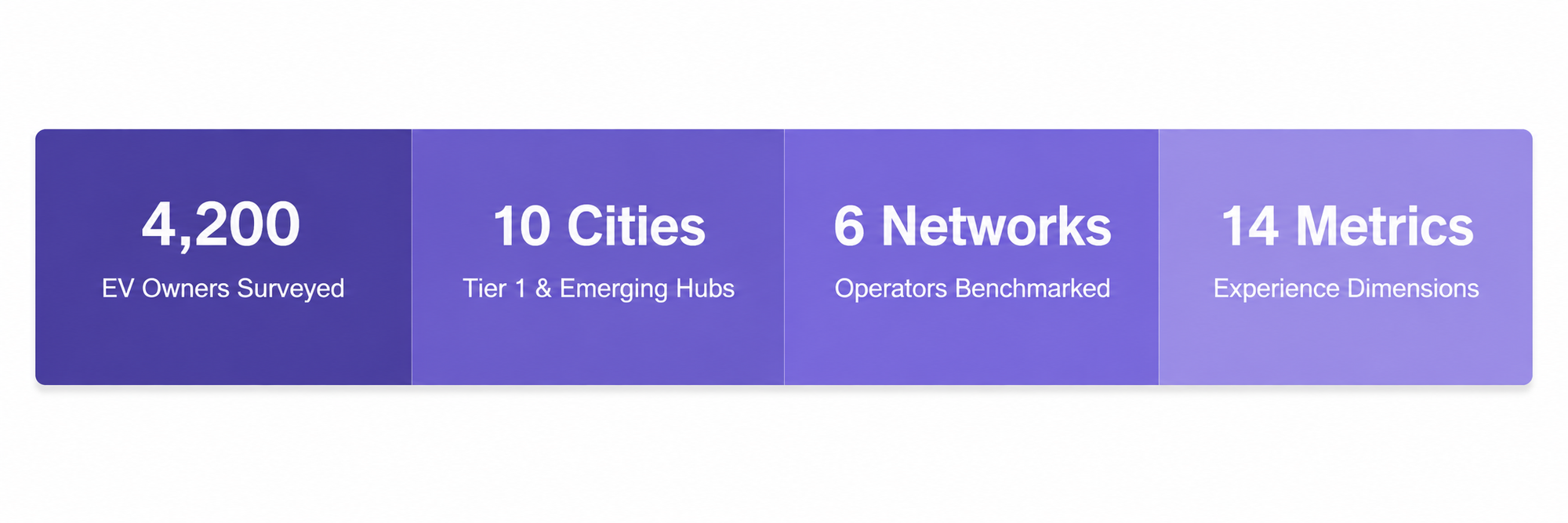
The survey was conducted across Q1 and Q2 2026, covering a stratified sample of 4,200 EV owners across ten cities: Delhi-NCR, Mumbai, Bengaluru, Hyderabad, Pune, Chennai, Ahmedabad, Lucknow, Jaipur, and Chandigarh. These cities account for approximately 68% of all registered EVs in India. The survey was administered through a blend of in-app intercepts via partner mobility platforms, assisted digital interviews at charging stations, and CATI for fleet segments.
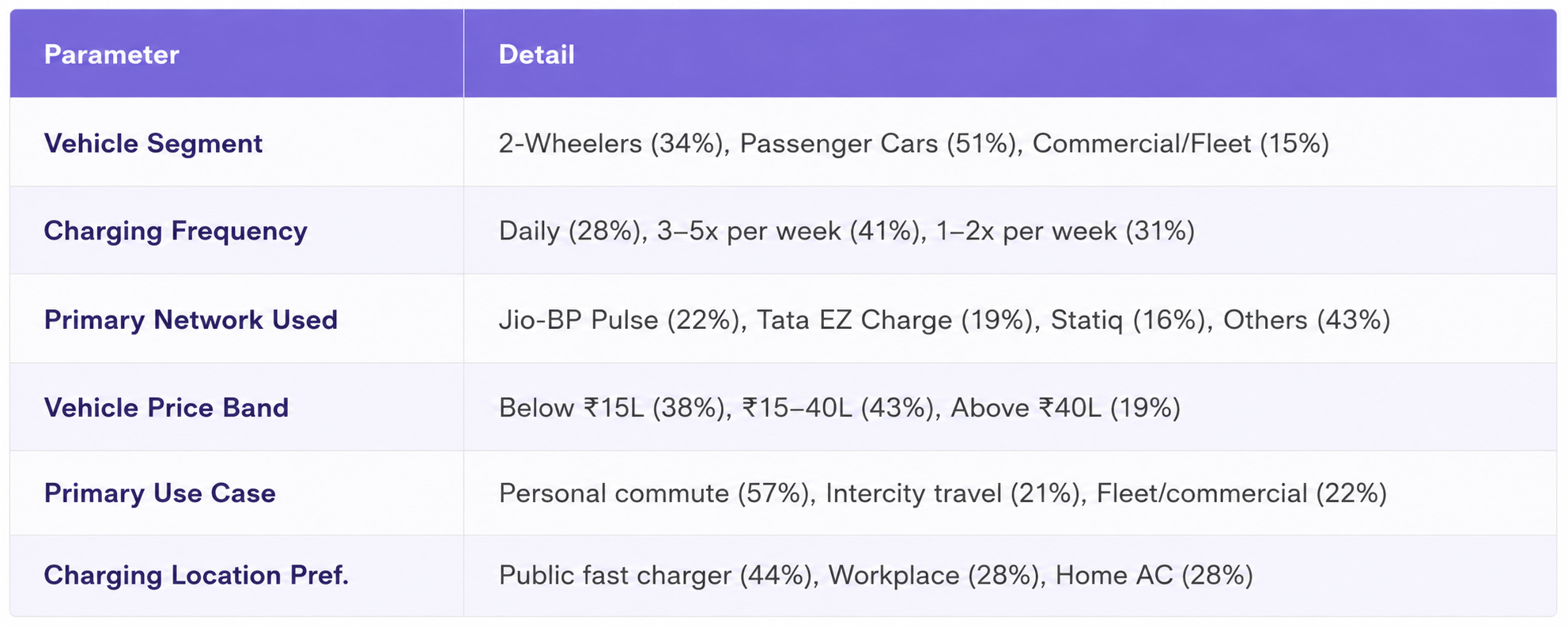
Owner and Vehicle Profile
The Satisfaction Illusion: What India's EV Drivers Are Really Experiencing
Before they commit to an EV, buyers hold a clear set of expectations: a reliable charging network, fast session turnaround, transparent billing, and an app that simply works. What our survey reveals is a systematic failure to meet those expectations - concentrated precisely in the moments where failure is most costly to driver confidence and journey planning.
India's public charging sessions carry a hidden premium: when they work, they are convenient; when they fail, they strand drivers and invalidate journey commitments. The fact that operators benchmark themselves on session completion rates while drivers measure their experience by what happens when sessions don't complete reveals the central diagnostic failure of the industry.
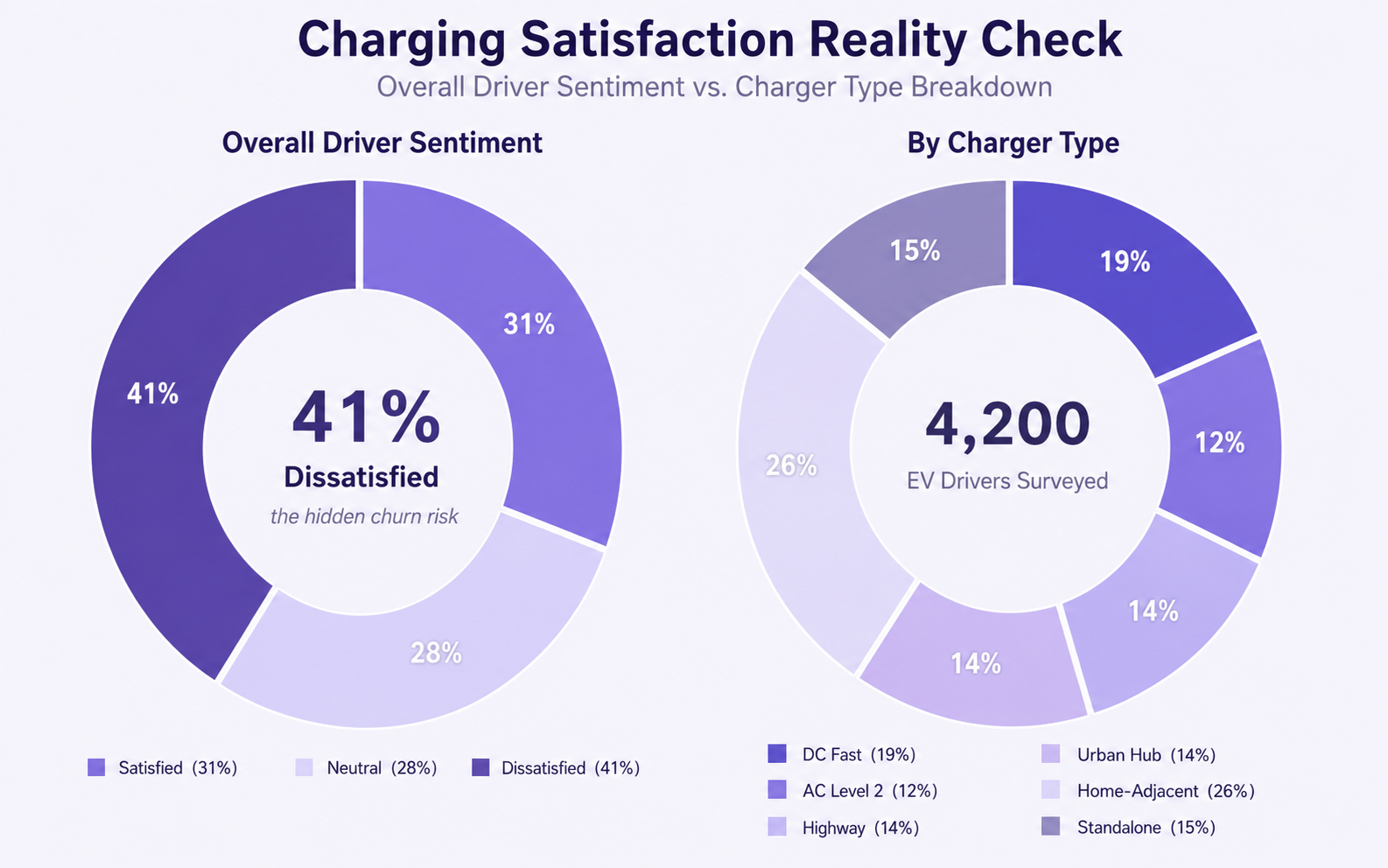
Only 31% of EV drivers classify themselves as genuinely satisfied with their primary charging network. A further 28% sit in a fragile neutral band - one bad session away from defection. The remaining 41% are dissatisfied, and among them, 67% say they will permanently switch networks after just two unsatisfactory sessions. This is not churn risk. It is a near-certainty waiting to be triggered.
DC fast charger users - the highest-value segment given premium per-kWh fees - report satisfaction scores only marginally higher than budget AC users, implying the premium is not translating into a premium experience. Fleet operators, the most predictable revenue profile in the market, are simultaneously its most vocal critics.
67% of dissatisfied EV drivers say they will permanently switch their primary charging network after just two unsatisfactory sessions - not a risk to model, but an attrition schedule already in motion.
The Critical Gap: Seven Pain Points Breaking Driver Trust
When we asked drivers to identify their most significant charging challenges, the responses coalesced around seven distinct pain points. The severity scores reveal a market failing at the most fundamental levels of service delivery - and the commercial consequences compound with every repeat experience.
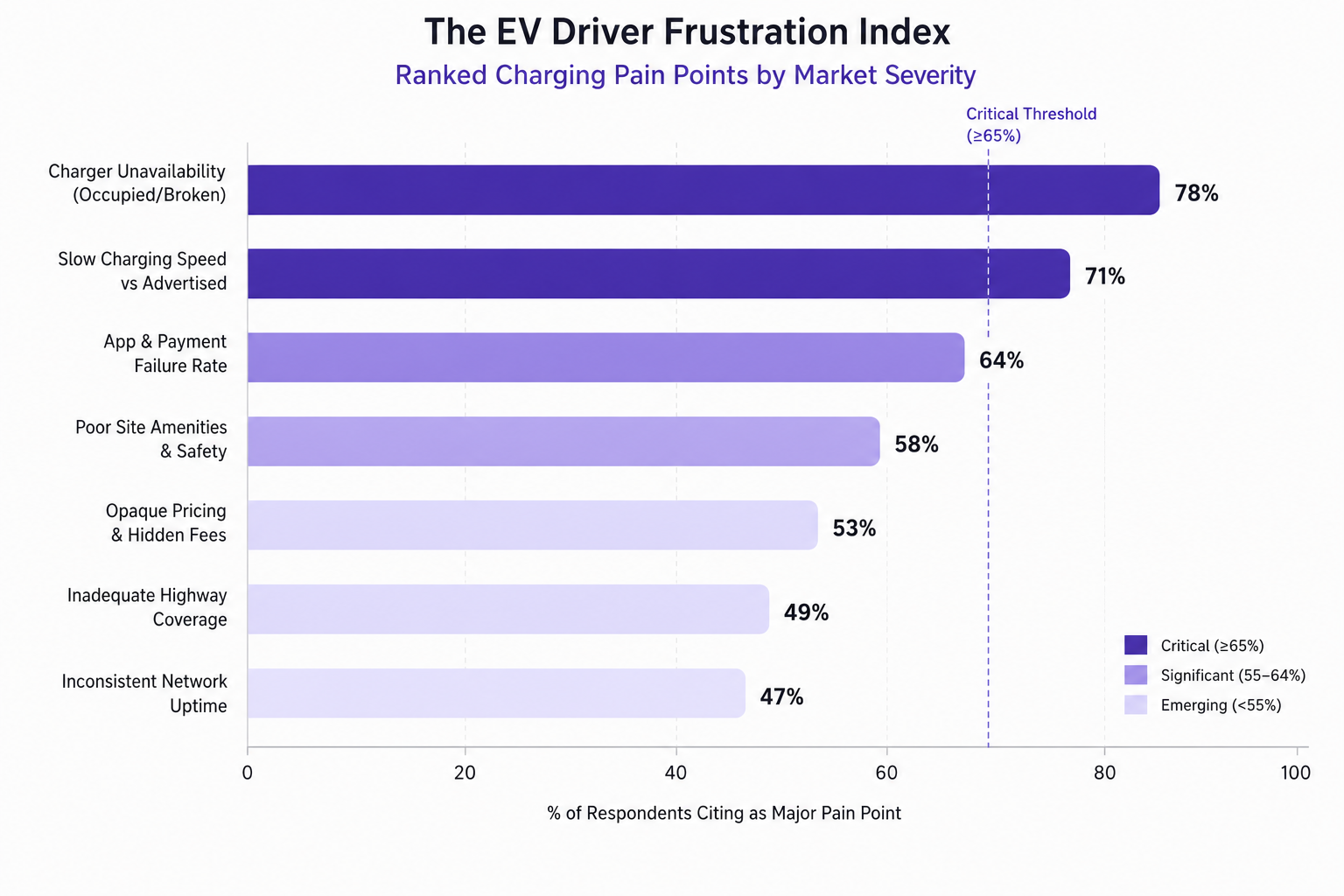
Charger unavailability, cited by 78% of respondents, sits at the intersection of hardware failure and network planning blindness. The problem is not merely that chargers break down - it is that operators lack real-time visibility systems capable of rerouting drivers before they arrive at a dead unit.
The second-ranked pain point - charging speed falling short of advertised rates (71%) - is a trust erosion problem with compounding consequences. When a driver parks expecting 60 minutes and waits 95, the damage isn't confined to that session. It recalibrates every future journey plan. App and payment failure (64%) is equally costly: among drivers citing it as a top frustration, 73% had reduced their willingness to plan journeys beyond 200 km - a market-level adoption constraint manufactured entirely by software quality.
The Loyalty Fault Lines: When Drivers Walk Away - And Who Is Most at Risk
Dissatisfaction does not remain dormant. It converts - into competitor evaluation, into network switching, and ultimately into a redefinition of the journey planning behaviour that determines which operator captures the next charging session. Our switching intent analysis reveals a loyalty fault line that network operators have largely failed to recognise or measure.
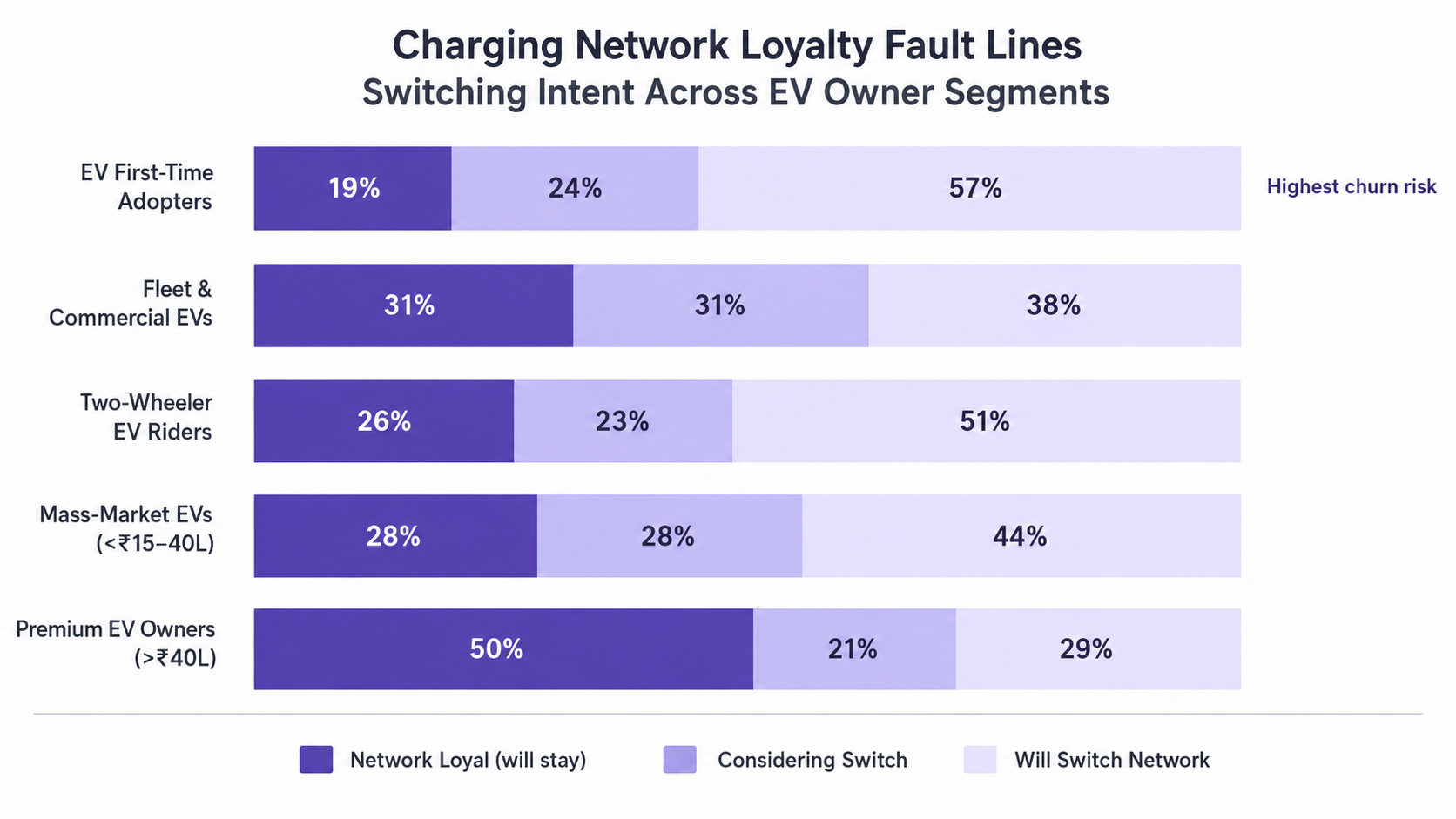
First-time EV adopters show the highest switching intent (57%) of any segment - paradoxically counterintuitive. New owners entered the ecosystem with expectations shaped by OEM marketing and peer narratives emphasising the convenience of electric mobility. When the charging experience fails those expectations, the psychological response is disproportionate: they are not simply dissatisfied with a service, they are questioning the foundational value proposition of their vehicle purchase.
Fleet and commercial EV operators (38% considering switch) represent the most concentrated switching consequence in the market: a single fleet operator's defection is not one session lost but potentially hundreds of daily charging events redirected. Premium EV owners show the highest network loyalty at 50% - but this is inertia, not earned trust, and it erodes as the competitive network landscape matures and OEM-bundled charging ecosystems face open-market comparison.
The most commercially alarming finding in the survey: 57% of first-time EV adopters - the segment most critical to the next wave of EV market growth - are actively evaluating a network switch. This is not post-experience regret. It is live competitive displacement occurring within the segment India's EV transition depends on most.
The Strategic Reckoning: What This Data Demands from Every Stakeholder
India's EV charging market is entering its most consequential competitive inflection since the first public charger was installed. The survey data draws a clear line between organisations that will define the next decade of electric mobility and those that will be displaced by operators who act on these findings first.
- Will network operators deploy real-time charger health monitoring with proactive driver rerouting - or continue operating invisible service pipelines that generate the frustration driving 41% dissatisfaction? Among drivers notified of charger issues before arrival, satisfaction scores were 2.4× higher than those who discovered the problem on-site.
- Will OEMs treat the charging experience as a brand extension risk requiring enforced standards - or continue outsourcing their charging ecosystem without accountability? When an EV cannot reliably charge, attribution implicates the vehicle brand, not only the network.
- Will real estate and destination developers recognise that 61% of EV drivers actively prefer destinations with known, reliable charging infrastructure over closer alternatives - or continue treating the charging amenity as a sustainability checkbox rather than a footfall driver?
- Will infrastructure investors shift their primary thesis from station count to trust score - or continue backing footprint over credibility? Trust, operationally constructed through uptime SLAs, app reliability, and transparent pricing, is a better predictor of long-term revenue than coverage alone.
The full survey findings - including city-level reliability indices, operator trust scorecards, segment churn risk rankings, and a 15-point charging experience diagnostic framework - are available to subscribers.
The operators who act on this data first will not simply retain more drivers. They will define the standard against which every other charging network in India is measured.
About the Author:
Siddharth Raj is a Survey Consultant at Ken Research with experience in primary market research, consumer insights, and survey analytics. He has worked on large-scale research and consulting engagements across multiple industries, supporting organisations with market assessment, strategic insights, and data-driven decision-making.
From the Author:
"India's EV charging narrative has been dominated by station count milestones and government targets. What this survey reveals is that the real metric of progress is something far harder to photograph at a ribbon-cutting ceremony: the confidence a driver feels when they plug in away from home. Until that confidence is earned at scale - through reliable hardware, honest pricing, and responsive networks - every station count milestone is a lagging indicator, not a leading one."
About Ken Research:
Ken Research is a market intelligence and strategy consulting firm delivering actionable insights across the various sectors in dynamic markets. We support industry stakeholders with data-driven analysis on emerging trends, competitive benchmarking, pricing strategies, and shifting consumer preferences. Our expertise enables clients to refine market entry and penetration strategies, optimize product positioning, and respond effectively to evolving competitive landscapes.
Related tags
Electric Vehicle
Automotive and Automotive Components
Automotive, Transportation and Warehousing
Get started
We've helped companies around the world future-proof
their businesses - and we can do the same for you.