Where Should the GCC Localise Value in Its USD 8 Billion Feed Market?
Ken Research
August 20, 2026 - 12 min read
August 20, 2026
by Gautam ChitkaraGCC feed security will depend on localising higher-value capabilities while retaining globally sourced commodities.
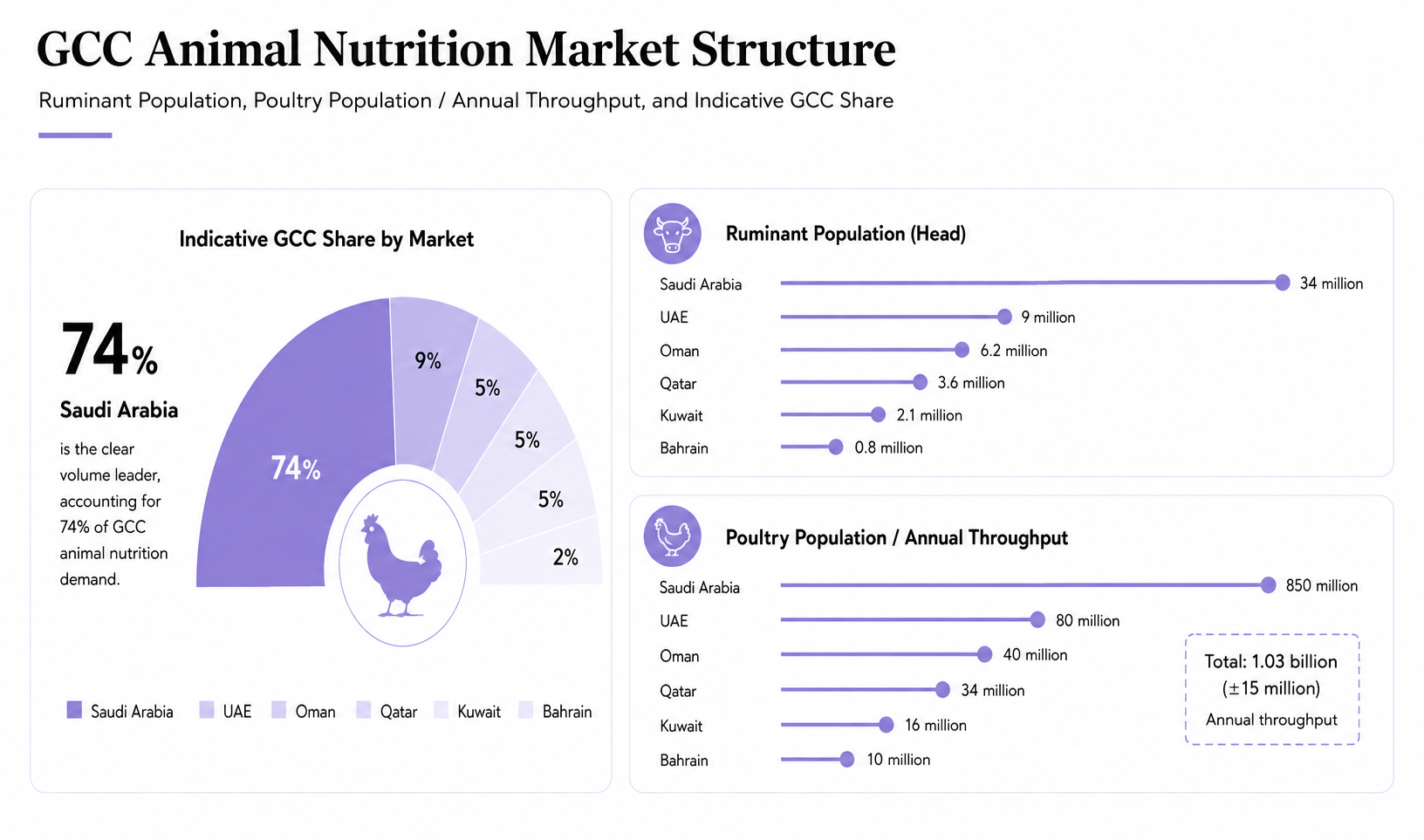
The GCC compound-feed market was valued at approximately USD 8 billion in 2025, representing around 18 million metric tonnes of demand. Saudi Arabia accounted for approximately 74% of regional compound-feed volume. The supplied country estimates present the following regional structure:
Why Localisation Has Become Strategically Important
The GCC animal-nutrition system depends on a small number of imported ingredients that account for most feed formulations and drive most of the industry’s raw-material costs.
Raw-material price movements illustrate this concentration of risk. Between 2020 and May 2026, soybean prices increased from approximately USD 373 to USD 452 per tonne, while corn prices rose from USD 165 to USD 209 per tonne. Barley declined from approximately USD 148 to USD 117 per tonne between the two endpoints but experienced substantial volatility during the period, particularly following disruptions to Black Sea trade in 2022. For feed millers, the core risk is a timing mismatch: input costs rise before feed prices can be reset, compressing margins, while buffer inventory ties up working capital and increases exposure to price corrections.
The impact of these movements is amplified by feed composition. Corn represents approximately 60–65% of poultry feed, with protein ingredients accounting for a further 20–25%. In ruminant concentrate formulations, the principal cereal ingredient typically accounts for approximately 65–70%, while the secondary ingredient contributes another 20–25%. A limited number of imported commodities therefore determine most of the feed cost base.
Domestic cultivation cannot fully offset this import exposure because water availability represents a binding regional constraint. Qatar illustrates the challenge: alfalfa and Rhodes grass historically accounted for approximately 60% of the country’s annual groundwater extraction. Qatar now targets a 70% reduction in groundwater use by 2030 and is encouraging greater use of recycled water and treated sewage effluent in forage production.
The localisation case therefore rests on a structural mismatch: the GCC requires greater control over feed security, but cannot economically or environmentally replace all imported inputs through domestic cultivation. The more credible strategy is to secure global sourcing while localising storage, formulation, premixes, feed minerals, alternative ingredients and downstream value creation.
Five Control Points Across the GCC Feed-to-Food Value Chain
The animal-nutrition value chain contains five principal control points. Each presents a different localisation opportunity and requires a distinct investment rationale.
International raw-material sourcing
International sourcing will remain a structural requirement for the GCC animal-feed industry. The relevant localisation objective is greater control over their availability, cost, quality and movement. This requires a coordinated sourcing model built around diversified origin markets, long-term procurement arrangements, overseas agricultural assets and contracted logistics. The approaches used by Al Dahra and Almarai illustrate how GCC companies can retain strategic influence over agricultural supply while production remains located in more efficient farming regions.
The value of this model lies in reducing exposure to supply disruption, emergency procurement, quality variability and concentration in individual countries or shipping routes. It also supports more stable feed-mill utilisation and improves procurement planning. The intended outcome is a resilient and commercially managed international supply base, rather than conventional domestic self-sufficiency.
Strategic storage and procurement
Storage is one of the most economically defensible localisation investments because it improves resilience without requiring domestic crop production.
ARASCO maintain approximately 500,000 tonnes of grain-silo capacity at King Abdulaziz Port in Dammam. This capability supports:
- Inventory buffering
- Multi-origin purchasing
- Reduced emergency procurement
- Continuity of mill operations
At this scale, storage capacity gives ARASCO greater flexibility over purchase timing, reducing exposure to spot-market premiums and lowering the risk of mill disruption during supply shocks. The value of storage is particularly high where long shipping lead times and exposure to Red Sea or Strait of Hormuz disruption require greater inventory cover. Additional inventory days extend the procurement window, reduce dependence on emergency spot purchases and lower the economic cost of mill downtime making storage capacity an investment priority where these avoided costs exceed the cost of carrying incremental stock.
Feed milling and compounding
The GCC already possesses substantial feed-manufacturing capacity.
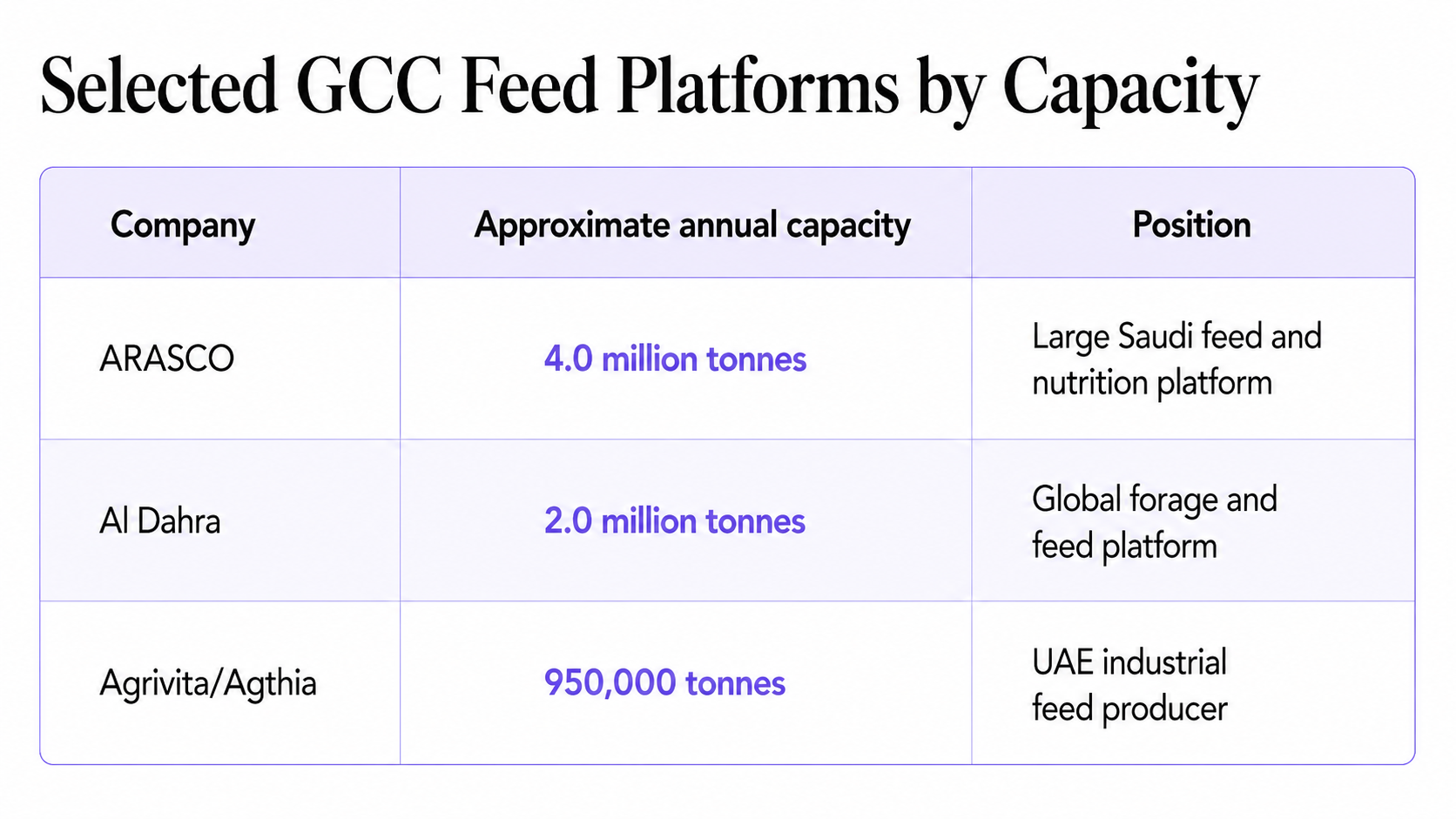
The strategic issue is no longer whether feed can be produced locally, but whether installed capacity can be used economically.
The relevant questions are:
- How much capacity is captive?
- How much depends on third-party farmer demand?
- What is the utilisation rate?
- Can raw-material cost changes be passed through?
- Can the mill supply export markets?
The implication is that local milling and distribution do not remove import exposure. Their value depends on the efficiency with which imported ingredients are converted into productive animal output.
Premixes, Additives, Feed Minerals and Alternative Ingredients
This stage presents the strongest combination of margin potential, technical differentiation and manageable capital intensity.
The source material provides the following directional margin hierarchy:
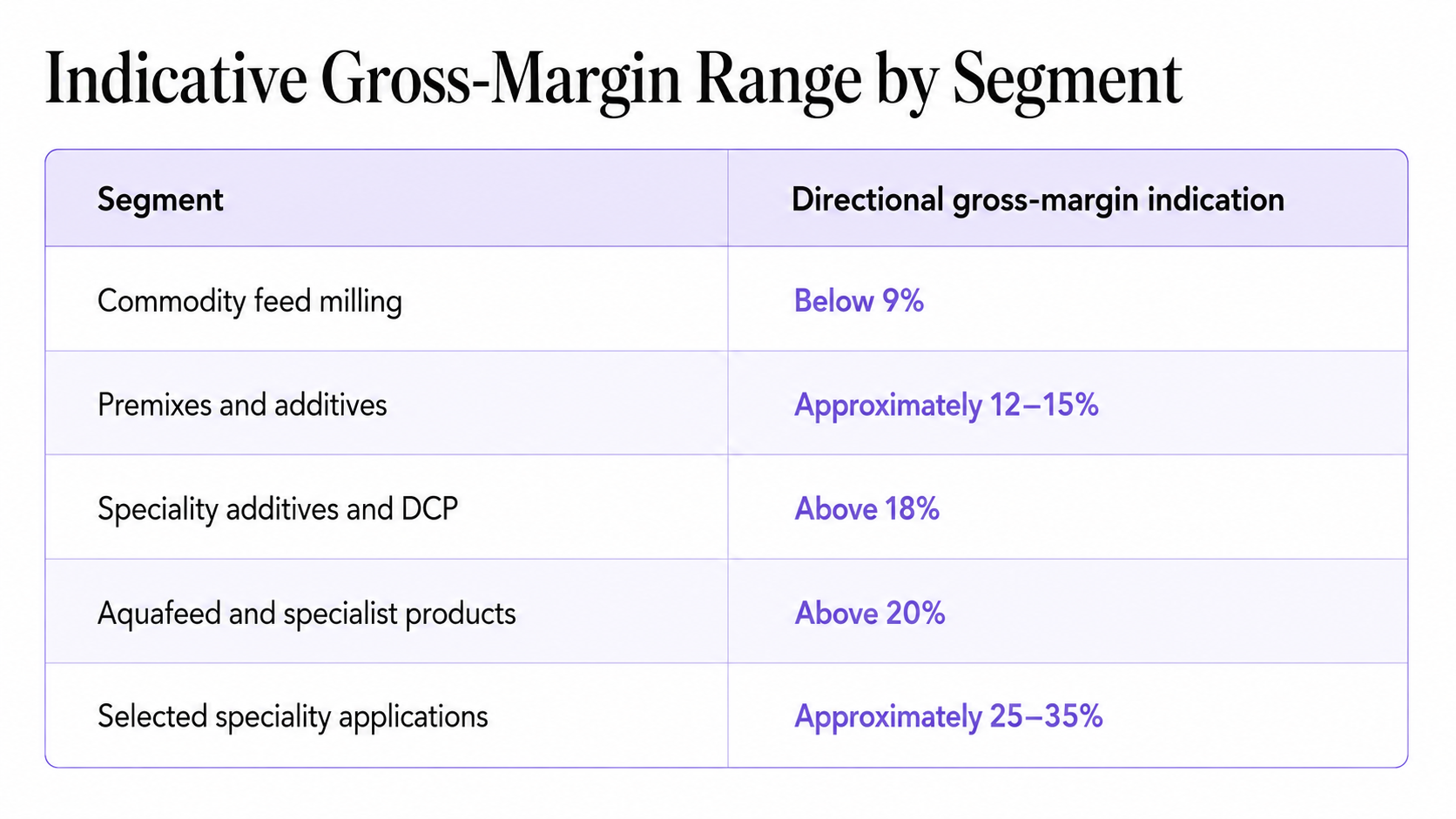
Margin potential increases as the product becomes more technically differentiated and more closely linked to animal performance.
- Feed minerals and DCP
Saudi Arabia’s phosphate resources create an opportunity to manufacture feed-grade calcium and phosphorus products domestically rather than importing them in finished form.
The supplied trade data indicates DCP unit values of approximately:
- USD 556 per tonne in 2022
- USD 1,795 per tonne in 2023
- USD 3,244 per tonne for selected exports to Vietnam
The reported unit value increased by approximately 223% between 2022 and 2023. However, differences in product grade, shipment size, freight treatment and contract structure may limit direct comparability across transactions.
- Surplus bread-to-feed
The proposed núaFEEDs model in the UAE would process surplus bakery products into a biosecure feed ingredient.
The resulting ingredient is reported to contain:
- 15.9% crude protein
- 16.1 megajoules of digestible energy per kilogram of dry matter
Each tonne of bread waste diverted from disposal is estimated to avoid more than 500 kilograms of carbon-dioxide-equivalent emissions and preserve approximately 13 cubic metres of embedded water.
Bakeries may also avoid landfill charges of up to USD 41 per tonne. For farms, the potential benefit is access to a locally produced ingredient that is less directly exposed to international grain-price volatility. Commercial viability will depend on consistent feedstock quality, contamination control, collection costs and regulatory approval.
- Salicornia and microbial protein
Qatar is evaluating alternative feed sources that require less freshwater than conventional forage cultivation. Salicornia can be irrigated with seawater or saline brackish water and is reported to contain more than 10% protein by dry weight. Microbial fermentation offers a second pathway, using biomethane or biogas to produce highly digestible proteins containing essential amino acids.
These technologies remain developmental, but they address the central regional constraint by separating feed-protein production from conventional freshwater agriculture. Qatar’s animal-food market exceeded approximately USD 37.4 million in 2021, providing an initial domestic demand base.
- Insect protein and waste recycling
Mukka Proteins has expanded into Oman through the acquisition of United Gulf Fishery Products. Its subsidiary, Ento Proteins, is developing Black Soldier Fly systems that convert organic waste into high-value meal with a lower water requirement than conventional forage.
Nadec is also pursuing circularity through its partnership with the Saudi Investment Recycling Company. The programme is expected to process:
- 150,000 tonnes of cow manure
- 55,000 tonnes of green waste
This is expected to produce approximately 90,000 tonnes of organic fertiliser annually.
Nadec is additionally testing 20 seasonal fodder varieties to evaluate opportunities for reducing groundwater consumption.
These initiatives indicate that alternative-feed localisation will develop through a portfolio of technologies rather than a single substitute ingredient.
Retail, Food Service and Export Markets
This control point determines whether production capability translates into market access, pricing power and realised margins. Domestic retail and food-service relationships improve demand visibility, product-mix control and downstream price realisation. Export markets provide a more demanding test of product quality, logistics efficiency and commercial competitiveness.
GCC feed-related exports were estimated at approximately USD 77 million in 2024. Identified trade corridors included approximately USD 29 million of Saudi dicalcium phosphate exports to Bangladesh, USD 14 million of Saudi feed preparations exported to Iraq, USD 11 million of Saudi dicalcium phosphate exported to Vietnam and USD 18 million of Omani marine-feed inputs supplied to Saudi Arabia.
The UAE’s distribution role is supported by the unified Fodder Market, which brings together 13 national agribusiness companies and serves approximately 40,000 breeders and more than 5 million livestock. Elite Agro’s Weshah Fodder Centre reportedly serves a further 14,700 beneficiaries in the Northern Emirates.
Localisation at this stage is created through stronger market organisation, distribution infrastructure, customer access and export capability.
Five localisation models in the GCC
Regional companies are not following one standard integration strategy. The evidence points to five distinct models.
Model 1: Almarai — Full feed-to-food integration
Almarai controls a broad system spanning:
International feed sourcing → captive nutrition → dairy and poultry farms → processing → cold chain → distribution → branded food
Almarai’s gross margin increased from approximately 29% in 2022 to 31.5% in 2025. FY2025 revenue reached approximately USD 5.8 billion, while net profit increased by around 6.2% to USD 0.26 billion. These results are consistent with value capture across dairy, poultry, processing, branding and distribution, although pricing, product mix, input costs and operating efficiency also influence profitability.
The model provides greater control over:
- Feed consistency
- Captive demand
- Processing utilisation
- Product availability
- Brand pricing
- Distribution
Its principal limitation is capital and organisational complexity. The company must operate efficiently across agricultural sourcing, manufacturing, logistics and consumer markets.
Model 2: Tanmiah — Feed-to-protein integration
Tanmiah operates a more focused system linking:
Feed mills → animal health → hatcheries and poultry farms → primary processing → protein products
The company processed approximately 168 million birds in 2025, an increase of 12.4%. Revenue reached approximately USD 681 million in the same period.
The model demonstrates that integration provides operating control but does not remove:
- Raw-material pressure
- Commissioning costs
- Utilisation risk
- Execution complexity
- Poultry-price volatility
- Working-capital requirements
Tanmiah therefore provides an important counterpoint to the assumption that greater vertical ownership necessarily produces continuous margin expansion.
Model 3: Baladna — Food-security-led integration
Baladna represents an integrated dairy system developed partly in response to national supply-security requirements.
Its model covers:
Feed and TMR → dairy herd → milk production → UHT processing → packaging → cold-chain distribution
The company’s herd exceeds 30,000 Holstein cows, and more than 4,000 cows were reportedly transported from Europe within approximately 90 days during the initial expansion following Qatar’s 2017 blockade.
Qatar’s dairy self-sufficiency increased from approximately 28% in 2017 to 100% by 2022. Total associated investment exceeded approximately USD 1.72 billion.
This model must be evaluated through both financial and strategic outcomes:
- Import substitution
- Supply continuity
- Crisis resilience
- Domestic capability
- National food-security control
The Baladna case demonstrates that not all localisation investments are designed to maximise short-term standalone returns.
Model 4: ARASCO — Industrial and technical localisation
ARASCO’s model combines:
Global sourcing → strategic storage → compound feed → premixes → DCP → laboratories → technical services → exports
The company is reported to have: 3,000 employees, around 4 million tonnes of annual feed capacity, around 500,000 tonnes of port-based silo capacity. Its WAFI complete-feed brand serves more than one million animals daily.
ARASCO demonstrates that an incumbent feed company does not need to own farms, slaughterhouses and retail channels to move beyond commodity milling.
Value can be created through:
- Storage
- Formulation
- Testing
- Technical support
- Exports
For many standalone GCC millers, this may represent a more practical and less capital-intensive localisation route than full feed-to-food ownership.
Model 5: NAQUA — Species-specific export integration
NAQUA combines:
Aquafeed → shrimp and fish farming → processing → traceability → cold-chain exports
Aquafeed has a direct relationship with:
- Feed conversion
- Survival
- Water quality
- Product uniformity
- Farm profitability
This creates a stronger economic incentive to control feed formulation than exists in fragmented commodity livestock markets.
The supplied material estimates the Saudi aquafeed market at approximately USD 499 million and places selected aquafeed and speciality-nutrition margins in a range of approximately 25–35%. These estimates require market-definition validation, but they explain why aquaculture is viewed as an emerging profit pool.
NAQUA demonstrates that localisation can be organised around one technically specialised species and one export-oriented protein chain.
When Is Localisation Profitable?
Localisation creates value only when it improves product economics, asset productivity or animal performance. Producing the same commodity feed locally, without a cost, technical or market advantage, does not automatically improve profitability.
Product economics
Commodity feed remains exposed to imported raw-material prices, limited differentiation and price-sensitive customers. Local manufacturing therefore offers limited margin protection unless the producer has a clear procurement, logistics or formulation advantage.
Premixes, feed minerals and speciality nutrition present a stronger localisation case because their value can be linked to measurable outcomes such as feed conversion, growth, milk yield, heat-stress resilience and animal health. This supports stronger customer retention and greater pricing power.
Asset economics
Local feed mills, storage facilities and processing assets are commercially viable when supported by captive demand, contracted offtake, high utilisation and efficient logistics.
They can destroy value when they create excess capacity, high fixed costs, excessive inventories or dependence on continuing subsidies. Installed capacity should therefore be assessed through utilisation, EBITDA per tonne, return on invested capital and working-capital efficiency, not through production capacity alone.
Biological economics
Feed profitability ultimately depends on whether animals convert nutrition into productive output. Disease, parasites and weak farm management can reduce the financial return generated by premium feed.
Feed-and-health bundling could increase gross margins by approximately five to eight percentage points, although the realised uplift will depend on customer profile, product mix and service-delivery costs.
GCC Animal-Nutrition Localisation Matrix
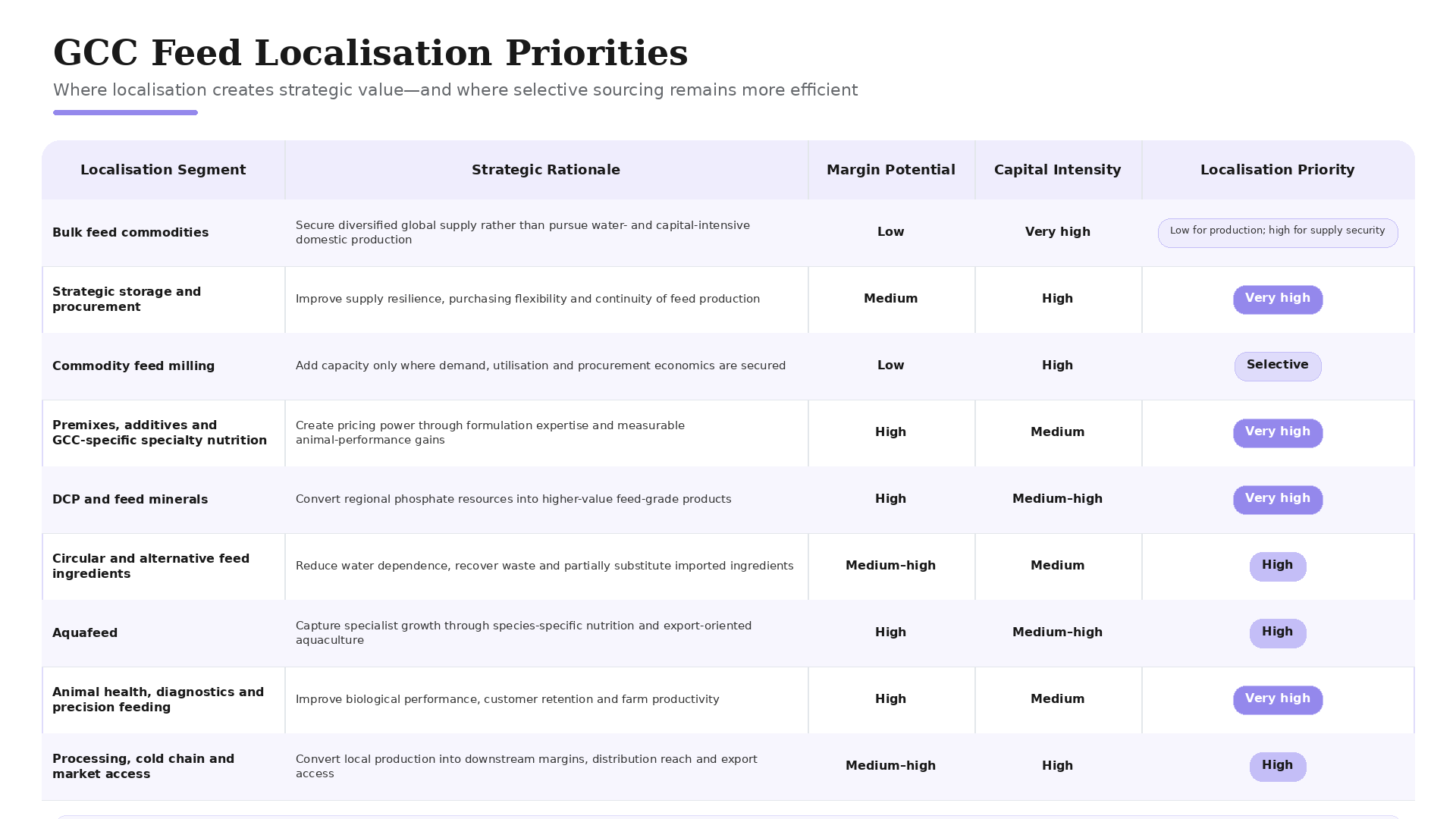
The matrix indicates a clear investment hierarchy across the GCC animal-nutrition value chain. The strongest localisation opportunities are concentrated in segments that combine differentiated capabilities, attractive margin potential, manageable capital requirements and relevance to regional operating conditions.
This places strategic storage and procurement, premixes and speciality nutrition, DCP and feed minerals, and integrated animal-health and precision-feeding solutions at the highest priority. Circular feed ingredients, aquafeed, and downstream processing, cold chain and market access also represent attractive opportunities where projects are supported by viable demand and execution capability.
By contrast, bulk feed commodities should remain globally sourced but strategically secured, while additional commodity-feed milling capacity should be developed selectively. In both cases, investment returns will depend more on procurement efficiency, utilisation, contracted offtake and logistics than on localisation alone.
Conclusion
The GCC animal-nutrition market will remain dependent on imported corn, soybean meal, barley and forage because water scarcity, limited arable land and global cost advantages make full raw-material self-sufficiency neither economic nor sustainable. The more credible localisation strategy is to secure international supply while building regional strength in storage, formulation, premixes, feed minerals, circular ingredients, animal health, aquafeed, processing, cold chain and export-oriented speciality nutrition.
Regional companies show that there is no single winning model. Almarai follows full feed-to-food integration; Tanmiah links feed, health and poultry production, Baladna reflects food-security-led integration, ARASCO focuses on industrial and technical capabilities and NAQUA combines specialised nutrition with aquaculture and exports.
The strategic priority is not simply to add local capacity, but to strengthen control over the capabilities that determine supply resilience, feed performance and downstream economics. Competitive advantage is therefore likely to depend less on milling scale alone and more on how effectively nutritional control translates into better animal-protein outcomes and more resilient margins.
Related tags
Animal Feed
Animal Care
Agriculture and Animal Care
Get started
We've helped companies around the world future-proof
their businesses - and we can do the same for you.