Where Will the Next Profit Pools Emerge in GCC Animal Nutrition?
A Ken Research POV on where margins are moving as commodity feed economics come under pressure
The GCC animal-feed market is expanding, supported by food-security investments, growing poultry and dairy production, aquaculture development, and increasing demand for domestically produced animal protein.
A Ken Research POV on where margins are moving as commodity feed economics come under pressure
The GCC animal-feed market is expanding, supported by food-security investments, growing poultry and dairy production, aquaculture development, and increasing demand for domestically produced animal protein.
But the next phase of value creation will not be won by simply producing more feed.
It will be won by moving into the parts of the animal-nutrition value chain where companies can differentiate products, deepen customer relationships, reduce commodity exposure and capture value beyond the mill gate.
Standalone feed millers remain exposed to imported raw-material costs, constrained pricing flexibility and the expansion of captive feed capacity among integrated agrifood operators. At the same time, value is moving toward specialty nutrition, feed additives, animal-health solutions, aquafeed and vertically integrated platforms.
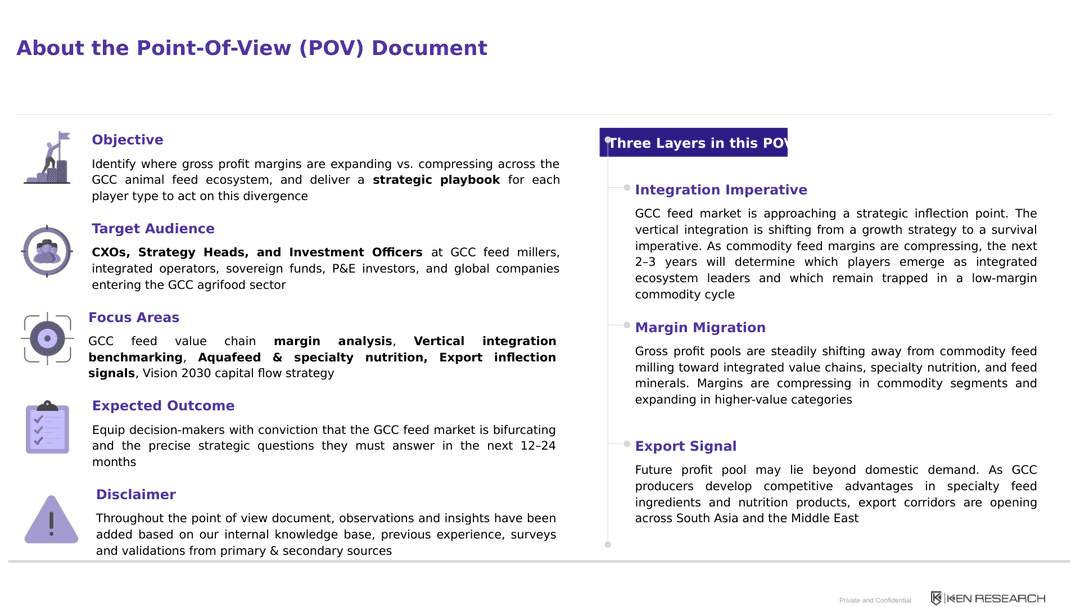
Ken Research’s GCC Animal Nutrition POV examines where gross-profit pools are expanding, where they are compressing and what this divergence means for feed millers, integrated operators, investors and global companies entering the region.
Is the GCC building more feed capacity, or more defensible animal-nutrition businesses?
As livestock and animal-protein production expand, the instinctive response is to increase milling capacity and capture additional feed demand.
However, capacity growth without business-model differentiation can create a larger operation without creating stronger economics.
Feed ingredients represent the majority of the cost base for a typical miller, while selling prices remain constrained by customer affordability, food-security priorities and commodity competition. Larger production volumes can improve utilization, but they do not remove exposure to imported corn, soybean meal, barley and other volatile inputs.
The GCC is now approaching this inflection point.
The strategic question is therefore shifting from:
How much additional feed capacity does the market require?to -Which parts of the animal-nutrition value chain can generate sustainable and defensible margins?
Market Context
GCC feed demand is growing, but the regional opportunity is not uniform
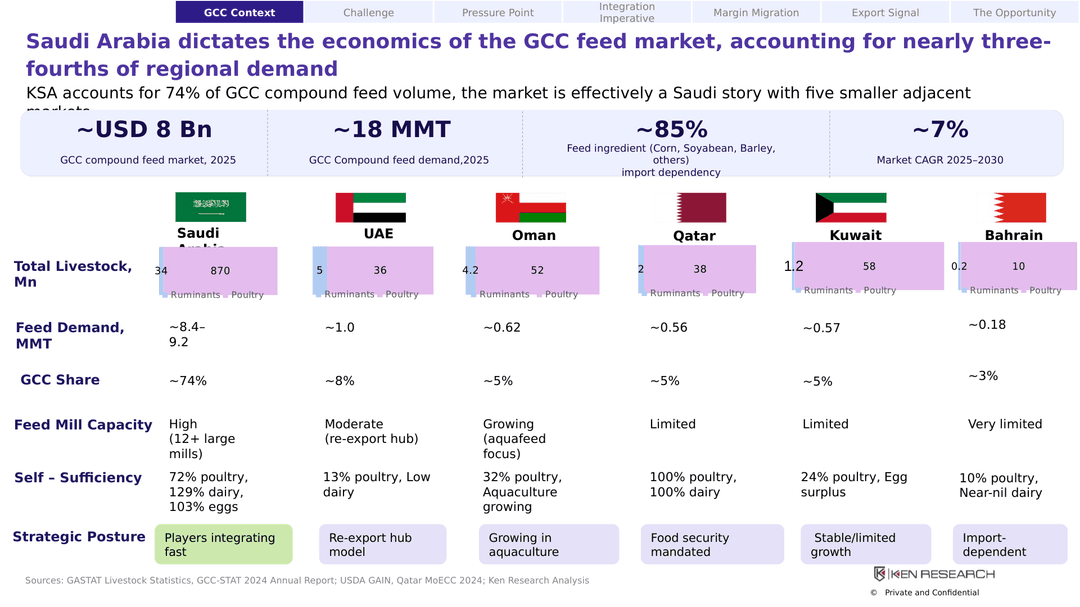
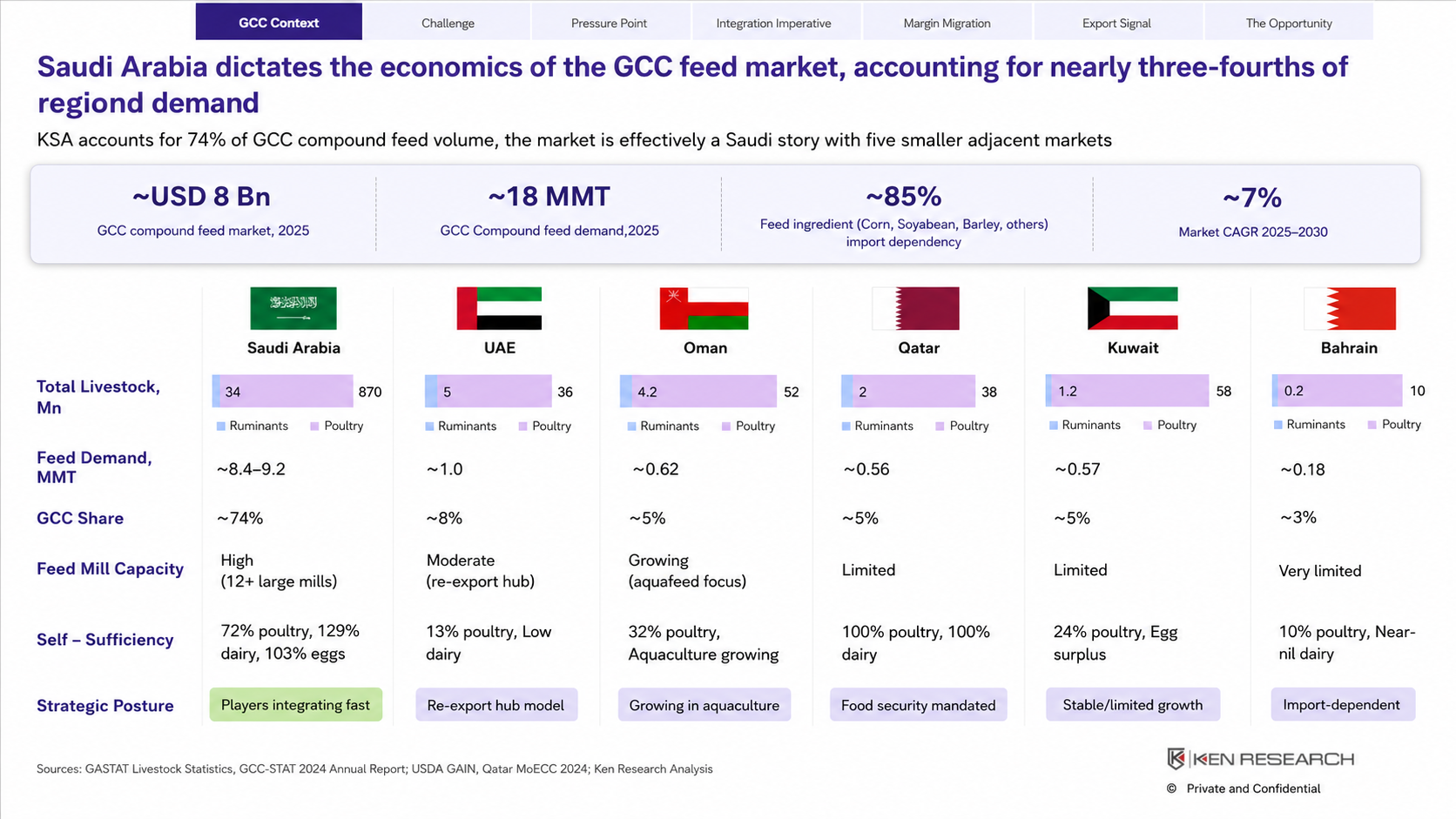
Saudi Arabia leads the GCC animal feed market, accounting for nearly 74% of regional compound feed demand.
The remaining GCC markets play different strategic roles.
The UAE combines domestic demand with trading, distribution and re-export capabilities. Oman is developing a more distinct aquaculture and marine-feed position. Qatar’s market is closely connected to food-security-led poultry and dairy integration, while Kuwait and Bahrain remain smaller and more import dependent.
This creates a highly differentiated regional landscape.
A GCC-wide market-growth figure may indicate overall momentum, but it does not reveal where the strongest business models are emerging. The commercial opportunity varies according to livestock structure, feed capacity, self-sufficiency objectives, logistics infrastructure and the degree of vertical integration within each country.
The regional feed market is therefore not one opportunity. It is a combination of scale markets, specialist categories, distribution hubs and food-security platforms.
Why This Matters Now
The economics of standalone commodity milling are becoming increasingly difficult to defend
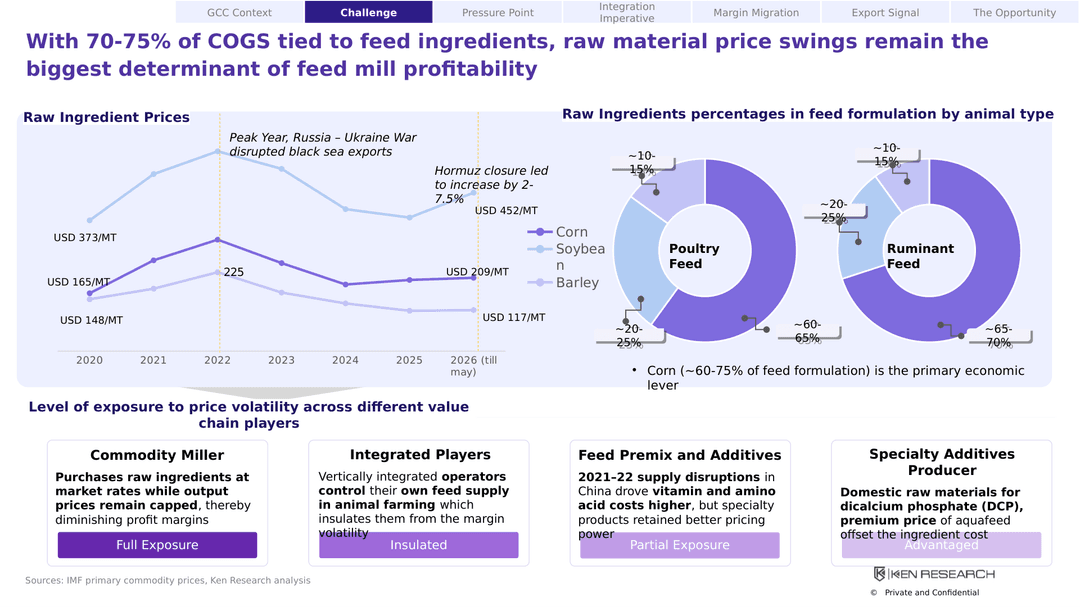
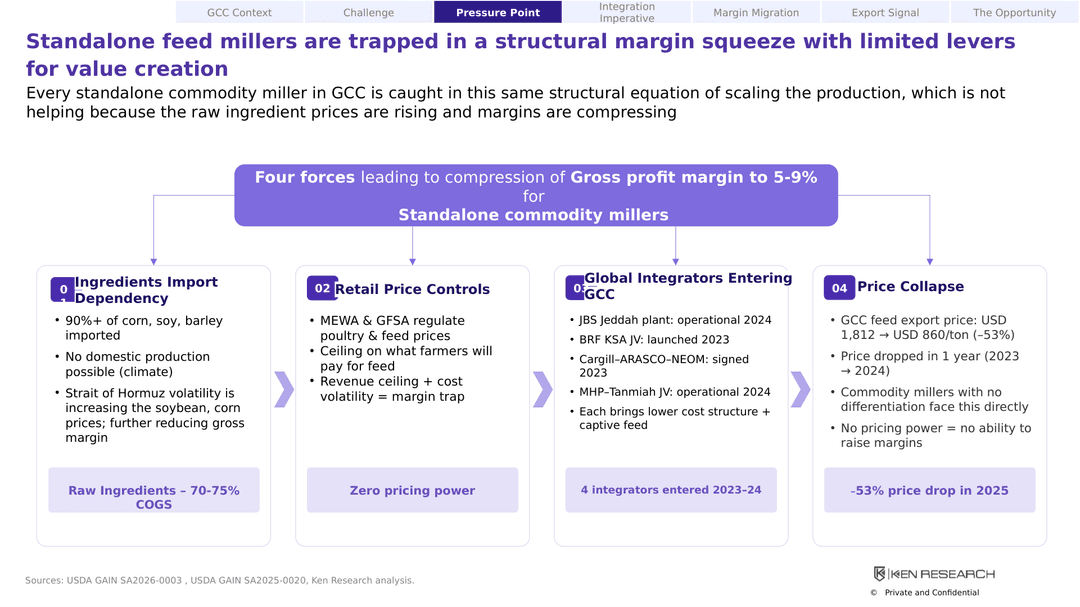
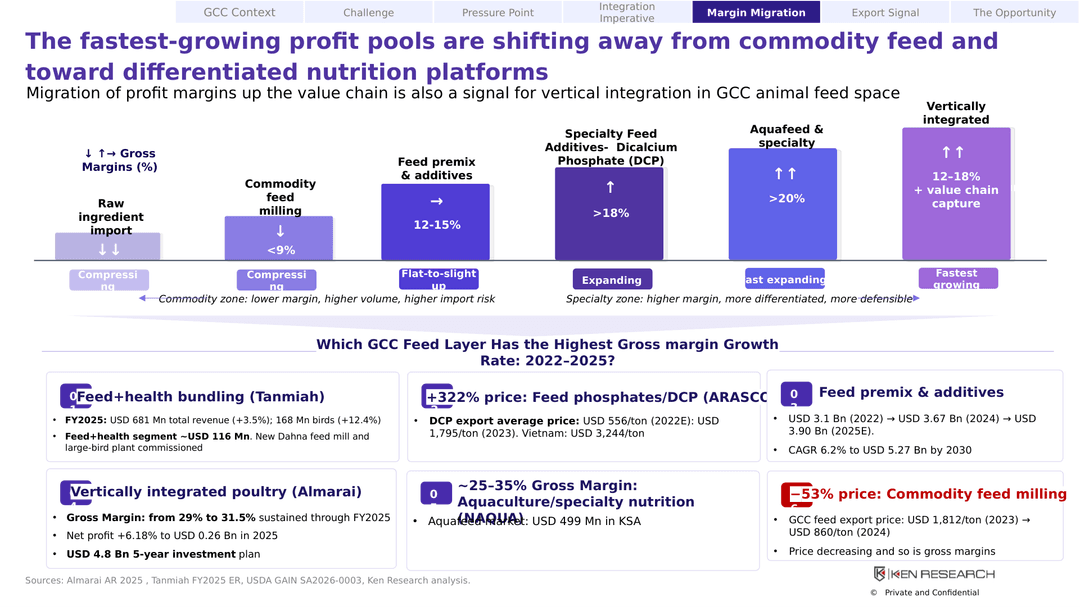
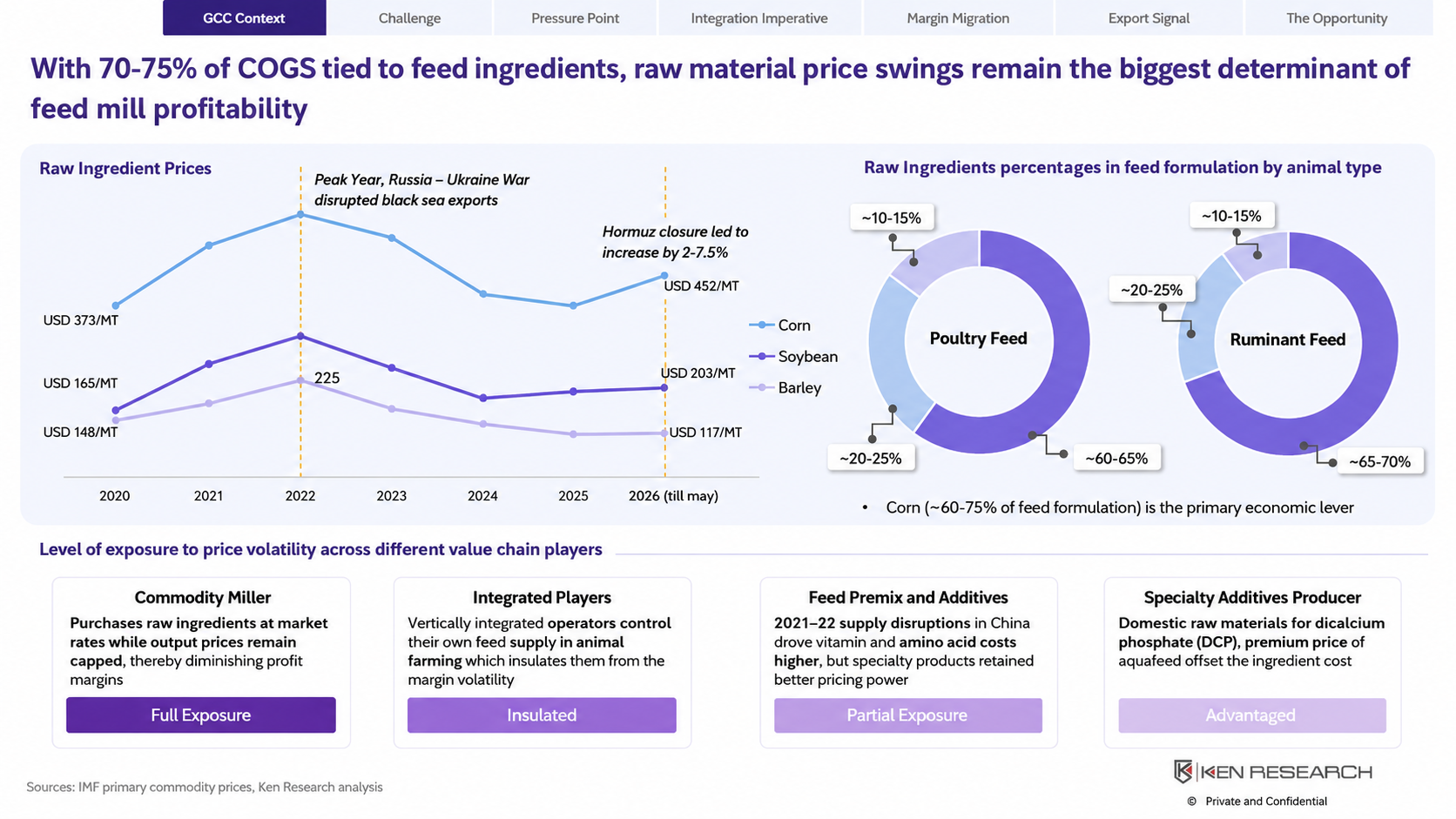
Feed ingredients account for 70–75% of COGS, making corn, soybean and barley price volatility a key driver of GCC feed mill profitability.
Commodity feed millers face a structural imbalance between costs they cannot control and prices they cannot freely increase.
Most major feed ingredients are imported, leaving producers exposed to global agricultural prices, freight costs, supply-chain disruptions and trade-route volatility. Yet higher costs cannot always be passed through to poultry, dairy and livestock producers without affecting downstream food economics.
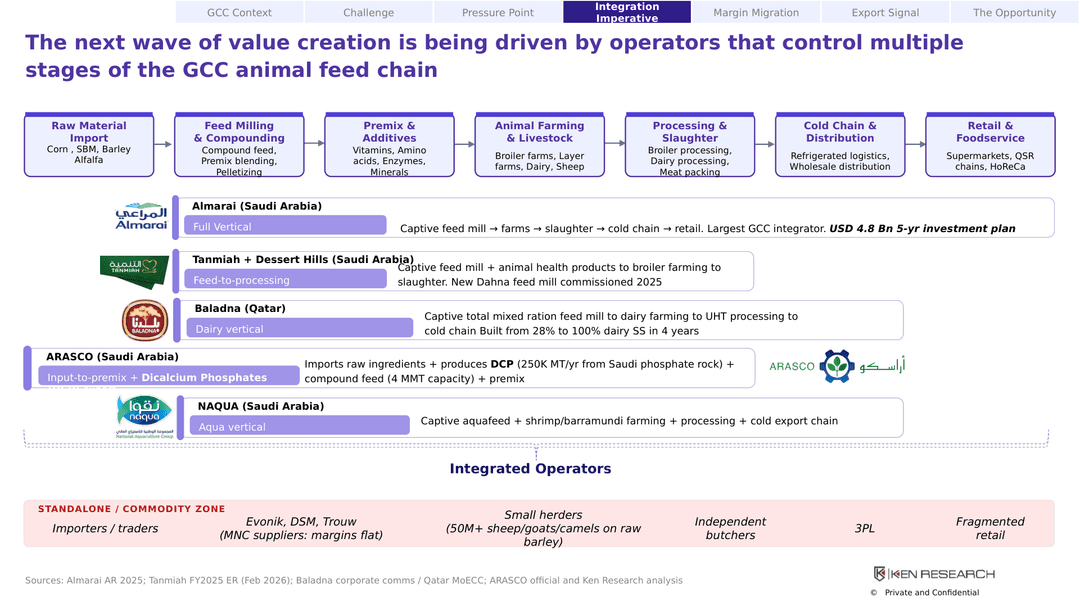
At the same time, large integrated agrifood operators are strengthening captive feed capabilities.
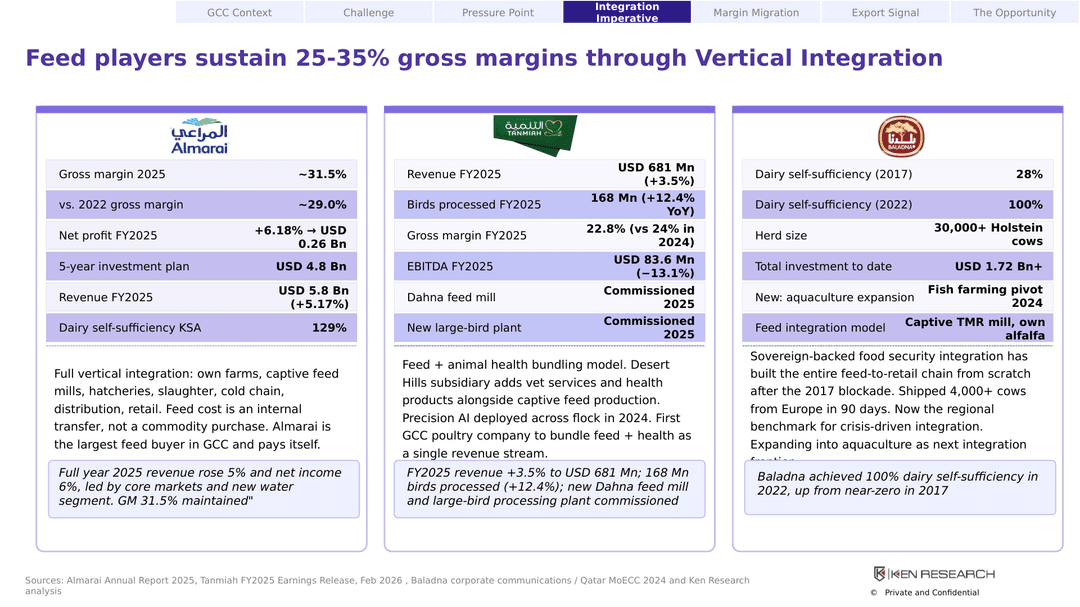
For these operators, feed is not necessarily the final profit centre. It is an internal input supporting farming, processing, cold-chain distribution and branded food sales. Profit can be captured at several points across the value chain rather than only at the feed-mill gate.
Independent millers do not have the same flexibility.
Their margins remain concentrated in a standardized product category where buyers frequently compare suppliers through price, consistency and availability. As more demand moves into captive systems, the addressable open market can also become more contested.
This raises the cost of remaining undifferentiated.
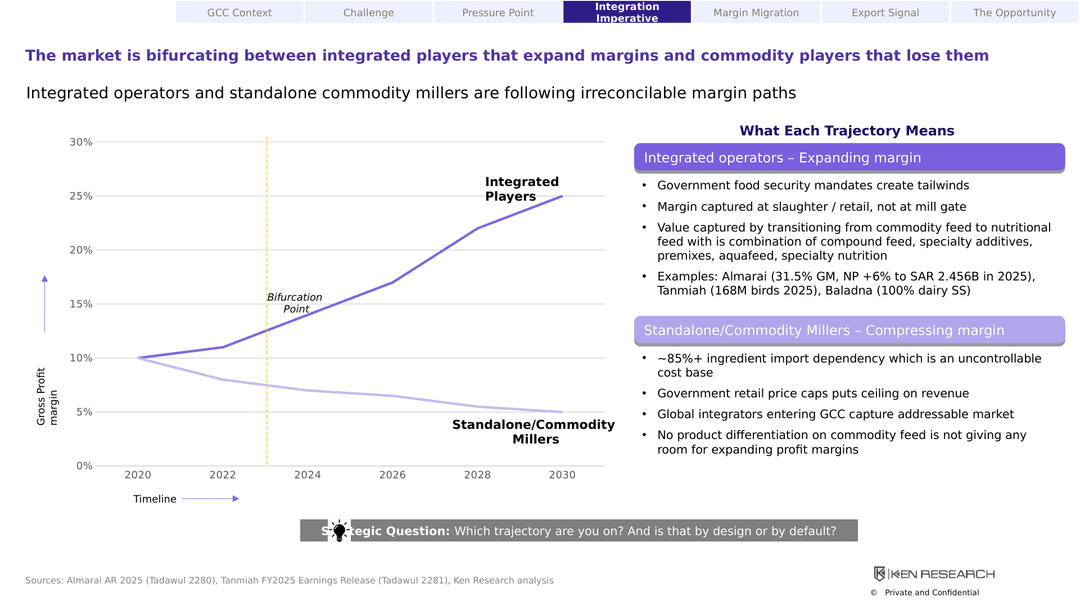
The industry is not simply experiencing another raw-material cycle. It is undergoing a separation between players that can capture value across the animal-production system and those that remain dependent on commodity-feed margins.
Key Insight From the POV
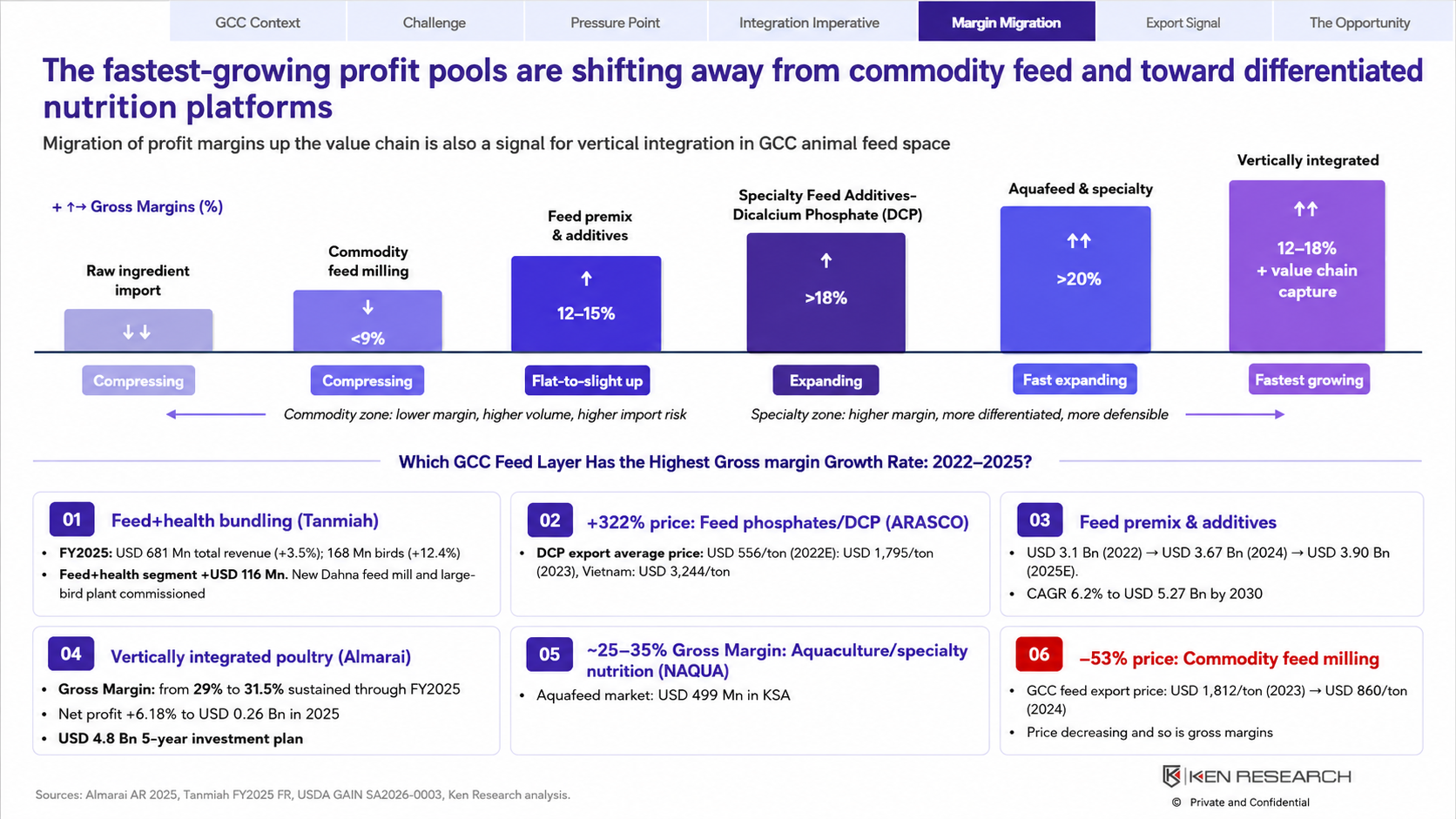
GCC animal-feed profit pools are migrating beyond commodity milling
The strongest future profit pools are unlikely to sit in the same parts of the value chain that created scale in the past.
Commodity feed will continue to represent a major volume category, but its economics remain constrained by import exposure, limited differentiation and price-sensitive demand.
As companies move further along the nutrition curve, the basis of competition begins to change.
Premixes and additives require formulation expertise and quality consistency.
Feed minerals can offer technical applications, higher value per tonne and selective export potential.
Specialty nutrition addresses the specific requirements of different animals, production systems and operating environments.
Aquafeed connects product performance directly with growth, feed conversion, mortality and water quality.
Feed-plus-health solutions combine nutrition with veterinary products, advisory support and farm-performance services.
Vertical integration enables companies to capture value across feed, farming, processing, logistics and distribution.
The implication is clear:
Margins become more defensible when the supplier moves from selling feed volume to influencing animal-production outcomes.
GCC animal feed profit pools are shifting from commodity milling toward premixes, specialty additives, aquafeed and vertically integrated nutrition platforms.
The GCC Feed Margin Migration Framework
Ken Research’s margin-migration framework is designed to assess where value is expanding and compressing across the GCC animal-feed ecosystem.
The framework evaluates the market through three connected lenses.
1. Commodity Exposure
This assesses how heavily each business model depends on imported raw materials, market-price procurement and the ability to pass cost increases to customers.
Standalone commodity millers sit at the most exposed end of the spectrum because their cost base is volatile while product differentiation remains limited.
2. Product Differentiation
This evaluates whether the offering competes primarily through price and availability or through formulation, technical performance, animal health and customer outcomes.
Premixes, additives, specialty minerals and species-specific nutrition generally provide greater scope for defensibility than standard compound feed.
3. Value-Chain Capture
This examines how many stages of the animal-production and food ecosystem a company can influence or control.
Integrated operators can absorb feed economics within farming, processing and distribution, while standalone players depend more heavily on margins generated directly at the mill gate.
Together, these lenses distinguish six broad positions across the value chain:
Value-Chain Position
Strategic Characteristic
Raw-material sourcing
High commodity and trade exposure
Commodity feed milling
Scale-led but pricing-power constrained
Premixes and additives
More technical and customer embedded
Feed minerals
Specialized applications and export
potential
Aquafeed and specialty nutrition
Performance-led and more differentiated
Vertically integrated platforms
Margin capture across multiple stages
The output is not a generic ranking of animal-feed segments.
It is a view of where business models are gaining or losing the ability to defend profitability.
Specialization Is Changing the Basis of Competition
Aquafeed demonstrates why technical performance can create stronger economics
Aquafeed provides one of the clearest examples of the shift from commodity supply toward performance-led nutrition.
Fish and shrimp production requires precise control over protein composition, digestibility, pellet stability, feed-conversion performance and water-quality impact.
For the customer, poor feed performance does not merely increase procurement costs. It can reduce growth, increase mortality and weaken the economics of the entire farming operation.
The supplier is therefore evaluated on more than price per tonne.
Technical credibility, consistency, species expertise and farm-level outcomes become central to the purchasing decision.
This creates greater scope for product differentiation and deeper customer integration than conventional feed milling.
AsGCC aquaculture investment expands, aquafeed could become a strategically important category for both domestic demand and selected intra-regional trade.
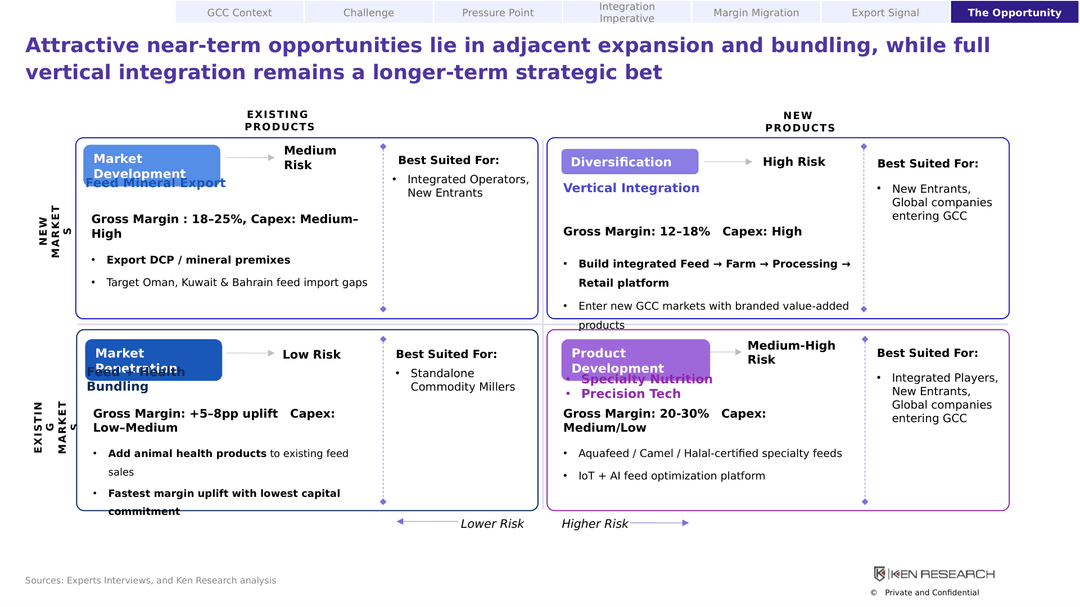
The Immediate Opportunity May Sit in Adjacency, Not Full Integration
Feed-plus-health can help millers move closer to customer economics
Full vertical integration offers greater value-chain control, but it also requires significant capital, operating expertise and execution capability.
For many feed millers, the more practical near-term move may be to expand around the existing customer relationship.
This can include:
Animal-health products
Veterinary support
Farm advisory
Feed-formulation services
Productivity monitoring
Species-specific nutrition
Digital feed optimization
Such services allow the supplier to become more involved in the customer’s production performance.
A standard feed supplier can often be replaced through a pricing or procurement decision. A partner supporting nutrition, animal health and operating outcomes is harder to substitute.
The strategic shift is therefore from:
Selling a feed productto -Supporting the economics of animal production
This can provide a path toward stronger customer retention and higher revenue per account without requiring immediate ownership of farming or processing assets.
The Export Signal
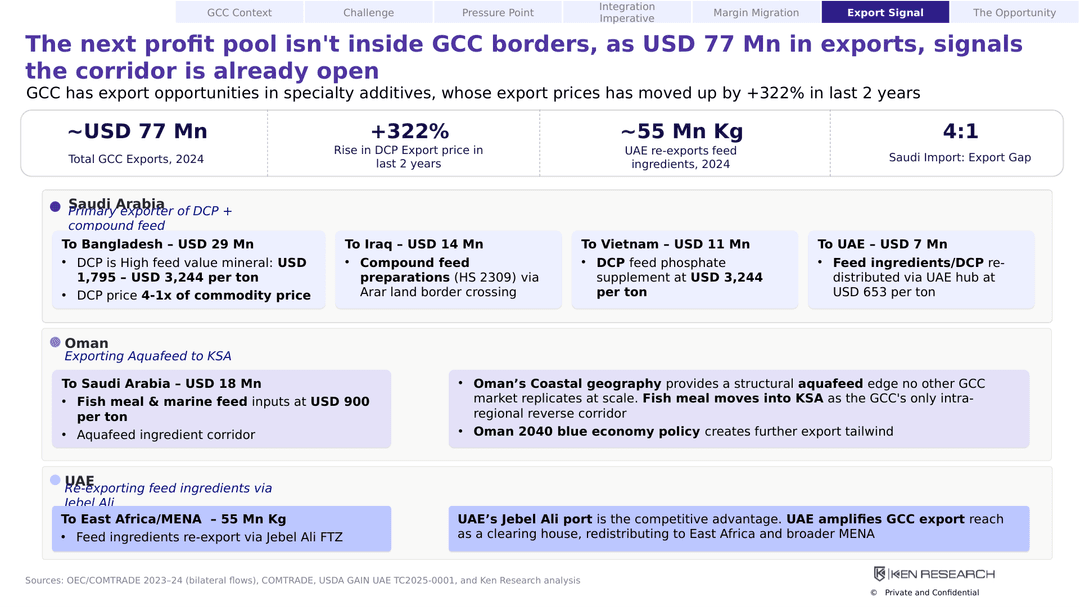
The GCC’s export opportunity lies in specialization, not commodity volume
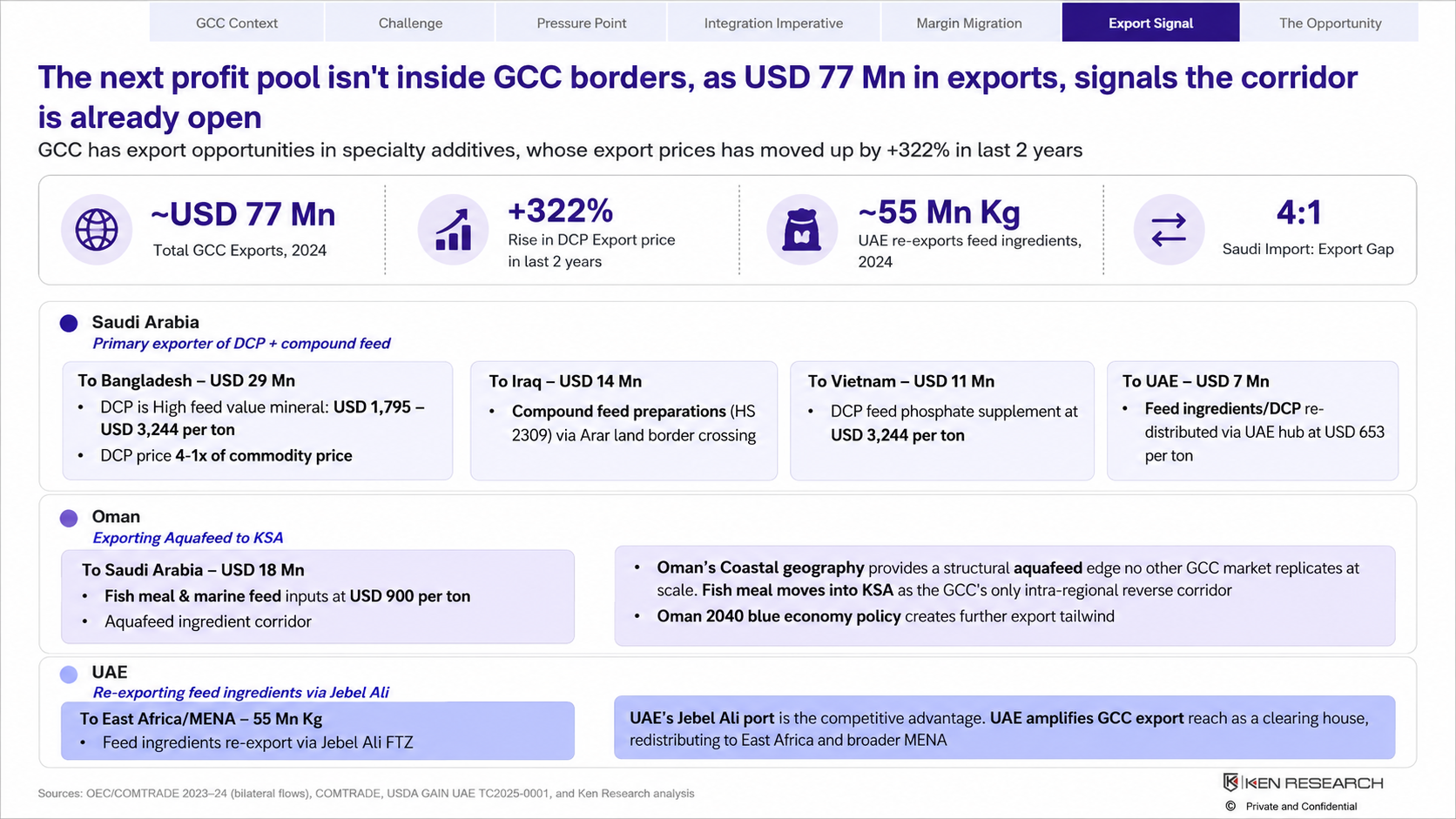
GCC animal feed exports reached approximately USD 77 million in 2024, while DCP export prices rose 322%, UAE re-exported about 55 million kg, and Saudi Arabia recorded a 4:1 import-export gap.
The GCC is unlikely to develop its strongest export position through standard commodity feed.
Commodity products remain highly exposed to raw-material costs, freight economics and price-based competition.
A more credible export pathway lies in products with greater technical differentiation and higher value per tonne, including:
Feed minerals
Premixes
Specialty additives
Marine-feed ingredients
Aquafeed inputs
Species-specific formulations
Different GCC markets can play different roles in this emerging export model.
Saudi Arabia can build on its scale, industrial base and access to selected mineral inputs.
Oman can develop marine-feed and aquaculture-linked corridors.
The UAE can extend the region’s reach through logistics, warehousing and re-export infrastructure.
The strategic export question is therefore shifting from:
How much feed can GCC producers export?to -Which specialized products can overcome logistics and market-access costs through stronger technical and commercial value?
What the POV Covers
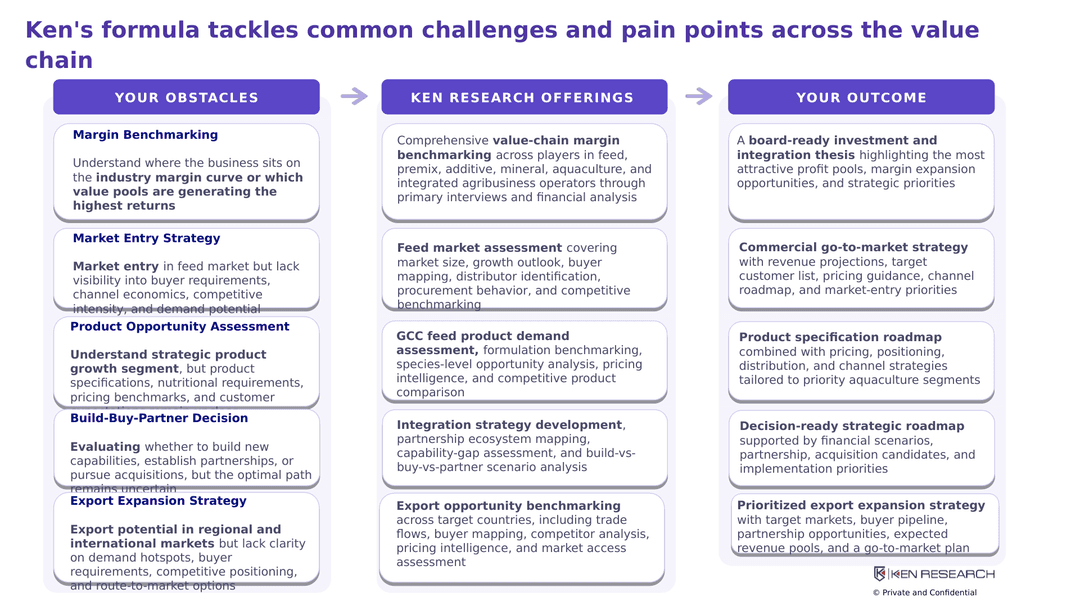
This consulting-led POV examines the GCC animal-feed opportunity through market structure, margin economics, integration, specialization and export lenses.
Area
What the POV Explores
GCC feed-market structure
How demand, capacity and strategic
positioning differ across the six GCC markets
Commodity-cost exposure
How imported ingredients and limited
pricing flexibility affect miller profitability
Standalone milling economics
Why additional production scale may not
produce stronger margins
Vertical integration
How integrated operators capture value
beyond the feed-mill gate
Margin migration
Where profit pools are expanding and
compressing across the value chain
Specialty nutrition
How additives, feed minerals, aquafeed
and technical formulations change the basis of competition
Export corridors
Where GCC producers could develop
selective positions in higher-value feed products
Strategic pathways
How different player types can evaluate
adjacency expansion, specialization, exports and integration
What Leaders Can Take Away
The GCC animal-feed market is moving from capacity expansion toward business-model differentiation.
Standalone millers need to assess whether procurement efficiency and production scale will remain sufficient as integrated competitors expand captive capacity.
Integrated operators need to determine where nutrition expertise can improve animal productivity and create external revenue opportunities.
Global companies need to identify where technical capabilities, partnerships and specialty products can address gaps in the regional ecosystem.
Investors need to distinguish businesses that are merely exposed to market growth from those positioned in expanding profit pools.
The central implication is clear:
The GCC does not only need more animal feed. It needs animal-nutrition business models that can convert feed demand into sustainable margin, customer dependence and value-chain control.